
You're usually not searching for a vehicle import broker because life is calm. You're moving for work, buying a car from out of state, sending a vehicle to family, relocating for military orders, heading south for the season, or trying to get a car to or from Puerto Rico without turning the process into a second full-time job.
That's when people learn a hard truth. Shipping a car isn't just a driving alternative. Once a route touches a port, a customs process, a territorial tax agency, or a compliance review, the job becomes specialized logistics. Paperwork, port handling, release timing, and carrier coordination all have to line up.
For U.S. mainland moves, the process is usually straightforward. For cross-border routes and Puerto Rico, it can feel like part domestic shipping and part import transaction. That's where confusion starts, especially when customers assume the company moving the car and the company handling the legal entry are always the same thing. They aren't.
Table of Contents
- Shipping Your Car Is More Than Just a Road Trip
- What a Vehicle Import Broker Really Does
- The US Vehicle Shipping Process Step by Step
- Shipping to Puerto Rico A Special Case
- Common Pitfalls and How to Avoid Them
- Choosing Your Partner Broker vs Carrier vs All-in-One
- Your Smooth Ride Starts with the Right Choice
Shipping Your Car Is More Than Just a Road Trip
If you're shipping from Miami to Dallas or Los Angeles to Chicago, the main concern is usually timing, carrier availability, and whether you want open or enclosed transport. Once the route involves a port, a border crossing, or Puerto Rico, the conversation changes. You're no longer just booking space on a truck. You're lining up documents, release procedures, and handoffs between multiple parties.

That need for specialization exists because the vehicle trade is massive. In 2018, the United States imported $179 billion worth of cars, and automobiles accounted for 8.3% of total U.S. imports, making them the country's most imported commodity by value, according to this U.S. car import trade analysis. When that much vehicle volume moves through ports and customs systems, mistakes in classification, documents, or timing don't stay small for long.
Where people misjudge the process
Most first-time shippers underestimate three things:
- Paperwork risk: A title issue or identity mismatch can stall the move before the vehicle even gets loaded.
- Port rules: Ports don't operate like curbside pickup. They release cargo based on documents, not urgency.
- Split responsibilities: The party booking transport may not be the same party handling customs or local tax requirements.
That matters for people shipping from mainland cities such as New York, Atlanta, Orlando, Houston, Phoenix, Seattle, Denver, Boston, Nashville, Las Vegas, Charlotte, San Diego, and many others. It matters even more when the destination is San Juan, Puerto Rico, because the route adds ocean handling and local clearance steps that don't apply to a simple interstate move.
Practical rule: If your shipment touches a port, ask who handles release documents, who handles local compliance, and who books the final carrier before you approve anything.
Customers want the move to feel simple. The backend rarely is. The smooth shipments happen when someone maps the process before the vehicle starts moving.
What a Vehicle Import Broker Really Does
A vehicle import broker is a compliance specialist. The simplest way to think about the role is this: a carrier moves the car, but the broker helps the car get accepted into the system legally. If a trucking company is the muscle, the broker is the file.
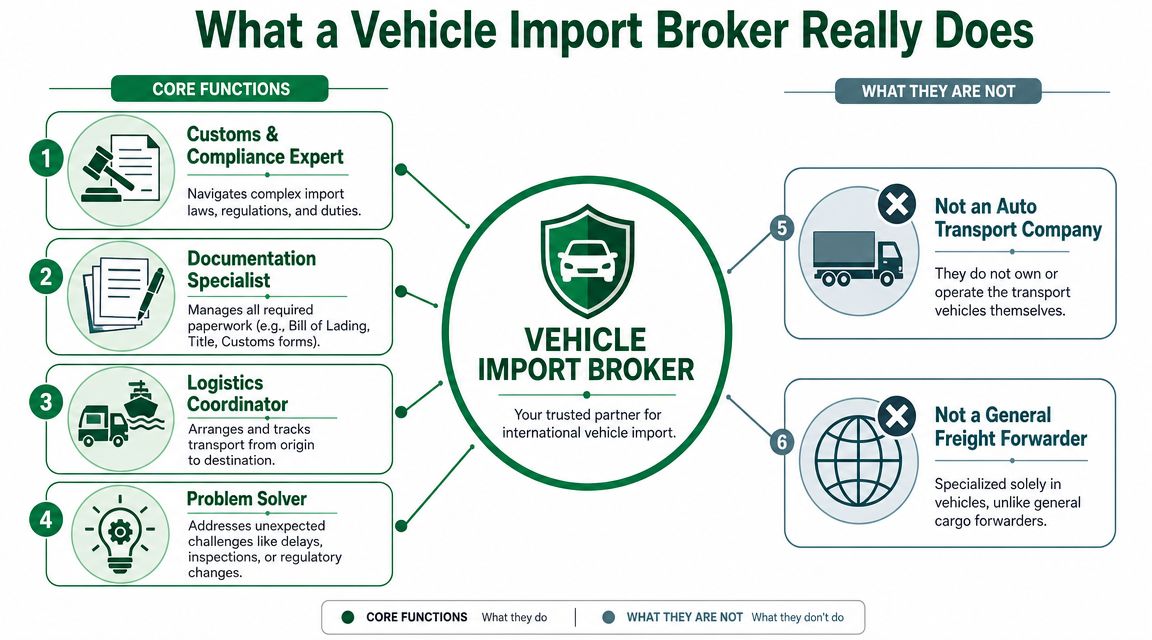
Their work usually includes classifying the vehicle correctly, preparing entry documents, filing required forms, arranging the customs bond, and responding if Customs and Border Protection asks questions or orders an inspection. For U.S. vehicle imports, that paperwork can include CBP Form 7501, EPA Form 3520-1, and DOT Form HS-7. Typical brokerage fees run from $450 to $1,200, with straightforward passenger vehicle entries commonly quoted around $450 to $700 and more complex imports reaching $800 to $1,200, as outlined in this breakdown of U.S. car import broker fees and forms.
What they are and what they are not
People often bundle several services into one mental category and call all of it “shipping.” That's where expensive assumptions start.
A vehicle import broker is usually:
- A customs paperwork manager: They prepare and submit the legal entry package.
- A compliance checkpoint: They watch for missing data, wrong classifications, and inconsistent vehicle details.
- A problem responder: They work the file when a port, customs office, or agency asks for clarification.
A vehicle import broker is usually not:
- The trucking carrier: They typically don't own the truck that picks up your car in Tampa, Denver, or Sacramento.
- The ocean carrier: They don't operate the vessel moving the vehicle to San Juan.
- A magic workaround: They can reduce paperwork friction, but they can't override eligibility rules.
A good broker makes the process cleaner. They don't make the law disappear.
Why the distinction matters
This distinction becomes critical on mixed routes. A customer shipping a vehicle from Orlando to San Juan may need inland transport to the port, port acceptance, ocean booking, local release steps, and final delivery. One company may coordinate all of that. Another may only handle one slice of it.
That's why experienced shippers ask direct questions before booking:
- Who handles the physical move?
- Who handles the legal file?
- Who handles the destination release?
- Who calls me if something gets held?
When those answers are vague, the shipment usually gets messy.
The US Vehicle Shipping Process Step by Step
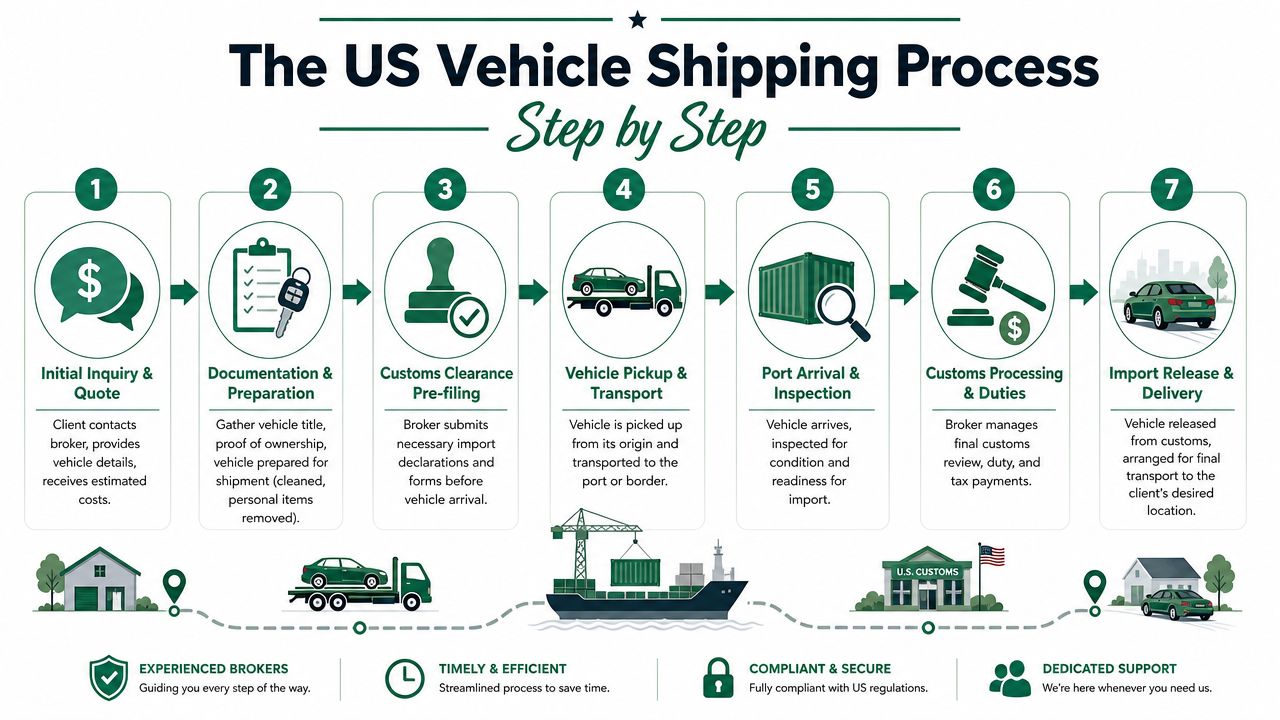
Most successful shipments follow a predictable sequence. The details change by route, but the logic doesn't. First the file gets built. Then the vehicle gets staged. Then the handoffs happen in order.
A visual overview helps before getting into the details.
The paperwork comes first
The move usually starts with a quote and document review. The shipper or coordinator checks the vehicle details, ownership records, pickup and delivery locations, and whether the route is mainland domestic, cross-border, or island-bound.
Then comes the part customers often rush and regret rushing. Every motor vehicle imported into the U.S. requires a DOT Form HS-7 and an EPA Form 3520-1, and the broker or transport partner must keep details like VIN and model year consistent across the file to avoid delay or rejection, according to NHTSA's Registered Importer guidance.
That sounds obvious until a real-world file gets built. A title may show one model year, a seller invoice may abbreviate the make differently, and a transport order may contain a transposed VIN digit. On a normal domestic shipment, that may be an annoyance. On an import-related file, it can stop release.
A practical sequence looks like this:
- Request the quote early: Especially if your route touches a port or a border.
- Submit readable documents: Title, registration, purchase paperwork, and identification should match cleanly.
- Confirm the route type: Interstate, cross-border, Hawaii, Alaska, and Puerto Rico don't run through the same playbook.
- Prepare the vehicle: Clean it, remove personal items if instructed, and follow the carrier's fuel and condition rules.
For companies managing multiple pickups, dispatch discipline matters too. Even outside customs work, routing mistakes create avoidable delays. Teams that coordinate field pickups across several locations often benefit from tools and methods like route optimization for sales teams, because the same logic applies to vehicle scheduling. Better sequencing cuts idle time and missed windows.
Later in the process, the customer usually sees only the pickup notice or port receipt. Behind that, several parties may be synchronizing title review, loading windows, and release documents.
The car moves only after the file makes sense
Once the paperwork is clean, the vehicle can move to pickup, linehaul, or port delivery. For a mainland route, that may mean a standard open or enclosed carrier. For Puerto Rico or another island route, the inland truck leg is only one part of the chain.
Here's the broad operating pattern:
- Pickup and inspection: The driver notes the vehicle condition and confirms it matches the order.
- Transit to terminal or port: The car moves by truck to the next handoff point.
- Port acceptance or border processing: Staff verify the file before release or loading.
- Final delivery: The receiving party inspects the vehicle and signs off.
What works is consistency. What fails is trying to fix document problems after the vehicle is already sitting at the port. Once storage clocks and release windows start working against you, every correction becomes slower and more expensive in practical terms.
Shipping to Puerto Rico A Special Case
Shipping a car between the U.S. mainland and Puerto Rico confuses people because it sounds domestic, but parts of the process behave more like an import transaction. The vehicle is still moving within a U.S. jurisdictional framework, yet the shipment goes through ocean freight handling, port procedures, and local tax requirements that don't exist on a truck-only route from Ohio to Florida.
Why Puerto Rico feels different
A mainland customer may think, “I'm not importing a foreign car, so why does this feel like customs?” The answer is that Puerto Rico has its own administrative process for vehicle entry and taxation. In practice, that means document review, port coordination, and local release steps carry much more weight than they do on a standard interstate move.
For people relocating from cities like Jacksonville, Tampa, Philadelphia, Newark, Baltimore, Dallas, Austin, San Antonio, Chicago, Los Angeles, or San Francisco to San Juan, the move usually involves:
- inland transport to the departure port
- port drop-off or coordinated terminal handling
- ocean movement
- destination release
- local tax and registration steps in Puerto Rico
- final pickup or delivery on the island
That's why Puerto Rico shipments reward patience and organized paperwork. The physical move across water is only one part of the job.
If a mainland move is mostly about truck capacity, a Puerto Rico move is about handoffs. Every handoff needs documents attached to it.
What shippers usually need to prepare
The exact file depends on ownership, lien status, and whether the vehicle is personally owned, financed, purchased from a dealer, or moved for business use. In practical terms, customers should expect to gather proof of ownership, identity, lienholder permissions if applicable, and destination paperwork needed for local processing.
A few habits make these shipments smoother:
- Start document collection early: Lenders and duplicate title requests can slow the timeline.
- Ask about port cutoffs: Missing a vessel cutoff can push the car to a later sailing.
- Confirm who handles Puerto Rico release: Some companies move the car to the island but leave the customer to manage the final paperwork.
- Get clear on taxes and local charges: Puerto Rico vehicle entry often includes local government requirements that don't show up in mainland quotes.
This is one lane where bilingual support matters in a very practical way. Customers often have to coordinate with mainland transport staff, port personnel, and island-side contacts. Clear English and Spanish communication reduces missed instructions and duplicate trips.
For snowbirds, military families, students, dealerships, and businesses, Puerto Rico shipping goes best when one coordinator treats the move as a chain of custody, not a one-leg booking.
Common Pitfalls and How to Avoid Them
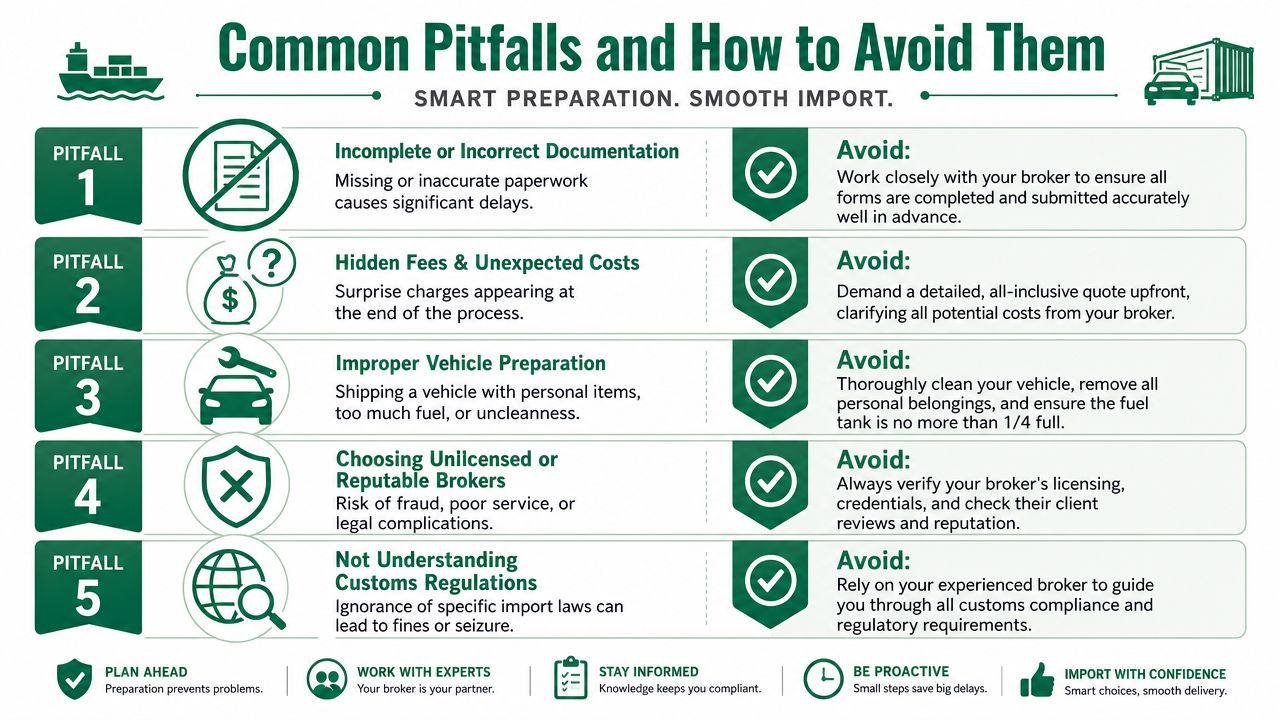
Problems in vehicle shipping usually aren't dramatic. They're administrative. A wrong VIN digit, an unreadable title image, a dirty undercarriage, or a quote that leaves too much undefined can turn a routine move into a week of phone calls.
The mistakes that create the most friction
One of the most overlooked issues is vehicle cleanliness. U.S. Customs and Border Protection can delay or reject a vehicle if inspectors find foreign soil contamination on the undercarriage, which is why this vehicle import preparation guide stresses thorough cleaning before shipment.
That warning applies beyond classic import scenarios. Any route involving inspection sensitivity benefits from sending a clean vehicle. Mud packed into wheel wells and underbody areas gives inspectors one more reason to pause the file.
Other common failures show up in clusters:
- Document mismatch: The title, booking order, and ID don't align exactly.
- Unclear pricing: The customer thinks port, terminal, or release costs are included when they aren't.
- Late coordination: The transport side is booked before the paperwork side is ready.
- Wrong service model: The customer hires a broker and assumes that also includes trucking or final delivery.
Field advice: Don't ask only for the price. Ask for the sequence of responsibility from pickup through final release.
How to keep a routine shipment routine
The fix is usually process discipline, not heroics.
Use this checklist before the vehicle moves:
- Match every identity field: VIN, year, make, model, owner name, and destination should read the same across all documents.
- Clean the vehicle thoroughly: Focus on undercarriage, wheel wells, and any area where dirt can collect.
- Clarify all handoffs: Know who handles pickup, port entry, release, and final delivery.
- Read delay language carefully: If you've ever tried to get your delayed package moving, you already know that “clearance delay” usually means someone needs information, not speed.
The best operators prevent surprises by slowing down before dispatch. The worst ones create urgency first and explanations later.
Choosing Your Partner Broker vs Carrier vs All-in-One
Most customers don't need a lesson in industry categories. They need to know which setup gives them the fewest problems for their route. The answer depends on whether you're handling a straightforward domestic move, a border-related shipment, or a Puerto Rico lane with port and local release requirements.
A common misconception is that a vehicle import broker handles everything. In reality, they manage customs paperwork but don't arrange transportation, so the importer still has to contract a carrier, as explained in this overview of importing vehicles into the USA.
Three ways to handle the job
Here's the practical comparison.
| Feature | DIY Do It Yourself | Import Broker Only | All-in-One Transport Company (e.g., National Car Transport) |
|---|---|---|---|
| Best for | Very simple domestic moves with time to manage details | Shipments needing compliance help but with separate transport already arranged | Customers who want one coordinator for transport and logistics |
| Paperwork control | You handle it | Broker handles import-related paperwork | Company coordinates paperwork and movement based on route |
| Carrier booking | You book it | You still book it | Included in the service model |
| Port coordination | You manage terminal instructions and timing | Often shared between you and other vendors | Usually coordinated for you |
| Risk of gaps | High | Moderate | Lower, because fewer handoffs are unmanaged |
| Good fit for Puerto Rico | Usually difficult for first-timers | Better, but still fragmented | Often the most practical option |
| Main downside | Time, confusion, and error risk | Split responsibility | You need to choose a company with real route experience |
DIY sounds cheaper until something stalls. Then you're the dispatcher, document chaser, customer service rep, and escalation contact all at once.
A broker-only setup works when you already understand the transport side or have a trusted carrier lined up. It's less ideal when the shipment requires several handoffs and no one party is clearly owning the full chain.
An all-in-one model fits most individuals, families, dealerships, and businesses because the process is easier to control when one team tracks the car from pickup through delivery. That doesn't remove every rule, but it usually removes the biggest source of trouble, which is responsibility getting split between vendors who each think the other party is handling the issue.
Your Smooth Ride Starts with the Right Choice
A smooth vehicle shipment rarely happens by accident. It happens because the route was identified correctly, the documents were checked early, the handoffs were defined, and the customer picked the right service model for the job.
For a domestic move inside the lower 48, that may mean choosing a dependable carrier and the right trailer type. For cross-border and Puerto Rico routes, it means understanding where transport ends and compliance begins. That's the point where many customers lose time. They assume one provider is covering the whole process when the job is split.
The strongest approach is usually the simplest one operationally. Fewer handoffs, clearer accountability, and one point of communication produce the least friction. That matters whether you're a relocating family, a student, a seasonal resident, a service member, or a dealership moving inventory.
If your route includes a port, a territory, or anything that feels even slightly “import-like,” ask better questions before the vehicle moves. Who handles the file. Who handles the carrier. Who handles the release. Who calls you when something changes. Get those answers in plain language, and the rest of the process gets much easier.
Need help with a vehicle move anywhere in the mainland, Alaska, Hawaii, or Puerto Rico? National Car Transport gives customers one coordinated path instead of a patchwork of vendors. With 25+ years of experience, an A+ BBB rating, transparent flat-rate pricing, and a network of 25,000+ vetted carriers, the company handles everything from standard U.S. car shipping to more complex island routes. Their USA-based bilingual agents speak English and Spanish, and they bring over 20 years of auto transport logistics experience to the day-to-day work of guiding customers through paperwork, scheduling, port timing, and delivery. No two vehicle shipments are exactly alike. Having a knowledgeable advisor who can make the process simple and quick is often what saves the most stress.