
If you're reading this, there's a good chance your move already has enough moving parts. Maybe you're relocating for work, sending a student to Puerto Rico, handling a military transfer, or trying to get your own vehicle to San Juan before you arrive. For first-time shippers, the car is often the piece that feels hardest to control because it combines domestic pickup, port rules, customs paperwork, and ocean transit.
That anxiety is normal. The good news is that when you transport cars overseas, you're not stepping into an unusual process. You're using an established shipping system that handles vehicle movements every day. A strong historical baseline comes from Eurostat's car trade data, which shows that in 2022, the U.S. was the EU's top export destination for cars, accounting for 23% of exports. That matters because it shows overseas vehicle shipping operates inside a large, mature trade network, not an improvised one.
For Puerto Rico moves, the route feels international because it involves an island port process, but clients often underestimate the paperwork and timing side. That's where experienced guidance helps most. One shipment might be a retiree sending a sedan from Florida to San Juan. The next might be a family moving from Texas with a financed SUV and a tight timeline. No two moves look exactly alike, which is why having a knowledgeable agent matters.
Table of Contents
- Your Guide to a Stress-Free Overseas Car Shipment
- Choosing Your Overseas Shipping Method
- Navigating Documentation and Customs Requirements
- The Shipping Process from Pickup to Delivery
- Understanding Your Shipping Costs and Insurance
- Frequently Asked Questions About Overseas Transport
Your Guide to a Stress-Free Overseas Car Shipment
A smooth shipment usually starts with one shift in mindset. Stop thinking of it as one giant task and treat it as a chain of smaller decisions: choose the right shipping method, gather ownership documents, prep the vehicle correctly, and hit the port timeline without rushing. That's how experienced coordinators keep the process calm.
For people shipping to Puerto Rico, that approach matters even more. The route may begin with a truck pickup in Miami, Atlanta, Dallas, Chicago, Los Angeles, or another mainland city, but the shipment doesn't really succeed until the vehicle clears the island-side process cleanly. Most avoidable problems happen because someone focused only on the ocean booking and ignored the handoff points before and after it.

The part that surprises first-time shippers
People usually expect the ship to be the hard part. It usually isn't. The hard part is making sure the title is usable, the vehicle is delivered on time, the prep rules are followed, and the receiving party knows exactly what to do once the car arrives.
Practical rule: Overseas car shipping gets easier when one person is tracking the full chain from inland pickup to port release, not just the sailing date.
That applies whether you're moving a family SUV from Orlando to San Juan, sending a college car from New Jersey, or relocating from California and trying to avoid living without transportation once you land.
What experienced coordination changes
When clients have a dedicated advisor, they ask better questions sooner. Is the title clear? Is the lienholder involved? Will the port accept the vehicle if paperwork is still pending? Does the person receiving the car in Puerto Rico have the right ID and release information? Those are the questions that prevent delays.
The human side matters here. People don't need more jargon. They need someone who can explain what happens next, in plain English or Spanish, and keep the sequence moving.
Choosing Your Overseas Shipping Method
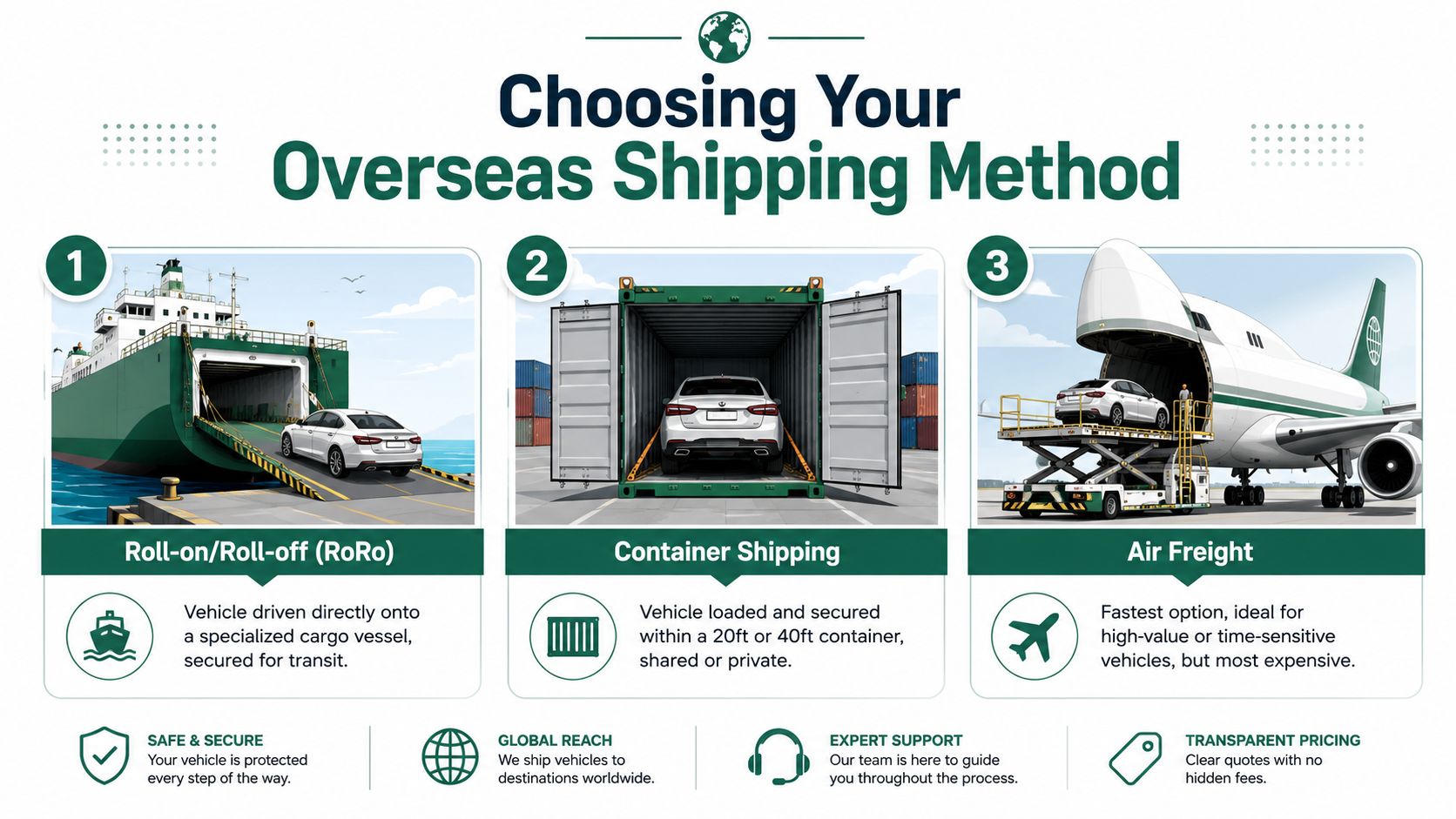
The right method depends on the vehicle, your budget, and how much exposure you're willing to accept during handling. Most clients begin by comparing RoRo, container shipping, and air freight, but the best choice isn't always the cheapest one.
Overseas Shipping Methods Compared
| Method | Best For | Cost | Security |
|---|---|---|---|
| RoRo | Standard running vehicles | Lower relative cost | Moderate |
| Container Shipping | Luxury, classic, exotic, or more protected moves | Higher relative cost | Higher |
| Air Freight | Time-sensitive or very high-value vehicles | Highest | High |
How RoRo works in practice
Roll-on/Roll-off means the vehicle is driven onto a vessel, secured, and driven off at the destination. It's popular because it's straightforward and usually the first option people consider for standard sedans, SUVs, and trucks in running condition.
Hoegh Autoliners' overview of international car shipping describes RoRo as one of the most popular long-distance vehicle transport methods. In practice, it works well when the car is operable, the route supports RoRo service, and your priority is practical transport rather than maximum enclosure.
RoRo is often a good fit when:
- The vehicle is a daily driver: You're shipping a normal-use car and don't need premium handling.
- You want simpler loading: The car can be driven under its own power.
- You're focused on value: You want a solid transport option without paying for enclosed space.
Where RoRo falls short is control. You can't treat it like a moving van. Loose items generally aren't allowed, and if you're shipping something rare, highly collectible, or especially sensitive to cosmetic exposure, RoRo may feel too open.
When container shipping makes more sense
Container service gives the vehicle a more enclosed travel environment. That's why it tends to be the stronger choice for luxury cars, classics, exotics, restored vehicles, and special-purchase cars that owners don't want passing through a standard handling chain.
The key question isn't just price. It's whether the added protection is worth it for the vehicle you're shipping. As noted earlier from Hoegh's industry guidance, the more useful comparison is when premium enclosed or container service materially reduces risk compared with standard RoRo.
Container shipping is usually worth stronger consideration when:
- The car has high financial or sentimental value
- You want reduced exposure during transit
- The vehicle has low ground clearance or custom features
- You need more controlled handling for a collector vehicle
A standard family crossover and a restored classic don't belong in the same risk conversation. The shipment method should match the vehicle, not just the quote.
For Puerto Rico shipments, container service can also be attractive when an owner wants a more controlled setup and clearer separation during handling. It isn't necessary for every vehicle, but for the right one, it can be the smarter call.
Where air freight fits
Air freight is the speed-first option. It makes sense when time matters more than cost, or when the vehicle itself justifies premium movement.
Typical users include:
- High-value owners who don't want long port dwell times.
- Event or show participants working against a firm deadline.
- Corporate or specialty shippers solving a very specific timing problem.
Most private vehicle owners won't need air freight. But it's useful to know it exists, especially when schedule pressure is strict.
Navigating Documentation and Customs Requirements
Paperwork is where many shipments either stay clean or start going sideways. The transport itself is usually manageable. The documentation burden is what catches first-time shippers off guard, especially when they're sending a vehicle to Puerto Rico and assume the carrier handles every customs-related task automatically.
The core documents you should gather early
For most overseas vehicle shipments, clients should start by locating the ownership and identity documents before booking gets too far along. That means checking the title status, confirming the registered owner, and making sure the names on the paperwork match the person authorizing the shipment.
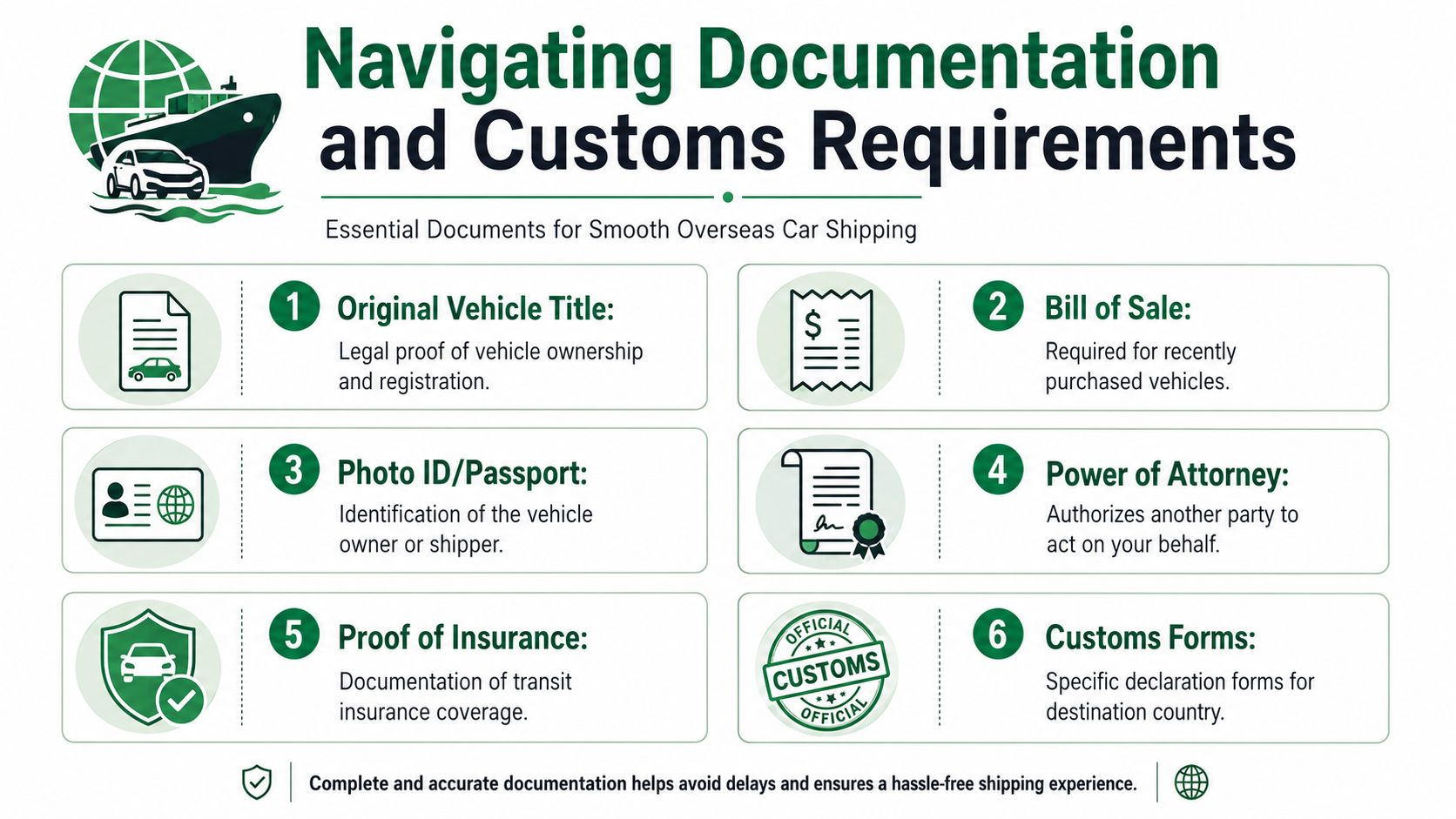
A practical checklist usually includes:
- Original vehicle title: This is the main ownership document. If there's a lien, you may need lender authorization or additional release paperwork.
- Bill of sale: Useful for recently purchased vehicles.
- Government-issued photo ID or passport: The shipper and sometimes the receiver need matching identification.
- Power of attorney: Often required if an agent or transport coordinator is signing or acting on your behalf.
- Proof of insurance: Good to have on hand even when separate cargo coverage is being discussed.
- Destination and customs forms: These vary by route and release process.
A short visual reference helps many first-time shippers:
What the contract must clarify
This is the part people skip because they're in a hurry. Don't skip it.
The Federal Maritime Commission's guidance on shipping your vehicle overseas warns that shippers are responsible for verifying both U.S. export rules and destination-country import rules. It also warns against assuming the mover handles all customs clearance. The contract needs to state what's included and what still falls on you.
That means you should confirm:
- Who files what: Export filing, customs paperwork, release coordination, and destination handling aren't always bundled.
- Who clears the vehicle: Sometimes the shipping company arranges it. Sometimes the owner or local broker does.
- What prep rules apply: The FMC notes that vehicles may need to have gasoline drained, batteries disconnected or removed, and loose items generally can't remain inside the car.
- What isn't included: Storage, missed sailing fees, and destination charges can surprise clients if they never asked.
If a shipment summary sounds simple, ask one more question: "Who is responsible for customs clearance and final release if anything gets held?"
Puerto Rico paperwork needs extra attention
Puerto Rico isn't a foreign country, but vehicle shipping there still has a more layered release process than a standard mainland move. That catches people by surprise. Clients often think, "It's U.S. to U.S., so it should be easy." The route can be smooth, but it still runs through port systems, island procedures, and tax-related steps that need to be handled correctly.
For Puerto Rico shipments, owners should expect to deal with local requirements such as SURI registration and arbitrios handling. Those details are exactly why experienced bilingual support matters. A customer in Ohio or Arizona may not know the island-side sequence, and a family member receiving the vehicle in San Juan may need help understanding what happens next and what documents must match.
The best approach is simple:
- Gather title and ownership paperwork early
- Confirm whether the vehicle has a lien
- Ask who handles Puerto Rico-side release steps
- Make sure the receiving party has the right documents
- Review every name, VIN, and signature for consistency
Most shipping delays aren't caused by the ocean. They're caused by a missing paper trail.
The Shipping Process from Pickup to Delivery
Once the method and documents are lined up, the move becomes an operations problem. That's good news, because operations can be managed. The key is timing the inland move, port delivery, and sailing window so they support each other instead of colliding.
Start with booking, not last-minute scrambling
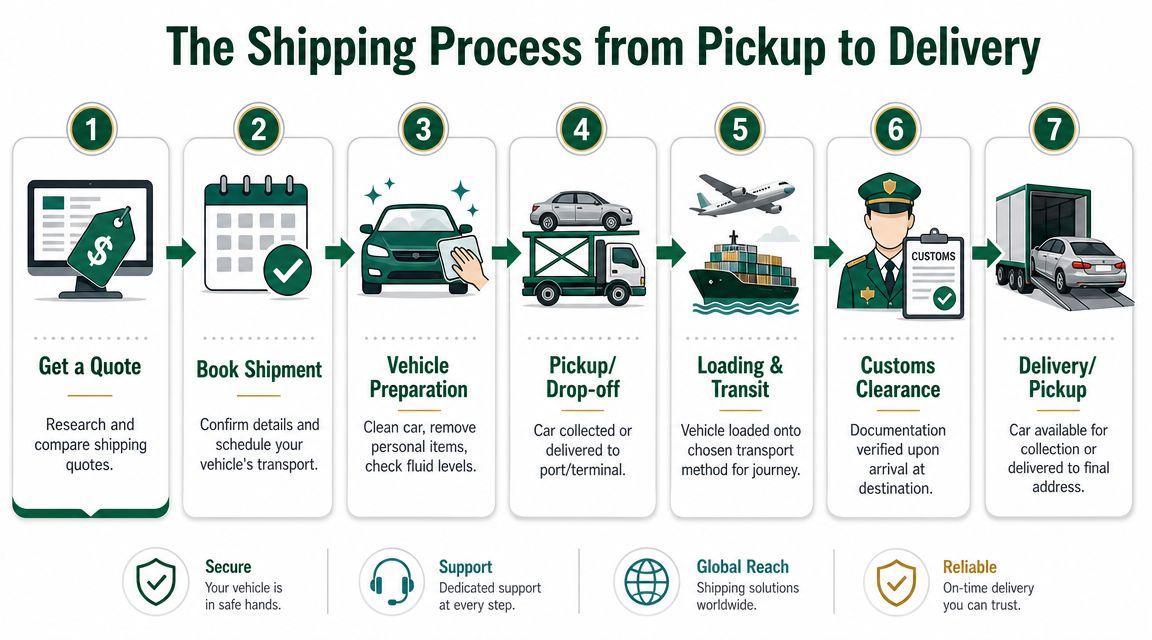
A clean shipment usually begins with a quote that reflects the actual move. That means the shipper should disclose whether the vehicle runs, where it's located, whether it's headed to a mainland port or Puerto Rico, and whether the title is available.
After booking, the domestic portion gets scheduled. The significance of a nationwide carrier network is apparent, because the ocean booking only works if the vehicle reaches the port on time from its inland origin. A car leaving Seattle, Denver, Dallas, Boston, or Nashville still has to fit the port cutoff, not just the owner's preferred pickup date.
The timing rule is clear. According to A-1 Auto Transport's overview of overseas car shipping timing, U.S. ports commonly require vehicles to be delivered 3 to 5 days before sailing, and total ocean transit often ranges from 15 to 45 days depending on route, carrier type, and destination-port processing. In practical terms, you plan backward from the vessel departure, not forward from the day you feel ready.
Preparing the vehicle the right way
Vehicle prep is less glamorous than booking, but it prevents a lot of trouble.
Before handoff, do these basics:
- Wash the vehicle: Dirt hides scratches, chips, and dents that should be visible during inspection.
- Remove personal belongings: This is one of the most common mistakes. Port operators and ocean carriers often won't allow loose contents.
- Leave only a low amount of fuel if instructed by the carrier: Follow the exact prep guidance for your route and carrier.
- Check battery and operating condition requirements: Some ports or movers have specific safety rules.
- Bring a working key: The vehicle may need to be moved during loading and unloading.
At pickup, the driver completes an inspection report, usually tied to the Bill of Lading. Read it. If the windshield is chipped or the bumper already has a scrape, make sure it's documented before the vehicle moves.
What happens at the port and after arrival
Once the vehicle reaches the port, it enters a tighter control environment. Cutoff dates matter. Missing one document can push the car off the intended sailing and into storage or rescheduling.
This is also where first-timers tend to get too relaxed. They think, "The car is at the port, so I'm done." Not yet. The shipment still needs loading, ocean transit, destination processing, and final release.
A typical chain looks like this:
- Inland pickup or terminal drop-off
- Port intake and paperwork review
- Loading onto vessel or into container
- Ocean transit
- Arrival processing
- Customs or release steps
- Customer pickup or final delivery
The handoff points matter more than the time spent at sea. Most avoidable delays happen before loading or after arrival.
For Puerto Rico, the final release phase deserves special attention. The vehicle may be physically on the island, but that doesn't mean it can be picked up immediately without the right documents, identification, and tax-related processing. Clients who arrange the receiving side early usually have a much smoother experience.
Understanding Your Shipping Costs and Insurance
Shipping costs make sense once you break them into the parts that move the price. Problems start when people compare two quotes that don't include the same services.
What actually changes the price
The main cost drivers are practical, not mysterious:
- Origin and destination: A vehicle moving from a port city is different from one that first needs long-distance inland transport from a rural area.
- Shipping method: RoRo and container service solve different problems, so they aren't priced for the same level of handling.
- Vehicle size and condition: Larger vehicles take different space and handling. Non-running units can require special arrangements.
- Route complexity: Puerto Rico shipments add island-port coordination and release steps that don't exist on a simple mainland lane.
- Season and schedule pressure: When clients wait too long, flexibility drops.
If you want an accurate quote, give exact pickup and delivery locations, vehicle year/make/model, whether it runs, and whether the title is in hand. Vague inputs produce vague pricing.
A trustworthy quote should also spell out what's included. Ask whether the price covers inland transport, port delivery, ocean booking, and destination handling, or whether some of those are separate. Flat-rate pricing is easier for customers because it reduces the chance of surprise add-ons late in the process.
Insurance and risk expectations
Every shipper should discuss insurance before the vehicle moves. Don't assume "insured" means every scenario is covered the way you imagine.
There are really two questions:
- What carrier coverage applies during transit
- Whether supplemental protection makes sense for your vehicle
For a standard commuter vehicle, the included carrier coverage may be enough for your comfort level. For a classic Porsche, a restored Bronco, or a luxury SUV with custom work, many owners want a stronger layer of protection and a clearer claims path.
A few smart insurance questions:
- What coverage applies during inland trucking
- What coverage applies during ocean transit
- Are there exclusions for personal contents left in the car
- Does the policy value the vehicle appropriately for its type
Insurance isn't just paperwork. It's part of choosing the right method. If the vehicle would be painful to repair or impossible to replace, risk control should drive the shipping plan.
Frequently Asked Questions About Overseas Transport
Can I ship a car to Puerto Rico from anywhere in the mainland U.S.
Yes. The process usually starts with domestic transport from your city to the departure port, then moves by ocean carrier to Puerto Rico. That includes pickups from major cities and surrounding areas across the lower 48 states. The important part isn't just where the car starts. It's whether the inland timing lines up with the vessel schedule and island release process.
Can I leave items inside the vehicle
In most cases, you should assume no, especially for ocean moves. Loose personal items often create compliance, inspection, and liability problems. Even when someone says a limited amount may be possible on a specific route, get that in writing first.
What if my car has a lien
A financed vehicle can require extra approval. Some owners find out too late that the title isn't freely usable for shipping. If there's a lienholder, ask early what authorization is needed and whether the port or carrier will require additional paperwork.
How early should I start
Begin sooner than you might expect. The safest approach is to start while you still have time to fix a paperwork issue, not when you're already aiming for a sailing date. If you're shipping around a move, school start, military timeline, or seasonal relocation, give yourself room for document review and port cutoff planning.
Do I need an English and Spanish speaking contact
For Puerto Rico moves, it often helps. The shipment may involve mainland pickup coordination, island-side release communication, and family members or representatives handling different parts of the process. Bilingual support reduces misunderstandings and helps keep everyone aligned.
Overseas car shipping isn't hard because one step is impossible. It's hard because several small details have to line up at the right time. When they do, the process feels organized. When they don't, delays stack up fast.
If you want help moving a vehicle across the mainland or to Puerto Rico, National Car Transport is a practical place to start. The company is U.S.-based, has 25+ years of experience, an A+ BBB rating, transparent flat-rate pricing, and zero upfront charges until your vehicle is matched with a carrier. Its network includes 25,000+ vetted carriers, and its bilingual U.S.-based advisors have deep experience in auto transport logistics, including Puerto Rico shipments that need careful coordination in both English and Spanish.