

You're probably staring at two tabs right now. One shows a cheap-looking tow dolly rental. The other has auto transport quotes that seem higher at first glance. If you're moving a car across state lines, heading south for the season, relocating for military orders, sending a student's vehicle to campus, or trying to get a car to or from Puerto Rico, that first number can fool you fast.
I've seen people lock onto the rental sticker price and ignore the rest. That's how a “budget” move turns into extra prep work, towing stress, vehicle risk, and a longer travel day than they expected. A tow dolly can make sense. But only in a narrow lane. If your move is long, complicated, or involves island shipping, the better question isn't whether the tow dolly rate looks cheap. It's whether the whole plan still makes sense after you add the costs, the limitations, and the risk.
Table of Contents
- Is Renting a Tow Dolly Really the Cheapest Option
- What Is the Average Tow Dolly Rental Price
- Key Factors That Influence Your Final Cost
- Comparing Tow Dollies To Other Transport Methods
- The Smart Choice for Long Distance and Puerto Rico Moves
- Your Car Transport Decision Checklist
Is Renting a Tow Dolly Really the Cheapest Option
A common moving scenario goes like this. You've got a truck booked, your apartment lease is ending, and your car needs to get from one state to another. You see a tow dolly advertised at a low daily rate and think, “That's probably the cheapest path.”
Sometimes it is.
If you have a front-wheel-drive vehicle, a short route, solid towing confidence, and enough time to handle pickup, loading, checks, and return, a tow dolly can be a practical tool. For a simple local move, that logic holds up. For a cross-state run, it starts to break down.
The sticker price only tells part of the story
A tow dolly isn't just a rental. It's a towing project. You need the right vehicle setup, the right hitching procedure, the right loading process, and the patience to drive differently for the entire trip. You're not just moving your car. You're managing equipment, road risk, and your own fatigue.
That matters more than one might initially think.
Practical rule: If the move already feels complicated before you leave, DIY towing usually gets more expensive in time and stress than it looks on paper.
Where DIY towing starts to lose its advantage
The biggest mistake I see is comparing only the first line item. A renter looks at the dolly price and ignores everything attached to it:
- Your time: Pickup, inspection, loading, route planning, return logistics.
- Your energy: Towing for hours is more demanding than normal driving.
- Your vehicle risk: Not every car should go on a tow dolly.
- Your error margin: One bad strap check or compatibility mistake can ruin the trip.
For people moving between major U.S. cities like Los Angeles, Phoenix, Dallas, Chicago, Atlanta, Miami, New York, Seattle, Denver, or Charlotte, that trade-off gets sharper as distance increases. For Puerto Rico moves involving San Juan, the tow dolly idea stops being a real option at all because you're dealing with port logistics and ocean transport, not a simple highway tow.
Cheap can still be the wrong answer
I'm not against tow dollies. I'm against using them for jobs they're not built for.
If you're doing a short mainland move with the right car, fine. If you're moving long distance across the lower 48, sending a vehicle between major cities, or trying to coordinate transport to or from Puerto Rico, the cheapest-looking option often becomes the most demanding one. That's the question you need to answer. Not whether the listed rental is low, but whether it's still the smartest choice once the whole move is on your shoulders.
What Is the Average Tow Dolly Rental Price
Let's get straight to the pricing figures. For car tow dollies specifically, rental prices start at approximately $39 for a 4-hour period, $49 for 1 day, and $196 for 1 week, according to AC&E Rentals tow dolly pricing. The same source notes that industry-wide, U-Haul car dolly rentals range between $40 and $70 per day, and out-of-state rentals can run higher.
That gives you a usable baseline for tow dolly rental price shopping.
What a tow dolly actually is
A tow dolly lifts the front wheels of the vehicle off the ground while the rear wheels stay on the road. It's typically meant for front-wheel-drive vehicles. That's an important limitation, not a small detail.
If you're towing the wrong vehicle type on a dolly, you can create mechanical problems you didn't budget for. This isn't multipurpose equipment. It's specialized gear with strict fit rules.
A direct approach to understanding this is:
| Equipment | Best fit | What stays on the road |
|---|---|---|
| Tow dolly | Usually front-wheel-drive cars | Rear wheels |
| Full car trailer | Most vehicle types | Nothing |
| Professional carrier | Any standard shipping scenario | Nothing |
What counts as normal pricing
Many shoppers confuse a standard moving dolly with a car tow dolly. They're not close. Basic furniture and appliance dollies rent much cheaper. Yelp's dolly rental pricing overview shows the national average daily rental price for general dollies ranges from $12 to $50, with a 4-hour rental at about $14 on average, a full-day rental averaging $20, and weekly rentals around $80 to $100. Some furniture dollies that support up to 1,000 pounds rent for $12 to $25 over 4 hours, and some companies require a refundable $25 deposit.
That's useful context because it shows why car tow dollies cost more than basic moving equipment. They do more. They also create more responsibility.
How to benchmark a quote
If you're pricing a tow dolly for a domestic move between major cities in the 48 states, use this quick filter:
- Around $39 for a short 4-hour rental can be normal for a local equipment pickup and use case.
- Around $49 for a day is a realistic starting point from the AC&E example.
- Around $40 to $70 per day is a common U-Haul range for car dollies.
- About $196 for a week gives you a reference point for extended use.
If a quote looks low, check what it excludes. A low base rate doesn't mean low total cost.
Why this matters for auto transport decisions
Tow dolly pricing looks attractive because the entry point is low. That's real. But the average tow dolly rental price only answers one part of the problem. It tells you what the equipment costs to reserve. It doesn't tell you whether your car is a good candidate, whether the route is wise, or whether the move is simple enough to justify doing it yourself.
That difference is where a lot of bad decisions start.
Key Factors That Influence Your Final Cost
The posted rate is the bait. The final cost comes from everything wrapped around it.
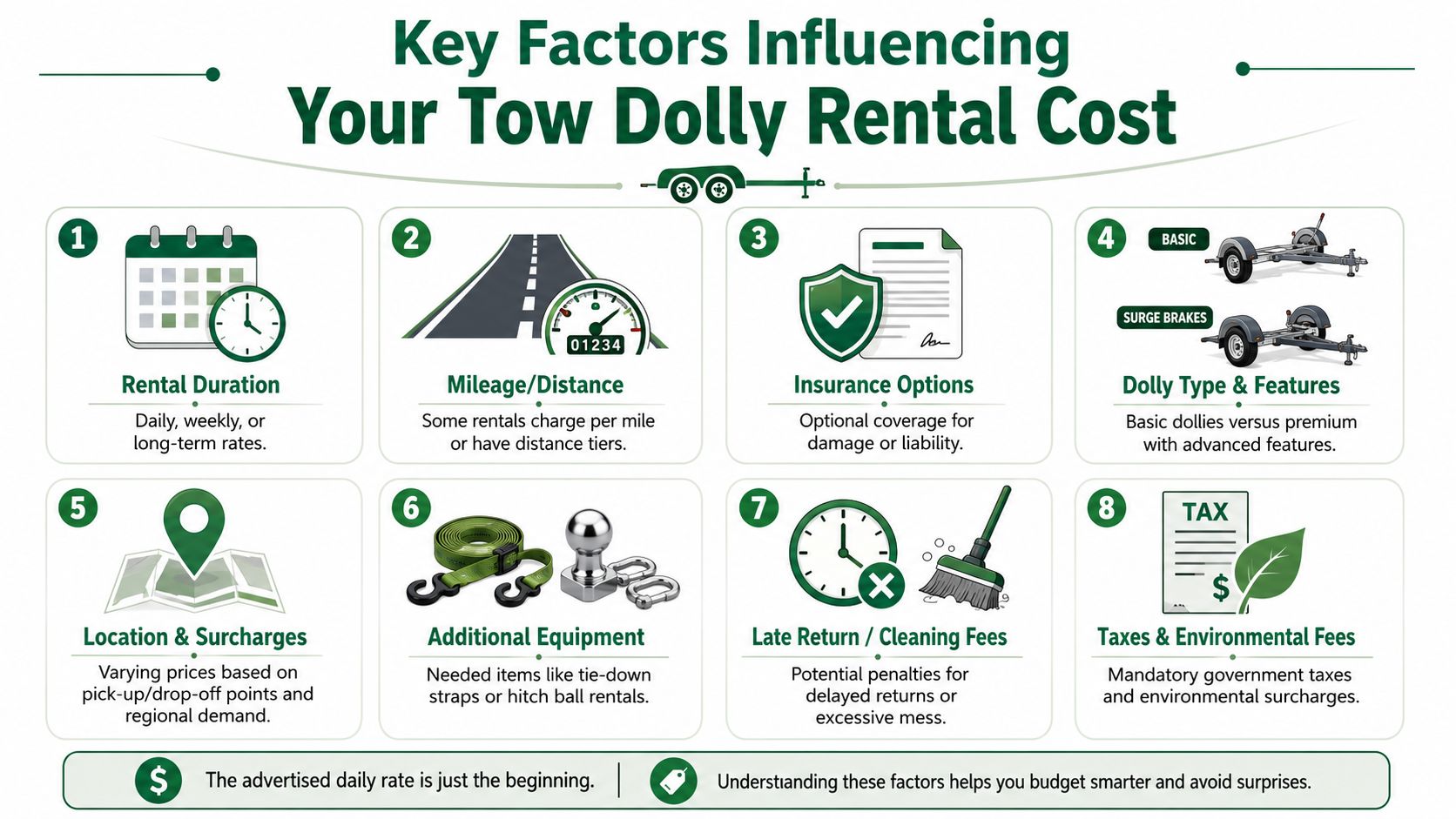
Vehicle prep can wreck your budget
This is the hidden issue that catches first-time renters. Most rental guides omit the critical $50 to $150 fee or risk of transmission damage if users fail to remove the drive shaft on rear-wheel-drive or all-wheel-drive vehicles before towing. Only 12% of DIY movers correctly prepare their cars, according to a 2025 AAA survey of 2,000 relocators cited by Budget Truck's tow dolly guide.
That single point changes the economics of DIY towing.
If your vehicle needs prep you didn't anticipate, the “cheap” rental doesn't stay cheap. Worse, if you skip the prep and tow anyway, you can turn a moving problem into a repair problem.
Distance changes everything
For a local run, a tow dolly can still pencil out. For a longer move, your cost picture starts spreading into multiple buckets:
- Rental time: Longer use can improve the hourly math, but it still extends your exposure to towing risk.
- Trip complexity: Multi-state routes mean more stops, more checks, and more fatigue.
- Return logistics: Round-trip equipment handling isn't free in practical terms, even if the invoice looks manageable.
The route matters as much as the rental period. A simple move between nearby cities is one thing. A run from Boston to Orlando, Denver to Nashville, or Sacramento to Houston is another.
Safety procedures also add time
Tow dollies require more than hitch-and-go confidence. U-Haul's tow dolly rental information notes that the equipment is typically limited to front-wheel-drive cars and requires checks on safety chains, electrical hookups, and tire straps after the first five miles and every 50 miles thereafter. It also warns that improper use with rear-wheel-drive vehicles can cause transmission damage if the drive shaft isn't reinstalled after towing.
That's not just a technical note. It's a time cost and a risk-management burden.
A tow dolly demands attention for the entire trip, not just during pickup.
The final bill usually includes more than people expect
Think in categories, not just rental lines:
| Cost area | Why it matters |
|---|---|
| Vehicle compatibility | Wrong fit can trigger prep costs or drivetrain damage |
| Trip length | Longer hauls add time, checks, and towing fatigue |
| Insurance choices | You may need extra protection depending on your policy |
| Equipment add-ons | Small accessories and protections raise the total |
| Operational errors | Late returns, poor loading, or strap issues can get expensive fast |
If you're moving a standard commuter car from one city to another in the mainland U.S., that list may still be manageable. If you're coordinating a household move, towing behind a rental truck, or trying to keep a strict relocation budget, every one of those variables matters.
The smart move is to price the entire job before you commit. Not the dolly. The job.
Comparing Tow Dollies To Other Transport Methods
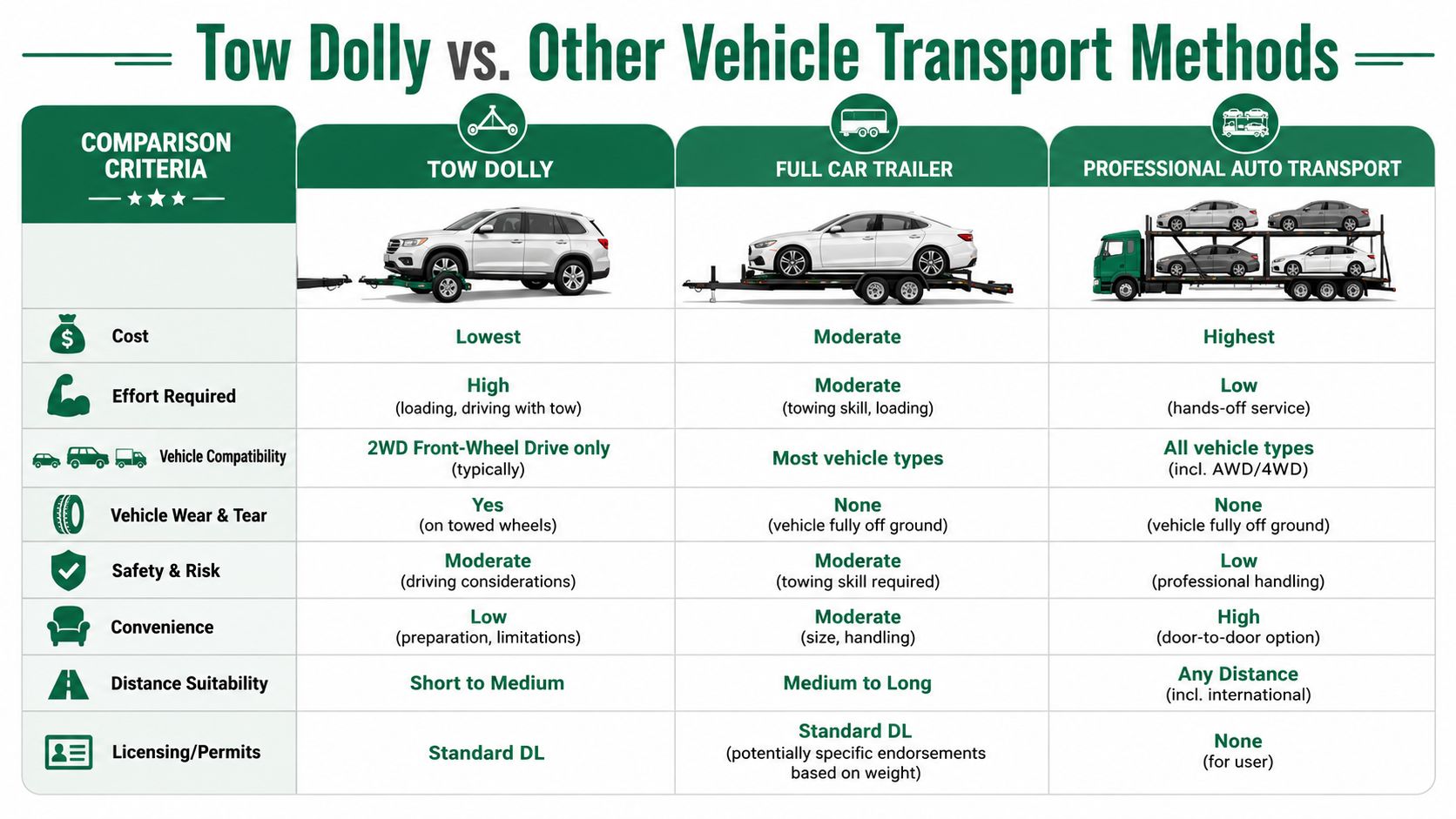
You really have three choices. Tow dolly. Full car trailer. Professional auto transport. Each one solves a different problem.
Cost isn't the same as value
The rough cost hierarchy is straightforward. A tow dolly usually has the lowest entry price. A trailer costs more. Professional shipping often looks highest at first quote. But that's only the surface.
RoadRunner Auto Transport's comparison of car trailers, tow dollies, and auto transport states that the average cost to rent a car trailer ranges from $300 to $400, whereas renting a tow dolly typically costs around $100, but combining it with a U-Haul truck for long-distance moves over 250 miles can exceed $1,000 total.
That's the turning point for a lot of moves. Once you bundle equipment, truck rental, and distance, DIY towing often stops being the obvious bargain.
Side-by-side reality check
| Method | Best use case | Main downside |
|---|---|---|
| Tow dolly | Short to medium moves with the right vehicle | Limited compatibility and more wear risk |
| Full car trailer | Better control and broader vehicle fit | Higher rental cost and more trailer to handle |
| Professional auto transport | Long distance, complex, or hands-off moves | Higher upfront quote in many cases |
A trailer is the better DIY tool if your vehicle isn't an ideal dolly candidate. The car stays fully off the ground. That reduces mechanical concerns and broadens compatibility.
Professional shipping is the better choice when your priority is avoiding DIY labor, avoiding tow setup errors, and not spending your move driving a loaded truck with a car behind it.
Insurance is the part people skip until it matters
Before you tow anything, check what your auto policy follows. Vehicle, driver, rented equipment, and liability don't always line up the way people assume. This explainer with ISU insights on car insurance is worth reading before you decide which option puts you at less risk.
That's especially true for military relocations, student moves, dealership transfers, and snowbird routes where timing and damage disputes can turn into a headache fast.
A quick visual helps if you're weighing the options in real time.
My blunt recommendation
Choose a tow dolly only if all of these are true:
- Your car fits the equipment requirements
- The route is manageable
- You're comfortable towing
- You have time for prep and inspections
Choose a full trailer if you still want DIY control but need better compatibility and less drivetrain risk.
Choose professional auto transport if the move is long distance, your time matters, the vehicle is valuable, or you don't want your relocation plan to depend on your towing skills. That's often the best value move, even when it's not the cheapest line item.
The Smart Choice for Long Distance and Puerto Rico Moves
Tow dollies belong on simple jobs. Long-distance auto transport is not a simple job.
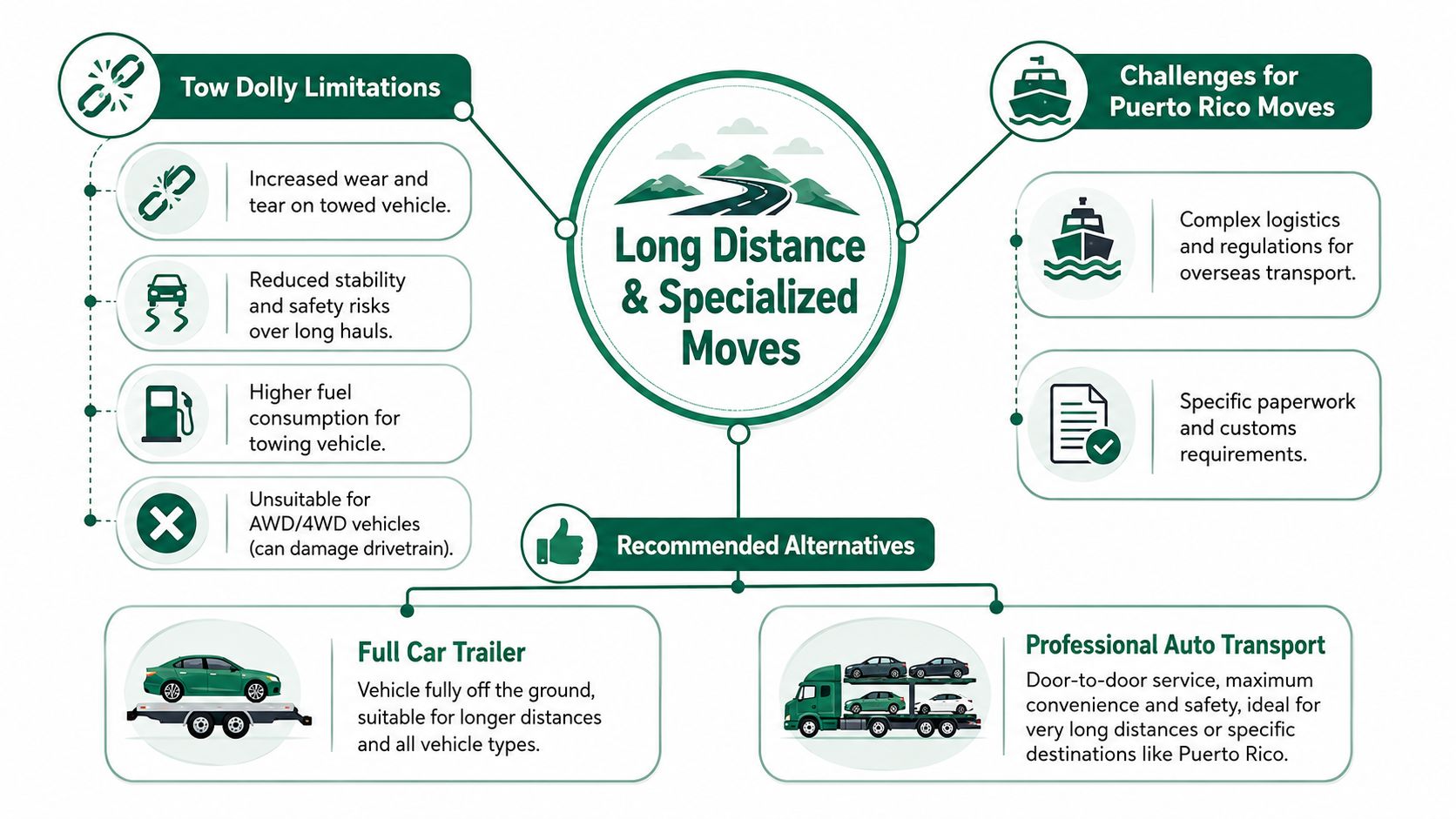
Long routes punish weak plans
A move from Miami to Chicago, Seattle to Dallas, San Diego to Atlanta, or Newark to Tampa asks a lot from the driver even without towing. Add a dolly and your margin for error shrinks. You're braking differently, turning differently, parking differently, and watching equipment for the entire trip.
That's why I push people to think in terms of total cost of ownership and risk. A low rental price doesn't buy convenience. It buys responsibility.
For snowbirds, students, military families, dealerships, and businesses moving vehicles across the mainland, professional shipping often wins because it removes the hardest part of the move. You don't have to drive the car. You don't have to tow it. You don't have to build your relocation around the limitations of rental equipment.
Puerto Rico changes the discussion completely
For Puerto Rico, there is no serious tow dolly debate. You're not towing a car across water. You're arranging regulated shipping and port coordination, usually through San Juan.
This discussion of vehicle shipping costs to Puerto Rico includes quoted examples of $1,500 for a subcompact car and up to $4,200 for two vehicles, which shows how specialized and logistics-heavy these moves are. That's not a DIY tow problem. That's a professional transport problem.
Why professionals make sense here
For Puerto Rico routes and long domestic moves across the 48 states, you need a provider that understands:
- Port procedures and paperwork
- Mainland pickup coordination
- Timing around ocean or carrier schedules
- Inspection and condition reporting
- Communication in English and Spanish when needed
For Puerto Rico shipments, experienced guidance isn't a luxury. It's part of the service.
That matters whether you're shipping from Orlando, Jacksonville, Houston, New York, Philadelphia, Chicago, Los Angeles, or another major mainland hub into San Juan, or moving a vehicle back from Puerto Rico to the continental U.S.
A good transport partner should also understand who's shipping. A military family on orders has different needs than a college student. A dealership moving inventory has different priorities than a retiree splitting time between the mainland and Puerto Rico. Not one vehicle transport is alike. That's why a knowledgeable U.S.-based advisor matters. Bilingual agents with deep auto transport experience can simplify the process, answer the questions people have, and keep the move from turning into a paperwork chase.
For these moves, the smartest choice usually isn't the one with the smallest first number. It's the one that reduces friction, protects the vehicle, and gets the logistics right the first time.
Your Car Transport Decision Checklist
If you're still deciding, use this as your filter.
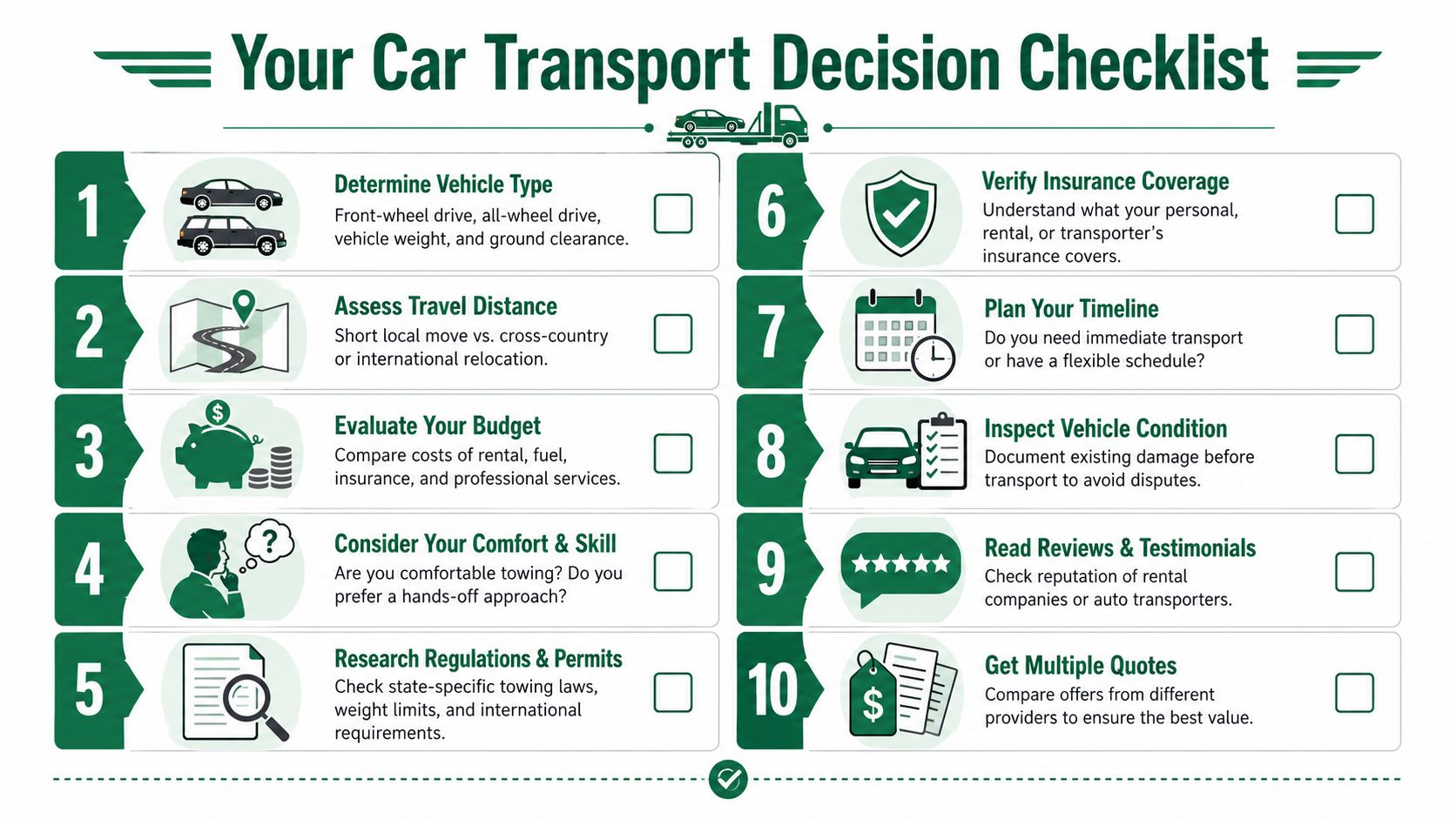
Start with the vehicle, not the quote
Ask yourself these questions first:
- What are you moving? Front-wheel-drive commuter car, AWD SUV, low-clearance vehicle, classic car, fleet unit?
- How far is it going? Local, cross-state, cross-country, or Puerto Rico?
- Who's doing the work? You, a family member, or a hired carrier?
If the car isn't a clean fit for a tow dolly, stop there. Don't force the cheap option onto the wrong vehicle.
Use this decision filter
- Check drivetrain and compatibility. A tow dolly is often best for front-wheel-drive vehicles only.
- Look at route complexity. City-to-city mainland transport is one thing. Port shipping to San Juan is another.
- Price the whole move. Include rental, prep, your time, fuel, and risk exposure.
- Be honest about towing skill. If you hate towing, don't build your move around it.
- Review insurance carefully. Don't assume your policy fills every gap.
- Think about wear and tear. Saving money upfront can cost more if the vehicle is poorly matched to the method.
- Match the method to the trip. Short haul, maybe a dolly. Bigger move, look harder at professional transport.
- Protect your schedule. DIY towing creates delays when loading, checking, or returning equipment goes wrong.
- Document the vehicle condition. That protects you no matter which option you choose.
- Choose simplicity when the move is already stressful. This one matters more than people admit.
My final read on it
If your move is short, your car is compatible, and you know what you're doing, a tow dolly can work.
If the trip is long distance, the vehicle is a bad fit, the route runs through multiple states, or the shipment involves Puerto Rico, don't overcomplicate your life. Professional auto transport is usually the better decision. It's safer, easier on the vehicle, and easier on you.
If you want a real-world answer instead of a generic quote, National Car Transport is a strong place to start. They handle door-to-door vehicle shipping across all 50 states and Puerto Rico, including major mainland cities and San Juan, with 25+ years of experience, an A+ BBB rating, transparent flat-rate pricing, and a network of 25,000+ vetted carriers. Their U.S.-based bilingual English and Spanish agents have over 20 years of experience in auto transport logistics, which matters because no two vehicle moves are exactly alike. If your goal is to make the process simple, quick, and cost-conscious without taking on DIY towing risk yourself, that's the kind of guidance worth using.