

That last cold ride of the season usually ends the same way. You pull into the driveway, hear the exhaust tick as it cools, and tell yourself you’ll deal with the bike next weekend. Then weather, work, and holidays get in the way, and the motorcycle sits exactly where you parked it.
That’s how good bikes come out of winter with dead batteries, stale fuel, flat-spotted tires, and rust where nobody looked.
Storing motorcycle for winter isn’t parking it and tossing a cover over it. You have two real options. Winterize it properly where it sits, or move it to a better place if your current setup is a bad one. For some riders, especially snowbirds, military families, students, and anyone relocating to or from Puerto Rico, shipping the bike is the smarter answer than trying to force a bad storage situation.
Table of Contents
- Your Motorcycle Winter Storage Game Plan
- The Pre-Storage Preparation Checklist
- Essential Mechanical Winterization Steps
- Protecting Tires, Suspension, and Finishes
- Shipping Your Motorcycle Instead of Storing It
- Final Checks Insurance, Security, and Spring Revival
Your Motorcycle Winter Storage Game Plan
The mistake I see most is simple. Riders treat winter storage like inactivity, when it’s really a maintenance event. A motorcycle that sits for months without a plan doesn’t stay neutral. Fuel ages, tires settle, moisture hangs around, and batteries go downhill fast in the cold.
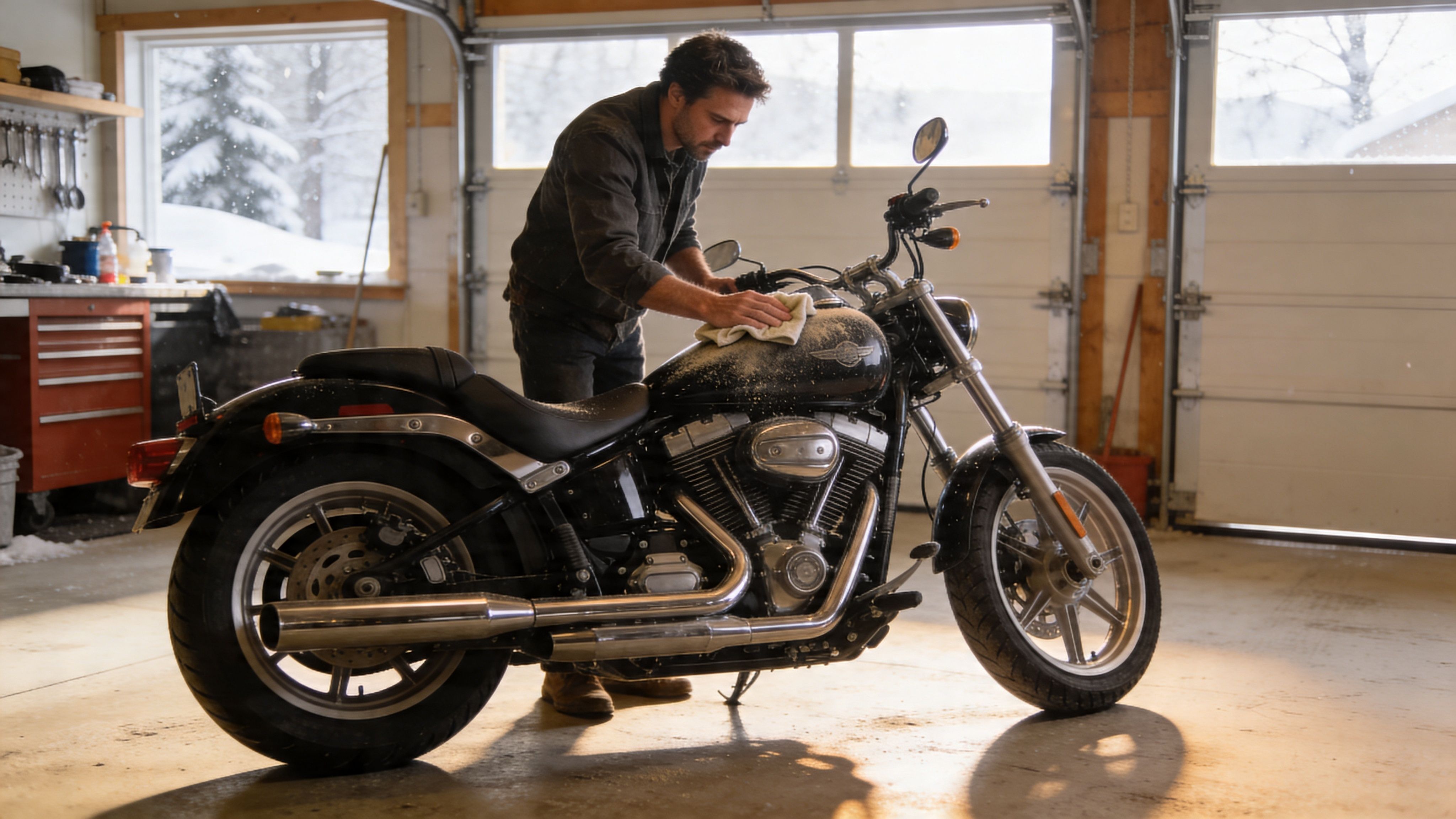
There are two sound paths.
One is home winterization. That works well if you have a dry garage, a stable place to keep the bike, basic tools, and the discipline to prep it before the first hard freeze. If your setup is clean, secure, and reasonably climate-stable, you can put the bike away correctly and pull it back out in spring with very little drama.
The other is moving the bike instead of letting it hibernate in a bad environment. That’s the better route if you’re heading south for the season, changing duty stations, losing garage access, or relocating between the mainland and Puerto Rico. A lot of riders only think about storing where they live. They should be thinking about where the bike will be safest and easiest to use.
Practical rule: If your only winter option is a damp shed, an outdoor cover, or an unsecured corner of an apartment lot, that’s not storage. That’s deferred damage.
The choice comes down to your situation
Use this quick decision view:
| Situation | Better option |
|---|---|
| Dry home garage and staying local | DIY winterization |
| No indoor space | Professional transport to proper indoor storage |
| Snowbird travel to warmer state | Ship the bike and keep riding |
| Military or student relocation | Transport to destination |
| Mainland to Puerto Rico move | Coordinated transport and island logistics |
A good plan is boring. That’s the point. You want no surprises in January and no repair bill in March.
The Pre-Storage Preparation Checklist
Before you touch fuel, battery leads, or stands, get the motorcycle clean and get honest about where it’s going to spend the winter. Dirty bikes hide leaks, hold moisture, and let bug acids, road film, and grime sit on paint, aluminum, and chrome for months.
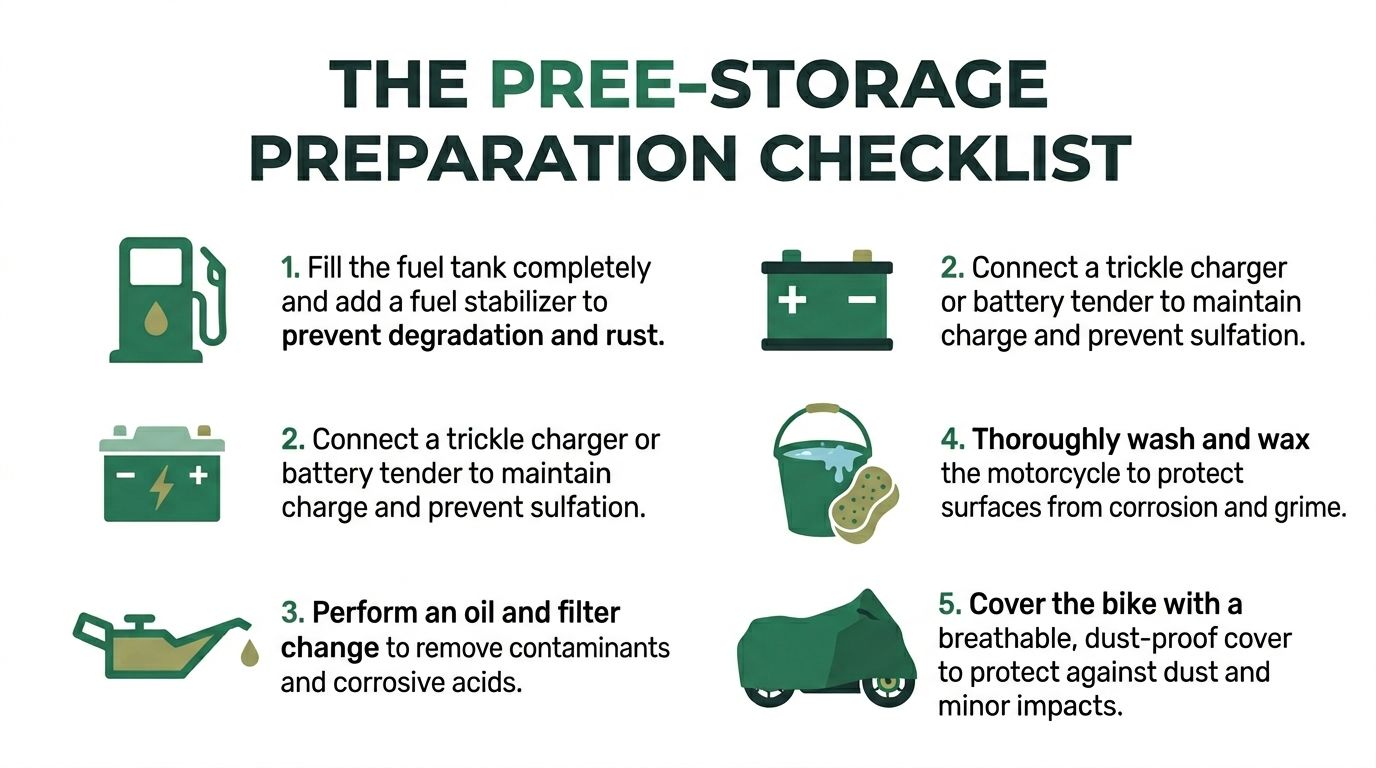
Clean it like you mean it
Wash the bike fully. Don’t just hit the tank and windscreen. Get into the lower fork legs, behind side covers, around the swingarm, under the fenders, and around the chain area if you ride chain drive. Dry it completely before it goes inside.
Wax painted surfaces if you use wax. On exposed metal, use an appropriate protectant. On the chain, clean and lube it before the bike sits.
A quick pre-storage walkaround should also catch the small things riders ignore:
- Fluid seepage: Look under the engine cases, fork seals, calipers, and shock area.
- Loose hardware: Mirrors, levers, luggage mounts, and battery terminals loosen over time.
- Pest entry points: Exhaust outlets and intake areas attract critters in cold weather.
Dirt on a stored bike isn’t just ugly. It holds moisture and salts against the surface far longer than it would during regular riding.
Pick the storage location before winterizing
The best storage location is dry, secure, and stable. A home garage is usually easiest because you can inspect the bike without much effort. A rented storage unit can be better if it gives you a cleaner, drier environment than you have at home.
A shed can work, but only if it stays dry and doesn’t swing wildly between damp nights and warmer days. Outdoor storage is the last option, not a normal option.
Build a short timeline
Don’t try to do everything the night before a freeze. Break it up.
- First step: Wash and inspect the bike while it’s still comfortable to work on.
- Next: Gather what you’ll use, such as fuel stabilizer, oil and filter, battery tender, stands, tire gauge, plywood squares, and a breathable cover.
- Final prep day: Handle fuel, battery, tires, and final placement in one session.
If you’re storing in a remote unit, think through access. If you’re shipping to another state or to Puerto Rico, line up transport before everyone else waits until the same weather shift.
Essential Mechanical Winterization Steps
A clean bike still gets parked with stale fuel, acidic oil, and a weak battery every fall. That is how riders create spring no-starts, stuck floats, and corroded internals. Handle the mechanical side properly now, and the bike either sits safely all winter or arrives ready to run if you decide storage is the wrong plan and ship it south instead.
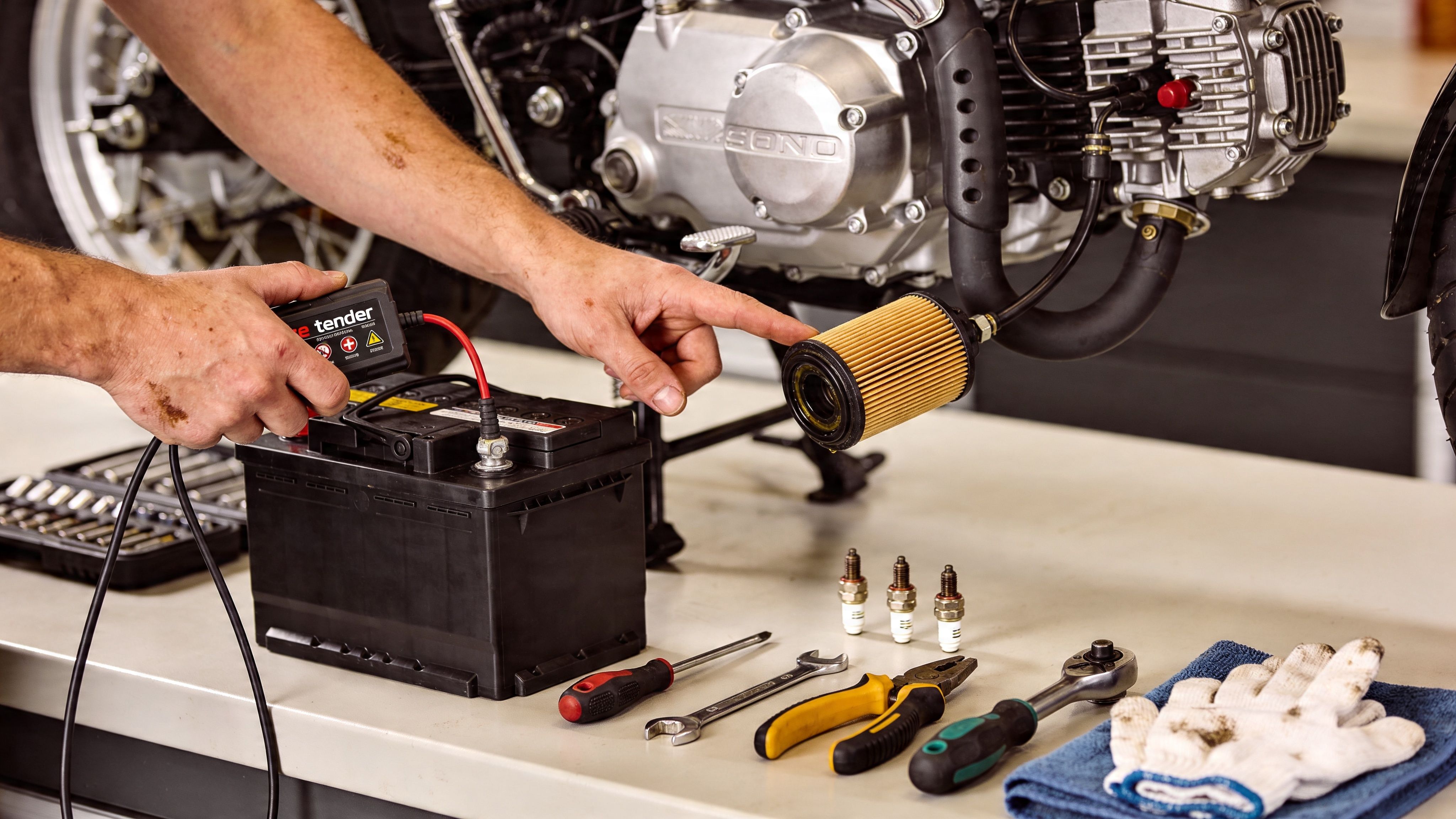
Start with the fuel system
Fuel storage mistakes cost more time than almost anything else on this list. Ethanol fuel absorbs moisture, light fuel fractions evaporate, and the residue left behind gums up injectors and carb passages.
According to winter fuel storage guidance for motorcycles, properly stabilized fuel maintains injectors and carburetors with 95% reliability over a 6-month storage period, compared to a 50% failure rate for untreated fuel. The same guidance notes that failing to run the engine for 5-10 minutes after adding stabilizer leads to untreated residual fuel causing 30% of clogs.
That lines up with what shows up in the shop every spring. The stabilizer went into the tank, but treated fuel never reached the rail or the carb bowl.
Use a clean sequence and finish it in one session:
- Fill the tank near full: Less air space means less condensation.
- Add the correct amount of stabilizer: Follow the bottle ratio. More is not better.
- Run the engine long enough to circulate treated fuel: Let it reach the injectors or carburetor.
- Shut the bike off: Don’t keep starting it for no reason after that.
Carbureted bikes need extra attention here. On some older carb setups, I prefer to shut the fuel off and let the bowls run down after stabilized fuel has circulated, especially if the bike may sit longer than one season. EFI bikes tolerate storage better, but stale fuel can still leave deposits in pumps and injectors.
Adding stabilizer without circulating it only protects the fuel in the tank.
Handle the battery correctly
Batteries hate sitting half-charged in the cold. Motorcycle winter storage data from Compass Self Storage states that batteries can lose up to 50% of their charge within a few weeks in freezing conditions, and that improper battery storage causes 60-70% of springtime starting failures. That same source says cold can push self-discharge from 1-3% per month at room temperature to 20-50% in sub-zero conditions.
A smart maintainer is the right tool. A cheap unregulated trickle charger can cook a battery over a long winter.
If the bike is in a garage with power, leave the battery installed, connect a quality maintainer, and confirm the lead is secure before you walk away. If the bike is in a storage unit without power, or you are arranging transport before a move, remove the battery, clean the terminals, and store it in a dry place with a stable temperature. That matters for riders splitting time between northern states and Puerto Rico, because a battery that is neglected in storage often becomes one more problem to solve when the bike finally gets shipped or recommissioned.
Use this checklist:
- Clean the terminals: Corrosion raises resistance and causes hard starting.
- Check electrolyte level if the battery is serviceable: Top up only with distilled water.
- Use a maintainer, not a basic trickle charger: Long-term charging needs regulation.
- Label accessory leads before disconnecting anything: This saves time on reassembly.
Change oil and inspect the rest of the fluids
Used oil holds combustion byproducts, moisture, and acids. Letting that sit in the engine for months is unnecessary wear.
Change the oil and filter before storage if the current fill has real use on it. If the oil was changed very recently and the bike was barely ridden, it may be reasonable to leave it alone. That is the actual trade-off. Fresh oil is cheap insurance, but there is no point dumping nearly new oil just to follow a ritual.
Check coolant strength and condition on liquid-cooled bikes. Check brake fluid if it looks dark or you already planned to service it. Clutch fluid, on hydraulic setups, deserves the same look. Winter storage is a good stopping point for deferred maintenance because the bike is already parked and accessible.
This walkthrough is a useful visual reference before you start:
Small mechanical jobs that prevent bigger ones
A few quick tasks make a real difference by spring:
- Lubricate the chain: Clean it first if it is dirty, then apply fresh lube.
- Lubricate control points: Cables, lever pivots, and the sidestand pivot dry out while sitting.
- Inspect coolant hoses and clamps: Small leaks get worse during long storage.
- Check intake and exhaust openings before the bike sits: If local storage conditions invite pests, block openings with a clear reminder tag so nothing gets left in place at startup.
- Look over hardware on guards, racks, and luggage mounts: This matters even more if the bike may be loaded for transport later.
Stored or shipped, the mechanical goal is the same. Park the bike in a condition that lets it wake up cleanly, without stale fuel varnish, a flat battery, or contaminated oil waiting inside the engine.
Protecting Tires, Suspension, and Finishes
A bike can have fresh fuel, a charged battery, and clean oil, then still come out of winter with flat-spotted tires, tired fork seals, surface corrosion, and a cover that trapped moisture against the paint. I see that a lot in garages where the mechanical prep was fine but the storage setup was lazy.
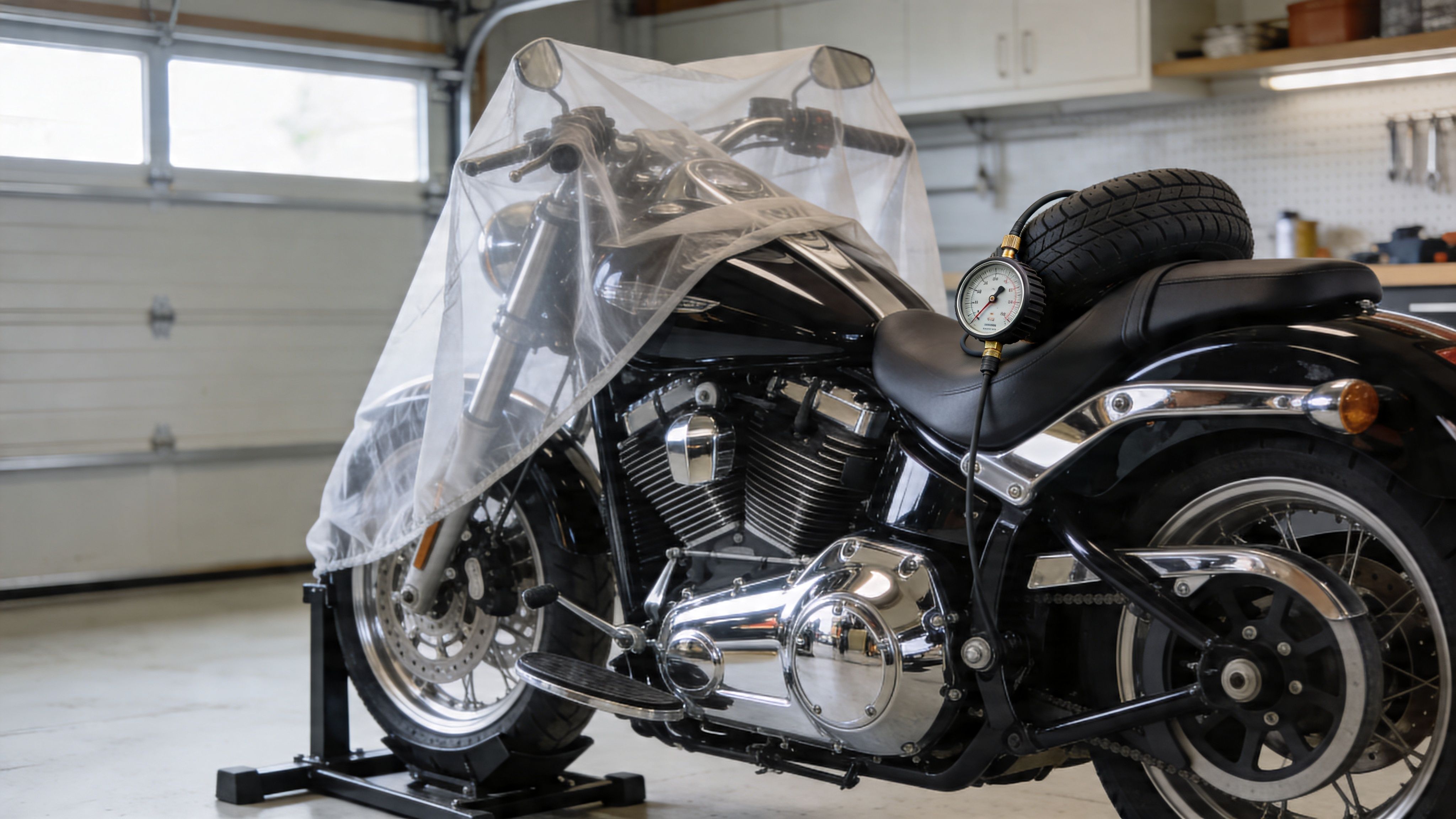
Support the bike properly
Weight sitting in one place for months is hard on tires and not great for suspension, especially on heavier touring bikes, cruisers, and machines already carrying luggage hardware. Motorcycle winter care guidance from Webster First recommends raising the bike on stands when possible, inflating tires for storage, and keeping rubber off bare concrete because concrete can transfer moisture into the storage environment.
Use front and rear stands if you have them. A center stand helps, but it does not solve everything on its own. If the bike must stay on its wheels, set tire pressure correctly for storage, put plywood or another dry barrier under each tire, and roll the bike occasionally if the space and weather allow it.
That matters even more if the bike may be shipped later. A tire that sat underinflated all winter is a poor starting point for loading, strapping, and transport inspection.
Keep moisture off rubber, paint, and exposed metal
Concrete floors, thin tarps, and non-breathable covers cause plenty of avoidable damage. The usual pattern is simple. The bike goes away clean enough, moisture gets trapped, and by spring you have light corrosion on fasteners, haze on metal, mildew on trim, or spotting on painted panels.
Do the storage setup in this order:
- Make sure the bike is fully dry before covering it
- Use a breathable indoor cover, not plastic sheeting
- Keep tires off bare concrete with wood or rubber mats
- Avoid shiny petroleum dressings on tire sidewalls
- Apply corrosion protection to exposed metal and hardware
- Block openings only if pests are a real issue, and tag them clearly
A cover should keep dust off. It should not hold damp air against the bike.
Reduce static load and protect cosmetic surfaces
Forks and shocks do not usually fail from one winter of sitting, but long periods under load do not help worn suspension. If a bike already has weeping fork seals, weak shock damping, or old bushings, storage tends to make those problems more obvious by spring. Stands reduce that strain and make inspection easier before the first ride or before a carrier picks the bike up.
The finish work is straightforward, but it pays off:
| Area | What to do |
|---|---|
| Chain drive | Clean and lubricate |
| Exposed metal | Apply suitable corrosion protection |
| Seat and soft trim | Keep clean and dry |
| Windscreen and painted panels | Use a breathable cover to prevent dust abrasion |
Riders staying put can handle all of this in a decent garage. Riders heading south for the season, reporting to a new duty station, or relocating to Puerto Rico should look at the bigger picture. If the storage space is damp, shared, unsecured, or temporary, sending the bike to a place where it will be used or stored correctly is often the better call than trying to force a bad winter setup.
Shipping Your Motorcycle Instead of Storing It
For many riders, the best answer to storing motorcycle for winter is not storing it where they are at all. If you’re leaving the state, losing garage access, splitting time between homes, or heading to Puerto Rico, the smartest move may be to relocate the bike to where it can be used or kept properly.
A lot of winterization advice assumes you have a good garage and no life changes. Plenty of riders don’t.
When transport is the better move
Industry commentary on winter storage gaps points out that most DIY guides overlook professional transport, even though it’s a critical option for snowbirds and relocating families. That same source says DOT reports show a 15% rise in seasonal vehicle transports, which fits what many transport coordinators see every fall when northern riders start moving bikes south.
Shipping makes sense in situations like these:
- Snowbirds: You spend winter in Florida, Texas, Arizona, or Puerto Rico and want the bike with you.
- Military families: A PCS move already has enough moving parts. A motorcycle shouldn’t become a side problem.
- Students and relocators: You’re changing residence and don’t have proper winter space at either end.
- Collectors and high-value owners: You don’t want a specialty bike sitting in a marginal shed or shared parking garage.
There’s also a practical truth here. Long-term neglect in a poor storage setup often costs more than proper transport to a better environment.
What matters on Puerto Rico routes
Puerto Rico adds complexity that local winter storage guides never address. Mainland-to-island transport involves scheduling, documentation, pickup timing, port coordination, and final delivery planning. Riders who wait until the last minute often discover that “I’ll just get it there somehow” is not a process.
That’s where a real transport coordinator matters. You want someone who can explain the route, timing, handoff points, inspection process, and whether enclosed service makes sense for your motorcycle. You also want clear communication if you’re handling a move between places like Miami, Orlando, Tampa, Jacksonville, Atlanta, Charlotte, Dallas, Houston, Phoenix, Los Angeles, San Diego, New York, Philadelphia, Chicago, or San Juan.
A few trade-offs are worth weighing:
| Question | Practical answer |
|---|---|
| Open or enclosed transport | Open is often the economical choice. Enclosed adds protection for classics, customs, and high-value bikes. |
| Door-to-door or terminal style handling | Door-to-door is easier for most households and relocations. |
| Store locally or move it | Move it if your local option is damp, insecure, or temporary. |
| Mainland only or Puerto Rico | Puerto Rico requires tighter coordination and better paperwork discipline. |
For riders who need a professional solution, National Car Transport is one of the established names to consider. The company handles vehicle shipping across the U.S., Alaska, Hawaii, and Puerto Rico, with 25+ years of experience, an A+ BBB rating, transparent flat-rate pricing, and a network of 25,000+ vetted carriers. Their U.S.-based bilingual English/Spanish agents are especially useful on Puerto Rico routes, where clear communication and logistics guidance matter.
That kind of support helps when no two moves look alike. A snowbird shipping from the Midwest to Florida has a different set of concerns than a military family moving from the mainland to San Juan. Good transport service accounts for that instead of forcing every shipment into the same script.
Final Checks Insurance, Security, and Spring Revival
The most persistent winter myth is that you should start the bike every so often and let it idle for a few minutes. That advice ruins engines.
Stop idling the bike over winter
According to winterizing guidance citing Motorcycle Safety Foundation findings, a 2025 Motorcycle Safety Foundation study found that 22% of springtime engine failures in stored bikes were caused by moisture-induced corrosion from periodic idling, compared to 4% in bikes left fully static. The same source says 60% of riders still idle their bikes monthly.
That’s exactly backward.
Short idling sessions don’t consistently bring the whole engine and exhaust system fully up to proper operating condition. Instead, they can introduce moisture and leave it there. If the bike is winterized correctly, leave it alone until it’s time to bring it back.
Don’t “exercise” a stored bike by idling it in the garage. Either ride it long enough to get everything fully hot, or keep it stored and untouched.
Lock in coverage and wake it up right
Insurance matters even when the bike isn’t moving. Theft, fire, and other non-riding losses don’t disappear because it’s winter. Ask your insurer about lay-up or storage coverage options and make sure you understand what remains covered while the motorcycle is off the road.
Security depends on where the bike is kept. In a home garage, that may mean a disc lock, quality door security, and a cover that doesn’t advertise what’s under it. In a storage unit, use a site with controlled access and check the lease terms. If the bike is being transported or held during a move, confirm the inspection process and insurance handling before pickup.
When spring comes, don’t just hit the starter and head out. Use a short return-to-service checklist:
- Battery first: Reconnect it or remove it from the tender and confirm terminals are tight.
- Tire pressure: Bring pressures back to the manufacturer’s normal riding spec.
- Fluids and leaks: Check oil, coolant if applicable, and look underneath the bike.
- Controls and brakes: Confirm throttle return, clutch feel, brake lever feel, lights, and horn.
- Test ride close to home: A short ride reveals issues without stranding you.
A properly stored bike should wake up cleanly. If it doesn’t, that usually points back to one skipped step months earlier.
If your winter plan involves more than a garage corner, National Car Transport is worth contacting for practical guidance. They handle door-to-door vehicle shipping across the mainland, Alaska, Hawaii, and Puerto Rico, and their U.S.-based bilingual agents help riders, snowbirds, military families, students, and businesses sort out the details without guesswork. If you need enclosed protection, transparent flat-rate pricing, or help planning a mainland-to-San Juan move, they can walk you through the options and make a complicated relocation much simpler.
Made with the Outrank app