
You're probably here because the move itself is already big enough. New job, PCS orders, school, family relocation, seasonal living, dealership transfer, or an online vehicle purchase that needs to cross the water. Then the practical question hits: how do ships to Puerto Rico work when the thing you need moved is your car?
The good news is that this isn't an unusual route. Puerto Rico's modern shipping history is tied to its role as a U.S. territory, and ocean transport is a core logistics link for the island's about 3.3 million residents in the mainland economy connection described here. For first-time shippers, that matters because it means vehicle shipping to Puerto Rico follows an established process, not an improvised one.
What makes it feel confusing isn't the ocean crossing. It's the mix of inland transport, port handling, paperwork, scheduling windows, and pickup rules in San Juan. That's where experienced guidance makes a real difference. A good coordinator doesn't just book space. They explain why a document matters, when a label entry can cause a delay, and what to do before your vehicle ever reaches the port.
Table of Contents
- Your Guide to Shipping a Car to Puerto Rico
- Choosing Your Puerto Rico Vehicle Shipping Method
- Required Documents for Shipping a Car to Puerto Rico
- Puerto Rico Car Shipping Costs and Transit Times
- The Shipping Process from Mainland to Island
- Frequently Asked Questions About Shipping to Puerto Rico
Your Guide to Shipping a Car to Puerto Rico
Shipping a car to Puerto Rico feels bigger than a normal state-to-state move because one mistake can follow the vehicle all the way to the port. That's why the smartest first step isn't shopping for the lowest number. It's understanding the route, the handoffs, and the document requirements before your vehicle is dispatched.
A mainland-to-island move usually has three parts. First, your vehicle travels from your home, office, dealer, auction, campus, or storage location to the departure port. Then it moves by ocean vessel to Puerto Rico. After arrival, there's a release process before you can take possession.
The stress often comes from not knowing where delays usually happen. It's easy to assume the vessel crossing is the risky part. In practice, many problems start much earlier, with title issues, lienholder approvals, booking details, or mismatched address fields.
Practical rule: The smoother the file, the smoother the shipment.
That's why first-time shippers benefit from talking to someone who handles Puerto Rico routes regularly. Military families want timing they can plan around. Snowbirds often care about schedule coordination on both ends. Students need simple instructions. Dealerships and businesses usually want repeatable process and clean documentation.
A coordinator who's done these shipments many times can translate the process into plain English or Spanish, flag missing items early, and match the shipping method to the vehicle instead of forcing every customer into the same lane. That human part matters because no two vehicle moves are exactly alike, even when the route looks similar on paper.
Choosing Your Puerto Rico Vehicle Shipping Method
The water portion of the move usually comes down to two methods: Roll-On/Roll-Off (RORO) and container shipping. Both are legitimate. Neither is automatically right for every vehicle.
The choice should match the car, your budget, and how much protection you want while the vehicle is in port handling and ocean transit.
When RORO makes sense
RORO is usually the simpler option for a standard running vehicle. The car is driven onto the vessel, secured, and then driven off at arrival. If your vehicle starts, steers, brakes, and doesn't need special handling, this method is often the practical choice.
RORO tends to fit people moving everyday sedans, SUVs, and pickup trucks. It also works well when the goal is straightforward transport without extra handling complexity. If you're relocating and just need your vehicle in Puerto Rico without adding household goods to the move, RORO often checks the right boxes.
When container shipping is the better fit
Container service gives the vehicle more separation from the surrounding port environment. That makes it appealing for classic cars, luxury vehicles, specialty builds, low-clearance vehicles, or situations where the owner wants more controlled handling.
It can also be the better route when the shipment itself is more complex. Some customers have a purchased vehicle that needs tighter oversight. Others are businesses moving inventory that benefits from a more structured loading plan.
Here's the side-by-side view that usually helps people decide:
| Feature | Roll-On/Roll-Off (RORO) | Container Shipping |
|---|---|---|
| Vehicle condition | Best for running vehicles | Can suit vehicles needing more controlled handling |
| Protection level | Standard vessel transport | More enclosed protection during transit |
| Cost profile | Usually the more economical route | Usually costs more due to added handling and equipment |
| Loading method | Vehicle is driven on and off the vessel | Vehicle is loaded into a container |
| Best fit | Daily drivers, routine relocations, standard auto shipments | Classic, luxury, specialty, or higher-sensitivity shipments |
| Flexibility | Simple process for many standard bookings | Useful when the move requires more customized planning |
If you're shipping a normal daily driver, paying for maximum enclosure may not be necessary. If you're shipping a collector vehicle, the lower-cost method isn't always the right value.
The method choice also affects how you prepare the vehicle. With either option, the car should be clean enough for inspection, mechanically honest about whether it runs, and booked with accurate dimensions. Trucks with oversized tires, roof racks, lift kits, or accessories can change handling plans quickly if they aren't disclosed up front.
Some shippers focus only on the ocean segment and forget the vehicle still has to move across the mainland first. That's another reason method selection should happen with the full route in mind. A practical quote should account for inland pickup, port delivery timing, vessel space, and release planning, not just the boat.
Required Documents for Shipping a Car to Puerto Rico
A lot of first-time customers feel confident once the vehicle is booked, then hit a wall when the document review starts. That is usually the point where confusion shows up. Names have to match, lender permissions have to be clear, and the port will not overlook missing ownership records just because the car is ready to move.
The paperwork that usually matters most
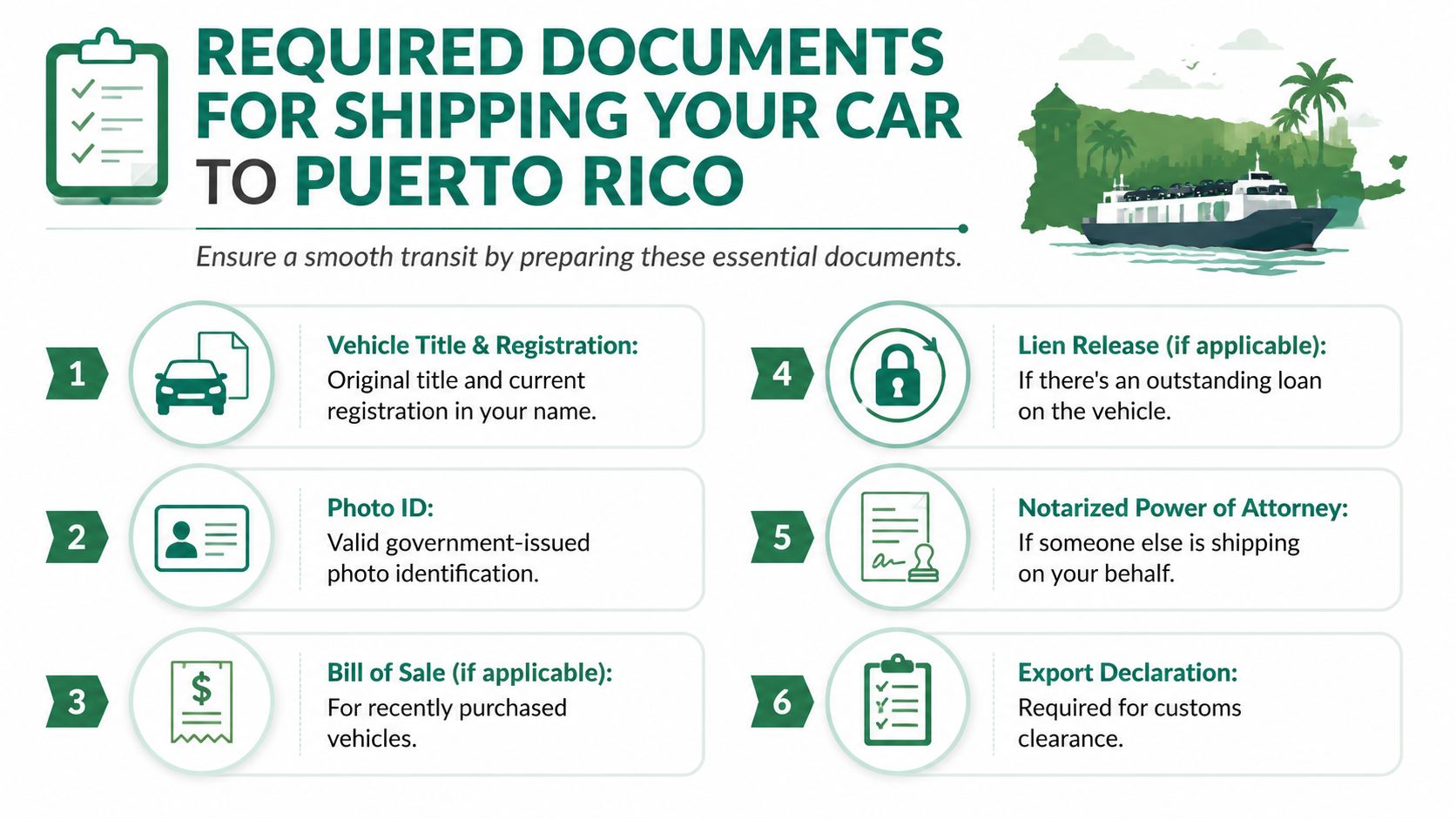
The file needs to show three things clearly. Who owns the vehicle, who is authorized to ship it, and exactly which vehicle is being released to the carrier.
That usually means providing:
- Title and registration if the vehicle is already in your name
- Government-issued photo ID that matches the booking and ownership records
- Bill of sale if the purchase is recent and the title has not fully updated yet
- Lienholder authorization or release if a lender still has a legal interest in the vehicle
- Power of attorney if another person is signing or handling the move for you
- Commercial invoice, which is often included in the normal documentation flow for Puerto Rico shipments
One detail trips people up more than expected. Puerto Rico moves are commonly treated as domestic shipments, but filing rules can still apply based on how the vehicle is documented and declared. That is why a coordinator reviews the file before the car ever heads to port, instead of trying to fix paperwork after arrival.
Why review matters before the vehicle reaches the port
Port teams and carriers work from exact records, not assumptions. If the shipper name does not match the ID, if the VIN on the paperwork is off by one character, or if the lender letter is missing, the vehicle can sit until the issue is corrected. That can lead to storage charges, missed sailings, and a lot of avoidable stress.
I have seen simple issues cause the biggest delays. A customer may use a nickname on the booking, a married name on the ID, and an older name on the title. None of those details feel major until the release file is checked against the port record.
A bilingual agent helps in a very practical way. Puerto Rico shipments often involve mainland pickup instructions, port cutoff times, lender paperwork, and island release steps that are easier to explain in both English and Spanish. At National Car Transport, that kind of support matters because customers are not just sending a car. They are trying to avoid mistakes that can cost time and money.
For teams handling repeat shipments, tools focused on streamlining freight documentation processes can reduce handoff errors when multiple parties touch the same file before port delivery.
A vehicle can be ready to ship and still miss its sailing if the paperwork is not ready with it.
The safest approach is simple. Gather the documents early, send clear copies, and let an experienced coordinator check the file line by line before dispatch is scheduled. That extra review saves far more time than it adds.
Puerto Rico Car Shipping Costs and Transit Times
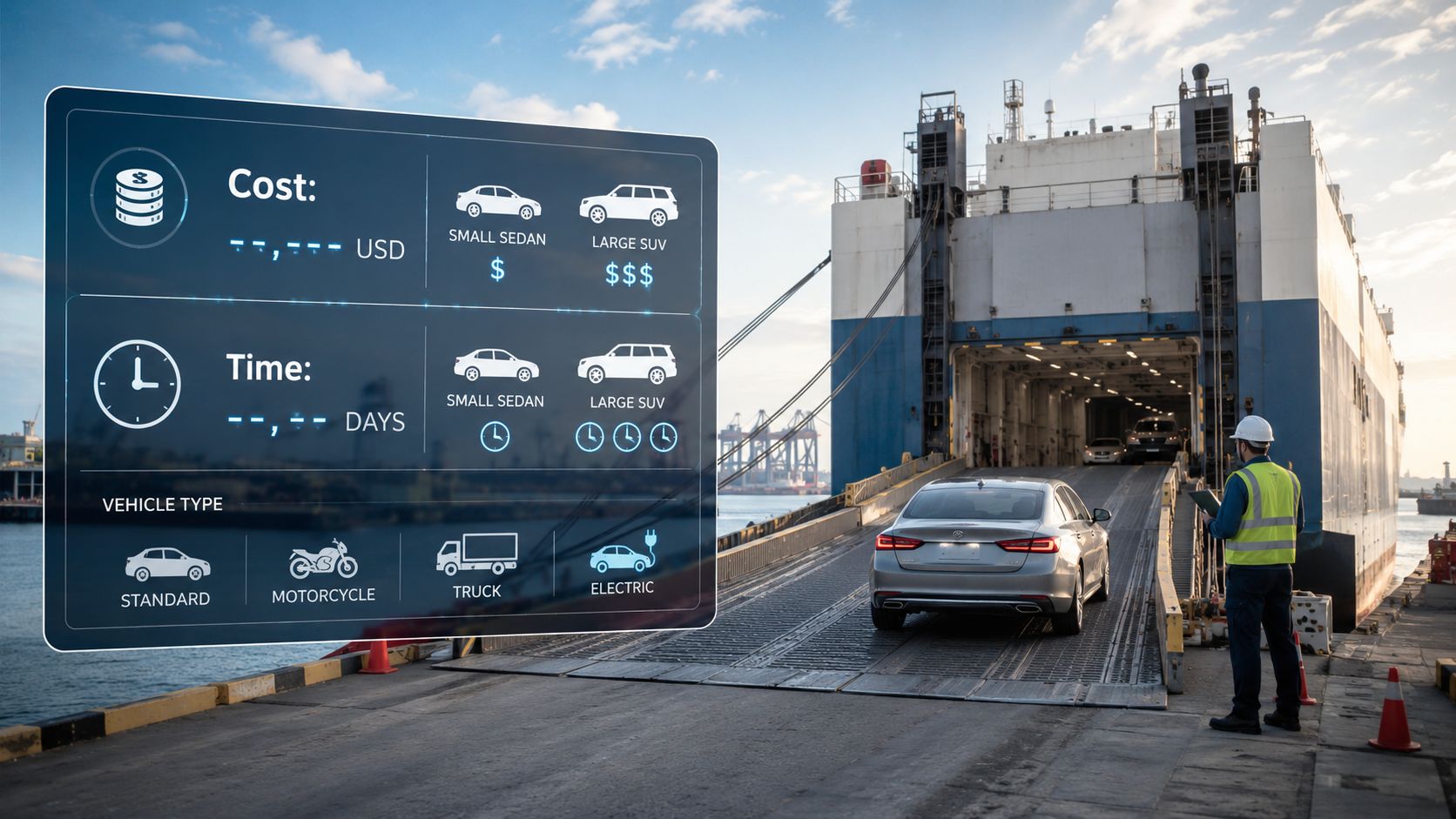
A first-time shipper usually asks the same two questions within the first few minutes. What will this cost, and when will my car be available in Puerto Rico? Those are the right questions, but the answer is never just a flat rate and a sailing date. Puerto Rico moves are built from two parts, inland transport on the mainland and ocean service to the island, and each part affects the final quote and timeline.
What changes your quote
Pricing changes for practical reasons, not mystery fees. A compact sedan that runs, loads easily, and ships from a common East Coast lane is usually simpler to move than a lifted pickup coming from an inland address with a tight deadline.
Your quote typically reflects these factors:
- Vehicle size and type. Larger vehicles take more space and can limit loading options.
- Running condition. Non-operational vehicles need special equipment and more planning at pickup and port handling.
- Mainland origin. Distance to the departure port matters, especially if the vehicle starts far from a common shipping lane.
- Shipping method. RORO and container service have different handling steps and different costs.
- Timing. Last-minute bookings and narrow availability windows can reduce carrier options.
If you want a rough sense of how transport pricing works, a general freight cost calculator helps explain why distance, dimensions, and handling requirements affect cost, even though vehicle shipping quotes still need a route-specific review.
How to set expectations on transit time
Transit time is where many first-time customers get frustrated, usually because they are given only the ocean portion and not the full door-to-port or door-to-island schedule. The vessel trip itself may be only part of the total timeline. Pickup scheduling, port intake, cutoff dates, and release on arrival all matter just as much.
As noted earlier, Puerto Rico shipments are often discussed in terms of about a week-plus end to end, with ocean transit making up only one portion of that window. For a vehicle shipment, the useful question is not just "How many days on the water?" It is "How long from my address, or my drop-off point, until I can pick up the car in Puerto Rico?"
A realistic schedule usually looks like this:
| Stage | What affects it |
|---|---|
| Mainland pickup | Your location, truck availability, and how quickly the vehicle can be released |
| Port processing | Delivery timing, vehicle inspection, and whether the file is already approved |
| Ocean transit | Sailing schedule, vessel space, and normal port operations |
| Release in Puerto Rico | Local processing, final charges, and how quickly pickup is arranged |
This is also where experienced coordination saves time in ways a price chart cannot show. A bilingual agent can explain the schedule clearly, confirm cutoff times, and make sure you understand whether a delay is happening on the truck side, at the port, or after arrival in Puerto Rico. That matters for families relocating, military households, and anyone trying to line up housing, work, and transportation at the same time.
Quotes that hold up best are built around the actual route and the actual timing constraints. National Car Transport handles the mainland leg and the Puerto Rico shipping process under one workflow, which reduces handoff problems and gives first-time shippers one point of contact instead of separate carriers and separate answers.
The Shipping Process from Mainland to Island
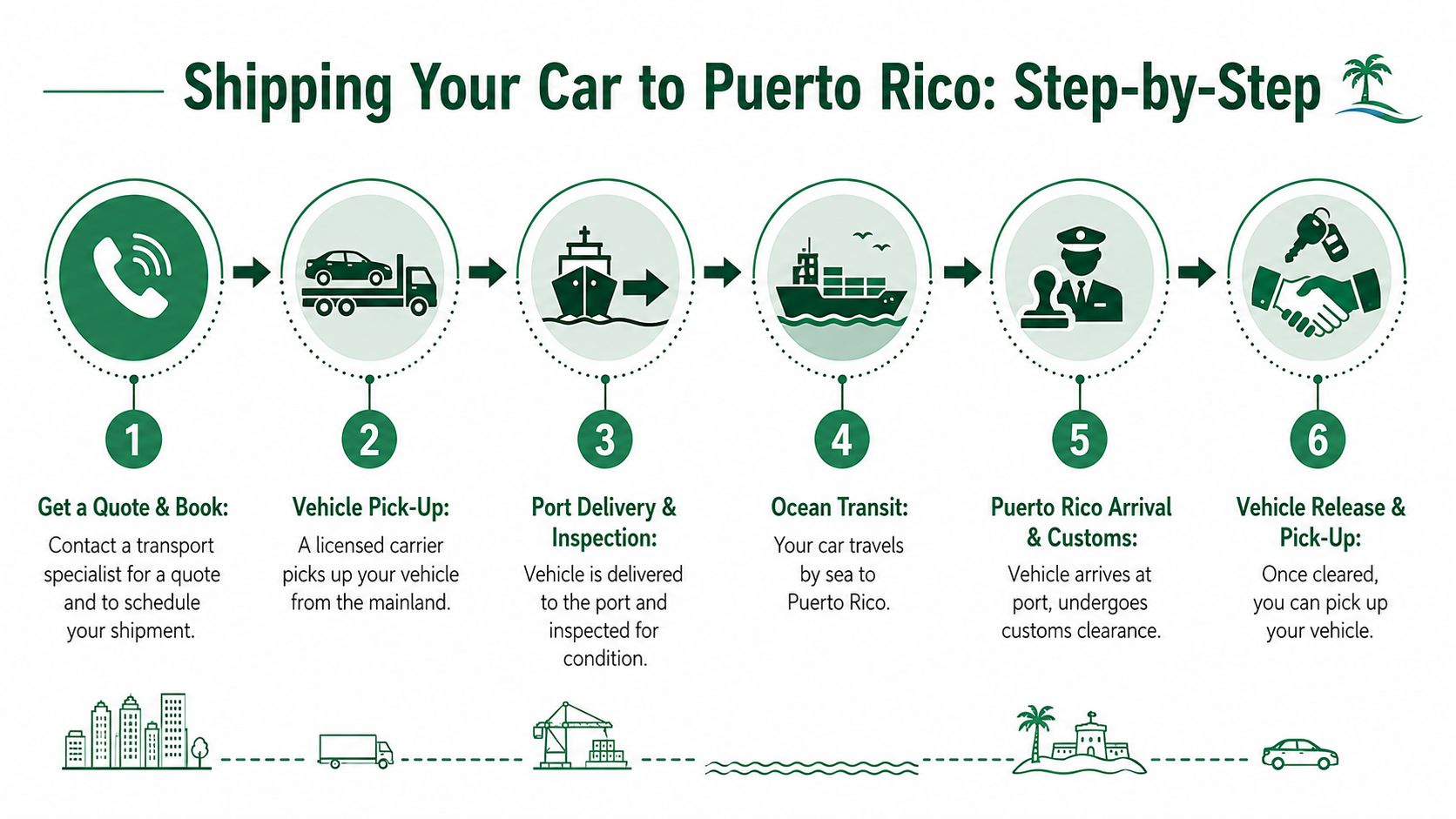
The process works best when you see it as a chain of handoffs, not one single event. Your vehicle doesn't just “go on a ship.” It gets scheduled, inspected, moved inland, checked at the port, loaded for ocean transit, processed on arrival, and released.
What happens before the ship leaves
The move starts with booking. Once the route, vehicle type, and shipping method are confirmed, a licensed carrier picks up the car from your mainland address or another agreed location. At pickup, the driver performs an inspection and records the vehicle's visible condition on the Bill of Lading.
After that, the car moves to the departure port. That inland segment is the part many first-time shippers underestimate. A vehicle may travel on a truck for the domestic leg, then move into port handling, then wait for its scheduled sailing.
At the port, the vehicle is checked again. If paperwork is incomplete, that's where schedules can start slipping. The biggest real-world schedule risk is often paperwork, not ocean transit, and most mainland shipments move through intermodal container processes with several touchpoints before final delivery in San Juan, as noted in this operational shipping discussion.
Clean documents beat rushed booking every time.
This video gives a helpful overview of the broader vehicle shipping flow before and during transport:
What happens after arrival in San Juan
Once the vessel arrives, your car doesn't instantly become available for pickup. It has to move through local processing and release steps. That's why experienced support is useful at the destination side too, not just during mainland booking.
The final stage usually includes a local notification, the required release steps, and your pickup appointment. Many customers also need guidance on where to go first, what to bring, and what must be paid before the car can leave the port area.
A simple way to think about it is this:
- Pickup on the mainland. The vehicle is inspected and documented.
- Transport to port. The inland leg gets the car to the departure terminal.
- Port intake. Staff review the vehicle and file.
- Ocean crossing. The car sails to Puerto Rico.
- Arrival processing. Release requirements are completed.
- Customer pickup. The vehicle is collected in San Juan.
People often assume the process is hard because it's unusual. In reality, it's manageable when each handoff is handled in the right order and with the right paperwork attached.
Frequently Asked Questions About Shipping to Puerto Rico
Most confusion comes from assumptions. People hear “island shipping” and think customs headache, foreign vessel restrictions, or a fully different legal system. For a vehicle move from the mainland, the pertinent questions are usually more practical.
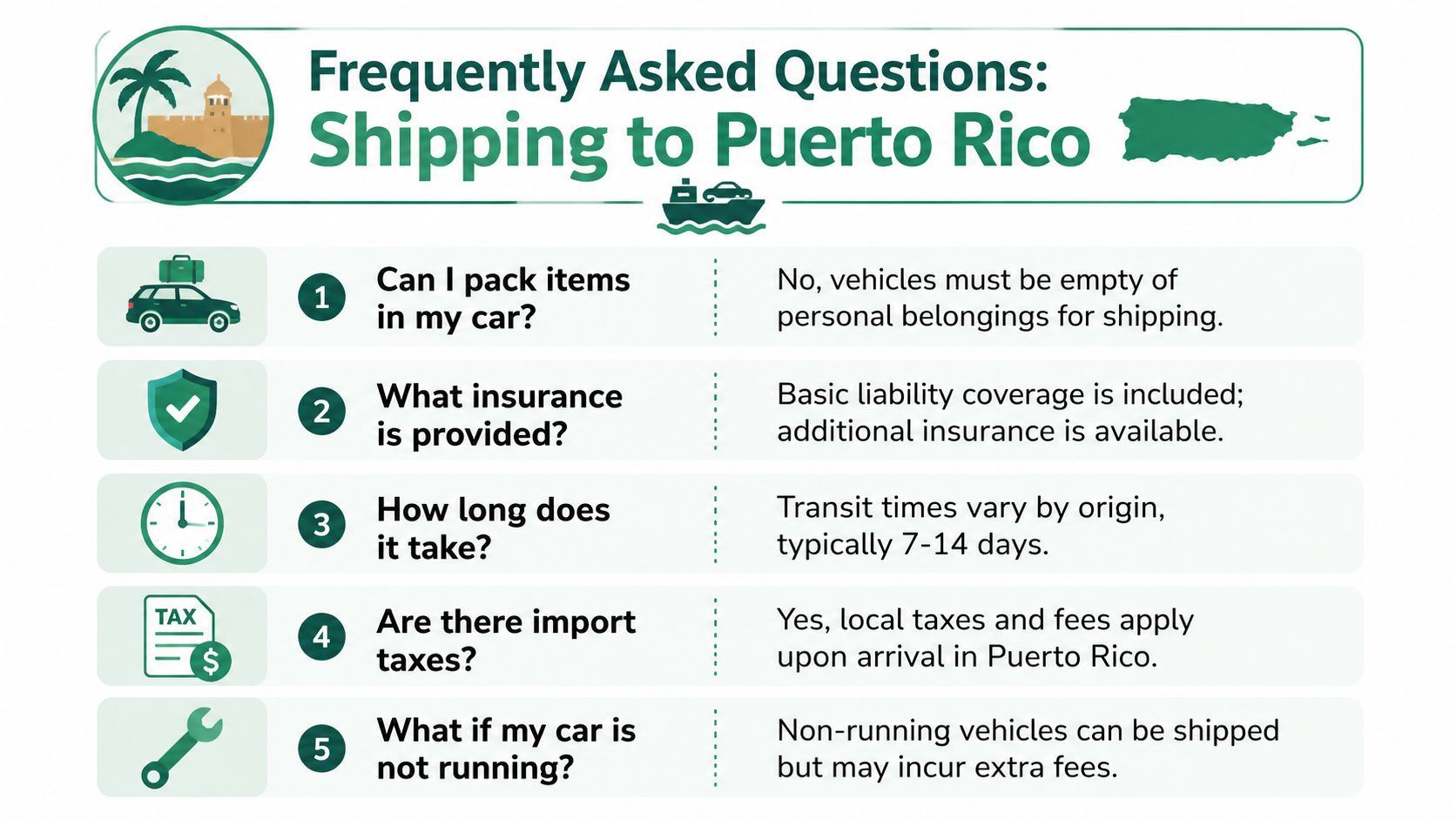
Can foreign ships go to Puerto Rico
Yes, foreign vessels can call at Puerto Rican ports. The confusion usually comes from the Jones Act, which restricts cargo moved between two U.S. ports to U.S.-flagged vessels. That distinction is explained clearly in this Jones Act overview focused on Puerto Rico.
For a car shipping customer, the practical takeaway is simple. If you're moving a vehicle from the U.S. mainland to Puerto Rico, you'll be using a compliant service arranged within that framework. You don't need to become a maritime policy expert to book correctly.
Can I leave personal items in the car
Usually, that's not the smart move, and many routes won't allow it. Ports and carriers want the vehicle prepared for transport, inspection, and handling without loose personal property complicating the file.
Keep the car as close to shipment-ready as possible. Remove valuables, loose electronics, important documents, and anything that could shift in transit. If you have an exception request, ask before booking, not at the port.
What if my car doesn't run
Non-running vehicles can often still be moved, but the process changes. The carrier and port need advance notice because inoperable vehicles may require different loading equipment, more time, and more careful scheduling.
This is one of the most common places where customers get into trouble by trying to simplify the truth. If the car has weak brakes, a dead battery, steering issues, or doesn't start reliably, say so up front. Accurate condition reporting gives you a real quote and a workable plan.
Some delays start with paperwork. Others start when a customer says a car runs and the port discovers it doesn't.
Do I need to drop the car at a port myself
Not always. Many customers start from inland cities, not coastal terminals. That's especially true for relocations from places like Dallas, Atlanta, Chicago, Phoenix, Los Angeles, Nashville, Denver, or major Northeast metros.
A full-service auto shipping arrangement can include the mainland transport leg before the ocean move. That matters because coordinating those legs separately leaves more room for timing gaps, missed cutoff windows, and communication problems between parties.
What kind of help actually makes the process easier
The most useful support usually isn't flashy. It's someone who can answer basic questions clearly, review your documents before dispatch, explain what the port will expect, and keep you from making preventable mistakes.
That human element matters even more when your move involves family deadlines, military reporting dates, school schedules, fleet timing, or bilingual coordination between mainland and Puerto Rico contacts. A U.S.-based English/Spanish agent with deep experience in auto transport logistics can make the process feel straightforward because they know where confusion usually starts.
For first-time shippers, that's often the difference between a stressful puzzle and a manageable checklist.
If you need help arranging a vehicle move between the mainland and Puerto Rico, National Car Transport offers U.S.-based auto shipping support for personal and commercial vehicles, including bilingual agent assistance, flat-rate pricing, and coordination for mainland pickup and island transport.