
Your move is booked, your flight is approaching, and the tracking update says your car has reached San Diego. You're ready to arrange pickup, but the vehicle still hasn't been released. A car can be physically in San Diego without being available to move, and that distinction can disrupt everything from a military relocation to a dealership delivery.
Shipping to San Diego starts with choosing the right transport method, but the handoffs matter just as much. Whether you're moving across the mainland, collecting an imported vehicle, or shipping between California and San Juan, Puerto Rico, you need to know who controls the next step before committing to a delivery date.
Table of Contents
- Shipping Options to San Diego Compared
- How Port Arrival Differs from Doorstep Delivery
- California Truck Rules That Affect Your Timeline
- Scenarios for Snowbirds, Movers, Dealers and Importers
- How to Prepare Your Car for San Diego Pickup
- Confirm Your Quote and Book Your San Diego Move
Shipping Options to San Diego Compared
Shipping methods for San Diego by handoff point
| Method | Where the Car Starts and Ends | Best For | What Changes the Timeline |
|---|---|---|---|
| Door-to-door open carrier | Your address to your address | Routine relocations, snowbirds, budget moves | Carrier route density and pickup window |
| Door-to-door enclosed carrier | Your address to your address | Classic, luxury and low-clearance vehicles | Fewer vehicles per load, so fewer dispatch slots |
| Port-to-door | San Diego terminal to your address | Imports, dealer stock, vehicles arriving by ship | Vessel discharge, customs release and terminal availability |
| Door-to-port | Your address to a port terminal | Vehicles already bound for ocean or island shipping | Terminal appointment times and cut-off times |
| Dealer or auction pickup | Auction or dealer lot to your address | Dealers, auction buyers and online purchases | Gate release and title paperwork |
Door-to-door open transport is the practical starting point for an ordinary sedan or SUV moving between mainland addresses. You're paying for transportation rather than an enclosed trailer's added protection. Door-to-door means the nearest safe, legal loading location, not a promise that a large truck can enter every apartment complex or narrow residential street.
Enclosed transport makes more sense for a restored classic, valuable finish, or vehicle with limited ground clearance. Confirm the loading equipment as well as the trailer type. An enclosed trailer alone doesn't establish whether its ramps will accommodate your car.
Match the service to the actual handoff
Port-to-door begins at a terminal, not when a vessel enters the harbor. The Port of San Diego's cargo guide identifies National City Marine Terminal as its specialized automotive facility, while Tenth Avenue Marine Terminal handles a broader cargo mix. Verify the actual terminal on the shipping documents rather than assuming either facility accepts your vehicle.
Door-to-port suits an island-bound shipment, but the truck appointment must work backward from the ocean carrier's receiving deadline. Dealer and auction pickups introduce another dependency: the seller must authorize collection before the driver arrives.
For Puerto Rico, our mainland process connects pickup with trucking to Jacksonville, Florida, followed by ocean transportation to San Juan. In the reverse direction, the mainland handoff connects with delivery to your address. A San Diego origin doesn't mean a direct sailing from San Diego to Puerto Rico.
Choose the appropriate row by answering:
- Ocean arrival: Is the car arriving by ship?
- Protection needs: Is it high-value or low-clearance?
- Pickup location: Is the starting point an address, seller's lot, or terminal?
How Port Arrival Differs from Doorstep Delivery
A vessel arrival update confirms a location milestone, not permission to collect your car. A driver sent too early can reach the gate without a releasable vehicle, leaving you to rearrange the trucking appointment.
The distinction matters during import surges. The San Diego Union-Tribune's port reporting recorded approximately 230,982 imported automobiles through August 2025, compared with 192,242 during the same period in 2024, and reported that port officials attributed longer dwell times to an influx of autos ahead of tariffs.
The handoffs follow this sequence:
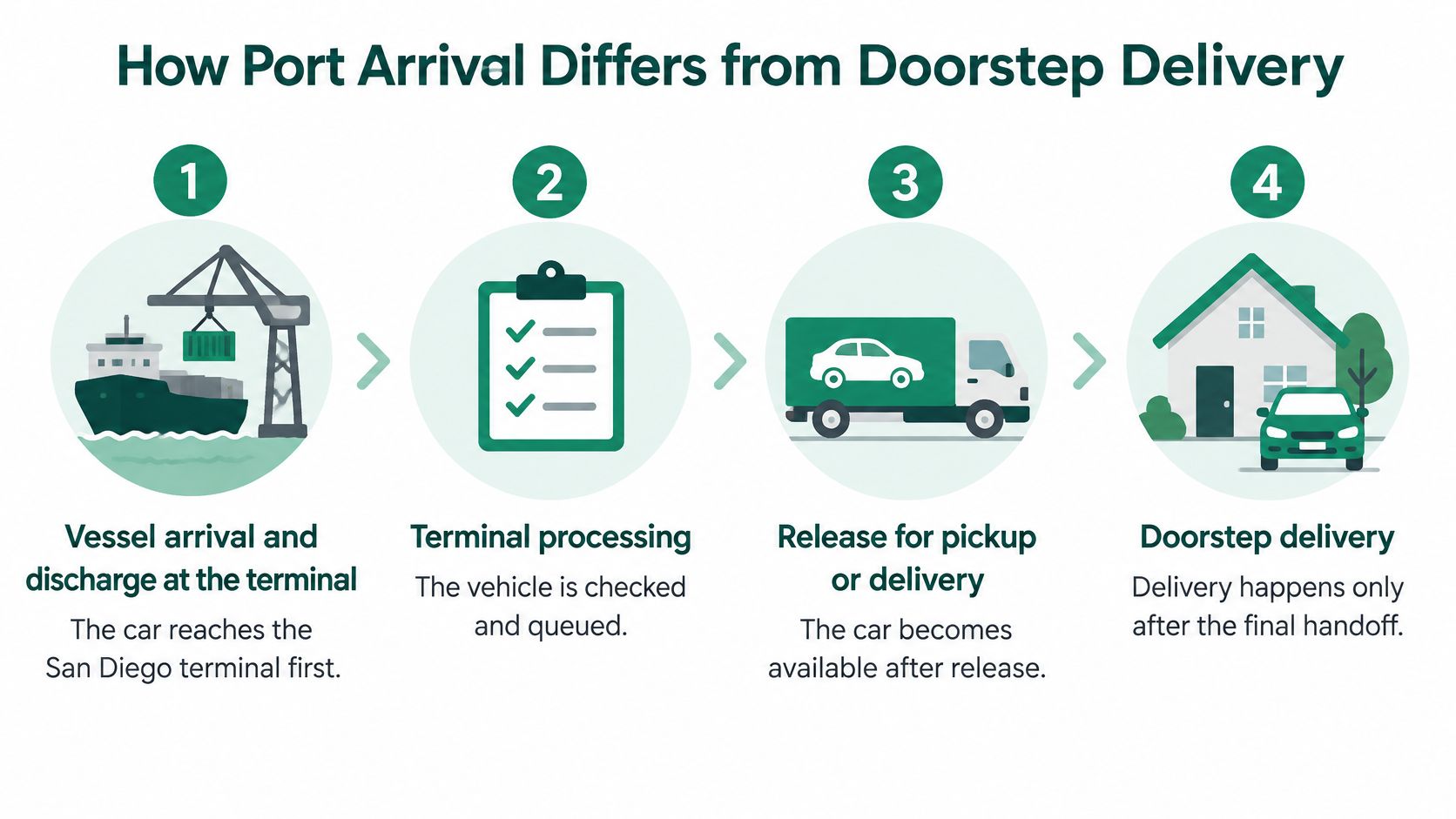
Who controls each release
Vessel arrival and discharge. The ocean carrier and terminal coordinate unloading. Your arrival notice doesn't establish that your particular vehicle has been discharged, checked, and entered into the terminal's available inventory.
Customs release and inspection. For an international import, the importer or consignee must ensure the necessary documents reach the customs broker or responsible filing party. Customs authorities control any inspection or customs hold; a trucking dispatcher can't override it.
Terminal availability and gate release. The terminal controls physical collection after applicable holds and release requirements are satisfied. Customs clearance and terminal release are separate confirmations.
Carrier dispatch. The transport coordinator assigns an eligible truck and arranges the terminal appointment. The driver needs usable collection instructions, not just a vessel name and estimated arrival.
Final delivery. The carrier coordinates the receiving appointment and a safe unloading location. For door-to-door auto transport, confirm the receiving contact can answer the driver and meet at an accessible location if necessary.
Practical rule: Treat vessel arrival, release, and delivery as separate milestones, each with its own confirmation.
A quoted delivery window assumes the preceding handoffs can happen. Missing consignee authorization, an inspection hold, or unavailable terminal appointments can prevent dispatch even when the truck route itself is straightforward.
Before authorizing collection:
- Get written release confirmation: Identify both customs status, where applicable, and terminal availability.
- Prepare consignee documents: Keep identification, authorization, and shipment references accessible before dispatch.
- Commit after release: Set the final delivery appointment once release and carrier availability are confirmed, rather than treating the ship's arrival as the delivery date.
California Truck Rules That Affect Your Timeline
Finding an available truck doesn't automatically mean that truck can collect your vehicle at a California port. Port access and equipment eligibility are separate from ordinary highway availability. A carrier accepting an inland move may need a different arrangement for a terminal pickup.
The SANDAG zero-emission freight white paper describes California's framework as of 2023, including generally requiring model-year-2010-or-newer engines and particulate-matter exhaust filters on most heavy trucks; it also describes a 2024 zero-emission requirement for newly registered drayage trucks and a 2035 target for all drayage trucks to operate with zero emissions. Those dates describe the paper's regulatory framework, not a substitute for checking current implementation and enforcement before dispatch.
Confirm the assigned equipment, not a general promise
Drayage is the short-haul movement associated with ports and intermodal facilities. Don't assume every auto transporter performs that work or that every vehicle shipment entering San Diego involves drayage.
The practical distinction is whether the assigned truck must enter a regulated terminal or collect from an inland location after a separate terminal transfer. That changes who needs access credentials, which equipment can perform the move, and how the appointments connect.
Carriers must maintain applicable equipment compliance and documentation. Charging or fueling availability, terminal access, and the need to coordinate a separate port transfer can also affect routing. For a fleet shipment or oversized vehicle, disclose the complete movement rather than describing it merely as a San Diego delivery.
Zero-emission requirements don't automatically make a shipment cheaper or faster. Equipment availability and infrastructure can introduce additional scheduling constraints.
Avoid choosing a carrier solely because its advertised pickup sounds earlier. An appointment that the assigned truck can legally and physically perform is more useful than an unverified promise.
Use this verification list before accepting a port-linked schedule:
- California authorization: Have the coordinator confirm that the assigned carrier is authorized and appropriately documented for California operations.
- Current drayage eligibility: Confirm whether the actual pickup requires drayage compliance and whether the assigned truck meets the applicable requirements.
- Schedule allowance: Leave room between the terminal collection window and any nonrefundable travel, warehouse appointment, or customer delivery commitment.
Scenarios for Snowbirds, Movers, Dealers and Importers
A snowbird leaving Chicago for San Diego has a different scheduling problem from a dealer collecting imported inventory. The first can usually choose a departure window; the second must work around a release it doesn't control.
These situations call for different booking decisions:
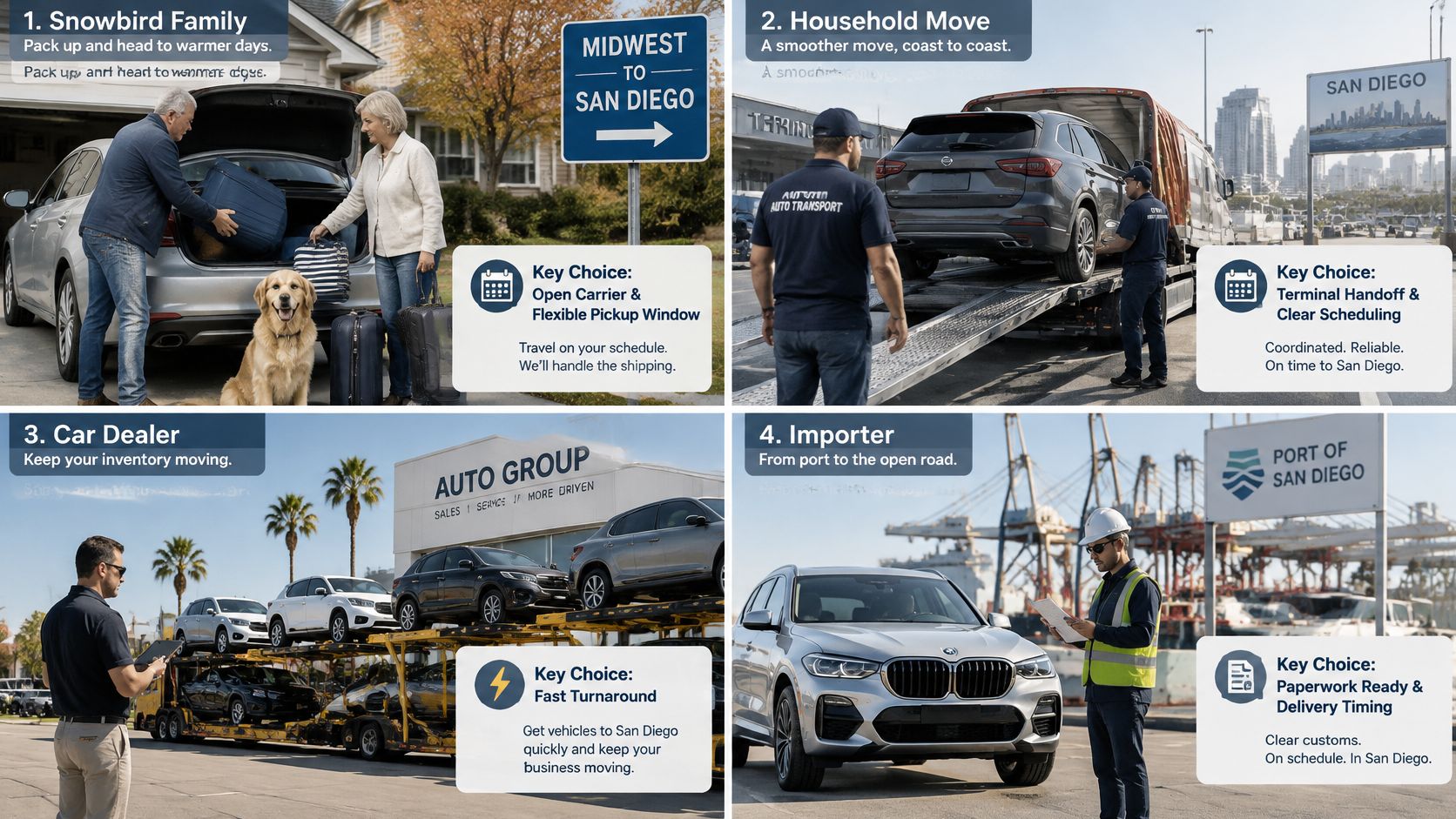
Personal moves and seasonal travel
The Midwest snowbird. Say you're leaving Minneapolis for the fall season but can depart before or after the weekend. An open carrier with a flexible pickup window gives the coordinator more routing options than a fixed collection hour. The decision is whether flexibility matters more than departure-day certainty.
The military family or student. A family reporting to San Diego should coordinate the receiving contact around the report date and keep orders, registration, and insurance accessible. A student should confirm campus loading access rather than using a dorm address without checking restrictions. The decision is who can receive the vehicle if the owner isn't available.
The classic-car owner. A restored car needs an enclosed trailer and a loading arrangement suitable for its clearance. The decision is to prioritize protection and suitable equipment over the earliest dispatch slot.
For a permanent California move, transport and registration are separate tasks. Fire House Smog's guide to California registration fees for out-of-state vehicles is a useful preparation resource, with final requirements confirmed through the appropriate state channels.
Commercial arrivals and Puerto Rico relocations
The dealer or online buyer. A dealer bringing stock through the port should have a receiving lot ready without committing its staff to an unconfirmed arrival. An auction buyer needs the lot's gate release, stock reference, and collection authorization. Our dealership transport coordination connects the seller, dispatcher, and receiving location rather than leaving the driver to resolve missing permissions.
The San Juan relocation. Mainland-to-Puerto Rico paperwork isn't identical to an international vehicle export: CBP's Puerto Rico vehicle guidance states that the federal 72-hour export ownership-documentation rule doesn't apply to these used-vehicle movements, but EEI filing through AES, including the VIN or PIN, and potential inspection still apply.
Military families should also distinguish shipping from island pickup obligations. Fort Buchanan's motor-vehicle guidance identifies proof of ACAA injury-liability coverage as necessary for military personnel collecting a vehicle from the Vehicle Processing Center.
The situation determines the method. The receiving schedule, season, and terminal readiness determine the workable date.
How to Prepare Your Car for San Diego Pickup
Prepare for an inspection and a controlled handoff, not merely the arrival of a truck. The driver needs to identify the vehicle, document its condition, and load it without having to solve an alarm, missing-key, or access problem.
Use this routine before the collection appointment:
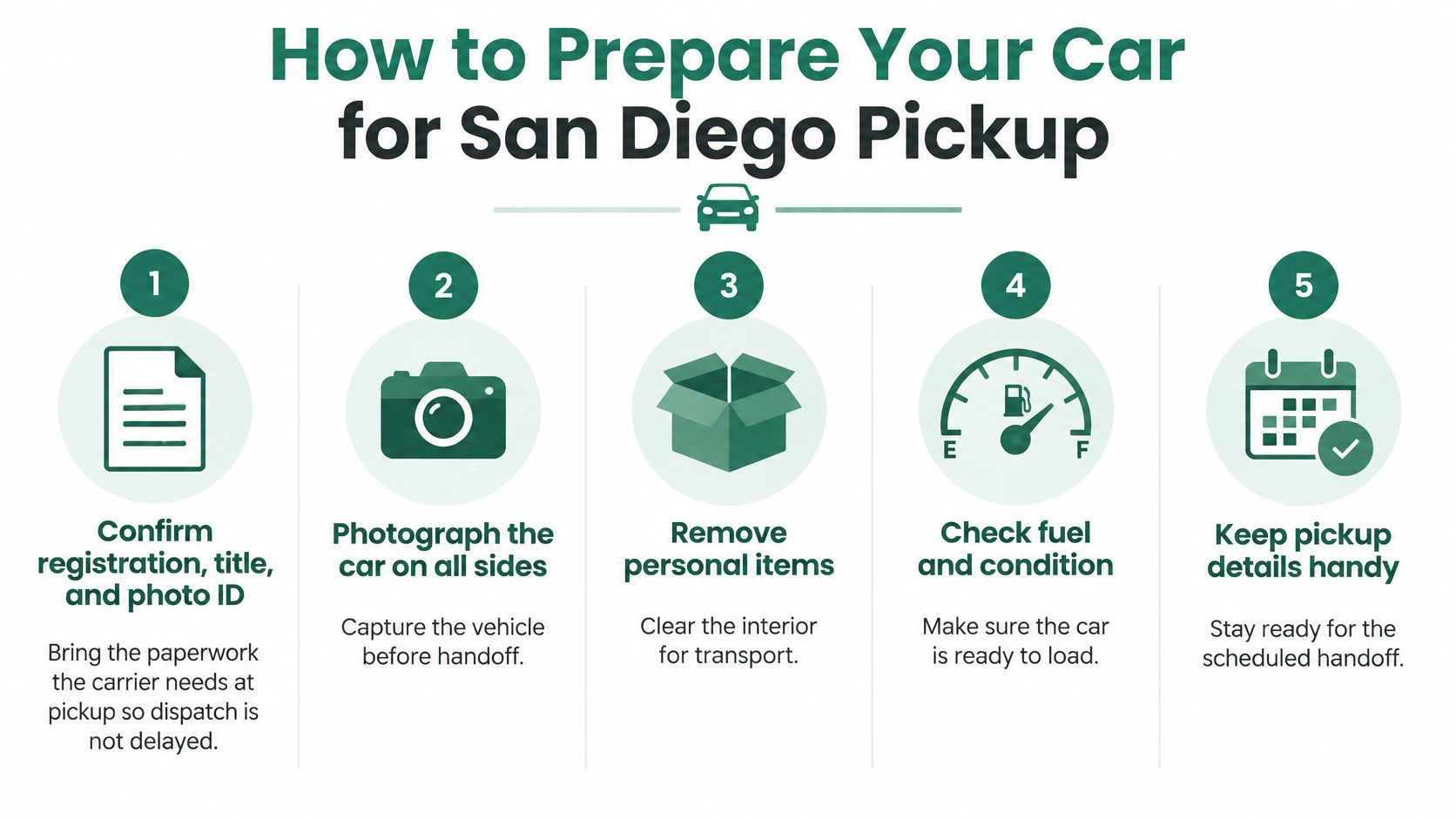
Complete the handoff routine
Confirm the required documents. Verify which registration, title, photo ID, and authorization documents apply to your specific move. An ordinary mainland address pickup isn't the same paperwork exercise as an auction release or ocean shipment, so don't leave original documents inside the car without explicit instructions.
Photograph the vehicle. Capture all sides, the roof where accessible, wheels, interior, and odometer, plus close-ups of existing damage. Clean enough road grime off the body to make scratches visible; SwiftJet's guide to protect your paint while washing offers useful washing preparation.
Remove belongings and loose accessories. Clear valuables, toll transponders, removable electronics, and unsecured items from the cabin. Don't assume vehicle cargo coverage protects personal belongings, and confirm any permitted contents before loading.
Leave a low fuel level. Around a quarter tank is a practical road-transport target unless the ocean carrier specifies otherwise. The car needs enough fuel for loading and unloading, not a full tank for the journey.
Disable alarms and supply working keys. Show the driver any unusual starting procedure, battery disconnect, or electronic parking-brake control. Keep your spare set with you and confirm that the supplied fob operates the vehicle.
Review the bill of lading. Compare the driver's condition notes with the car before signing, and make sure existing damage is recorded clearly. Retain a readable copy and use it when inspecting the vehicle at delivery.
Verify port collection details. For a terminal move, have the release reference, appointment instructions, gate hours, and authorized pickup party ready. Check that the shipment identifier matches the vehicle rather than relying on the owner's name alone.
Declare modifications before assignment
Tell the coordinator about lift kits, oversized tires, roof racks, lowered suspension, nonrunning condition, and aftermarket bodywork. Provide actual dimensions when modifications change the vehicle's height, width, length, or loading clearance.
A complete pickup means documents ready, condition recorded, keys handed over, and receiving instructions confirmed in writing. If something changes, especially whether the car runs or where it can be loaded, tell the coordinator before the driver arrives.
Confirm Your Quote and Book Your San Diego Move
Choose the transport method first, then compare quotes for that same scope. A low figure for address-to-address trucking isn't comparable to a quote that also includes ocean transportation and terminal handling.
Our continental U.S. estimate is $600 to $1,500, with 1 to 10 days of transit depending on distance. National Car Transport offers door-to-door, open, enclosed, same-day pickup, classic-car, dealership, Puerto Rico, Hawaii, and Alaska shipping services; same-day pickup remains subject to availability. Use our car shipping cost guide to frame the estimate, then obtain a route-specific written quote.
Make the scope explicit
- Method and route: Identify the pickup address or terminal, destination, trailer type, and vehicle condition.
- Handoff ownership: Name the party responsible for each terminal, seller, and receiving appointment.
- Carrier eligibility: Confirm appropriate California authorization and any applicable port-access requirements.
- Timing and preparation: Agree on a realistic collection window and complete the vehicle handoff routine.
- Included charges: Establish whether the quote covers trucking, ocean freight, and port handling where applicable.
For Puerto Rico, our flat rate covers trucking, the ocean sailing to San Juan, and port handling, without hidden fees. Island customers collect or drop off at the Port of San Juan, while the mainland portion connects with their address.
Mainland coverage without confusing the route
We coordinate across the 48 contiguous states, including these major-city origins and destinations:
| Region | State and city examples |
|---|---|
| Northeast | Connecticut, Bridgeport; Maine, Portland; Massachusetts, Boston; New Hampshire, Manchester; Rhode Island, Providence; Vermont, Burlington; New Jersey, Newark; New York, New York City; Pennsylvania, Philadelphia |
| South | Alabama, Birmingham; Arkansas, Little Rock; Delaware, Wilmington; Florida, Miami; Georgia, Atlanta; Kentucky, Louisville; Louisiana, New Orleans; Maryland, Baltimore; Mississippi, Jackson; North Carolina, Charlotte; Oklahoma, Oklahoma City; South Carolina, Charleston; Tennessee, Nashville; Texas, Houston; Virginia, Virginia Beach; West Virginia, Charleston |
| Midwest | Illinois, Chicago; Indiana, Indianapolis; Iowa, Des Moines; Kansas, Wichita; Michigan, Detroit; Minnesota, Minneapolis; Missouri, Kansas City; Nebraska, Omaha; North Dakota, Fargo; Ohio, Columbus; South Dakota, Sioux Falls; Wisconsin, Milwaukee |
| West | Arizona, Phoenix; California, San Diego and Los Angeles; Colorado, Denver; Idaho, Boise; Montana, Billings; Nevada, Las Vegas; New Mexico, Albuquerque; Oregon, Portland; Utah, Salt Lake City; Washington, Seattle; Wyoming, Cheyenne |
National Car Transport brings 25+ years of experience, an A+ BBB rating, and a network of 25,000+ vetted carriers. Our U.S.-based bilingual English/Spanish agents have over 20 years of auto transport logistics experience and can guide the details that make your shipment different, without making you coordinate every party yourself.
National Car Transport offers transparent flat-rate vehicle shipping to San Diego and coordinated mainland connections to and from San Juan, Puerto Rico. Visit National Car Transport to request a quote with your vehicle details, origin, destination, and pickup address or terminal, and let a U.S.-based bilingual advisor help you build a workable schedule.