

You've probably got two problems in front of you right now. The vehicle needs to get to Hawaii, and the clock doesn't care whether it's a family move, a military transfer, a snowbird return, or a dealership delivery. The hard part is that shipping to Hawaii isn't just “mainland transport with water in the middle.” It's a port-to-port system with real inspection steps, limited routing choices, and more ways for a shipment to slow down if the paperwork or handoff details are sloppy.
A good starting point is to understand the scale of the lane. Hawai'i's Marine Cargo Report shows that, on average, 12.4 million tons of maritime cargo moved into the state each year from 2001 to 2021, while only 1.6 million tons moved out each year, and 88.4% of total maritime cargo weight was inbound (Marine Cargo Report). That is why island transport works differently from a typical interstate run. If you need a place to compare a vehicle-related opportunity on the islands, you can also find Hawaii salvage auctions, which is useful context for buyers and dealers who work the market regularly.
Table of Contents
- Why Shipping a Vehicle to Hawaii Requires Careful Planning
- Choosing the Right Shipping Method for Your Vehicle
- Understanding Costs and What Drives Your Final Price
- Preparing Your Vehicle and Required Documentation
- Navigating the Pickup to Delivery Process
- Common Mistakes and How to Avoid Them
- Your Action Plan for a Successful Hawaii Vehicle Shipment
Why Shipping a Vehicle to Hawaii Requires Careful Planning
A customer calls, says the car is ready, and assumes the move will work like a California-to-Texas shipment. That assumption usually breaks the first time the route reaches the port. The mainland leg, the ocean sailing, the island terminal, and the final handoff all have to line up, and each step adds a chance for a delay if the vehicle isn't prepared correctly.
The route is built around a few gateways
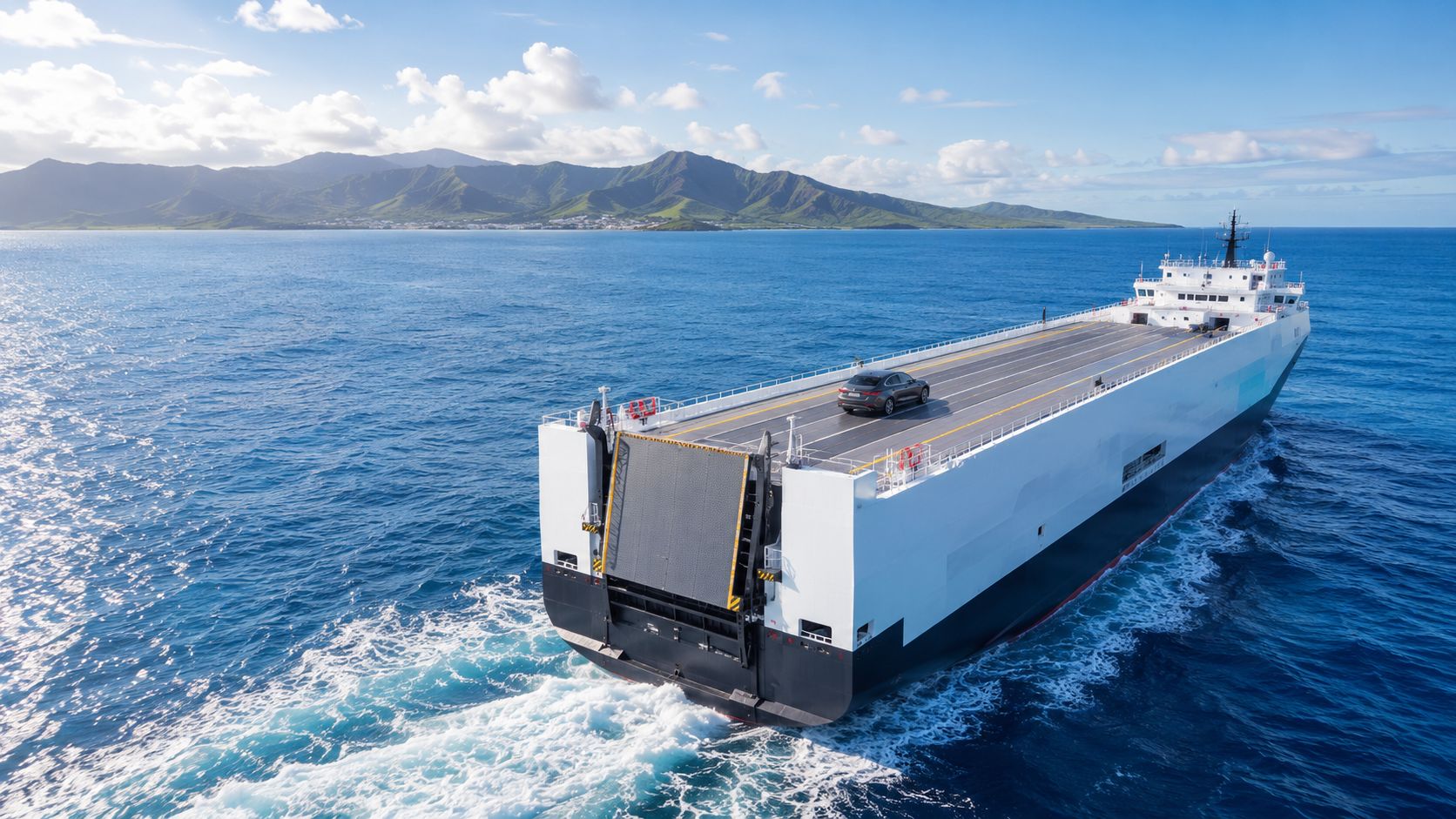
Hawai'i's freight system is concentrated in a small number of high-volume ports. The U.S. Department of Transportation freight tables show Honolulu at 14,274,405 tons total, including 12,903,023 tons of domestic tonnage, and Barbers Point at 8,670,956 tons total, including 6,575,240 tons of foreign import tonnage (DOT Hawaii freight tables). Honolulu also recorded 867,108 TEUs loaded, far above Kahului, Kawaihae, Nawiliwili, and Hilo in those tables.
That concentration matters in practice. It means vessel schedules, berth availability, and terminal handoffs carry more weight than they do on a mainland route with multiple alternate truck lanes. It also explains why a shipper can't treat every Hawaiian destination the same.
Practical rule: the island, not the quote, determines the real complexity. Oahu usually has the cleanest routing, while outer-island shipments often need an extra handoff after the ocean leg.
Outer-island delivery changes the whole job
The biggest gap in most guides is the difference between Oahu and the rest of the state. Delivery to Maui, Kauai, or the Big Island can require additional inter-island transfer planning, and that adds coordination risk. A booking that looks simple on paper can turn into a timing problem if someone leaves out the second leg.
That's also why a lot of generic advice fails. A mainland-style estimate sounds reassuring, but the route still depends on where the vehicle lands, who handles it at arrival, and whether the final delivery is port-to-port or arranged through a carrier network that can keep the handoffs tight. For buyers who are shopping island inventory, that same routing complexity is one reason services like National Car Transport matter, because the move has to be coordinated around the actual port path, not just the pickup zip code.
Choosing the Right Shipping Method for Your Vehicle
The right method depends on the vehicle, the value of the vehicle, and how much handling risk you can tolerate. Standard sedans, SUVs, and daily drivers usually don't need the same protection as a classic car, a specialty build, or a low-clearance vehicle. If you choose the wrong method, you either overpay or expose the vehicle to unnecessary touchpoints.
RoRo, container, and intermodal each solve a different problem
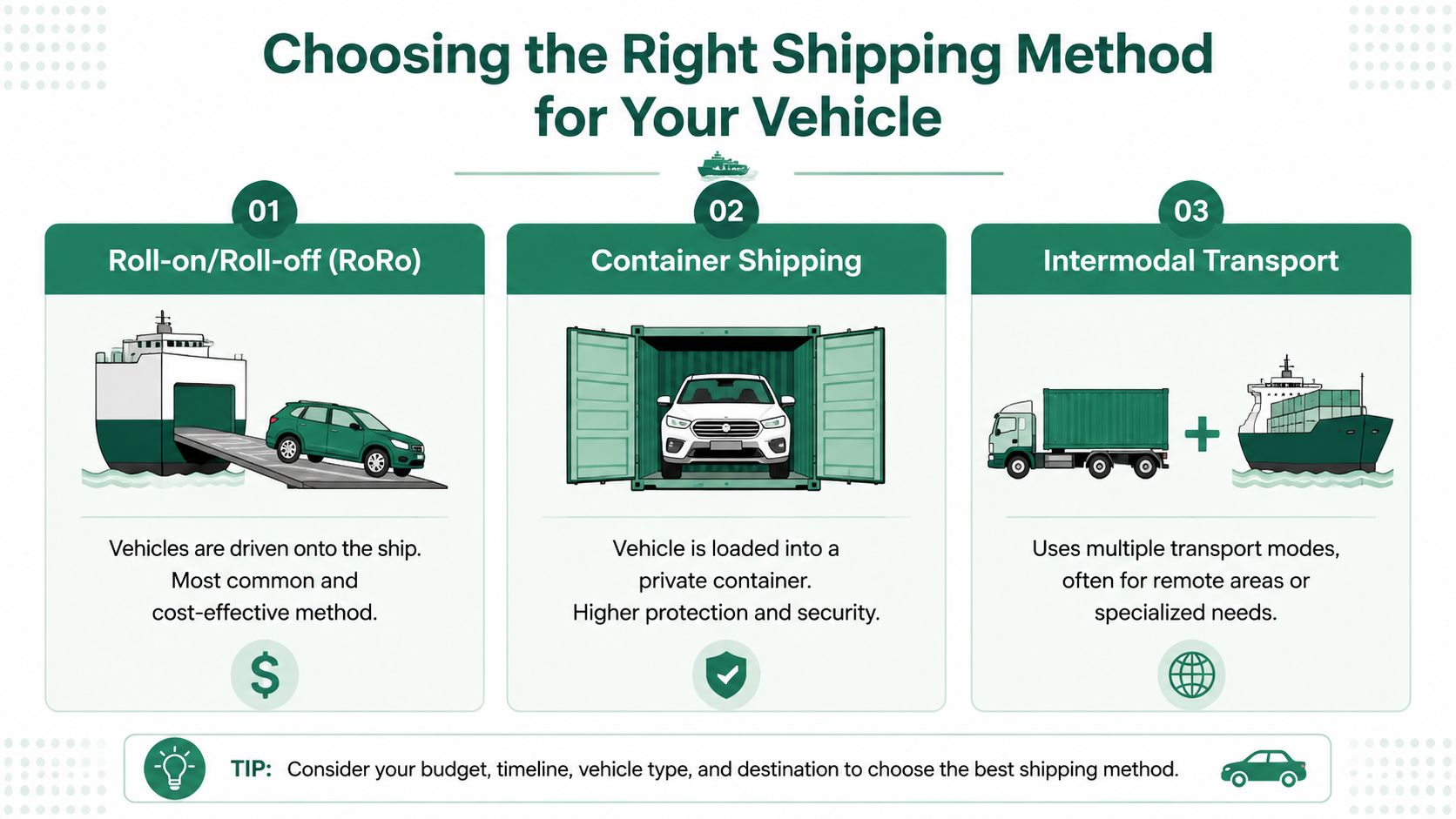
Roll-on/Roll-off, or RoRo, is the most common choice for standard vehicles because the car is driven onto the ship and off again at arrival. It's operationally straightforward and usually the most economical fit for ordinary daily drivers.
Container shipping adds a layer of protection because the vehicle rides inside a private container. That's the better choice when the vehicle is especially valuable, freshly restored, or needs more security from handling and exposure.
Intermodal transport fits more complicated routes. It combines transport modes, which is useful when the mainland origin, the port access, or the final delivery point isn't simple. That can make sense for specialized situations, but it's not the first choice for every move.
Match the method to the use case
A military family moving a reliable sedan usually wants a clean, predictable route and a simple handoff. A snowbird shipping a newer SUV may care more about balancing cost and convenience than about premium protection. A collector, on the other hand, often accepts more planning friction in exchange for better enclosure and fewer exposure points.
If you're comparing methods on the mainland side first, it helps to look at an open-car reference point like open car transport so you can separate the vehicle-handling issue from the ocean leg. That distinction matters because island shipping isn't one product. It's a sequence of transport decisions.
A good dispatcher doesn't just ask what car you have, they ask how much risk the route can absorb.
Understanding Costs and What Drives Your Final Price
Pricing for shipping to Hawaii is shaped by distance, origin port, vehicle size, method, and market conditions. A quote that looks low at first often leaves out the costs that show up later, such as handling, port access, or route changes. If you want a quote you can trust, it has to match the shipment's actual structure from the start.
A useful way to pressure-test pricing is to compare it with a published benchmark like car shipping cost estimates, then ask what parts of your move sit above or below that baseline. Hawaii shipments are rarely priced off the vehicle alone. They are priced off the route, the port pair, and the amount of terminal work needed to get the car on and off the water.
Published ocean ranges and where they start to move
For ocean freight, published 2025 cost ranges show a 20-foot container at $2,500–$5,500 and a 40-foot container at $5,000–$11,000, with the West Coast generally the cheapest origin because mainland-to-island freight usually routes through Pacific ports (FreightAmigo ocean freight guide). That gives you a usable starting point, but the final price still changes with access conditions, booking timing, and whether the shipment needs extra port work.
A separate industry guide says shippers should plan for seasonality, limited lift capacity, and a projection of a 12% increase in shipping-to-Hawaii costs in 2025 (FreightAmigo cost and carrier guide). I use that as a planning signal, not a fixed rule. Rates move, and island lanes feel those changes faster than dense mainland routes do.
What drives the quote
| Origin Region | Estimated Cost Range | Typical Transit Time |
|---|---|---|
| West Coast mainland | Lower end of ocean pricing, especially when routing from Pacific ports | Usually the shortest ocean transit window |
| Central mainland | Higher than West Coast because the vehicle has to reach a departure port first | Longer because of inland movement plus ocean leg |
| East Coast mainland | Usually the most expensive origin profile | Longest overall routing chain |
Distance is only part of the bill. A lower inland leg, easier port access, and a straightforward handoff can keep costs in check, while added drayage, storage, or rebooking pushes the quote up fast.
Transparency matters more than a low teaser rate. A flat-rate quote is easier to verify than a price that changes after port handling is added.
That's why a clear carrier model helps. National Car Transport offers flat-rate pricing and a quote structure meant to avoid surprise add-ons once the route is defined. If you're comparing policy-level protection for a high-value move, Select Insurance Group, Inc. relocation cover is a useful place to review how move-related coverage is usually discussed before you lock anything in.
Preparing Your Vehicle and Required Documentation
A lot of Hawaii shipment problems start before the vehicle ever reaches the port. The car shows up with a full tank, loose personal items, or missing documents, and the handoff stalls. That delay is avoidable if the vehicle is treated like a port shipment, not a driveway pickup.
Get the vehicle ready before pickup
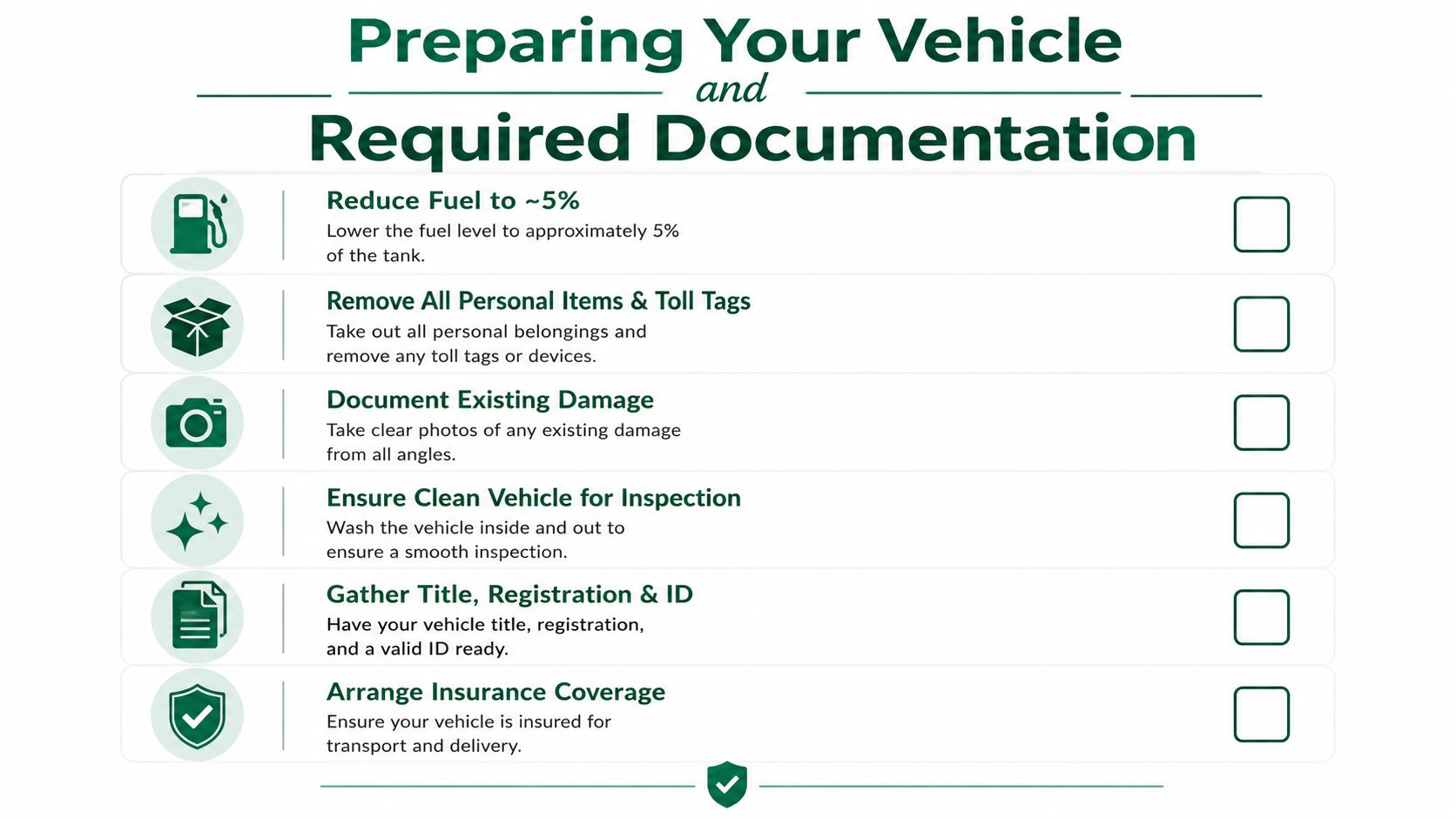
Start with the fuel level. For Hawaii auto transport, the practical benchmark is to reduce fuel to about 5% capacity so the vehicle is safer and lighter during loading and handling (Move.org vehicle shipping guide). Remove all personal belongings, toll tags, and loose accessories. A clean cabin and trunk make the inspection easier and reduce the chance of something getting flagged at the terminal.
Take photos of the exterior, wheels, roofline, and interior before the carrier arrives. Those images matter if you need to compare pickup condition against delivery condition. If the car has an alarm, disable it or make sure the carrier knows how to shut it off without triggering repeated alerts.
Gather the paperwork that stops the delay
You should have the title, registration, and photo ID ready before the vehicle is scheduled. If a lender still holds the title, get the lien holder authorization sorted out early. The more time the carrier spends waiting on documents, the more likely the shipment misses a clean handoff window.
Hawai'i also has agricultural biosecurity rules that affect what can travel with the car. Plant material must be declared, presented for inspection, and packaged so it's free of soil, insect pests, and disease (Hawai'i Plant Quarantine travel and shipping information). Parcels containing plant material must be labeled on the outside with wording such as “Contains Agricultural Material – May Be Opened for Inspection” and include a manifest.
Practical rule: if you wouldn't want a port inspector to question it, don't leave it in the vehicle.
That's also why the pickup inspection report matters so much. It creates the condition record that protects the claim process if damage shows up at delivery. A clean inspection at origin is one of the few things that can save you a lot of arguments later.
Navigating the Pickup to Delivery Process
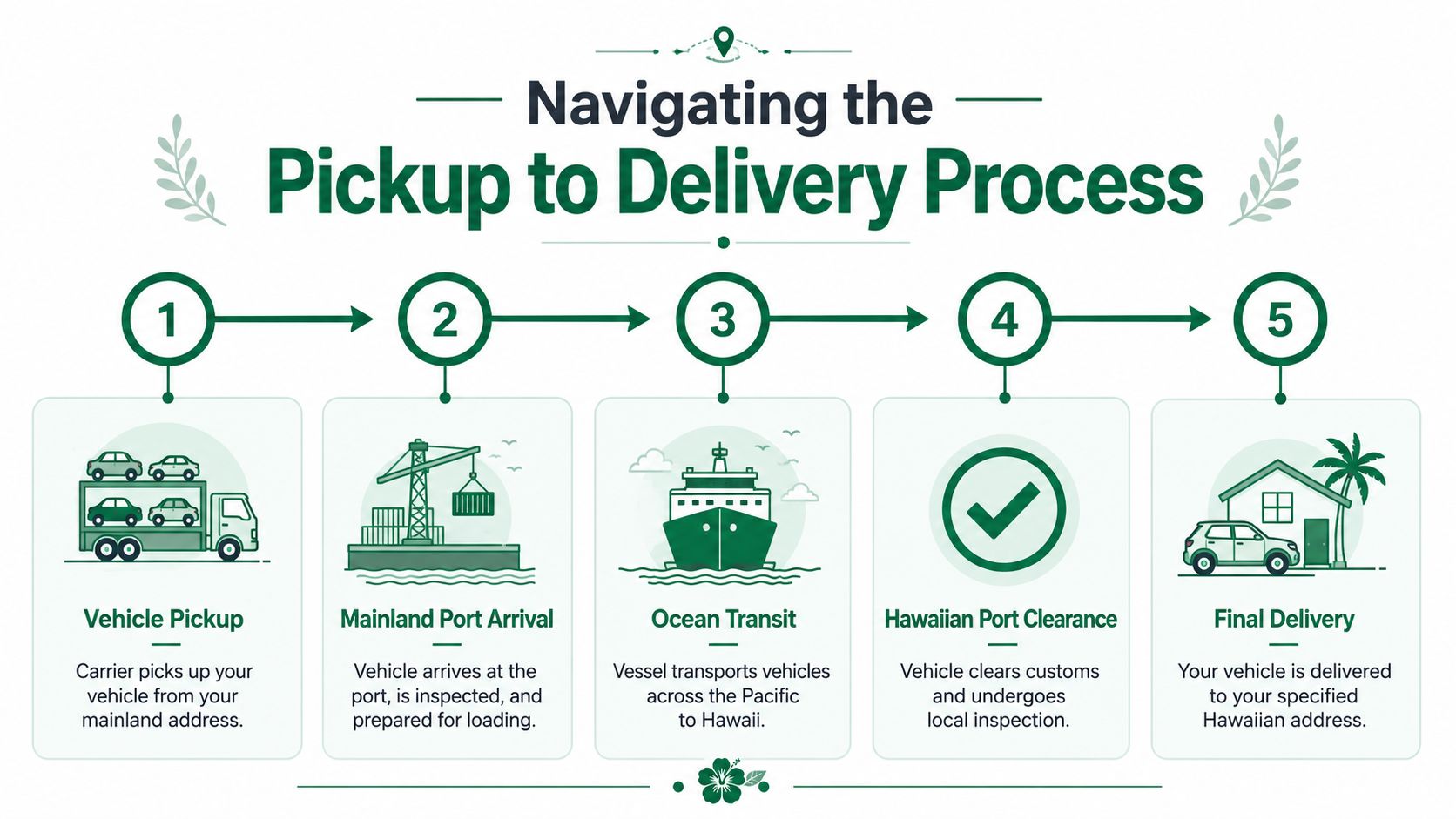
The process is more mechanical than most first-time shippers expect. A mainland carrier picks up the vehicle, the vehicle moves to the departure port, it sails to Hawai'i, and then it clears the island-side handoff before final delivery can happen. Each stage has its own failure points, and the weak link usually isn't the ocean crossing. It's the timing around the handoffs.
Pickup and port arrival
After the shipment is booked, the carrier picks up the vehicle and starts the mainland leg. For car shipments to Hawai'i, sources note that pickup is often scheduled within about a one-week window after the shipment date is set (Move.org vehicle shipping guide). That timing depends on the market and the route, so it's smart to leave buffer time instead of assuming a same-week handoff.
At the port, the vehicle is checked again before loading. The inspection process is there for a reason. Any mismatch between pickup condition and port condition can complicate the final delivery record.
Ocean transit and island clearance
Once the vessel departs, the car is no longer in a trucking lane where updates happen every few hours. The ocean leg is slower and more rigid, so shipment timing depends on sailing schedules and terminal processing rather than freeway distance. If you're shipping to Oahu, the main port path is usually simpler. If you're shipping to another island, the routing can include another transfer after arrival.
For a direct door-based setup, a dedicated route like door-to-door auto transport is often easier to coordinate on the mainland side, because pickup and final delivery stay tied to a single dispatch plan. That doesn't remove the island port step, but it does reduce confusion on the domestic legs.
Final delivery
At delivery, inspect the vehicle immediately and compare it against the pickup report. If there's a claim issue, that condition report is what keeps the conversation focused on facts instead of memory. A smooth Hawaii shipment feels boring at delivery, and boring is what you want.
Common Mistakes and How to Avoid Them
The biggest mistakes are usually caused by treating Hawaii like an ordinary mainland lane. That creates bad assumptions about timing, carrier choice, and final cost. It also produces avoidable frustration when the vehicle lands on the wrong side of a routing expectation.
The outer-island assumption
People often book as if “Hawaii” means one uniform delivery zone. It doesn't. Outer-island delivery can require additional transfer steps, and those handoffs create different timing and coordination risks than an Oahu delivery. If the quote doesn't account for the island, the schedule probably doesn't either.
The cheapest-quote trap
A low quote looks good until you realize the route needs extra handling or the carrier can't support the exact island path. Recent industry coverage says Hawaii shipping is constrained by limited carrier options, capacity limits, and price rigidity, so rate shopping alone isn't a strategy (Supply Chain Brain coverage on Hawaii shipping). In this market, a cheap quote without route clarity is a setup for rebooking.
The wrong booking choice doesn't save money, it just moves the cost into delays and rework.
The paperwork and cargo mistakes
Leaving personal items in the car is a classic error. So is ignoring agricultural restrictions or failing to line up the title and ID before pickup. If the vehicle is being shipped from the mainland with anything that may trigger inspection questions, you want the issue resolved before the carrier arrives, not at the terminal window.
The scheduling mistake
Booking too close to the desired departure date is a real problem in a lane with limited options. The smarter move is to secure the route early, then let the carrier match the timing to the port schedule. That's where a dedicated dispatch team helps, because it keeps the shipment from becoming a last-minute scramble.
Your Action Plan for a Successful Hawaii Vehicle Shipment
The cleanest Hawaii shipment starts with the route, not the rate. Decide whether the vehicle needs open transport, enclosed protection, or a more complex routing setup, then verify the mainland departure port, island destination, and delivery method. After that, prepare the car, gather the paperwork, and give the carrier enough lead time to line up the handoff.
Established carriers matter here because the shipment has more moving parts than a normal interstate move. National Car Transport brings 25+ years of experience, an A+ BBB rating, transparent flat-rate pricing, and a network of 25,000+ vetted carriers. The company also uses bilingual agents with 20+ years of auto transport logistics experience, which helps when a customer needs a shipment explained clearly and handled without guesswork.
The best results come from realistic expectations and tight coordination. When the advisor knows the route, the port, and the vehicle details, the move gets simpler fast.
If you're planning a vehicle shipment to Hawaii and want the route handled with clear pricing, careful coordination, and real port experience, visit National Car Transport to request a quote. They can help you line up the right transport method, prepare the paperwork, and keep the shipment on track from pickup to final delivery.