
A snowbird may be planning a winter in Arizona while their sedan stays behind, or a military family may have orders to move before they've decided how to get both cars to their new home. Shipping for cars lets the vehicle travel by truck or ship while its owner flies, drives separately, or remains where they are. The practical challenge is choosing the right service and understanding who's responsible for the vehicle, paperwork, timing, and cost at each handoff.
This guide walks through those decisions for mainland routes and shipments to or from Puerto Rico. If you're preparing a car for a change in weather or a long period away, Pete Nelson Automotive's seasonal car preparation guide offers useful maintenance reminders to consider before arranging transport.
Table of Contents
- How Car Shipping Works and Who Needs It
- Open, Enclosed, and Ocean Shipping Compared
- What Drives the Cost of Shipping a Car
- Insurance and Protection for Your Vehicle
- Timelines and Pickup and Delivery Options
- Shipping a Car to or from Puerto Rico
- How to Choose a Carrier and Book Your Shipment
How Car Shipping Works and Who Needs It
A service member receives relocation orders, but the family needs the car at the new duty station after the move. A student heads to campus without wanting to drive across the country. A buyer finds a car online, but the vehicle is hundreds of miles away. In each case, auto transport moves the vehicle separately from its owner.
The process starts with the vehicle details, pickup and delivery locations, and preferred dates. A provider uses those details to quote the shipment and, if you book, match it with a carrier. The carrier schedules pickup, inspects the vehicle, transports it, and records its condition again at delivery. You'll need to be available, or arrange for someone you trust to handle the handoffs.
Shipping can mean a truck journey within the mainland, an ocean voyage for an island route, or both. A mainland-to-San Juan shipment, for example, involves port and ocean handling in addition to trucking. The steps and documents can differ from a move between two mainland addresses, so it helps to clarify the route before comparing prices.
Who uses auto transport
People ship cars for many reasons: individuals relocating within the mainland or to Puerto Rico, snowbirds, military families, students, classic-car owners, dealerships, auctions, businesses, and online vehicle buyers. The right arrangement depends on whether the car runs, its value and dimensions, how flexible the dates are, and whether it must cross water.
A quote isn't the whole agreement. The sales contract, transport booking, condition report, and delivery records all help establish what was promised and who is responsible at each point. The following choices can help you compare services and identify what to confirm before payment.
Open, Enclosed, and Ocean Shipping Compared
Open transport is the familiar option: a car rides on an open multi-car trailer, much like furniture sharing space on a moving truck. The vehicle is exposed to ordinary road and weather conditions. For many everyday cars, it's a practical way to arrange mainland shipping.
Enclosed transport carries vehicles inside a covered trailer. That barrier can help shield paint and trim from weather and road debris, making it worth considering for classic, luxury, exotic, or low-clearance vehicles. It doesn't remove the need to check loading procedures, securement, or insurance terms. If you're moving a collector vehicle, compare the service details with National Car Transport's classic car shipping information.
Ocean transport is the practical connection for island destinations. With roll-on/roll-off, or ro-ro, service, vehicles are driven or pulled onto internal ship decks rather than packed individually into containers. Ro-ro vessels are designed for this work, and purpose-built vehicle carriers move cars, trucks, buses, and other vehicles. Container shipping is another possible arrangement, depending on the route, vehicle, and service offered.
The U.S. supply chain shows why these journeys involve more than finished cars. In 2023, 54% of U.S. imports of motor vehicles and parts arrived through seaports, representing about $185.3 billion in trade and 15.3 billion kilograms of shipping weight, according to a U.S. Department of Transportation supply-chain analysis. A port may handle engines, electronics, tires, and other components as well as vehicles, then connect them to inland rail or truck routes.
| Service Type | Best Fit | Main Trade-Off |
|---|---|---|
| Open truck transport | Everyday vehicles traveling by road | The vehicle is exposed to weather and road conditions |
| Enclosed truck transport | Vehicles needing added protection during road transport | Availability and price can differ from open service |
| Ocean, including ro-ro | Island routes and other journeys requiring sea transport | Port handling and sailing add coordination steps |
| Container shipping | Shipments where a container arrangement suits the vehicle or route | Container availability and handling must be confirmed |
For island planning, review the route details for Hawaii car shipping. The same basic questions apply to an ocean move: where the vehicle enters the port process, what service includes, and who handles each transfer.
What Drives the Cost of Shipping a Car
A car's shipping price reflects more than the miles between two addresses. Think of the carrier as a moving truck with limited room and weight capacity. A vehicle takes up deck space, and a larger or heavier vehicle can affect how the carrier loads the rest of its shipment.
Distance and route matter, but so does the route's structure. A mainland trip between two cities is different from a journey that includes an ocean leg, port handling, and an inland truck connection. Exact pickup and delivery locations also matter. A major urban address, a rural road, and a port terminal may involve different access and coordination needs.
Vehicle and service details
Vehicle dimensions and weight help determine what equipment can carry it. An electric vehicle may weigh more than a comparable gasoline car, which can affect how many vehicles fit within a carrier's capacity and how a provider matches the shipment. That can influence scheduling; it doesn't automatically mean a carrier is providing poor service. Tell the provider the exact model and disclose modifications or damage that could affect loading.
Service type is another factor. Open and enclosed transport use different equipment and offer different levels of exposure protection. If you're comparing them, ask for quotes based on the same route, vehicle details, and pickup window. A price comparison is only useful when both quotes describe the same job.
Ask what the quoted price includes. Confirm whether the amount covers the route and service you requested, and ask what changes could affect it before dispatch.
A transparent flat-rate quote can make comparisons easier, especially when the provider explains any conditions and doesn't charge upfront before a carrier is matched. National Car Transport describes its pricing as flat-rate, with no upfront charge until a carrier is matched. Don't rely on the headline figure alone. Check whether the pickup location, delivery point, operating condition, and any port steps match your actual shipment.
Insurance and Protection for Your Vehicle
A transport quote and a vehicle sales contract do different jobs. The quote describes the shipping arrangement. The sales agreement may say who must arrange or pay for transport, when delivery is due, and who bears the risk of a delay. That distinction matters when a vehicle is bought online: a low shipping price won't settle a dispute about a seller's delivery promise.
The Federal Trade Commission announced more than $934,000 in refunds in March 2025 for consumers harmed by Vroom's failed delivery promises. The agency alleged that Vroom misrepresented delivery timing, failed to obtain consent to shipment delays, and didn't promptly refund buyers when vehicles weren't delivered as promised. The FTC announcement about the Vroom refunds is a reminder to get delivery terms and remedies in writing before paying.
Build a clear condition record
At pickup, the bill of lading records the vehicle's condition and documents the transport handoff. Review it with the driver, point out existing marks, and keep a copy. Take clear photos from multiple angles before loading, then compare the vehicle with those records at delivery. If you notice new damage, note it on the delivery paperwork before signing and contact the appropriate party promptly.
Cargo insurance terms vary. Ask what the policy covers, what it excludes, and how to report a claim. Don't assume personal belongings inside the car are covered or that every type of damage qualifies. National Car Transport says shipments are insured and handled by vetted, licensed, and bonded drivers; ask for the specific coverage terms that apply to your shipment.
For owners focused on keeping paint in good condition, APEX NANO - Titan Coatings' paint protection guide offers care considerations beyond the transport paperwork.
Before payment, ask:
- Who arranged transport? Confirm whether the seller, buyer, broker, or carrier made the booking.
- Who bears delay risk? Check the sales contract and the written transport terms.
- What does insurance exclude? Request the applicable coverage details.
- What happens if the promised window is missed? Get the remedy and contact process in writing.
Timelines and Pickup and Delivery Options
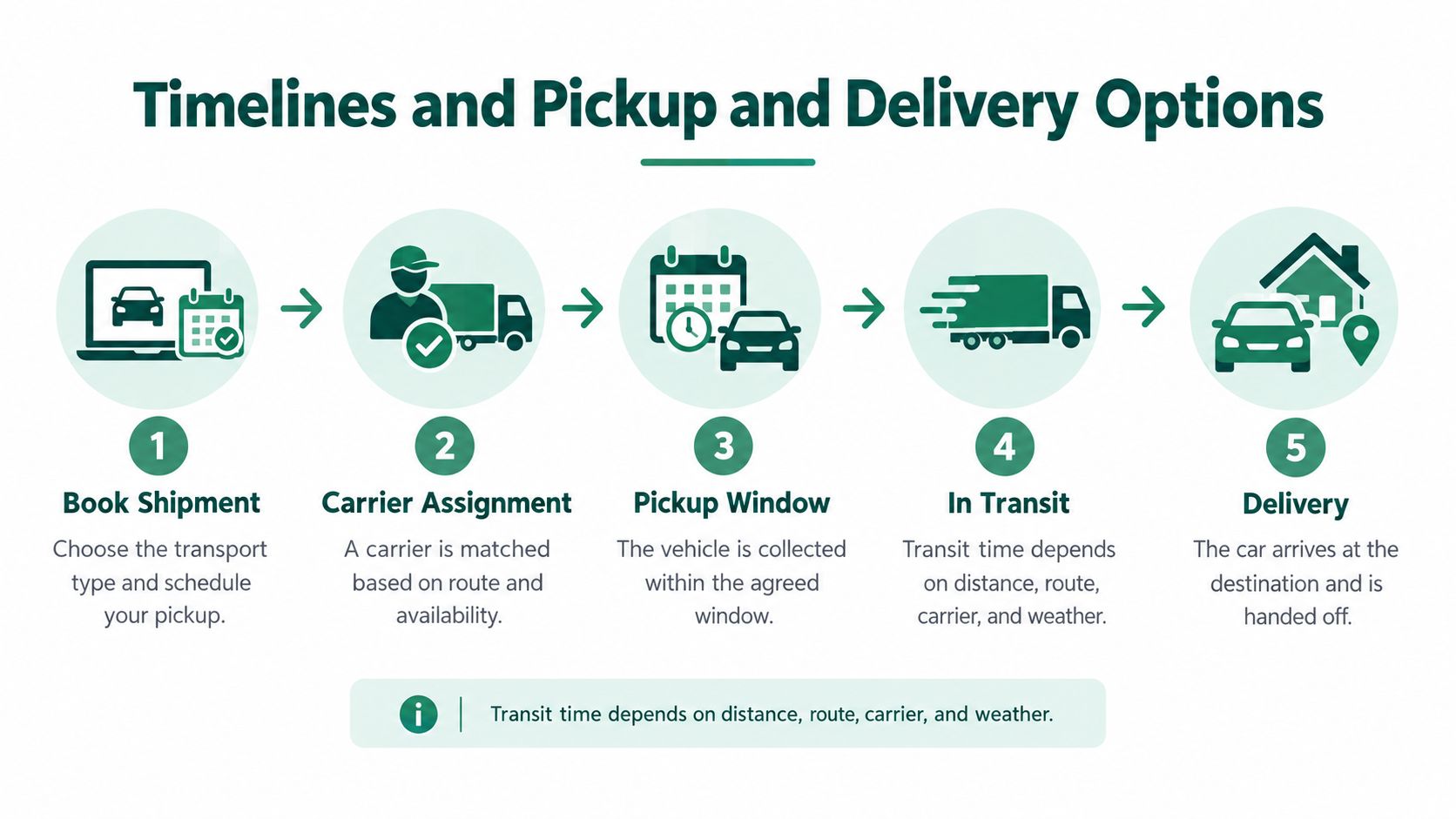
A transport window isn't automatically a guaranteed delivery date. The schedule depends on distance, route, carrier availability, service type, and, for ocean shipments, port and sailing coordination. Build in flexibility rather than arranging travel or a move around an unconfirmed arrival day.
Follow the shipment from pickup to delivery
First, confirm the booking details. Make sure the vehicle, addresses, service type, and pickup window match what you requested. Clarify who will be present at pickup and who can accept delivery.
At pickup, inspect and document the car. Walk around it with the driver and make sure existing marks are recorded on the bill of lading. Remove personal items unless the provider has expressly confirmed they're allowed and explained how they're handled.
During transit, follow the agreed communication process. Ask who will provide status updates and how to reach them if your plans change. For door-to-door transport, the truck comes as close as safe and accessible to the addresses you provide. Narrow streets or access limits may require a nearby meeting point. You can compare the details of door-to-door auto transport before deciding whether that arrangement fits your pickup and delivery locations.
Door-to-port service takes the vehicle to the departure port, while port-to-door service begins with the vehicle at the destination port. A mainland-to-island move may use either option or a combination. The ocean leg adds handoffs and port procedures, so ask who coordinates them and what updates you'll receive.
Leave room for changes
Plan around your relocation date by leaving a buffer between the expected delivery window and any appointment that depends on the car. National Car Transport says same-day pickup is often available and service runs year-round, but availability and timing should be confirmed for the specific route.
Federal cargo-securement rules require the securement system to resist forces equivalent to 0.8 g of forward deceleration and 0.5 g of rearward acceleration. The FMCSA cargo-securement rules explain why professional carriers use appropriate tiedowns and attachment points rather than relying on a parking brake or transmission lock alone.
This video offers another view of the vehicle-shipping process:
Shipping a Car to or from Puerto Rico
A mainland-to-San Juan shipment usually combines truck transport to an ocean port, a sailing, and port handling. Depending on the arrangement, you may choose door-to-port service, port-to-door service, or a shipment coordinated across both the mainland and island portions of the route. Ask which party handles each leg and which documents must be ready before the vehicle reaches the port.
For a military family relocating to San Juan, the practical first step is to confirm the destination, desired pickup window, and who can hand over and receive the vehicle. The family should also ask whether the move is a domestic mainland-to-Puerto Rico shipment or involves a vehicle with foreign-origin or foreign-held status. Those details affect which paperwork questions need to be settled before booking.
A dealership moving inventory has a different coordination challenge. It may need to align multiple vehicles with port receiving, internal inventory records, and the timing of sales. The dealership should make sure the VIN or PIN and the shipping documents are accurate, and clarify who is responsible for the vehicle at each handoff.
Understand the paperwork boundary
For used, self-propelled vehicles moving between the continental United States and Puerto Rico, U.S. Customs and Border Protection says the movement isn't an export under 19 CFR 192.2. Electronic Export Information is still required through the Automated Export System, and the VIN or PIN must be entered. CBP says the title state and title number aren't required for that filing. See the agency's Puerto Rico vehicle-movement guidance and confirm the documents needed for your specific shipment before delivery to the port.
That domestic movement is different from importing a foreign-origin vehicle into the United States. If the vehicle's origin, prior status, or compliance is unclear, contact the Area Port of San Juan or an import specialist for guidance. A carrier can move a vehicle, but that doesn't by itself resolve customs, safety, emissions, or duty requirements that may apply to an import.
How to Choose a Carrier and Book Your Shipment
Start with verifiable details, not the lowest number on a screen. Check whether the provider and carrier are properly authorized for the work, ask what insurance applies, and read recent customer feedback. Find out whether the company operates its own trucks or arranges transport through a carrier network. Neither arrangement answers every question by itself, so focus on who will handle your shipment and how you'll receive updates.
The service should fit the vehicle and route you've described. Confirm the equipment, loading plan, pickup window, and delivery arrangement. For an ocean route, ask who coordinates port handling and what paperwork must be submitted. Then compare written quotes that use the same vehicle details and locations, and check the cancellation, payment, delay, and damage procedures before committing.
National Car Transport is a U.S.-based option for vehicle moves across the mainland and to or from Puerto Rico. The company describes its service as using a network of vetted, licensed, and bonded carriers, with flat-rate pricing and no upfront charges until a carrier is matched. It also states that it has more than 25 years of experience, an A+ BBB rating, and a network of more than 25,000 carriers. Those are company-provided details, so you should still verify the terms that apply to your own booking.
Its U.S.-based agents speak English and Spanish and have over 20 years of experience in auto transport logistics, according to the company. They coordinate scheduling and shipment updates. That kind of guidance can help when a shipment involves a seller, buyer, carrier, and port, but no two vehicle moves are alike. Ask your agent to explain your specific handoffs and make the process clear before you book.
Gather the vehicle's make, model, dimensions if available, operating condition, pickup and delivery addresses, preferred dates, and any relevant title or registration documents. Then request a free quote and compare its written terms with the checklist above.
National Car Transport arranges mainland and Puerto Rico vehicle shipping, with open, enclosed, and ocean transport options and shipment coordination. If you're ready to compare a route and clarify the paperwork and handoffs, visit National Car Transport with your vehicle details and preferred dates.