

You're probably dealing with one of two situations right now. You're moving from Texas to California and trying to reduce the number of things you have to do yourself, or you bought a vehicle from out of state and need a safe way to get it home without turning the trip into a multi-day drive.
That's where shipping a car starts to make sense. This route is busy, familiar to carriers, and straightforward when the details are handled correctly. It also has a few pressure points that first-time customers usually don't hear about until they've already booked, especially the pickup window, changing quote levels, and oversize vehicle issues.
If you're shipping within the mainland, arranging transport to another state, or coordinating a move that also connects with Puerto Rico service through San Juan, the same rule applies: the shipment goes smoother when an experienced agent handles the timing, paperwork, and carrier fit. Not one vehicle transport is alike. People shipping family sedans, dealership inventory, student vehicles, snowbird cars, military PCS units, and collector cars all need different handling. That's why many customers prefer working with bilingual English and Spanish agents based in the USA who've spent over 20 years in auto transport logistics and know how to keep the process simple and quick.
Table of Contents
- Your Guide to Shipping a Car from Texas to California
- What It Costs and How Long It Takes to Ship
- The Core Shipping Process from Start to Finish
- How to Prepare Your Vehicle for Transport
- Essential Documents and State Requirements
- FAQs for Military Moves Snowbirds and Classic Car Owners
Your Guide to Shipping a Car from Texas to California
A typical customer on this lane is juggling more than just the car. They're booking flights, signing a lease, closing on a house, coordinating a college move-in, or trying to receive a vehicle from a Texas seller without taking time off to drive it across the Southwest.
That's why shipping a car from Texas to California works best when you treat it like a logistics job, not just a quote-shopping exercise. The route itself is common, but the outcome depends on details like the exact city pair, whether your street can handle a carrier, whether your vehicle is standard size, and whether you're flexible on the pickup window.

A smooth shipment usually starts with clear information. If someone says, “I need my car moved from Texas to California,” that's only the start. The actual work begins when the exact pickup ZIP code, delivery ZIP code, vehicle year, make, model, running condition, and preferred schedule are on the table.
Why this route feels simple but isn't always simple
Texas to California is one of the busiest lanes in the country. That helps. Carriers know the corridor, dispatchers see frequent volume, and customers can usually find both open and enclosed options without hunting for a rare route.
What causes trouble isn't the lane itself. It's the assumptions.
Practical rule: The more specific your order is at the start, the fewer pricing surprises and pickup delays you'll deal with later.
Customers often assume the quoted transit days include everything. They often don't. Others assume an SUV will price like a sedan, or that “enclosed available” means any enclosed trailer can fit any truck or lifted vehicle. Those are the mistakes that lead to stress.
Who uses this route most often
Different customers ship for different reasons, but the process works well for several common situations:
- Relocations: Household moves, job transfers, and family transitions where driving the vehicle yourself would add time and wear.
- Students: A parent sends a car ahead to California so the student doesn't have to make the trip.
- Military families: Timing matters, and a backup contact often needs authority to release or receive the vehicle.
- Dealerships and online buyers: The seller in Texas hands off the vehicle, and the buyer receives it in California.
- Seasonal movers: Snowbirds often prefer transport over a long drive.
The same planning mindset also matters for broader mainland transport and island routes. Customers moving between the continental U.S. and Puerto Rico, especially through San Juan, face another layer of coordination with port scheduling and documentation. Domestic service across the 48 states and Puerto Rico shipping both reward the same habits: accurate vehicle details, realistic timing, and an agent who knows how to guide the shipment from start to finish.
What It Costs and How Long It Takes to Ship
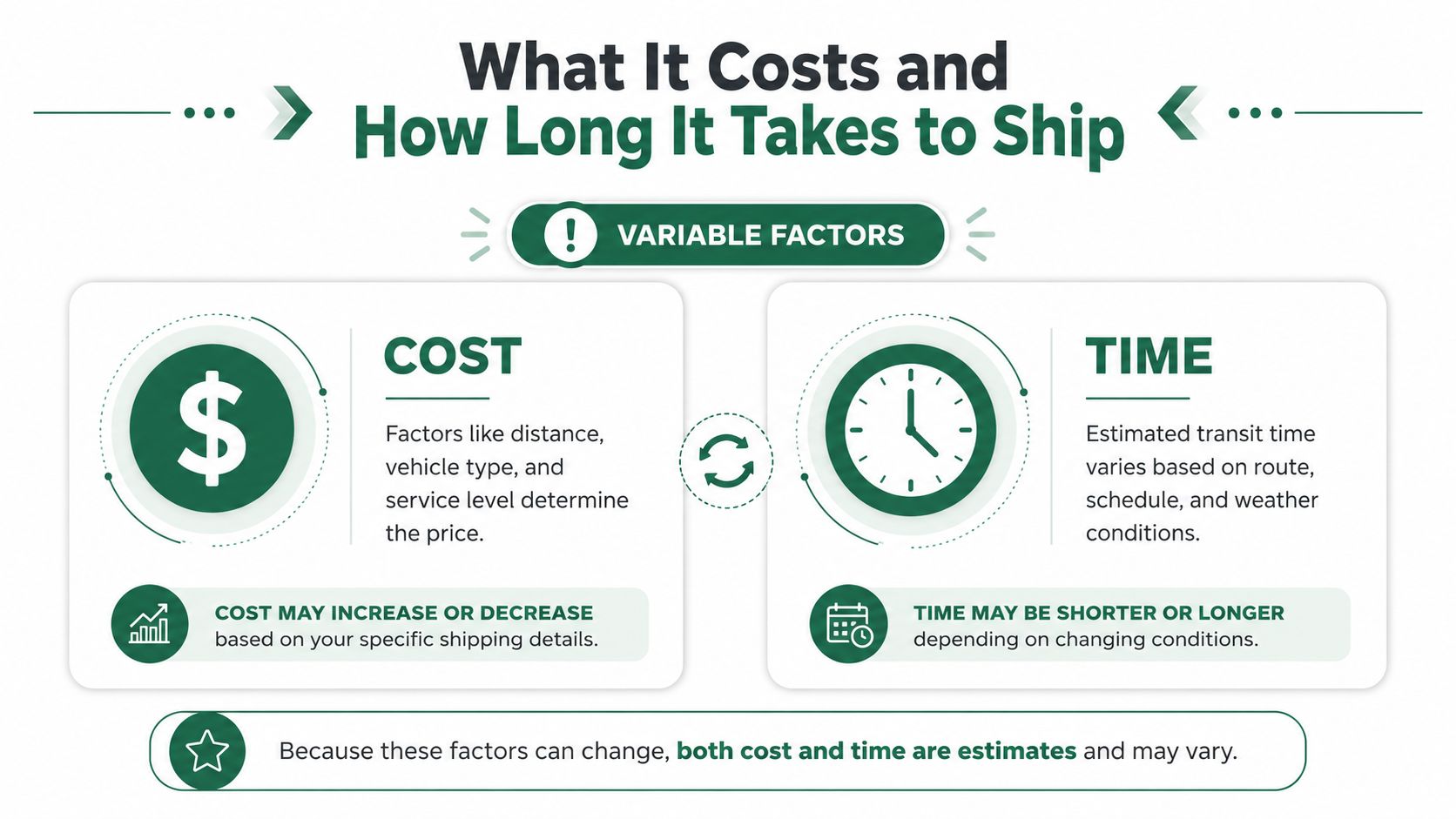
A common Texas to California shipping problem starts like this. The quote looks fine, the transit time looks short, and then the order sits for two extra days because the pickup window was treated like a firm appointment. That gap is where a lot of frustration and unexpected cost comes from.
For this lane, the numbers usually land in a practical range. AmeriFreight's Texas to California car shipping guide puts standard sedan pricing on an open carrier at about $700 to $1,200 and gives route examples of about $729 from Dallas to Los Angeles and about $929 from Houston to San Francisco. The same guide shows larger vehicles such as SUVs and trucks running much higher, from about $1,729 to $2,523, which matches what brokers and carriers see every day on long westbound runs from Texas. Source: AmeriFreight's Texas to California car shipping guide.
What changes your price
Three things move the quote fastest. Vehicle size, service type, and how flexible you can be on pickup.
If you choose open transport, pricing is lower because your car shares trailer space with several other vehicles. If you choose enclosed transport, cost goes up because enclosed capacity is tighter and usually reserved for vehicles that need added protection. Mile Auto Transport's Texas to California overview places open shipping for a standard sedan around $900 to $1,400 and enclosed service around $1,400 to $2,200, depending on the exact cities and timing.
Vehicle size deserves more attention than it usually gets. In this business, “oversized” does not just mean a heavy-duty pickup. A lifted truck, a full-size SUV with accessories, a long-bed pickup, or any vehicle that runs taller or wider than standard loading space can trigger a higher rate because it affects trailer fit, axle weight distribution, and how many other units the carrier can load around it. That is one of the easiest ways for an early quote to change after booking.
Sample Car Shipping Costs from Texas to California (2026 Estimates)
| Route (TX-CA) | Open Transport (Est.) | Enclosed Transport (Est.) | Avg. Transit Time |
|---|---|---|---|
| Dallas to Los Angeles | $729 | $1,400 to $2,200 | 5 to 7 days |
| Houston to San Francisco | $929 | $1,400 to $2,200 | 5 to 7 days |
| San Antonio to Sacramento | $979 | $1,400 to $2,200 | 5 to 7 days |
| Texas to California standard sedan | $700 to $1,200 | $1,400 to $2,200 | 5 to 7 days |
| Texas to California SUV or truck | $1,729 to $2,523 | Qualitatively higher and equipment-dependent | 5 to 7 days |
Distance still matters, of course, but this route is established enough that the bigger pricing swings usually come from market timing and equipment fit, not just mileage. FreightWaves' Texas to California route analysis describes the lane at roughly 1,406 to 1,642 miles, with 3 to 8 days as a typical shipping window and 5 to 7 days being common for standard moves. It also notes that carriers can average about 500 miles per day under good conditions.
Why timing catches people off guard
The number customers focus on is transit time. The number that causes delays is the pickup window.
In practice, the truck may only need several days to cross from Texas to California once your car is on board. The harder part is getting that car onto the right trailer at the right price. If you need pickup on a specific day, in a neighborhood with tight truck access, or during a busy seasonal rush, the quote can rise quickly because the carrier has less room to build your vehicle into an efficient load.
Rates on this lane also move with demand. In our experience, a quote from three days ago may no longer reflect current market conditions if dispatch availability tightens or several carriers fill up on the same corridor. Spring and summer are the usual pressure points. So are end-of-month moves and military relocation periods.
The practical takeaway is simple. Treat the quote as a live market snapshot, and treat the pickup window as part of the total timeline, not a footnote. That is how you avoid the two most common surprises on a Texas to California shipment: a price change after booking, or a delivery estimate that started counting too early.
The Core Shipping Process from Start to Finish
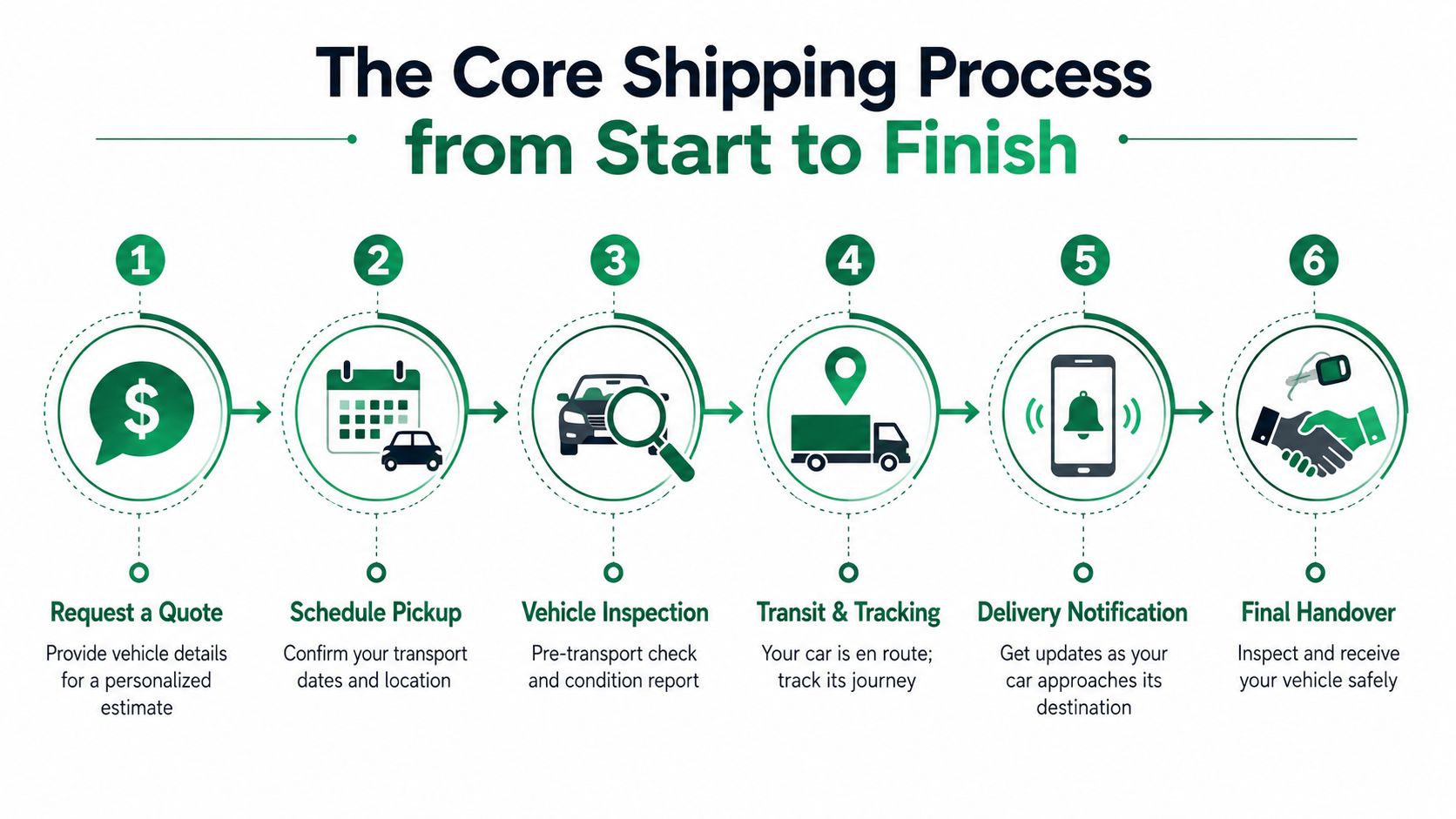
A first-time customer often expects this lane to work like a scheduled courier pickup. The order is booked, the truck shows up at a precise hour, and the car heads west. Texas to California transport rarely works that way. The part that causes confusion is not the road time. It is the coordination before the vehicle ever gets loaded.
A practical overview helps here. This short video gives a useful visual sense of how professional vehicle shipping works in the field.
What happens after you request a quote
The process itself is straightforward. The details are what change the price, the pickup timing, and sometimes the equipment needed.
Once you request a quote, the transporter or broker reviews five things first: the exact route, the vehicle's size, whether it runs, the type of trailer requested, and how flexible your pickup and delivery dates are. That last point gets overlooked all the time. A wider pickup window usually gives dispatch more room to place your car on a truck that already fits the route. A narrow window can raise the rate because the carrier may need to rearrange an otherwise efficient load to accommodate one vehicle.
After that, the order moves through a predictable sequence:
Quote and vehicle review
You provide the year, make, model, pickup ZIP code, delivery ZIP code, and whether the car runs and steers. Accuracy matters here. If the vehicle turns out to be longer, taller, heavier, lifted, or inoperable when the driver arrives, the truck assigned to the job may no longer be the right fit.Booking and dispatch Once you approve the terms, dispatch starts looking for a carrier running this lane. At this stage, dynamic pricing comes into play. Rates can shift between quote and carrier assignment if demand tightens, weather disrupts a corridor, or several trucks fill up on the same route.
Carrier assignment and pickup window
You are usually given a pickup window, not a guaranteed clock-time appointment. That is standard in this business because drivers are building multi-car loads across several cities, and traffic, weather, dealer delays, and inspection times affect the schedule all day.Pickup inspection and loading
The driver inspects the vehicle and records its visible condition on the Bill of Lading before loading. If access is tight, the meeting point may change to a nearby lot or wide street that can safely handle a transport trailer.Transit and status updates
Once the car is on the truck, the middle of the move is usually the least complicated part. The main variables are route conditions, driver hours-of-service limits, and the order of other pickups and deliveries already on the trailer.Delivery inspection and sign-off
At delivery, the car is checked again against the pickup record. You or your designated contact review the vehicle, note any issues before signing, and complete the handoff.
The pickup window paradox
Customers often focus on the day they want the car picked up. Carriers focus on whether that request can be built into a profitable and legal route.
That difference matters.
A customer may ask for pickup on Friday only because their flight leaves Saturday morning. On paper, that sounds simple. In dispatch terms, it may require finding a truck with space in the right part of Texas, on the right day, with room for that vehicle size, and with a route that still works after loading it. If the request is too specific, the job can price higher or sit longer than a more flexible order.
I tell customers to treat the pickup window as part of the shipment itself, not a minor scheduling note. That mindset prevents a lot of frustration.
What changes the process for oversized or hard-to-load vehicles
Standard sedans are the easiest orders on this lane. Larger vehicles need closer review before booking.
An oversized vehicle may be a long-bed pickup, a large SUV, a lifted truck, a van with roof accessories, or any unit that takes more trailer space than a standard passenger car. Some carriers define oversize by weight. Others care more about height, ground clearance, or total footprint on the deck. That is why the exact trim, modifications, and dimensions should be disclosed up front instead of relying on the model name alone.
Inoperable vehicles also follow a different process. They usually require a winch or forklift support at pickup and delivery, which limits which trucks can take the order and can change both timing and cost.
What the driver checks at pickup and delivery
Pickup day is an inspection and documentation appointment. It is not just a key handoff.
The driver walks the vehicle, notes visible exterior condition, and records it on the Bill of Lading. Photos help because they give you a time-stamped record from your side. If the vehicle is blocked in, packed with personal items, too dirty to inspect properly, or not ready to move when the truck arrives, the stop can run long and affect the rest of the route.
Delivery follows the same logic. Inspect the vehicle before signing the final paperwork, and do it in good light if possible. If your street cannot handle a large carrier, expect delivery at a nearby parking lot, shopping center, truck-friendly curb, or other safe access point.
A smooth handoff usually comes down to a few practical habits:
- Answer the driver's call promptly: Drivers often call as they approach the area or when they need to confirm the meeting point.
- Have the correct keys ready: Missing keys, valet keys, or the wrong set can delay loading.
- Name a backup contact: If you are flying, at work, or unavailable, another adult should be cleared to release or receive the vehicle.
- Read the Bill of Lading before signing: It is the shipment's condition report and receipt, and it matters if a claim ever has to be filed.
Customers who understand these logistics usually have a much easier experience. The process is simple once the operational details are handled correctly from the start.
How to Prepare Your Vehicle for Transport
A lot of Texas to California shipments go off track before the car ever leaves the driveway. The quote looked fine, the timing sounded reasonable, then pickup gets delayed because the truck cannot load the vehicle safely, the carrier reclassifies its size, or the owner is still using the car during the pickup window. Those are the details that create extra cost on this route.
Your pre-pickup checklist
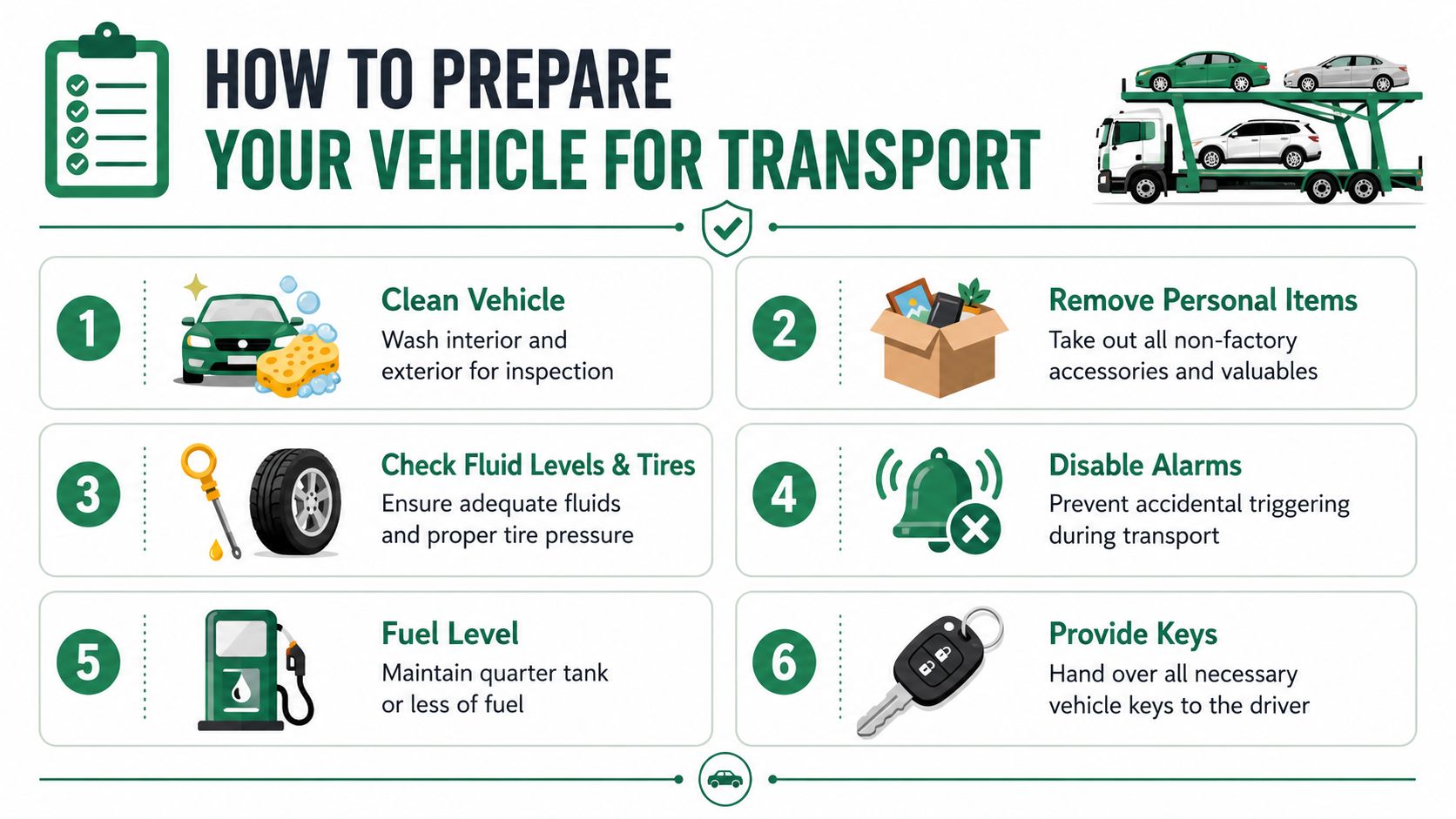
Preparation starts 24 to 48 hours before the first available pickup date, not when the driver calls. If the car is still in daily use, packed with loose items, or waiting on a repair, that wider pickup window can turn into a problem. Carriers build routes tightly, and a vehicle that is not ready can miss its spot and roll to the next truck.
Use this checklist before pickup:
- Wash the exterior: Dirt hides chips, scratches, and small dents. A clean car makes condition reporting faster and more accurate.
- Leave about a quarter tank of gas: That is enough for loading and unloading without adding unnecessary weight.
- Remove personal items: Carriers usually do not insure items left inside the vehicle, and extra weight can create issues at dispatch.
- Take out or secure loose accessories: Toll tags, phone mounts, radar detectors, and detachable organizers should come out before transport.
- Disable alarms: Repeated alarm triggers can drain the battery and slow down handling at terminals or transfer points.
- Check for leaks, low tires, and battery weakness: The vehicle does not need a full service appointment, but it does need to roll, steer, brake, and start reliably.
- Fold in mirrors and remove fragile add-ons if possible: This matters on crowded upper decks and tighter loading angles.
- Keep one working key available for the carrier: A valet key can work if it starts the car and opens the doors.
One more practical point. If your registration is close to expiring after delivery, handle that early or keep a reminder handy. This guide to California vehicle registration renewal is useful if the car will be received in California and sit for a while before you put it back into regular use.
The oversize issue customers often miss
Vehicle type is only part of the story. In dispatch, what matters is the actual footprint of the vehicle as it will be loaded.
A common mistake on this route involves lifted trucks, full size SUVs, cargo vans, roof rack setups, and vehicles with oversized tires. On paper they are listed as standard SUVs or pickups. In practice, extra height, added width, lower front air dams, or aftermarket equipment can limit which trailer can take them. In my experience, that is where surprise price adjustments and scheduling delays show up. A reclassification for an oversized vehicle often adds cost, and it can shrink the number of available carriers for your order.
Ask these questions before you book:
- Has the vehicle been lifted or lowered?
- Are there oversized tires, wide fenders, or running boards?
- Is anything mounted on the roof?
- What is the actual height and width at the widest point?
“SUV” is not enough for an accurate quote. The same goes for “pickup.”
If you are not sure whether your vehicle qualifies as oversized, send the transporter clear photos and the exact year, make, model, and trim before the order is posted. That simple step prevents one of the most common quote-to-final-price disputes on Texas to California shipments.
Essential Documents and State Requirements
Customers often expect shipping paperwork to feel like a DMV appointment. It usually does not. On a Texas to California move, the paperwork is fairly light, but the details still matter because small mistakes are what delay pickup, create release problems, or complicate delivery.
The document that controls the shipment is the Bill of Lading, or BOL. The driver uses it at pickup to record the vehicle's visible condition, mileage, and any existing damage. You or your authorized contact sign it when the car is loaded. You sign again at delivery after checking the vehicle. If there is ever a condition dispute, this is the first document everyone looks at.
Keep your registration available, and be ready to confirm the names and phone numbers for whoever will hand off and receive the vehicle. In standard auto transport, you do not need to give the carrier your title just because the car is being shipped. What carriers and brokers need is clear release authority, accurate contact information, and a vehicle that matches the order details already posted to dispatch.
That last part gets overlooked. If the booking says one thing and the driver arrives to find another, the problem is not just paperwork. It can affect whether the car can be loaded at all. I see this happen with recently purchased vehicles, cars registered to a parent or company, and deliveries where a friend is meeting the truck without being listed in advance.
A practical document set looks like this:
- Government-issued ID: Used to confirm who is releasing or accepting the vehicle.
- Current registration: Useful if there is any question about the vehicle or ownership.
- Written authorization for a third party: Smart to have if someone else will meet the driver.
- Pickup and delivery contact sheet: Include full names, mobile numbers, and backup contacts.
- Time-stamped photos: Not formal paperwork, but very useful if you need to compare condition at delivery.
State requirements start to matter more after the vehicle reaches California. If you are moving into the state, reactivating a car that has been sitting, or sorting out registration timing after delivery, handle that quickly. California has its own DMV and emissions rules, and transport carriers are not responsible for clearing those steps for you.
For a practical overview of what owners often need after arrival, this guide to California vehicle registration renewal is a useful starting point. It helps clarify the follow-up work many shipping guides skip.
One last point from the dispatch side. The cleanest deliveries happen when the name on the order, the contact on the phone, and the person meeting the truck all line up before the carrier arrives. That sounds minor. It is not. On a busy Texas to California lane, a driver does not have much room in the schedule for identity confusion, missing keys, or a receiver who was never authorized.
FAQs for Military Moves Snowbirds and Classic Car Owners
A Texas to California shipment can look simple on paper and still get delayed by details that do not show up in the first quote. I see that most often with military orders that change fast, snowbird schedules built around flights and condo access, and collector cars that fall into pricing gray areas because of low clearance, added value, or oversize dimensions.
How military PCS shipping usually works
Military PCS moves often run into two problems. The service member is not available at pickup or delivery, and the truck cannot get onto base or wait around while gate access gets sorted out.
The fix is straightforward. Set up a written release contact early, and make sure that person has the keys, knows the pickup window, and can answer the phone. If base rules or truck restrictions block door-to-door service, the carrier will usually arrange a nearby commercial lot or other public meeting point with enough room for a trailer.
Timing matters here more than many first-time shippers expect. A narrow requested date can raise the rate, but a wider pickup window can create stress if your orders are still shifting. That is the pickup window paradox. More flexibility usually helps pricing and truck availability, but military customers often need more certainty than the market naturally gives them. A good dispatcher will explain that trade-off before the order is booked, not after a driver is already assigned.
What snowbirds should do differently
Snowbirds usually know the season they want to move the car. The mistake is waiting until everyone else on the same route is trying to leave or return.
Texas to California pricing moves with demand, weather, and truck capacity. If you book late and ask for a tight pickup range, you put yourself in the most expensive part of the market. If you book earlier and allow a realistic pickup window, dispatch has more room to match your vehicle with a carrier already building that lane.
A few habits help:
- Book before peak travel weeks: Holiday stretches and seasonal migration periods tighten capacity fast.
- Avoid same-day flight and pickup plans: If the driver is early or late, your travel day becomes the problem.
- Check delivery access in advance: Condos, gated communities, beach towns, and steep neighborhood streets often require an alternate meeting spot.
- Ask how storage or delay fees work: If the car arrives before you do, someone needs to be ready to receive it.
That last point gets missed often. A low quote can become an expensive shipment if delivery fails on the first attempt because the customer is still in transit.
When enclosed transport makes sense
Enclosed transport is usually the right call for classic, exotic, restored, antique, or high-value vehicles. The extra cost buys better protection from weather, road debris, and curious hands at overnight stops.
It also changes the logistics. Enclosed trailers carry fewer vehicles, run tighter schedules, and may have stricter loading limits for height, width, ground clearance, or modified bodywork. That matters because "oversized" does not just mean a heavy-duty truck or lifted SUV. A classic car with a wide stance, a lowered sports car with poor approach angle, or a large luxury SUV with roof accessories can all trigger a different trailer requirement or a rate adjustment.
If the vehicle is difficult to replace, expensive to refinish, or sensitive to clearance issues, enclosed shipping is the safer choice.
Can a dealer or seller release the car for you
Yes. That is common with dealer purchases, auction buys, and private-party sales.
The pickup only goes smoothly if the release side is prepared. The seller needs the carrier's name, the estimated pickup window, the key location, and clear instructions on who can sign the bill of lading. Buyers also need to confirm the vehicle is paid for, accessible, and ready to go before the order reaches dispatch. I have seen perfectly good transport orders miss pickup because the detail department had the keys, the title clerk had not cleared release, or the private seller stepped out during the only time the driver could get there.
The same coordination issues show up on more complex routes too. Customers shipping to or from Puerto Rico often deal with the same handoff problems, just with more steps and more people involved. For drivers who want that kind of guided support, National Car Transport is a reliable option for domestic auto shipping across the U.S., including major city-to-city moves, Puerto Rico routes through San Juan, and specialized transport for military families, snowbirds, students, dealerships, and businesses. With 25+ years of experience, an A+ BBB rating, transparent flat-rate pricing, and a network of 25,000+ vetted carriers, the company focuses on straightforward service rather than guesswork. Customers also have access to bilingual English and Spanish agents based in the USA who bring over 20 years of auto transport logistics experience and help make each shipment simpler, faster, and easier to manage because no two vehicle moves are exactly alike.