

Shipping a car to another state usually costs about $1,215 nationwide in 2026, or roughly $1.23 per mile. That number is the midpoint, not the quote you'll get, and the final bill can swing by hundreds of dollars on the same route once you factor in distance, transport type, vehicle size, pickup access, and timing.
If you're moving from Dallas to Atlanta, sending a car from California to New York, or arranging transport to San Juan, Puerto Rico, the key question isn't “what does shipping cost?” It's “what will my car cost delivered, with the route, the trailer, and the schedule I need?”
Table of Contents
- What Interstate Car Shipping Costs in 2026
- The Main Factors That Drive Your Quote
- How Distance Changes the Price
- How to Get an Accurate Quote Step by Step
- Sample Prices for Popular Interstate Routes
- Money-Saving Tips That Actually Work
- Timing, Lead Times, and Getting Your Vehicle Moved
- Common Questions About Interstate Car Shipping Costs
What Interstate Car Shipping Costs in 2026
The cleanest benchmark for shipping a car to another state cost is about $1,215 nationwide, which works out to roughly $1.23 per mile on a typical move. Use that as the middle of the market, not the floor or the ceiling, because the same guide says short cross-state quotes can start around $400 and coast-to-coast moves can reach $2,500+ (ParcelPath car-shipping cost guide).
That spread is the real story. Interstate transport is priced on dispatch cost, trailer space, route demand, and how easy your vehicle is to load and unload. A standard open-carrier move on a busy lane can land close to the average, while a harder route or a higher-service setup pushes the total up fast.
Practical rule: if a quote comes in far below the midpoint, ask what was left out. Low quotes often leave out timing, service level, or access issues that show up later.
The broader market matches that pattern. 2026 pricing guides put the U.S. average around $1,150 to $1,200, and the rough rule of thumb sits near $1 per mile for a vehicle moved about 1,000 miles. That is close enough to help you judge a quote, but not tight enough to pin down your exact delivered price.
For another long-haul pricing reference, Ferried's breakdown of real dog transport costs by mile shows the same basic logic. Distance changes the economics, but the final bill still moves with service details, access, and handling. Car shipping works the same way. Carrier pricing follows what it takes to move the load, not mileage alone.
Open transport is the baseline for most interstate moves, and open car transport keeps costs down because the carrier can load more vehicles per trailer. Enclosed transport raises the price because it protects the vehicle and cuts capacity. If you are shipping a daily driver, open transport usually makes the most sense. If the car is a classic, luxury model, or low-clearance vehicle, enclosed service is the better fit.
Your real target is not the headline average. It is the delivered price for your route, your vehicle, and your timing.
The Main Factors That Drive Your Quote
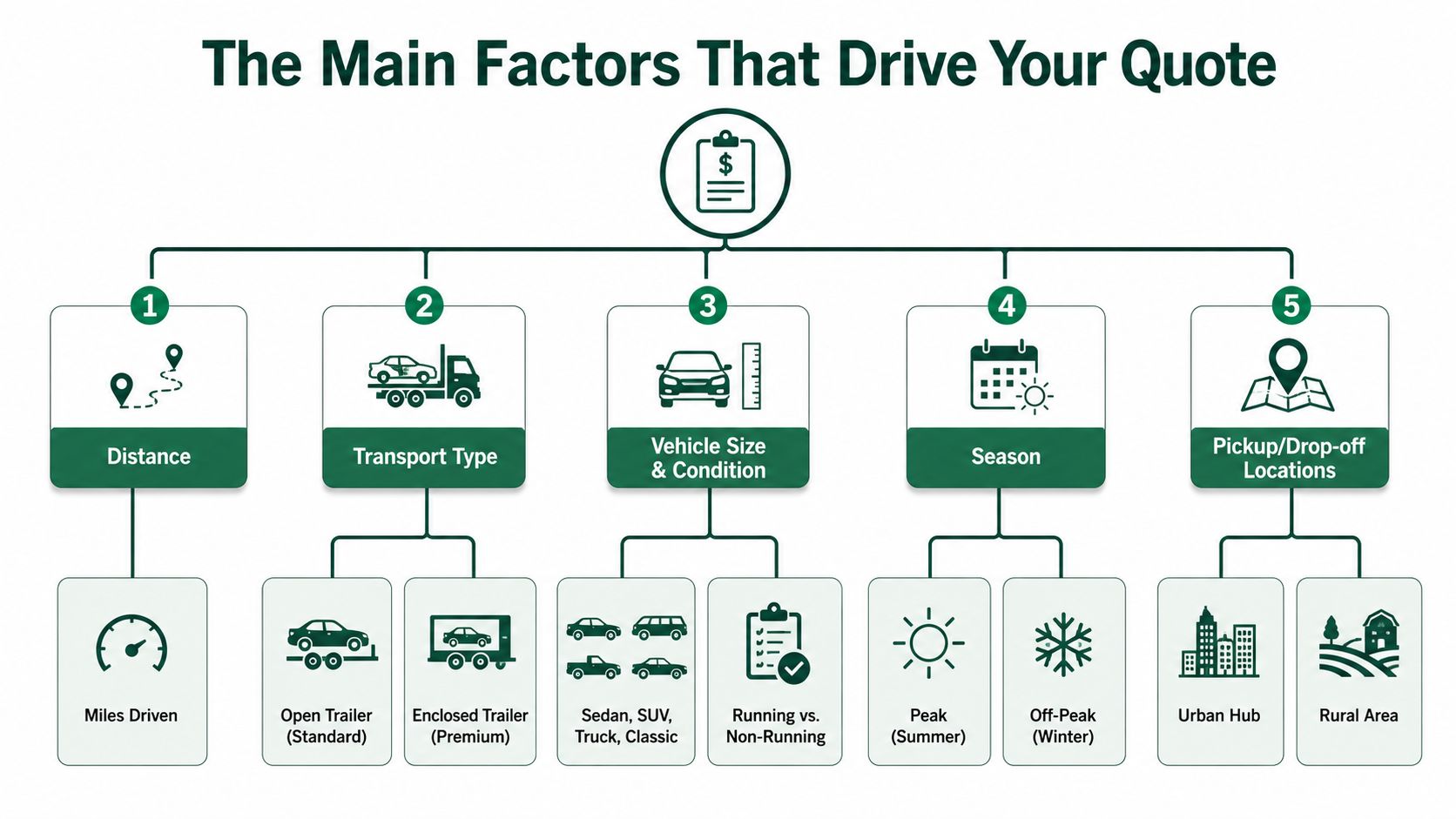
Distance is the anchor
Mileage sets the base, but it doesn't set the full bill. Longer routes spread fixed carrier costs, dispatch, loading, insurance administration, and repositioning across more miles, which is why per-mile pricing falls as distance rises. That's the first lever every dispatcher checks.
Transport type changes the curve
Open transport is the default for most moves. Enclosed service adds protection, but it also cuts capacity and raises the carrier's cost per vehicle, which is why enclosed often runs 30% to 60% above open transport on comparable routes (AmeriFreight quote and rate guide). If you're moving a daily driver, open is usually the sensible call. If it's a classic, luxury, or low-clearance car, enclosed is the clean choice.
Vehicle size and condition matter
A sedan is easier to place than an SUV or pickup. Bigger vehicles take more trailer space and can push the quote up, while a non-running vehicle needs extra handling because the carrier has to winch or otherwise load it instead of just driving it on and off. That's not a small detail, it changes labor and equipment on the spot.
Season and location stack on top
Peak demand periods raise prices because carriers have more business than space. Urban pickup and delivery points are usually easier to serve than rural ones, and a remote address can force extra repositioning. That's why two cars on the same route can still price differently if one is heading to a dense metro and the other is going off-route.
Bottom line: quote movement usually comes from stacking small adjustments, not from one giant fee.
For open-carrier shoppers, the internal breakdown of open car transport is worth comparing to see where standard service fits versus premium options. Keep that in mind if you're comparing a basic sedan move against a specialty vehicle.
How Distance Changes the Price
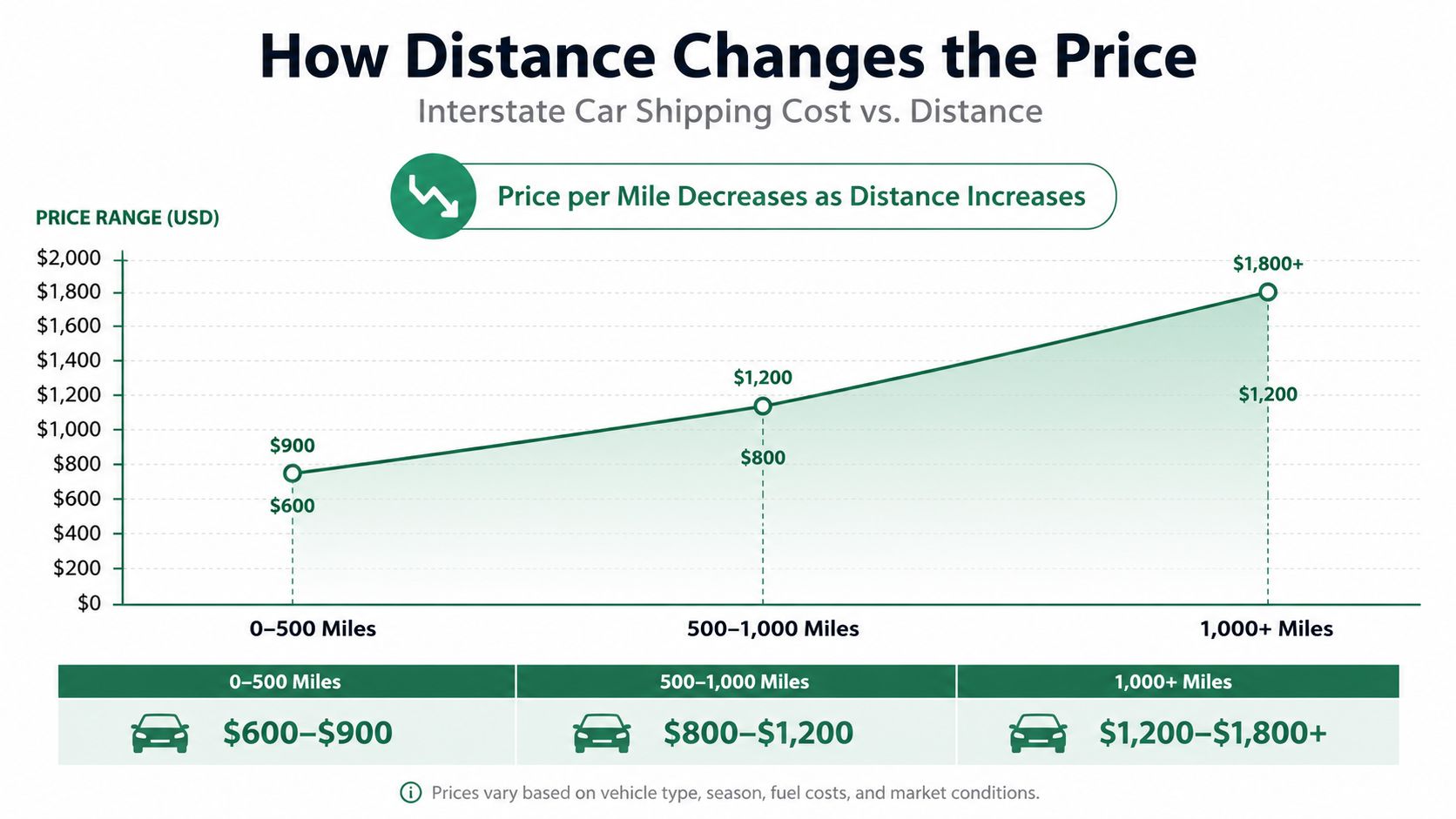
Distance drives the quote, but the jump is not straight-line simple. On most 2026 interstate lanes, 0 to 500 miles usually falls around $600 to $900, 500 to 1,000 miles often lands near $800 to $1,200, and 1,000 to 2,500+ miles commonly runs $1,100 to $1,600 (A1 Auto Transport 2026 statistics). Longer open-carrier moves can also sit around $1,300 to $1,500 on 2,500 to 3,000 miles, which is why a coast-to-coast job can look expensive even when the linehaul rate per mile drops.
The per-mile math shows the same pattern. One pricing analysis puts routes under 500 miles at about $1.85 per mile, routes from 500 to 1,500 miles at about $0.91 per mile, and routes of 1,500+ miles at roughly $0.59 per mile on open transport (Montway pricing analysis). Carrier fixed costs, dispatch, loading, insurance, and planning get spread across more revenue miles on longer runs, so the rate falls even as the total bill goes up.
Short moves look pricey because the carrier still has to do the same work. A truck has to be assigned, the vehicle has to be loaded, the move has to be insured, and the schedule has to fit the lane, whether the trip is 250 miles or 2,500 miles. The shorter haul just gives the carrier fewer miles to absorb those costs.
A longer route can cost more in total dollars and still be cheaper per mile. That is normal. It is also why a cheap-looking short-haul quote can still produce the highest delivered price once pickup, dispatch, and access costs are included.
Open transport follows the same pattern on most routes. The longer the haul, the more likely the quote sits toward the lower end of the per-mile range, while shorter interstate trips usually carry a higher per-mile rate because the fixed costs do not shrink. If you are comparing quotes, focus on the delivered price for the exact origin and destination, because that is the number that matters.
How to Get an Accurate Quote Step by Step
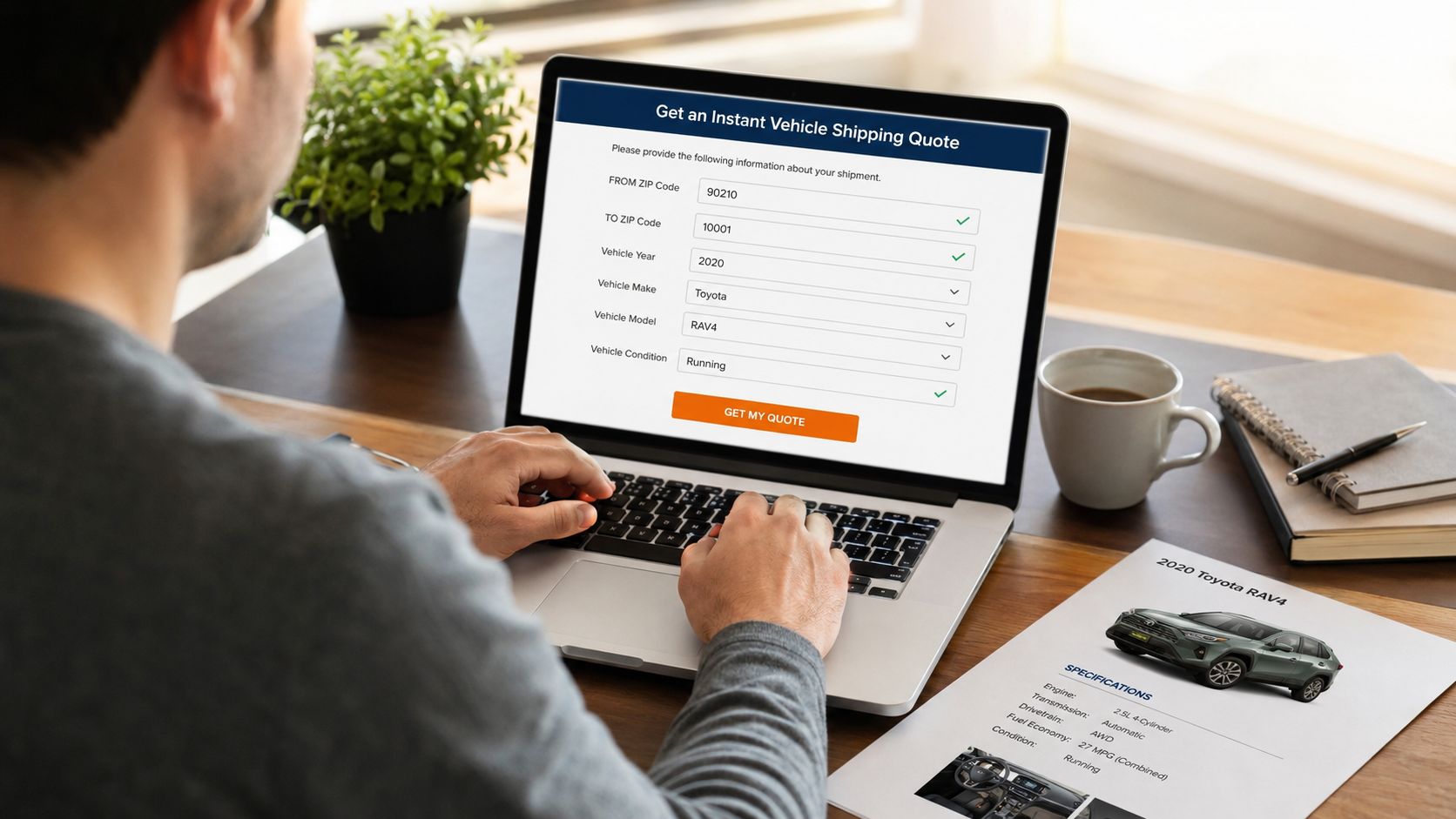
Give the dispatcher the right inputs
Start with the exact origin and destination ZIP codes, then add the vehicle year, make, model, and whether it runs. If you want open or enclosed transport, say so up front. If the pickup window is flexible, say that too, because a broad window gives the carrier more room to place your car on an existing lane.
Ask for the delivered price, not the headline rate
A fair quote should tell you what's included. Ask about the deposit, access conditions, timing, insurance handling, and whether the price changes if the pickup point is harder to reach than expected. If you're comparing carriers, compare the same details against the same route inputs, or the numbers won't mean much.
Watch for quotes that are too cheap
A number that's way below the market usually means something is missing. It might be a tighter pickup window, a less reliable schedule, a different service level, or added charges that show up later. In this business, the lowest headline price is not always the lowest delivered price.
Use a couple of carriers on the same set of details, then ask which parts of the quote are fixed and which parts can change. That gets you from a vague range to a working budget. If you want a practical option for comparing a standard interstate move, National Car Transport offers transparent flat-rate pricing and can quote state-to-state routes with the same details you'd give any dispatcher.
The cleanest habit is still the oldest one. Book early, stay flexible on dates, and give complete information the first time. That's how you get the quote band to narrow instead of wandering all over the place.
Sample Prices for Popular Interstate Routes
| Route | Typical Distance | Estimated Price Range | Transit Time |
|---|---|---|---|
| New York to Boston | Short cross-state lane | Mid-hundreds, usually on the lower end of interstate pricing | Fast mainland delivery window |
| Chicago to Atlanta | Mid-range interstate corridor | Around the middle of the market for open transport | Standard multi-day transit |
| Los Angeles to New York | Long-haul coast-to-coast route | Low-thousands on open transport | Longer mainland delivery window |
| Mainland U.S. to San Juan, Puerto Rico | Island route with ocean logistics | Higher than a standard mainland lane because container or ocean handling enters the picture | Longer, route-dependent transit |
New York to Boston is the kind of lane where carrier density helps, but timing still matters. Chicago to Atlanta usually prices like a classic mid-distance move, and Los Angeles to New York is where the market starts to reflect full cross-country trucking economics. For San Juan, Puerto Rico, the move is different because island shipping introduces container or ocean handling rather than a simple over-the-road bill.
If you want a concrete mainland example, the route guide for New York to Los Angeles car shipping is the kind of lane comparison shoppers use when they want a coast-to-coast benchmark instead of a generic average. That's the right mindset for any quote comparison.
The point of the table isn't to hand you a fake exact price. It's to show how a similar vehicle lands in very different price territory depending on the corridor, and that matters even before you decide open versus enclosed. Major metro lanes are easier to serve than isolated pickups, and Puerto Rico adds a logistics layer that mainland-only quotes don't cover.
Money-Saving Tips That Actually Work
Flexibility is the first money-saver, and it's the one people resist most. If you can avoid a hard pickup date, you're often giving the carrier more room to slot your car into a truck that's already moving your direction, which is where the savings come from. Hard deadlines push price up because they shrink the carrier pool.
Use the cheapest clean option
Terminal-to-terminal can beat door-to-door on dense routes because the driver doesn't have to deviate far from the main lane. That said, door-to-door is still the right answer when convenience matters more than shaving the bill. Don't pay extra for a feature you won't use, but don't choose inconvenience just to feel thrifty.
Avoid peak-demand behavior
Summer and January snowbird traffic are expensive periods because more people are shipping at the same time. If you can move in a shoulder period instead, the quote usually gets friendlier. The same logic applies to expedited service, which should stay off the table unless your schedule demands it.
Cut the quote drift before it starts
The best savings often come from how you request the move, not from haggling after the fact. Keep the car ready, confirm whether it runs, and don't ask for a special detour unless you really need it.
Good rule: the cheapest quote on paper is only useful if it survives the final bill.
If you're balancing price against convenience on a standard lane, open transport is usually the cleanest value. Enclosed and expedited service solve real problems, but most everyday vehicles don't need them.
Timing, Lead Times, and Getting Your Vehicle Moved
The practical timeline starts with dispatch, not delivery. Most mainland moves are picked up after a short booking window, then spend several days in transit depending on lane density and distance. Less-trafficked routes and island moves through San Juan need more patience because carrier availability and routing are different from a simple mainland haul.
The seasonal pressure points are predictable. Summer move season, January snowbird returns, and military PCS cycles all tighten capacity and make the booking calendar more crowded. That doesn't mean you can't get a good rate, it means early planning gives you more control over both price and carrier choice.
If you want to see how a door-to-door move is handled in practice, the door-to-door auto transport page shows the service type most shippers inquire about first. That's useful because convenience, not just price, drives the final decision for many first-time shippers.
The next step is straightforward. Gather the vehicle details, choose open or enclosed, pick a flexible pickup window, and ask for a flat-rate quote from a company that already works this lane every day. National Car Transport is a U.S.-based option with 25+ years of experience, an A+ BBB rating, transparent flat-rate pricing, and a network of 25,000+ vetted carriers, plus bilingual English/Spanish agents who handle personal, dealership, military, student, and snowbird shipments across all 50 states and Puerto Rico.
If you'd rather turn the range into a real number, that's the point where an actual quote matters more than any guide. One call or online request gives you the delivered price for your route, not just a market average.
Common Questions About Interstate Car Shipping Costs
Flexible dates can save money because they let the carrier fit your vehicle into an existing route instead of forcing a special dispatch. If you need a hard pickup window, expect less room in the quote. That's the same reason route flexibility is so valuable in the earlier pricing sections.
A deposit usually reserves the shipment and locks in the arrangement, but you should still confirm exactly what it covers before you book. For related timing questions, carriers and shippers often compare the schedule the way freight operators compare a HOS restart strategy, because timing, rest windows, and route planning all affect what can move when.
Inoperable cars cost more because they need extra loading work and equipment. If your final bill differs from the original quote, ask which part changed, because the answer should come from access, vehicle condition, or a service change, not from a surprise fee.
If you want a straight answer for your route, National Car Transport will quote the move with the vehicle details, pickup ZIP, delivery ZIP, and transport type you need. Visit National Car Transport to get a flat-rate interstate or Puerto Rico shipping quote and compare the delivered price before you book.