

Shipping a car from Florida to Massachusetts on an open carrier generally costs $900 to $1,400 for a running sedan from Miami to Boston in 2026, and you should budget a 3 to 8 day door-to-door window rather than a same-hour appointment. That transport price is only part of the bill.
A car that arrives with a clean inspection can still trigger Massachusetts tax questions and start corroding on salted roads within weeks. Two quotes $150 apart matter less than a use tax bill you didn't expect or a summer tire meeting ice outside Worcester. Treat this corridor as three jobs, the haul, the legal handoff, and the first Massachusetts winter. Pricing all three before you book is how you avoid winning the quote and losing on the move.
Table of Contents
- Florida to Massachusetts Shipping Cost in 2026
- Prepare the Car, Addresses and Inspections
- How to Book and Finish the Shipment
- Handle Delays, Damage Claims and Cancellations
- Massachusetts Tax and Registration After Arrival
- Salt Belt Care After a Clean Delivery
- Lock the Rate Before the Window Closes
Florida to Massachusetts Shipping Cost in 2026
A running sedan shipped from Miami to Boston on an open carrier generally costs $900 to $1,400 in 2026, according to Rivalane's Florida to Massachusetts route pricing page. Operable cars from Miami, Orlando, Tampa, Fort Lauderdale, or Jacksonville to Boston, Worcester, or Springfield usually fall in a similar range when both addresses are near I-95 or other carrier lanes.
The quote covers transport, not the full cost of moving a car north. Massachusetts tax and registration are separate, and road salt after delivery can bring corrosion concerns that a cheaper carrier bid will not address.
Dispatch needs time to assign a truck, then the loaded carrier travels north alongside other stops, driver rest periods, and weather. Plan around a pickup and delivery window rather than a specific appointment hour.
2026 Florida to Massachusetts Transport Price and Timing
| Vehicle and service | Typical 2026 price | Door-to-door window | What moves the price |
|---|---|---|---|
| Running sedan, open carrier | $900 to $1,400 | 3 to 8 days | Miami to Boston benchmark, rural pickup costs more |
| Running SUV or pickup, open | $1,050 to $1,600 | 3 to 8 days | Height, weight, and longer loading time |
| Inoperable or heavily modified | $1,100 to $1,750 | 4 to 10 days | Winch load, clearance, or extra stops |
| Enclosed classic or luxury | $1,260 to $2,240 | 4 to 9 days | Enclosed service, liftgate loading, low clearance |
| Motorcycle | $650 to $950 | 3 to 8 days | Crate or strap method and terminal access |
| Autumn or spring snowbird sedan | Upper half of sedan band | Book 2 to 3 weeks ahead | October to November and March to April demand |
Enclosed transport costs noticeably more than open transport for the same sedan. The table shows typical ranges, not guaranteed quotes. Massachusetts tax and registration are outside every row.
What Pushes You Toward the Top of the Band
Distance is only one pricing factor. A rural pickup can pull a driver away from the northbound lane. A lowered car, oversized pickup, dead battery, or vehicle that will not roll can require different equipment or limit where it fits on the trailer.
- Rural access: A pickup near a major Florida metro is easier to match than an address far from the carrier's route.
- Condition at booking: A car described as running must start, roll, steer, and brake when the driver arrives. Otherwise, the quoted load may no longer fit.
- Position requests: First-on or last-off requests limit how dispatch can arrange the trailer.
- Seasonal pressure: Snowbird movement in October, November, March, and April tightens capacity, especially around fixed flight and lease dates.
A useful quote states the service plainly: door-to-door or terminal, open or enclosed, the pickup window, and whether payment is due before a carrier is matched. If the price depends on an unexplained deposit, compare the terms as closely as the transport rate.
Compare your quote with a current car shipping cost breakdown for your vehicle and ZIP codes. A clear flat rate within the typical band is easier to plan around than a low quote with vague condition requirements or pickup timing. Flexibility on pickup days and addresses near a main carrier lane can keep the price lower. A vehicle, address, or calendar that calls for a custom arrangement can push it higher.
Prepare the Car, Addresses and Inspections
A car that will not load, a street a carrier cannot enter, or a VIN mismatch can derail a planned pickup. Prepare the vehicle and both meeting points before confirming the shipment.
Make the Car Loadable
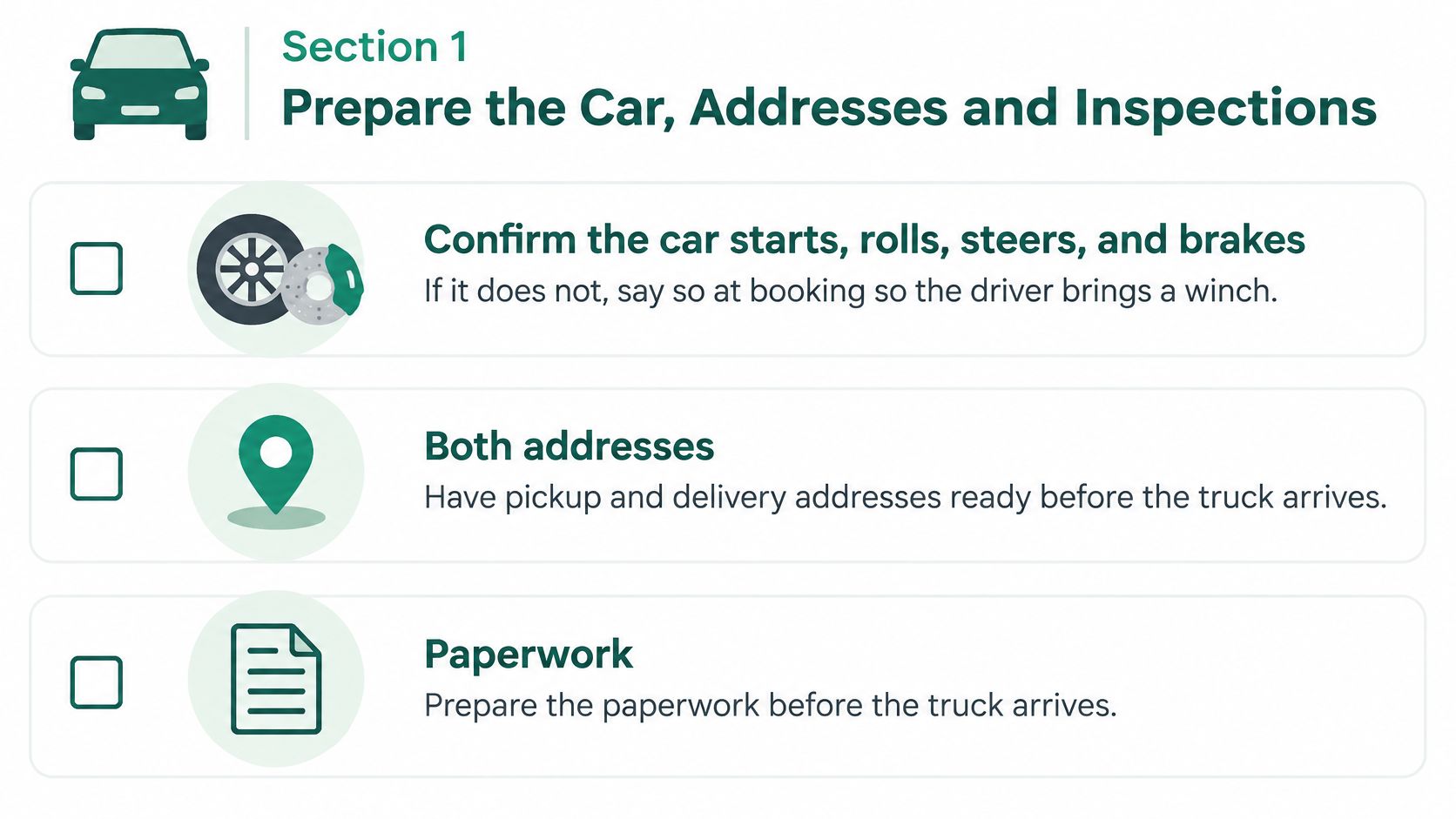
Start the car cold, drive it a short distance, turn the wheel lock to lock, and brake firmly. The basic test is whether it starts, rolls, steers, and brakes. If anything fails, disclose it at booking so dispatch can arrange equipment to winch the car onto the carrier.
Check the vehicle before release. Disclose a dead 12-volt battery, alarm that will not disarm, air suspension, lowered splitter, oversized tires, roof box, or EV charging needs. The driver needs to know what may affect loading or handling.
Empty the cabin and trunk of personal property. Remove or secure bike racks, loose spoilers, antennas, toll tags, and garage remotes. Leave roughly a quarter tank for loading and unloading, and set tires to the door jamb placard pressure, not the maximum molded into the sidewall. For an EV, photograph the charge percentage and list each charging cable and adapter.
Release standard: Confirm the VIN matches the paperwork, record the odometer and fuel or charge level, and count keys, accessories, and charging equipment before the truck leaves.
Check Both Addresses Like a Driver
A standard car carrier needs room to stop, extend ramps, turn, and clear branches and wires. Walk the Florida pickup street and Massachusetts delivery street before dispatch. Check for tight cul-de-sacs, steep driveways, parked cars on both sides, low bridges, weight limits, and condominium or gated-community truck rules.
Downtown Boston alleys, narrow Cape Cod lanes, low parking garages, and some gated communities may not accommodate a tractor-trailer. Name a nearby alternative in advance, such as a wide retail lot, truck-legal commercial street, or large parking area where the driver can load without blocking traffic. A door-to-door auto transport service can use a nearby safe meeting point when the exact address is inaccessible to the carrier.
Give the dispatcher gate codes, guard instructions, call-box details, and a reachable contact at each end. If you will not be there, authorize a specific adult to sign and send that person your photographs. Confirm access before pickup day.
Run the Three Handoffs the Same Way
Keep the vehicle record consistent from pickup through delivery. Use the bill of lading and condition report to record the car's condition and note any damage or missing items.
- Before pickup: Verify the VIN against the title or registration. Wash the car, then photograph every exterior panel, wheels, glass, roof, odometer, fuel gauge, interior, and each existing chip or dent in daylight.
- At loading: Walk around with the driver and compare your photos with the carrier's condition report. Before signing, confirm that existing damage, keys, accessories, and EV cables are listed. Keep a copy or clear phone image of the signed bill of lading.
- At delivery: Repeat the inspection in daylight before the driver leaves. Compare each panel, start the car, check the odometer, and count keys and charging equipment.
Record every discrepancy. If you find new damage, photograph it, describe it specifically on the delivery receipt, and report it promptly. A verbal acknowledgment does not replace a written record.
Ask separately what the carrier's cargo coverage includes and excludes, and who handles a claim. Registration and insurance checks do not answer those questions. Get the coverage terms before booking.
How to Book and Finish the Shipment
Booking is simple when you give dispatch the facts in the right order. Relocating households, students, military families, online buyers, and dealerships all run into trouble at the same points, vague vehicle condition, unreachable contacts, and a pickup address nobody checked.
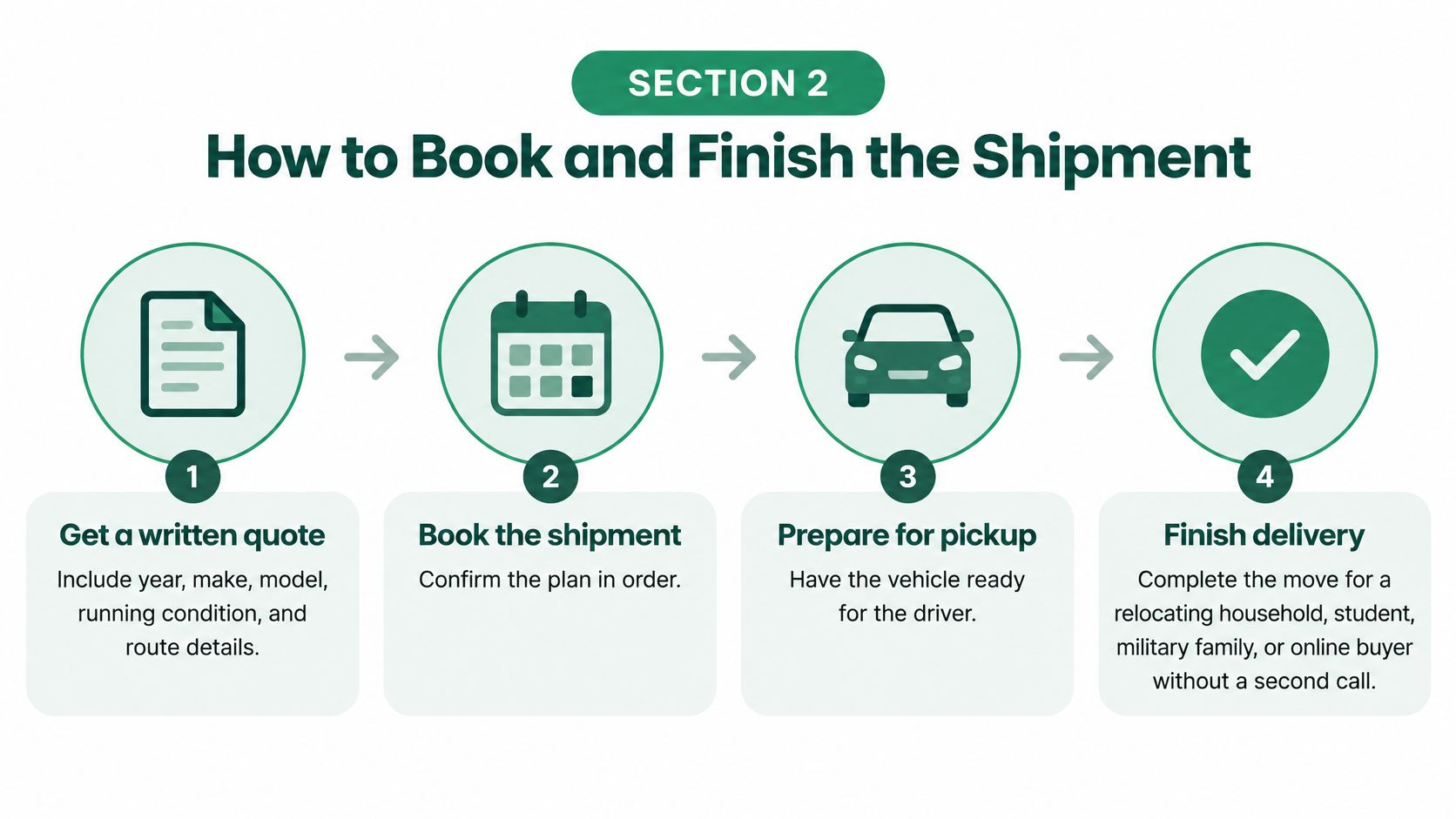
The four-stage flow below condenses the process before the fuller step list.
Seven Steps From Quote to Signed Delivery
- Get a written quote: Provide year, make, model, trim if it affects size, running condition, Florida pickup city, Massachusetts delivery city, and your preferred dates. Say whether you want open or enclosed service.
- Compare the window and terms: Compare pickup windows, not a single promised hour. Ask whether the rate is flat, whether it's door to door, and when payment is collected.
- Book with reachable contacts: Give a mobile number that will be answered at pickup and another contact for delivery. Any deposit or card hold should be explained before you agree.
- Confirm the assigned carrier: Get the carrier name, U.S. DOT number, expected pickup day, and the process for the driver's advance call. Confirm your primary address and backup lot.
- Meet the driver and document loading: Bring the key, title copy if requested, and your dated photos. Match the condition report before signing the bill of lading, and keep your copy.
- Stay available during transit: Keep your phone on and don't schedule delivery around a nonrefundable commitment. Weather on I-95, traffic, and driver hours can move arrival by a day.
- Inspect, then sign in Massachusetts: Meet in daylight if possible, inspect before signing, note any new damage on the paperwork, and only then release the driver.
Most standard vehicles belong on open car transport, where they're carried on the multi-car trailers you see on the interstate. Enclosed service makes sense for collectible paint, high-value luxury cars, very low ground clearance, or a vehicle you'd protect from road weather on a winter run. It isn't automatically better for a daily driver, and the premium doesn't remove the need for destination winter prep.
This short walkthrough shows how pickup, loading, and delivery fit together once a carrier is assigned.
Choices That Change Timing
Terminal service can help if you can't meet a truck, but it adds drop-off, storage, and pickup coordination. A first-on or last-off request can affect both price and assignment speed. Same-day pickup is sometimes possible near major metros, but it's a capacity question, not something to build a flight around without confirmation.
If you're a snowbird who makes this trip every year, book the busy direction early and keep two or three acceptable pickup days open. If you're buying online from a Florida dealer or auction, confirm the vehicle is paid, released, and accessible during business hours before dispatch sends a driver. For a military PCS or student move, put the person who can hand over the keys on the order, even if someone else is paying.
I would rather rework dates before dispatch than force a bad pickup. Once the truck is routed, every address change affects other customers on the trailer and can delay your car rather than rescue it.
Handle Delays, Damage Claims and Cancellations
A window can move without anyone acting in bad faith. A loaded carrier deals with traffic, weather, delivery access, and legal limits on driver hours. Your job is to turn oral updates into a written record you can act on.
When the Pickup or Delivery Window Slips
Ask the dispatcher for the revised window in writing. Ask whether the cause is driver hours, a weather closure, a prior customer who wasn't ready, or trouble accessing an address. The cause tells you whether the new estimate is credible.
Log each call with the date, time, name, and promised next update. If delivery in Massachusetts moves, confirm the new day still works for gate access, street parking, and the person signing. Don't send the driver to a location where nobody can meet the truck.
Don't chase the truck hour by hour. Get one named contact, one next update time, and one revised window you can plan around.
If the battery dies or the car won't roll on pickup day, call before the driver arrives. Dispatch may be able to send winch-capable equipment, but the load can be rescheduled and the rate can change. Hoping the driver will solve an undisclosed no-start at the curb usually costs everyone the day.
If Damage Shows Up
Compare delivery photos with pickup photos and the signed bill of lading. File a prompt written claim with the carrier using the documented damage, not a general statement that the car looks worse. If you bought separate coverage, notify that insurer as well and ask what repair estimates they require.
Keep the delivery receipt exactly as signed. If damage was noted on it, don't add notes later. Save original photo files with their timestamps, the quote, invoices, texts, emails, and claim correspondence in one folder until the vehicle is registered and the claim is closed.
Cancellations and Failed Matches
Before booking, ask three direct questions. How do cancellation fees work, is any deposit refundable, and what happens if a carrier can't be matched inside your window? Get the answers in writing.
A low quote with an unclear cancellation rule is not flexible. It's unfinished. You need to know your cost if a home closing slips, a dealer delays release, or military orders change. I would not book fixed travel until the carrier assignment and cancellation terms are both clear enough to survive a date change.
Massachusetts Tax and Registration After Arrival
The truck invoice is not the cost of putting the car legally on Massachusetts roads. Arrival can raise a destination tax question that dwarfs a modest difference between two transport quotes, especially on a recently purchased vehicle.
Under Massachusetts regulation 830 CMR 64H.25.1 on motor vehicles, the state applies a 5% use tax to vehicles brought into Massachusetts for storage, use, or consumption. The state presumes a vehicle brought into Massachusetts is subject to that tax unless it was used exclusively outside Massachusetts for six months before arrival, and people required to title or register generally must file and pay within 10 days of the purchase, transfer, or use date.
This map separates the shipping charge from the state process that follows delivery.
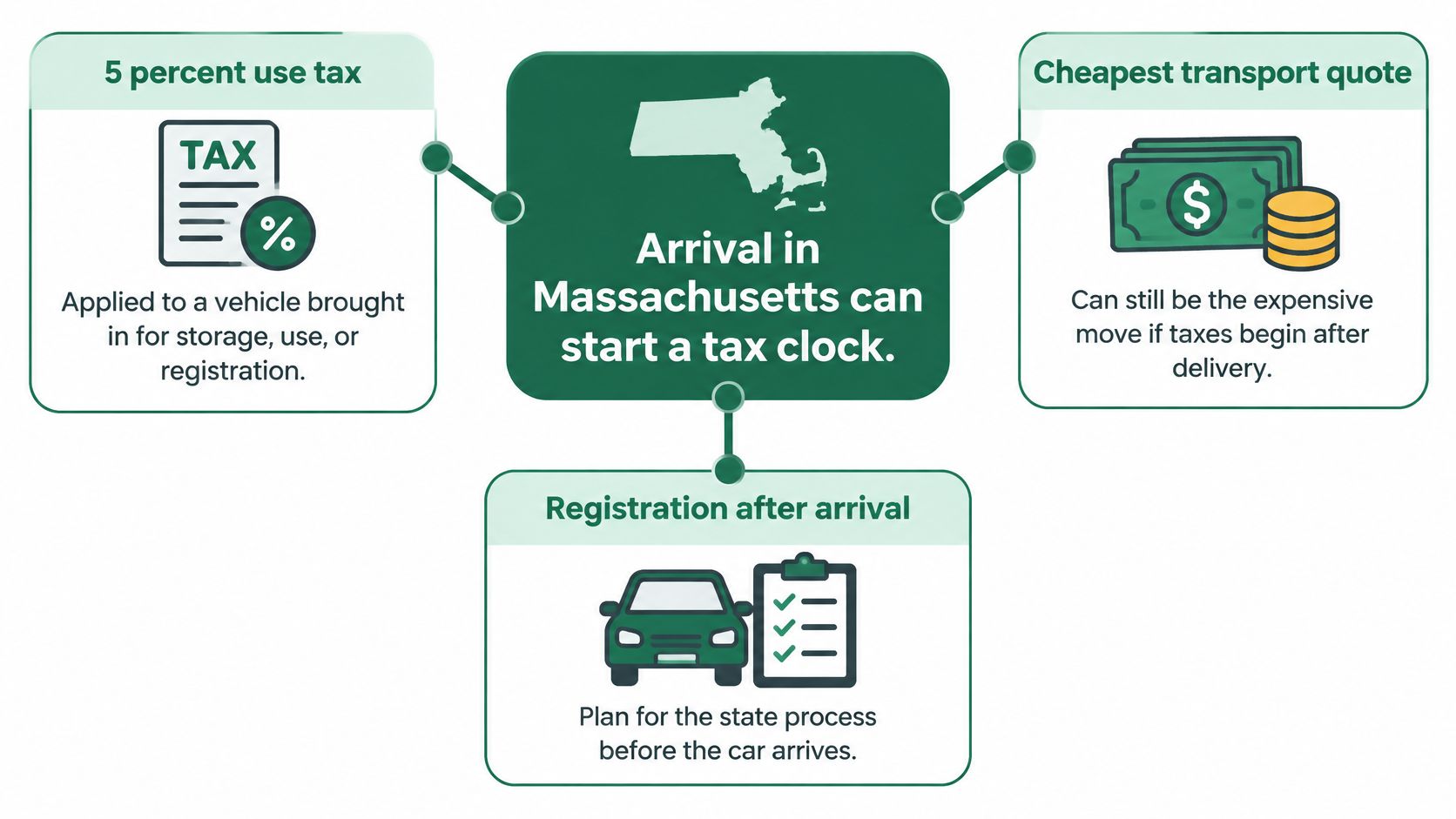
The lowest carrier price is not the lowest cost of getting the car legally on Massachusetts roads.
Run Your Facts Through a Short Decision Path
Start with purchase timing. If you bought the car in Florida last week and you're establishing Massachusetts residency, budget for a possible 5% use tax question and identify which event starts the 10-day filing clock. Don't assume the clock starts when you booked the truck.
Next, look at use history. If you've owned and used the car exclusively outside Massachusetts for more than six months, the state's presumption may not fit your facts. You still need a registration path, title documents, any lien release, insurance, and an RMV appointment.
Then test residency facts. Snowbirds, remote workers, students, and military families can have facts that look similar from the outside and differ for registration purposes. PCS orders, a seasonal home, a school address, and a permanent relocation aren't interchangeable.
- Recently purchased vehicle: Highest surprise risk. Budget tax before you judge the transport quote.
- Long-owned Florida vehicle: Document purchase date and exclusive out-of-state use, then confirm how the RMV treats it.
- Seasonal or military stay: Don't assume shipping the car north either creates or avoids an exemption.
- Dealer or online purchase: Confirm title transfer timing, because purchase, transfer, and first use dates can matter.
The carrier's bill of lading proves transport and delivery condition. It doesn't title or register the car, and it doesn't answer the tax question. Confirm the current interpretation with the Massachusetts RMV or Department of Revenue before delivery if your purchase is recent or your residency status is changing.
I would make that call before spending the savings from a cheaper quote. The strongest quote comparison includes freight, likely tax exposure, title and registration costs, and the time you'll spend resolving them after the truck leaves.
Salt Belt Care After a Clean Delivery
Massachusetts road salt and winter moisture can accelerate corrosion after a vehicle arrives from Florida. Salt collects under the car, in wheel wells, around fasteners, and along body seams. A clean delivery receipt records the vehicle's condition at drop-off, not how it will hold up through its first Massachusetts winter.
Prepare in Florida, Before the First Freeze
Inspect the underbody with a flashlight or on a lift before departure. Photograph existing surface rust, exhaust components, brake lines, subframe edges, and rocker panels. These images give you a baseline for later inspections.
Test the battery. A weak battery may start reliably in Florida heat and struggle on a cold Massachusetts morning. Check that the coolant's freeze protection suits winter temperatures, replace worn wipers, and fill the washer reservoir with winter-rated fluid that can clear salt film.
Check tire type and tread. Summer tires are poorly suited to slush and ice. If the car arrives late in autumn, arrange all-season or winter tires before driving it in winter conditions.
Classics, luxury cars, and vehicles stored for months need extra attention to seals, tires, brakes, and batteries. Heat can age rubber and weaken batteries, while cold weather makes those problems more noticeable. Enclosed transport can reduce transit grime, but it does not prepare a car for winter.
Rinse and Inspect After Arrival
After driving on salted roads, rinse the underbody and wheel wells with fresh water. Use moderate pressure so water does not get forced into electrical connectors, sensors, or body seams. Dry the car where possible, and clean slush residue from carpets before it sets into the fibers. Follow these steps to prevent salt stains from reappearing.
Arrange an inspection soon after delivery if the car arrives in November. Snowbirds returning in early autumn have more time to wash, inspect, and prepare before freezing weather becomes routine.
Prioritize tires, battery, coolant, and an underbody inspection before cosmetic detailing. Paint can wait for spring. A failed start, unsuitable tires on ice, or corroded brake lines cannot.
Lock the Rate Before the Window Closes
Compare the full move cost, not just the carrier quote. Freight, possible Massachusetts use tax, registration, and winter preparation all affect what the move costs after delivery. A small difference between bids can matter less than the tax bill or corrosion prevention that follows.
For a running daily driver, open transport is the practical default on this route. Enclosed service costs more, but may suit a collectible, a luxury finish, or a low splitter. It does not replace winter tires, a battery check, or an RMV plan.
Book While Your Dates Are Still Flexible
Give the dispatcher two or three workable pickup days, a phone number that will be answered, accurate vehicle-condition details, and a backup meeting lot if either street is difficult for a truck. Flexible dates give dispatch more options and can help protect the rate.
National Car Transport describes its service as door-to-door transport across all 50 states, with more than 25 years of experience, an A+ BBB rating, flat-rate pricing, and no upfront charge until a carrier is matched. It offers open and enclosed carriers through a nationwide network of more than 25,000 vetted, licensed, and bonded drivers. Bilingual agents provide support in English and Spanish, with some Portuguese.
Vehicle details affect the dispatch plan. A snowbird sedan near I-95, a non-running project car outside Orlando, a student vehicle headed to Boston, and a dealer purchase bound for Worcester may need different equipment and timing. Have the title or registration, VIN, running condition, and both addresses ready when requesting a quote.
If an instant quote seems high, ask whether different dates or carrier options change the written price before booking. National Car Transport can be reached by phone or text at (800) 320-1050, with service available year-round. Request a quote based on your actual vehicle and pickup window.
Ready to set a Florida-to-Massachusetts pickup window? Request a written quote from National Car Transport and have your VIN, vehicle condition, and both addresses ready.