
Hawaii had 1,264,579 registered motor vehicles in 2024, a scale that makes shipping cars to the islands a practical part of moving people and goods, not a niche service, according to Hawaii's 2024 State Data Book. If you need to ship a vehicle to Hawaii from the mainland, plan for more than the sailing: your method, paperwork, port cutoff and destination island all affect when the car is ready for pickup.
Table of Contents
- Hawaii Car Shipping at a Glance
- Electric and Hybrid Vehicles Need an Extra Check
- How Long Each Leg of the Trip Takes
- What Drives Hawaii Car Shipping Costs
- How to Prepare Your Car and Paperwork
- Pickup, Port Drop-Off and Insurance Tips
- Book Your Hawaii Shipment with the Right Plan
Hawaii Car Shipping at a Glance
Operable vehicles usually travel by roll-on/roll-off (RoRo), driven onto the vessel and secured on a vehicle deck. A container is the alternative for owners who want the vehicle enclosed or need a method better suited to a classic, low-clearance or high-value car.
Hawaii's road network is separated by ocean, so a mainland shipment needs an ocean leg, followed by local delivery or, for some destinations, onward island transport. The state's vehicle population is spread across several islands: Honolulu had 780,978 registered vehicles in 2024, compared with 216,949 on Hawai'i Island, 179,842 on Maui and 86,810 on Kaua'i, according to the Hawaii 2024 State Data Book. Oahu's concentration makes its port infrastructure a major gateway, while the other islands also require vehicle distribution.
| Method | How the car travels | Best fit | Protection | Main trade-off |
|---|---|---|---|---|
| Roll-on/roll-off (RoRo) | Driven onto the vessel and secured on deck | Operable cars, SUVs and trucks on the regular weekly sailing | Lower, exposed to weather on deck | Usually the lower price, but only factory-installed items may stay inside |
| Container | Loaded into a shared or dedicated container and sealed | Classic, low-clearance or high-value vehicles | Higher, enclosed from weather and road debris | Usually priced higher, and container space can add scheduling time |
Decision rule: If the car runs, rolls, steers and brakes and doesn't need special protection, start with RoRo. If it's a collector car or you want more protection, compare container pricing before booking. Check eligibility separately for electric and hybrid vehicles, since the transport method alone doesn't determine whether a carrier will accept them.
Electric and Hybrid Vehicles Need an Extra Check
A battery question can decide whether your car sails on the date you booked. New and used electric vehicles and plug-in hybrids may be refused under current carrier policies because of safety concerns involving large lithium-ion batteries, according to the carrier's EV shipping information. Acceptance can change by carrier, vessel and route, so get a clear answer before you arrange mainland pickup or pay to prepare the vehicle.
| Vehicle type | Acceptance risk | What to confirm before booking |
|---|---|---|
| Fully electric (BEV), new or used | High; carriers may refuse | Battery state-of-charge limit and the carrier's battery-safety policy |
| Plug-in hybrid (PHEV), new or used | High; carriers may refuse | The same battery rules as fully electric vehicles |
| Conventional hybrid | Not named in carrier policy | Acceptance confirmed in writing |
| Any EV or hybrid with a damaged, recalled or modified battery | Highest | Disclose the issue and request the manufacturer's transport guidance |
Treat eligibility as a vehicle-specific check. Before booking, ask three things:
- Ask about charge limits. Get the carrier's battery state-of-charge requirement in writing.
- Disclose the battery's condition. State whether it's damaged, recalled or modified, even if the vehicle still drives.
- Request manufacturer guidance. Check the vehicle maker's transport instructions and share relevant details with the carrier.
Military families relocating with newer vehicles, luxury EV owners and snowbirds moving late-model hybrids should make this check early. A battery concern discovered at the port can derail a pickup and leave you with a vehicle that isn't accepted for the scheduled sailing. If you're handling a small repair before the move, a practical guide to installing a replacement door handle covers that job separately from the carrier's safety and acceptance requirements. A late battery answer can miss the port cutoff, which pushes the sailing and any neighbor-island barge connection, so the delivery date moves with it.
How Long Each Leg of the Trip Takes
Hawaii door-to-port shipments take 10 to 18 days total. That clock starts at mainland pickup and ends at port release in Hawaii, and the ocean crossing is only one part of it.
| Leg | Honolulu | Neighbor islands (Hilo, Kahului, Nawiliwili, Kona) |
|---|---|---|
| Trucking to West Coast port | Several days, varies by origin distance | Several days, varies by origin distance |
| Sailing at sea | About a week | About a week plus connecting transfer |
| Port processing and inspections | Included in total | Included in total, neighbor islands can add a few days |
| Typical total range | 10 to 18 days door-to-port | 10 to 18 days door-to-port, plus a few extra days |
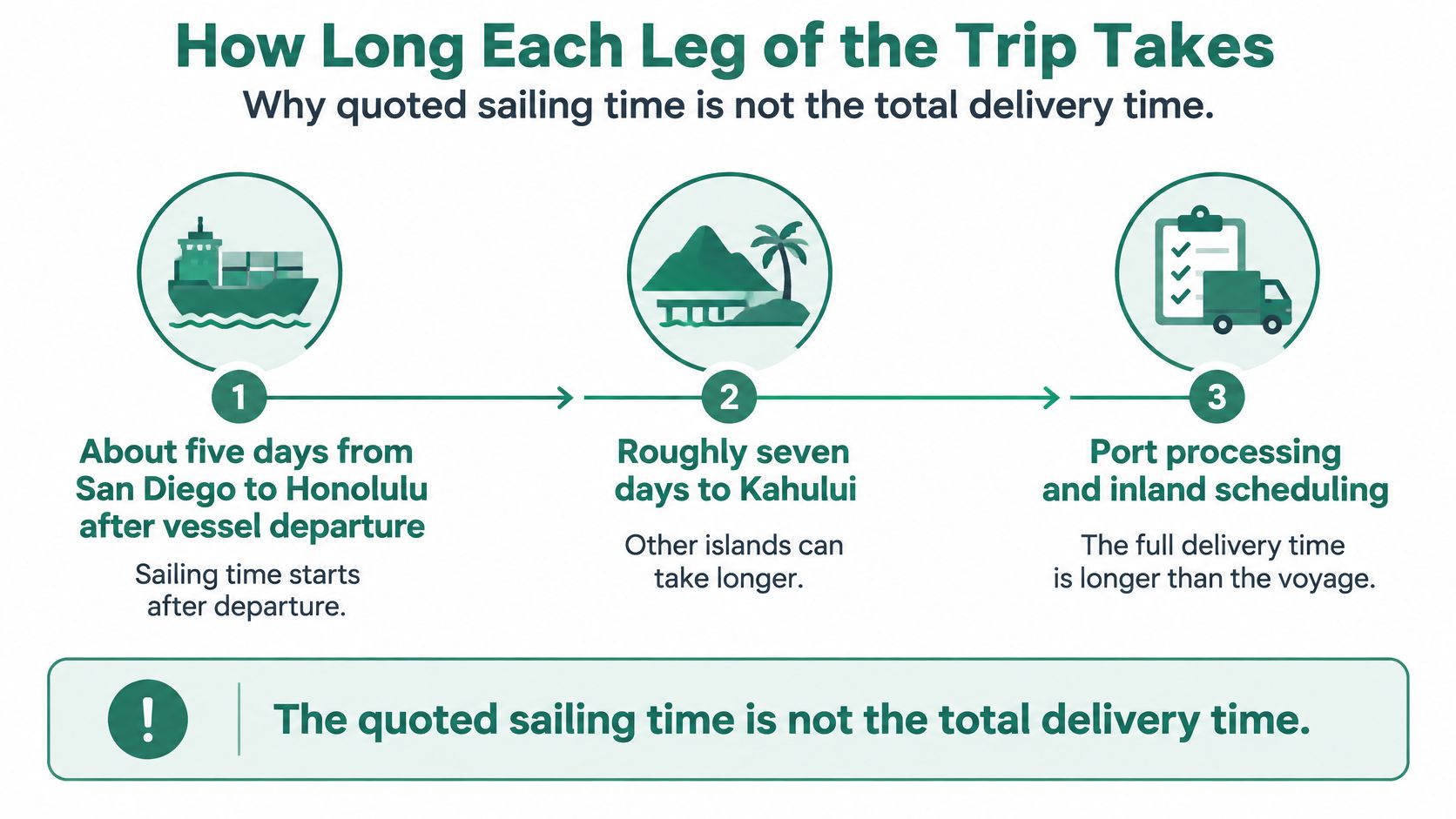
Hawaii sailings connect to the mainland West Coast on weekly sailings through Honolulu, Hilo, Kona, Nawiliwili, and Kahului. Vehicles are inspected at the port before sailing and immediately after arrival, and both inspections are documented. That handling plus the port cutoff decides the actual delivery date as much as time at sea.
Before the vessel leaves, the vehicle must reach the correct West Coast port, clear booking and document checks, complete the pre-sailing inspection, and arrive before cutoff. Miss that cutoff and the car waits for the next weekly departure. Paperwork corrections, weekends, and destination release can also extend the schedule. For comparison on how island routing differs elsewhere, Puerto Rico car shipping uses a separate ocean and delivery arrangement.
Planning rule: Book backward from the date you need the vehicle, and leave at least one extra sailing cycle for a neighbor-island move. Confirm whether the quote covers port-to-port or door-to-door responsibility, when pickup appointments are available, and who pays storage if the vehicle waits at a terminal.
After pickup in Hawaii, registration is due within 30 calendar days. Confirm which plate and permit option applies to your circumstances and allow time to complete the paperwork.
What Drives Hawaii Car Shipping Costs
The inland distance to a West Coast port often surprises owners more than the ocean leg. A car collected in Houston, Dallas, Chicago or Phoenix first needs to travel by truck to the port, so an ocean-only rate won't tell you the full cost.
| Cost driver | How it changes the price | What to confirm |
|---|---|---|
| Origin distance | Inland pickups add a truck leg to a West Coast port | Whether the quote includes trucking to the port |
| Shipping method | Container is usually priced above RoRo | Price both methods for your exact vehicle |
| Destination island | Neighbor islands can add a barge leg and longer waits | Port-to-port or door-to-door responsibility |
| Vehicle size and type | Larger SUVs, trucks and vans are quoted higher | Exact make, model and dimensions |
| Enclosed or special handling | Adds to the base rate | Whether it's included or charged extra |
| Sailing flexibility | A missed sailing can add storage or demurrage | The next available sailing date |
As a price reference, a sedan shipped from California to Honolulu typically costs $1,500–$2,300. Inland shipments cost more because the vehicle must first travel by truck to a West Coast port. That range is a useful starting point, not a substitute for a quote that reflects your vehicle, origin and destination.
A complete quote should spell out the mainland trucking, ocean freight and port handling rather than leave you to assume which legs are included. Compare the total service and its responsibilities, not just the lowest line item. A port-only rate may require you to arrange your own transport to or from the terminal.
When comparing providers, review a car-shipping cost breakdown alongside the written quote. Then ask three direct questions: What's included in the total? Is trucking to the port included? What charges apply if the vehicle misses its sailing or waits at the terminal?
How to Prepare Your Car and Paperwork
Paperwork can stop a shipment before the vehicle reaches the port. Book the ocean movement before port delivery, then match the documents and vehicle details to that booking. The carrier's vehicle-shipping requirements outline the core paperwork and condition rules.
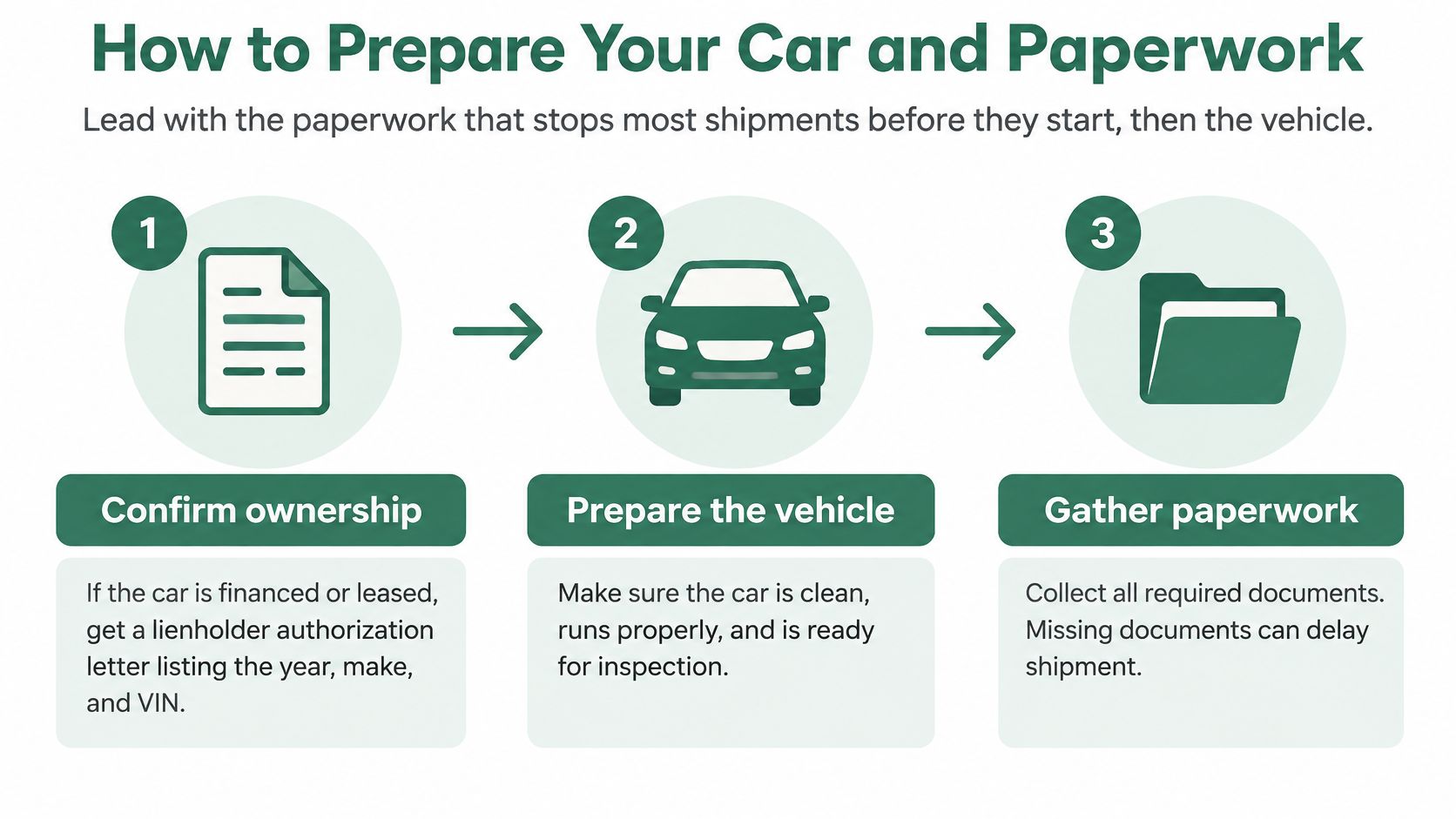
Confirm ownership. If the car is financed or leased, get a lienholder authorization letter listing its year, make, model, VIN, destination port and authorized shipper. A missing or incomplete authorization is a common reason for a port acceptance delay.
Match the documents to the booking. Bring the booking number, government-issued identification and current registration; where required, provide the original title or a notarized copy. Check that the owner and vehicle details agree across the documents before port delivery.
Wash and inspect the vehicle. Clean the exterior and remove dirt, mud and plant material so the inspection can record the car's existing condition accurately. Concealed dirt or agricultural material can delay acceptance or inspection, so take dated photographs after washing.
Remove prohibited items and accessories. Clear out personal belongings, roof carriers, bike racks, auxiliary batteries, fire extinguishers, propane tanks and ignition-interlock devices. Only factory-installed items and child car seats may remain inside; non-factory accessories must be removed before port acceptance.
Check the fuel level. Leave approximately one-eighth to one-quarter of a tank. Excess fuel can delay acceptance, so don't rely on a low-fuel warning as a substitute for checking the gauge.
Confirm the car's operating condition. The vehicle should be operable, have a functioning emergency brake and show no fluid leaks. A leak or a brake that doesn't hold can create a safety problem during handling and stop the vehicle from being accepted.
For a Hawaii-origin outbound move, check the agricultural declaration before packing anything into the car. It excludes items such as fresh produce, sugar cane, cotton, straw, grass and pulpy seeds.
At the port, a ready vehicle is clean, nearly empty, matched to its booking documents and free of visible leaks. Keep the authorization letter and dated photographs available, rather than assuming a last-minute correction will fit the sailing cutoff.
Pickup, Port Drop-Off and Insurance Tips
Start by matching the destination port to where the car will be driven. Hawaii shipments use Honolulu, Hilo, Kona, Nawiliwili and Kahului; choosing the wrong island port can add a connecting move and more coordination.
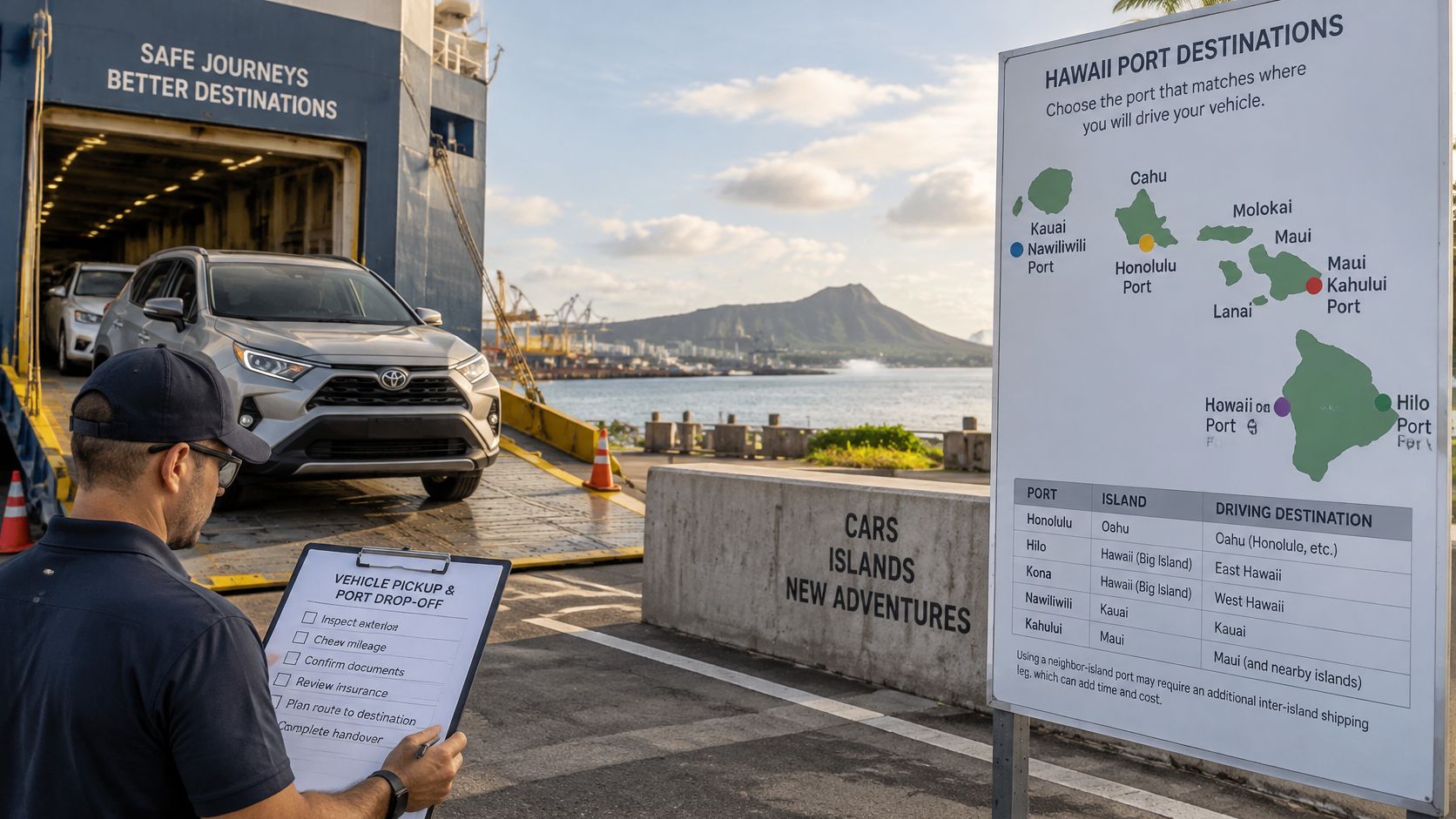
At pickup and port drop-off
Before the vehicle changes hands, photograph the odometer, each exterior panel and the interior. Keep those dated images with the inspection report, title and registration so you can compare the recorded condition at delivery.
Vehicles are inspected at the port before sailing and immediately after arrival, and both inspections are documented. Keep a copy of each report and check that existing damage is recorded before signing the bill of lading. For the mainland portion, confirm the pickup location, port delivery responsibility and timing through the agreed door-to-door auto transport arrangement.
Confirm coverage and delivery condition
Ask for the carrier's certificate of insurance and confirm the cargo coverage limit. Personal belongings are usually excluded, which is another reason to clear the cabin rather than treat it as extra storage.
At destination, compare the vehicle against your origin photographs before signing. If you find new damage, note it on the bill of lading at delivery; a clean signature can make a later dispute harder to support. Keep a copy of the signed paperwork and report any concern promptly through the carrier's claims process.
After pickup in Hawaii, arrange registration within 30 calendar days, or obtain a permit that allows out-of-state plates to remain in use until they expire. Don't leave that step until the last minute: gather the inspection and ownership documents you'll need while the shipment paperwork is still at hand.
Book Your Hawaii Shipment with the Right Plan
The sailing time is only one leg. A realistic plan starts with the method, the time available and the port that serves the final island, then works backward from port cutoff to mainland pickup. A California to Honolulu sedan typically costs $1,500–$2,300, while an inland origin costs more because the car must first travel by truck to a West Coast port.
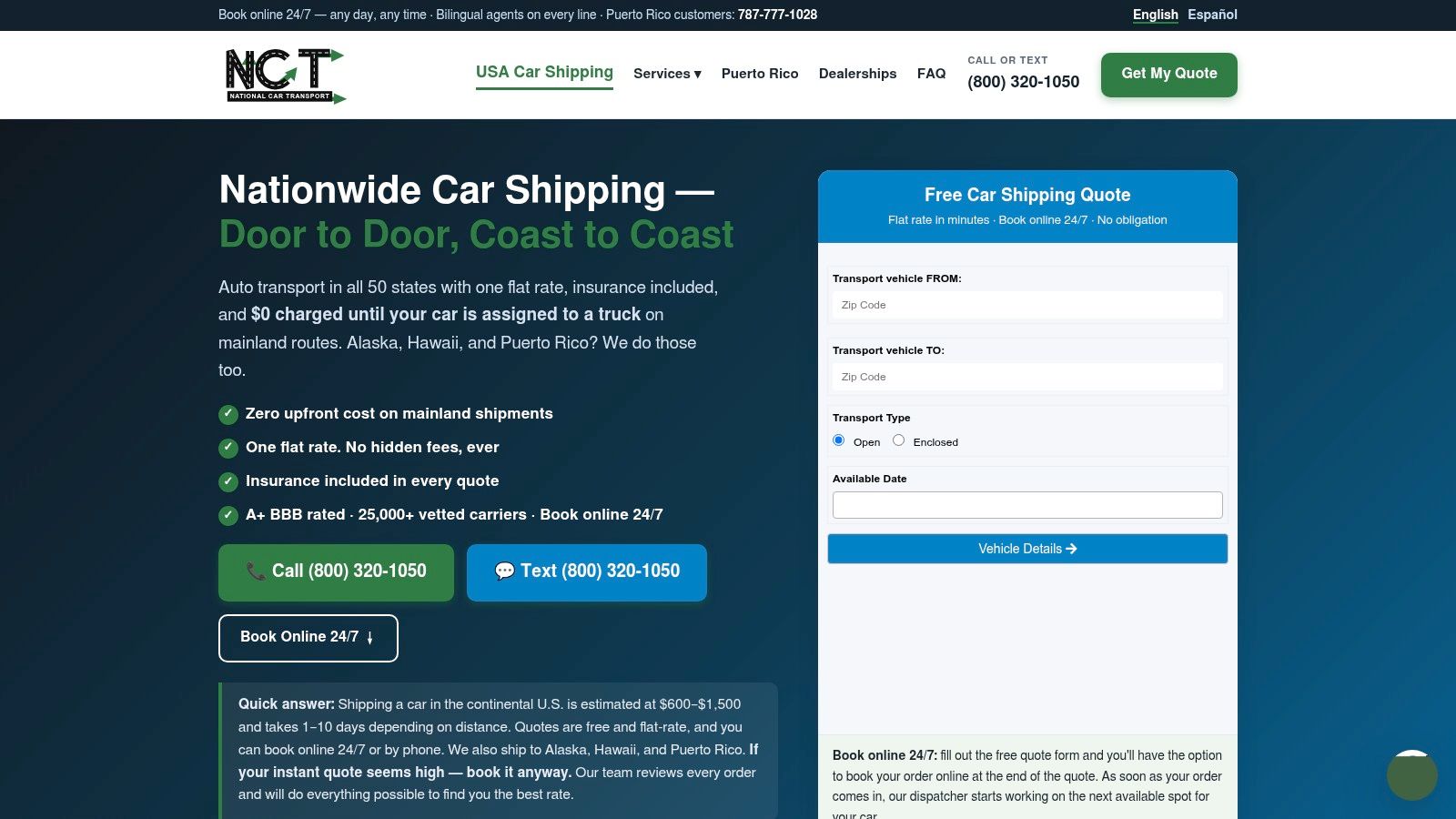
National Car Transport quotes Hawaii shipments at one flat rate with insurance included, covering trucking, ocean freight and port handling; a deposit at booking secures the sailing. The company has 25+ years of experience, an A+ BBB rating and a network of 25,000+ vetted carriers. Its U.S.-based bilingual English- and Spanish-speaking agents can help coordinate the details of an individual shipment.
Compare the full door-to-port quote, not the ocean charge alone. Neighbor-island delivery, a missed cutoff, or incomplete paperwork moves the delivery date more than the week at sea does.
For people coordinating travel as well as a vehicle move, it can also help to book Big Island island-hopping flights, since the car's port and your own itinerary may not line up automatically.
Hawaii is one part of a wider U.S. auto-transport network. For mainland moves, common city-to-city routes include Birmingham, Montgomery, Anchorage, Phoenix, Little Rock, Los Angeles, Denver, Hartford, Wilmington, Jacksonville, Atlanta, Honolulu, Boise, Chicago, Indianapolis, Des Moines, Wichita, Louisville, New Orleans, Portland, Baltimore, Boston, Detroit, Minneapolis, Jackson, Kansas City, Helena, Omaha, Las Vegas, Concord, Newark, Albuquerque, New York City, Charlotte, Fargo, Columbus, Oklahoma City, Salem, Philadelphia, Providence, Columbia, Pierre, Nashville, Austin, Salt Lake City, Montpelier, Richmond, Olympia, Charleston, Madison and Cheyenne. Large-city population examples include New York City, Los Angeles, Chicago, Houston and Phoenix, according to the U.S. Census Bureau's 2024 city population estimates. Actual pickup or delivery can be in a suburb, rural community, dealership, auction location or port-adjacent area, so give the carrier the full addresses, vehicle details, operability and preferred dates.
Puerto Rico is also a U.S. territory for vehicle-import purposes, not a foreign country under the import procedures described by the Pennsylvania DMV's import and export guidance. A move between the mainland and Puerto Rico still requires coordination for pickup, ocean transport, delivery and destination registration. For a shipment to San Juan, confirm the handoff and documentation for the route, especially if you're coordinating a military relocation, seasonal move, student transfer or dealership inventory.
Gather the title or lienholder authorization, your destination port and preferred dates before requesting a Hawaii quote. Those details give a logistics agent what is needed to check eligibility, plan the sailing and explain which parts of the journey the price covers.
For a Hawaii move, National Car Transport can coordinate mainland trucking, ocean freight and port handling under one insured flat rate, with a bilingual agent to help plan the shipment. Gather your vehicle documents, destination port and preferred dates, then request a quote from National Car Transport.