
Shipping a standard sedan from the West Coast to Honolulu usually lands in the $1,800 to $2,800 range, and the most common all-in benchmark for a standard vehicle headed to Hawaii is about $3,200 when mainland transport to the port and ocean freight are both included. If your route is less direct, your vehicle is larger, or you need inland transport before it even reaches the ship, the price can climb fast.
That's the part that can be frustrating. You're already coordinating housing, flights, paperwork, maybe a military move or a school start date, and then the car question hits: keep it, sell it, or ship it? For many people, shipping makes sense. But only if you understand what you're paying for.
A lot of articles throw out one number and leave it there. That's not how island vehicle shipping works. Ship vehicle to Hawaii cost depends on where the car starts, which Hawaiian port it's going to, how the carrier classifies the vehicle, and whether you're doing port-to-port or adding inland trucking.
That's also why people who ship vehicles regularly between the mainland and non-contiguous markets like Hawaii, Alaska, and Puerto Rico usually approach these moves differently than a simple lower-48 route. The logistics are layered, and the quote should reflect that clearly.
Table of Contents
- Planning Your Move to Paradise and Your Car
- Why Hawaii Shipping Costs More Than Mainland Routes
- Decoding Your Quote A Breakdown of Key Cost Factors
- Sample Shipping Scenarios and Price Estimates for 2026
- Navigating the Timeline From Pickup to Island Delivery
- Expert Tips to Reduce Your Hawaii Shipping Cost
- Get Your Exact Quote from a Hawaii Shipping Expert
Planning Your Move to Paradise and Your Car
You book the flight, sign the lease, tell family you're moving to Hawaii, and then reality shows up in the driveway. Your car has to get there too.
For some people, it's a sedan they've already paid off. For others, it's the family SUV, a student's compact car, or a pickup that's needed for work. The question is always the same: what's this going to cost, and how complicated is it going to be?
The price question hits early
The answer usually starts with route and service level. If you're moving a standard sedan from a major West Coast port to Honolulu, you're often looking at a cost that fits the opening range above. If you need door-to-port service, port-to-door service, or you're shipping to a less accessible island port, the quote changes because the shipment has more moving parts.
That's why broad averages help, but they don't solve the problem. People don't ship averages. They ship one specific vehicle from one specific place on one specific timeline.
Practical rule: If your move includes both mainland trucking and ocean transport, treat it as two linked shipments, not one simple route.
Different shippers need different answers
A military family handling PCS paperwork has a very different set of cost questions than a snowbird splitting time between states. A college student usually cares about the cheapest workable option. A dealership or business shipping inventory cares more about consistency, scheduling, and clean documentation.
The same is true across other non-contiguous routes. Mainland-to-Puerto Rico shipping has similar decision points because island transport doesn't behave like a standard domestic lane between cities such as Miami, Dallas, Phoenix, Chicago, Los Angeles, Atlanta, or San Juan. You're dealing with port systems, vessel schedules, terminal rules, and added handling.
Here's the good news. Once you understand the cost structure, the process gets less intimidating. You can spot a realistic quote, avoid bad assumptions, and make a cleaner decision about whether shipping your car to Hawaii is worth it.
Why Hawaii Shipping Costs More Than Mainland Routes
Mainland car shipping and Hawaii car shipping are not close cousins. They're different jobs.
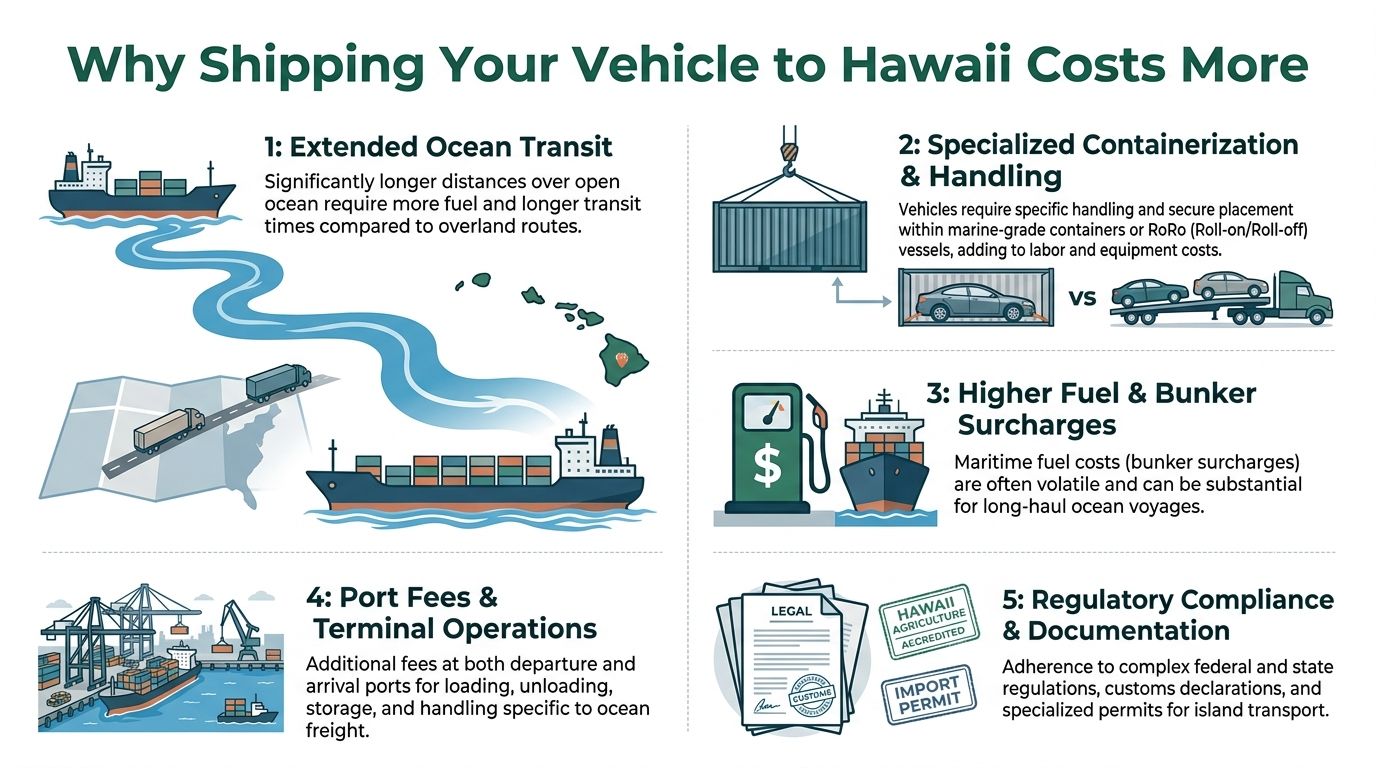
A standard lower-48 move usually involves one transport mode. A truck picks up the vehicle and delivers it. Hawaii adds a second logistics layer, and that's where many customers underestimate the cost. According to Move.org's Hawaii car shipping guide, shipping a car to Hawaii typically adds about $1,000 to $1,500 compared with a similar-distance move within the continental U.S. The same guide estimates an average Hawaii shipment for a standard vehicle at around $3,200, combining about $1,080 in ground transport to a West Coast port and roughly $2,100 in ocean freight.
Two separate logistics legs
That extra cost doesn't come from one mystery fee. It comes from the structure of the move itself.
First, the vehicle often has to reach a mainland departure port. If you live near Long Beach, Oakland, or another practical departure point, that leg may be manageable. If the car starts in the Midwest, the South, or Alaska, inland transport becomes a major part of the bill.
Second, the car still has to cross the Pacific. That means terminal intake, port handling, loading onto a vessel, ocean transit, unloading, and release at the destination port. Even when the ocean leg looks simple on a map, the operation behind it isn't.
Why island freight changes the math
Hawaii shipping also carries costs that don't show up on a straight mainland run:
- Port operations matter: your vehicle has to be checked in, staged, loaded, unloaded, and released through terminal procedures.
- Marine handling is specialized: carriers use systems built for vessel transport, not standard over-the-road delivery alone.
- Routing is tighter: fewer lanes and fixed sailings leave less flexibility than a truck route between mainland cities.
- Add-on geography matters: Honolulu is usually easier than secondary Hawaiian ports.
The mistake I see most often is treating Hawaii like a long California route. It isn't. It's a port move plus an ocean move, with inland transport often attached before either one starts.
Puerto Rico gives useful context
People who ship vehicles to and from Puerto Rico from the mainland run into a similar logic chain. Whether the route starts in New York, Orlando, Houston, Jacksonville, Los Angeles, or Chicago and ends in San Juan, the shipment depends on port access, vessel scheduling, documentation, and local release rules. That's why island shipping expertise matters more than flashy low quotes.
The cost is higher because the job is harder. That's the honest answer.
Decoding Your Quote A Breakdown of Key Cost Factors
Most customers don't need a lecture on freight theory. They need to know why one quote is materially higher than another.
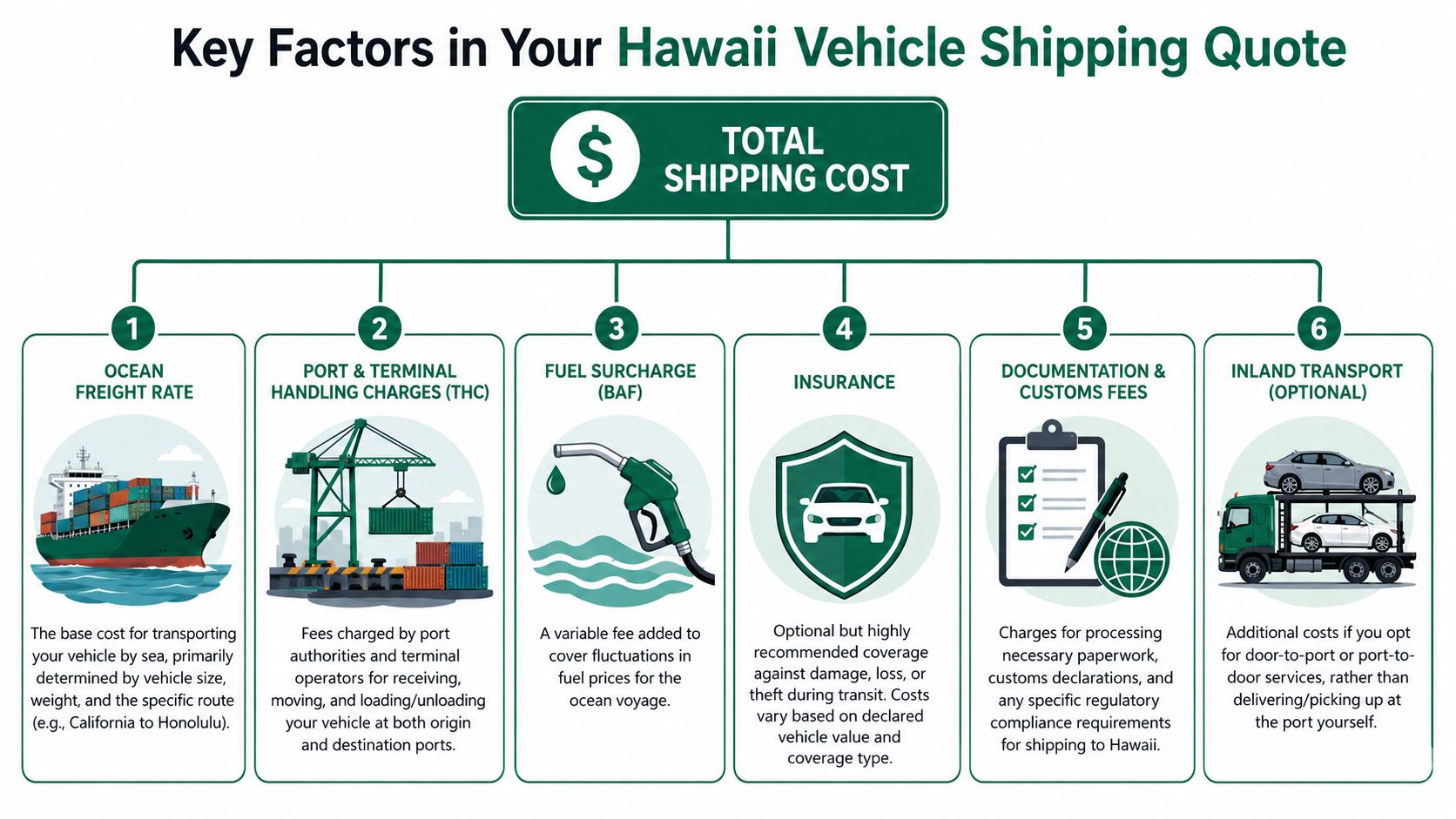
A Hawaii shipping quote usually combines several cost drivers. If a company can't explain those clearly, move on.
Vehicle size and weight drive the ocean rate
This is one of the biggest pricing levers. According to Hawaii Car Transport's pricing breakdown, carriers segment vehicles by weight class, and heavier vehicles can see an ocean freight component that is 20% to 40% higher than lighter vehicles on the same route. That's why a sedan, a Honda Pilot-class SUV, and a full-size pickup won't price the same.
Weight class matters because space on a vessel isn't just about footprint. Heavier units affect handling, lashing, and fuel use. If your vehicle sits close to a threshold, even accessories can matter.
A few examples that can affect classification:
- Roof racks and exterior add-ons: these may contribute to oversize handling concerns.
- Long-wheelbase trucks: these don't move like compact sedans in a tariff system.
- Cargo left in the vehicle: this can create problems for both billing and acceptance.
Route and destination port change the quote
Origin and destination are not minor details. They are pricing fundamentals.
A shipment that starts near a major West Coast port is usually more straightforward than one that needs a truck hauled across several states first. On the Hawaii side, Honolulu is usually the simplest destination. Secondary ports often cost more because the routing and handling are less efficient.
Here's a clear perspective:
| Cost driver | Why it changes price |
|---|---|
| Major mainland port access | Reduces inland trucking complexity |
| Secondary mainland origin | Adds overland transport before the ocean leg |
| Honolulu destination | Usually the most straightforward Hawaii release point |
| Hilo, Kahului, or Nawiliwili | Often involves more handling or more limited routing |
The video below gives a useful visual overview of Hawaii vehicle shipping logistics.
Service level changes what you pay for
Port-to-port is usually the leanest option because you handle the mainland drop-off and Hawaii pickup. Door-to-port or port-to-door adds convenience, but it also adds labor, scheduling, and an extra carrier leg.
That distinction matters for people shipping from inland cities such as Denver, Nashville, Minneapolis, Kansas City, or Boston. It also matters for Puerto Rico-bound moves from the mainland where customers often compare port delivery against full-service pickup.
Best money-saving move: If you can reasonably deliver your car to the departure port and retrieve it at the destination port, port-to-port service usually gives you the cleanest price.
Insurance and paperwork still deserve attention
Even when the rate looks attractive, don't gloss over coverage and documentation. You should know what's included, what condition reporting is required, and what happens if the car arrives with an issue. Cheap quotes often get fuzzy right where accountability should be sharpest.
A good quote isn't just lower. It's understandable.
Sample Shipping Scenarios and Price Estimates for 2026
Real people don't shop by theory. They look for a scenario that feels close to their own.
The most reliable published benchmark for ocean freight on Hawaii lanes comes from Matson's vehicle rate and payment information, which shows terminal-to-terminal rates for standard autos from major West Coast ports to Honolulu typically around $1,790 to $2,600 as of 2026. The same source shows routes to Hilo, Kahului, and Nawiliwili often around $2,600 or more. It also highlights how inland trucking can push totals much higher on remote origins.
2026 Estimated Hawaii Vehicle Shipping Costs Sample Scenarios
| Scenario | Vehicle Type | Origin → Destination | Estimated Cost Range |
|---|---|---|---|
| Straightforward port move | Standard sedan | Long Beach → Honolulu | $1,790–$2,600 |
| Similar major-port route | Standard sedan | Oakland → Honolulu | $1,790–$2,600 |
| Neighbor island routing | Standard sedan | Long Beach or Oakland → Kahului | $2,600 or more |
| More complex island destination | Standard sedan | Long Beach or Oakland → Hilo | $2,600 or more |
| Inland plus ocean | Standard sedan | Mainland pickup + West Coast port + Honolulu | Often aligns with the broader all-in benchmark discussed earlier, depending on inland distance |
| Remote origin example | Standard vehicle | Anchorage → Honolulu | Just over $6,400 |
| Very remote origin example | Standard vehicle | Fairbanks → major Hawaiian ports | Exceeding $10,000 |
How to read these examples correctly
The first two rows are pure terminal-to-terminal examples. They are useful if you can get the car to the port yourself and pick it up at the Hawaii terminal. That's often the most cost-effective option for people already located in California or Northern California lanes.
The middle rows show what happens when the Hawaiian destination is less accessible. Honolulu is usually the easiest target. Maui, the Big Island, and Kauai commonly cost more because the routing requires added handling or less direct service.
The last rows matter because they expose the biggest pricing trap in this market. Many customers focus on the ocean leg and ignore the inland leg. If the vehicle starts far from practical departure ports, the truck move to the ship can become the dominant cost.
Which scenario fits different shippers
- Military families near West Coast bases: often have the cleanest path if their route lines up with major port access.
- Snowbirds and retirees: usually do best when they can stay flexible on timing and use port-to-port service.
- Students: should focus on a standard vehicle, simple route, and early planning.
- Businesses and dealerships: need repeatable process more than guesswork, especially if they also move inventory to Puerto Rico through San Juan and mainland hubs.
If your quote doesn't resemble one of these patterns, ask why. A solid answer should come quickly.
Navigating the Timeline From Pickup to Island Delivery
Cost matters first. Timing usually comes next.
People ask how long Hawaii shipping takes because they're trying to line up flights, housing access, work start dates, school schedules, or military reporting windows. The right answer is the process answer. Your vehicle doesn't teleport from a driveway to Oahu.
What the shipping timeline usually looks like
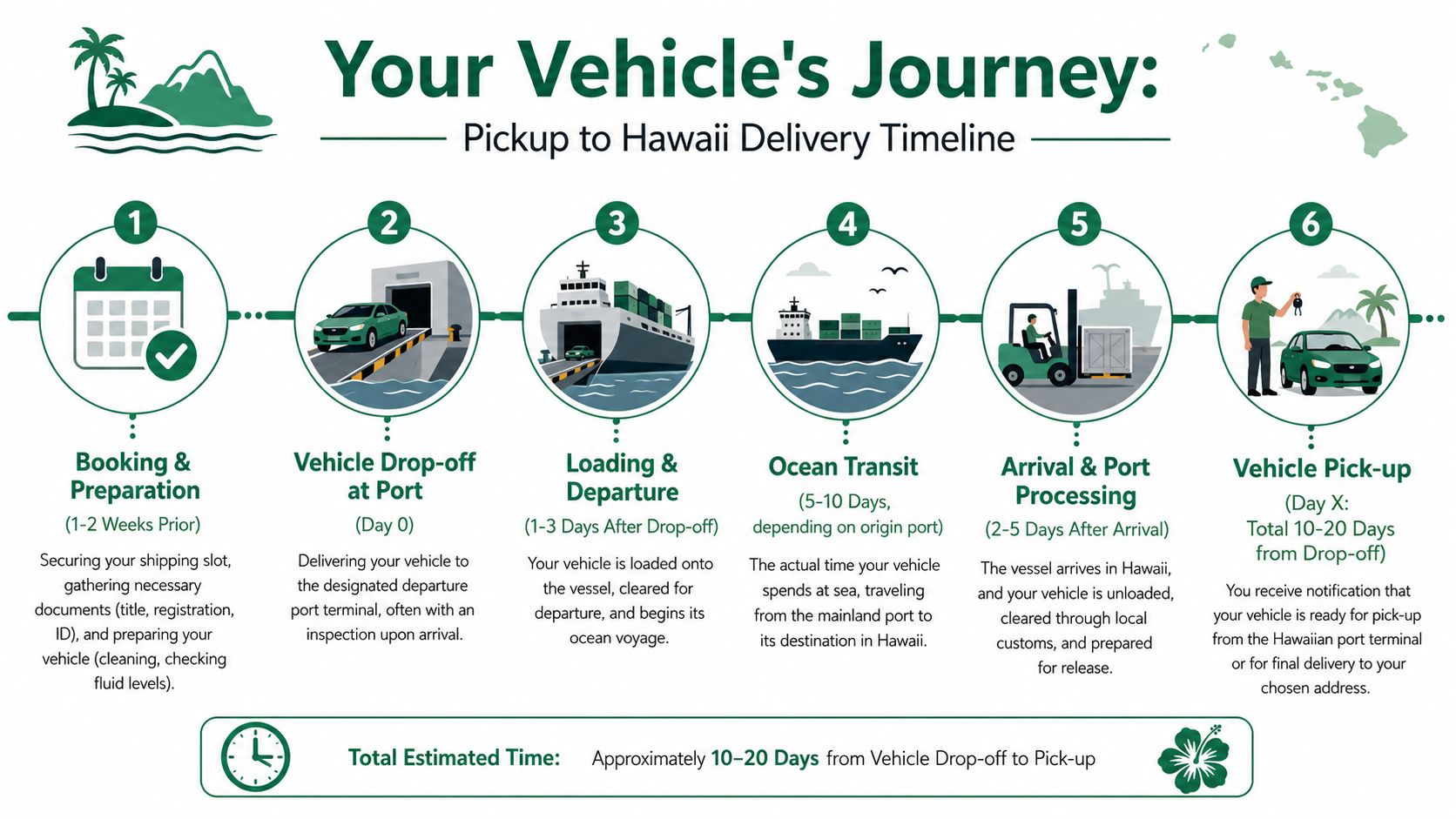
The graphic above lays out a practical planning sequence:
- Booking and preparation
- Vehicle drop-off at port
- Loading and departure
- Ocean transit
- Arrival and port processing
- Vehicle pickup or final delivery
That sequence matters because delays usually happen at handoff points, not while the car is sitting on a truck or vessel.
Where people lose time
Documentation issues slow shipments down. So does showing up with a dirty vehicle, leaving personal items inside, or misunderstanding port instructions. Hawaii-bound shipments are inspected closely, and terminal staff won't bend rules because your flight leaves tomorrow.
A cleaner workflow looks like this:
- Before drop-off: confirm ID, title or registration, lienholder requirements if applicable, and terminal instructions.
- At handoff: arrive on time, with the vehicle cleaned out and prepared according to port rules.
- After sailing: stay reachable so release or pickup coordination doesn't stall.
Missed details create preventable delays. Clean the vehicle, follow the port checklist, and keep your paperwork accessible.
Set expectations the right way
The infographic's planning windows are realistic for general scheduling. Booking and preparation often starts 1 to 2 weeks prior, loading may happen 1 to 3 days after drop-off, ocean transit is often 5 to 10 days depending on origin port, arrival processing may take 2 to 5 days, and the total can land around 10 to 20 days from drop-off based on the timeline shown above.
That doesn't mean every shipment lands at the fast end. It means you should plan conservatively. If your vehicle needs an inland truck move before reaching the departure port, build in more breathing room.
For customers using similar island routes to Puerto Rico, the same principle applies. Port systems run on schedules and procedures, not wishful timing. If you need the vehicle by a hard date, book earlier than you think you need to.
Expert Tips to Reduce Your Hawaii Shipping Cost
Individuals can't change the ocean. They can change how they book.
The biggest savings usually come from avoiding convenience you don't need, reducing the chance of add-on charges, and choosing a route structure that fits the actual vehicle. If you want to lower your ship vehicle to Hawaii cost, be disciplined instead of reactive.
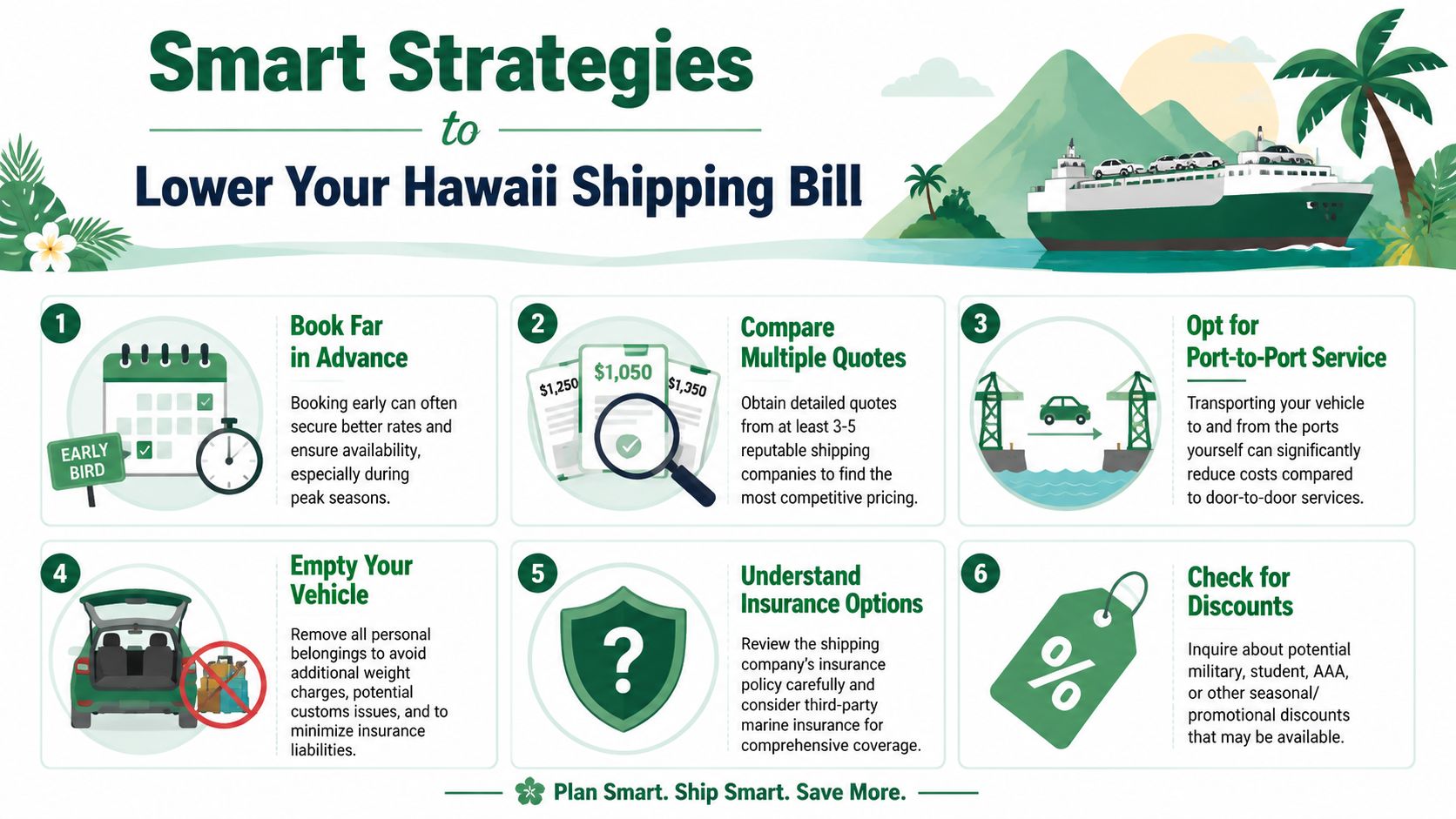
The moves that usually save money
- Book early: Island capacity isn't unlimited. Early booking gives you more routing options and fewer last-minute compromises.
- Choose port-to-port when practical: If you can drop off and pick up yourself, you cut out optional trucking legs that inflate the price.
- Ship the smallest practical vehicle: Larger vehicles often price into higher classes, so don't assume your SUV will quote like a sedan.
- Remove everything from the car: Personal items create weight, acceptance issues, and claims headaches.
- Stay flexible on exact timing: Tight deadlines can limit choices and force a more expensive solution.
Military families should push harder on allowances
This is the most overlooked cost-control angle in Hawaii shipping. According to Matson's Hawaii military vehicle shipping page, Matson advertises a $100 military discount for POV shipments to or from Hawaii. That same verified guidance also notes that many consumer-facing guides fail to explain how active-duty members may combine carrier discounts with Defense Personal Property System allowances that can help offset the broader $1,500 to $3,200 shipping range discussed in published consumer guidance.
If you're active duty, don't treat the posted commercial rate as the final answer until you've checked what your orders, command guidance, or approved channels may cover.
Ask two separate questions, not one. First: “What is the commercial rate?” Second: “What will my real out-of-pocket cost be after any military benefit or allowance applies?”
Don't chase the cheapest quote blindly
Lowball quotes are common in complex shipping lanes. They often leave out inland transport assumptions, terminal realities, or the actual vehicle class. That's how customers get surprised later.
Use this checklist when comparing offers:
| What to confirm | Why it matters |
|---|---|
| Port-to-port or door service | Service level changes the total materially |
| Vehicle class used in the quote | Sedans, SUVs, and trucks don't bill the same |
| Destination port | Honolulu and neighbor islands price differently |
| Required prep rules | Missed port requirements can create delays and extra hassle |
A cheap number without clear scope isn't a deal. It's a problem waiting to mature.
Get Your Exact Quote from a Hawaii Shipping Expert
The lesson is simple. Hawaii vehicle shipping costs make sense once you break the move into its actual components.
A straightforward port-to-port sedan move from a major West Coast port to Honolulu can be relatively predictable. The moment you add inland trucking, a larger vehicle, a secondary Hawaiian port, or a rigid deadline, the quote changes. That's normal. What matters is whether the quote is transparent enough for you to trust it.
The same logic applies whether you're relocating from the mainland, returning from Hawaii, shipping for a student, coordinating a military move, or moving inventory between the lower 48 and island markets like Puerto Rico through San Juan. Complex routes need clear advice, not vague promises.
If you want the right number, use your actual details. Vehicle type, running condition, pickup city, destination port, and timing window determine the actual price. Anything else is just a rough benchmark.
If you need a precise quote instead of a generic range, talk with National Car Transport. With 25+ years of experience, an A+ BBB rating, transparent flat-rate pricing, and a network of 25,000+ vetted carriers, they handle vehicle moves across all 50 states, Alaska, Hawaii, and Puerto Rico. Their U.S.-based bilingual agents in English and Spanish bring over 20 years of auto transport logistics experience, and that matters because no two shipments are alike. A knowledgeable advisor can make the process simple, quick, and far less stressful while helping you understand exactly what you're paying for.