

You've got a job waiting in Anchorage, household goods moving north, and a car sitting in a Seattle driveway. Your start date is close enough to feel urgent, but driving through Canada and along the Alaska Highway isn't the same as taking a Lower 48 road trip. Remote stretches, weather, border logistics, and limited route choices can turn a simple relocation into a demanding transport project.
The practical choice usually comes down to driving the vehicle, combining road travel with the Alaska Marine Highway, or sending it by ocean vessel. The right answer depends less on mileage than on your vehicle's dimensions, the next available sailing, port deadlines, and whether you need door service or can manage a terminal handoff. This guide focuses on those details, because they're where Alaska shipments most often lose time and money.
Table of Contents
- Picture This Your Car in Seattle and Your Move in Anchorage
- Three Real Ways to Ship a Car to Alaska
- The Tacoma to Anchorage Ocean Route Step by Step
- What It Actually Costs and Why Your Truck Matters
- Paperwork and Vehicle Prep That Prevent Rejection
- Booking With National Car Transport From Quote to Delivery
- Timing Traps That Stall Alaska Shipments and How to Avoid Them
Picture This Your Car in Seattle and Your Move in Anchorage
A household move from the Pacific Northwest to Anchorage often starts with a driveway full of decisions. The moving truck is being loaded, the car still needs to reach Alaska, and a new employer expects you at work in three weeks. You could drive north, but the Alaska Highway is 1,387 miles long, or 2,232 kilometers, according to Britannica's history of the Alaska Highway. That route is practical, but a long drive through Canada and remote territory requires more planning than a normal interstate trip.
The highway was built by U.S. Army engineers from March through November 1942 as an emergency wartime supply route, at a cost of $135 million, and civilian non-military use officially began in 1948, as described by Alaska's highway history. Those facts explain why overland travel remains important, while also showing why Alaska doesn't have a conventional road connection to the rest of the United States.
Practical rule: Treat the Alaska move as a coordinated logistics project, not simply a longer version of shipping a car between two mainland cities.
Weather adds pressure. Winter conditions can narrow practical driving and sailing options, and a vehicle that misses a port window may sit until the next departure. The Alaska Marine Highway System is a major state-run vehicle and passenger ferry network, and its published traffic reporting shows that marine transport has long moved substantial vehicle volumes across the state's coastal network. An Alaska transportation presentation recorded 108,500 total vehicles and 319,000 total passengers in 2014, including vehicles transported without drivers, RVs, container vans, and non-motorized vehicles, as documented in the Alaska transportation presentation.
If you're packing the home at the same time, sturdy cardboard boxes for moving can make the household-goods side easier to organize, but keep those belongings out of the vehicle unless the carrier expressly permits them. The car needs its own inspection, paperwork, and sailing plan. The rest of this guide shows how to match those pieces to Anchorage, Fairbanks, Juneau, or another Alaska destination.
Three Real Ways to Ship a Car to Alaska
There are three workable transport patterns, and each serves a different type of customer. A standard sedan moving from a mainland city usually fits Ro-Ro ocean service. A traveler who wants to bring the car along personally may prefer the ferry. A lifted truck, classic, or unusually valuable vehicle may need container protection or a custom routing review.
| Mode | Best For | Typical Transit | Key Limitation |
|---|---|---|---|
| Road and ferry combination | Travelers who want to make the journey with the vehicle | Depends on road leg and sailing schedule | Passenger and vehicle space can be limited |
| Ro-Ro ocean service | Standard sedans and small SUVs | Ocean transit depends on sailing and port calls | Height and length limits can affect eligibility |
| Container shipping | Lifted trucks, classics, high-value, or oversized vehicles | Depends on inland positioning and vessel schedule | Higher handling complexity and cost |
Road and ferry combination
The Alaska Marine Highway can make sense from Bellingham or Prince Rupert when the customer wants the vehicle to travel with them. It offers a direct marine solution for coastal destinations and can be appealing to snowbirds, adventurous relocators, and families planning to use the car immediately after arrival. The trade-off is that ferry availability and passenger planning matter just as much as vehicle space.
The AMHS reservation page states that reservations close 4 hours before sailing at staffed terminals and 15 minutes before sailing at unmanned ports. Those cutoffs are operational deadlines, not suggestions, so arriving late can eliminate an otherwise workable booking. Check the Alaska Marine Highway reservation and fare information before building your itinerary.
Ro-Ro ocean service
For most standard cars, Ro-Ro is the sensible default. The vehicle is driven onto a vessel, secured for the voyage, and driven off at the Alaska port. A Tacoma to Anchorage workflow can combine inland trucking from almost anywhere in the United States with ocean transport, which is usually simpler than asking the owner to drive through Canada.
National Car Transport coordinates mainland pickup and Alaska port delivery, and customers can review door-to-door auto transport options when deciding whether to pay for home pickup or deliver the vehicle to a gateway themselves.
Container shipping
Container service is the better fit when a vehicle won't clear Ro-Ro dimensions, when added protection matters, or when the shipment involves a classic or high-value car. It can also work for certain modified vehicles, but container availability and loading requirements need confirmation before booking. If you're comparing storage or container planning, reviewing costs and sizes of shipping containers can help you understand why container dimensions matter before requesting a quote.
The Tacoma to Anchorage Ocean Route Step by Step
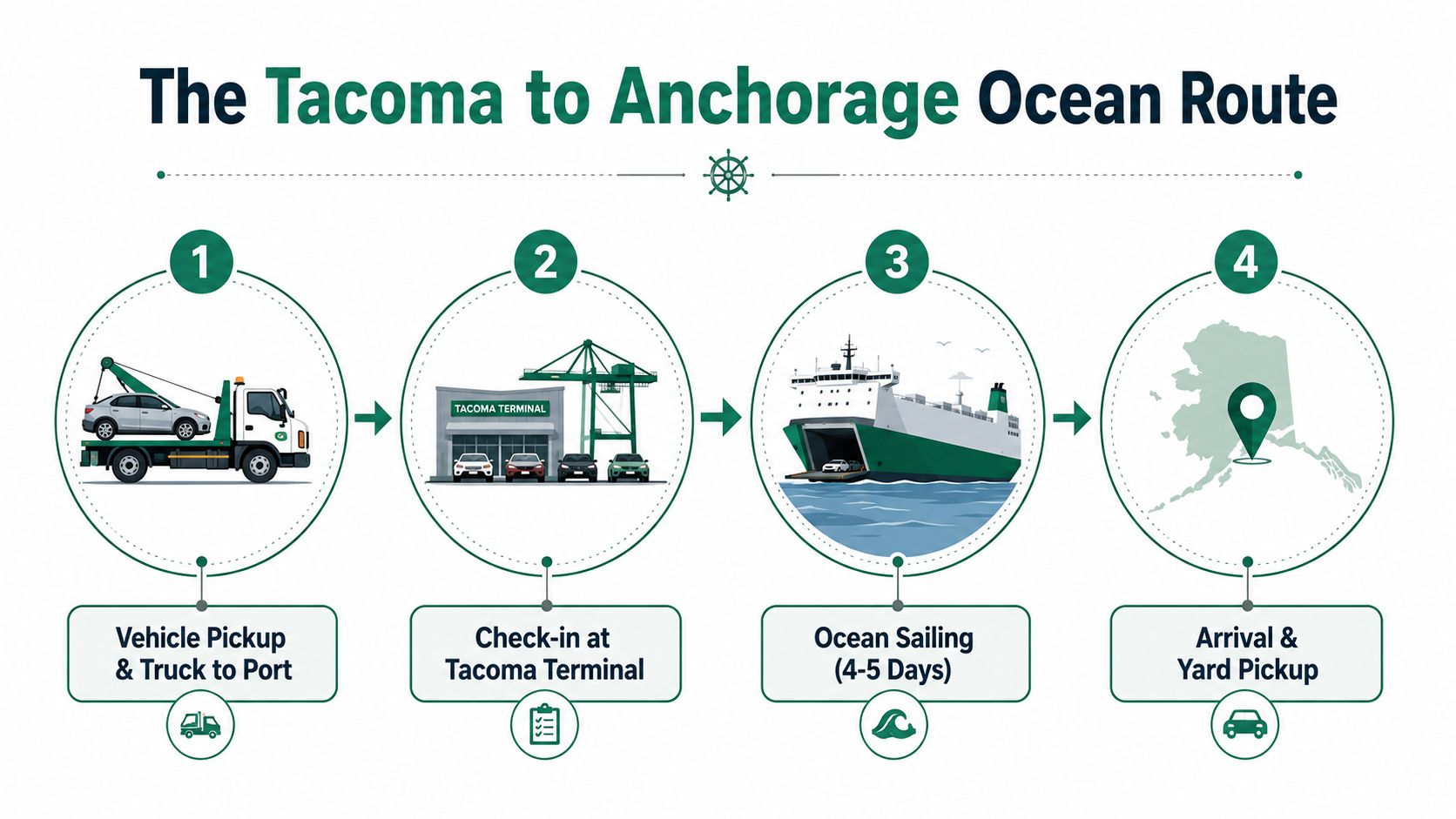
Tacoma to Anchorage is a useful working example because it separates the mainland pickup from the ocean leg. A customer in Seattle, Portland, Dallas, or another Lower 48 city can use an inland carrier to reach the Tacoma gateway, then transfer the vehicle to a Ro-Ro sailing.
Step 1 Pickup and port positioning
The car-hauler collects the vehicle at the agreed location and moves it to Tacoma. In practice, the inland leg must be planned around the vessel cutoff, not around the driver's availability. A late pickup can be more serious than a late delivery on a normal domestic route because the vehicle may miss the booked sailing.
At the origin, the driver records the vehicle's condition, checks that it starts and rolls if required, and confirms the dimensions supplied during quoting. A car with a roof rack, lift, brush guard, or other modification may need a revised classification before the terminal accepts it.
Step 2 Terminal handoff
The terminal receives the vehicle, completes its inspection process, and takes over the paperwork for the ocean leg. The bill of lading should match the vehicle identification, condition notes, dimensions, and destination instructions. Customers should keep copies of the signed documents and inspection photos.
The most common avoidable problems here are incomplete paperwork, an unclean exterior, excess fuel, and a vehicle that doesn't match the booked size class. Terminal staff and ocean carriers work to specific acceptance rules, so a shipment that looked fine at pickup can still be held at the port.
Step 3 Ocean sailing
The vessel loads the car and sails north. Industry guidance describes weekly Tacoma to Anchorage sailings with roughly 60 hours of ocean transit, while other service patterns and port calls can create a longer overall sailing window. A Tacoma to Anchorage shipping guide explains why the next available departure often affects the total timeline more than the driving distance to Tacoma.
Step 4 Alaska delivery
At arrival, the vehicle moves through the carrier's release and clearance process before final-mile trucking to Anchorage, Fairbanks, Whittier, Juneau, or terminal pickup. A realistic door-to-door estimate should be treated as a planning range rather than a guarantee, because pickup timing, port staging, sailing availability, and Alaska delivery capacity all affect the final date.
This video gives a visual overview of the vehicle-shipping process and the handoffs involved:
What It Actually Costs and Why Your Truck Matters
The vehicle class can change the quote more than the distance. A compact sedan may fit comfortably within a published Ro-Ro category, while a lifted Silverado, dually, or work truck can require a higher class, a custom quote, or a different shipping method.
Published Tacoma to Anchorage carrier rates list approximately $2,541.25 for small vehicles, $3,175.00 for medium vehicles, and $4,646.25 for large vehicles, with dimensions tied to height and length limits in the Alaska vehicle rate information. These are route-specific published figures, not universal promises, and the quote can change when the vehicle's measurements or sailing change.
| Vehicle Class | Example | Ocean (Tacoma to Anchorage) | Road and Ferry (Seattle to Anchorage) | Notes |
|---|---|---|---|---|
| Small | Standard sedan | About $2,541.25 | Custom quote | Under 68 inches high and 260 inches long on the cited rate card |
| Medium | SUV or standard pickup | About $3,175.00 | Custom quote | Under 84 inches high and 260 inches long on the cited rate card |
| Large | Tall SUV, truck, or work vehicle | About $4,646.25 | Custom quote | Under 102 inches high and 275 inches long on the cited rate card |
A lifted suspension adds height. A brush guard or long bed adds length. Roof racks, dual rear wheels, oversized tires, and underbody equipment can push the vehicle into a different class even when the vehicle appears ordinary from the driver's seat.
The quote must reflect the vehicle as loaded for transport, not the factory specification.
You can control some cost variables. Port handoff may cost less than home pickup, flexible sailing dates can create more options, and Ro-Ro generally avoids the added handling associated with container service. But don't remove equipment or understate dimensions to force a lower quote. That strategy usually creates a terminal problem later. If road salt and marine exposure concern you, researching where to find undercarriage protection services can help with ownership preparation, though it doesn't replace carrier inspection requirements.
For broader planning, use the car shipping cost information as a starting point, then provide exact height, length, width, running condition, origin, destination, and preferred sailing window for a usable quote.
Paperwork and Vehicle Prep That Prevent Rejection
Alaska vehicle shipping goes smoothly when the documents and the physical car agree with the booking. The carrier needs proof that the person tendering the vehicle has authority to ship it, especially when a lender, dealership, employer, or family member is involved.
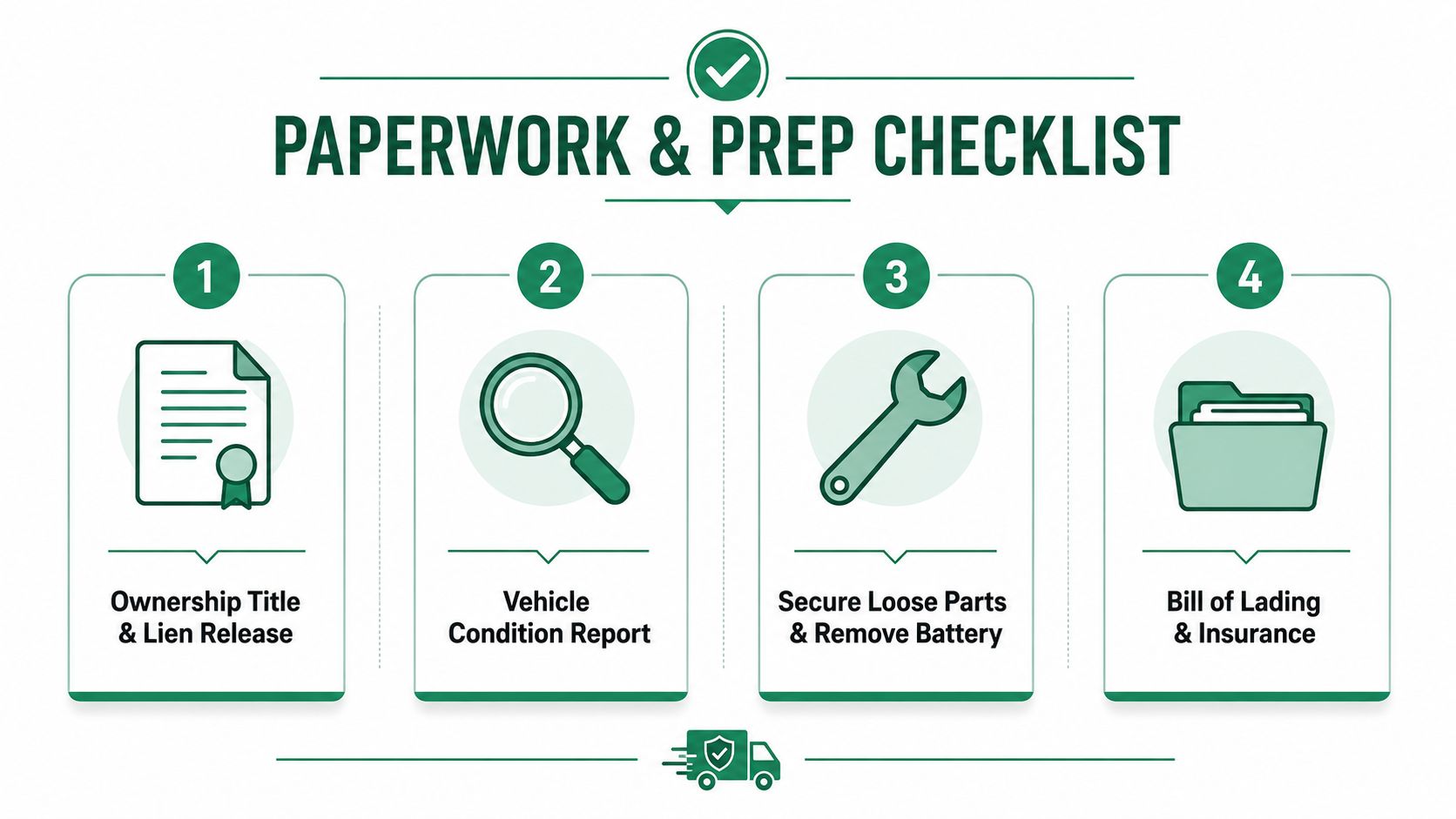
Prepare the title or ownership documentation, current registration when applicable, lien release paperwork if the vehicle has been financed, and a valid identification document. The carrier or ocean operator will also use a bill of lading to record the vehicle identity, condition, destination, and handoff instructions.
Physical preparation
Clean the exterior before pickup. Matson states that a vehicle must be clean enough for inspection, and USDA inspection can prevent release when mud, seeds, or other contaminants remain. Its preparation guidance also requires the fuel tank to be between 1/8 and 1/4 full, not above 1/4, and says propane auxiliary tanks must be emptied and certified gas-free. Review Matson's vehicle preparation requirements before the appointment.
Use this working checklist:
- Remove personal property: Clear the cabin, trunk, and cargo areas unless the carrier has approved a specific exception.
- Photograph existing damage: Take clear photos of every side, the roof, wheels, glass, interior, and any scratches or dents.
- Secure loose equipment: Remove detachable racks, spoilers, antennas, tools, and accessories that could shift or break.
- Check the battery: Secure it firmly. Classics or special vehicles may need battery disconnection based on carrier instructions.
- Confirm winter readiness: Use coolant suitable for expected sub-zero conditions and disclose mechanical issues before pickup.
- Document modifications: Send photos showing lift height, undercarriage clearance, racks, brush guards, tire size, and any unusual equipment.
Customers arranging enclosed auto transport should still follow the same inspection discipline. Enclosed service may provide added protection, but it doesn't waive port safety, fuel, cleanliness, or dimension rules.
Booking With National Car Transport From Quote to Delivery
A reliable booking starts with accurate information, not a low placeholder estimate. Provide the vehicle year, make, model, running condition, loaded dimensions, origin city, preferred port, Alaska destination, and whether the vehicle will be picked up at your door or delivered to Tacoma or Seattle.
National Car Transport offers mainland-to-Alaska coordination through door-to-port or port-to-door arrangements, alongside domestic transport across the 48 contiguous states, including major cities such as Seattle, Portland, Los Angeles, Phoenix, Denver, Dallas, Chicago, Atlanta, New York, and Miami. Its network also supports Puerto Rico movements, with San Juan serving as the key arrival port in the reviewed shipping sources. The company has 25+ years of experience, an A+ BBB rating, transparent flat-rate pricing, and a network of 25,000+ vetted carriers, as described in its company information.
The handoffs that matter
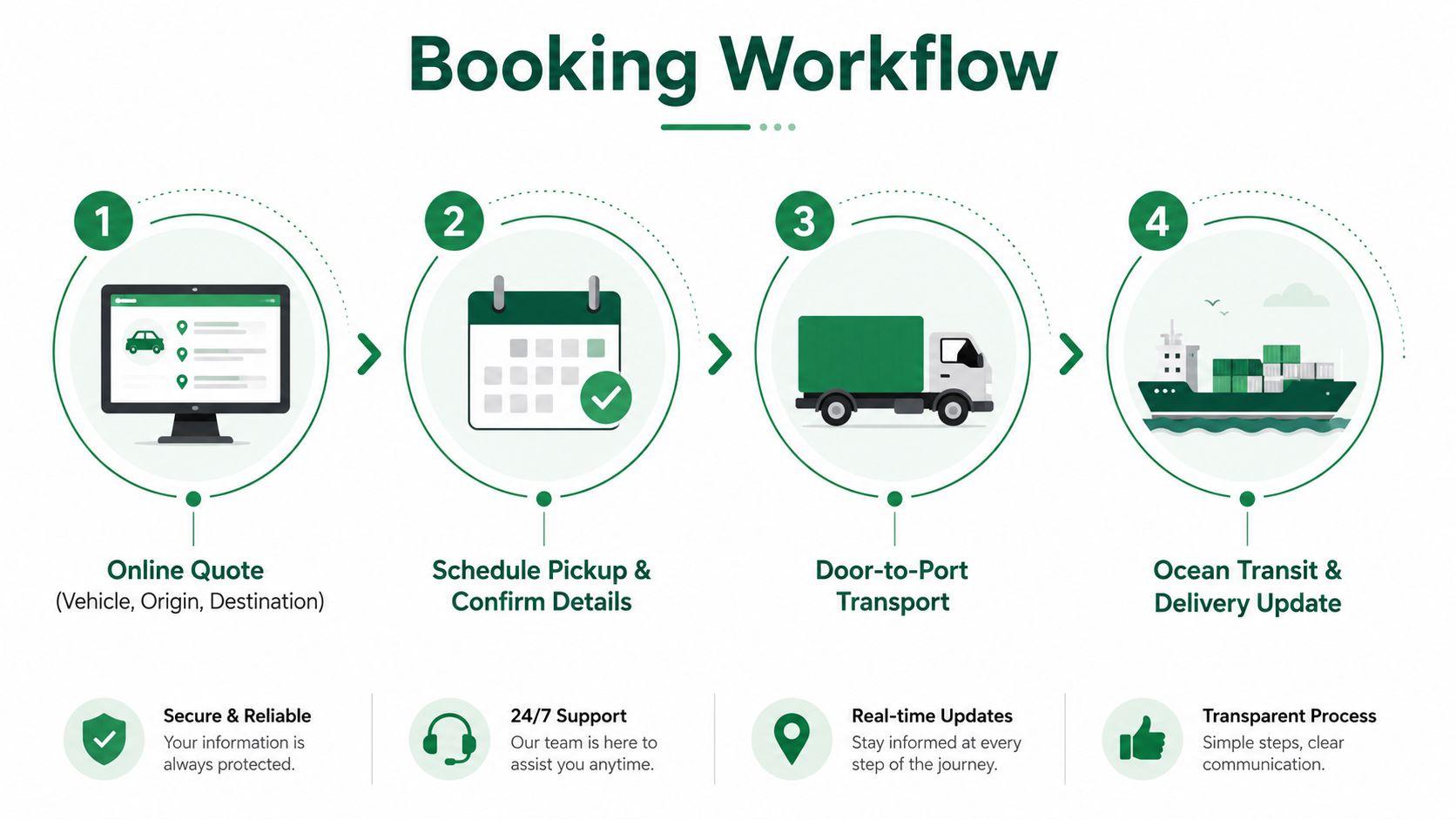
The booking process normally includes an online quote, confirmation of vehicle details, pickup scheduling, a digital bill of lading, and a carrier inspection with photos. The inland carrier then moves the vehicle to the selected gateway, where the ocean operator handles terminal acceptance and sailing.
Customers should receive confirmation when the vehicle reaches the port, when the sailing is assigned, and when the Alaska terminal releases it for final delivery or pickup. If the car misses a sailing, ask immediately about terminal storage, the next departure, and whether the revised plan changes the destination terminal.
A dedicated advisor is especially useful for relocations, snowbirds, military families, students, dealerships, auction purchases, and business fleets because each move has different timing and documentation needs. National Car Transport has bilingual English and Spanish agents based in the United States, with agents bringing over 20 years of auto transport logistics experience. Not one vehicle transport is alike, and the practical value of an experienced agent is keeping the process simple, clear, and coordinated at a reasonable value.
Timing Traps That Stall Alaska Shipments and How to Avoid Them
The biggest mistake is treating the quoted transit time as if it begins when someone picks up the car. Alaska moves are controlled by port cutoffs and sailing availability. A vehicle can travel efficiently across the mainland and still lose substantial time if the truck arrives after terminal acceptance closes.
The Alaska Marine Highway publishes reservation cutoffs of 4 hours before sailing at staffed terminals and 15 minutes before sailing at unmanned ports. That makes the final handoff a hard operational deadline, particularly for customers connecting a long inland drive with a ferry departure.
| Timing Trap | What Goes Wrong | Workaround |
|---|---|---|
| Booking the sailing after inland transport | The truck reaches the gateway without a confirmed vessel space | Confirm the sailing first, then schedule the mainland leg |
| Misstating vehicle dimensions | The terminal reclassifies the car or requests a custom quote | Measure the vehicle with racks, lift, tires, and accessories installed |
| Arriving with mud or excess fuel | Inspection or release is delayed until the vehicle is corrected | Clean the exterior and follow the carrier's fuel limit before tender |
| Choosing a narrow delivery date | A missed sailing leaves little room to recover | Build flexibility into the destination appointment |
| Assuming every Alaska destination works the same way | Anchorage, Fairbanks, Whittier, and Juneau require different final-mile plans | Confirm the port, yard, and delivery leg before booking |
Some customers focus on the drive from their home to Tacoma and overlook gateway staging. That's backwards. The sailing is the scarce resource, so lock the vessel window before committing the inland pickup. Keep communication open with the coordinator if weather, traffic, mechanical trouble, or border delays threaten the terminal appointment.
The same scheduling logic applies to Puerto Rico. Mainland customers commonly choose door-to-port or port-to-port service, with Jacksonville and Pennsauken identified as common departure points and San Juan as the principal arrival port in the reviewed guidance. For shipments from Puerto Rico to the mainland, Crowley identifies Jacksonville and Eddystone as main arrival ports and states that U.S. Customs and Border Protection inspection isn't required for vehicles moving to the mainland, although documentation and carrier procedures still apply. Review the Puerto Rico vehicle shipping guidance before selecting the return route.
National Car Transport can coordinate door-to-port, port-to-door, Ro-Ro, container, open, and enclosed vehicle transport across the mainland, Alaska, Hawaii, and Puerto Rico. Visit National Car Transport with your vehicle dimensions, origin, destination, and target date so a bilingual U.S.-based agent can help match the shipment to a realistic sailing and delivery plan.