

You've sold the house in Texas, started a new job in California, or bought a vehicle from a distant dealership. The move is scheduled, but the car still has to cross the Southwest. A quote may say three to eight days in transit, yet that usually isn't the same as the time from booking to delivery. Carrier matching, pickup flexibility, vehicle condition, and seasonal demand can shape the experience as much as the highway distance.
To ship a car from Texas to California safely, treat the move as a logistics project rather than a simple road trip. The right service depends on whether you're moving a daily driver, an EV, a non-running vehicle, a classic car, or a business fleet. It also depends on whether your schedule can absorb dispatch variation.
Table of Contents
- Understanding the Texas to California Transport Corridor
- Preparing Your Vehicle and Documentation for Pickup
- Choosing Between Open and Enclosed Carrier Options
- Navigating Pricing Factors and Seasonal Demand
- Managing Transit Times and Dispatch Realities
- Finalizing Your Booking and Delivery Inspection
Understanding the Texas to California Transport Corridor
The Texas to California lane follows a practical Southwest routing pattern, usually using the I-10 corridor through New Mexico and Arizona. Exact mileage depends heavily on the city pair. Route guides report corridor averages of 1,406, 1,407, 1,548, and 1,642 miles, while broader operational estimates place many shipments between roughly 1,400 and 1,800 miles. These figures explain why Dallas to Los Angeles, Houston to San Diego, and El Paso to California shouldn't receive the same timeline or price expectation. (Texas to California route data)
The difference between driving the route yourself and using commercial auto transport is substantial. A personal road trip is often estimated at roughly 20 to 24 hours of driving, but a carrier loads several vehicles, makes operational stops, follows driver safety requirements, and coordinates multiple pickups and deliveries. Route guides commonly quote two to six days or three to eight days for the move, depending on route density, weather, pickup timing, and dispatch planning. (Texas to California shipping guidance)
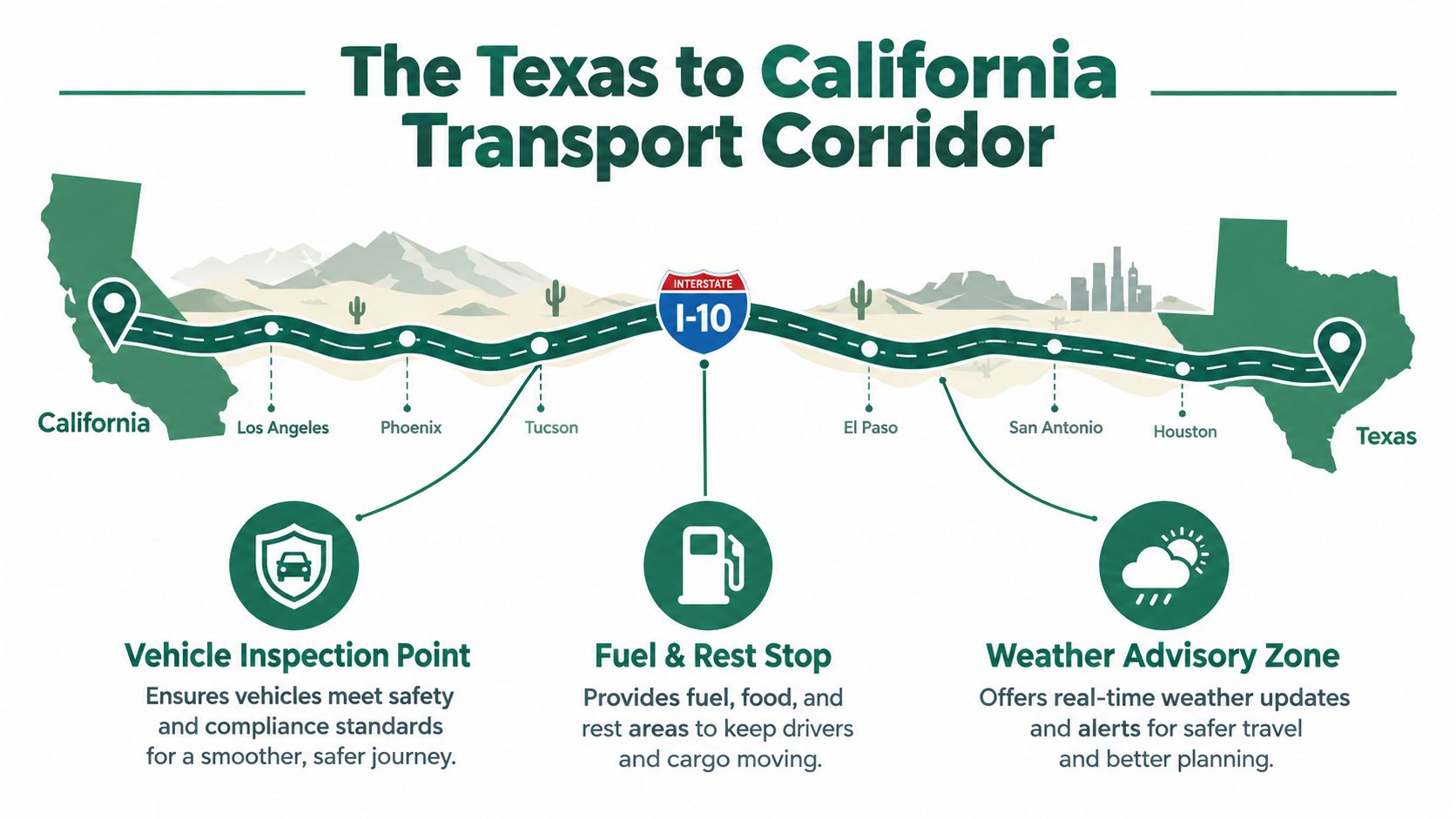
Why city pairs matter
Dallas to Los Angeles is a very different dispatch assignment from El Paso to San Diego. A major metro pickup may offer more carrier traffic, while a rural origin or destination can require a driver to make a deliberate detour. Houston, Dallas, Austin, San Antonio, Los Angeles, San Diego, San Francisco, Sacramento, and surrounding metro areas generally give coordinators more routing options than isolated communities.
The same principle applies in reverse. Customers moving snowbirds, military households, students, or dealership inventory may need service from any of the 48 contiguous states, not only the largest Texas and California cities. For a broader comparison involving a different long-distance relocation pattern, you can compare moves Boston to Texas before deciding how much scheduling flexibility your move requires.
Practical rule: A quoted transit window begins when the carrier has the vehicle, not necessarily when you first request service.
For a Houston-origin shipment headed west, review the Houston to Los Angeles car shipping service alongside the exact pickup and delivery addresses. A carrier may not be able to load directly at a narrow residential street, and the driver could arrange a nearby commercial lot if the truck can't safely maneuver.
Preparing Your Vehicle and Documentation for Pickup
A pickup can lose time before the truck arrives if the vehicle's condition or operating status was described loosely during booking. Give the coordinator an accurate description, keep the vehicle accessible, and leave enough flexibility for the driver's arrival window. On the I-10 corridor, dispatch timing can shift with traffic, weather, terminal congestion, or seasonal demand, so a prepared vehicle is easier to load when the appointment moves within that window.
Wash the exterior if possible. Dust and road film can conceal scratches, chips, and dents. Photograph every side, the roof, wheels, glass, interior, and existing damage before the inspection. Keep those images available through delivery.
The bill of lading records the vehicle's condition at pickup and delivery. Inspect the car with the driver, confirm the odometer and visible damage are recorded accurately, and correct omissions before signing. Keep a copy of the signed document. (FMCSA and bill of lading guidance)
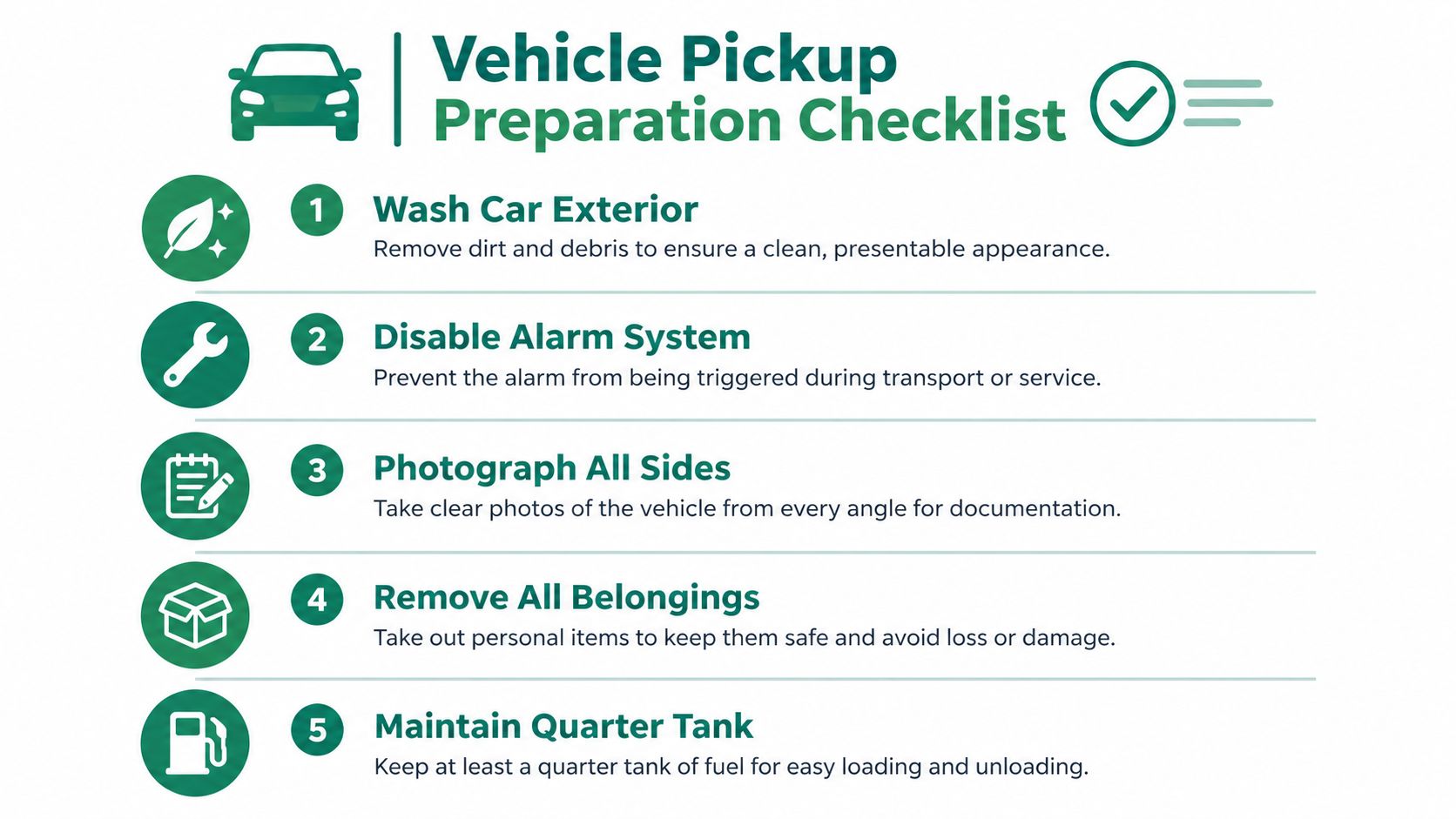
A practical pickup checklist
- Remove personal belongings: Take out loose electronics, documents, valuables, and anything that could shift. Personal items generally are not insured as part of the auto shipment.
- Disclose special conditions: Report a non-operational vehicle, low clearance, oversized tires, disabled brakes, steering problems, or a dead battery before dispatch. Non-runners can ship, but the carrier may need a winch or other loading equipment. (Non-operational vehicle guidance)
- Prepare an EV accurately: State the battery status, charging limitations, and whether the vehicle rolls, steers, and brakes. Those details affect equipment and carrier selection.
- Leave usable fuel: Keep enough fuel for loading and unloading while following the carrier's preparation instructions.
- Secure access and keys: Provide required keys, disable alarms when instructed, fold in mirrors where appropriate, and ensure an authorized person can release the vehicle.
At delivery, compare the vehicle with the pickup report and photographs, not memory. Record any new condition issue on the delivery inspection before accepting the shipment.
Choosing Between Open and Enclosed Carrier Options
A standard sedan leaving Texas on the I-10 corridor usually fits open transport. The vehicle rides on a multi-car trailer, giving dispatchers more carrier options and keeping the rate lower. The trade-off is direct exposure to sunlight, dust, rain, and ordinary road debris during the run.
That exposure is a normal operating condition, not automatically a safety problem. The better question is whether the vehicle's condition or value justifies added protection. A daily driver with existing cosmetic wear may suit open service, while a restored classic, high-value exotic, or carefully finished custom vehicle may warrant enclosed transport.
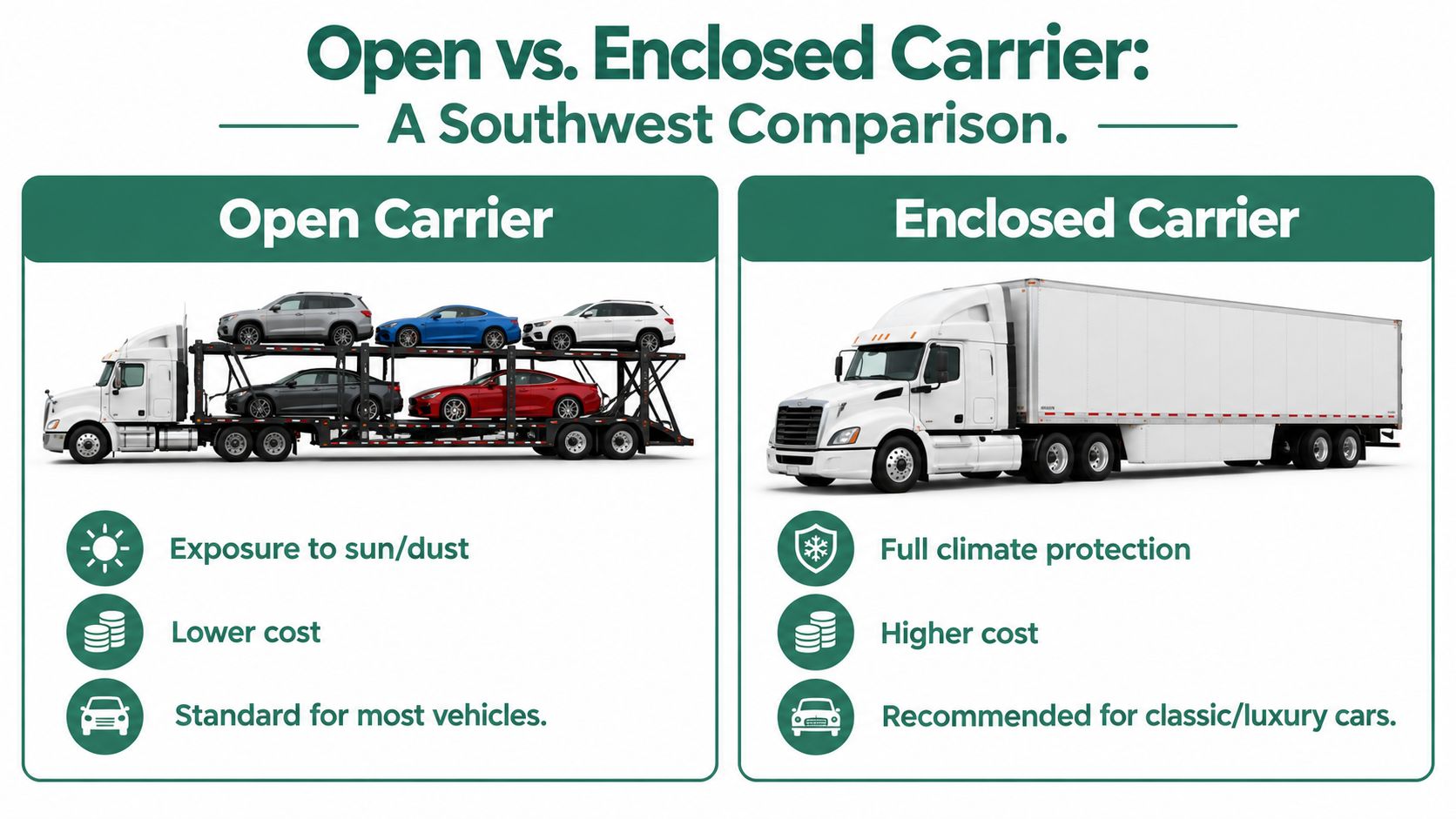
Match the equipment to the vehicle
| Vehicle situation | Practical choice | Why it matters |
|---|---|---|
| Standard sedan or family SUV | Open carrier | Cost-efficient and widely available |
| Classic, luxury, or exotic vehicle | Enclosed carrier | Reduces exposure to weather and road debris |
| Lowered or modified vehicle | Equipment review first | Ramp angle and clearance must be confirmed |
| Non-running vehicle | Open or enclosed, with disclosure | Winch and loading requirements affect dispatch |
| High-value EV | Enclosed may be appropriate | Battery condition, clearance, and handling deserve closer review |
Enclosed transport commonly costs 30% to 50% more than open service on this corridor. Published estimates place enclosed moves around $1,400 to $2,500 or more in relevant cases, while open estimates range roughly from $600 to $1,400, depending on vehicle type, lane, and booking conditions. (Texas to California vehicle-type and carrier estimates)
The quoted equipment type also affects the booking experience. Enclosed capacity is narrower, so a customer who needs a fixed pickup date may wait longer for a suitable truck. Open service generally offers more dispatch opportunities, but a quote still depends on pickup flexibility and current corridor demand.
Compare the premium with the vehicle's replacement value and the cost of resolving a condition dispute. If the paint, suspension, battery system, or custom bodywork cannot tolerate ordinary exposure, the lower quote may carry more risk. Review open car transport when affordability and broad carrier availability are the priority.
Navigating Pricing Factors and Seasonal Demand
A Texas to California quote reflects more than mileage. Dispatch needs the exact origin and destination, vehicle year and model, running condition, modifications, pickup access, transport type, and preferred dates. If the customer omits a lowered suspension, oversized dimensions, dead battery, or rural access, the attractive rate may fail when the carrier tries to schedule the load. See the Texas to California pricing factors that affect the quoted amount.
For a standard sedan on open transport, published corridor estimates range from about $600 to $999 at the lower end, while broader 2026 estimates cluster around $850 to $1,450 for common moves. Enclosed service is commonly 30% to 50% higher, and summer peak periods are associated with 10% to 20% price increases.
What changes the quote
- Vehicle size and condition: A large SUV, truck, oversized vehicle, or non-runner uses more trailer space or requires additional handling.
- Pickup flexibility: A wider pickup window gives dispatch more chances to match the vehicle with an efficient route. A fixed date can narrow those options and extend the booking-to-pickup timeline.
- Seasonal demand: Summer demand can tighten capacity and raise prices. Softer periods reported for 2026 include late September through early November and mid-January through mid-February. The seasonal booking and lead-time guidance can help set expectations before selecting dates.
- Carrier type: Open transport remains the dominant cost-efficient choice on this corridor, while enclosed capacity is more limited.
Ask whether the rate is flat, which conditions can change it, and whether the quote covers the vehicle exactly as described. A low number tied to immediate availability may lead to a pickup delay or later adjustment. Use this car shipping cost guide to compare the quote with the actual vehicle, pickup window, and seasonal demand rather than a generic sedan assumption.
Managing Transit Times and Dispatch Realities
A delivery estimate is not the same as total lead time. Route guidance may describe three to eight days or five to ten days for delivery-related windows, while carrier assignment can add time before pickup. Operational planning also allows for additional days when the vehicle has not yet been matched to a truck. Treat the quoted transit period as the highway portion, not the complete booking-to-delivery schedule.
The delay often starts in dispatch, not on the I-10 corridor. A carrier may be moving through Texas and California but still need compatible trailer space, workable pickup access, the right delivery direction, and an opening in its schedule. High-volume lanes offer more trucks, yet they also bring competing loads. Route balance and pickup flexibility determine when a vehicle joins a carrier.
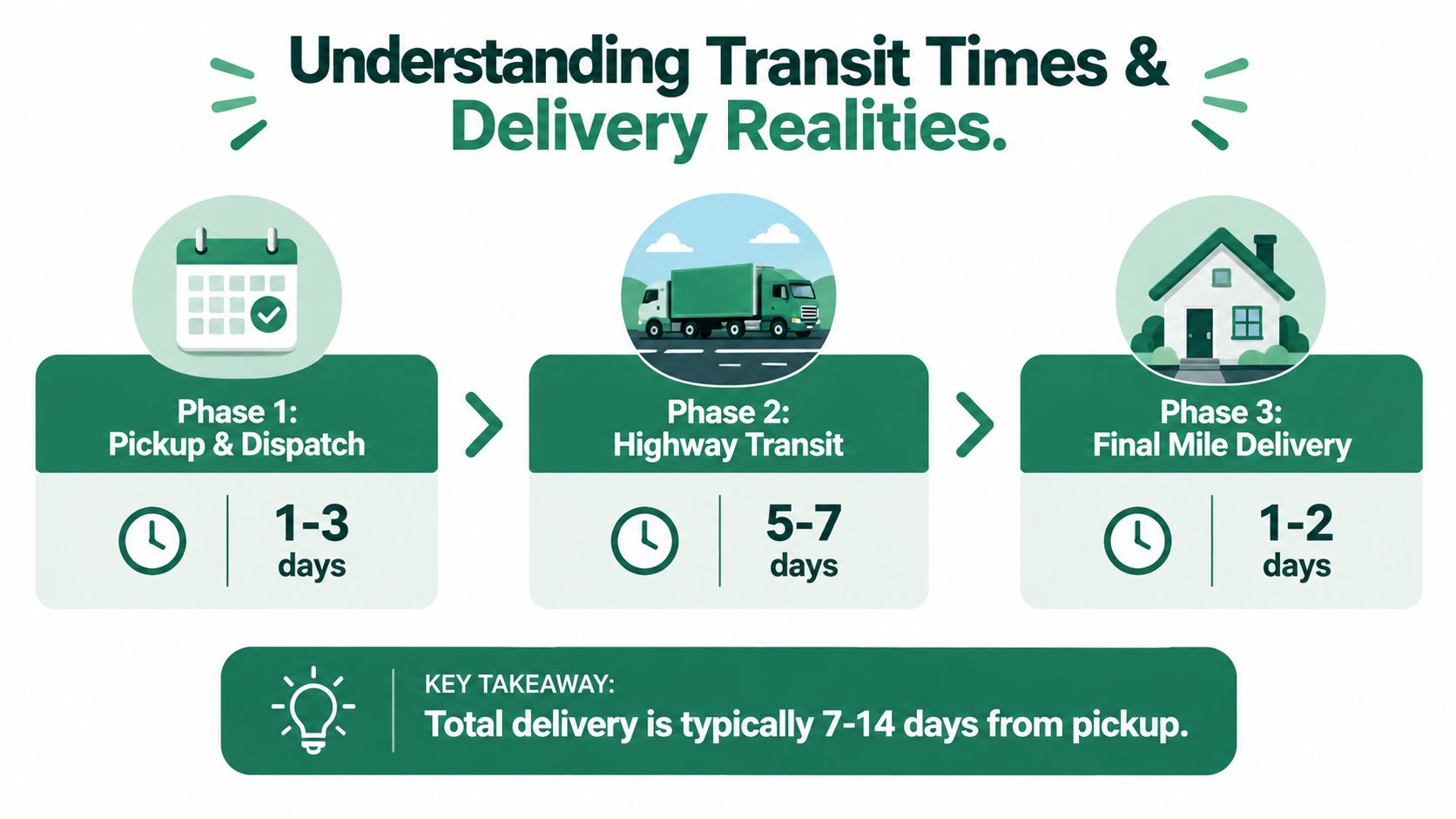
Build the schedule around the actual clock
If the vehicle is needed for a new job, military reporting date, school term, or snowbird arrival, avoid ending temporary transportation on the same day delivery is expected. Leave room between the projected delivery and the event that depends on the car. A missed dispatch window can shift the entire plan even when the route itself is moving normally.
Pickup flexibility is usually more useful than paying for a supposedly shorter route. A broader window gives dispatch more chances to place the vehicle on a truck already moving along a suitable route. Off-peak timing can also improve availability during the softer periods identified in the 2026 route reporting, as noted in the seasonal demand timing.
The fastest shipment is often the one that fits an available truck, not the one attached to the most aggressive promise.
Ask three separate questions: when assignment is likely, when pickup is likely, and how long transit should take after pickup. Those answers reveal the actual booking-to-delivery timeline and make dispatch delays easier to manage.
Finalizing Your Booking and Delivery Inspection
A reliable booking begins with complete, accurate details. Provide pickup and delivery addresses, vehicle condition, operability, dimensions, preferred pickup window, and access restrictions. If a driver cannot safely reach the delivery address, choose a nearby location with room for the truck, loading equipment, and inspection.
Before pickup, photograph the vehicle from multiple angles, including existing damage, wheels, glass, and interior. Review the bill of lading with the driver and keep your photographs. At delivery, compare the vehicle with that record before signing. Document any new issue on the final condition report immediately, then retain copies of every document.
Keep delivery expectations separate from the booking date. Dispatch assignment, pickup, and transit are different milestones, and a flexible pickup window can matter more than a promised fast route on the I-10 corridor. Leave extra time before a job, school term, military reporting date, or snowbird arrival, particularly during seasonal demand.
Individuals, dealerships, auctions, online buyers, and businesses may benefit from one coordinator, especially when several vehicles or changing driver schedules are involved. National Car Transport offers door-to-door service in the United States and Puerto Rico, with open and enclosed options, 25+ years of experience, an A+ BBB rating, flat-rate pricing, and 25,000+ vetted carriers. Its U.S.-based bilingual agents support personal and commercial moves. (National Car Transport)
National Car Transport can review the route, vehicle condition, pickup flexibility, and carrier type before scheduling. Request a route-specific quote and confirm the inspection process with the bilingual U.S.-based agent.