
Shipping a standard vehicle from the mainland to Hawaii usually costs $1,500 to $3,500, with an average around $2,500, and most shipments take about 3 to 4 weeks door to port. The exact quote and schedule depend on where the vehicle starts, how large it is, and whether you choose budget-friendly RoRo service or a more protective container option.
If you're reading this, you're probably balancing two realities at once. Hawaii is exciting. The vehicle logistics are not. Most customers aren't confused about whether a car can be shipped. They want to know what it will cost, how long they'll be without it, what paperwork can derail the move, and who is going to answer the phone when something changes.
That last part matters more than many people expect. To ship a vehicle to Hawaii, you aren't booking one simple ride. You're coordinating a chain of handoffs, land transport, port timing, vessel space, island arrival, and local pickup requirements. When someone is relocating for work, heading out on military orders, sending a student to school, or returning as a snowbird, the difference between a smooth move and a stressful one is often the person guiding the process.
Table of Contents
- Your Journey to Hawaii Starts Here
- Budgeting and Timelines for Your Hawaii Shipment
- Choosing Your Shipping Method and Logistics
- Navigating Hawaii's Paperwork and Port Requirements
- Preparing Your Vehicle for a Safe Ocean Voyage
- Answering Your Top Hawaii Shipping Questions FAQ
Your Journey to Hawaii Starts Here
The process typically begins in a similar fashion. They have a move date, a rough housing plan, a lot of questions, and one car they either need badly on the island or can't justify replacing once they get there.
Shipping a vehicle to Hawaii feels bigger than it is because the ocean leg gets all the attention. In practice, this is a manageable logistics project when you treat it like a sequence of steps instead of one giant unknown. The vehicle has to get to the right port, clear the right paperwork, board the right vessel, and arrive with the right release documents waiting on the other side.
That sounds technical, but it becomes straightforward once you know the pressure points.
What usually makes customers nervous
The first concern is cost. The second is timing. The third is paperwork, especially if the vehicle is financed or the owner is coordinating a relocation from somewhere far from a West Coast port.
A close fourth is communication. Island shipping has more handoffs than a typical mainland move, so customers want a single person who can explain what happens next in plain English. That human side gets overlooked in a lot of online content, but it matters. A bilingual agent can be especially helpful when a family is coordinating documents across different people, addresses, or states.
Practical rule: The earlier you resolve title, registration, and pickup logistics, the smoother the rest of the shipment goes.
What a good shipping plan looks like
A solid Hawaii move starts with a realistic quote and a realistic calendar. After that, the work is mostly about preventing avoidable delays.
The basics look like this:
- Choose the right service level: Some customers want the lowest-cost port drop-off. Others need pickup from home because they're nowhere near a departure terminal.
- Match the method to the vehicle: A daily driver usually fits one plan. A classic, luxury, or highly sentimental vehicle may justify a different one.
- Handle documents early: Lien authorization problems don't get easier at the port.
- Prepare the car correctly: Carriers won't ignore fuel, alarm, or personal-item rules just because your move date is close.
National Car Transport is one option customers use for this kind of move because it coordinates mainland pickup and island shipping through a U.S.-based advisor model, with bilingual English and Spanish support available. That matters when not one vehicle transport is alike and you need someone to keep the process simple instead of bouncing you between departments.
Budgeting and Timelines for Your Hawaii Shipment
A customer might call on Monday with a fair question: “If I give you my car this week, what am I really paying for, and when do I see it in Hawaii?” That question matters because Hawaii shipping is rarely a single straight move. It is usually a mainland handoff, a port schedule, an ocean leg, and an island release, all with their own timing and costs.
The cleanest quotes break those pieces out so you can see where the money goes and where delays usually start.
What you can expect to pay
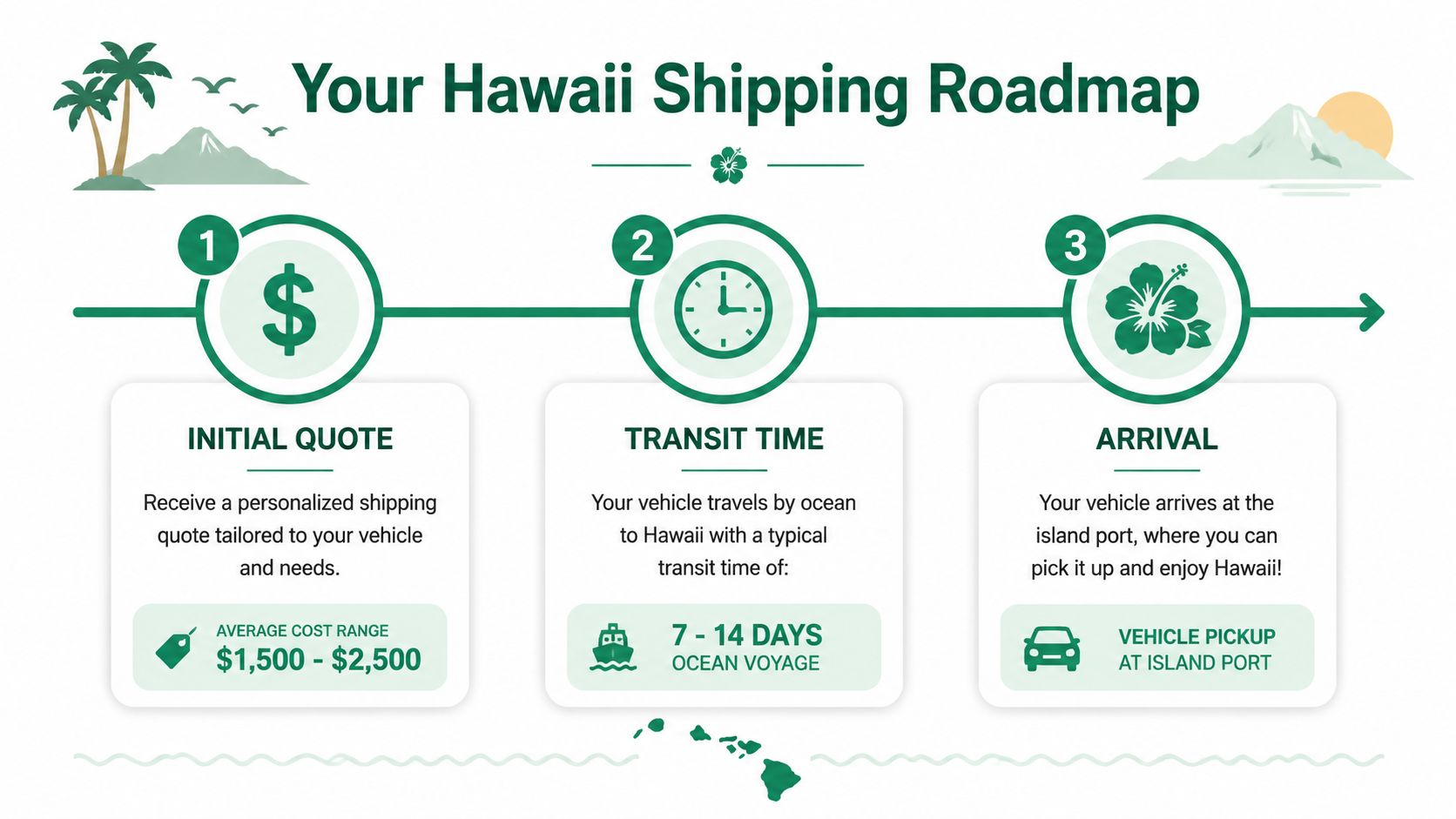
Typical pricing to ship a vehicle to Hawaii falls between $1,500 and $3,500, with an average around $2,500. According to Living in Hawaii's guide to Hawaii car shipping costs, West Coast port moves often run about $1,600 to $2,100, East Coast moves can reach $3,000 or more, Matson lists $1,597.00 from Long Beach and Oakland to Honolulu and $2,347.01 to Hilo, Kahului, and Nawiliwili, vehicle classes are based on registered weight, and outer-island transshipped cargo can carry an added 25% freight surcharge.
That range is why a cheap headline number can be misleading. A quote may look lower until you confirm whether it includes inland trucking, port fees, island routing, and the actual vehicle size class.
The biggest pricing factors are usually straightforward:
- Where the car starts: A vehicle already near a West Coast port costs less to position than one coming from the Midwest or East Coast.
- Vehicle size and weight: Larger SUVs, trucks, and vans can price differently than compact sedans.
- Which island receives it: Honolulu is often the simplest arrival point. Outer-island delivery can add handling and transfer cost.
- Service level: Port drop-off lowers cost. Home pickup adds convenience and another scheduling layer.
- Shipping format: RoRo is usually the lower-cost option. Container service costs more because the handling is different and the car has more enclosure.
I tell customers to budget for the actual route, not the advertisement. If the plan involves a rural pickup, a lienholder authorization, or an outer-island transfer, those details belong in the quote on day one.
A dedicated agent helps here more than many people expect. At National Car Transport, that often means one person checking that the origin, service level, and port plan all match the customer's budget before the booking goes live. For families coordinating a move across multiple states or between English and Spanish speakers, that single point of contact can prevent the kind of small misunderstanding that later turns into a rebooking fee or a missed vessel.
For businesses comparing freight options more broadly, it also helps to understand how ocean pricing works outside the auto space, including affordable ocean shipping for SMEs, because Hawaii vehicle transport follows the same basic rule: every handoff, lane, and capacity limit affects the final price.
What the full timeline really includes
Transit time is not just the time on the water.
According to this Hawaii vehicle shipping timeline video overview, ground transport to a West Coast port often takes 3 to 7 days, port staging adds 3 to 5 days, RoRo ocean transit runs about 5 to 8 days, and arrival processing adds about 2 more days. That creates a standard total window of 20 to 27 days. The same source says container moves usually take longer, with the water leg around 10 to 15 days and the full process extending past 30 days.
Those are planning ranges, not appointment times.
The part customers misjudge most often is port staging. A car can be physically ready, documents can be correct, and the move can still wait on vessel space or cutoff timing. That same source advises booking at least one month in advance, and notes that Young Brothers Hawaii requires 30-day advance notice to avoid capacity problems.
That is why experienced coordinators do not promise an arrival date that only works if every transfer hits perfectly. They give you a working window, explain where the risk sits, and stay available when the port or vessel schedule changes. That human support matters more in Hawaii than on a simple mainland route, because the shipment has fewer recovery options once a vessel cutoff is missed.
If budget is the main concern, port-to-port RoRo is usually the lower-cost path. If timing matters more, earlier booking and clean paperwork usually save more stress than paying for a faster sounding service that still depends on the same vessel schedule.
Choosing Your Shipping Method and Logistics
The biggest operational choice isn't just who books the shipment. It's how much of the route you're asking the shipper to manage, and what level of protection your vehicle needs.
Hawaii routes are almost always multi-leg moves. A vehicle often starts nowhere near the vessel departure point, so the mainland trucking segment can be one of the longest parts of the trip before the ocean crossing even starts, as explained in JNR Global Logistics' overview of the Hawaii vehicle journey. That same source identifies the main Hawaiian arrival ports as Honolulu, Hilo, Kahului, and Nawiliwili.
Service levels and where the convenience changes
Most customers fit into one of three service patterns.
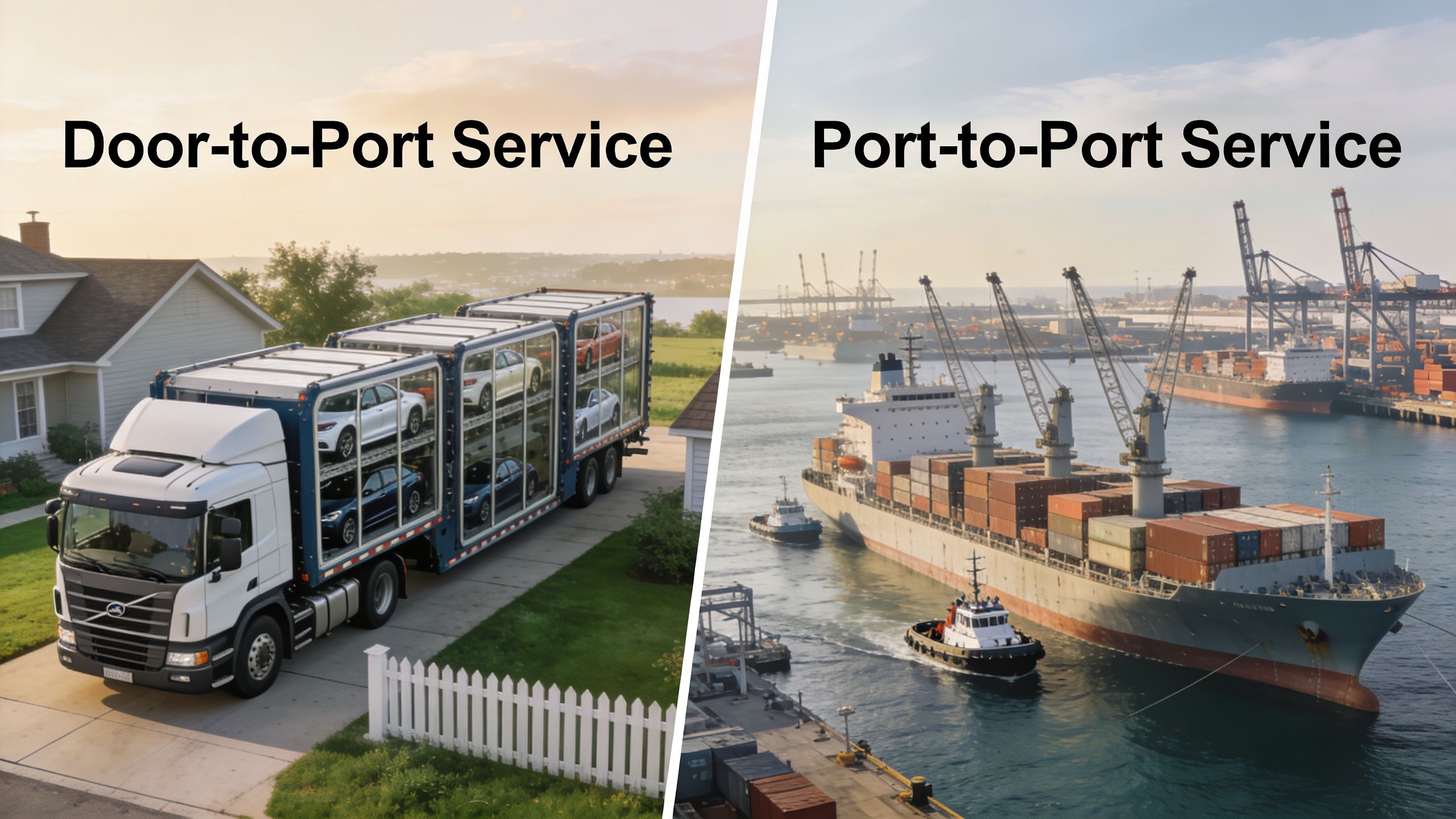
Port-to-port works best if you live close to a departure terminal and don't mind handling both ends yourself. It's usually the most economical because you drive the vehicle to port and pick it up at the island port.
Door-to-port makes sense when you're not near Long Beach, Oakland, Tacoma, or another practical departure point. The carrier handles the inland pickup, then your vehicle continues through the ocean leg.
Door-to-door is the most convenient if available for your route, but it's also the most layered. It requires someone to coordinate the mainland pickup, vessel booking, and final release timing cleanly. When that coordination is weak, customers feel every gap.
One specific cost point is worth knowing. For customers who need pickup rather than port drop-off, Hawaii Car Transport's paperwork and service guide notes an additional $1,100 charge for ground transport to port on door-to-door arrangements.
If you live far from a West Coast port, the inland trucking isn't a side detail. It's a major part of the shipment.
For readers comparing broader freight models, this overview of affordable ocean shipping for SMEs is useful context on how sea freight planning changes when cargo has to move through multiple handling points.
RoRo versus container shipping
For most standard vehicles, RoRo is the practical answer. The car is driven onto the vessel, secured, and driven off at arrival. It's usually the lower-cost option and, on many Hawaii routes, also the faster one.
Container shipping is the protection-first choice. Customers usually consider it when moving a classic car, a luxury vehicle, or something with very specific condition concerns. It can be shared or exclusive depending on the carrier arrangement, but either way you're paying for a more controlled environment.
What works in practice:
- RoRo works well for: Daily drivers, relocation vehicles, student cars, military household moves where budget and timing matter most.
- Container service works well for: Collector cars, high-value purchases, or vehicles whose owners want more shielding from normal port and marine exposure.
- Port drop-off works well for: Customers who can reach the terminal without much trouble and want to keep costs down.
- Managed pickup works well for: Families, businesses, and remote-origin customers who need the mainland leg coordinated for them.
Hawaii Shipping Options Compared
| Method | Best For | Cost | Convenience |
|---|---|---|---|
| Port-to-port | Customers near departure and arrival ports | Usually lower | Lower |
| Door-to-port | Customers far from mainland ports | Higher than port-to-port | Moderate |
| Door-to-door | Customers wanting the most coordination | Higher | Highest |
| RoRo | Standard operable vehicles | Usually lower | Straightforward |
| Container shipping | Classic, luxury, or more sensitive vehicles | Premium | Protection-focused |
The right answer usually isn't the cheapest line item. It's the option that fits your origin, your schedule, your vehicle type, and your tolerance for handling parts of the move yourself.
Navigating Hawaii's Paperwork and Port Requirements
A Hawaii shipment can be booked on time and still stall at the terminal if the paperwork file is incomplete. I see that more often than missed vessel space. A customer has the car ready, the schedule works, then pickup gets delayed because a lien letter is missing or the title copy is unreadable.
The documents you need before the vehicle moves
The standard file usually includes the vehicle title, current registration, and a shipping receipt. If the car is financed, get written lienholder authorization before the shipment is scheduled. Hawaii Car Transport's guide also notes that these same records matter again after arrival when you apply for a Temporary Out-of-State Permit.
That financed-vehicle step causes a lot of preventable trouble. Owners often assume the registration card proves enough ownership to ship. Lenders do not always see it that way, and ports or carriers may not either. If a bank still has an interest in the vehicle, get the approval letter early.
A solid paperwork file should include:
- Proof of ownership: Usually the title.
- Current registration: It shows the vehicle is properly registered.
- Insurance information: Port or carrier staff may ask for it during coordination or release.
- Lienholder approval if financed: Request it well before your ship date.
- Shipping receipt: Keep it with your other release documents.
What happens after the vehicle arrives
After the vehicle reaches Hawaii, you will need the arrival documents organized and easy to access. That matters because the car may be physically there, but release and local permit steps still depend on paperwork.
For many customers, the hardest part is not the form itself. It is keeping track of everything during a move. People are checking into housing, changing utilities, meeting family, starting work, and trying to remember which folder has the title copy and shipping receipt.
Keep every vehicle document in one folder you carry yourself. Do not pack it with household goods.
The permit fee is small. The hassle of missing documents is not. A hold at the Hawaii side can turn into extra waiting, extra coordination, and in some cases storage concerns if pickup gets pushed back.
An experienced agent helps more than a low quote does. At National Car Transport, we do not treat paperwork like an afterthought. A dedicated coordinator checks the file before the vehicle leaves the mainland, flags lien issues early, and explains port requirements in plain language. If a customer is more comfortable in Spanish or needs extra help understanding release steps, having a bilingual or experienced point of contact can make the process much less stressful.
Good paperwork support is quiet work. That is the point. If your agent does the job well, your documents clear, your car gets released, and the port process feels routine.
Preparing Your Vehicle for a Safe Ocean Voyage
A Hawaii shipment can be booked correctly and still get delayed at handoff if the vehicle is not prepared to meet port and ocean carrier rules. This stage is where small oversights turn into real problems. A bag left in the trunk, an active alarm, or a modified vehicle that was never measured can stop acceptance before the car ever reaches the vessel.
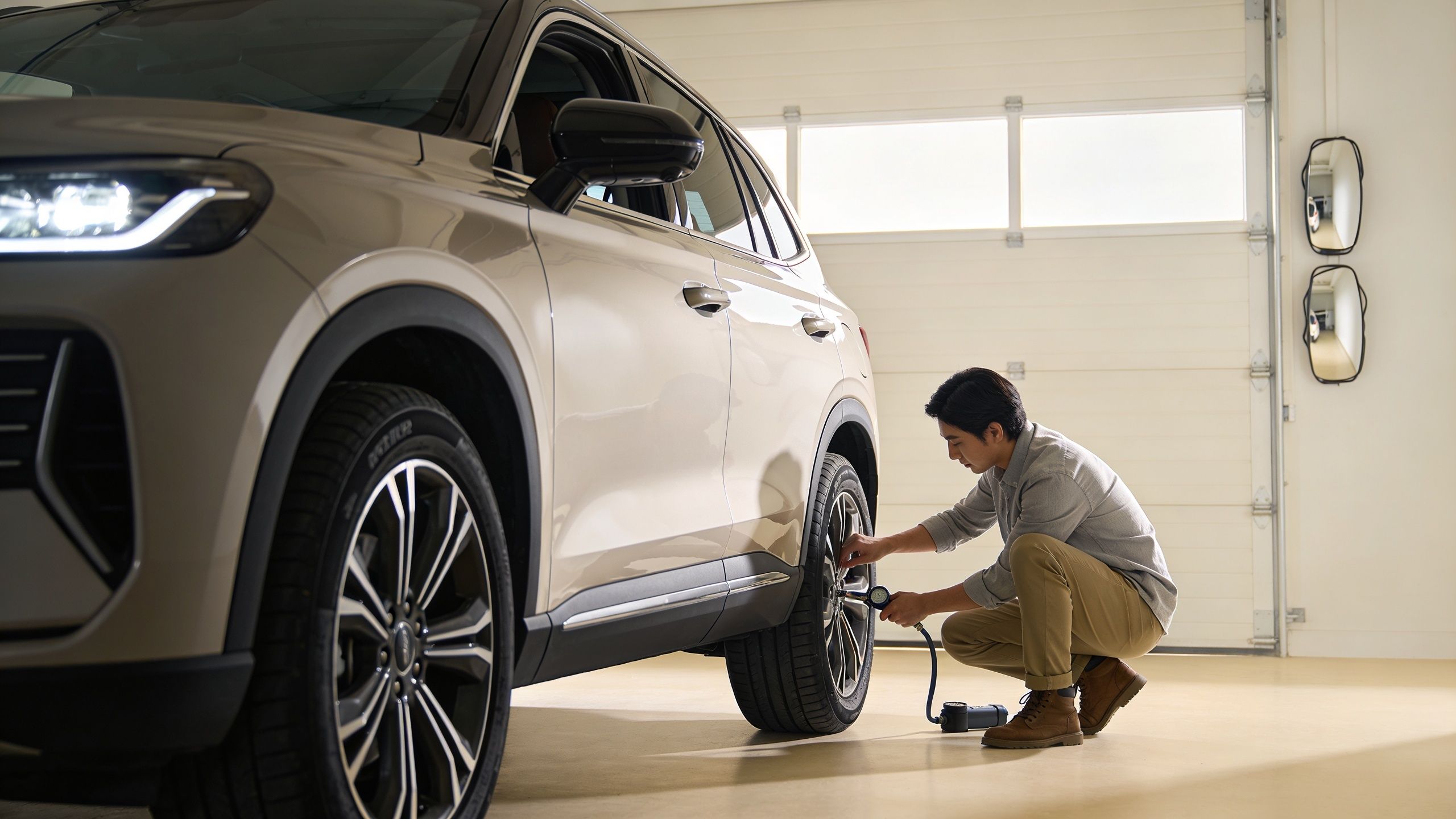
Your handoff checklist
Major shippers like Matson state in their Hawaii vehicle shipping requirements that vehicles may not be accepted over certain dimensions, that personal items must be removed, and that carriers may require alarms to be disabled and fuel to be kept below the usual threshold for safety. If you are shipping a lifted truck, modified SUV, roof-rack-equipped vehicle, or oversized van, confirm the exact height, width, and length before anyone schedules pickup.
A solid prep routine includes:
- Remove all personal belongings: Clear the cabin, trunk, cargo area, and door pockets. Do not leave clothes, chargers, documents, tools, or household overflow in the vehicle.
- Keep fuel low: Follow the carrier's stated limit. Too much fuel can create a handoff issue.
- Turn off alarms: Aftermarket alarms can interfere with loading and port handling.
- Confirm the vehicle operates normally: It should start, steer, brake, and roll unless non-running service was approved in writing.
- Take current photos: Get clear shots from all sides, plus close-ups of any existing damage.
- Read the inspection report carefully: Make sure the Bill of Lading reflects the vehicle's condition before you sign.
The details matter more on Hawaii moves than many first-time shippers expect. Ocean carriers and ports are stricter than a standard over-the-road handoff.
What people forget most often
The common misses are predictable. Toll tags stay on the windshield. A gym bag gets left under a seat. A customer removes the obvious items but forgets paperwork in the glove box or a stroller in the cargo area. Extra gas is another frequent problem, especially for customers dropping off a vehicle after a long drive to the port.
Modified vehicles deserve extra attention. Lift kits, oversized tires, roof accessories, low spoilers, and bike racks can change whether a car is accepted and how it must be handled. I tell customers to mention every nonstandard feature early, even if it seems minor. A dedicated National Car Transport coordinator can catch those issues before a truck is dispatched, which is far better than finding out at the port gate. If a customer wants updates in Spanish or is more comfortable asking detailed prep questions in a bilingual conversation, that kind of support can prevent simple misunderstandings.
One final habit protects you on pickup and delivery. Review the inspection at handoff line by line and make sure existing marks are listed correctly.
If you are shipping an electric vehicle, ask your coordinator for the current battery and charge-level instructions before pickup. Carriers update those requirements from time to time, and guessing is how preventable delays start.
Answering Your Top Hawaii Shipping Questions FAQ
How is shipping from Hawaii back to the mainland different
The reverse move follows the same general logic, but availability, routing, and mainland destination planning can change the timing. The key practical difference is that return shipments often require closer coordination on the mainland side after arrival, especially if the vehicle isn't being picked up near the receiving port. Customers also need to stay organized with release paperwork on the Hawaii side before the vehicle boards.
What if I have a classic luxury or modified vehicle
The chosen method often matters more than the headline price. For a classic or high-value vehicle, many owners prefer the additional protection of container service. For modified vehicles, the biggest issue is often acceptance, not price. Oversize dimensions, low ground clearance, or nonstandard equipment can affect whether a carrier or port will take the unit at all.
Ask direct questions about operability, dimensions, and how the vehicle will be inspected at handoff. Vague answers are a warning sign.
Can the same company help with Puerto Rico shipping
Yes, many customers who need Hawaii service also ask about Puerto Rico because both moves involve island logistics and ocean coordination. The process is different by route, but the planning mindset is similar. You want an advisor who understands domestic pickup, port schedules, release procedures, and the paperwork rhythm that comes with non-contiguous destinations.
That matters for families moving between major mainland cities, military households, dealerships, online buyers, and snowbirds. It also matters if you prefer to work with a bilingual English and Spanish agent based in the U.S. who can keep communication simple from quote through delivery.
What extra fees catch people off guard
The most common surprises are not mysterious. They're usually tied to choices or omissions:
- Mainland pickup charges: This can apply when the vehicle isn't being dropped at port.
- Outer-island handling: Delivery beyond the main arrival flow can add cost.
- Storage exposure: Missing or incomplete documents can turn into hold time.
- Vehicle size issues: Larger or heavier units may price differently.
- Service upgrades: Container protection or added convenience usually costs more.
The best way to avoid surprises is to ask for the quote assumptions in writing. Where is the pickup? Which island? Which service level? Is the vehicle standard size? Is the owner or lienholder paperwork complete? Clear answers early usually prevent expensive confusion later.
If you're ready to get a quote or want someone to walk you through the route step by step, National Car Transport helps customers ship vehicles across the mainland, Hawaii, Puerto Rico, Alaska, and all 50 states with dedicated advisor support, transparent flat-rate pricing, and bilingual agents in the U.S. who can guide the process from first scheduling through final pickup.