

You've got a quote in hand, a browser full of tabs, and a simple question that turns complicated fast. Can you trust what you're seeing in Ship a Car Direct reviews?
That's often a sticking point. A transport quote can look reasonable, the website can sound polished, and the star rating can seem reassuring. But auto transport is one of those services where the details matter more than the headline. A clean sedan moving from Dallas to Atlanta is one thing. A non-running SUV leaving Phoenix, a student shipment from Chicago to Miami, or a vehicle headed from the mainland to San Juan, Puerto Rico is something else entirely.
Reviews are useful, but only if you know how to read them. The best way to evaluate Ship a Car Direct is to separate broad reputation from route fit, broker promises from carrier execution, and standard domestic moves from shipments that need specialized coordination.
Table of Contents
- Making Sense of Ship a Car Direct Reviews
- Decoding Their Online Reputation and Ratings
- What Customers Praise Common Compliments
- Common Complaints and Red Flags to Watch For
- Verifying Legitimacy Beyond Customer Reviews
- The Right Choice For You Puerto Rico and Other Considerations
- Frequently Asked Questions About Shipping a Car
Making Sense of Ship a Car Direct Reviews
Those searching for Ship a Car Direct reviews aren't looking for entertainment. They're trying to reduce risk before handing over a vehicle, a schedule, and a meaningful amount of money to a broker and an unknown carrier.
That's the right instinct. In auto transport, reviews don't just tell you whether customers felt happy or frustrated. They reveal how a company handles uncertainty. Pickup timing, driver communication, route availability, and condition reporting all show up in customer comments, even when the reviewer doesn't use industry language.
What reviews actually tell you
A strong review profile usually points to a repeatable internal process. That can mean better carrier screening, cleaner handoffs between broker and driver, or clearer expectations at booking.
A weak or inconsistent review profile often points to one of these problems:
- Loose carrier selection: The broker fills orders, but the quality of the assigned hauler varies too much.
- Poor expectation setting: Customers think they booked firm dates or fixed pricing when they booked a market-based transport request.
- Weak support after dispatch: Once the car is assigned, the customer has to chase updates on their own.
Practical rule: Don't read reviews only for emotion. Read them for process clues.
What matters more than the star score
A review only helps if it matches your shipment type. Someone moving a running car between major metro areas in the lower 48 isn't dealing with the same logistics as a military family relocating to Florida, a snowbird shipping north in spring, or a customer trying to move a vehicle between the mainland and Puerto Rico.
That's why the useful questions are specific:
| Shipment question | Why it matters |
|---|---|
| Is the car running normally? | Non-operable units often trigger equipment and loading issues. |
| Is the route common? | Common lanes are easier to price and cover. |
| Are there port steps involved? | Puerto Rico shipments add paperwork, port handling, and ocean coordination. |
| Do you need close guidance? | Some customers want a self-serve quote. Others need an experienced agent. |
How to read with confidence
When I evaluate a competitor's review footprint, I look for three things first. Consistency, complaint patterns, and fit for difficult lanes. If those line up, the company is probably competent. If one breaks down, the customer experience usually does too.
For domestic car shipping across the 48 states, including moves between major cities, Ship a Car Direct can be a reasonable company to examine seriously. For more specialized moves, especially Puerto Rico routes involving San Juan and mainland pickup from cities across the U.S., the standard review scan isn't enough.
Decoding Their Online Reputation and Ratings
A high rating matters. It just doesn't answer every question by itself.
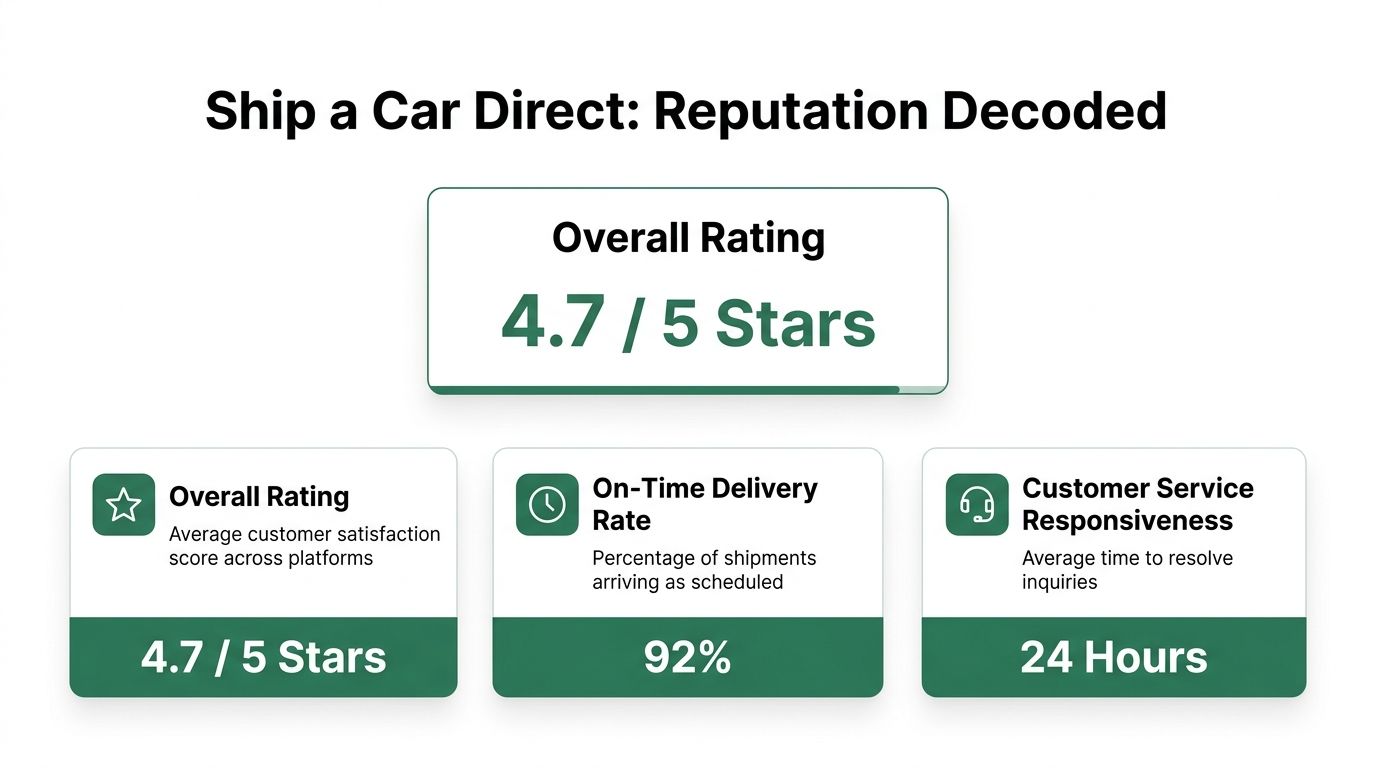
Ship a Car Direct maintains a verified aggregate customer rating of 4.8 out of 5 stars based on 6,200+ reviews across third-party platforms including Trustpilot, the Better Business Bureau, and Yelp, according to Move.org's review of Ship a Car Direct. That's a meaningful trust signal because review volume and cross-platform consistency are harder to fake than a handful of glowing testimonials on a company website.
Why the review volume matters
A strong score with a tiny sample can be misleading. A strong score across thousands of reviews is more durable. It suggests the company has handled a large number of shipments without letting service quality swing wildly from month to month.
That doesn't mean every customer had a flawless move. It means the company has likely built a repeatable operating model that works often enough to produce stable public feedback.
What a broker rating can and cannot prove
Ship a Car Direct is a broker, not the truck that physically carries your vehicle. That distinction matters. The broker's rating usually reflects:
- Booking experience
- Clarity of communication
- Responsiveness when problems come up
- How carefully the broker selects carriers
It does not guarantee that every assigned carrier will perform the same way on every route.
A common pitfall for shoppers is to read a broker's rating as if it were a direct measurement of one uniform fleet. It isn't. It's a measurement of broker oversight and customer-facing service.
A review score is best treated as evidence of process discipline, not a promise that your exact route will be friction-free.
How to compare ratings intelligently
When checking any transport company, use the same logic you'd use when buying parts online. You don't just see that the item looks right. You confirm whether it fits your vehicle and application. The same mindset helps when vetting transport providers, and the habit of checking details carefully is similar to learning how to verify auto part fitment before you buy.
For transport reviews, that means reading beyond stars and looking for pattern consistency:
- Do complaints cluster around timing? That usually points to market realities or weak scheduling communication.
- Do complaints cluster around pricing changes? That may point to quoting practices that need closer scrutiny.
- Do positive reviews mention calm, informed support? That's one of the strongest signs of a broker that knows how to manage handoffs well.
For a standard domestic shipment, Ship a Car Direct's public reputation is stronger than many brokers in the category. The caution is simple. Good aggregate ratings lower risk. They don't remove the need to match the company to your route and vehicle condition.
What Customers Praise Common Compliments
The most favorable Ship a Car Direct reviews tend to sound similar in the places that matter. Customers often describe a booking process that feels less intimidating than expected, especially if they've never shipped a car before.

The strongest praise usually centers on reduced risk
One reason positive feedback repeats around this company is its no upfront deposit approach. For many customers, that changes the tone of the transaction immediately. It lowers the feeling that they're committing cash before they know whether the shipment will be handled properly.
That matters in a business where customers are already nervous. They're not ordering a small item online. They're turning over a vehicle that may be needed for work, school, family transportation, or a relocation deadline.
Communication tends to shape the best reviews
When customers describe a shipment positively, they usually aren't celebrating the truck itself. They're relieved that someone explained the process clearly, answered calls, and didn't disappear when questions came up.
The compliments that carry the most weight are usually about things like:
- Clear expectations: The customer understood the pickup window, the payment flow, and what the driver would need.
- Professional coordination: The handoff between broker and carrier felt organized.
- Less financial friction: The booking process felt lower pressure because payment wasn't front-loaded.
- Simple pickup and delivery: The move worked as planned without a lot of chasing or confusion.
A practical comparison helps here. Customers who want a more guided, service-heavy version of this experience often prioritize door-to-door auto transport because it reduces the amount of coordination they have to manage themselves.
Good reviews often come from ordinary shipments
The smoothest stories usually involve straightforward lanes and common vehicles. A running sedan, SUV, or light truck moving between major cities is where a broker's process has the best chance to shine.
That doesn't make the praise less valid. It just gives it context. If your move looks like a typical domestic shipment, those positive reviews are more relevant to you than if you're shipping a non-running vehicle, coordinating around a military report date, or moving a car to an island destination.
Later in the process, it helps to hear a real walkthrough instead of reading comments alone.
What the praise does and doesn't prove
Positive reviews can tell you that Ship a Car Direct has earned trust from a large number of customers. They can't tell you whether your shipment has hidden complexity.
That's why the best use of praise is this. Treat it as evidence that the company may handle standard routes well, then test your own shipment against the harder variables: vehicle condition, timing rigidity, pickup access, and whether the route includes specialized logistics.
Common Complaints and Red Flags to Watch For
No transport broker gets through years in business without unhappy customers. The question is whether the complaints point to normal industry friction or to a deeper process problem.
With Ship a Car Direct reviews, most caution flags fit into familiar broker issues. Timing can move. Carrier communication can be uneven. A quote can feel different once a real truck is being sourced. None of that is unique to one company.
The most important complaint category is usually expectation mismatch
Customers often think they've purchased certainty when they've purchased access to a carrier network. That misunderstanding is where frustration starts.
A broker can be honest and still have an unhappy customer if the customer expected:
- Firm pickup timing on a flexible market lane
- A final price that never changes under any condition
- Direct control over the carrier's every update
- No complications for a difficult vehicle condition
If a review sounds angry but the underlying problem is scheduling drift on a busy route, that's not automatically a sign of dishonesty. It may just mean the booking conversation didn't explain the realities well enough.

Non-operable vehicles deserve extra scrutiny
This is one area where shoppers should slow down and ask detailed questions.
A significant gap in reviews is the ambiguity around non-operable vehicles. While a $150 additional fee is often mentioned, industry reports show 35% of these shipments require specialized handling that can add $200–$500 to the base rate, according to MoveBuddha's review discussion of Ship a Car Direct. That issue matters because many customers use “non-operable” loosely when the transport side needs specifics such as whether the vehicle can brake, roll, and steer.
Questions worth asking before you book
A customer with a non-running or damaged vehicle should never stop at “Do you ship non-operable cars?” The better questions are more specific:
- Can the vehicle roll freely? A locked wheel changes loading needs.
- Does it steer and brake? If not, the equipment required may be different.
- Is the battery dead, or is the drivetrain disabled? Those are not the same issue operationally.
- Will the quote change if a winch or specialized trailer is required? You want the answer before dispatch, not at pickup.
The phrase “non-operable” sounds simple to customers. To dispatch, it can describe several very different loading scenarios.
Other review red flags that matter
Beyond vehicle condition, I'd pay close attention if multiple reviews describe the same pattern:
| Red flag in reviews | What it may indicate |
|---|---|
| Repeated confusion about final price | The quoting conversation may be too broad or too optimistic. |
| Complaints about silence after booking | Support may be strong before sale and thinner after dispatch. |
| Surprise at pickup conditions | Inspection and prep expectations may not have been explained clearly. |
For most standard shipments, these are manageable risks if you ask direct questions. For higher-stakes moves, they become much more important.
Verifying Legitimacy Beyond Customer Reviews
Customer feedback is useful, but it's still subjective. If you want a cleaner read on whether a transport company is legitimate, check credentials that don't depend on opinion.
Start with licensing and operating identity
An auto transport broker should be properly registered and easy to identify. You should be able to confirm the company's operating details, see whether it is acting as a broker or carrier, and match the business name to the records it presents publicly.
That check matters because the transport world includes polished marketing from companies that aren't always transparent about who is actually handling the order.
Ask about insurance in practical terms
Many customers ask, “Is my car insured?” That's a good start, but it's not enough. The better question is, “Whose cargo policy applies while the vehicle is in transit, and what is the claims process if damage is found at delivery?”
Here's the practical workflow a legitimate company should explain clearly:
- Before pickup: The vehicle condition gets recorded on the bill of lading.
- During transit: The carrier's cargo coverage typically applies while the car is on the truck.
- At delivery: You inspect the vehicle before signing final paperwork.
- If there's an issue: The claim process should be documented immediately, not days later after memory gets fuzzy.
Checklist item: If the company can't explain the damage-claim path in plain English, keep shopping.
BBB standing matters, but context matters too
A Better Business Bureau profile can help, especially when it shows long-term responsiveness and professional complaint handling. It's one signal, not the whole answer.
Pricing transparency also belongs in this legitimacy check. If you're comparing brokers, it helps to understand what usually changes a quote and what shouldn't. A useful reference point is this guide to car shipping cost factors, because it frames the variables customers should expect a transport company to explain upfront.
A quick verification routine
When vetting any company, use a short routine instead of relying on gut feeling:
- Match names carefully: The business name on the quote should match the operating identity you verify.
- Confirm broker versus carrier: That changes what the company directly controls.
- Read a few negative reviews closely: Look for repeated operational patterns, not just emotion.
- Inspect the paperwork flow: A legitimate company should explain pickup inspection, delivery inspection, and payment timing clearly.
Reviews tell you how customers felt. Verification tells you whether the company is operating in a way that deserves your trust.
The Right Choice For You Puerto Rico and Other Considerations
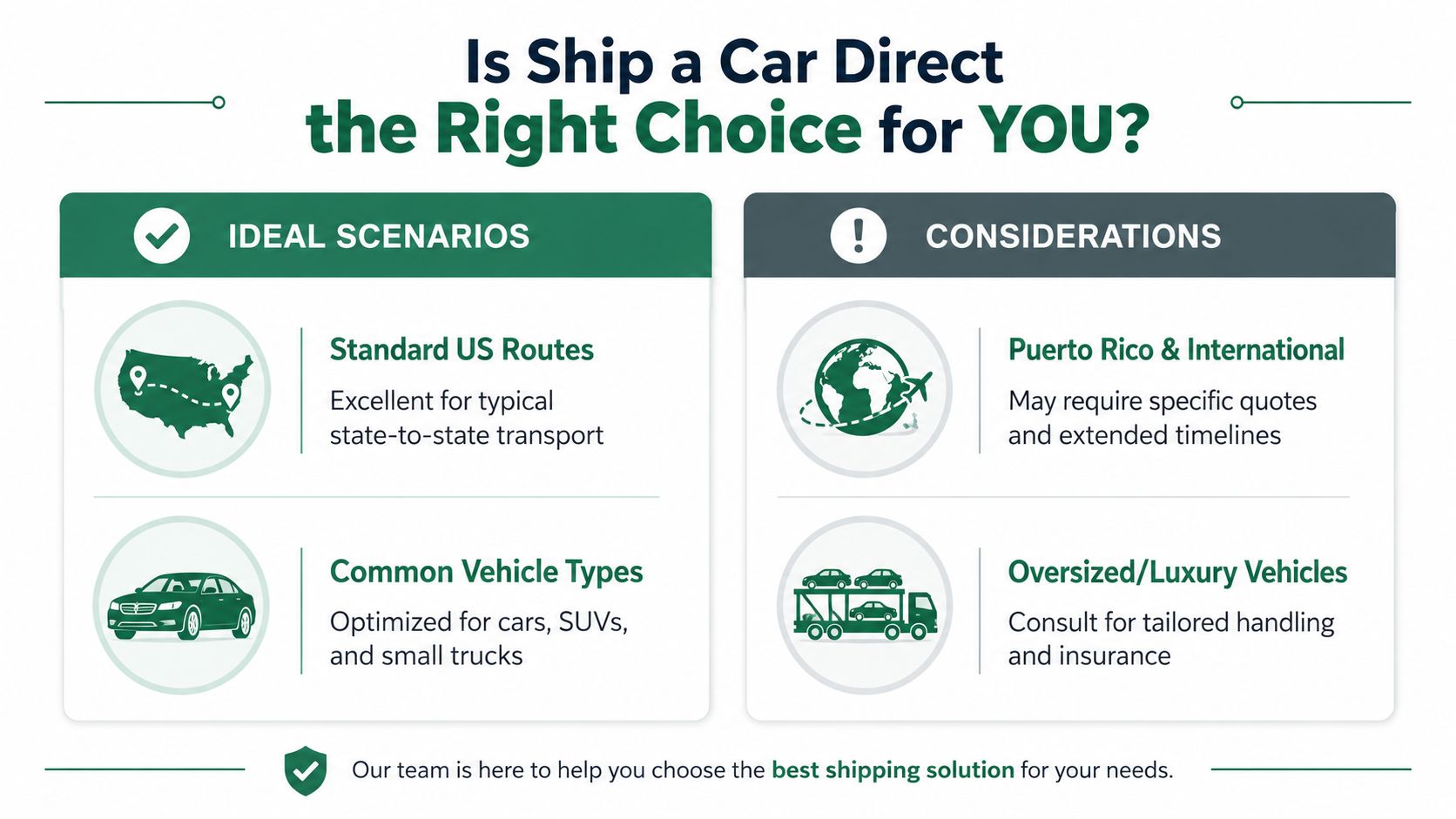
Ship a Car Direct may be a good fit for some customers. It may also be the wrong fit if your move has more moving parts than a standard lower-48 shipment.
That distinction matters most on Puerto Rico routes. Shipping a car from the mainland to San Juan isn't just a longer domestic trip. It combines inland transport, port scheduling, ocean freight, vehicle release procedures, and timing coordination on both sides.
When a mainstream broker model can work well
If you're moving a common vehicle on a familiar mainland lane, a broker with a broad carrier network can be effective. That's especially true for ordinary pickups and deliveries involving major U.S. cities where carrier availability is usually better.
For these customers, the appeal is straightforward:
- Common vehicle types
- Flexible timing
- Standard pickup environments
- No unusual handling requirements
That's the kind of shipment many review platforms reflect most heavily.
Puerto Rico changes the equation
A vehicle going to Puerto Rico needs more than a domestic dispatch mindset. The ocean leg alone typically costs $1,200–$2,500, with compact cars from Florida ports averaging about $1,500, according to Vehicle Transport Reviews on shipping a car to Puerto Rico. That's just for the RoRo portion, so mainland pickup and related logistics still have to be coordinated around it.
This is why Puerto Rico moves demand sharper questions:
| Question | Why it matters for Puerto Rico |
|---|---|
| Who handles port coordination? | Missed port steps create avoidable delays. |
| Is the quote explaining ocean and inland legs clearly? | Customers often compare incomplete quotes. |
| Who helps with paperwork? | Port and release details need close attention. |
| Is support bilingual if needed? | That can matter for families, businesses, and local coordination in Puerto Rico. |
Who should be extra careful
Some customers should avoid assuming that a strong mainland review profile automatically translates to island-route expertise.
That includes:
- Military families managing strict reporting timelines
- Snowbirds who want predictable seasonal coordination
- Students who can't spend days sorting out paperwork confusion
- Dealerships and businesses that need repeatable logistics, not improvisation
For customers in those categories, it often makes more sense to work with a company that routinely handles mainland-to-island coordination and can walk through the process clearly in English or Spanish. If you're comparing route-specific options, a dedicated Puerto Rico car shipping service is the right benchmark to review.
A company can be good at domestic auto transport and still not be the strongest choice for Puerto Rico. Those are related services, not identical ones.
The right decision comes down to shipment complexity. On ordinary mainland moves, review strength may be enough. On Puerto Rico routes, specialized process knowledge matters much more.
Frequently Asked Questions About Shipping a Car
Is Ship a Car Direct a broker or a carrier
Ship a Car Direct operates as a broker. That means it arranges transport by matching your shipment with a carrier in its network rather than using its own fleet for every move. For customers, the practical issue is simple. You're evaluating both the broker's coordination quality and the carrier that ultimately gets assigned.
What should I do if my vehicle arrives with damage
Document the condition at delivery before signing final paperwork. Compare the vehicle to the pickup inspection record, note any new issues on the bill of lading, take clear photos, and start the claim process immediately through the proper channel identified in your paperwork. Waiting too long makes any claim harder because the condition record gets weaker.
Can I pack personal items in my vehicle
Ask first and keep expectations conservative. Some customers put a few light personal items in the trunk, but many carriers limit or discourage this because added contents can create compliance, liability, and weight issues. If the contents matter to you, get the rule in writing before pickup.
What's the biggest mistake people make when reading reviews
They read for reassurance instead of relevance. A five-star review from a customer shipping a running sedan between two common metro areas doesn't tell you much if your vehicle doesn't run, your street has limited truck access, or your route includes Puerto Rico.
Are reviews enough to choose a company
No. Reviews should help you narrow the list, not make the final decision alone. Pair them with credential checks, insurance questions, route-specific questions, and a clear understanding of whether your shipment is routine or specialized.
If you're shipping within the mainland or planning a move to or from Puerto Rico, National Car Transport is worth a serious look. With 25+ years of experience, an A+ BBB rating, transparent flat-rate pricing, and a network of 25,000+ vetted carriers, the company is built for both standard domestic routes and more complex island logistics. Customers also get support from bilingual U.S.-based agents in English and Spanish who bring over 20 years of auto transport logistics experience. That matters because no two vehicle shipments are exactly alike, and having a knowledgeable advisor who can guide the process clearly is often the difference between a stressful move and a smooth one.