
Your move is already scheduled, the buyer is waiting, or a military, student, dealership, or snowbird relocation has left you with almost no room in the calendar. You call asking for same day pickup and delivery, expecting a truck to appear as soon as the order is submitted. In auto transport, that outcome depends less on the promise printed on a website and more on whether a suitable carrier is close, available, equipped for your vehicle, and able to reach the pickup before its next commitment.
Mainland same-day pickup is a live dispatch problem. Puerto Rico shipping is a different process entirely, because the vehicle must connect with an ocean route to San Juan or another island port. The right approach is to give your advisor complete information, understand what can move today, and keep a practical backup window available.
Table of Contents
- Why Same Day Pickup and Delivery Is Harder Than It Sounds
- What Actually Determines Same Day Availability
- Booking the Shipment So a Driver Can Accept It Today
- Mainland Carrier Matching Versus Puerto Rico Ocean Routes
- Expedited Fees and How Pricing Shifts on Tight Timelines
- Talking to Your Advisor When the Schedule Slips
- Limitations, Realistic Expectations, and a Final Checklist
Why Same Day Pickup and Delivery Is Harder Than It Sounds
The request enters dispatch as a time-sensitive load, not as an automatic appointment. An advisor first confirms the pickup ZIP code, delivery ZIP code, vehicle year, make, model, and whether the car runs, rolls, steers, and brakes. An inoperable SUV needs different equipment from a running sedan, and that difference can determine whether a nearby driver can accept the job.
The advisor then checks the carrier board for trucks already moving near the pickup area. Location matters, but so does the truck's route, remaining space, equipment, and next scheduled stop. A carrier passing through Atlanta may be able to collect a running sedan quickly, while a truck several hours away may have no practical ability to reach a rural pickup before its route closes.
The dispatch clock starts immediately
Morning requests generally have more room because drivers are still building the day's route. Afternoon requests face a narrower window, especially when the customer needs the vehicle loaded before the driver reaches a delivery appointment, rest location, or terminal cutoff. The exact cutoff varies by route, traffic, carrier schedule, and how quickly the customer completes the booking.
Most successful same-day requests fall into one of two patterns. A suitable carrier accepts quickly because the load fits an existing route, or the request moves to next-day pickup because no qualified truck can reach the address responsibly. That isn't a failure of the advisor. It's the difference between a live carrier match and a marketing phrase.
Dispatcher's rule: A same-day request is realistic only when the truck, the vehicle, the address, and the clock all line up.
Same-day service also doesn't always mean same-day delivery across the country. Ground auto transport works best when the pickup and delivery points fit a regional or corridor-based move. A carrier may collect the vehicle today and deliver later according to the route, distance, legal driving limits, and other vehicles on the trailer.
That distinction matters for customers in New York City, Los Angeles, Chicago, Houston, Miami, Phoenix, Denver, Seattle, Boston, Atlanta, Dallas, and other dense markets. It also matters for moves between the 48 contiguous states, where a same-day pickup may be possible even though final delivery requires normal transit time.
What Actually Determines Same Day Availability
Four variables control the odds of a same-day match: carrier proximity, route density, vehicle condition and type, and booking time. You can influence some of them before calling, but you can't manufacture a truck where no truck is available.
McKinsey reports that same-day delivery remains a relatively small part of the broader courier, express, and parcel market. It accounts for less than 5% in most countries, about 1% in France and Germany, roughly 2% to 3% in the United Kingdom, Japan, and the United States, and no more than 4% overall in China, although major Chinese cities can reach 10% to 15% for intracity service. Those figures describe general delivery markets rather than auto transport specifically, but they illustrate why same-day capacity tends to appear first in dense corridors. See McKinsey's analysis of same-day delivery constraints for the operational context.
Four inputs shape the live match
A sedan leaving Atlanta for Charlotte has a better practical profile than an inoperable SUV leaving a remote ZIP code in Montana. The Atlanta vehicle is likely to sit near active carrier lanes, while the Montana shipment may require a truck to reposition before loading.
| Factor | Raises Odds | Lowers Odds |
|---|---|---|
| Carrier proximity | A qualified truck is already near the pickup ZIP | The nearest truck is too far away or committed |
| Route density | Pickup and delivery follow an active corridor | The address sits outside regular carrier lanes |
| Vehicle condition | Running vehicle with standard dimensions | Inoperable, oversized, modified, or unusually heavy vehicle |
| Booking time | Complete request clears the board early | Late booking leaves little route flexibility |
Address access can decide the result after a driver accepts. A narrow residential street, gated facility, steep driveway, low clearance, or restricted loading area may force the carrier to meet at a nearby commercial location. Give the advisor exact access notes before dispatch, not after the truck is already moving.
Live location data helps dispatchers distinguish a truck that appears nearby from one that can reach the pickup. For background on how fleet location tools support route awareness and carrier coordination, the Mobile Systems Limited fleet tracker guide is a useful reference. Tracking alone doesn't create capacity, but accurate visibility helps an advisor make a faster decision.
Your best influence comes from flexibility. Offer a safe alternate pickup location, keep the vehicle ready, answer your phone, and accept a practical pickup window instead of insisting on one exact minute. Those choices widen the set of carriers who can say yes.
Booking the Shipment So a Driver Can Accept It Today
A dispatcher reads the basic quote fields as operational inputs, not as paperwork. Start with the exact pickup and delivery ZIP codes, vehicle year, make, model, running status, and a phone number someone will answer throughout the booking.
If the vehicle is inoperable, say so plainly. “It starts but doesn't move” is different from “it runs and drives.” The carrier needs to know whether a winch, special loading equipment, or extra labor may be required.
Give the advisor a complete release package
The name on the registration should match the name on the order, or you should explain the ownership or authorization arrangement before a driver is assigned. Confirm the pickup address, access restrictions, gate instructions, keys, and the person handing over the vehicle. Do the same for delivery. A carrier can't complete a clean handoff if nobody is available at the destination.
Use direct language:
- State the deadline: Tell the advisor that you need pickup today, not merely an expedited quote.
- Confirm the vehicle: Identify whether it's operable, modified, oversized, or carrying personal property.
- Confirm the address: Provide a truck-accessible location and a backup meeting point if necessary.
- Confirm contacts: Give reachable names and phone numbers at pickup and delivery.
- Review the deposit: Ask when the deposit is due, what it reserves, and when the carrier receives dispatch details.
- Wait for assignment confirmation: A quote or soft hold isn't the same as a released driver.
For customers who want the vehicle collected at home, review the company's door-to-door auto transport service and confirm whether the exact address can accommodate a transport truck. Door-to-door service still depends on safe access and carrier approval.
Incomplete forms stall the board because an advisor must stop and chase missing information. A reachable customer with a ready vehicle can be dispatched quickly. A customer who hasn't confirmed keys, authorization, operability, or access may lose the available truck while those details are being resolved.
The practical sequence is simple: submit accurate information, answer the advisor's verification call, approve the quoted service, complete the required payment step, confirm pickup instructions, and obtain the driver's name, phone number, and estimated arrival window. Ask for written confirmation so everyone works from the same details.
Mainland Carrier Matching Versus Puerto Rico Ocean Routes
A mainland move and a Puerto Rico move shouldn't be placed on the same timeline. On the mainland, same-day pickup depends on a carrier reaching the origin and loading the vehicle. A Puerto Rico shipment must also connect with port handling and an ocean sailing before the vehicle can reach San Juan.
Puerto Rico vehicle shipping is commonly arranged as door-to-port or port-to-door service, and the route uses ocean shipping rather than simple overland delivery, as explained by Puerto Rico Ship's vehicle shipping overview. San Juan-bound transport therefore has a carrier handoff that mainland customers don't face.
Compare the two operating models
| Factor | Mainland Carrier Matching | Puerto Rico Ocean Routes |
|---|---|---|
| Dispatch speed | A nearby truck may accept and collect the vehicle the same day | A mainland driver must deliver the vehicle to the port or approved handoff point |
| Main constraint | Carrier location, route, equipment, and pickup access | Sailing schedule, port cutoff, documentation, and vehicle acceptance |
| Vehicle release | Driver inspects and loads the car at the origin | Carrier transports the car to the port, then the ocean operator receives it |
| Transit model | Ground movement across domestic routes | Ocean movement followed by island-side delivery |
| Final delivery | Mainland carrier completes delivery according to its route | A Puerto Rico-side carrier completes the final leg after release |
For San Juan, the mainland pickup can sometimes happen quickly if the vehicle is near an active corridor, but the island schedule still controls the overall shipment. A guide describing mainland-to-San Juan moves identifies Philadelphia and Jacksonville as two major mainland ports and estimates about 10 to 14 days from drop-off for the overall process, including sailing and port processing. Read the San Juan vehicle shipping review for that route-specific explanation.
A Miami-to-San Juan example from National Car Transport's Puerto Rico route information lists about $895 to $1,195 and an estimated 7 to 10 days in transit. That example shows why origin city, port handling, ocean freight, and final-mile arrangements all affect the quote.
Same-day pickup may still be worth requesting for the mainland leg. It won't turn an ocean route into same-day delivery.
Expedited Fees and How Pricing Shifts on Tight Timelines
Same-day auto transport pricing reflects a real operational cost. The carrier may need to leave an existing route, reposition an empty trailer, wait for a vehicle, or accept a less efficient load sequence. You're paying for access to a truck that can alter its plan, not for a label placed on an ordinary shipment.
An expedited request can change a flat quote after the dispatcher checks live availability. The base rate may no longer cover the carrier's empty miles, fuel exposure, tolls, extra coordination, or the opportunity cost of taking a time-sensitive load. Ask whether the quoted amount includes the expedited request or whether the price will be confirmed after a carrier accepts.
Ask what activates the price change
A clean pricing conversation should cover:
- Expedite fee: Confirm whether same-day pickup carries a separate charge and when it applies.
- Fuel adjustment: Tight schedules can require faster repricing when the carrier's route and fuel exposure change.
- After-hours handling: Evening, weekend, or holiday requests may require a separate operational arrangement.
- Deposit timing: Ask what payment locks the available slot and what happens if no carrier accepts.
- Puerto Rico costs: Clarify port delivery, ocean freight, terminal handling, and island-side delivery separately.
Use the auto shipping cost guide to understand the elements that shape a quote, then ask your advisor to apply them to your vehicle and route. Don't compare a same-day request with a standard quote unless the service level, pickup window, equipment, and delivery terms match.
The economics are under pressure across delivery operations. A 2026 industry report covering more than 500 delivery operators found a median year-over-year cost-per-delivery increase of 12%, with 60% reporting increases above 10% and 20% reporting increases above 20%. The report is summarized by VoxBooster's 2026 delivery statistics. It also notes that last-mile delivery can consume up to 28% of total delivery costs in urban supply chains. That's why pushing every vehicle into same-day service can raise cost faster than reliability.
Talking to Your Advisor When the Schedule Slips
Your advisor is the control point once the order is active. A customer who communicates clearly can help the operations team re-dispatch, widen the pickup window, or move the meeting point before the available capacity disappears.
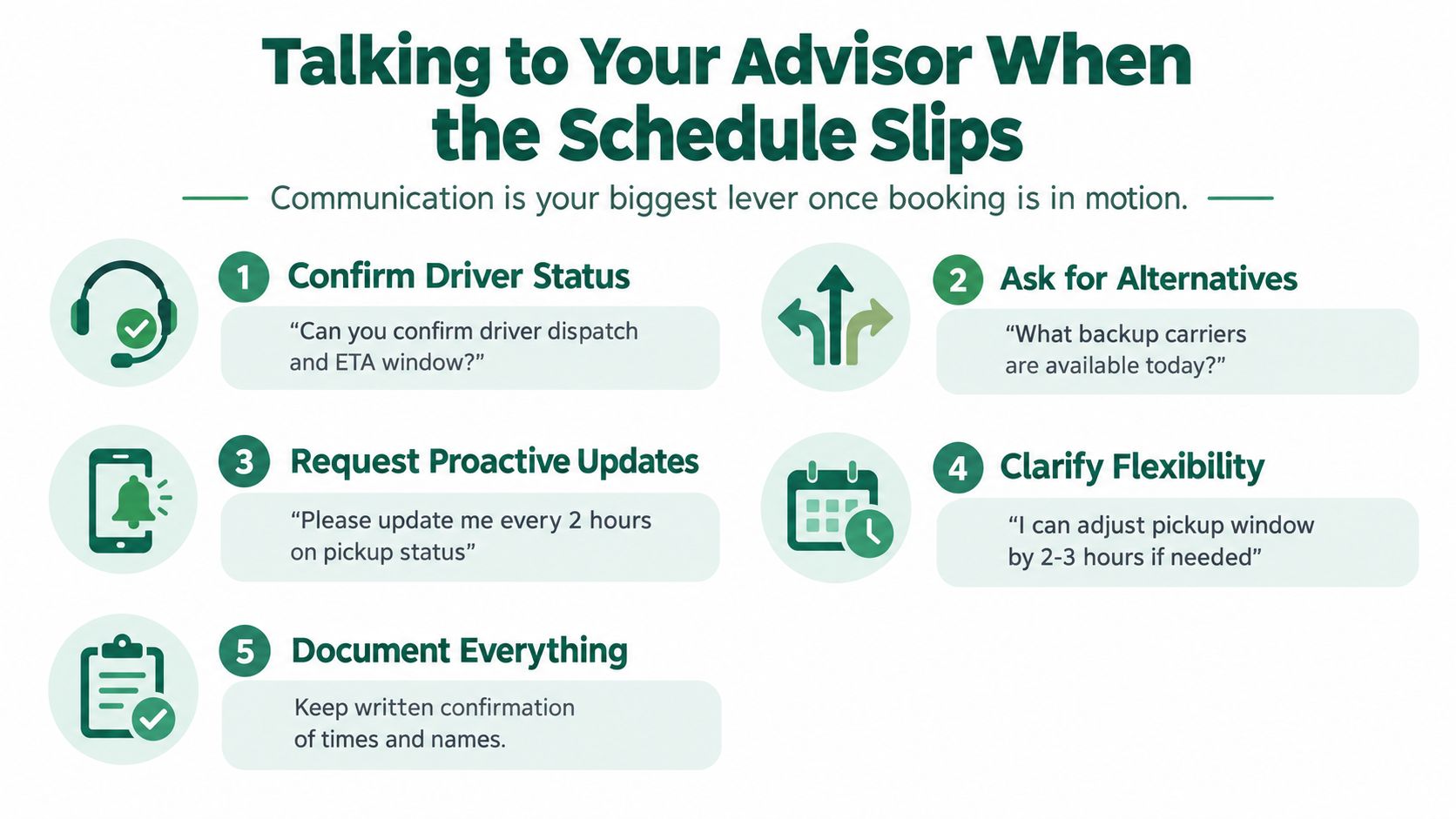
Don't ask only, “Any update?” Ask for the exact status. A soft hold means the request is being worked or a carrier is being considered. A dispatched load means a specific carrier has accepted the vehicle and received the pickup details. Those are different stages, and you need to know which one applies.
Use direct questions and timestamps
Try these scripts:
- “Can you confirm whether a driver has been dispatched, and what ETA window the driver gave you?”
- “Is this a soft hold, or has a carrier accepted and received the release information?”
- “The original carrier can't meet the window. What backup carriers are available today?”
- “The pickup window is closing. Please escalate this to the operations manager and tell me when I'll receive the next update.”
- “I can adjust the pickup window by a few hours if that gives dispatch a workable truck.”
Request the time the driver was assigned, the time the pickup details were released, the latest location or route status, and the next promised update. Keep the names of the advisor and driver with those notes. Written confirmation prevents a simple misunderstanding from becoming a missed handoff.
The delivery industry increasingly relies on real-time visibility, dynamic capacity management, and coordinated systems. One retailer survey summarized in industry reporting found that only 29% said they were doing a good job meeting same-day windows. The leading obstacle was lack of real-time order visibility and tracking at 36%, followed by travel distance at 24% and lack of drivers or small fleets at 23%, according to Market Data Forecast's same-day delivery market report.
That evidence supports a practical customer habit: stay reachable and give the advisor useful flexibility. If the original driver falls through, a fast, complete response gives the team a chance to search the board again instead of starting with unanswered questions.
Limitations, Realistic Expectations, and a Final Checklist
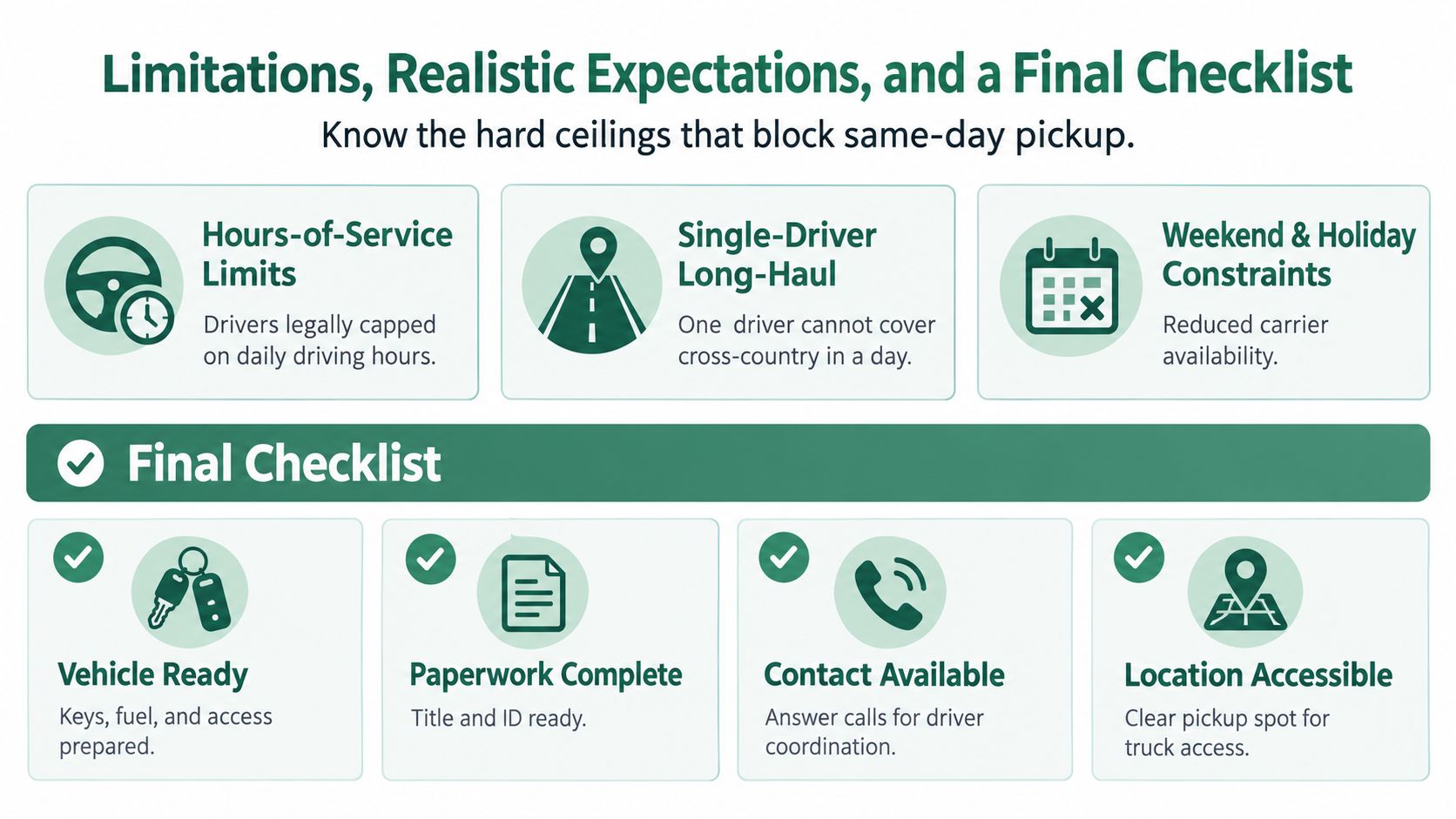
Some constraints cannot be negotiated. Drivers must follow hours-of-service rules, a single driver can't cover a cross-country route in one day, and weekend or holiday rosters can reduce available capacity. Weather, road closures, vehicle condition, rural access, and port schedules can block a same-day pickup even when a truck is visible nearby.
Rural ZIP codes are especially difficult because a truck may be close geographically but still far from a practical route. The carrier may need to finish a prior delivery, find safe access, or reposition empty equipment before reaching the vehicle. Moving pickup by 24 hours often creates a confirmed match because the board has more time to align the load with a normal route.
Run this check before you call
- Confirm the corridor: Know whether the pickup ZIP sits near an active mainland carrier route.
- Prepare the vehicle: Have keys, fuel, access instructions, and the vehicle's operability details ready.
- Complete the paperwork: Keep registration, identification, authorization details, and contact names available.
- Set the budget: Decide whether you're prepared to pay for expedited dispatch and ask what activates the fee.
- Keep alternatives open: Offer a nearby accessible meeting point and a wider pickup window.
- Stay reachable: Answer calls from the advisor and driver until the vehicle is loaded.
- Plan Puerto Rico correctly: Treat mainland pickup, port handoff, sailing, and San Juan delivery as separate milestones.
For businesses and dealerships, written customer updates reduce confusion when schedules move. A practical resource such as these post-purchase SMS templates from YipSMS Inc. can help teams phrase arrival updates, delay notices, and confirmation messages clearly, although your advisor should remain the source for carrier-specific timing.
National Car Transport serves domestic moves across the 48 contiguous states and Puerto Rico, including routes involving major cities and San Juan. Its U.S.-based bilingual English and Spanish agents have more than 20 years of auto transport logistics experience, while the company reports 25+ years in business, an A+ BBB rating, transparent flat-rate pricing, and a network of 25,000+ vetted carriers. Not one vehicle transport is alike, so an experienced agent who can guide the details is often more useful than a generic same-day promise.
Same-day pickup is a request you can strengthen, not a result you can demand. Have the vehicle ready, provide accurate access information, answer quickly, and accept that carrier density sets the ceiling. If today's match fails, that usually means the network is constrained, not that your shipment is impossible.
For a same-day pickup assessment, Puerto Rico ocean-route planning, or domestic transport across the 48 states, contact National Car Transport with your pickup ZIP, destination, vehicle details, and deadline. Visit National Car Transport to request a clear quote and speak with a bilingual U.S.-based advisor who can coordinate the next practical step.