

Professional auto transport is exceptionally safe, with a 99.7% damage-free delivery rate across more than 1.5 million annual shipments. If you need to move a car across the mainland U.S. or ship it to Puerto Rico, the safest path is usually not driving it yourself. It's choosing a properly vetted transporter, using the right trailer type, and documenting the handoff correctly.
That's the point most customers need to hear first. You're likely staring at a move, a purchase, a deployment, a seasonal relocation, or a student drop-off date, and the car question has become one more thing that can go wrong. Handing over your keys feels personal because it is.
Safe auto transport isn't about a company saying “trust us.” It's about whether the truck, the driver, the paperwork, the insurance, and the route all work together in a controlled process. That matters on a simple state-to-state move from Los Angeles to Dallas or Chicago to Miami. It matters even more when the trip includes a port, ocean freight, San Juan processing, and Puerto Rico excise tax.
Customers shipping from the mainland often ask the same practical questions. Is open transport safe enough? When is enclosed worth it? What paperwork protects me if something happens? How different is Puerto Rico from a normal domestic route?
The answers are straightforward when you strip away the marketing and focus on logistics. That's what this guide does.
Table of Contents
- What Safe Auto Transport Really Means
- Open vs Enclosed Transport The Right Choice for Your Car
- How to Vet Your Transport Company and Verify Insurance
- Preparing Your Vehicle for a Smooth Handover
- Shipping to Puerto Rico A Mainland to Island Guide
- Special Guidance for Military Classic Car and Student Moves
- Tracking Your Vehicle and Final Delivery Inspection
What Safe Auto Transport Really Means
Thoughts of car shipping rarely arise until the service is required. Then the concern shows up fast. Who's driving it, where will it sit overnight, what happens in bad weather, and what if it arrives with damage?
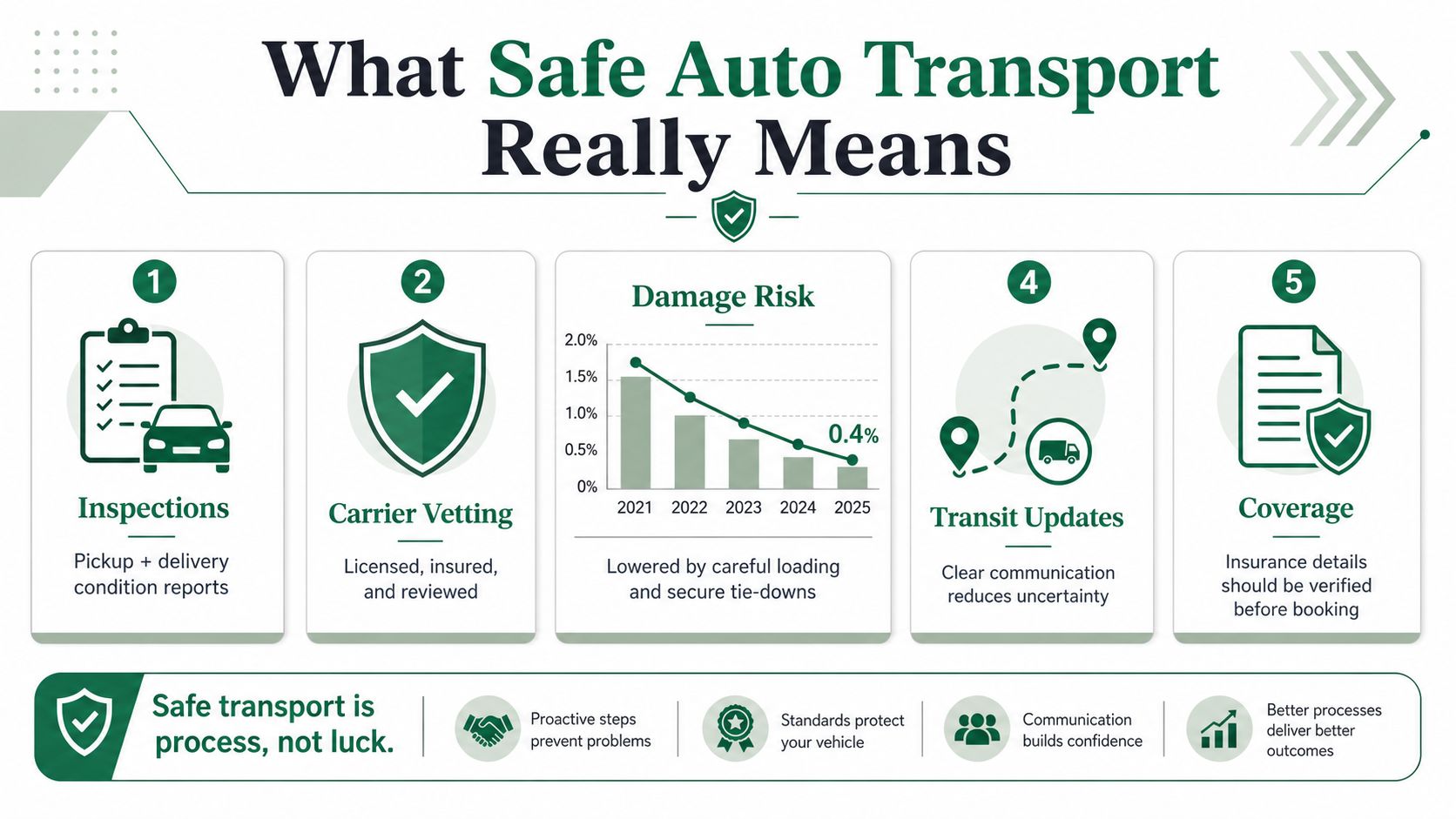
In this business, safety has to be defined by outcomes, not slogans. The clearest benchmark available is that professional carriers in North America have maintained a verified 99.7% damage-free delivery rate across more than 1.5 million annual shipments, which means a 0.3% failure rate in the cited dataset from Hanamark's review of vehicle transport safety.
What that number actually tells you
A safe auto transport move isn't “risk free.” Nothing on the road is. What that number tells you is that professional transport operates inside a structured system where loading methods, carrier equipment, route discipline, and inspection procedures reduce the chance of loss or damage to a very low level.
That's different from a long self-drive. A personal road trip exposes the vehicle to fatigue, roadside incidents, parking lot damage, weather shifts, and ordinary highway wear. Shipping removes the owner from that part of the equation.
Practical rule: Safety in auto shipping starts before pickup. The right carrier, the right trailer, and the right inspection matter more than any promise in an ad.
What safe looks like in practice
Customers usually recognize safe transport by a few concrete signs:
- Licensed operation: The company can identify the carrier and provide proper registration details.
- Clear inspection process: Pickup and delivery aren't rushed. Existing marks get noted before the vehicle moves.
- Appropriate equipment: The trailer type matches the car. A daily-driver sedan and a low-clearance collector car don't belong in the same risk category.
- Real communication: Someone can explain the route, timing, and handoff process in plain language.
That last point matters more than people think. Not one vehicle transport is alike. A dealer transfer from Phoenix to Denver, a snowbird move from Boston to Tampa, and a mainland-to-San Juan shipment all require different handling. Good logistics support makes the process simple because the details are managed before they become problems.
Open vs Enclosed Transport The Right Choice for Your Car
The first real decision most customers make is trailer type. This isn't just a budget question. It's a risk and fit question.
Most vehicles moving around the U.S. ride on open carriers because that setup is efficient and widely available. But “most common” doesn't always mean “best for your car.” The right choice depends on value, ground clearance, finish sensitivity, and how much exposure you're willing to accept.
Open vs enclosed at a glance
According to Move.org's guide to keeping a car safe during transport, 90% of customers choose open transport for affordability, while enclosed transport costs 40–50% more and provides added protection with nylon straps, wheel nets, and four-wall weather barriers.
| Feature | Open Carrier | Enclosed Carrier |
|---|---|---|
| Typical use | Standard daily drivers, commuter cars, many SUVs and trucks | Classics, exotics, luxury vehicles, show cars, low-clearance vehicles |
| Cost position | More affordable | Usually costs 40–50% more |
| Weather exposure | Exposed to normal road and weather conditions | Protected by four-wall enclosure |
| Road debris protection | Limited | Stronger protection |
| Securement approach | Professional carrier securement | Often includes nylon straps and wheel nets |
| Best fit | Practical transport for common vehicles | Higher-protection transport for vulnerable or high-value vehicles |
When open transport is the right call
For a typical family sedan, crossover, or pickup, open transport is often a sensible and safe choice. It's the standard tool for mainstream moves between major markets like Atlanta, Houston, Las Vegas, Charlotte, Minneapolis, Seattle, and Orlando.
Open transport works well when the vehicle has normal clearance, normal use, and no unusual finish or body concerns. If you're shipping a car you drive every day and your main priority is dependable delivery at a better price point, open is often enough.
When enclosed becomes the smarter decision
Enclosed transport isn't just for prestige vehicles. It becomes the practical option when the car has something to lose from exposure.
That includes:
- Low-clearance vehicles: Front lips, splitters, or underbody components need extra care.
- Vintage cars: Older paint, trim, body materials, and restoration work can be harder to protect and harder to repair.
- Exotics and specialty builds: These often need gentler loading angles and tighter handling controls.
- Freshly detailed or show-ready vehicles: If presentation matters, reduced exposure matters too.
If a car would upset you more from cosmetic exposure than from a higher shipping bill, enclosed usually makes sense.
A lot of bad trailer choices happen because people compare price before they compare vulnerability. That's backwards. Start with the car, then choose the trailer.
How to Vet Your Transport Company and Verify Insurance
A safe shipment starts with due diligence. Most transport problems don't begin on the highway. They begin when a customer books with a company that can't clearly explain who is moving the car, what insurance applies, or how a claim would be handled.
You don't need to be an industry insider to screen a transporter well. You need a short list of questions and the discipline to ask them before booking.
Start with regulatory basics
Professional auto transporters must follow Federal Motor Carrier Safety Administration regulations, including Hours of Service rules, and they must maintain cargo insurance that typically ranges from $100,000 up to $5 million, as outlined in Super Dispatch's overview of car transport requirements.
Hours of Service rules matter because fatigue control is part of transport safety. Insurance matters because “insured” by itself doesn't tell you enough. You need to know what kind of policy is in place and whether it fits the vehicle being shipped.
Questions worth asking before you book
Ask direct questions and listen for direct answers.
- Who is the actual carrier? If a company can't explain whether it is brokering the load or hauling it directly, that's a problem.
- Can you provide the motor carrier and DOT details? You should be able to verify authority and active status.
- What are the cargo insurance limits? Don't stop at “yes, we're covered.”
- What exclusions apply? Ask specifically about debris, weather exposure, and ordinary wear language.
- How are condition reports handled? If pickup and delivery inspection sounds casual, the claim process may be worse.
- What does the quote include? Flat-rate pricing is easier to trust than vague pricing that changes at dispatch.
What reputable operators do differently
Strong operators don't dodge paperwork. They expect these questions and answer them without getting defensive.
That usually includes:
- Proof of authority that can be checked.
- Insurance documentation that shows actual limits.
- A clear dispatch process so you know when the vehicle is assigned.
- A practical claim path instead of vague reassurances.
- A reputation you can verify through established business profiles.
For customers who want a known point of contact, an established company can make the experience much simpler. National Car Transport is one example customers often look at because it has 25+ years of experience, an A+ BBB rating, transparent flat-rate pricing, and access to a network of 25,000+ vetted carriers. The company also has bilingual USA-based agents in English and Spanish, with more than 20 years of experience focused specifically on auto transport logistics. That matters because not one shipment is alike, and having an agent guide the process often prevents mistakes before the truck is even scheduled.
The best sign of a trustworthy transport company is simple. They make the paperwork easier to understand, not harder.
Preparing Your Vehicle for a Smooth Handover
Pickup day shouldn't feel rushed. The handoff is where customers have the most control over a safe auto transport move, and the most important tool on that day isn't the trailer. It's the inspection record.
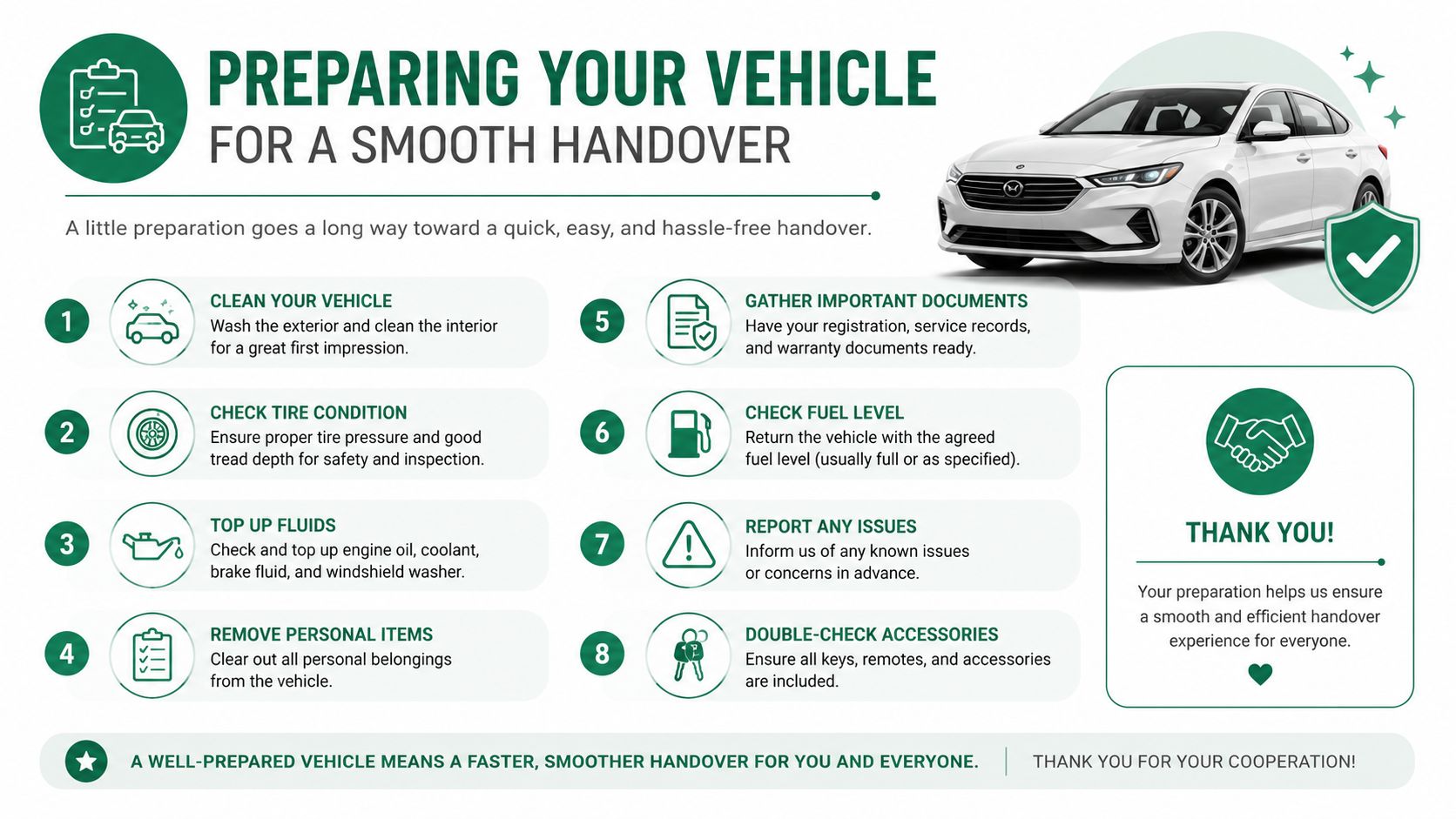
The number worth remembering is this: over 35% of damage claims are denied due to insufficient pre-load inspection documentation, according to uShip's guidance on questions to ask an auto transport carrier. If the condition report is thin, unclear, or incomplete, proving what happened gets much harder.
What to do before the driver arrives
A clean, prepared vehicle is easier to inspect and easier to move.
- Wash the exterior: Dirt hides chips, scuffs, and scratches.
- Remove personal items: Carriers focus on the vehicle, not loose property inside it.
- Check for leaks and battery issues: If the car has mechanical quirks, disclose them early.
- Leave only the needed fuel: Enough to load and unload is fine. The goal is operability, not a full tank.
- Have keys and documents ready: Delays at pickup usually come from missing basics.
If you're also dealing with a key issue before pickup, a practical reference on help when car keys are locked in can save you from turning a routine handoff into a missed dispatch window.
Why the Bill of Lading matters so much
The Bill of Lading, often called the BOL, is both a receipt and a condition report. Treat it like a legal document, because that's what it becomes if there's a claim.
Walk the car with the driver. Look closely at bumpers, rocker panels, mirrors, wheels, roofline, windshield area, and any existing cosmetic flaws. Make sure those marks are noted. If something is visible and not written down, don't assume it will be remembered later.
Here's a practical visual walkthrough that helps many customers understand the handoff process before pickup:
Don't sign a pickup inspection that feels incomplete. A two-minute shortcut at origin can create a long argument at delivery.
Shipping to Puerto Rico A Mainland to Island Guide
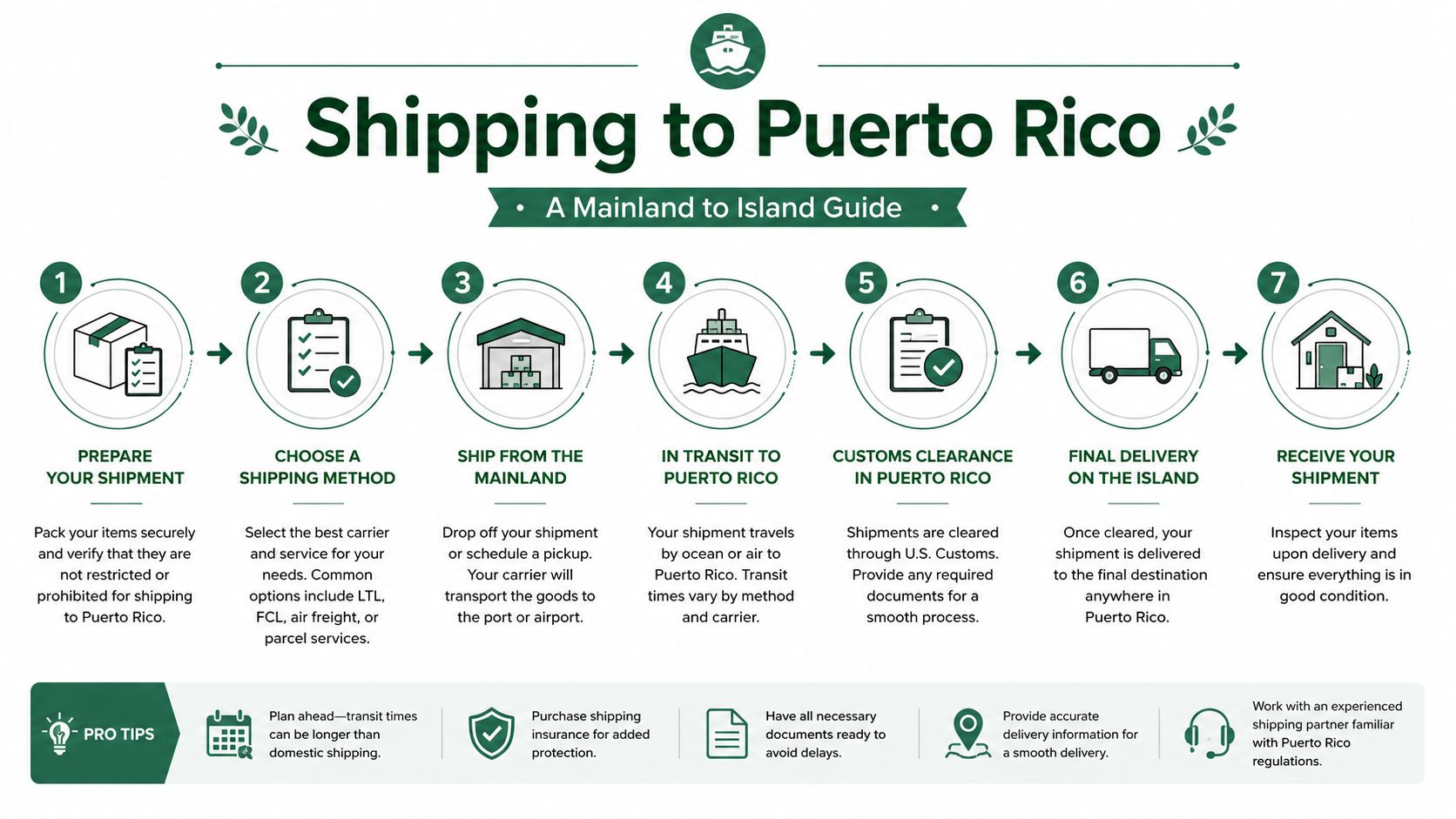
Shipping a vehicle to Puerto Rico is still auto transport, but the workflow changes in a few important ways. A standard mainland move is truck pickup to truck delivery. A Puerto Rico move usually includes inland transport to port, ocean booking, port processing, arrival in San Juan, and then release or final delivery coordination.
That's why customers get tripped up when they treat Puerto Rico like an ordinary state-to-state route. It isn't difficult when handled properly, but it does require a cleaner sequence.
How the move typically unfolds
A mainland-to-island shipment often starts with domestic pickup from places like New York City, Philadelphia, Boston, Miami, Orlando, Jacksonville, Atlanta, Dallas, Houston, Phoenix, Los Angeles, San Diego, Las Vegas, Chicago, Detroit, Nashville, Charlotte, or Seattle. The vehicle then moves to a departure port, commonly in Florida for many routes.
From there, the vehicle is booked onto ocean service. Depending on the service selected, that can be roll-on/roll-off or container-based handling. Once the vessel reaches San Juan, the vehicle goes through local port procedures before release or onward delivery.
What customers usually need ready
Puerto Rico shipments are document-sensitive. Before the vehicle reaches port, customers should confirm the title or lienholder paperwork, photo identification, and booking details are all in order. Any mismatch between ownership records and shipping instructions can slow release.
A smooth move depends on making the domestic and ocean legs line up cleanly. If the truck arrives too early, too late, or with incomplete paperwork, the vehicle can sit longer than expected. This is one reason experienced coordination matters more on Puerto Rico jobs than on a simple over-the-road route.
Cost and transit expectations
For cost, AmeriFreight's Puerto Rico shipping guide notes that shipping a car from the U.S. mainland to Puerto Rico typically costs $1,200 to $3,500 for transport alone, with total costs including taxes and registration often reaching $2,000 to $5,000, depending on vehicle size, shipping method, and departure port.
Transit time depends on the inland route, vessel timing, and how quickly the vehicle clears each step. Vehicle Transport Reviews' Puerto Rico shipping overview states that East Coast routes such as Jacksonville to San Juan typically run 7–14 days including inland transport, while expedited options can reduce that to 5–7 days with an added cost of $500 or more.
The Puerto Rico tax issue customers miss
This is the piece that surprises many first-time shippers. Puerto Rico charges an excise tax called arbitrios, and it is separate from the shipping quote.
As explained in this guide to Puerto Rico car transport taxes, the tax is calculated through the SURI Hacienda portal and ranges from 6.6% to 13.5% based on vehicle value. The same source notes that this amount must be paid separately from shipping charges, with fully electric vehicles as the primary exception.
The safest Puerto Rico shipment is the one priced in full before booking. Ocean transport, port handling, and arbitrios are different line items. Treat them that way.
Why Puerto Rico moves benefit from hands-on support
For many customers, the best help isn't just a truck. It's an advisor who understands the full chain from mainland pickup through San Juan release.
That matters for military families, students, relocating professionals, seasonal residents, dealerships, and businesses moving inventory to the island. Bilingual USA-based support is especially valuable because Puerto Rico shipments often involve English and Spanish communication across multiple parties.
If you're comparing route options and service types, National Car Transport's Puerto Rico car shipping service is a useful reference point because it reflects how mainland and island logistics are coordinated as one move rather than treated as two disconnected jobs.
Special Guidance for Military Classic Car and Student Moves
Some shipments need more than standard scheduling. The route may be ordinary, but the customer's situation isn't.
Military moves, collector vehicles, and student relocations all raise different questions. Timing pressure, documentation sensitivity, and vehicle type all change what “safe” looks like.
Military households
Military families usually care about predictability first. PCS moves involve enough variables already, so auto transport works best when dates, handoff authority, and destination access are confirmed early.
If the move includes Puerto Rico, the extra paperwork and port coordination make early communication even more important. A spouse, sponsor, or designated contact may need to receive updates and handle part of the process. Clear contact roles prevent missed calls and missed handoffs.
Classic and collector cars
Classic cars deserve a stricter standard. Age, finish, body style, and replacement difficulty matter more than the transport quote.
Enclosed shipping is often the prudent choice here, especially for low-clearance cars, restored vehicles, and collector units with trim or paint that won't tolerate exposure well. For owners comparing options, National Car Transport's classic car shipping page is a practical starting point because it reflects the kind of higher-protection handling these moves usually require.
A classic car move should be planned around preservation, not convenience.
Students and snowbirds
Students usually need a simpler process, not a cheaper one at any cost. Campus schedules, apartment move-in windows, and family coordination all make timing more important than people expect. A flexible pickup range helps, but communication matters more.
Snowbirds tend to be more calendar-driven. They often book around departure dates, return dates, condo access rules, and seasonal congestion. For them, the safest move is usually the one booked before the peak rush, with clear pickup and delivery contacts on both ends.
Dealerships and business fleets
Commercial customers think differently because consistency matters as much as the single unit. They want clean condition reporting, repeatable scheduling, and direct communication when routes change. That same discipline benefits private customers too.
Tracking Your Vehicle and Final Delivery Inspection
Once the car is loaded, the job isn't finished. Customers still need two things. Realistic communication during transit and a disciplined inspection at delivery.
For many people, the hidden benefit of shipping is what they avoid. When a vehicle is shipped by professional carrier instead of driven 1,000+ miles, the owner avoids exposure to the accident risk reflected in the 1.19 fatalities per 100 million vehicle miles traveled recorded in 2024, and personal vehicle travel carries a death rate over 1,200 times higher than scheduled air travel, according to Wikipedia's transportation safety summary for the United States.
What tracking should look like
Tracking in auto transport usually means coordinated updates rather than a consumer app with minute-by-minute movement. Weather, traffic, delivery sequencing, and legal driving limits affect timing. Good communication means you know the shipment status, the expected delivery window, and who to call if timing shifts.
Dedicated advisors can offer significant assistance. Customers using a managed service often find it easier because one person monitors the shipment and relays changes instead of leaving the customer to chase the driver for every update.
If you're comparing delivery formats, National Car Transport's door-to-door auto transport service is a useful example of how reduced handling can simplify both communication and final delivery.
How to inspect at delivery
Delivery inspection needs good light, a calm walkaround, and the same seriousness you gave pickup.
Use this short checklist:
- Look before signing: Don't sign first and inspect second.
- Check the same panels you checked at pickup: Bumpers, mirrors, wheels, lower body lines, roof edge, and glass.
- Compare with the Bill of Lading: Confirm whether anything visible is new.
- Photograph concerns immediately: Clear photos help preserve context.
- Write notes on the BOL before acceptance: If there's an issue, document it before the driver leaves.
If new damage appears, the paperwork has to reflect it before the delivery is closed out.
What closes a shipment out properly
A successful delivery isn't just “the car arrived.” It means the condition matches the record, the customer has inspected it, and the final paperwork is accurate. That last step protects everyone.
A lot of stress disappears when customers know what to expect. The truck won't always arrive at a perfect clock time. Ports may run differently from highway routes. Urban streets may require a nearby meeting point instead of a driveway. None of that is a problem when the company explains it clearly in advance.
National Car Transport makes that kind of guidance easier. With National Car Transport, customers can arrange domestic U.S. shipping and Puerto Rico moves through experienced USA-based bilingual agents who understand the details of auto transport logistics, not just quoting. The company brings 25+ years of experience, an A+ BBB rating, transparent flat-rate pricing, and a network of 25,000+ vetted carriers, so whether you're moving a daily driver, a student vehicle, a dealership unit, or a car headed to San Juan, you get practical support from pickup through final delivery.