
You're probably in the same spot a lot of RV owners hit right before a big trip. You want your car with you once you park the coach, but you don't want to turn every grocery run, campground transfer, or sightseeing stop into a full RV production. So you start looking at RV towing car setups, and at first it seems straightforward enough.
It isn't.
You can absolutely tow a car behind an RV. People do it every day. But the version commonly imagined in their head is much simpler than the one they deal with on the road. The actual job includes legal compliance, weight math, equipment matching, setup geometry, trip checks, and the constant risk of expensive damage if one detail is off. For many travelers, especially snowbirds, military families, students, dealerships, and anyone shipping to or from Puerto Rico, professional auto transport is the cleaner solution.
Table of Contents
- The Hidden Complexities of Towing a Car Behind Your RV
- A Simpler and Safer Alternative Professional Auto Transport
- How Car Shipping for Your Trip Actually Works
- Shipping to Top Destinations Mainland US and Puerto Rico
- Who Benefits Most from Shipping Instead of Towing
- Enjoy the Journey Let a Pro Handle the Car
The Hidden Complexities of Towing a Car Behind Your RV
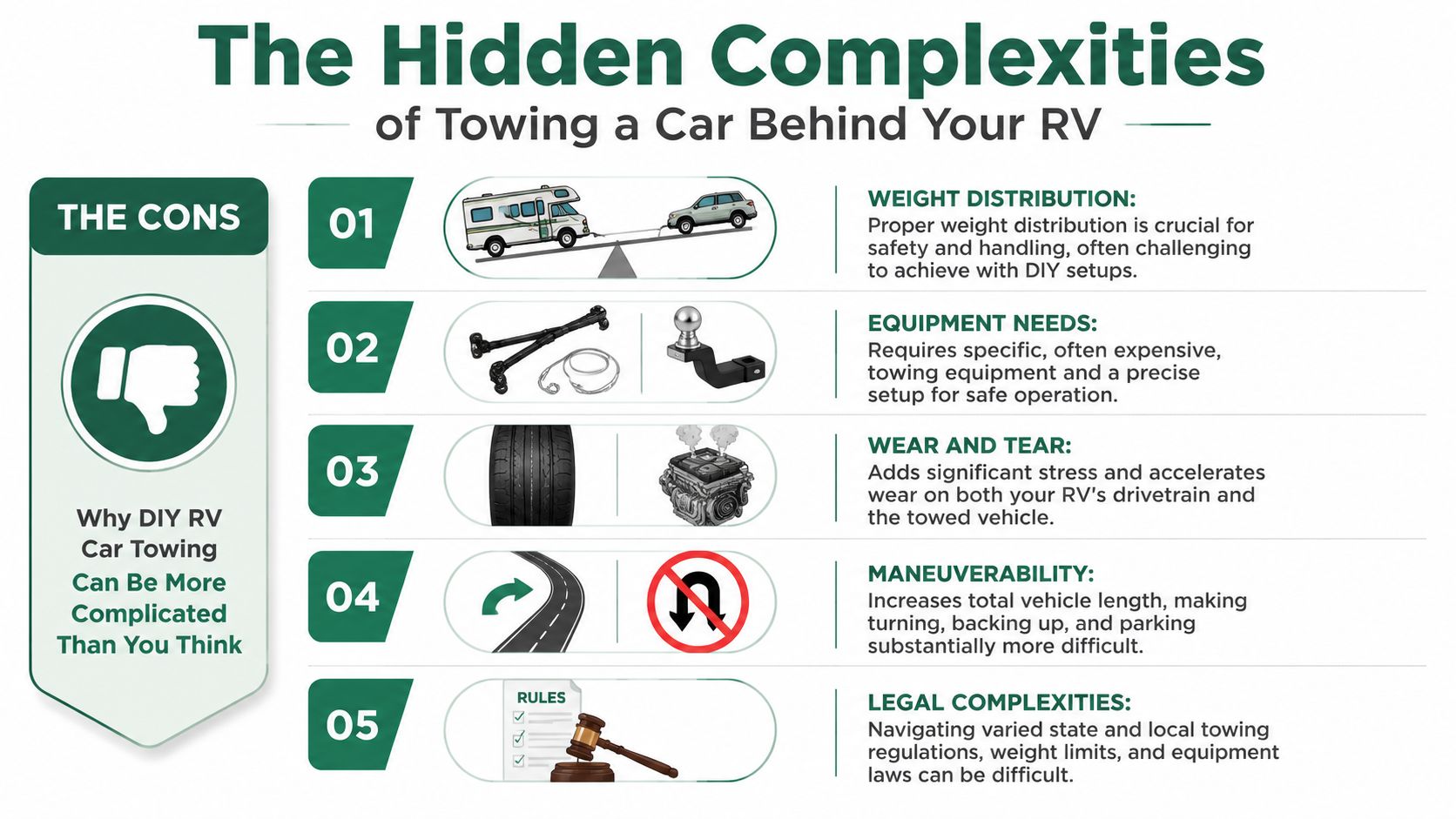
The biggest mistake people make with RV towing car plans is assuming the tow setup is just an accessory purchase. It's not. It's a system. If one part of that system is wrong, the whole trip gets harder, riskier, and more expensive.
A lot of first-time RVers also assume towing is the default because it keeps the car with them. That sounds practical until you start working through vehicle compatibility, braking laws, hitch height, turning clearance, and the fact that you can't treat a towed car like a passive piece of luggage.
The legal side is stricter than most people think
The braking issue alone stops a lot of casual towing plans cold. Lippert's flat towing law guide states that 49 out of 50 U.S. states and all of Canada require a supplemental braking system, with legal thresholds commonly around 3,000 lbs, and in some places as low as 1,500 lbs or as high as 4,500 lbs. Some jurisdictions also use stopping-distance rules such as stopping within 40 feet at 20 mph. That makes a supplemental braking system a legal baseline, not a nice extra (flat towing laws by state from Lippert).
That matters because plenty of vehicles people want to bring behind an RV aren't especially light once they're loaded for a real trip. If you cross state lines, you don't get to follow just your home state's logic. You have to stay compliant across the route.
Practical rule: If you're still asking whether a braking system is optional, you're not ready to tow yet.
Insurance is another part people underweight. Before you tow anything, review liability, collision, roadside assistance, and equipment coverage. A current roundup of top RV insurance providers for 2026 is useful if you want to compare how insurers handle towing-related exposure.
The setup has to work in the real world, not just on paper
Weight calculations are where optimism usually collides with reality. Kelley Blue Book explains towing capacity with the formula GCWR − (curb weight + payload) and recommends leaving a safety buffer of about 20% below the rated maximum. That's why the usable margin is often much smaller than the number people quote from the brochure (Kelley Blue Book towing capacity guide).
Here's what usually gets overlooked:
- Passengers count: Everyone in the RV eats into your real-world margin.
- Cargo counts too: Water, tools, bikes, food, and camping gear all matter.
- Hitch setup matters: An incorrect setup can affect handling even when the numbers look close.
- Road conditions change the equation: Steep grades, crosswinds, and rough pavement expose bad assumptions fast.
Then there's geometry. One practical guide on tow-bar setup gives a usable tolerance of 3 inches above to 3 inches below level for most motorhome-mounted tow bars, and recommends measuring hitch height to ground against base-plate height to ground instead of eyeballing it (etrailer guidance on level tow-bar setup). That sounds minor until a driveway dip, fuel station apron, or campsite entrance starts stressing the hardware.
The point isn't that towing can't be done. It can. The point is that towing a car behind your RV is not the simple, low-effort move many travelers think it is.
A Simpler and Safer Alternative Professional Auto Transport
If your goal is to enjoy the trip, shipping the car is often the smarter move. You remove the entire tow equation from your travel day. No tow bar. No base plate alignment. No braking system setup. No wondering whether the next state sees your rig the same way the last one did.
That doesn't make towing wrong. It just means towing isn't automatically the best answer.
You remove the riskiest parts of the trip
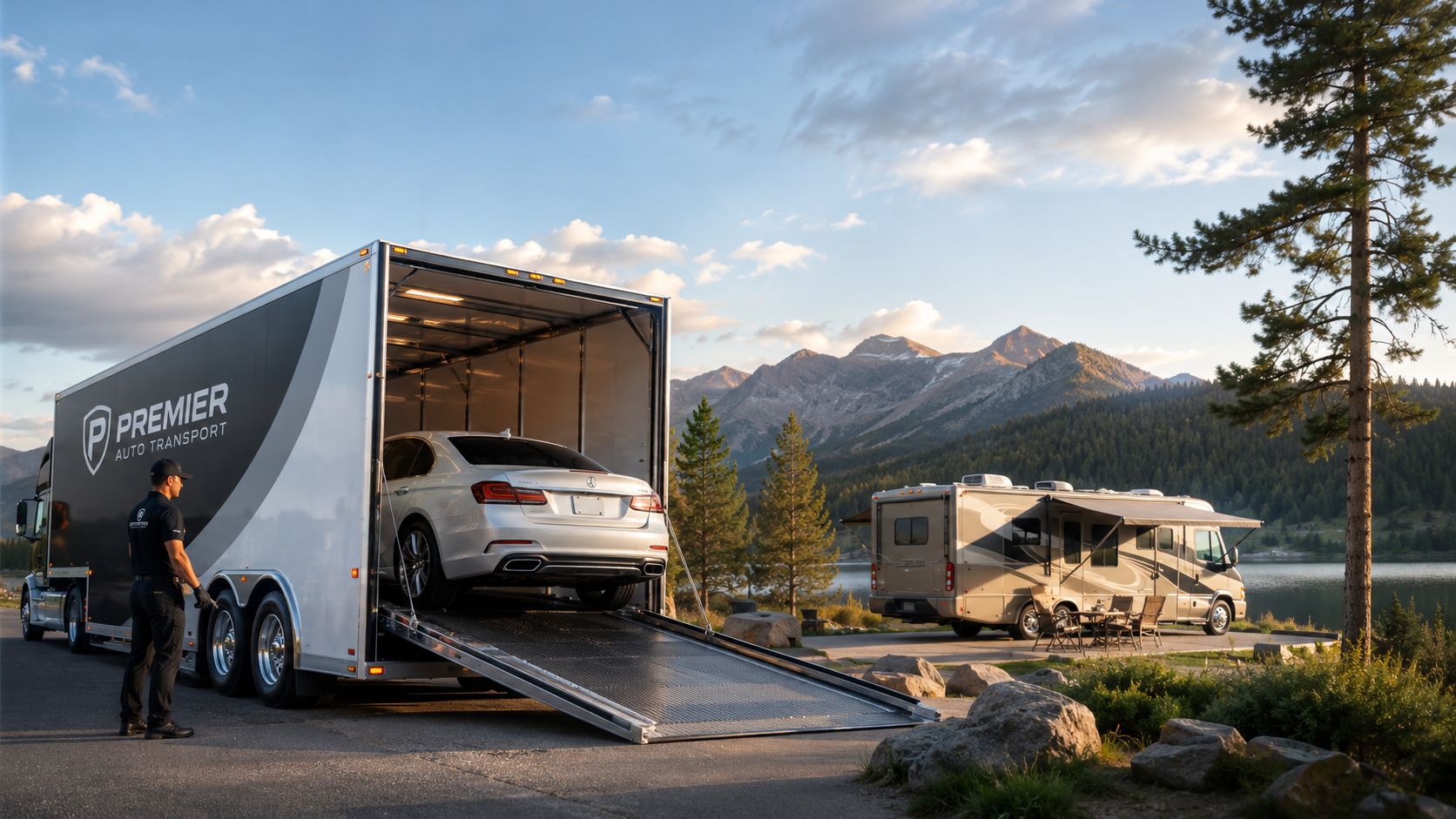
The cleanest advantage of professional auto transport is simple. The car travels on a carrier, not behind your coach. That eliminates the towing-specific risks that make RV owners tense in traffic, at fuel stops, in campgrounds, and on uneven terrain.
You also avoid the hidden operational burden. Towing asks you to become part driver, part equipment manager, part compliance checker. Shipping lets you go back to being a traveler.
A few situations where shipping makes more sense than towing:
| Situation | Why shipping wins |
|---|---|
| Long relocation | You avoid turning a cross-country drive into a towing exercise |
| Luxury or specialty vehicle | You reduce exposure to road debris and tow-related wear |
| New RV owner | You skip the steep setup and handling learning curve |
| Puerto Rico move | You need coordinated transport, not a DIY workaround |
You bought the RV for mobility, not to spend every transfer day thinking about hitch height, braking modules, and turn radius.
You get your travel day back
Professional auto transport also gives you cleaner logistics. Your RV trip and your vehicle movement become separate tasks. That's useful when your schedule includes campground reservations, family stops, service appointments, ferry or port timing, or a seasonal move.
For mainland routes and Puerto Rico shipments, a strong transport coordinator can line up timing so your car arrives where you need it. That matters for snowbirds heading south, military households planning a move, students changing campuses, or businesses moving inventory between markets.
The best transport experiences feel boring in the best way. The car gets picked up. It moves through the network. It arrives where it's supposed to. You don't spend the whole drive listening for problems behind you.
How Car Shipping for Your Trip Actually Works
You want your car at the destination without turning your RV into a rolling tow project. That is exactly what professional auto transport solves. The process is straightforward because it centers on timing, inspection, and handoff, not brackets, braking systems, wiring checks, and constant mirror watching.
The process is simpler than most RV owners expect
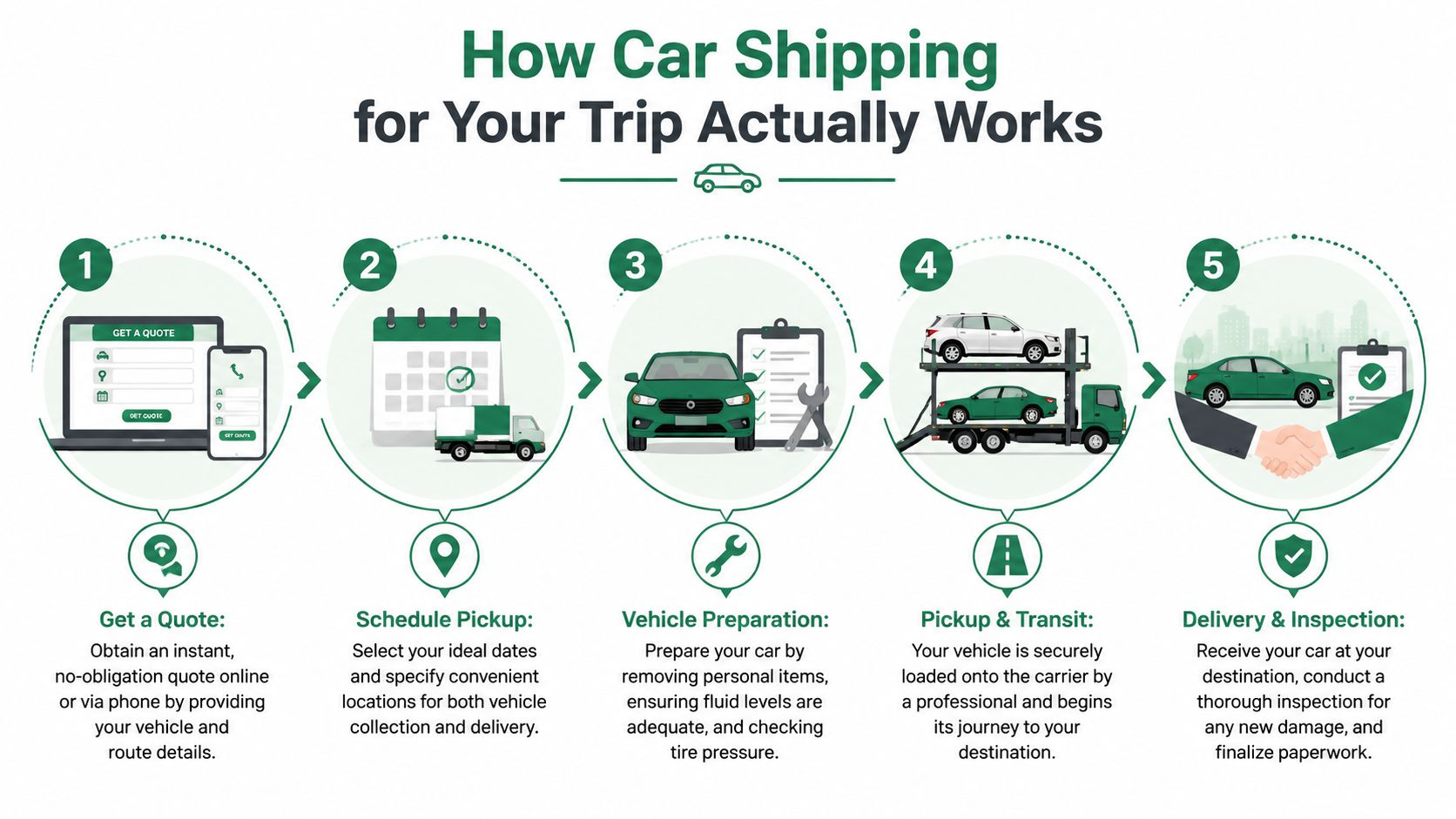
Most trips follow the same sequence:
Request a quote
Share the vehicle, pickup area, delivery area, and your target dates. A good transporter gives you clear pricing and a realistic window, so you can compare shipping with the cost, time, and risk of towing your own car.Book your dates
This is where good planning matters. Your pickup and delivery windows should match your campground reservations, route changes, family stops, or move-in schedule.Prepare the vehicle
The carrier sends basic prep instructions, usually things like cleaning out personal items, leaving an accessible key, and being available for inspection. That is far easier than setting up tow gear and testing it before a long haul.Pickup and transit
The driver inspects the car, loads it, and moves it through the route. You drive the RV as an RV, not as a heavy combination vehicle with extra stopping distance and more things that can go wrong.
- Delivery and final inspection
At delivery, the car is checked again and released to you or your authorized contact. Clean, simple, done.
Why this works better for RV travel planning
Shipping gives you control without giving you extra driving stress. That matters when your trip includes fixed dates, family coordination, school schedules, military orders, or port timing for Puerto Rico.
Look for a transport provider that gets the logistics right:
- One point of contact: You need one person who can answer questions and fix problems quickly.
- Clear communication: Pickup windows, transit status, and delivery expectations should be plain and specific.
- Route knowledge: Mainland moves are one job. Puerto Rico moves involve port coordination and tighter timing.
- Bilingual support when needed: English and Spanish support makes the process easier for many U.S. and Puerto Rico customers.
If your car is heavy, this choice gets easier. As noted earlier, once you account for your usable towing margin instead of the headline number on paper, professional transport often comes out safer, simpler, and easier to schedule.
Shipping to Top Destinations Mainland US and Puerto Rico
The most common reason people search for RV towing car help isn't curiosity. It's route planning. They're heading somewhere specific and want a car waiting when they arrive. That's where shipping earns its keep.
Popular mainland routes for seasonal travel and relocation
The mainland side is straightforward in concept but still easier with a professional hand. Snowbirds often move vehicles between northern cities and southern winter hubs. Think New York City to Miami, Chicago to Tampa, Boston to Orlando, Philadelphia to Fort Lauderdale, or Detroit to Phoenix. The same pattern shows up from Minneapolis, Cleveland, Denver, Seattle, Portland, and other major cities when travelers want to spend a season in Florida, Arizona, Texas, Nevada, or Southern California.
Relocations work the same way. Students may need a car shipped from Los Angeles to Dallas, from Atlanta to Charlotte, or from Houston to Nashville. Military families often need timing and communication more than anything else. Dealerships and businesses may need vehicles moved between major markets without tying up drivers and internal staff.
Shipping also helps if your RV route and your car route shouldn't be the same. Maybe the coach is headed through one string of campgrounds while the car needs to arrive near family, storage, campus housing, or a service center in another metro area. Those are transport problems, not towing problems.
A practical consideration:
| Travel need | Better fit |
|---|---|
| You want the car with the RV every mile | Towing might fit if your setup is fully sorted |
| You want the car waiting near your destination | Shipping is usually cleaner |
| You're combining travel with a move | Shipping keeps the trip less chaotic |
| You're managing multiple vehicles | Shipping scales better than DIY towing |
Puerto Rico is where experience matters most
Puerto Rico changes the conversation. This is no longer just a question of hitching up and heading down the road. You're dealing with mainland pickup, port logistics, ocean transport, delivery coordination, and timing around San Juan or other island destinations. That's why trying to force an RV towing solution into a Puerto Rico move misses the point entirely.
For people moving between the U.S. mainland and Puerto Rico, expert coordination matters more than bravado. Military families, students, seasonal residents, businesses, and Puerto Rico dealerships need accurate paperwork handling, realistic scheduling, and a team that can explain the process in plain English or Spanish.
Puerto Rico vehicle shipping isn't difficult because cars can't move there. It's difficult because too many customers start with the wrong mental model. This is a logistics job, not a towing job.
The best support for this route comes from U.S.-based agents who understand both mainland transport and island shipping workflows. Bilingual service is especially valuable when family members, port contacts, dealerships, or receiving parties prefer Spanish. San Juan is the widely known name, but the same need for competent coordination applies whether the vehicle starts in Florida, Texas, New Jersey, Georgia, or California.
When people ask whether they should tow a car behind the RV or ship it for Puerto Rico, the answer is easy. Ship it. Don't create complexity where the route already has enough of its own.
Who Benefits Most from Shipping Instead of Towing
Some travelers enjoy the technical side of towing. Most don't. They just want the car to be there when they need it. Shipping serves those people better.
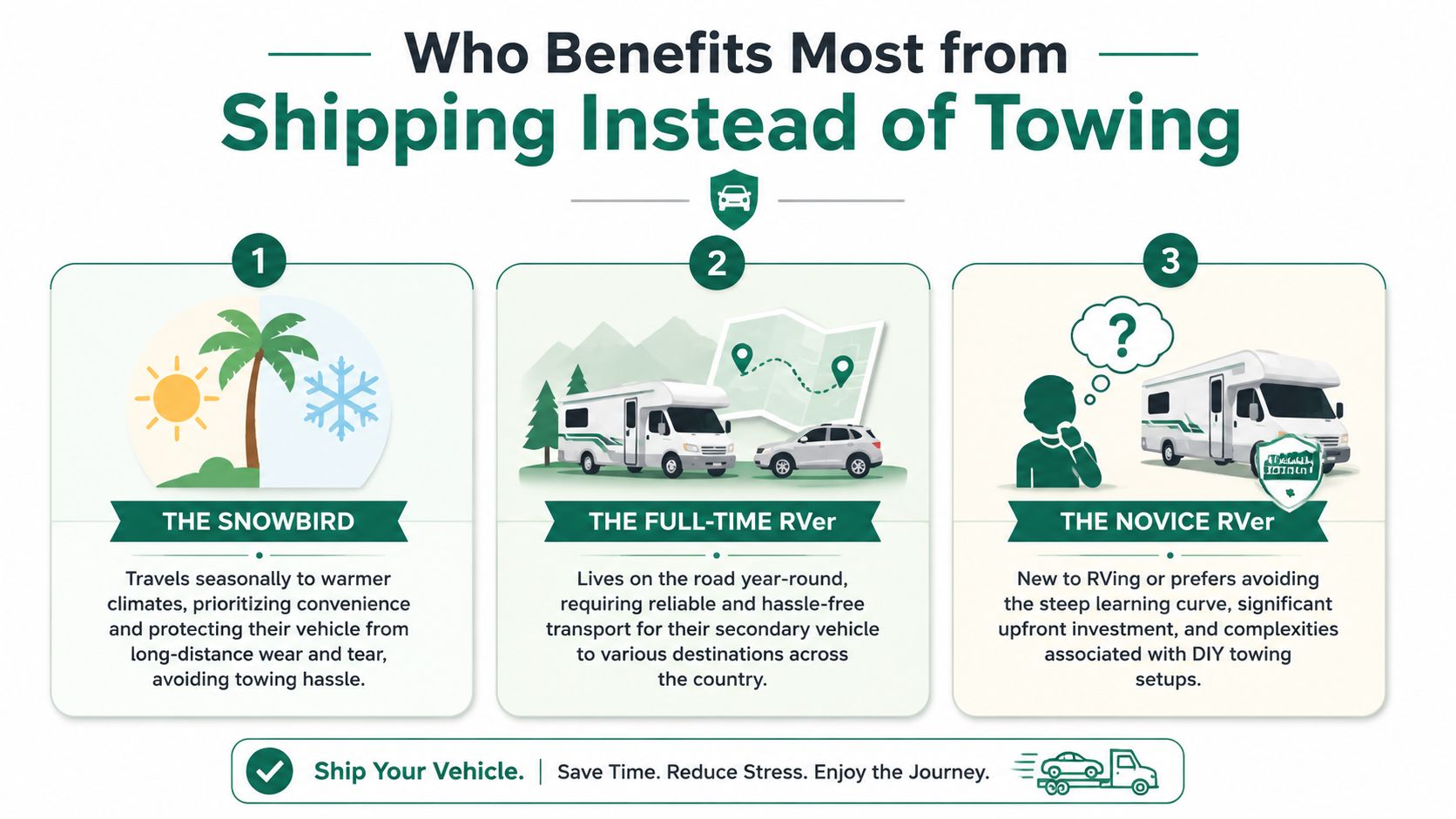
Travelers who want less friction
The clearest fit is the snowbird. If you spend part of the year in one region and part in another, the goal isn't to master a tow system. The goal is to arrive with less stress and start living. Shipping gets you there faster mentally, even before the car arrives physically.
The full-time RVer is another strong fit. Long-distance travel already includes route changes, weather calls, campground constraints, and maintenance windows. Adding a towed vehicle means adding one more thing that can go wrong on a moving day.
Then there's the novice RVer. This group should be especially careful. Towing looks manageable online because most guides talk about hookup, not what happens after hours on the road. One practical source notes that some flat-tow setups need rechecking every 300 miles, and backing up while flat towing can cause severe damage to the towed vehicle's steering and drivetrain (practical flat towing guidance video).
Owners who can't afford a mistake
Some people don't need convenience first. They need risk reduction.
- Military families: They already have enough moving parts. Car shipping removes one major headache from a PCS or duty-station transition.
- Students: School starts don't leave much room for roadside towing problems or setup mistakes.
- Classic and luxury car owners: A valuable vehicle deserves a transport plan that matches its value.
- Dealerships and businesses: Time spent arranging DIY movement is time staff aren't spending on operations.
Bottom line: If a towing mistake would ruin your schedule, your budget, or your peace of mind, shipping is the better tool.
This isn't about saying nobody should tow. It's about being honest about who benefits from outsourcing the job. For a lot of real-world travelers, the answer is obvious.
Enjoy the Journey Let a Pro Handle the Car
If you're still weighing RV towing car options against shipping, use one test. Ask which choice gives you the trip you want. Not the one that looks efficient in theory. The one that feels manageable on departure day, in traffic, at the campground, and at the destination.
Towing can work when the vehicle is compatible, the setup is right, the laws are covered, and the driver is comfortable managing the system. That's a narrow lane. Shipping works for a much wider group of people because it removes the hardest parts instead of asking you to become an expert in them.
For mainland moves, it simplifies long seasonal travel, relocations, school moves, business shipments, and family logistics. For Puerto Rico, it's not just the better option. It's the right category of solution.
The smartest travel decisions usually aren't the most hands-on ones. They're the ones that reduce failure points and let you focus on the road ahead. If bringing your car matters, that doesn't mean you need to tow it yourself. It means you need a plan that fits the trip.
If you want a practical way to compare your options, get a no-obligation quote from National Car Transport. They're U.S.-based, have 25+ years of experience, an A+ BBB rating, transparent flat-rate pricing, and access to 25,000+ vetted carriers. Their bilingual English and Spanish agents in the USA have deep auto transport logistics experience and can help you sort out mainland routes, major city moves, and Puerto Rico shipping without turning your trip into a towing project.