
If you're trying to move a car over water for the first time, the hardest part usually isn't the ship. It's understanding how the whole move works from your driveway on the mainland to the port, onto the vessel, through arrival, and then out to your final destination. That confusion shows up most often on Puerto Rico shipments, where customers may have a simple port quote in hand but still don't know who handles inland pickup, documents, terminal timing, or delivery after arrival in San Juan.
Roll on roll off car shipping is the method commonly used for standard, operable vehicles on these routes. It isn't a niche system. It's a major part of global vehicle logistics, with the roll-on/roll-off shipping market projected at USD 23.43 billion in 2026 and USD 36.69 billion by 2035, with about 57% total growth and a projected 5.1% CAGR. That scale matters because it tells you this method is built around moving cars, trucks, trailers, and machinery efficiently, not improvising one-off shipments.
If your move also involves crossing a customs border on another route, it helps to review the practical paperwork sequence in these steps for importing a car so you can see how title documents, compliance checks, and border procedures fit into the bigger transport plan.
Table of Contents
- Your Guide to Shipping a Car Across the Water
- What Is Roll On Roll Off Car Shipping
- The RORO Shipping Process From Start to Finish
- Comparing RORO to Other Vehicle Transport Options
- Understanding RORO Shipping Costs and Insurance
- How to Prepare Your Vehicle for RORO Transport
- Frequently Asked Questions About RORO Shipping
Your Guide to Shipping a Car Across the Water
Most customers start with one urgent question. How do I get my car from the mainland to Puerto Rico without making a mistake at the port?
The answer is usually simpler than people expect, but only after the move is broken into its real parts. A water move isn't just ocean transit. It's domestic coordination, terminal timing, vehicle eligibility, paperwork, and handoff at destination.
For a military family changing duty stations, a student relocating for school, a snowbird avoiding a long drive, or a dealership moving inventory, the common thread is the same. You need a method that works cleanly for wheeled vehicles and doesn't add unnecessary handling.
Why RORO fits this kind of move
With roll on roll off car shipping, the vehicle moves through a system designed for vehicles that can be driven. That matters because the less a car is lifted, repacked, or transferred between loading methods, the fewer chances there are for avoidable complications.
This is one reason the method became such an important part of automotive logistics. As noted earlier, the global market is substantial and still growing, which reflects how firmly RoRo is tied to vehicle trade rather than occasional specialty shipping.
Practical rule: If your car runs, steers, brakes, and you're shipping on a route that supports RoRo service, it's often the first option worth considering.
What first-time customers usually overlook
The ship itself rarely causes the confusion. The friction usually happens around the edges of the shipment.
- Mainland pickup: Someone has to move the vehicle from your home or business to the departure port.
- Port instructions: Terminals have acceptance windows, document checks, and condition requirements.
- Arrival planning: Once the vehicle reaches Puerto Rico, you still need a clear plan for pickup or onward delivery.
- Communication: If English or Spanish support matters to your household, clear bilingual guidance can prevent simple errors from turning into delays.
For Puerto Rico routes, that full-chain view matters more than the ocean leg alone. A straightforward shipment feels easy when every handoff is managed in the right order. It feels stressful when the customer is left stitching together trucking, port drop-off, and release procedures on their own.
What Is Roll On Roll Off Car Shipping
Roll on roll off car shipping means the vehicle is driven directly onto and off the vessel instead of being lifted by crane into a container. That's the defining difference, and it's the reason the method is so efficient for operable vehicles. In automotive market analysis, the shipment of new cars and vehicles is identified as the most significant RoRo segment, and the method's key advantage is direct drive-on, drive-off loading.
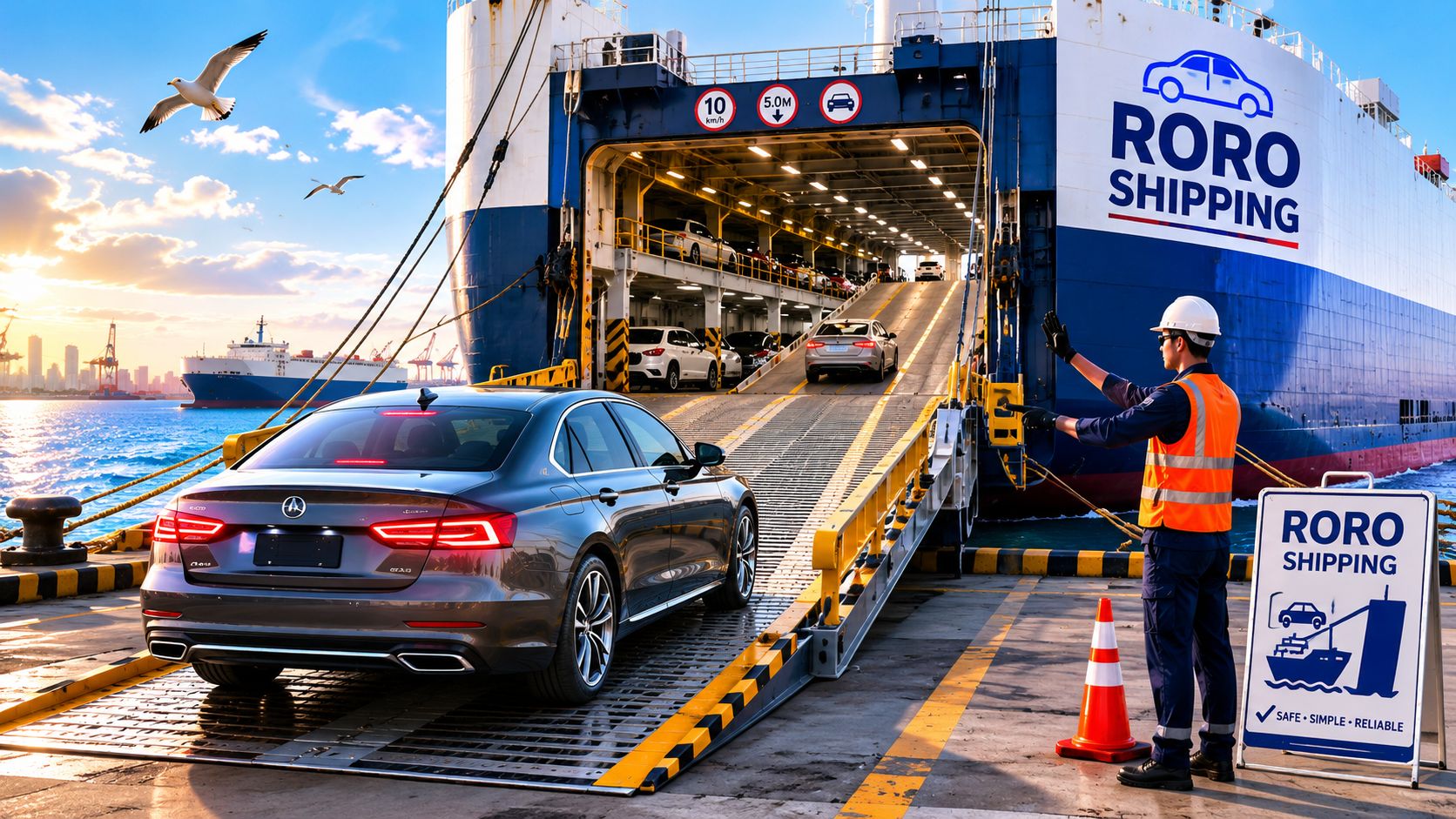
Think of the vessel as a secured multi-level parking structure on the water. Port staff direct the vehicle up a ramp, into its assigned position, and secure it for the voyage. At destination, the process runs in reverse.
Why that loading method matters
Crane-based loading has its place, especially with containers and oversized cargo. But for a standard running vehicle, driving it on and off is cleaner and more direct.
That creates a few practical advantages:
- Less handling: The vehicle isn't being hoisted in and out of a box.
- Faster terminal flow: Vehicle traffic moves in a purpose-built pattern through the port.
- Good fit for standard cars and trucks: The method was built around wheeled cargo, not adapted to it later.
Most first-time customers understand RoRo immediately once they stop picturing a container ship and start picturing a vessel built around ramps and vehicle decks.
How it differs from container shipping
Container shipping places the vehicle inside a container, then lifts that container with port equipment. That can make sense when someone needs the extra enclosure or has route requirements that point away from RoRo.
RoRo is usually the simpler choice when the vehicle is operable and the route supports it. But it's not automatically the best choice for every shipment. If a car is non-running, highly delicate, or being moved with other cargo that must travel with it, another method may be more practical.
A good shipping plan starts with the vehicle's condition and the route, not with a one-size-fits-all script.
The RORO Shipping Process From Start to Finish
The easiest way to understand a RoRo move is to separate the job into the land portion and the port-to-port portion. Customers who only look at the vessel schedule often miss the part that takes the most coordination.
What happens before the vessel
A mainland-to-Puerto Rico shipment often starts with domestic transport. If the vehicle is in Chicago, Dallas, Phoenix, Atlanta, Seattle, or another inland market, it doesn't magically appear at the ocean terminal. A domestic carrier picks it up or the customer arranges to deliver it to the port.
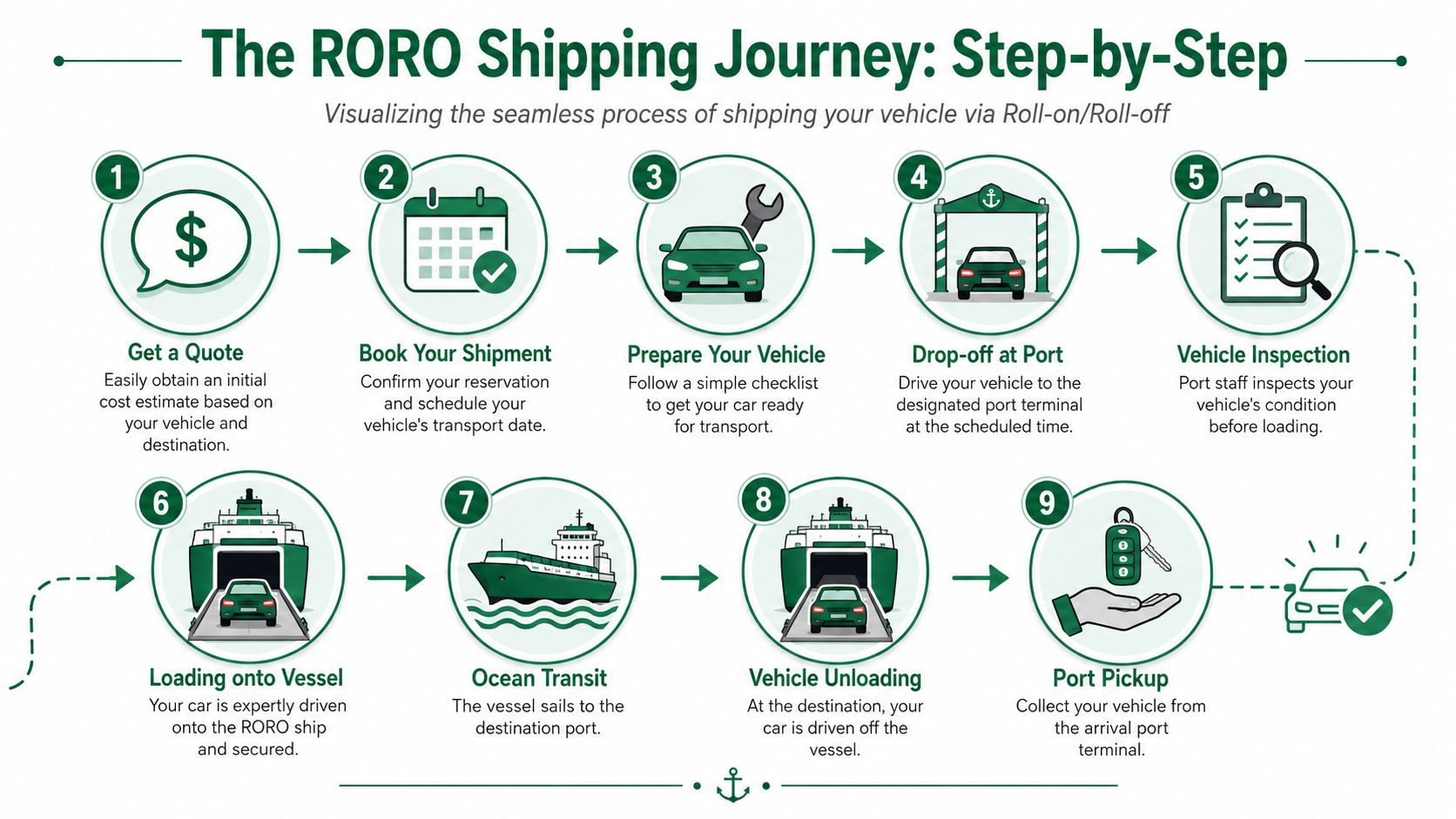
From there, the shipment usually follows this sequence:
Quote and booking
The carrier or broker confirms the vehicle details, route, and whether you're booking port-to-port or adding inland service on one or both ends.Vehicle preparation
The car must meet port rules. It needs to be in acceptable condition for RoRo handling, and prohibited items need to be removed before the terminal accepts it.Mainland handoff
The vehicle either gets picked up from your location or dropped at the assigned departure terminal, depending on the plan you chose.Port check-in
The terminal reviews documents, inspects condition, and places the unit into the loading flow for the scheduled sailing.
A helpful visual of that flow appears below.
What happens at the port and after arrival
Once the vessel is ready, trained port staff drive the car onto the ship and secure it in its assigned space. During ocean transit, the customer usually isn't interacting with the vehicle. The next key event is arrival.
At destination, the process continues in a structured order:
- Unloading: Port staff drive the vehicle off the vessel.
- Arrival processing: Release procedures must be completed before pickup.
- Pickup or onward transport: The customer either collects the vehicle at port or arranges inland delivery to the final address.
For Puerto Rico, this is the point where many first-time shippers realize the quote they compared wasn't describing the same scope of service. One quote may be port-to-port only. Another may include mainland pickup. A third may include both mainland pickup and delivery after San Juan arrival.
A shipment doesn't become simple because the ship portion is simple. It becomes simple when every handoff has an owner and every document is ready before the terminal asks for it.
That distinction matters for families on a relocation deadline, students arriving near the start of term, and businesses trying to position units for sale without tying up staff time at the port.
Comparing RORO to Other Vehicle Transport Options
The right method depends on what you're moving, where it's going, and how much protection or flexibility you need. Customers often compare unlike services and assume the cheapest line item is the best deal. It usually isn't.
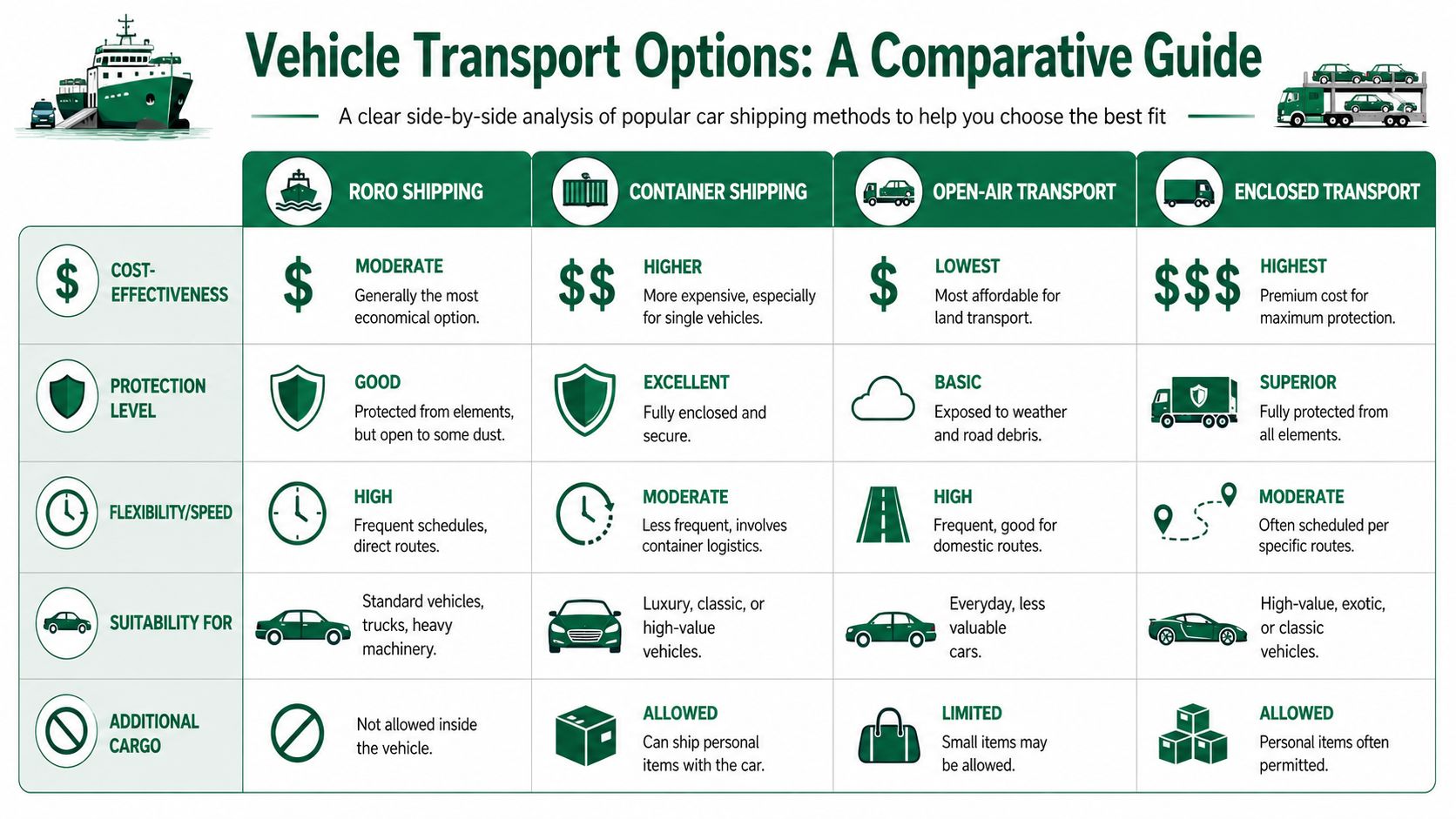
A practical side-by-side view
| Method | Best fit | Main advantage | Main limitation |
|---|---|---|---|
| RORO | Standard operable vehicles moving over water | Streamlined loading and unloading for wheeled cargo | Personal items usually aren't allowed in the car |
| Container shipping | Vehicles needing more isolation or special handling | Strong enclosure and flexibility for certain cargo setups | More logistics steps and usually more complexity |
| Open-air transport | Domestic mainland routes | Common, efficient choice for everyday vehicles | Exposed to weather and road grime |
| Enclosed transport | High-value, classic, exotic, or sensitive vehicles | Highest protection during land transport | Higher cost and narrower equipment availability |
Which option usually fits which customer
RoRo tends to make the most sense when the vehicle is ordinary in the best way possible. It runs, it can be driven, and the owner wants an efficient ocean method without paying for extra structure they don't need.
Container shipping enters the conversation when one of these issues appears:
- The vehicle isn't a standard fit for simple drive-on service
- The owner wants a more isolated shipping environment
- The route, schedule, or cargo mix points away from RoRo
- There are special handling concerns that justify the extra logistics
Open-air and enclosed transport are different because they're land services, not ocean services. They often connect to the water move rather than replace it. A customer in Ohio shipping to Puerto Rico may use open transport to reach the departure port, then RoRo across the water, then port pickup in San Juan. A collector shipping a specialty car might choose enclosed service on the mainland leg before switching to a different ocean method if the situation calls for it.
Choose by shipment profile, not by label. "Best" depends on whether you're moving a daily driver, a dealership unit, a collector car, or a non-running vehicle.
For most everyday mainland-to-Puerto Rico vehicle moves, the comparison isn't RoRo versus open carrier. It's whether you want a coordinated chain that combines domestic trucking with ocean transport, or whether you're comfortable managing one of those pieces yourself.
Understanding RORO Shipping Costs and Insurance
Many customers frequently encounter frustration. They receive a low number for the ocean leg, assume that's the shipment price, and only later find out they were looking at one slice of the bill.
One industry explainer notes that many shippers are surprised by hidden costs because the final bill can include origin and destination port handling, documentation fees, and inland transport to and from the port, making all-in landed cost especially important on routes such as the U.S. mainland to Puerto Rico.
What the base quote often misses
A real RoRo budget usually has several moving parts. The exact combination depends on whether you're buying port-to-port service only or building a full mainland-to-destination move.
Common cost categories include:
- Ocean freight: The vessel portion of the shipment.
- Origin charges: Terminal handling, document processing, and any required staging before loading.
- Mainland inland transport: Trucking from your home, dealership, auction, or business to the departure port.
- Destination charges: Arrival handling and release-related costs at the receiving port.
- Final delivery: If you don't want to collect the vehicle at port, inland delivery after arrival adds another leg.
The mistake isn't asking for the lowest quote. The mistake is comparing a partial quote to an all-in quote and treating them as equal.
How to think about insurance
Insurance questions deserve direct answers. Customers should ask what cargo coverage applies during each leg of the move, how vehicle condition is documented, and what process applies if damage is discovered at handoff.
A few practical checks help:
- Ask where coverage changes: Inland trucking and ocean handling may involve different operational stages.
- Review the inspection process: Pre-transport and post-arrival condition reports matter.
- Know what isn't covered: Personal items left in the car can create problems even before a claim issue arises.
If you want a broader overview of maritime risk management, these insurance solutions for marine operations give useful context on how ocean-related coverage is typically framed.
A transparent pricing model matters here because insurance conversations are easier when the service scope is clear. If one provider includes the coordinated inland legs and another leaves them to the customer, the risk questions aren't the same even if both are described casually as "car shipping to Puerto Rico."
How to Prepare Your Vehicle for RORO Transport
Port delays often start with avoidable issues. The car arrives dirty, packed with personal items, low on battery power, or missing a required document. That doesn't make the shipment impossible, but it can turn a routine handoff into a reschedule.
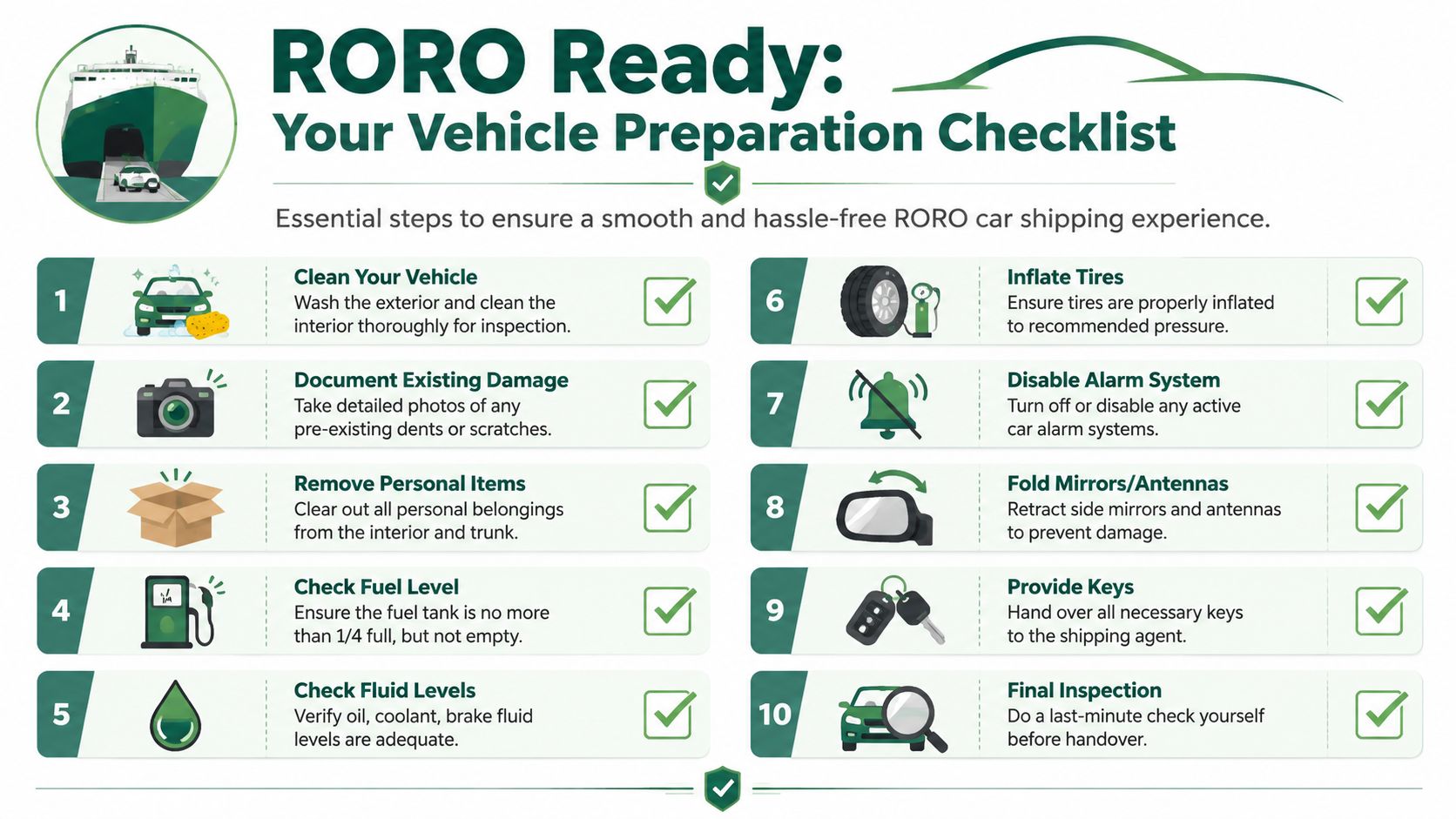
Your port-ready checklist
Use this checklist before the vehicle heads to the terminal:
- Clean the vehicle: A clean exterior makes inspection easier, and a clean interior helps confirm nothing prohibited was left behind.
- Photograph current condition: Take clear photos of each side, the wheels, and any existing scratches or dents.
- Remove personal belongings: RoRo shipments generally require an empty vehicle.
- Leave only limited fuel: The tank shouldn't be full. Follow the instructions given for your shipment.
- Check basic operating condition: The battery should hold charge, tires should be properly inflated, and the car should start, steer, and brake normally.
- Turn off alarms: A triggered alarm at the port creates unnecessary complications.
- Secure or remove loose accessories: Fold mirrors where appropriate and deal with removable exterior items before handoff.
- Keep the keys ready: Port staff need what they need to move the vehicle safely.
Clean cars speed up inspections because everyone can see the actual condition quickly.
Documents and handoff basics
For Puerto Rico moves, customers should be ready with the ownership and identification documents required for release and transport processing. The exact list can vary by shipment setup, so don't rely on assumptions from a previous domestic-only move.
A good handoff file usually includes:
- Photo identification
- Proof of ownership or title-related documentation
- Booking confirmation or transport order
- Any route-specific forms requested in advance
If the vehicle is financed, leased, recently purchased, or being shipped on behalf of a business, ask for the exact document list early. Those details are where avoidable delays usually begin.
Frequently Asked Questions About RORO Shipping
Can I leave items in the car
Usually, no. For RoRo service, the safe assumption is that the vehicle needs to be empty unless you've been told otherwise in writing for your shipment. Customers most often run into trouble with trunk items, aftermarket loose parts, and everyday things they forgot in the console.
Does the vehicle need to be running
For standard RoRo loading, yes. The vehicle generally needs to start, steer, and brake so port staff can move it safely. If your car is non-running, ask about alternatives before booking. Don't assume the port will work around it on arrival day.
What documents are usually needed for Puerto Rico shipments
Expect to provide identification and proof that you have the right to ship the vehicle. Depending on ownership status, that may include title-related documents, registration-related documents, lienholder authorization, purchase paperwork, or company authorization if the vehicle belongs to a business.
If you're sending a car for a family member, student, dealership transfer, or military relocation, verify the exact name that must appear on the shipping documents. Name mismatches cause more delays than people expect.
Should I choose port pickup or inland delivery
That depends on your time, location, and comfort with terminal procedures. Port pickup can work well if you're local to the arrival area and can respond quickly once the vehicle is ready. Inland delivery is often easier if you're coordinating a move, arriving on a tight schedule, or sending the vehicle to a town outside the immediate port area.
For Puerto Rico customers outside San Juan, this choice matters. A port quote may look attractive until you add the time, travel, and coordination needed to recover the vehicle yourself.
What causes delays
Three issues show up most often:
- Document problems: Missing, mismatched, or late paperwork.
- Vehicle condition issues: The car doesn't meet the operating or acceptance requirements at handoff.
- Pickup timing gaps: The customer isn't ready when the terminal or delivery side is ready.
No two vehicle transports are exactly alike. A daily driver from Miami to San Juan, a student car from Ohio, and dealership inventory from Texas can all move under the same broad shipping method while requiring different timing and paperwork discipline.
If you're planning a vehicle move across the mainland, to Puerto Rico, or back again, National Car Transport can help you sort out the full trip, not just the port leg. With 25+ years of experience, an A+ BBB rating, transparent flat-rate pricing, and a network of 25,000+ vetted carriers, the team handles domestic and ocean vehicle logistics with practical, bilingual support in English and Spanish from U.S.-based agents who know auto transport inside and out.