
You're probably reading this with a move, a purchase, or a deadline hanging over you. Your car may need to get from Miami to Dallas, Los Angeles to Chicago, New York to San Juan, or back from Puerto Rico to the mainland, and you don't want a vague promise. You want a vehicle moved safely, priced clearly, and handled by someone who knows what can go wrong before it does.
That's what people usually mean when they search for a reliable transport service, even if they don't say it that way. They're asking who will answer the phone, explain the route, coordinate the pickup, deal with port paperwork when Puerto Rico is involved, and keep the process steady when schedules shift. In real auto logistics, reliability comes less from slogans and more from experienced coordination.
A car is rarely a casual shipment. The Institute for Transportation and Development Policy reported that, citing the U.S. Department of Transportation, U.S. transportation spending reached $12,295 per household annually in 2023, with total household transportation spending at about $1.6 trillion, making it the fourth-largest household expenditure category in the country (ITDP summary of U.S. transportation spending). That's one reason customers scrutinize transport companies so closely. They should.
Table of Contents
- What Reliable Transport Service Really Means for Your Vehicle
- The Three Pillars of a Trustworthy Auto Transporter
- The Auto Shipping Journey Step by Step
- Matching the Right Transport to Your Vehicle and Budget
- A Checklist for Hiring Your Auto Transport Partner
- Navigating Pricing Transparency and the Claims Process
- Frequently Asked Questions About Vehicle Shipping
What Reliable Transport Service Really Means for Your Vehicle
Most customers start with one simple fear. They don't want their vehicle handed off into a process they can't see or control.
That concern is reasonable. A family relocating across the country, a student heading to campus, a snowbird setting up a seasonal move, or a military household managing PCS timing all face the same problem. The car has to move through multiple hands, multiple checkpoints, and sometimes multiple modes of transport before it reaches the final address.
Reliability is more than arriving on time
A reliable transport service doesn't just show up eventually. It does a few practical things well, every time:
- Sets realistic expectations: Pickup windows, route timing, and delivery conditions are explained before the order is booked.
- Protects the vehicle properly: The transporter uses the right trailer type for the car and the route.
- Documents condition clearly: Pickup and delivery inspections are handled carefully, not rushed.
- Communicates without disappearing: You know who your point of contact is and what happens next.
- Solves route-specific issues: Puerto Rico shipments, military moves, dealership transfers, and auction purchases all require different handling.
Practical rule: If a company talks only about speed and price, but not about inspection, insurance, communication, and contingency planning, it's not talking about reliability. It's talking about lead generation.
People often underestimate how much coordination matters until the route gets complicated. Puerto Rico is the clearest example. Mainland moves usually involve truck scheduling. Puerto Rico moves involve inland pickup, port timing, documentation, vessel coordination, release procedures, and final delivery or terminal handoff. A generic script won't carry that shipment.
Why human guidance matters more on complex routes
Good auto shipping is operational work, not just booking software. The difference shows up when a customer asks practical questions:
- Can the truck reach my street?
- Should this car go open, enclosed, or containerized?
- What paperwork will the port require?
- What if the pickup city is easy, but the delivery address is rural?
- What changes if the vehicle is financed, newly purchased, or not currently running?
Those aren't edge cases. They're normal cases.
If you're also coordinating a household move, broad relocation planning helps. One useful companion resource is this guide to car shipping tips for movers, which covers the moving side of the decision and helps people line up timing more realistically.
For customers shipping across the mainland or to and from Puerto Rico, calm coordination is what turns an anxious shipment into a managed one.
The Three Pillars of a Trustworthy Auto Transporter
Anyone can sound polished on a website. The test is whether the company can verify what it says.
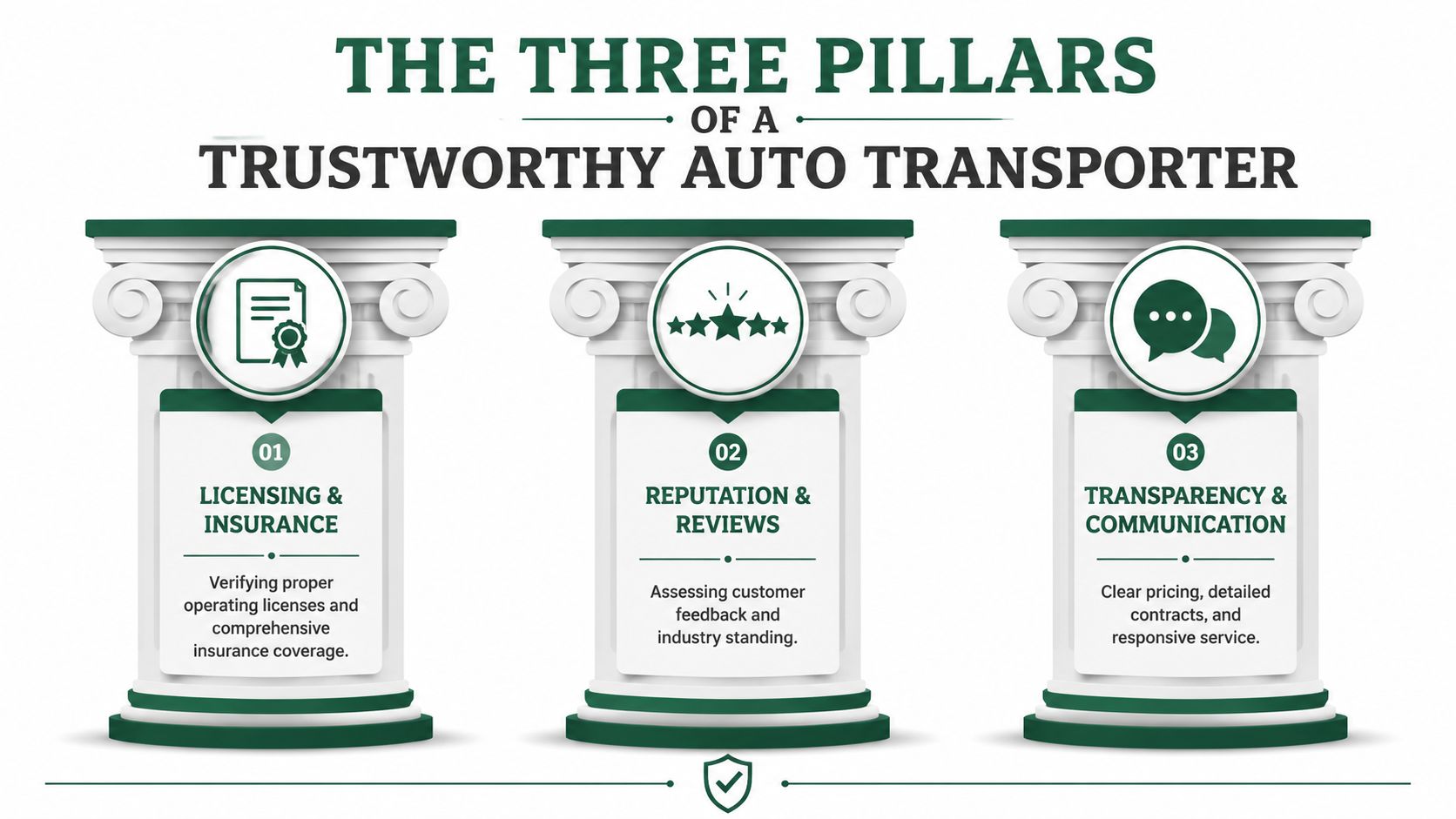
A trustworthy transporter stands on three things: legal authority, real insurance, and disciplined screening of the carrier that will physically move the vehicle. If one of those is weak, the shipment is exposed.
Licensing and operating authority
Start with the basics. Ask for the company's USDOT number and MC number if applicable. Those identifiers matter because they connect the business to its federal operating authority and compliance record.
If a company hesitates to provide those details, that's a warning sign. Legitimate operators and brokers expect customers to ask. They should also be able to explain whether they are acting as the broker arranging the move, the motor carrier hauling the vehicle, or both in limited situations.
A credential by itself doesn't guarantee a smooth shipment. But no credential means stop.
Insurance that matches the actual move
Insurance confuses a lot of customers because two different protections are often discussed as if they're the same thing.
Here's the practical distinction:
| Item | What it covers | Why it matters |
|---|---|---|
| Broker bond | Financial compliance tied to brokerage activity | It does not replace cargo coverage for your vehicle |
| Carrier cargo insurance | The vehicle while in transport | This is the coverage customers usually care about most |
| Liability coverage | General operating liability | Important, but separate from cargo protection |
Ask who the assigned carrier is, what cargo coverage applies, and how claims are documented. Serious companies answer clearly. Vague answers usually mean the sales side is outrunning operations.
Vetting the carrier network
Reliable service is either established or undermined by operational realities. A company can advertise aggressively and still assign a poor-fit truck for the route.
The better practice is to screen carriers before they ever receive a dispatch. That means reviewing authority status, insurance, operating history, and whether the equipment matches the shipment. For brokered moves, network quality matters as much as the quote.
One example is National Car Transport, which works through a network of 25,000+ vetted carriers and presents itself with flat-rate pricing, 25+ years of experience, and an A+ BBB rating based on the publisher information provided. That kind of structure is useful because customers don't just need availability. They need disciplined matching between route, vehicle, and carrier.
A reliable transport service is rarely the one that promises the most. It's the one that verifies the most.
The Auto Shipping Journey Step by Step
Customers feel better once they understand the sequence. Auto transport has a rhythm, and Puerto Rico shipments add a few extra checkpoints that need close handling.
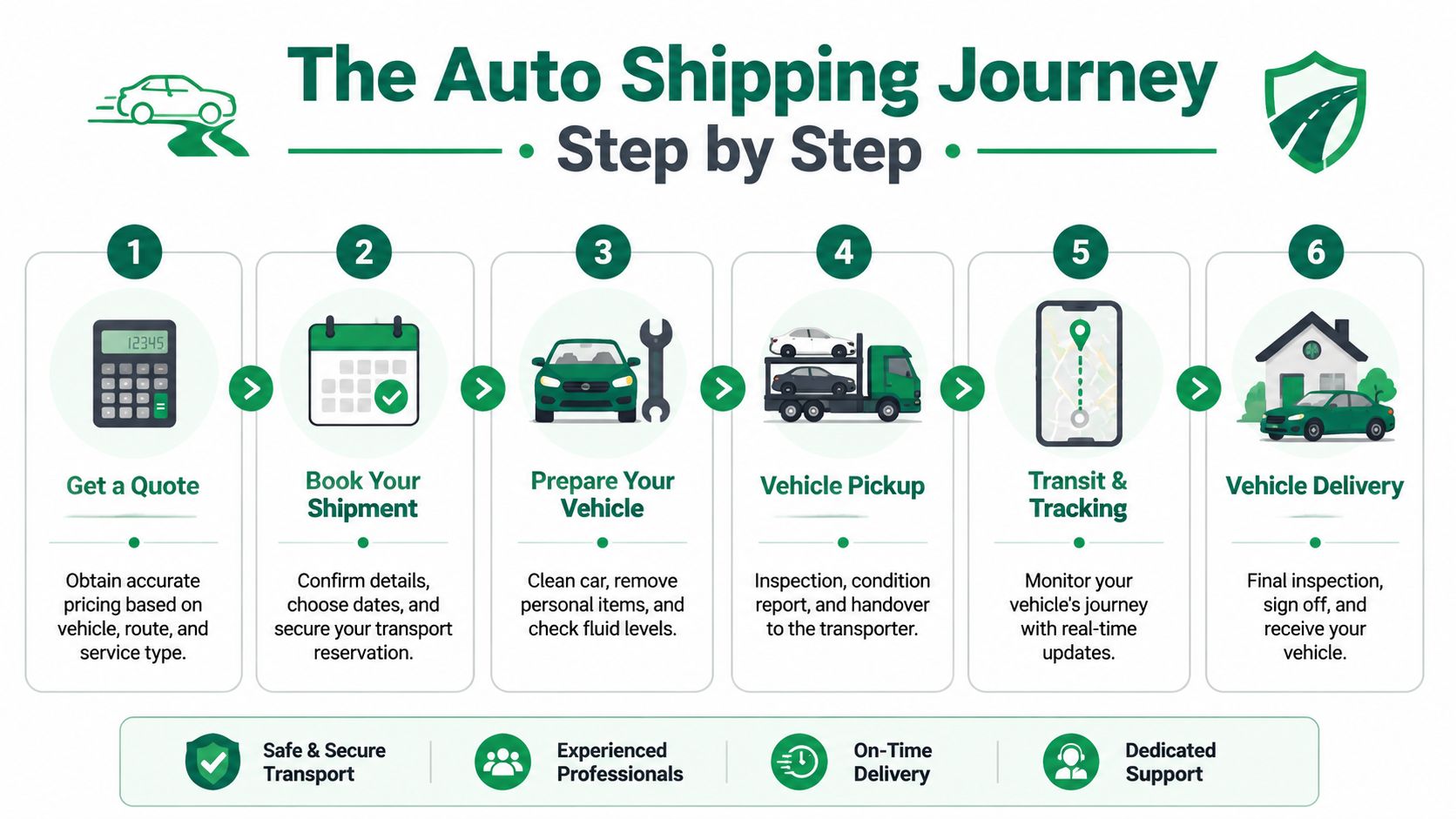
Near the start of the process, this overview helps visualize the flow.
Quote and booking
An accurate quote starts with the basics: vehicle year, make, model, running condition, pickup city, delivery city, and preferred timing. Route accessibility matters too. A truck can't always enter a tight downtown street, steep neighborhood road, or port-side staging area without adjustment.
Once the details are confirmed, the shipment is booked and scheduled. This is where an experienced agent earns their keep. The route may look simple on paper, but practical issues come up fast. Seller availability, apartment complexes, gated communities, title-holder questions, and weather delays all affect execution.
Vehicle preparation and pickup inspection
Before pickup, clean the vehicle enough to see its condition clearly. Remove personal items unless the transport coordinator gives a very specific exception. Leave only the fuel needed for loading and unloading. Make sure the battery is working and the tires hold air if the car is operable.
At pickup, the driver and customer inspect the vehicle together. The condition is recorded on the Bill of Lading, which becomes the core shipping document for the transport itself. Don't rush this part. Good photos from multiple angles help support the written inspection.
The Bill of Lading is not paperwork for paperwork's sake. It's the before-and-after record that protects both the customer and the transporter.
A short video walkthrough can help first-time shippers understand how professional handling looks in practice.
Transit, Puerto Rico handling, and delivery
For a mainland shipment, the vehicle moves on the assigned carrier to the destination area, then to final delivery or a nearby safe meeting point if the truck can't access the exact address.
Puerto Rico follows a longer chain. The vehicle may first move by truck to the departure port, then transition to ocean transport, then clear release steps on the island before final handoff. Customers shipping to or from San Juan often need guidance on required documentation, including port and treasury-related paperwork commonly referred to in conversation as Hacienda requirements. The exact document set can vary by ownership status, route direction, and port procedure, which is why a bilingual agent matters so much here. Small paperwork mistakes can create expensive delays.
For English- and Spanish-speaking customers alike, having a U.S.-based bilingual agent is more than a convenience. It reduces misunderstanding between mainland dispatch, port staff, and island-side coordination. That's especially important when every shipment has its own timing, release conditions, and handoff details.
Matching the Right Transport to Your Vehicle and Budget
Customers often ask the pricing question first. The better question is which method fits the vehicle and the route.
A daily driver going from Atlanta to Phoenix doesn't need the same setup as a restored classic heading from Boston to San Juan. Reliable service comes from matching the equipment to the job, not forcing every customer into the same lane.
Open carrier for standard moves
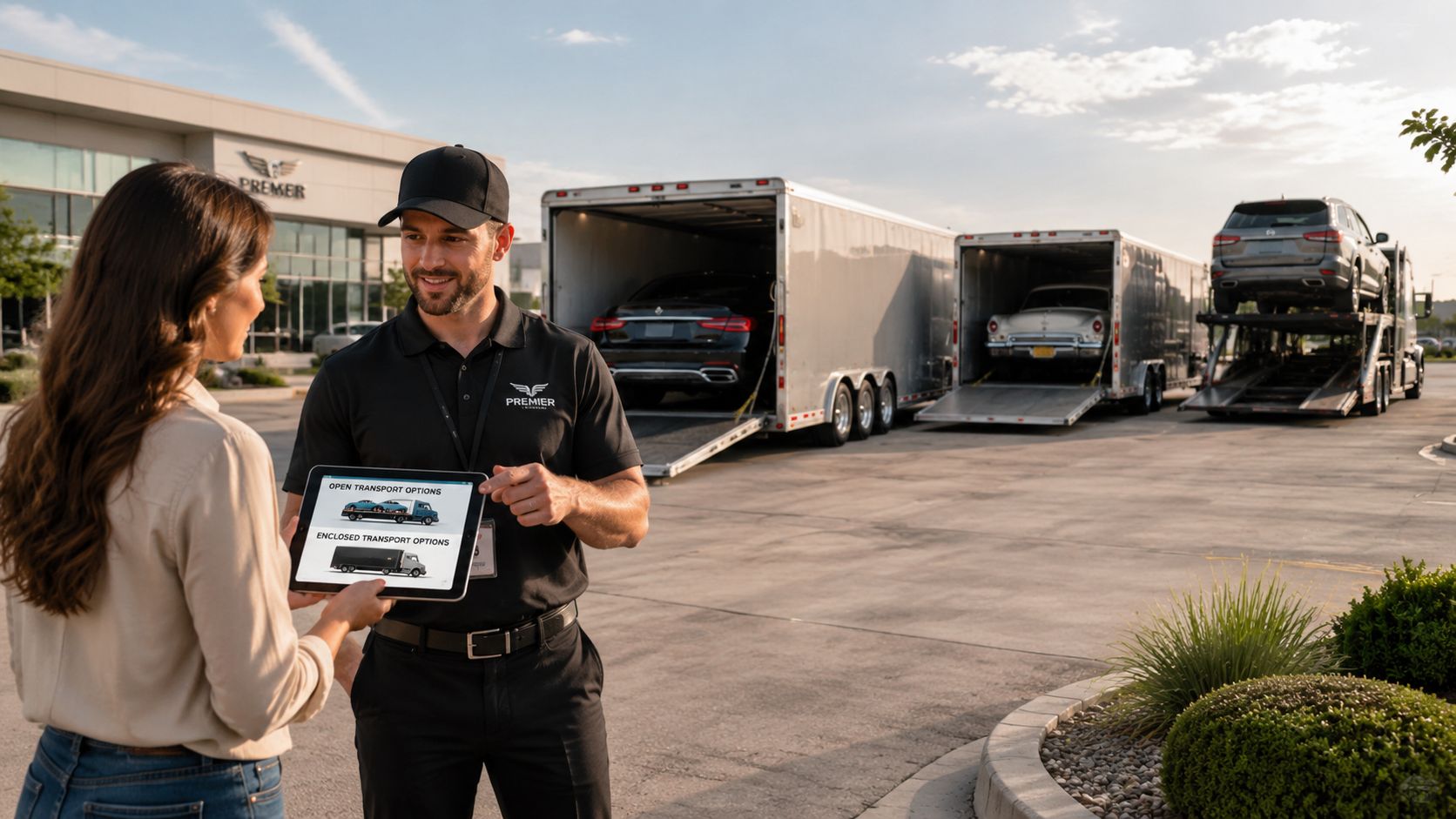
Open transport is the industry workhorse. Most everyday sedans, SUVs, pickups, and crossovers move this way across the lower 48 states because it's practical and widely available.
Think of open transport as commercial air travel for vehicles. It's efficient, common, and well-suited for standard use cases. Your car is exposed to weather and normal road conditions, but that's acceptable for most daily drivers.
Enclosed carrier for higher-protection needs
Enclosed transport is a different decision. This option fits classic cars, luxury vehicles, exotics, low-clearance cars, and motorcycles where added protection matters more than maximizing route flexibility.
To illustrate the difference: open transport is parking in a standard lot, enclosed transport is putting the vehicle in a private garage while it travels. Customers paying for preservation, presentation, or collector-level care usually choose enclosed because the shipment priorities are different.
If the vehicle's condition is part of its value, protection should drive the method choice.
Container shipping for Puerto Rico and other island routes
Puerto Rico introduces a different transport mode. Ocean movement commonly involves container shipping or other port-based shipping arrangements, depending on the route and service setup. Containerized service adds security and structure for island transit because the vehicle is moving through port systems, vessel schedules, and release procedures rather than only over-the-road dispatch.
Here's a simple comparison:
| Transport type | Best for | Main trade-off |
|---|---|---|
| Open carrier | Daily drivers, routine domestic routes | Least shielding from weather and road dust |
| Enclosed carrier | Luxury, classic, exotic, collector vehicles | Higher cost and tighter availability |
| Container or port-based ocean shipping | Puerto Rico and other non-mainland routes | More documentation and more handling stages |
Some customers compare shipping against towing or self-moving strategies. If you're weighing that option for an RV setup or secondary vehicle, this guide on choosing a Blue Ox towing bar is a useful reference for understanding when towing equipment makes sense and when professional transport is the better fit.
A Checklist for Hiring Your Auto Transport Partner
A sales call can sound excellent and still leave out the details that matter. The easiest way to avoid trouble is to interview the company the same way you'd interview anyone handling a valuable asset.
The checklist below works for mainland routes, dealership moves, military relocations, student transport, and Puerto Rico shipments.
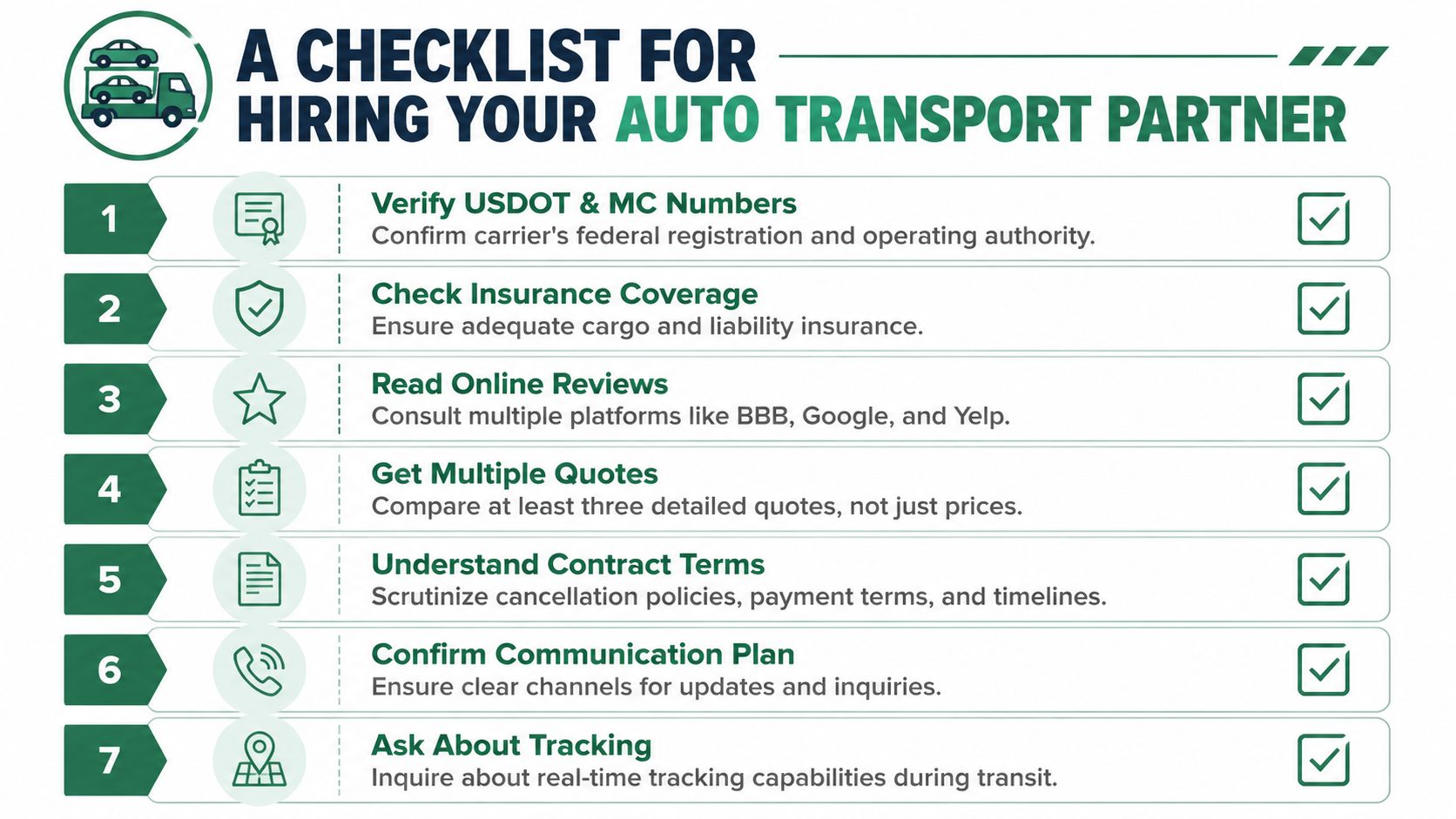
What to verify before you book
- Federal registration: Ask for the USDOT and MC information and verify the company's operating role.
- Insurance details: Confirm who provides cargo coverage on the actual move.
- Business history: Look for a real operating track record, not just a new website and aggressive phone sales.
- Review quality: Read reviews for communication patterns, not only star ratings.
- Pricing model: Ask whether the quote is a flat rate or an estimate that may change later.
- Pickup and delivery process: Find out how inspection, contact updates, and final handoff are handled.
- Puerto Rico experience: If the route involves San Juan or another island handoff, ask who handles port coordination and bilingual communication.
Questions that expose weak operators quickly
Use direct questions. Strong operators won't mind them.
- Is the quote a guaranteed flat rate, or can it change after booking?
- When is payment due, and is there any charge before a carrier is assigned?
- Who is my main point of contact once the order is dispatched?
- How do you vet the carrier or driver assigned to my vehicle?
- What happens if the truck can't access my street?
- How is the vehicle condition documented at pickup and delivery?
- For Puerto Rico, who helps with port paperwork and release steps?
A bad operator usually gets slippery around at least one of those questions. A good one gives direct answers, even when the answer is, “That depends on the route and here's why.”
Signs the service is built for real-world shipments
Watch for operational maturity, not polished wording.
- Clear contracts: Terms are readable and specific.
- Realistic timing: Pickup windows are clearly explained.
- Dedicated coordination: You're not bounced between anonymous departments.
- Bilingual support when needed: Especially important for Puerto Rico routes and family members coordinating across languages.
Navigating Pricing Transparency and the Claims Process
Low quotes attract attention because shipping feels expensive until you compare it to the cost of delay, confusion, and poor handling. The problem isn't that inexpensive transport is always bad. The problem is that some quotes are built to win the order, not to move the car smoothly.
What transparent pricing looks like
A transparent quote reflects the actual shipment conditions. The vehicle size, route, operability, trailer type, timing, seasonality, and special handling all affect price. Puerto Rico adds port logistics and ocean coordination, so pricing should reflect those added stages instead of pretending the route is just another highway delivery.
Watch for these warning signs:
- A quote that avoids specifics: If no one asks detailed questions about the vehicle or route, the number may not be usable.
- Pressure to book immediately: Reliable coordinators explain the order. They don't rush customers past the details.
- Murky payment terms: You should know what is due, when, and under what condition.
- No discussion of access limits: Dense urban blocks, gated communities, and port schedules all affect execution.
If there's a damage issue
Claims are straightforward when the paperwork is done correctly and difficult when it isn't.
The key steps are simple:
- Inspect at delivery before signing off fully.
- Compare the vehicle to the pickup condition noted on the Bill of Lading.
- Photograph any issue clearly before the driver leaves if possible.
- Note the issue on the delivery paperwork.
- Report it through the company's claims process promptly.
Don't rely on memory after delivery. Written inspection notes and photos taken at the handoff carry the most weight.
Good companies don't act offended when customers ask about claims. They explain the process because a professional operation plans for documentation before a problem ever appears.
Frequently Asked Questions About Vehicle Shipping
What documents do I need to ship a car to or from Puerto Rico
The exact document set can vary by route direction, ownership status, and port procedure. In practice, customers are often asked for identification, vehicle ownership documents, and forms tied to port release and treasury requirements. Financed vehicles, dealer purchases, and recently bought cars can require extra coordination; a bilingual agent makes a real difference in such scenarios. The paperwork isn't hard because it's mysterious. It's hard because small mismatches create delays.
Can I pack personal items in the car
Usually, it's better not to. Personal items can complicate inspections, create weight and liability issues, and cause problems at ports on Puerto Rico shipments. If you need to leave anything in the vehicle, ask first and get clear guidance tied to your exact route.
How does shipping differ for military PCS moves
Military customers often need tighter coordination around orders, reporting dates, family scheduling, and changing addresses. The biggest operational need is flexibility. A shipment may be straightforward one week and suddenly need timing adjustments the next. Experienced coordinators understand that PCS moves don't always stay fixed.
Why does a dedicated agent matter so much
Because no two vehicle transports are identical. One customer is shipping a family SUV from Orlando to San Antonio. Another is moving a college student's sedan from New Jersey to Miami. Another needs a dealership transfer from Illinois to Georgia. Another is shipping to San Juan and needs help in English and Spanish with port timing and release steps.
An experienced agent reduces error by keeping the shipment coherent from start to finish. That matters even more on Puerto Rico routes, where trucking, port handling, ocean movement, and final release have to line up cleanly. A bilingual U.S.-based coordinator with deep auto transport experience can translate more than language. They translate process.
If you need practical help planning a mainland or Puerto Rico vehicle shipment, National Car Transport is one option to consider. The company offers door-to-door service across the U.S., Puerto Rico, Alaska, and Hawaii, with bilingual agents based in the U.S. who help customers manage route details, scheduling, and port-related logistics.