
You've accepted a new job across the country, bought a vehicle online, or booked a seasonal move to Puerto Rico. The departure date is approaching, but the practical questions remain: Which carrier should handle the car? What does the quote include? Can an electric vehicle travel by ocean? What happens if the delivery window slips or damage appears at the port?
Private car shipping works well when those details are handled before pickup, not improvised beside a trailer. The right service depends on the vehicle, route, operating condition, transport mode, documentation, and your tolerance for schedule changes. This guide explains the decisions that matter for moves across the 48 contiguous states, between major cities such as New York, Los Angeles, Chicago, Houston, Miami, Seattle, Denver, Atlanta, Boston, Phoenix, and San Francisco, and between the mainland and San Juan, Puerto Rico.
Table of Contents
- What Private Car Shipping Actually Means
- Understanding Your Transport Options
- Calculating Costs and Timelines
- Securing Your Vehicle with Insurance
- Preparing Your Car for Pickup
- Why Experience Matters in Auto Transport
- Booking Your Shipment with Confidence
- Moving Forward with Your Vehicle
What Private Car Shipping Actually Means
A family relocating from Boston to Dallas may only need one SUV moved while the household travels separately. A snowbird might send a sedan from New Jersey to Florida before the winter season. A student may need a compact car moved from Los Angeles to Chicago, while a dealership may be arranging several vehicles at once. These are different scheduling problems, but each can use private car shipping, a consumer-focused service for moving an individual vehicle rather than managing a manufacturer's full production flow.
Private shipping doesn't mean your car travels alone on a truck. Most vehicles share space with other automobiles, but the shipment receives its own booking, inspection record, pickup instructions, delivery coordination, and claims trail. That distinction matters. A commercial fleet may be managed through standing lanes and standardized paperwork, while a private customer needs someone to confirm a safe pickup location, explain what to remove from the car, and provide updates when the route changes.
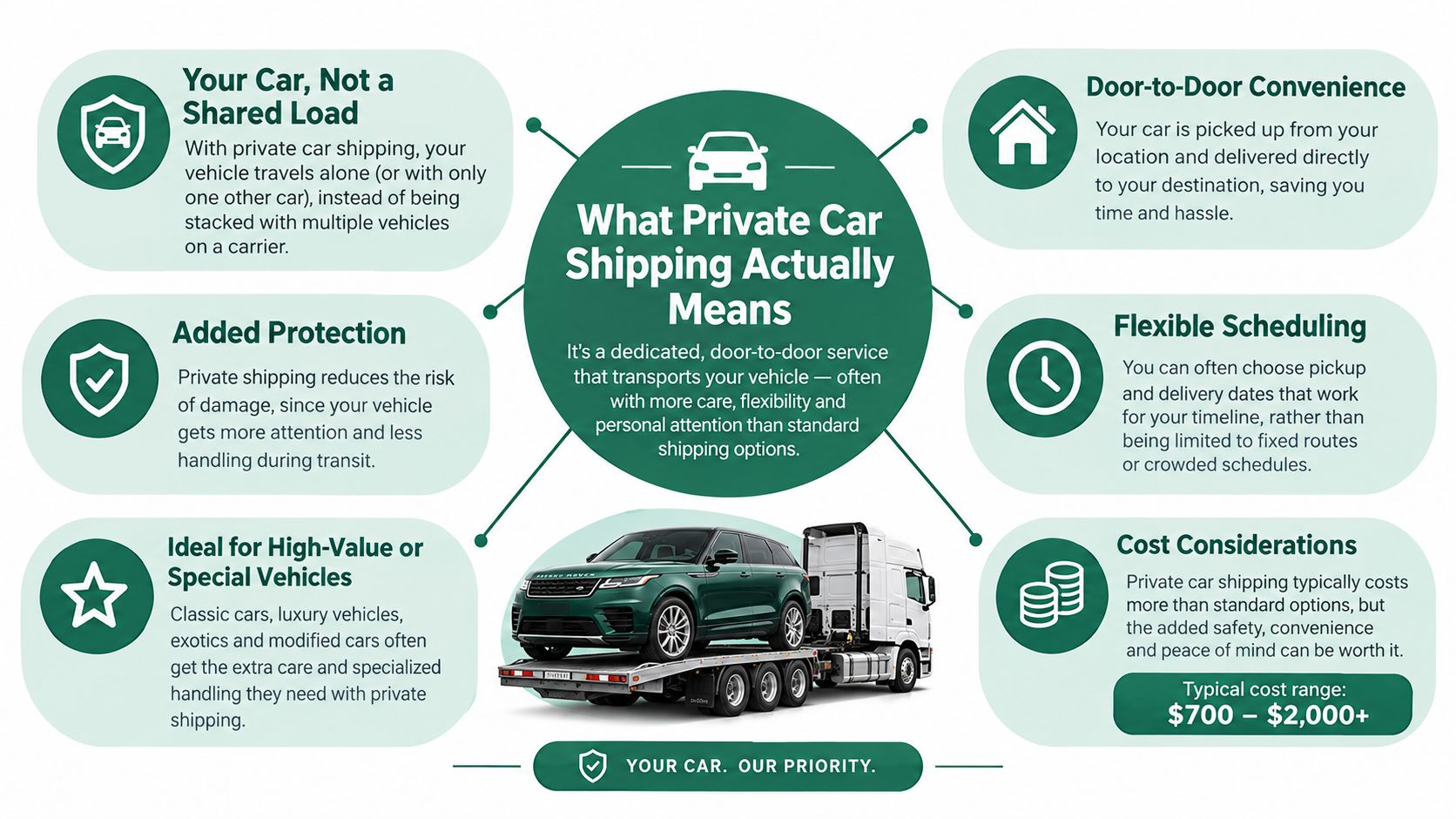
The industry grew from a much larger automotive logistics system. Early vehicle movements relied on railroad boxcars, which carried only a few automobiles. In 1954, Volkswagen engineers and German railroads developed a two-level railcar capable of carrying 10 automobiles, establishing the basic autorack concept. North American logistics advanced again in 1959, when 85-foot flatcars were introduced for automobile transportation and could carry two 40-foot highway trailers in trailer-on-flatcar service. Purpose-built carriers increasingly replaced boxcars during the early 1960s because they loaded more efficiently and handled more vehicles. The Association of American Railroads describes this development in its automotive freight history.
That history explains today's structure. Your car may move by truck, rail, port equipment, or ocean vessel, but the service exists because specialized networks make long-distance vehicle handling more predictable than asking an owner to drive every mile.
Practical rule: Treat your car as a separately managed shipment, not as extra luggage. The booking record, inspection report, and delivery receipt are part of the transport.
Understanding Your Transport Options
Start with the vehicle, then choose the equipment. Open transport is the common option for daily drivers, family SUVs, dealer purchases, and ordinary relocations. The vehicle travels on a multilevel trailer exposed to weather and road conditions, with loading and unloading procedures designed for routine vehicle movement.
Enclosed transport places the vehicle inside a covered trailer. It can make sense for a classic, restored, exotic, luxury, or unusually valuable vehicle because it reduces exposure to weather and road debris. It doesn't eliminate loading risk, delays, or the need for a careful inspection. An enclosed trailer also has limited capacity and may not serve every address directly.
Door-to-door or terminal service
Door-to-door service means the carrier collects and delivers at the requested addresses when local road access allows it. A narrow residential street, low bridge, cul-de-sac, or restricted loading zone may require the driver to meet you at a nearby wide road, shopping center, or safe landmark. That isn't a service failure. Large transporters need turning clearance and enough space to load without creating a traffic hazard.
Terminal service can work for customers who have flexible schedules or live near a reliable storage facility. It may reduce coordination at the residence, but the customer must arrange transportation to and from the terminal and confirm storage, hours, inspection access, and release procedures. For most individual moves, door-to-door auto transport is easier when the pickup and delivery locations can safely accommodate the equipment.
Match the mode to the vehicle
Use this decision sequence:
- Check operating condition. A running vehicle is simpler to load. An inoperable vehicle requires advance disclosure and compatible loading equipment.
- Assess protection needs. Daily drivers generally fit open transport. Vehicles with fragile finishes or collector value may justify enclosed equipment.
- Confirm access. A carrier may use a nearby landmark rather than enter a restricted street.
- Consider the route. Mainland moves usually combine highway transport with regional dispatching. Puerto Rico shipments add port coordination, ocean freight, and customs-related paperwork.
- Separate convenience from protection. Door-to-door improves handoff convenience. Enclosed transport changes exposure to weather and debris. Neither option replaces documentation or proper securement.
For island shipments, a truck may carry the car to a mainland port, ocean freight may move it to Puerto Rico, and another truck may complete delivery toward San Juan or another destination. Ask which party handles each handoff and where the inspection occurs.
Calculating Costs and Timelines
A transparent quote starts with the actual shipment, not a generic vehicle description. Route distance, pickup and delivery access, vehicle dimensions, operating condition, transport type, season, and carrier availability all influence the rate. Popular corridors may offer more dispatch options, while remote origins, unusual vehicle sizes, and difficult pickup locations may require additional planning.
Open and enclosed transport should be compared as separate services. Open equipment usually offers broader availability for ordinary cars and SUVs. Enclosed transport may require a more specific truck, a compatible route, and additional coordination. The cheaper option isn't automatically the better value if the vehicle needs protection that open transport doesn't provide.
For a practical pricing breakdown, National Car Transport's car shipping cost guide explains why route, vehicle size, and transport type affect the quote. A flat-rate structure should identify what the customer is paying for and avoid turning normal route variables into surprise charges at delivery. Confirm whether the quoted price includes pickup, delivery, carrier assignment, port handling, and any disclosed access limitations.
Mainland trucking compared with ocean freight
A coast-to-coast truck move and a mainland-to-Puerto Rico shipment aren't interchangeable. Highway transport offers a direct overland itinerary, although the carrier still manages dispatching, traffic, weather, and loading points. Puerto Rico service adds port scheduling, vessel availability, terminal handling, and documentation. The shipment may move by truck to a port, by vessel, and then by truck again.
Rail and intermodal planning can reduce emissions intensity on long corridors. A lifecycle assessment cited in a peer-reviewed environmental study found rail freight produces approximately three times fewer emissions than truck freight per tonne-kilometre when vehicle manufacture, fuel production, and operational fuel use are included, while excluding infrastructure construction and use. The same source reports that shifting finished-vehicle distribution from road-only to rail-road intermodal service reduced tank-to-wheel emissions by 33% to 65%, averaging 53% across 18 routes. The environmental study explains the assumptions and limitations behind those findings.
Those figures describe freight systems, not a guaranteed result for an individual shipment. Short urban moves may favor direct trucking because terminal transfers add handling. Long corridors are stronger candidates for intermodal planning, but the actual benefit depends on route length, train utilization, terminal access, and repositioning.
Ask for windows, not promises: Get pickup and delivery dates in writing, and confirm whether each date is an estimate or a guaranteed appointment.
Securing Your Vehicle with Insurance
Insurance answers only part of the risk question. A carrier's cargo coverage may address physical damage to the vehicle during transport, but it doesn't automatically cover personal belongings, mechanical failure, delay expenses, hotel bills, rental cars, or a dispute caused by missing inspection evidence. Ask for the carrier's insurance information, exclusions, claims procedure, and any deductible before handing over the keys.
A reputable loading process also matters. Federal Motor Carrier Safety Administration rules require cargo to be firmly immobilized with suitable structures, chocks, wedges, cradles, tiedowns, or combinations of those devices, and each securement component must be in proper working order. The aggregate working load limit of the securement system must be at least 50% of the vehicle's weight, and rolling cargo must be blocked with appropriate restraints. FMCSA outlines the cargo-securement requirements for interstate commercial vehicles.
What the quote should identify
A flat-rate quote is useful only when its boundaries are clear. Before booking, confirm:
- Transport equipment: Open or enclosed, and whether the equipment fits the vehicle's dimensions.
- Vehicle condition: Running, non-running, modified, lowered, oversized, or otherwise difficult to load.
- Pickup and delivery method: Residence, business, terminal, port, or nearby safe location.
- Insurance scope: Physical damage coverage, exclusions, claims contact, and documentation requirements.
- Additional services: Port handling, storage, special equipment, or address changes.
Do not assume that a high-value vehicle is fully protected just because the carrier says “insured.” Owners of classics, exotics, and restored vehicles should ask whether the stated coverage reflects the vehicle's agreed value and whether loading, unloading, weather, theft, and storage are treated differently. Supplemental protection may be appropriate, but only after you understand the base policy and exclusions.
The strongest claim file begins before departure. Photograph every panel, wheel, window, trim piece, and existing scratch or dent in good light. Record the odometer, fuel level, or battery status, and make sure the inspection report describes visible conditions rather than using vague language.
Preparing Your Car for Pickup
Preparation prevents two common problems, delayed loading and arguments about pre-existing damage. The carrier needs a vehicle that can be inspected, moved, secured, and released without discovering undisclosed conditions at the curb.
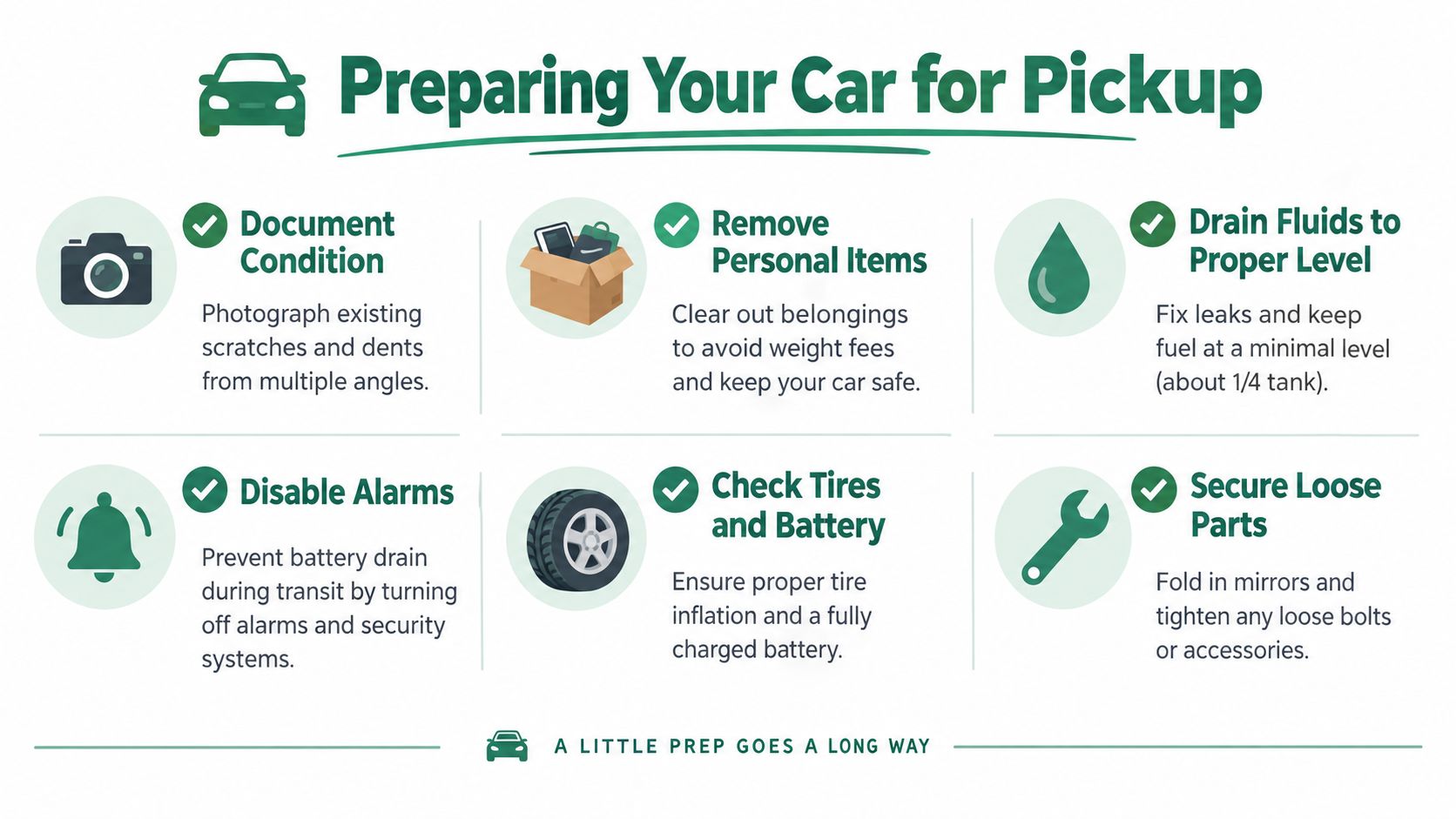
Use this pickup checklist
Gather the paperwork. Keep the title, registration, bill of sale when relevant, military orders when applicable, port instructions, and carrier contact details available. Ask which original documents must travel with the car and which should remain with you.
Wash the exterior. Dirt hides scratches and dents. A clean surface makes the origin inspection more reliable. If the vehicle needs more than a basic wash, a local service such as mobile car detailing in Columbus can help prepare the surface before photographs.
Photograph the condition. Take clear images of all sides, wheels, glass, roof, interior, dashboard, odometer, and fuel or battery status. Add the date and preserve the files until delivery and claims resolution.
Remove belongings. The safest car is empty. Remove cash, electronics, jewelry, documents, firearms, food, plants, and anything irreplaceable. If your carrier allows limited personal items, disclose them in advance, keep them secured below the window line, and understand that cargo insurance generally protects the vehicle, not those belongings.
Check mechanical basics. Repair active leaks, maintain proper tire inflation, leave the vehicle with enough fuel for loading and unloading, disable alarms, and secure loose parts. Fold mirrors where appropriate, remove detachable accessories, and disclose modifications, lowered suspension, oversized tires, roof racks, or spoilers.
Record the operating condition. Tell the carrier whether the car starts, rolls, steers, and brakes. An inoperable vehicle may require a winch or specialized loading equipment, so hiding that fact can cause a refused pickup or a revised quote.
EV preparation requires more disclosure
Electric vehicles need a separate conversation. Battery condition, warning lights, recall status, state of charge, vehicle weight, and loading instructions can affect acceptance, routing, equipment planning, insurance, and delivery timing. Enclosed transport isn't automatically safer for every EV. Improper loading, inadequate weight or axle planning, and incomplete battery disclosure may create greater operational problems than exposure to ordinary weather.
For overland service, ask whether the carrier accepts the exact make and model, what battery range is required for loading and delivery, and whether the vehicle must be driven, towed, or placed in a particular transport mode. Disclose battery damage, warning indicators, flood exposure, and active recalls rather than assuming the carrier will discover them at pickup.
Island routes require extra attention. Maritime guidance reported for 2026 identifies lithium-ion-powered vehicles as UN 3556 under the revised IMDG framework, with dangerous-goods declarations, Class 9 labeling, and documented battery-condition information. Confirm whether the carrier and vessel accept your model, what state-of-charge range applies, and whether cargo or marine insurance addresses battery damage rather than only visible body damage.
Why Experience Matters in Auto Transport
A private shipment can involve a simple driveway pickup or a chain of handoffs between a residence, truck, port, vessel, terminal, and final delivery address. Experience matters because someone has to recognize the weak point before it becomes a missed pickup. A seasoned coordinator checks access, vehicle condition, route constraints, paperwork, and communication responsibilities instead of treating every booking as an identical sedan on a standard lane.
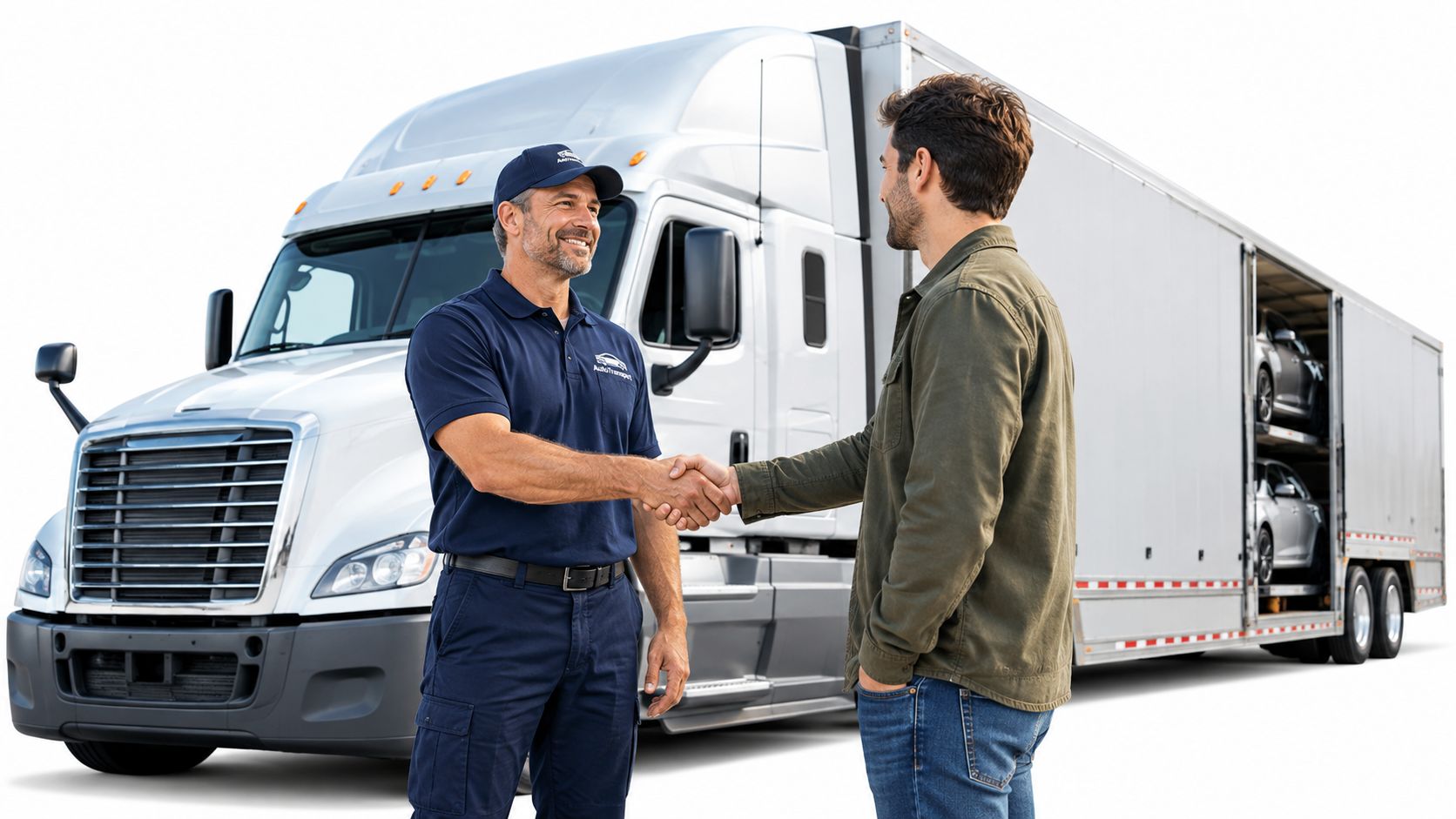
National Car Transport is one example of a U.S.-based provider that states it has 25+ years of experience, an A+ BBB rating, transparent flat-rate pricing, and a network of 25,000+ vetted carriers. Its service scope includes open and enclosed transport, door-to-port and port-to-door Puerto Rico moves, and support for individuals, snowbirds, military households, students, dealerships, and businesses.
Those credentials don't replace shipment-specific questions. A large network can provide flexibility, but the customer still needs a named agent, a written quote, a clear pickup window, and a process for handling weather, port congestion, vehicle condition changes, or a carrier reassignment. The coordinator should explain what happens when the original plan no longer fits the vehicle or location.
Coordination is the real service
The small details usually determine whether a move feels controlled:
- Access review: The agent identifies safe meeting points when a truck can't enter the requested street.
- Condition review: The booking reflects whether the car runs, rolls, steers, and brakes.
- Route planning: Mainland and Puerto Rico moves account for trucking, ports, ocean freight, and final delivery.
- Communication: The customer knows who to contact when the estimated window changes.
- Claims support: The origin and destination inspection records can be compared without relying on memory.
A bilingual English and Spanish agent based in the United States can also reduce misunderstandings, especially when a military family, Spanish-speaking household, dealership, or Puerto Rico customer is coordinating several parties. National Car Transport says its bilingual agents have more than 20 years of auto transport logistics experience. Not one vehicle transport is alike, and an agent who can guide the shipment in the customer's preferred language may make a complicated process simpler and faster.
A professional network is most valuable when it applies judgment. The correct carrier is not the first available truck. It must be the carrier whose equipment, route, timing, and handling process fit the vehicle.
Booking Your Shipment with Confidence
A controlled booking starts with precise information. Have the pickup and delivery ZIP codes, vehicle year, make, model, operating condition, preferred dates, transport type, and access restrictions ready. For Puerto Rico, specify whether the route runs from the mainland to San Juan, from San Juan to the mainland, or onward to another island.
Use this sequence:
- Request a written quote. Confirm the route, equipment, pickup and delivery methods, included services, payment terms, and conditions that could change the rate.
- Disclose exceptions. Report an EV, inoperable vehicle, oversized modification, lowered clearance, battery warning, personal items, or port requirement before dispatch. For an EV, ask whether the battery must meet a specific charge level or maritime handling rule.
- Review the schedule. Establish whether pickup and delivery dates are estimates or guarantees. Keep contingency plans for rental transportation, lodging, work, and school.
- Confirm paperwork. For Puerto Rico, verify VIN details, title and registration requirements, EEI filing responsibility, port instructions, and military-order documentation. Review the Puerto Rico shipping guide alongside the carrier's instructions.
- Complete both inspections. Photograph every side, wheel, glass panel, interior, dashboard, mileage display, and existing mark at pickup and delivery. Record lighting, weather, mileage, fuel or battery status, and new damage before signing.
For used, self-propelled vehicles moving between the continental United States and Puerto Rico, CBP determined the movement is not an “export” under 19 CFR 192.2. The standard 19 CFR 192 requirements, including presenting ownership documentation 72 hours before export, therefore do not apply. EEI must still be filed through the Automated Export System, with the VIN or PIN included, and vehicles remain subject to inspection. CBP's Puerto Rico ruling resource document explains the filing and inspection rules.
Military customers should verify current instructions with their installation and transportation office. Fort Buchanan guidance states that one POV shipped under qualifying official orders is tax-exempt, while additional vehicles may face Puerto Rico local import taxes before release. The official Fort Buchanan overview provides the applicable military shipping context.
Moving Forward with Your Vehicle
Private car shipping becomes manageable when you control the variables that create avoidable trouble. Choose equipment based on the vehicle, compare trucking with intermodal or ocean routing, insist on clear pricing and schedule language, prepare the car carefully, and preserve condition evidence from pickup through delivery.
Puerto Rico shipments deserve extra planning because ports, EEI, inspections, military exemptions, and EV maritime documentation can affect release. Mainland moves still require the same discipline around access, securement, insurance, and delivery records. A carrier's reputation matters, but the booking is only as strong as the information you provide and the questions you ask.
Use an agent who will explain the route in plain English or Spanish, identify what could change, and stay accountable through the handoffs. That approach won't eliminate every delay, but it gives you a defensible record and a practical response when conditions change.
National Car Transport coordinates open and enclosed vehicle transport across the United States, plus door-to-port and port-to-door service for Puerto Rico, with bilingual English and Spanish agents based in the USA. Request a route-specific quote from National Car Transport, disclose your vehicle's condition and timing needs, and let an experienced logistics agent build the shipment around the details that make your move different.