
If you're shopping open car carrier trailers for sale, you're probably in one of two situations. You need more control over vehicle moves, or you're tired of paying for transport often enough that ownership looks cheaper on paper. That could mean a small dealer moving inventory across state lines, a seasonal resident sending a car south, a military family planning a relocation, or a business trying to tighten delivery schedules.
The part many buyers miss is that a trailer isn't just a purchase. It's an operating decision. You aren't only buying steel or aluminum. You're taking on towing compatibility, loading geometry, insurance, upkeep, storage, and compliance. That gets even more important when the route isn't a simple mainland move and involves port handling and ocean shipping to Puerto Rico.
Table of Contents
- Your Guide to Buying an Open Car Carrier Trailer
- Choosing the Right Type of Open Car Trailer
- Understanding Key Trailer Specifications and Features
- Buying a Trailer vs Hiring a Professional Car Shipping Service
- Special Logistics for Shipping Cars to and from Puerto Rico
- Safety Legal Requirements and Maintenance
- Frequently Asked Questions About Open Car Carriers
Your Guide to Buying an Open Car Carrier Trailer
Open car carrier trailers stay popular because they solve a real business problem. They're practical, visible, easier to load than many enclosed units, and flexible enough for personal moves, dealer transfers, auction pickups, and local fleet work. For many operators, an open trailer is the first serious piece of transport equipment they buy.
That decision sits inside a market that is steady, not speculative. The broader car carrier market was valued at USD 10.4 billion in 2023 and is projected to reach USD 13.7 billion by 2033, with a 2.8% CAGR, according to car carrier market projections from Market.us. For buyers, that usually points to a mature category with ongoing replacement demand rather than a boom-and-bust niche.
Who usually benefits from owning one
Some buyers clearly fit trailer ownership better than others:
- Small dealerships: They want faster local inventory moves without waiting on third-party scheduling.
- Independent transport operators: They need an entry point into commercial hauling without jumping straight into larger specialized equipment.
- Collectors and enthusiasts: They move one or two vehicles often enough that convenience starts to matter more than occasional rental costs.
- Repair shops and body shops: They need predictable control over pickups, drop-offs, and non-running vehicle handling.
Where buyers get in trouble
The mistake isn't buying an open trailer. The mistake is buying the wrong open trailer for the work.
A trailer that looks good in a listing can fail in daily use because the deck is too heavy, the payload is too tight, the ramps are too steep, or the tow vehicle is poorly matched. Buyers also underestimate how often route type changes the equation. Towing a vehicle from Dallas to Atlanta is one thing. Managing pickup in the mainland U.S. and final delivery into or out of San Juan, Puerto Rico is a completely different logistics chain.
Practical rule: Buy a trailer for the hardest vehicle and the hardest route you expect to handle, not the easiest one.
That approach prevents the common cycle of buying once for price, then upgrading after a few difficult loads.
Choosing the Right Type of Open Car Trailer
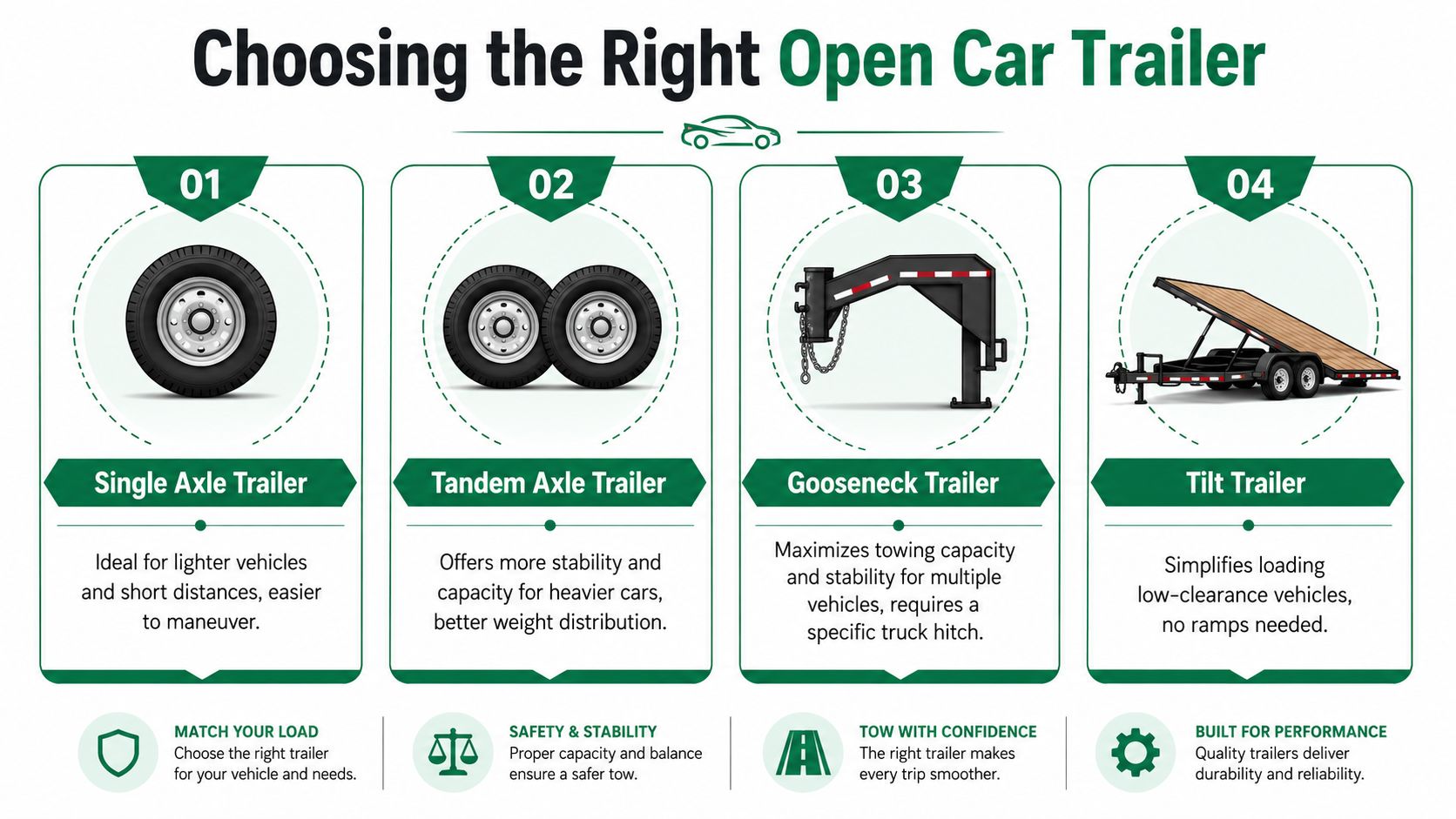
The phrase open car carrier trailers for sale covers several very different machines. Some are built for a single personal vehicle. Others are designed around repeated commercial loading and tighter scheduling. The right choice depends less on the ad copy and more on how often you load, what you haul, and whether your tow vehicle is suited for the job.
The main trailer types buyers compare
Some configurations are common because they fit predictable use cases.
| Trailer Type | Capacity | Ideal For | Pros | Cons |
|---|---|---|---|---|
| Single axle trailer | Lighter-duty vehicle hauling | Occasional personal use | Easier to maneuver, simpler to store, lighter overall | Less stability, less margin for heavier vehicles |
| Tandem axle trailer | More substantial single-vehicle hauling | Dealers, shops, frequent personal transport | Better weight distribution, improved road stability, stronger everyday utility | Heavier, more maintenance points |
| Gooseneck trailer | Multi-vehicle or heavier commercial work | Operators moving more than one unit or running regular routes | Excellent stability, higher towing confidence, more deck utility | Requires the right truck setup, less practical for casual users |
| Tilt trailer | Single-vehicle transport where clearance matters | Sports cars, lowered cars, some EV applications | Easier loading, reduced ramp issues, cleaner single-operator workflow | Usually more specialized, not always the cheapest option |
What works for different buyers
A single axle trailer usually fits the occasional mover. If you're hauling a personal vehicle short distances and storage space is tight, it can be enough. It usually isn't the best answer for repeated commercial use.
A tandem axle trailer is where many serious buyers land. It gives better road manners and better confidence when the load isn't perfectly forgiving. Dealers, repair shops, and frequent transport users often find this setup more practical than the lightest entry-level option.
A gooseneck makes sense when your work is commercial and your truck is set up for it. It isn't just about carrying more. It's about stability, especially when you're loading multiple units or running longer routes.
A tilt trailer solves a very specific pain point. If the vehicle sits low, has an aggressive front fascia, or has battery packaging that doesn't tolerate bad loading angles, tilt can save a lot of frustration.
The cheapest trailer type often becomes the expensive one if every difficult load requires extra boards, extra labor, or a second attempt.
A simple way to narrow the field
Ask these questions before you compare brands:
- How many vehicles at a time: One car occasionally is a different job than regular dealer transfers.
- What kind of ground clearance: Low-profile cars change the trailer choice quickly.
- What truck are you towing with: Hitch type, wheelbase, and towing confidence matter in practice.
- How often will it work: Weekend use and weekly commercial use should not be bought the same way.
Understanding Key Trailer Specifications and Features
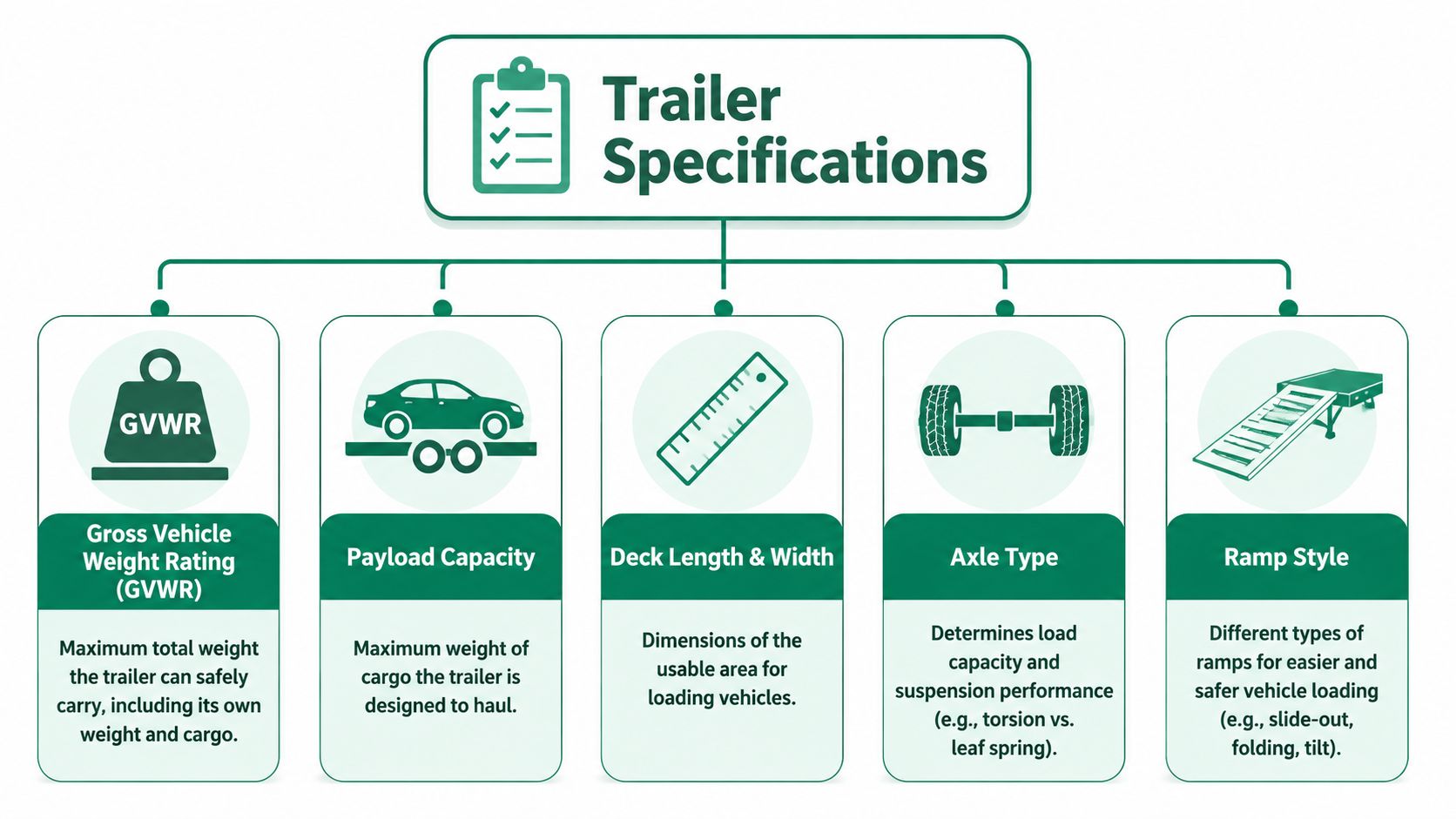
Most trailer buying mistakes happen after the buyer picks the right category. The problem is usually in the spec sheet. GVWR, payload, axle setup, deck size, and load height sound technical, but they decide whether the trailer is useful or frustrating.
Commercial-style open car haulers are often built in 7' x 18' to 7' x 24' sizes with 7,000- to 12,000-lb GVWR, according to Kaufman multi-car trailer specifications. The important part is what those numbers don't mean. GVWR is not payload. Payload is the rated gross limit minus the trailer's own empty weight.
Start with payload, not brochure language
A trailer can sound heavy duty and still leave you short on usable carrying capacity. Heavier steel construction can improve stiffness and long-term abuse tolerance, but that added trailer weight also eats into what you can legally haul. Aluminum usually preserves more payload margin.
That matters when the vehicle itself is heavier than expected, or when you need room for tools, straps, spares, or loading equipment.
One spec example that shows why details matter
A benchmark open car hauler configuration from Hillsboro is an 8.5 x 20 ft aluminum trailer with 9,990-lb GVWR, 1,550-lb empty weight, and 8,440-lb payload capacity, as shown in Hillsboro open car hauler specifications. That combination shows why aluminum appeals to many midsize operators. The trailer stays relatively light while still leaving meaningful room for the vehicle.
The same source also notes tandem torsion axles in the 3,500- to 5,200-lb range and a low load height around 20 to 21.5 inches. In practice, lower load height usually helps reduce ramp angle and underbody contact risk.
Features that deserve more attention
Buyers often focus on length and price first. I'd put these items much higher on the checklist:
- Deck height: Lower is usually easier on low-clearance vehicles.
- Ramp design: Long, well-positioned ramps load differently than short steep ones.
- Axle type: Torsion and leaf-spring setups can feel very different under load.
- Tie-down layout: Good placement saves time and secures vehicles more cleanly.
- Winch readiness: If you'll ever load a non-runner, this stops being optional.
A spec sheet should answer one question clearly. Can this trailer load and carry your real vehicle mix without drama?
Steel vs aluminum in plain terms
Steel usually wins when the buyer values ruggedness, lower upfront cost, and straightforward repairability. Aluminum usually wins when payload margin, corrosion resistance, and easier towing matter more.
Neither material is automatically right. A buyer hauling local inventory in mixed weather may accept extra weight for a tougher deck. A buyer trying to preserve capacity and make loading easier may prefer aluminum even if the initial price is higher.
Buying a Trailer vs Hiring a Professional Car Shipping Service
A buyer finds an open car carrier trailer at a price that looks manageable, figures a few vehicle moves will pay for it, and then runs into the part the listing did not show. Insurance renews whether the trailer rolls or not. Tires age out. Wheel bearings still need service. A truck that was fine for light towing starts spending more time in the shop.
That is why the relevant comparison is not trailer price versus shipping quote. It is total cost of ownership versus paying for transport only when you need it.
One pricing example from open versus enclosed trailer pricing and ownership discussion from Jim Glo shows open car haulers starting at $9,495 while enclosed trailers can be $28,995 or more. That gap matters, but it only answers the purchase question. It does not answer the operating question.
What ownership actually includes
A trailer keeps costing money after the sale.
- Insurance and registration: Fixed costs continue even during slow periods.
- Maintenance: Tires, brakes, lights, bearings, wiring, deck wear, and corrosion need regular attention.
- Storage and security: The trailer needs legal parking and protection from theft or damage.
- Tow vehicle wear: Extra towing weight affects brakes, transmission load, fuel use, and service intervals.
- Labor and time: Someone still has to plan routes, load correctly, handle delays, and solve problems on the road.
The same Jim Glo source points out that hiring a transport service removes direct trailer costs such as maintenance, insurance, registration, and tire replacement. For many individual owners and smaller businesses, that changes the math fast.
When buying makes sense
Buying usually works best for operators with repeat moves, a suitable tow vehicle, trained staff, and enough volume to keep the trailer earning its keep. Dealers moving local inventory every week can make ownership pencil out. The same goes for repair shops, auctions, or fleets that control their own schedules and already have yard space.
Control has value too. If your team regularly needs same-day pickup within a defined service area, owning equipment can cut waiting time and reduce dependence on outside carrier availability.
When hiring is the better business decision
Hiring a professional carrier is often the better call for occasional shipments, interstate routes, seasonal moves, and jobs with multiple handoffs. The less predictable the route, the less attractive ownership becomes.
I have seen buyers focus on trailer price and miss the operational burden. One long-distance move can involve pickup timing, driver hours, weather exposure, delivery restrictions, and customer communication. Add apartment access issues, dealer receiving windows, or a non-running vehicle, and the trailer itself becomes only one small part of the job.
A professional service also gives you access to equipment and capacity you may not want to own. National Car Transport handles vehicle shipping across the U.S., including Puerto Rico, with open and enclosed options, bilingual U.S.-based agents, vetted carrier capacity, and flat-rate pricing. That is a service model for customers who need the vehicle moved correctly, not another asset to maintain.
A short overview of carrier-based transport helps show how that process works in practice.
A useful decision test
Use a simple ownership test. If the trailer will be used often enough to cover fixed costs, maintenance, storage, and tow-vehicle wear, buying may make sense. If those costs are harder to justify than the shipment itself, hiring is usually the cleaner choice.
| Situation | Usually the better fit |
|---|---|
| Frequent local moves with compatible truck, staff, and storage | Buy a trailer |
| Occasional interstate shipping | Hire a transport service |
| Routes involving Puerto Rico or port coordination | Hire a transport service |
| Low-clearance or specialty vehicles with uncertain loading fit | Depends on equipment, often specialists |
If you started searching for open car carrier trailers for sale because one or two difficult shipments created urgency, run the full cost first. In many cases, the cheaper sticker price is not the cheaper decision.
Special Logistics for Shipping Cars to and from Puerto Rico
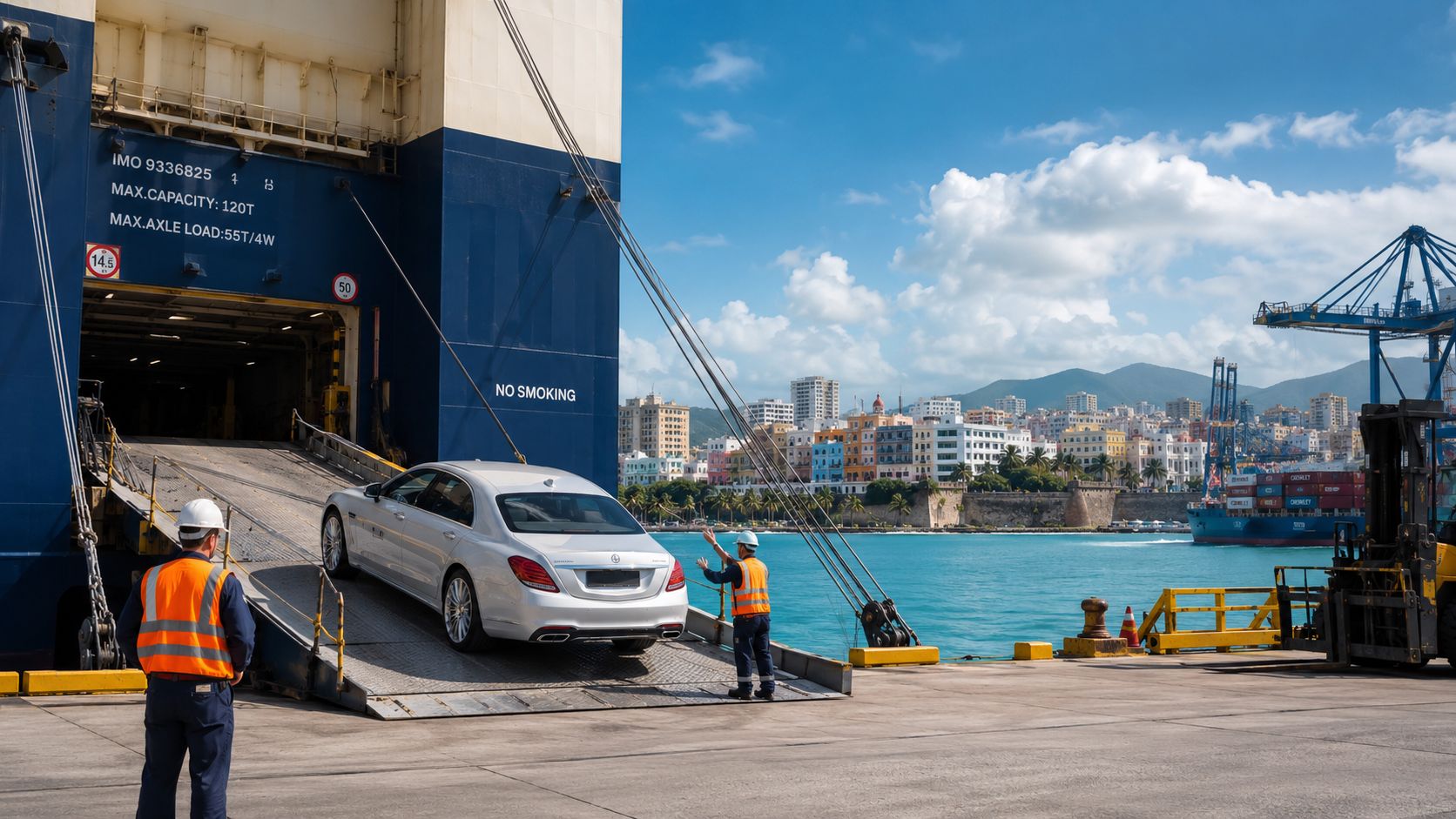
Puerto Rico changes the conversation. A trailer can help with the mainland leg, but it doesn't replace port procedures, ocean booking, document handling, or delivery coordination on the island. That's why many buyers who initially look at trailers end up deciding they don't need to own the equipment. They need someone to manage the chain.
What the route actually involves
A mainland-to-Puerto Rico shipment usually has multiple handoffs:
- Pickup in the mainland U.S. at a home, business, auction, or dealer.
- Ground transport to the departure port on the mainland side.
- Port intake and documentation review before ocean movement.
- Ocean shipping to San Juan.
- Release, pickup, or final delivery after arrival in Puerto Rico.
That sequence is why mainland buyers often underestimate the job. The trailer solves only one segment. It doesn't solve the port.
Where experience matters most
Puerto Rico shipments tend to punish small mistakes. A missed document, a misunderstood handoff window, or poor communication between the stateside and island side can delay release and create needless stress for the customer. That matters to individuals relocating, but it matters even more for military families on timelines, students coordinating arrival, and dealerships trying to keep inventory moving.
The most valuable part of a Puerto Rico shipment often isn't the truck or the ship. It's having one point of contact who keeps the handoffs from breaking down.
Bilingual communication also matters here. English and Spanish support can make a real difference when a customer, receiving party, dealer, or port contact needs quick clarification. A knowledgeable U.S.-based agent can walk people through what the route requires and what their specific shipment doesn't require, which is just as important.
Who should avoid trying to self-manage it
Some routes are fine for owner-operators with the right setup. Puerto Rico usually isn't where I'd advise a first-time trailer buyer to learn by doing.
That includes:
- Snowbirds splitting time between the mainland and the island
- Students moving around semester start dates
- Military households dealing with compressed move timelines
- Dealerships and businesses that need consistent delivery coordination
- Individuals buying a car remotely and trying to merge purchase logistics with transport logistics
For domestic moves across the lower 48, trailer ownership can be sensible in the right hands. For Puerto Rico, service management usually beats self-managed equipment ownership.
Safety Legal Requirements and Maintenance
Trailer ownership gets expensive fast when buyers treat safety and compliance like paperwork instead of operations. North America held 49.24% of the global light car trailer market share in 2025, valued at USD 0.98 billion, according to Fortune Business Insights on the North American light car trailer market. In a market that large, operators who ignore regional safety and transportation rules don't stay competitive for long.
The non-negotiable checks
Before every trip, the trailer needs a real inspection, not a quick walk-around.
- Tires and wheels: Check condition, visible damage, inflation, and lug security.
- Lights and wiring: Verify brake lights, turn signals, running lights, and connector fit.
- Brakes and breakaway system: Confirm function before the load goes on.
- Coupler and safety chains: Make sure the hitch connection is fully seated and correctly rated.
- Tie-down points and straps: Inspect for wear, cuts, bent hardware, and poor anchor placement.
Legal responsibility doesn't stop at the trailer
Commercial use raises the bar. Once money changes hands, or the trailer is part of business operations, the insurance side gets more important. If you're sorting out what policy language means in practice, this business auto insurance explanation is a helpful primer on what commercial coverage can include and where owners often make assumptions.
Insurance isn't the only issue. Buyers also need to know whether their use case triggers additional registration, operating, or load-securement obligations in the states where they work.
Field advice: If you can't explain how the vehicle is secured, inspected, and documented before departure, you aren't ready to run that load commercially.
A maintenance routine that actually works
The best maintenance plan is boring and repeatable.
| Interval | What to check |
|---|---|
| Before each trip | Tires, lights, coupler, chains, straps, brake response |
| On a regular service schedule | Bearings, brake wear, wiring, deck condition, corrosion points |
| After heavy or difficult loads | Ramps, fenders, winch mount, cross-members, tie-down hardware |
The key is consistency. Owners often spend time shopping for the right trailer, then lose money because they don't inspect the same trailer with the same discipline.
Frequently Asked Questions About Open Car Carriers
Is financing a trailer always the smart move
Financing makes sense when the trailer will stay busy enough to cover the payment, insurance, maintenance, storage, and downtime. If you only move vehicles a few times a year, the monthly note can outlast the value you get from owning it.
That is where buyers get tripped up. The purchase price is only one part of the decision. Total ownership cost decides whether buying beats hiring a carrier.
What insurance should trailer buyers think about first
Start with three questions. Is the trailer covered for physical damage, does your policy address liability while towing, and are you hauling your own vehicles or customer vehicles?
Personal-use coverage and commercial-use coverage are not the same. Once you haul for a customer, even part-time, cargo claims, liability limits, and documentation become much more serious.
Are open trailers a bad choice for valuable vehicles
Open trailers are a practical fit for many vehicles, including higher-value units, if the route is short, the loading angle works, and exposure risk is acceptable. The trade-off is straightforward. Open transport leaves the vehicle exposed to weather, road debris, and public visibility.
For collector cars, exotic cars, and freshly restored vehicles, many owners decide that enclosed shipping is the better call. The right choice depends on the car, the route, and what level of risk you are willing to carry yourself.
What's the biggest mistake first-time buyers make
Many first-time buyers shop by deck length and sticker price, then discover the trailer is frustrating to use in practice.
Low-clearance loading is a common example. A trailer can look right on paper and still be wrong at the ramp. If the approach angle is too steep, the vehicle scrapes, loading takes longer, and every pickup becomes a problem. This low-clearance trailer loading discussion shows the issue clearly.
A workable trailer does more than hold the vehicle. It needs to load it cleanly.
Should I buy a trailer if I need to ship to Puerto Rico
In most cases, no. Buying an open car carrier trailer does not solve the hard part of a Puerto Rico move. You still have to handle mainland pickup, port scheduling, paperwork, ocean transport, and delivery coordination on the island.
For that kind of route, hiring a professional transport service is usually the better business decision. You avoid tying up money in equipment that only solves the first leg of the move, and you avoid learning port and carrier procedures the hard way.
If you're comparing ownership with hiring a transporter, National Car Transport handles mainland U.S. and Puerto Rico vehicle moves and can help you decide which option fits the route, volume, and total cost.