
Fewer than 3% of customers had purchased a vehicle fully online, while 29% wanted to buy their next car entirely online, according to McKinsey research on digital used car platforms. That gap is where most remote deals get messy. The checkout is easy to copy. The handoffs aren't, especially when the seller, lender, carrier, and port each hold a different piece of the paperwork.
Online car shopping with delivery works when you treat delivery as a second transaction, not a shipping label. You need a verified vehicle, a written all-in price, and a record of who inspected the car at pickup and who accepts it at arrival.
Table of Contents
- How Online Car Shopping With Delivery Works
- What Delivery Really Costs, Line by Line
- Delivery Timelines and Transport Options
- Shipping a Car to or From Puerto Rico
- Verifying the Vehicle and the Deal Before You Pay
- Inspecting, Accepting and Fixing Problems on Delivery Day
- Pros, Cons and Who Should Buy This Way
- Book Your Delivery With a Clear Plan
How Online Car Shopping With Delivery Works
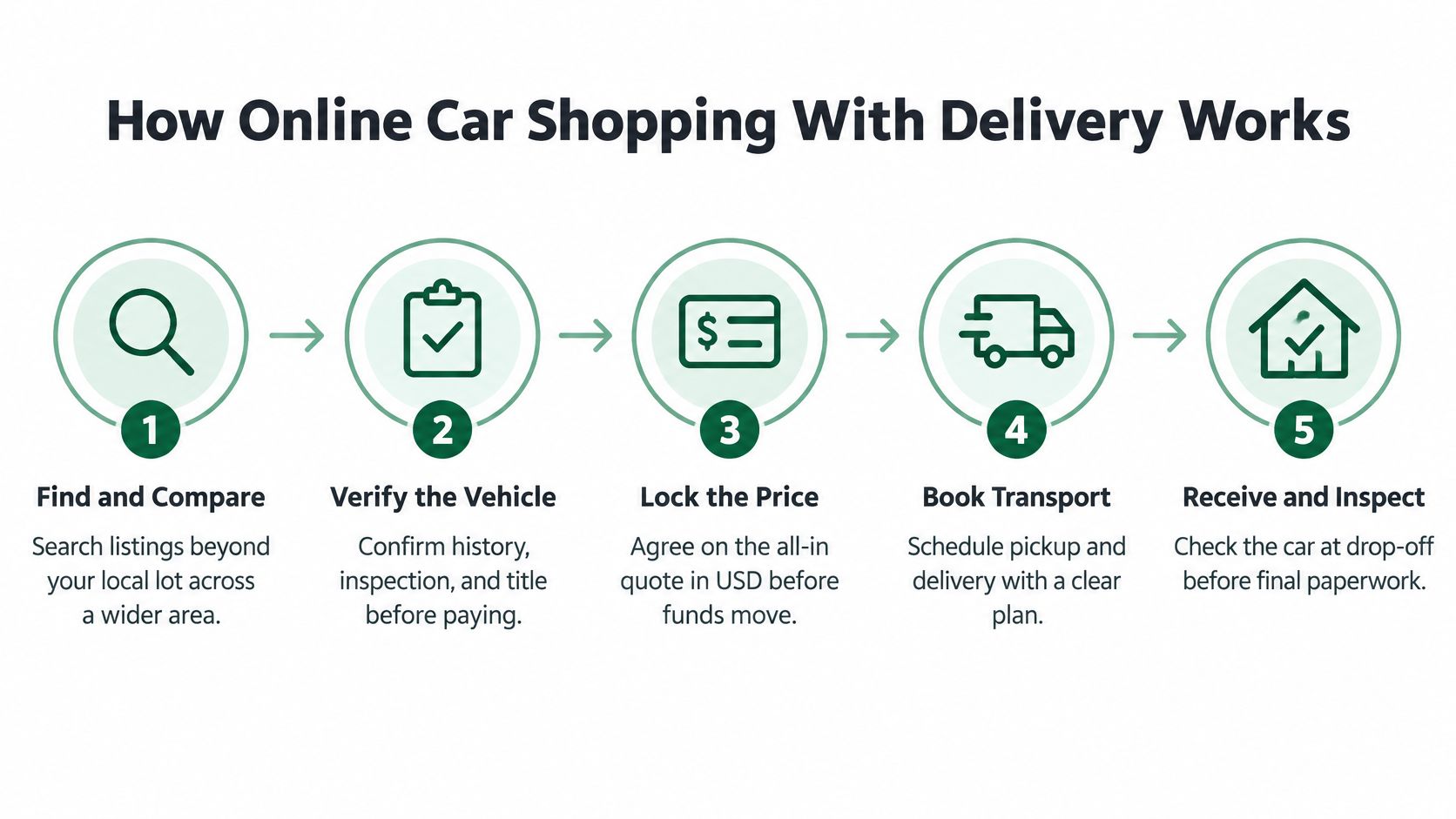
Online car shopping with delivery means you buy a vehicle you haven't inspected in person, and a licensed carrier moves it to your address. I break it into five stages, because each stage has a different owner and a different failure point.
- Find and compare listings beyond your local lot. Online search reaches inventory across a much wider area than a single dealership, which is the point and the risk.
- Verify the vehicle and sign the retail purchase. Confirm history, condition, title, and the written out-the-door price before money moves.
- Book transport. Confirm the exact pickup location, access limits for a large truck, and wait for a carrier match.
- Track the shipment. Follow pickup inspection, transit, and arrival through dated milestones, not casual text updates.
- Inspect and accept the vehicle. Check condition, mileage, keys, and documents before you sign the delivery receipt as clean.
It works much like ordering furniture online. The order only works if the seller hands over the exact item you bought, in the condition described, and someone checks it at both ends. A car adds a title, a VIN, financing, and registration to that same basic problem.
Expect a hybrid process, not a pure digital one. Cox Automotive reported that 80% of consumers wanted to complete at least part of their vehicle purchase online, yet only just over 13% of transactions were taking place online at the time of the study. Physical steps remain, and a dealer that wants to streamline the vehicle sales workflow still has to connect the online deal record to a real car on a real truck.
Where the risk concentrates
Stages 2 and 5 carry most of the risk. Stage 2 decides whether you're buying the car in the photos. Stage 5 decides whether you can prove what arrived. If you get those two right, the middle stages are mostly scheduling and patience.
What Delivery Really Costs, Line by Line
The advertised price is rarely your landed cost. Build the total from its parts before you compare a distant car against a local one, because a cheap listing can lose its advantage once transport, tax, tags, and a possible return are priced accurately.
Landed-cost worksheet for a delivered vehicle
| Cost item | Usual treatment | Who usually pays | Confirm before paying |
|---|---|---|---|
| Vehicle price | Agreed out-the-door price in writing | Buyer | Matches the signed buyer's order |
| Dealer documentation fee | Often listed separately from the sticker price | Buyer | Whether it's included in the advertised price |
| Sales tax, title and registration | Set by the state where the car is registered | Buyer | Which tax rate applies at the delivery address |
| Temporary tags | Often needed for an out-of-state delivery | Seller or buyer as named in the buyer's order | Who obtains them and by what date |
| Base transport quote | Flat rate or per-mile quote | Buyer | Whether fuel, insurance and tolls are included |
| Ocean freight (Puerto Rico routes) | Included in the flat rate on quoted island routes | Buyer | Whether port handling and paperwork are included |
| Storage or redelivery | Charged when a delivery is missed or refused | Party at fault under the contract | Written terms and any daily storage rate |
| Return transport | Not a standard inclusion | Buyer, unless the seller accepts fault in writing | Whether the seller or carrier must pay if the car is rejected |
Use the worksheet with a live quote, not a generic estimate. A car shipping cost breakdown only helps if distance, vehicle size, running condition, season, and pickup flexibility match your actual move.
Three budgets for the same car
A best case budget is the signed out-the-door price plus one standard transport quote, tax, and registration. Everything closes on schedule, the carrier loads on the first window, and you accept the car without exceptions.
A normal case adds the lines buyers forget. That's an independent inspection, temporary tags, transit insurance questions, and registration at your home address. While you're sorting coverage dates so the car is insured the day it arrives, a guide to choosing auto coverage for your family can help you line up liability and physical damage coverage before the truck shows up.
A failure case is the one nobody prices. The car is late, you miss the delivery window, storage starts, or the vehicle arrives in a condition you can't accept and someone has to pay to send it back. That case can add redelivery, storage, a second inspection, and return transport to a deal that looked tidy online.
Practical rule: Ask for one written all-in quote that names every line in the worksheet. Treat any missing line as an open question, not as a zero.
Separate the contracts in your head. A seller's return policy and a transport cancellation or redelivery rule are separate contracts, so a seller's refund promise doesn't automatically cover carrier charges. Cox Automotive's 2025 digitization research found 83% of dealers said customers repeat online steps in-store, affecting dealership efficiency. For a buyer, that repetition often signals that price or document details weren't transparent the first time.
Transparent flat-rate pricing helps when one quote replaces several separate charges, but only if you confirm which lines it covers. Ask directly about fuel, tolls, cargo insurance, port handling, and paperwork. If the answer isn't in writing, it isn't included.
Delivery Timelines and Transport Options
A delivery date is a logistics estimate, not a guarantee. Trucks run multi-car routes, pickup windows shift with loading order, and a late vehicle release can move the schedule. Plan around handoffs, not a single promised date. The point where control passes from seller to carrier is also where a remote buyer has the least visibility, so get each milestone and its owner in writing.
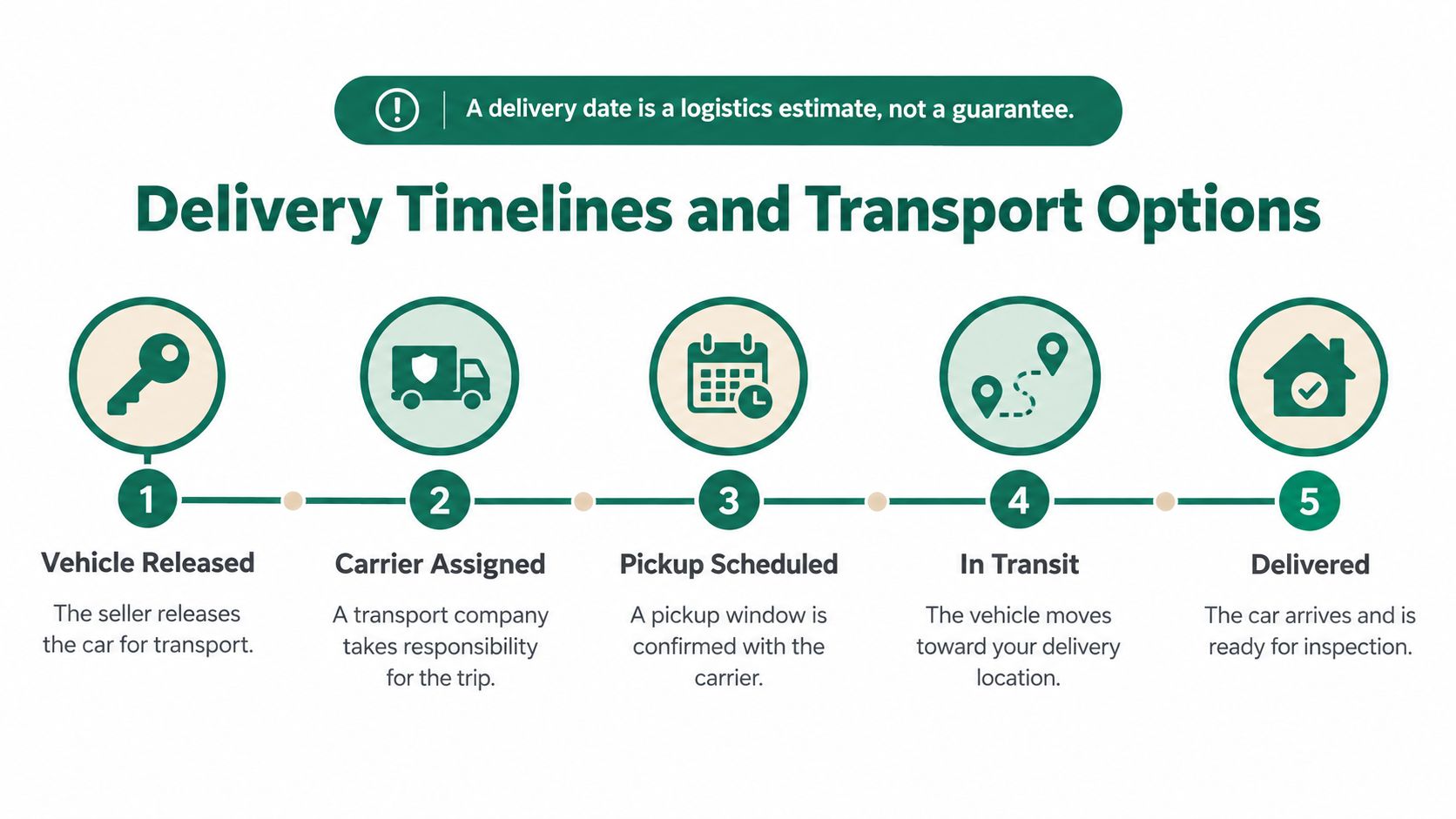
Ask for these events in writing: vehicle released, carrier assigned, pickup inspection completed, in transit, arrival appointment, and final inspection. Each milestone helps locate a delay. Paperwork, carrier availability, weather, port operations, and destination scheduling have different causes and responsible parties. If one handoff slips, ask which party has the vehicle and what the next confirmed step is.
The delivery claims that brought Vroom under FTC scrutiny were for delivery within 14 days or less. The FTC said Vroom failed to obtain customer consent for delays or provide prompt refunds. The Cox Automotive report covers digitization of car buying, but it is not the source for that enforcement action. Under the FTC Mail, Internet, and Telephone Order Rule, sellers generally must ship within the stated time, or within 30 days if no time is stated, and offer cancellation with a prompt refund if they cannot meet a revised schedule.
The video below shows the handoffs from booking through delivery.
Transport options compared by transit and price
| Transport option | Typical transit | Price compared with open | Best for |
|---|---|---|---|
| Open carrier | Route-based window set at dispatch | Baseline | Daily drivers and most domestic moves |
| Enclosed carrier | 1 to 10 days once dispatched | About 40% to 60% more | Classic, luxury, exotic, and low-clearance vehicles |
| Container shipping | Port sailing schedule plus inland trucking | Above enclosed on most island routes | Vehicles shipped in a shared or sealed container |
Open carrier is the baseline for most daily vehicles and generally offers more scheduling capacity because more trucks run it. Enclosed transport costs more, but limits exposure to road grime and weather and can accommodate vehicles with low ground clearance. Container and ocean options are for island or overseas routes where a vessel is part of the move.
Choose based on the vehicle and route. If its value or finish makes the price difference feel small, price enclosed transport. For a sound daily driver on a busy mainland corridor, open transport with clear pickup photos is usually a practical fit. Ask when the carrier expects to collect the car, not just when it is estimated to arrive.
Domestic coverage and corridor reality
Shipments cover the 48 contiguous states, including major metro areas such as Los Angeles, Phoenix, Denver, Dallas, Houston, Chicago, Atlanta, Miami, New York, Boston, and Seattle. Busy interstate corridors such as I-95, I-10, I-40, and I-80 typically have more carrier availability than rural addresses. Smaller-town pickups may need a longer window or a meeting point near a hub. Door-to-door auto transport means delivery to the nearest safe, legal spot a large truck can reach, not necessarily your driveway. Confirm that location before booking so the final handoff does not become a surprise.
Shipping a Car to or From Puerto Rico
The sailing cutoff controls a Puerto Rico delivery as much as the truck pickup date. On the mainland-to-island route through Jacksonville, the car travels by truck to the port, sails to the Port of San Juan, then leaves by truck or is collected by the buyer. Each handoff has its own deadline. Missing a cutoff can mean waiting for the next sailing.
Confirm where your booked service starts and stops. Door-to-port ends with port collection; port-to-door includes delivery after arrival but requires you to arrange the origin-port handoff. Door-to-door covers the inland legs at both ends.
Estimated mainland-to-San Juan transit
Use these typical total-transit ranges for planning, rather than treating the sailing date as a delivery appointment.
| Mainland origin | Typical total transit |
|---|---|
| Miami / South Florida | 7 to 10 days |
| Orlando / Tampa / Jacksonville | 7 to 10 days |
| Atlanta | 8 to 11 days |
| New York / New Jersey / Philadelphia | 9 to 12 days |
| Boston / Hartford | 10 to 13 days |
| Chicago | 10 to 14 days |
| Houston / Dallas | 10 to 14 days |
A longer inland truck leg generally adds time and cost before the car reaches Jacksonville. Check the Puerto Rico car shipping details for port cutoffs, required documents, and the service endpoints available for your route.
Get the quote broken down before booking. It should state whether trucking, ocean freight, port handling, and paperwork charges are included in the quoted total. A flat rate is useful only when its boundaries are clear.
Shipping is not the same as importing
Moving a vehicle between the mainland and Puerto Rico is different from importing one into the United States from abroad. An overseas import requires formal entry paperwork. Confirm the current U.S. Customs and Border Protection requirements before booking that shipment.
Budget separately for Puerto Rico's vehicle excise tax, called arbitrios. It sits outside the freight charge. Your landed-cost worksheet should show the vehicle purchase, the quoted transport total, any excluded port or paperwork charges, and arbitrios separately. Otherwise, a complete freight quote can still leave you short when the car arrives.
Prepare your title, photo ID, and any ownership documents the carrier requests before committing to a sailing. Ask which paperwork you must supply and which steps the carrier handles. Resolve those responsibilities before pickup: once the car is at the port, a missing document can turn a paperwork problem into a missed sailing.
Verifying the Vehicle and the Deal Before You Pay
Keep the purchase approval separate from the transport booking. Once a pickup is scheduled, pressure to keep that slot can push you toward accepting an unresolved title issue or an unchecked car. Set the release conditions before money or scheduling creates that pressure.
Six checks in order
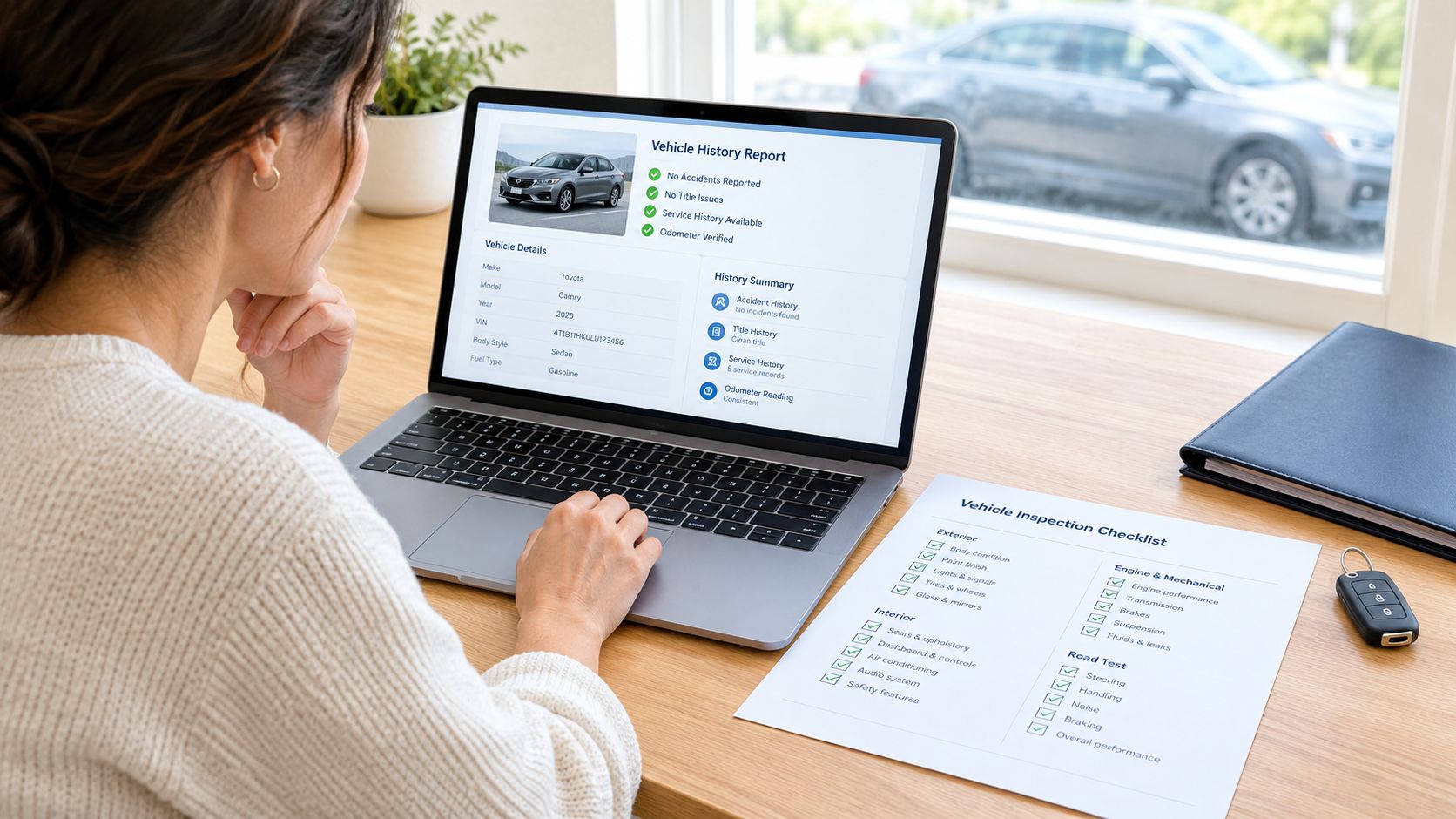
- Get a vehicle-history report. It can show title information, the latest reported odometer reading, and reported condition details. Paid reports may add accident and repair history. Use it to screen for title brands and mileage discrepancies, then have the car's physical condition checked separately.
- Arrange an independent mechanic inspection. Do this even if the seller calls the car certified or inspected. A mechanic working for you can check leaks, warning lights, tire age, and prior repair quality. Resolve concerns before authorizing pickup, while the vehicle is still with the seller.
- Read the federal Buyers Guide on a dealer used car. It must disclose whether the vehicle carries a warranty or is sold as-is. Compare that disclosure with the purchase paperwork so you understand the stated coverage before paying. Don't treat “inspected” as a promise to cover later repairs.
- Reconcile the VIN everywhere. Match it across the listing, buyer's order, insurance paperwork, and transport order. Resolve any mismatch before dispatch. The carrier's order needs to identify the exact vehicle you approved, not a similar car on the lot.
- Confirm title and lien status and the written out-the-door price. Get title or lien confirmation before committing to pickup. A delayed lien release can leave a paid car at the seller while the pickup window expires. Carry the written purchase total into your landed-cost worksheet, keeping the transport commitment separate.
- Get the delivery window, cancellation terms, and one named coordinator. Record who schedules the carrier, who can authorize a revised date, and whom to contact when a milestone slips. Get those responsibilities in writing alongside the promised window.
A correct transport order cannot resolve an unfinished retail deal.
Delivery promises deserve the same scrutiny as the vehicle paperwork. The FTC's Vroom action alleged that the company advertised delivery within 14 days or less but failed to give consumers the required option to accept a delay or cancel for a prompt refund. Before paying for shipping, make sure the written terms explain what happens if the promised window slips.
Before the first carrier payment, gather the signed buyer's order, history report, inspection result, Buyers Guide where applicable, title or lien confirmation, insurance binder, and transport order with the correct VIN. Check them together rather than treating each document as a separate task. If a document is missing or the details conflict, hold dispatch until the gap is resolved.
Inspecting, Accepting and Fixing Problems on Delivery Day
Delivery day is where a remote buyer can lose control of the process. The driver may be working to a schedule, but signing a clean bill of lading before checking the car can make a later damage claim harder to support. Take the time to inspect first.
Compare the vehicle with the pickup condition report, panel by panel. Photograph the sides, roof, wheels, glass, interior, and odometer, with timestamps enabled. Check the VIN plate and confirm the keys, EV charging cables, temporary plates, and title documents arrived with the car.
Cox Automotive's 2025 research found 65% of U.S. buyers complete some or all of the car-buying process online. In a remote purchase, the listing, dealer paperwork, and physical delivery may be handled by different parties. Your photos and written notes connect the vehicle's condition at pickup to what you find at delivery.
Delivery-day problems, immediate actions and who to contact
| Problem found | Action before signing | Record to keep | Who to contact |
|---|---|---|---|
| Undisclosed body damage | List it on the bill of lading; do not sign a clean receipt | Timestamped photos of each affected panel | Carrier, then the insurer handling the carrier's cargo coverage |
| Warning light or mechanical fault | Describe the symptom and test it only if safe | Dashboard photo or video and a written description | Seller, under the sales contract |
| Missing keys, cables or plates | List the missing items on the delivery receipt | Photo of the receipt and the items received | Seller and carrier |
| Odometer or VIN does not match | Pause acceptance until the mismatch is resolved | Photos of the VIN plate and odometer | Seller first, then carrier |
| Late arrival or missed window | Get a revised date in writing | Milestone log and messages | Carrier and seller together |
Record each bill of lading exception before signing. In most cases, you can note an issue and still accept the vehicle, which may make sense for cosmetic damage or a missing cable. If the VIN is in doubt, do not accept the car until its identity is confirmed. Taking possession of the wrong vehicle can create title and insurance complications as well as a transport dispute.
Check your own policy's start time before delivery, and do not drive until coverage is active at the delivery address. State minimums differ. If you are taking delivery in New York, ask your insurer to confirm the state's required liability limits rather than assuming your previous state's limits still apply. Your insurer can also confirm that the policy covers the vehicle identified by its VIN.
Escalate problems the same day. Contact the carrier and seller in one message thread, attach the photos and signed exception, and request a written correction, repair plan, or revised delivery date. Responsibility for a return depends on the contract and the cause of the problem. Documenting the condition before the truck leaves gives both parties a clear record to work from.
Pros, Cons and Who Should Buy This Way
The honest trade-off is this. Online buying with delivery saves travel and widens your choice of cars, but it moves inspection and trust into paperwork, photos, and the carrier's process.
Advantages
- Wider inventory: You shop beyond your local market instead of settling for what's parked nearby.
- No long trip to a distant seller: You skip flights, hotels, and driving an unfamiliar car home.
- One coordinated move: A single transport quote can cover pickup, transit, and delivery scheduling.
Disadvantages
- No test drive: You rely on an inspector's report instead of your own hands and ears.
- Estimated dates: Delivery windows shift with routes, weather, and port schedules.
- Distance slows disputes: A problem that takes an afternoon locally can take weeks across states.
Who it fits, and what each buyer must control
Snowbirds and seasonal residents need pickup and delivery windows that match arrival and departure dates, plus a person at each end who can release and receive the car. For island moves, port-to-door service often fits better than asking a neighbor to handle port pickup in San Juan.
Military families should confirm entitlement before booking anything privately. Military OneSource states that, when authorized, the government generally ships one privately owned vehicle for a permanent change of station. A qualifying POV must be self-propelled, licensed for public-road use, cleaned inside and out before turn-in, and fueled to no more than one-fourth of a tank. Oversized trucks, SUVs, campers, and recreational vehicles can create excess-cost issues, so review dimensions and orders with the transportation office first.
Students need a delivery address that can receive a transport truck, a named adult to sign, and insurance confirmed at that address. Dealerships, auctions, and businesses need one synchronized deal record per VIN and repeatable paperwork across many units, because volume turns small document errors into daily ones. Puerto Rico buyers must decide whether the move is transport or an import before choosing documents.
Buy this way if you'll verify the vehicle and budget the full landed cost. Buy locally if you need to drive the exact car first or can't absorb a shifted delivery window.
Book Your Delivery With a Clear Plan
Treat delivery as the handoff where a remote buyer can lose control. Keep the sequence clear, and do not let a low quote rush you past checks.
- Lock the all-in quote against every line of the landed-cost worksheet.
- Complete the six verification checks before paying a carrier.
- Choose open or enclosed transport based on the vehicle and price.
- Get the milestone schedule and cancellation terms in writing, rather than relying on one estimated date.
- Book pickup only after verifying the vehicle, and confirm who will inspect and sign at delivery.
National Car Transport is a U.S.-based provider with 25+ years of experience, an A+ BBB rating, flat-rate pricing, and no upfront charge until a vehicle is matched with a carrier. Its nationwide network includes 25,000+ vetted carriers. Bilingual English- and Spanish-speaking agents based in the USA can answer questions about port paperwork, scheduling, and enclosed options. Same-day pickup is often available, but align booking with the paperwork, not just truck availability.
The right service depends on the vehicle, route, and dates. Confirm those details with the agent, then keep the quote, schedule, and delivery contact in writing. A verified vehicle and a documented plan make the delivery handoff easier to manage.
Get a flat-rate quote for an online purchase, mainland move, or San Juan shipment, and ask a bilingual U.S.-based agent to map pickup, milestones, and the delivery inspection before paying the seller. Visit National Car Transport to price the route and review the paperwork before booking.