

Nearly 80% of vehicle purchases on eBay in 2024 paired a buyer with a seller in a different state, the company reported when it outlined a checkout system built to combine payment, financing, registration, ownership transfer and transport in one place (Automotive Remarketing). That number explains why the online car shipping calculator stopped being a side tool. For most buyers on a national marketplace, the car isn't down the road. It's a purchase with a delivery problem attached.
The shopping already moved home. A U.S. survey fielded in July and August 2024 asked 3,150 adults who had bought a new or used vehicle in the previous four months which steps they completed exclusively online or from home, including vehicle research and monitoring a vehicle's value (Statista). Research happens at a kitchen table. The car still arrives on a truck.
A calculator is where those two facts meet. It turns a route and a vehicle description into a number you can set beside the purchase price, the sales tax and the registration fee before you commit. Getting a usable number comes down to three habits: knowing how the range is built, knowing what it leaves out, and knowing how to test it against what other people paid.
Table of Contents
- Car Shipping Price Benchmarks to Check Any Estimate
- Inputs a Calculator Needs and How Each Changes Price
- Why Estimates Shift Between Request and Booking
- Puerto Rico Costs a Single Estimate Often Leaves Out
- Paperwork That Changes Puerto Rico and Import Quotes
- Special Vehicles That Need More Than a Standard Quote
- Confirm Your Quote Before You Book
Car Shipping Price Benchmarks to Check Any Estimate
A calculator result means nothing in isolation. It means something when you hold it next to what shippers charged on comparable routes, and there's enough published data now to run that comparison in about two minutes.
Start with per-mile rates from a 1,500-mile secret-shopper test. Automoblog's 2024 study averaged $0.82 per mile for open transport and $1.25 per mile for enclosed transport, which works out to roughly $1,230 and $1,875 per vehicle over a route that length (Automoblog car shipping cost study). The same shopper logged online quotes spanning $565 to $2,211 in total, so the gap between the cheapest and dearest quote for similar work is wide enough that any single figure tells you very little (Automoblog online quote results).
Volume changes the arithmetic. Commercial Carrier Journal reported that in 2024 six-VIN shipments averaged $0.49 per mile against $0.66 per mile for a single VIN, a 26% per-mile saving (Commercial Carrier Journal). Distance cuts the rate the other way, which is why a 1,000-mile benchmark from Kelley Blue Book's 2026 quote survey of eight transport companies came in at $1,020, or $1.02 per mile (Kelley Blue Book).
| Source and year | Transport type | Distance or basis | Reported cost |
|---|---|---|---|
| Automoblog 2024 secret-shopper average | Open | 1,500 miles | $0.82 per mile, about $1,230 per vehicle |
| Automoblog 2024 secret-shopper average | Enclosed | 1,500 miles | $1.25 per mile, about $1,875 per vehicle |
| Automoblog 2024 online quotes | Mixed | Full range recorded | $565 to $2,211 total |
| Commercial Carrier Journal 2024 | Single VIN | Per mile | $0.66 per mile |
| Commercial Carrier Journal 2024 | Six-VIN load | Per mile | $0.49 per mile, 26% less |
| Kelley Blue Book 2026 quote survey | Mixed | 1,000 miles | $1,020 average, $1.02 per mile |
The two-minute check: multiply your route miles by the per-mile figure that matches your transport type, then compare. A 1,500-mile open-transport estimate should land near the open benchmark, not half of it.
Say a calculator returns $700 for 1,500 miles in an open carrier. That's under $0.50 per mile against a $0.82 benchmark, and something isn't in the number: an operability surcharge, a rural pickup, terminal handling, or the fuel line. The reverse case is just as informative. A figure well above the top of the range usually points to enclosed service, a non-running vehicle, or an origin far from a freight lane. Both outcomes deserve a question before you build a budget around them.
Set the calculator next to our own car shipping cost breakdown to see which line items a flat rate is meant to cover. Then write down three details before you look at any estimate: route mileage, transport type and the number of vehicles. Find the matching row and judge the figure against it, not against a number someone quoted on a different route in a different year.
Inputs a Calculator Needs and How Each Changes Price
A calculator is a form with a pricing model underneath it. Every field exists because it moves a cost, and the fields are ordered roughly the way the costs stack.
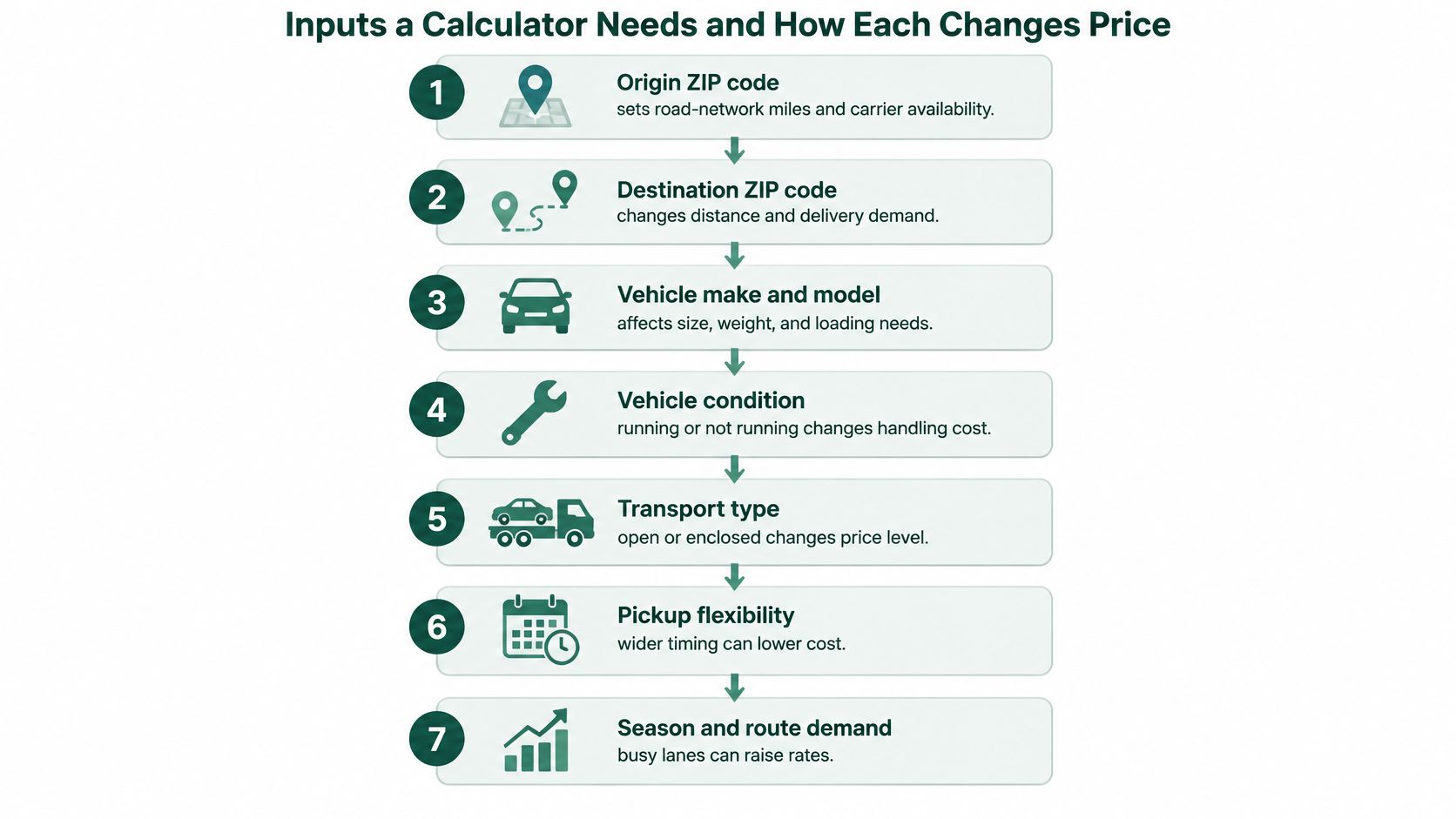
Start with the lane, not the car
Origin and destination ZIP codes do the heaviest lifting. They set road-network mileage, and they tell the model how many carriers already run that corridor. A New York to Miami run moves on a dense freight lane with trucks leaving weekly. A pickup forty minutes off the interstate in rural Montana doesn't, and the difference shows up in the price before the vehicle is even entered.
That's why city-to-city lanes deserve their own pricing. Los Angeles to Dallas, Chicago to Atlanta, and a New York to Tampa or Phoenix snowbird run each carry different carrier density, so a serious calculator prices the actual road miles and the local pickup conditions rather than a statewide average. San Juan, Puerto Rico is a lane of its own type, which is covered further down.
Then the vehicle, which costs more than its weight
Make, model, year and body style determine how much deck space and payload a car consumes on a multi-vehicle carrier. Weight matters because it's regulated, not just measured. Federal standards cap interstate commercial vehicles at 80,000 pounds gross vehicle weight, 20,000 pounds on a single axle and 34,000 pounds on tandem axles, and automobile transporters are allowed overall lengths of at least 65 feet with conventional equipment and 75 feet with stinger-steered equipment (Federal Highway Administration).
That creates a nonlinear effect: a heavy SUV or a lifted pickup can reduce usable carrier capacity even when its own weight looks modest, because the shipment eats deck space and allowable payload at the same time. Length limits also govern routing and terminal access, which is why a narrow street or a low-clearance garage can change whether door-to-door works at all.
Operability comes next. A car that can't roll, brake or steer needs winch handling, and that usually raises the quote. Transport type follows, with open carriers the economical default and enclosed service running about 50% more per mile in Automoblog's data. Modifications such as lift kits, oversized tires, roof racks and unusually low ground clearance should push the estimate into manual review rather than through the model unexamined.
| Input | Why the calculator asks | Effect on the estimate |
|---|---|---|
| Origin and destination ZIP codes | Sets road-network miles and carrier density on the lane | Longer routes and remote pickups raise the cost |
| Make, model, year and body style | Sets size and weight on a multi-vehicle carrier | Heavier SUVs and pickups can cost more than sedans on the same route |
| Operability | Determines whether winch handling is needed | Inoperable vehicles usually raise the quote; amount varies by carrier |
| Transport type | Open or enclosed carrier | Enclosed service runs about 50% more per mile in Automoblog data |
| Modifications such as lift kits, oversized tires or roof racks | Changes height, width and clearance | May trigger manual review and a higher quote |
| Pickup and delivery flexibility | Lets carriers combine loads | Flexible windows can lower the price; amount varies |
| Vehicle count on one load | Shares deck space and fuel across vehicles | Six-VIN loads averaged $0.49 per mile versus $0.66 for single VIN |
| Season and route direction | Affects demand and empty-mile repositioning | Peak seasons and remote origins can raise the estimate |
Flexibility and season close the form. A wide pickup window lets a dispatcher slot your car into a load that's already forming, which often costs less than a guaranteed date. Peak moving season does the opposite, and a snowbird route in the wrong direction can leave a truck chasing freight. Dealers feel this most acutely, since a unit sitting in transit keeps accruing cost, and if you run inventory you'll want to understand floorplan interest and curtailments alongside the transport line rather than after it.
Answer every field accurately. A calculator that guesses at size, operability, or modifications produces a number that a firm carrier quote will change, and the change always arrives after you've planned around it.
Why Estimates Shift Between Request and Booking
The figure on screen looks like a price. It behaves more like a forecast: useful, explicit about its assumptions, and capable of moving between the day you check it and the day a truck arrives.
Fuel is the clearest reason. Long hauls are exposed to diesel prices, so a responsible pricing model applies a dated fuel adjustment instead of baking one permanent surcharge into the rate. The Bureau of Transportation Statistics maintains a monthly fuel cost and consumption database covering U.S. transportation operations from 2000 onward, which is what makes fuel a measurable time-series input rather than a guess (Bureau of Transportation Statistics).
Mileage is the second. Carriers get paid for drivable road distance, including detours and repositioning, not the straight line a mapping app draws between two pins. A calculator that uses crow-flies distance will underestimate every route with a mountain range or a Great Lake in the middle of it.
Empty miles and the lanes carriers actually run
Utilization decides a lot. A truck already hauling several vehicles along a busy corridor spreads fuel, tolls and driver time across every unit on the deck. A remote origin may force a carrier to run in empty and out empty, and you pay for both directions.
Carrier availability shifts weekly and seasonally as well. Demand spikes in summer, warm-weather destinations fill up in winter, and a lane that was cheap in April can be thin in August. None of this is hidden information. It's the normal churn of a market where capacity moves.
A practical test: if a calculator shows no timestamp, no route miles, no transport type and no note about revalidation, treat the figure as a rough budget and ask for a firm quote before you plan around it.
A trustworthy tool shows its work. Look for the estimate date, the assumptions behind the range, whether the vehicle is operable, how flexible the pickup window is, and a plain statement that the price may need revalidation. That transparency is what separates a planning range from a low-ball number dressed up as a quote. Snowbirds budgeting a seasonal move often fund the car and an RV together, and it helps to estimate your monthly RV payments so the transport bill sits next to a real finance figure instead of a vague annual guess.
Puerto Rico Costs a Single Estimate Often Leaves Out
A Puerto Rico shipping estimate may bundle the ocean leg, but it does not usually include the vehicle excise tax. For National Car Transport, the estimated cost to ship a car to Puerto Rico is $845–$1,795, with ocean freight included. Treat that range as a shipping budget, then plan separately for the tax.
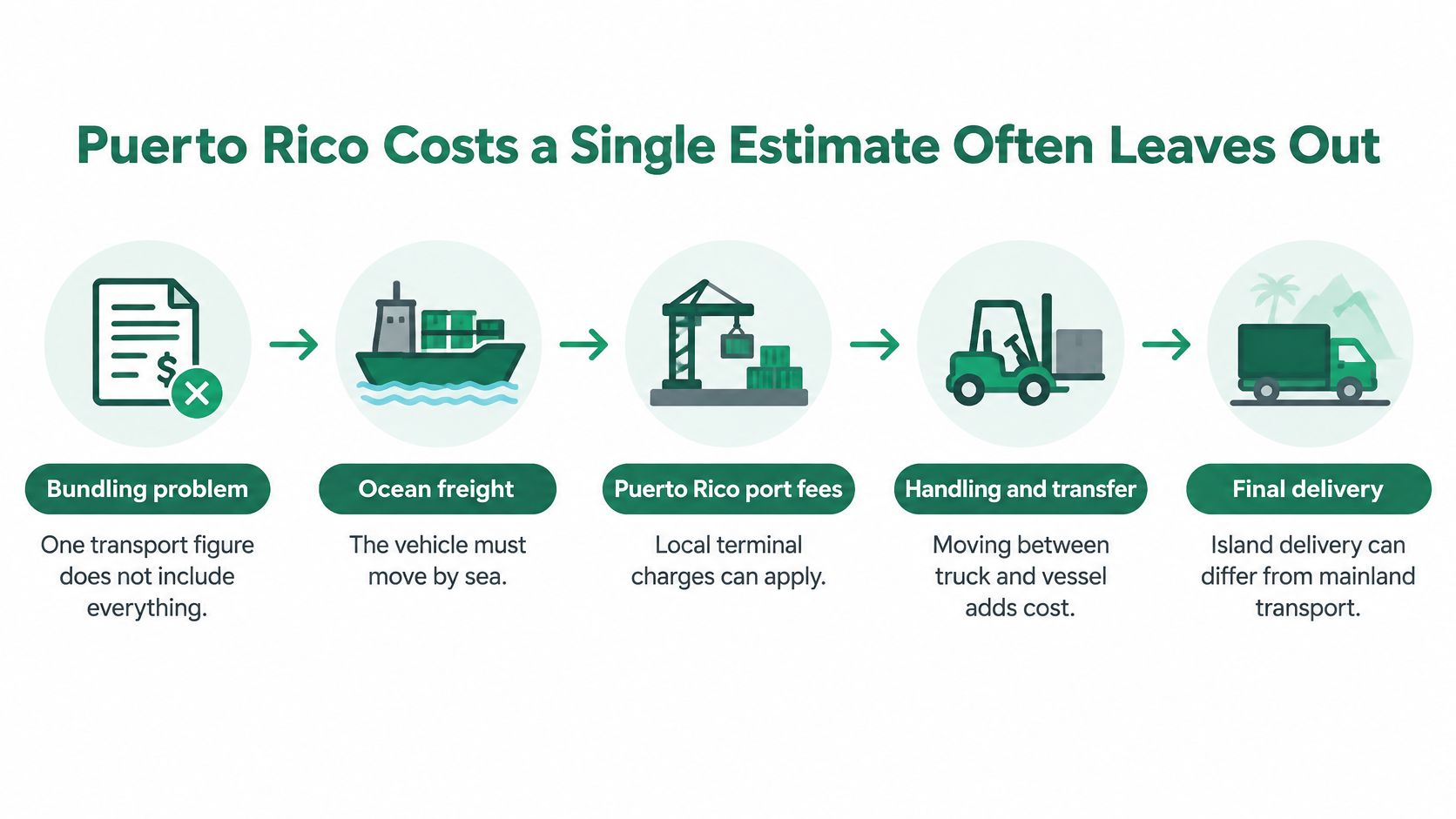
The excise tax is based on Hacienda's taxable vehicle valuation, which may differ from the amount the buyer paid. The published schedule ranges from a minimum of $637.50 for vehicles valued up to $6,170 to $9,253.10 plus 34% of value above $44,890 (Rivalane guide to Puerto Rico car shipping). A calculator that uses only the purchase price can therefore leave a gap in your cash budget.
The four legs of a mainland-to-island move
- Pickup and mainland trucking: the vehicle travels from its starting point to the port.
- Ocean freight: the vehicle travels by vessel to Puerto Rico. National Car Transport's Puerto Rico estimate includes this leg.
- Port handling and documentation: the shipment requires work and paperwork at the port.
- Local delivery: the vehicle travels from the port to its destination on the island.
A bundled estimate can make several legs look like one price. Before booking, ask the company to confirm in writing which legs and services its firm quote covers, and whether port handling and local delivery are included.
| Cost component | What it covers | Usually in a bundled estimate? |
|---|---|---|
| Pickup trucking | Moving the car from its origin to the mainland port | May be included; confirm the scope |
| Ocean freight | Vessel travel to Puerto Rico | Included in National Car Transport's Puerto Rico estimate |
| Port handling and documentation | Port work and shipping paperwork | Confirm whether it is included |
| Puerto Rico excise tax | Local tax based on Hacienda's taxable vehicle valuation | Budget separately from the shipping estimate |
| Local delivery on the island | Final leg from the port to the destination | Confirm whether it is included |
Snowbirds may need the car ready when they arrive. Military families, students, dealerships, and online car buyers may have different schedules, but all need a budget that separates shipping from the excise tax.
For details on the route and estimate, see National Car Transport's Puerto Rico car shipping service. Use the shipping estimate as one part of the budget, and account for the tax separately.
Paperwork That Changes Puerto Rico and Import Quotes
Paperwork rarely changes the price of a 48-state move. On an island route it can change the timeline, and a timeline that slips can change the price.
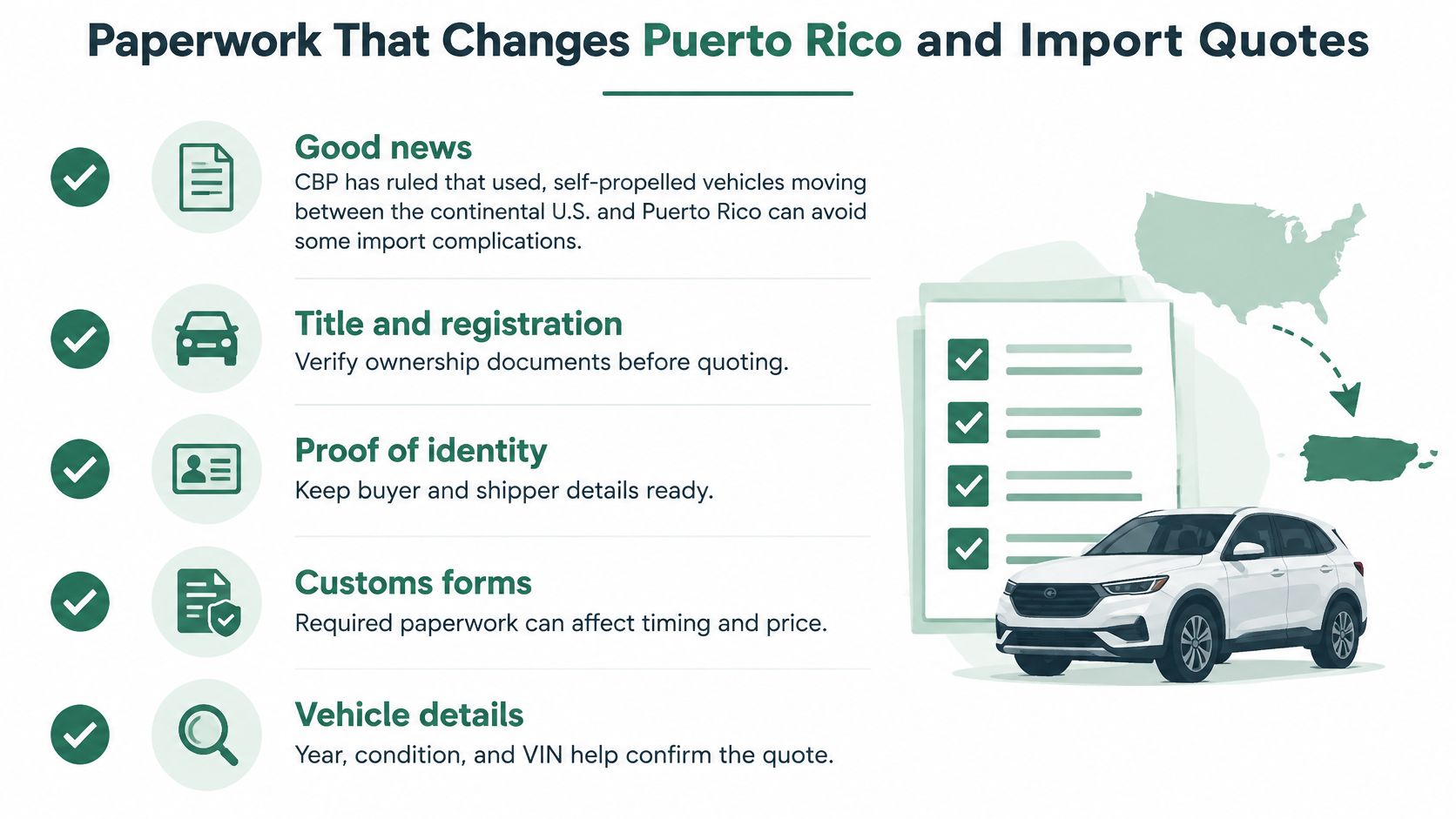
Start with the good news. For used, self-propelled vehicles moving between the continental United States and Puerto Rico, U.S. Customs and Border Protection determined that the movement does not constitute an "export" under 19 CFR 192.2, so CBP does not enforce the usual 72-hour advance presentation of ownership documents (CBP Puerto Rico ruling resource document). The rule runs in both directions, which simplifies a permanent change of station or a seasonal move.
The exemption doesn't remove every filing. Electronic Export Information must still go through the Automated Export System, using the vehicle identification number or product identification number, and the title state and title number aren't required for that filing. Direction matters too: CBP's commodity format guidance requires an ultimate consignee on every shipment transaction and limits Puerto Rico to U.S. movements in the cited system to vessel, air, passenger hand-carried and mail (CBP commodity format guidance). Name the receiving party accurately and don't treat both directions as identical.
Coming back the other way is where import rules bite. CBP notes that vehicles entering the United States may need to meet EPA emissions rules and DOT safety standards, with EPA Form 3520-1 and DOT Form HS-7 as the key declarations, and that a motor vehicle less than 25 years old generally must comply with applicable Federal Motor Vehicle Safety Standards (CBP vehicle import answers). Classic cars don't escape automatically; the importer still files the EPA form with supporting title documentation.
The practical split: the filing duty follows the vehicle, not the invoice. Confirm who files what before the car is handed to the carrier, because a missing declaration stops a sailing, not a truck.
Clearance happens at the first port of entry unless the vehicle moves in bond, and CBP lists the original bill of lading, bill of sale and foreign registration among documents that may be needed, in addition to title proof (CBP importing a car). Build your checklist in three piles:
- Mainland departure. Title or certified copy, VIN or PIN for the EEI filing, consignee name and contact, carrier booking details.
- Island arrival. Consignee identification, the entry paperwork if customs applies, payment ready for the excise tax before registration.
- Return to the mainland. EPA Form 3520-1, DOT Form HS-7 where applicable, proof of ownership, and a port that can process the entry.
Special Vehicles That Need More Than a Standard Quote
An online calculator can price a standard vehicle from basic details, but unusual vehicles often need a closer look. The reason is practical: a form may not capture the equipment, loading method, or route requirements that affect transport.
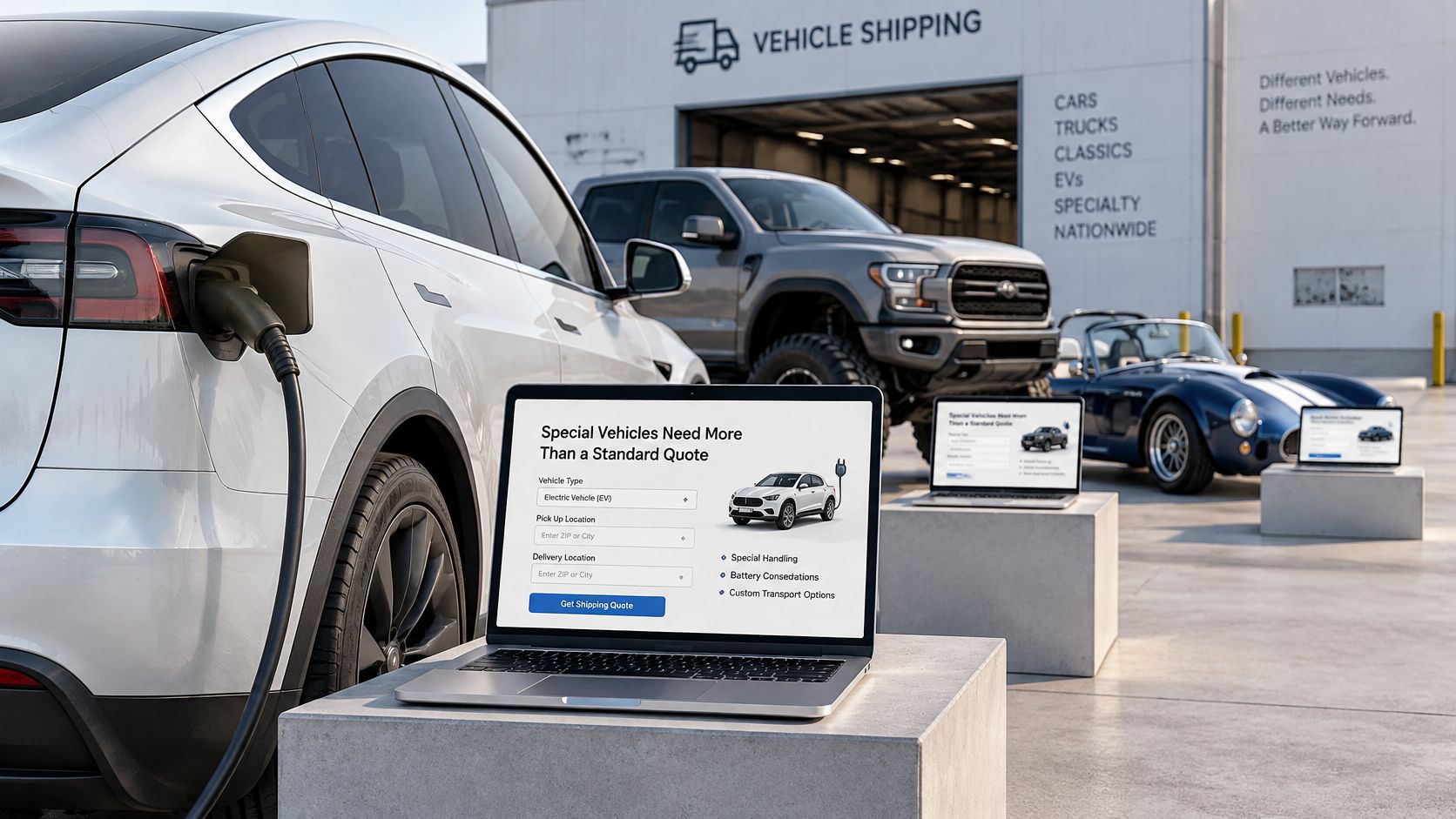
Electric vehicles are one example. A quote may need to account for whether the vehicle runs, has damage, or is under recall, as well as whether it will travel by ocean. Ocean carriers may ask owners to leave an EV battery at a moderate charge level. Confirm the carrier's exact requirement when booking.
Other special cases need different information. An inoperable car may require winch loading. Classic vehicles use enclosed trailers, soft tie-downs, and hydraulic loading, so their quote should reflect those handling needs. National Car Transport offers classic car shipping nationwide. Lifted trucks and low-clearance sports cars may need loading adjustments, while motorcycles require suitable tie-down equipment. For dealer or fleet shipments, the vehicle count and pickup window help determine the quote.
| Vehicle type | Detail to add | Likely effect on the quote | Manual review |
|---|---|---|---|
| Electric vehicle | Drivable status, damage or recall status, ocean route | Carrier requirements and handling needs may affect eligibility, timing, and price | Often, if damaged or not drivable |
| Inoperable car | Non-running status | Winch loading may raise the quote | Yes |
| Classic or collector car | Enclosure and tie-down requirements | Enclosed transport and careful loading affect the service and price | Sometimes |
| Lifted truck or low-clearance sports car | Lift height and ground clearance | Loading adjustments may affect the quote | Often |
| Motorcycle | Weight and tie-down requirements | Dedicated equipment affects handling and price | To confirm equipment |
| Dealer or fleet batch | Vehicle count and pickup window | Multiple vehicles on the same route may qualify for a multi-car discount | To confirm the quote |
Treat an estimate for a special vehicle as a starting range, not a final figure. Share the vehicle's condition, dimensions or modifications, and route details so the quote can account for what a standard form may miss.
Confirm Your Quote Before You Book
A calculator gives you a planning range; a firm quote confirms the amount you can book against. Before committing, check that the quote reflects your vehicle, route, transport type, and the services included.
- Check every detail. Confirm the origin and destination ZIP codes, vehicle year, make, model, body style, operability, modifications, and transport type.
- Keep the estimate and its assumptions. Save the date and any conditions listed so you can compare them with the final quote.
- Compare it with the relevant benchmark. If the number is far outside the typical range, ask what accounts for the difference.
- For Puerto Rico, ask for the cost breakdown. Clarify which charges cover trucking, ocean freight, port handling, documentation, any excise tax, and delivery on the island.
- Confirm coverage and booking terms. Ask what the price includes, what might change it, when payment is due, and how pickup scheduling works.
National Car Transport says car shipping includes one flat rate with insurance included. Customers can book online 24/7 through the free quote form and choose to book at the end of the quote. A dispatcher then starts working on the next available spot for the vehicle.
The company has 25+ years of experience and an A+ BBB rating. Its bilingual English and Spanish agents can help with questions about non-standard vehicles and island routes, so talk to a person before committing if your quote needs clarification.
National Car Transport ships vehicles across the mainland, Puerto Rico, Alaska, and Hawaii. For an island shipment, ask which charges are included in the flat rate and which may need to be budgeted separately, such as taxes or paperwork. You can request a quote through the free quote form at National Car Transport.