
Domestic vehicle shipments typically take 1 to 10 days, while island routes require additional ocean-freight days. The right booking depends on the vehicle, route, carrier credentials, delivery promise, and the paperwork that connects an online purchase to physical handoff.
You may be buying a car from a dealer several states away, moving for military orders, leaving a northern state for a seasonal home, or sending a vehicle from a mainland seller to San Juan. The transaction can happen from your phone in minutes, but the car still needs a qualified carrier, suitable equipment, accurate documents, and a clear inspection record.
That gap between digital convenience and physical responsibility causes most avoidable problems. A website may show a delivery estimate, yet the seller, broker, ocean carrier, and transporting motor carrier can have different obligations. Treat online auto shipping as part of the vehicle purchase and relocation plan, not as an afterthought.
Table of Contents
- Understanding the Modern Vehicle Shipping Experience
- Choosing Between Open and Enclosed Transport Options
- Navigating Pricing Factors and Booking Logistics
- Verifying Carrier Credentials and Safety Compliance
- Shipping Vehicles to Puerto Rico and Island Routes
- Essential Tips for a Smooth and Secure Delivery
Understanding the Modern Vehicle Shipping Experience
A buyer in New York can purchase a used vehicle from a dealer in Atlanta, arrange financing online, and never visit the lot. A snowbird can keep a vehicle in Miami for winter use, then send it back north later. A customer in Denver can win an auction in Los Angeles and need the car collected before the auction storage window closes. The convenience is real, but the final step still involves loading, securing, inspecting, tracking, and delivering a physical vehicle.
The growth of digital vehicle sales explains why shipping has become a core service. Statista's overview of online car sales reports global automotive e-commerce at approximately $38.67 billion in 2021, with projected growth at a 17.5% compound annual growth rate to about $176.24 billion by 2031. That projection covers online discovery, purchasing, auctions, financing, and fulfillment. As buyers and sellers operate from different cities, states, or countries, transport connects the online transaction with the handoff.
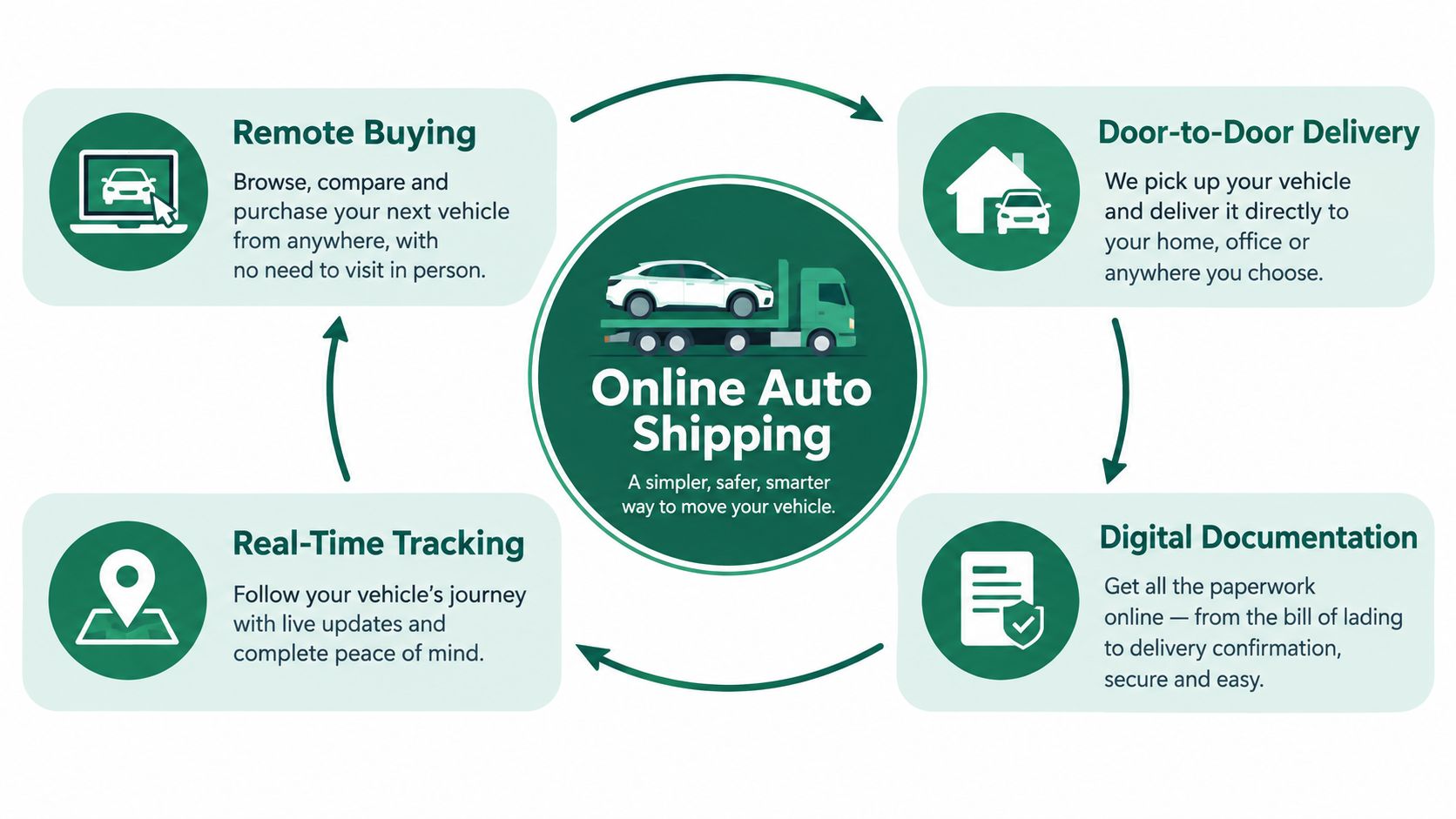
What the booking actually coordinates
A sound booking joins several moving parts:
- Remote purchase: Confirm who owns the vehicle, who can release it, and whether the seller or buyer pays for transport.
- Pickup planning: Provide an exact address or a safe nearby meeting point if a truck can't access the property.
- Physical documentation: Use the bill of lading, title information, registration, inspection notes, and delivery instructions.
- Shipment visibility: Keep written records of status updates and delivery changes instead of relying only on a phone conversation.
Federal motor carriers are part of a mature freight system, not an informal extension of an online marketplace. The Federal Motor Carrier Safety Administration traces major milestones to the Commercial Motor Vehicle Safety Act of 1986 and the creation of FMCSA through the Motor Carrier Safety Improvement Act of 1999. Its motor-carrier overview also states that motor carriers accounted for 64% of the total weight of freight moved in the United States, based on the 2017 Pocket Guide to Large Truck and Bus Statistics.
Practical rule: Book the transport only after you know who has custody, who carries insurance, who can authorize release, and who must resolve a missed delivery promise.
For customers using National Car Transport, the process can include online quoting and scheduling, door-to-door coordination, open or enclosed equipment, and ocean shipping for island routes. Its bilingual English and Spanish agents are based in the United States, with more than 20 years of auto transport logistics experience. Not one vehicle transport is alike, so a knowledgeable agent can simplify decisions that a generic checkout form can't.
Choosing Between Open and Enclosed Transport Options
Open transport is the normal choice for most daily drivers, family vehicles, dealership inventory, and ordinary online purchases. The vehicle travels on an exposed multilevel carrier with other vehicles. That approach usually offers broader availability and a lower price, but the vehicle remains exposed to road dust, weather, and ordinary highway debris.
Enclosed transport places the vehicle inside a covered trailer. It generally costs more and may have less availability on some lanes, but it provides stronger protection for classic cars, luxury vehicles, restored automobiles, low-clearance models, and vehicles whose owners want tighter control over exposure. The decision isn't only about whether the car is expensive. It also depends on condition, replacement difficulty, ground clearance, season, route, and the buyer's tolerance for risk.
| Transport Type | Protection Level | Estimated Cost Difference | Best For |
|---|---|---|---|
| Open transport | Standard protection from handling, with exposure to weather and road conditions | Usually the more economical option, but the exact difference depends on route, vehicle, timing, and availability | Daily drivers, SUVs, dealer inventory, auction purchases, and routine interstate moves |
| Enclosed transport | Added protection from weather and road debris, with specialized loading options when needed | Usually higher than open transport because equipment and capacity are more specialized | Classics, luxury vehicles, restored cars, low-clearance vehicles, and high-value purchases |
A quote isn't useful if the service type is unclear. Ask whether the price includes open or enclosed equipment, door-to-door service, an operable or inoperable vehicle, and any special loading requirements. A low open-car quote isn't directly comparable with an enclosed quote for the same route.
For a straightforward daily driver, National Car Transport's open car transport information can help you understand the standard equipment and service model before requesting a price. For a classic or luxury car, ask specifically about enclosed capacity, loading clearance, tie-down procedures, insurance limits, and the inspection process.
Match equipment to the vehicle
Open transport usually works well when the vehicle runs, has normal dimensions, and doesn't require unusual clearance. Enclosed equipment becomes more relevant when the vehicle has a fragile finish, modified suspension, very low clearance, valuable original parts, or a condition that makes exposure unacceptable.
Don't choose enclosed transport solely because it sounds premium. If the vehicle is a normal commuter car and the route has strong open-car availability, the added protection may not justify the higher price. Conversely, saving money on open transport can be a poor trade if a rare vehicle's finish, bodywork, or loading geometry requires more protection.
Navigating Pricing Factors and Booking Logistics
Online quotes work best when the form captures the shipment as an operational job rather than a rough mileage estimate. The Bureau of Transportation Statistics intermodal database organizes freight around origin, destination, mode, facilities, and connectivity. That framework explains why two routes with similar displayed mileage can produce different quotes.

Build an accurate shipment record
Enter exact locations. Use pickup and delivery ZIP codes, not only city names. A rural address, narrow street, military installation, dealership lot, auction yard, or port facility can change the workable meeting point.
Describe the vehicle accurately. State the make, model, dimensions, weight, modifications, operability, and ground clearance. An inoperable vehicle may require winch or specialized loading equipment.
Choose the service level. Identify open or enclosed transport, door-to-door or terminal handling, requested dates, and whether an ocean leg is involved. A mainland shipment and a Puerto Rico shipment aren't priced from the same network assumptions.
Compare like with like. Hold the vehicle condition, service level, pickup point, delivery point, and timing window constant. Then ask what explains any difference, such as enclosed equipment, access restrictions, expedited timing, or additional handling.
Read the rate language. A transparent flat-rate model should identify what the quoted amount covers and when a surcharge can apply. National Car Transport describes transparent flat-rate pricing and doesn't charge an upfront amount until the vehicle is matched with a carrier. Customers should still read the shipment terms and confirm the party responsible for any approved change.
The National Car Transport car-shipping cost guide is a useful reference for the variables that affect a quote. Don't accept a generic estimate as a guaranteed dispatch. A price becomes operationally meaningful only when the carrier, equipment, dates, and addresses are confirmed.
Before pickup, remove personal property, photograph every side of the vehicle, record existing scratches and dents, confirm whether the vehicle runs, and keep keys and release instructions available. The carrier will use the condition report and bill of lading to compare pickup and delivery condition.
This short video can help customers understand how an online booking conversation should translate into a real shipment plan.
The price isn't the only variable. A flexible date may improve dispatch options, while a strict delivery window can narrow the carrier pool. Remote origins, oversized vehicles, damaged vehicles, and port transfers also need early disclosure because a standard online form may not capture every handling requirement.
Verifying Carrier Credentials and Safety Compliance
The company that answers your quote request may be a broker, a motor carrier, or another transportation intermediary. Those roles matter. The Federal Motor Carrier Safety Administration distinguishes motor carriers, brokers, freight forwarders, and intermodal equipment providers, and explains that a company may need a USDOT number and operating authority for commercial interstate transportation.
Before pickup, obtain the legal name of the operating carrier, its USDOT and MC identifiers, operating status, insurance status, and the name of the party contractually responsible for the shipment. The FMCSA registration guidance explains that financial-responsibility filings are required before operating authority is granted, with coverage varying by authority type, cargo, and vehicle classification.
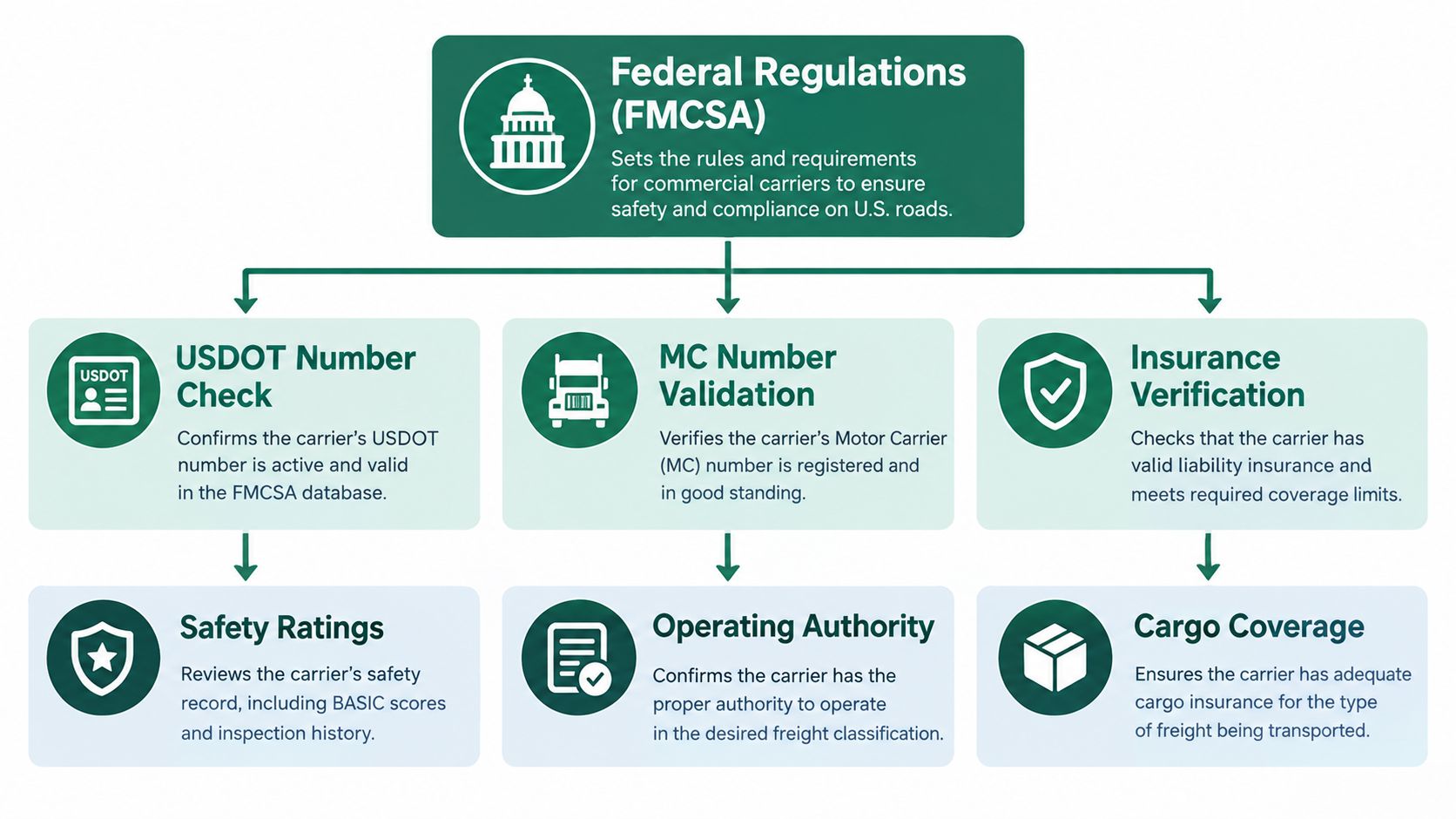
What to verify before releasing the keys
- Operating authority: Confirm that the entity moving the vehicle has the authority appropriate to the shipment.
- Insurance status: Check that required insurance filings remain active, then ask about cargo limits, exclusions, deductibles, and claims procedures.
- Carrier identity: Make sure the name on the dispatch information matches the actual operating company, not only the website or salesperson.
- Safety oversight: Interstate rules cover registration, driver qualifications, licensing, hours of service, equipment, inspections, operating condition, and maintenance. The electronic Code of Federal Regulations requirements show why transport is a regulated commercial operation rather than a casual private handoff.
For-hire interstate property carriers operating qualifying vehicles and transporting nonhazardous property face a minimum $750,000 liability level, according to the FMCSA safety planner. That figure is a regulatory minimum, not proof that your particular vehicle's full replacement value is protected. A high-value classic, luxury vehicle, or modified car may need written confirmation of cargo limits and exclusions before dispatch.
The booking website isn't automatically the carrier. Ask who physically possesses the vehicle, whose insurance responds to cargo damage, and where a claim must be filed.
At pickup, review the bill of lading line by line. Photograph wheels, glass, bumpers, paint, roof, interior, odometer, and any existing damage in good light. For a classic vehicle, an independent inspection resource such as Auto Appraisal Expert's inspector tips can help you prepare a more useful condition record before the carrier arrives.
A quote that avoids credential questions isn't necessarily a bargain. Verification reduces confusion when a vehicle changes hands between a marketplace, seller, broker, trucker, terminal, and ocean carrier.
Shipping Vehicles to Puerto Rico and Island Routes
A mainland-to-Puerto Rico move has two logistics layers. A truck collects the vehicle in a mainland state, delivers it to a port, and an ocean carrier moves it toward San Juan or another Puerto Rico destination before customs and island delivery take place. The vehicle may pass through several responsible parties, so the customer needs a document trail rather than a single verbal promise.
Puerto Rico is a U.S. territory for vehicle-procedure purposes. Pennsylvania's official DMV import and export guidance states that vehicles shipped from Puerto Rico don't follow the state's foreign-country imported-vehicle procedures. That distinction doesn't remove port requirements, customs inspection, or destination documentation.
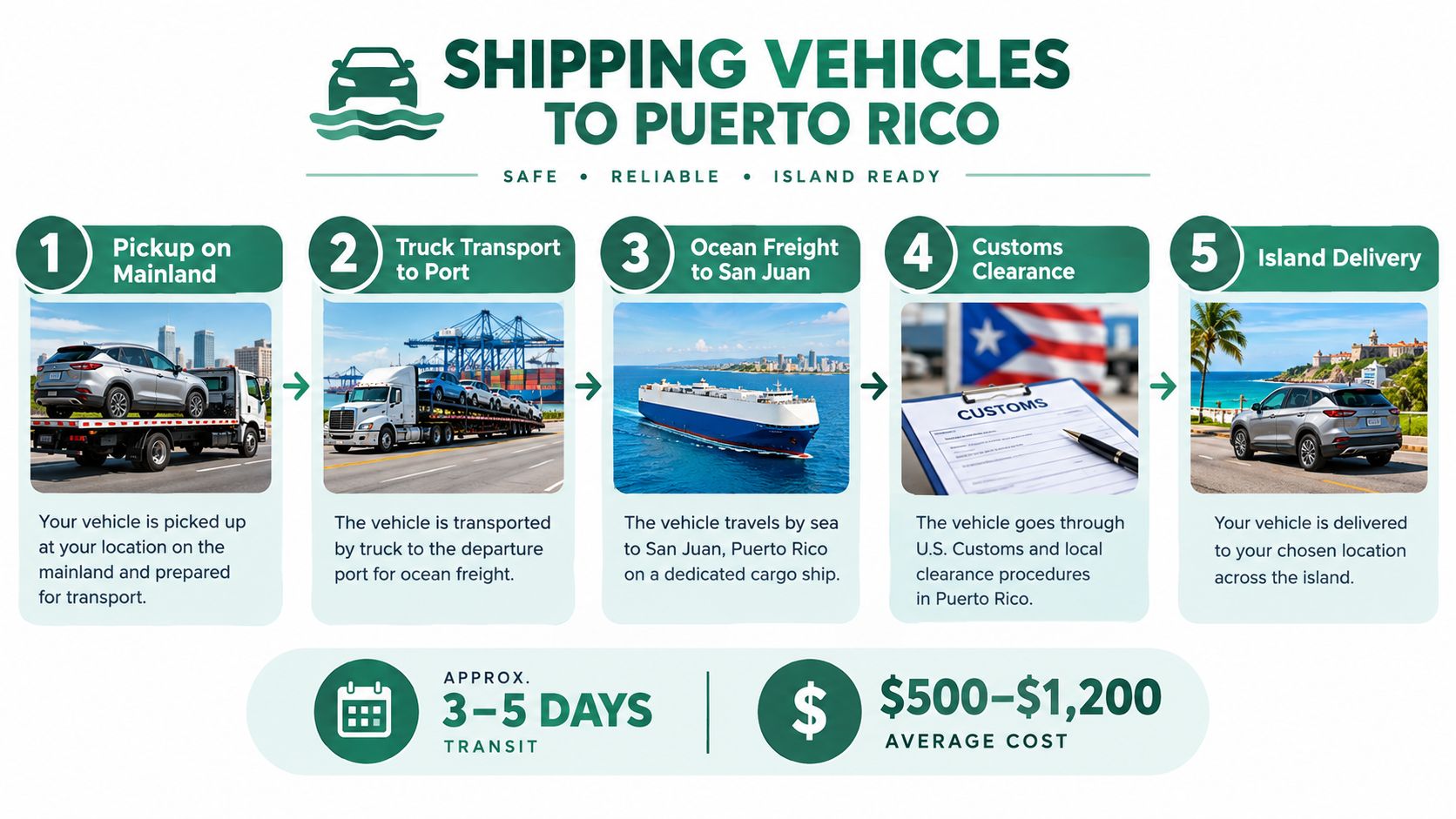
Prepare the port file
For a shipment from the mainland to San Juan, gather the original title and registration, identification, and bill of lading. If a lien exists, the lien-holder letter should identify the vehicle identification number, make, and model. Pickup trucks and vans may require a commercial invoice, so confirm that point with the destination agent before the vehicle reaches the port.
Destination guidance also identifies additional documents commonly requested for Puerto Rico, including the owner's driver's license and Social Security number, proof of a Puerto Rico address, and keys provided to the destination agent before arrival. Puerto Rico customs and destination procedures state that arriving vehicles are subject to full customs inspection and that duties and taxes must be paid before release.
The same guidance says personal belongings shouldn't be loaded inside a vehicle shipped to Puerto Rico. This is a common mistake for snowbirds and relocating families who see unused cabin space as convenient packing capacity. Treat the vehicle as cargo, not as a moving box.
Allow for the ocean leg
A quote for mainland trucking isn't a confirmed island booking. The ocean carrier may need to review vehicle condition, documentation, dimensions, and route availability. Electric vehicles require additional attention. Maritime guidance classifies EVs as Class 9 dangerous goods under the International Maritime Dangerous Goods framework and discusses undamaged batteries, secure stowage, and controlled state of charge. The 2025 IMDG guidance describes the 2025 edition as mandatory from January 1, 2026, with tighter rules affecting EV and lithium-ion battery transport.
A damaged, flooded, or collision-involved EV may be rejected even after an initial quote. Confirm battery condition, operability, charge instructions, charging cables, spare batteries, and ocean-carrier acceptance in writing.
National Car Transport's Puerto Rico car-shipping information describes the route as a coordinated transport service rather than a normal interstate delivery. That distinction matters for military families, dealers, students, and homeowners who need to schedule around port cutoffs and customs release.
Essential Tips for a Smooth and Secure Delivery
A smooth delivery starts before pickup. Clean the vehicle enough to reveal existing damage, remove personal items, disable alarms if appropriate, secure loose accessories, and confirm that the carrier has the correct keys and contact details. Ask whether the vehicle must be operable and whether the driver needs special equipment for loading.
Keep one folder, physical or digital, containing the listing screenshot, purchase agreement, promised delivery window, inspection report, bill of lading, pickup photographs, delivery photographs, and every written change to the schedule. The FTC reported in March 2025 that it was distributing more than $934,000 in refunds to consumers affected by Vroom's failed delivery promises. The agency alleged that Vroom misrepresented vehicle inspections, failed to obtain consent to shipment delays, and didn't provide prompt refunds when vehicles weren't delivered as promised. The FTC's Vroom announcement shows why the sale contract and shipping arrangement must be reviewed together.
Use a delivery checklist
- Inspect before signing: Compare every panel, wheel, window, mirror, light, and accessory with the pickup condition report.
- Photograph discrepancies: Take clear photographs before unloading is complete, including wide views and close-ups.
- Write damage on the paperwork: Record the discrepancy on the bill of lading and ask the driver to acknowledge it before departure.
- Notify the responsible party: Send the report to the carrier, broker, seller, marketplace, and insurer as applicable.
- Separate delay from damage: A late arrival, physical damage, missing equipment, and a vehicle that differs from its listing may involve different remedies.
A seller's delivery promise isn't automatically the carrier's guarantee. Check the purchase agreement for the point at which delivery risk transfers to you, then ask who must authorize a refund, chargeback, marketplace remedy, or claim if the vehicle is late or materially different from its listing.
Tracking helps you plan, but it doesn't replace documentation. A practical explanation of how vehicle tracking works can clarify the difference between location visibility, status updates, and proof of condition. For Puerto Rico shipments, also confirm customs release, port charges, destination-agent instructions, and whether the vehicle can be collected immediately after clearance.
The safest booking is the one with a clear carrier identity, realistic timing, complete paperwork, suitable equipment, and a documented handoff. Low price matters, but it shouldn't outrank custody, coverage, and accountability.
National Car Transport coordinates door-to-door open and enclosed auto shipping across the U.S. mainland and Puerto Rico, with transparent flat-rate pricing, a nationwide network of 25,000+ vetted carriers, and bilingual English and Spanish agents based in the USA. Visit National Car Transport to request a quote, explain your vehicle and route, and get guidance from an experienced auto transport logistics agent.