
You've accepted a new job in California, booked the movers, and still have one stubborn question: how will your car get there without adding days of driving, mileage, and stress? North Carolina to California car shipping is a practical solution, but it isn't a local tow. The route crosses a major national corridor, involves a long pickup and delivery window, and may create California registration work after the vehicle arrives.
The right plan depends on the vehicle, pickup address, delivery location, timing, and destination-state requirements. Open transport usually fits ordinary daily drivers, while enclosed service makes more sense for classics, exotics, restored vehicles, and low-clearance builds. The most important decision, however, is choosing a provider that documents the vehicle carefully and explains who is responsible at every stage.
Table of Contents
- Why This Lane Matters for North Carolina Relocators
- What Drives the Cost on This Route
- Open vs Enclosed Transport on a 2,500-Mile Haul
- Booking, Pickup, Transit, and Delivery
- Documentation You Should Have Ready
- California Registration and Compliance After Delivery
- Route-Specific Tips and Common Mistakes to Avoid
Why This Lane Matters for North Carolina Relocators
A Raleigh family moving to Los Angeles, a military household leaving Fayetteville for San Diego, and a dealership sending inventory from Charlotte to Sacramento face the same basic problem. The vehicle has to travel across the country, while the owners manage housing, work, school, or a permanent change of station.
The backbone of this move is Interstate 40. It runs 2,556.61 miles between Wilmington, North Carolina, and Barstow, California, making it the third-longest Interstate in the United States. About 420.21 miles of I-40 cross North Carolina, while approximately 154.61 miles lie in California, according to the documented route history of Interstate 40 in North Carolina.
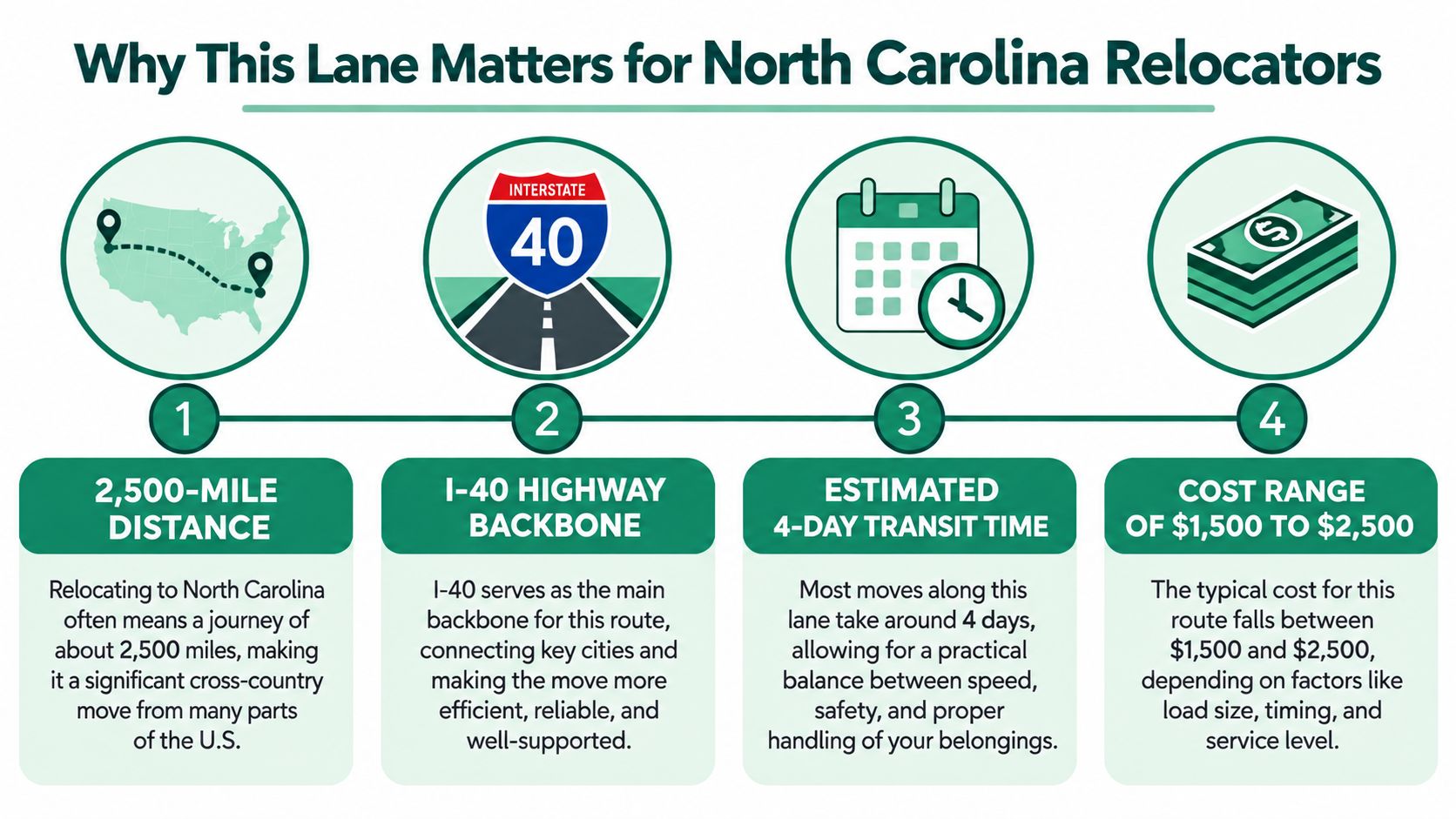
I-40 matters because it connects North Carolina population centers, port activity, and inland markets with western distribution areas. Actual carrier mileage can exceed the highway's posted length because the truck may need to reach a neighborhood away from the interstate, then use connecting roads such as I-85, I-95, I-15, or I-10.
That geography creates real logistics exposure. Weather, construction, rural pickup points, urban delivery restrictions, and carrier availability can all affect the handoff. A useful way to evaluate the broader relocation is to review relocation scores from ReloMaps, then treat the vehicle shipment as one part of the move rather than an isolated transaction.
What Drives the Cost on This Route
A North Carolina to California quote is built from several inputs, not just mileage. The carrier considers the exact addresses, vehicle dimensions, running condition, ground clearance, trailer space, pickup flexibility, and whether the shipment can fit an existing westbound route.
Demand also matters. The Census Bureau's 2024 state-to-state migration table records 18,428 people moving from North Carolina to California, while the broader national context includes approximately 8.2 million interstate moves in 2022. Those figures describe people, not vehicles, but they help explain why relocation lanes create continuing demand for long-haul auto transport. The migration figures are documented in the Census state-to-state migration table.
Vehicle size and condition can change the quote substantially. A standard sedan is easier to place than a large SUV, full-size pickup, lowered car, or vehicle with oversized tires. An inoperable vehicle may need winch loading, while a remote address can require extra routing or a safer meeting point near a major road.
Sample price bands
The table below gives practical comparison bands for planning. These are editorial planning ranges, not guaranteed quotes. The precise amount depends on the shipment details and market conditions.
| Vehicle Type | Open Transport | Enclosed Transport | Typical Transit |
|---|---|---|---|
| Sedan | $1,500 to $2,000 | $2,500 to $3,500 | 7 to 14 days |
| SUV or pickup | Above sedan band | Above sedan band | 7 to 14 days |
| Classic or exotic | Quote based on vehicle and equipment | Usually selected for added protection | 7 to 14 days |
| Inoperable vehicle | Requires equipment review | Requires equipment review | Depends on loading plan |
Use a written quote that identifies the vehicle, service type, addresses, payment terms, and conditions that could trigger a re-quote. A suspiciously low number may leave out remote access, non-running status, dimensions, or the actual carrier assignment. For broader planning, compare the assumptions behind your quote with the car shipping cost guide, rather than comparing headline prices alone.
Open vs Enclosed Transport on a 2,500-Mile Haul
For most operable sedans, crossovers, family SUVs, and ordinary pickups, open transport is the sensible default. The vehicle travels on the same type of carrier commonly used for dealership inventory, and the service is generally easier to schedule because more open equipment operates on major interstate lanes.
Enclosed transport earns its higher price when the vehicle's condition or value justifies additional protection. A classic restoration, exotic car, collector vehicle, freshly painted car, motorcycle, or low-clearance build may benefit from a covered trailer, controlled loading, and protection from road debris and weather exposure.
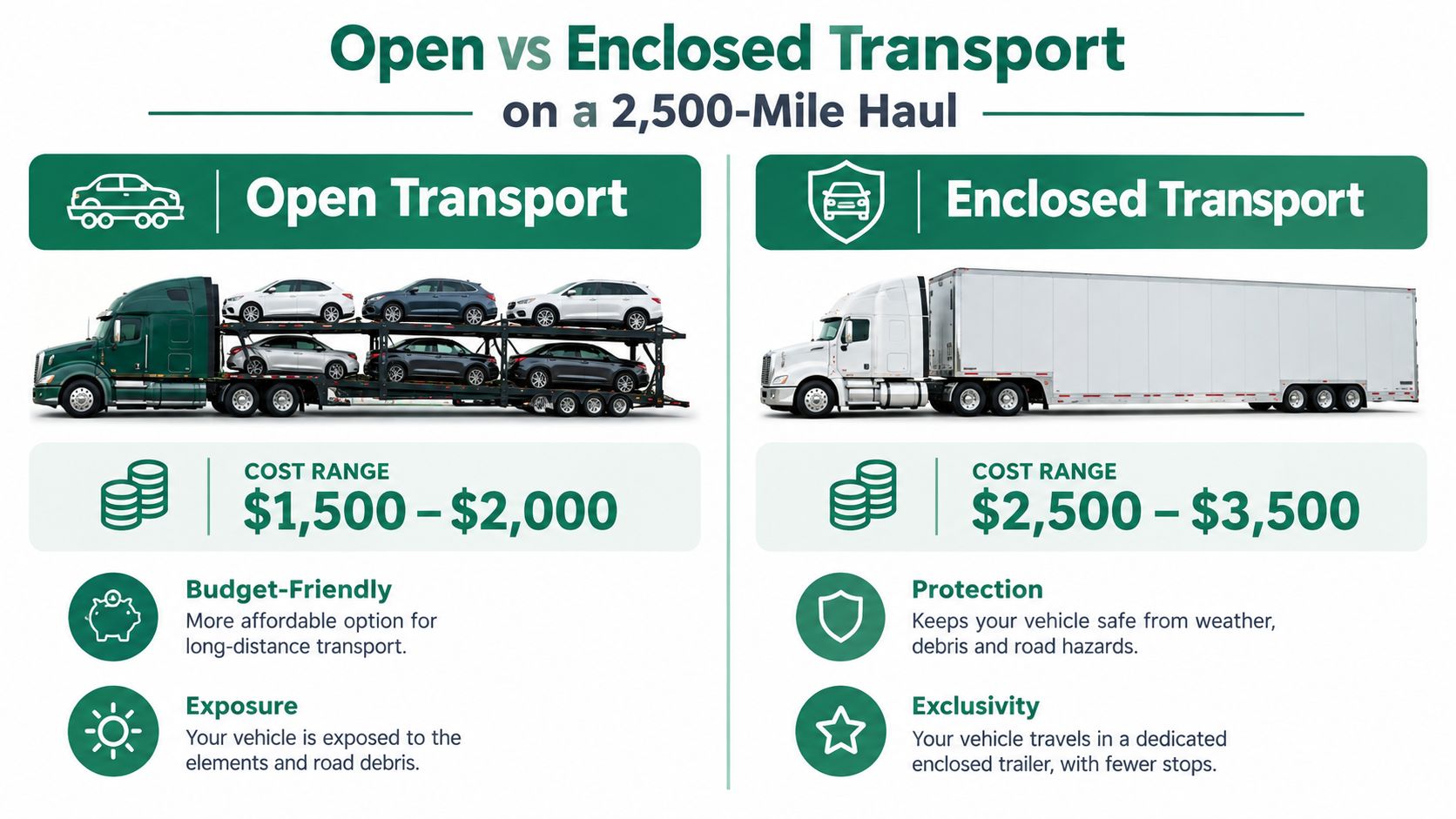
Enclosed auto transport typically carries a 40% to 60% premium over open transport. Enclosed trailers may carry up to six vehicles, compared with up to ten on open carriers, which can support more direct routing and higher cargo insurance limits. Those differences are described in enclosed auto transport guidance.
Match the trailer to the vehicle
Choose open transport when:
- The car is a daily driver: Normal ground clearance and an operable vehicle usually fit standard loading.
- Budget matters: Open service preserves money for moving, registration, inspections, or storage.
- The vehicle can tolerate normal exposure: The car should arrive clean enough for inspection, but it isn't being treated as a concours vehicle.
Choose enclosed transport when:
- The vehicle is unusually valuable or vulnerable: Classics, exotics, restorations, and sensitive finishes deserve a stronger protection case.
- Ground clearance is limited: Ask whether the carrier has liftgate or specialized loading equipment before booking.
- The vehicle has fragile exterior parts: Disclose spoilers, aftermarket trim, roof accessories, and other loose or exposed components.
Prepare the car before the truck arrives. Verify that it starts, rolls, steers, and brakes. Check tires, look for fluid leaks, reduce the fuel level to a practical amount, remove personal property, disable alarms and GPS systems, fold in mirrors, and remove loose exterior accessories that could detach at highway speed.
A carrier needs accurate information before dispatch. A standard sedan isn't interchangeable with a lowered, oversized, modified, or inoperable vehicle. Misstating those details can cause loading problems, scheduling changes, or a re-quote.
Protect the handoff
Use this four-stage workflow:
- Verify the vehicle: Record operability, dimensions, ground clearance, and approximate weight.
- Document pickup condition: Take timestamped photos of every exterior panel, glass area, wheel, odometer, and existing defect.
- Confirm the loading plan: Ask about tie-down equipment, delivery contact details, and the inspection process.
- Repeat the inspection: Compare the vehicle at delivery before signing acceptance.
Federal cargo-securement rules require the aggregate working-load limit of the securement system to be at least one-half the weight of the secured article or group of articles. The rules also require cargo to be restrained against shifting or falling during interstate commercial transportation, as explained by the Federal Motor Carrier Safety Administration cargo-securement rules.
The video is useful as a visual reminder, but your own photos and bill of lading remain the working record for this shipment.
Booking, Pickup, Transit, and Delivery
A reliable shipment follows a visible sequence. You should know what happens after the quote, when dispatch begins, how the carrier is selected, and who will call before pickup and delivery.
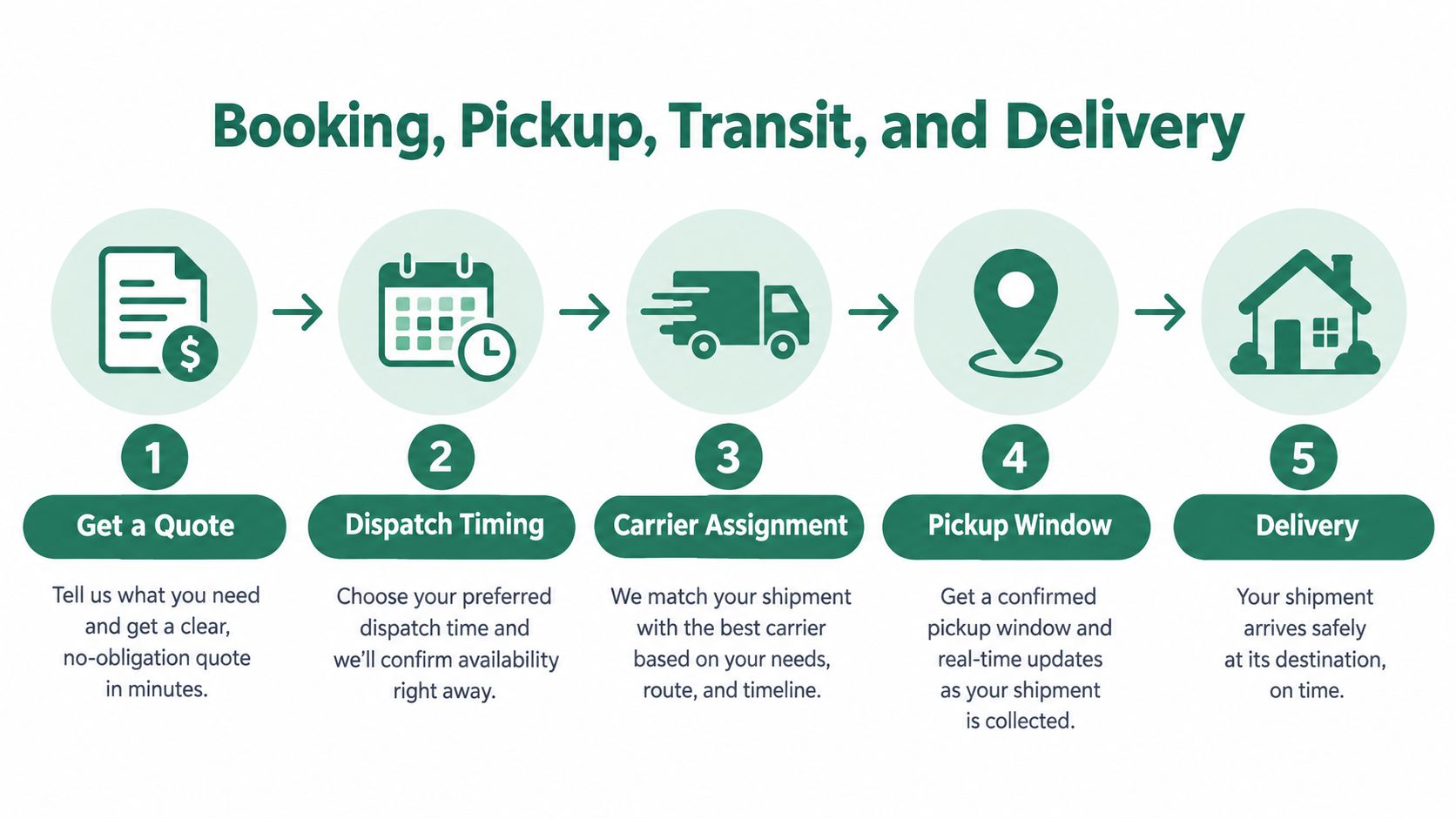
The operating sequence
Get a quote. Provide exact addresses, vehicle details, operability, dimensions, and your preferred service. A quote built on incomplete information isn't dependable.
Set dispatch timing. A flexible pickup window gives the dispatcher more ways to match the vehicle with a carrier already moving through North Carolina.
Confirm the carrier. Ask whether the company is acting as a broker, carrier, or both. Get the assigned carrier's information before the handoff.
Prepare for pickup. Residential streets, gated communities, apartment access, and narrow driveways may prevent a large truck from reaching the door. Share gate codes and identify a safe alternate location if needed.
Track delivery. A cross-country move can take 7 to 14 days, depending on carrier capacity, weather, route conditions, and legally required driver rest periods. Winter conditions in higher elevations along I-40, weather systems through the Rockies and Southwest, and urban delivery access can all shift the schedule.
For a door-to-door plan, confirm that the vehicle can be safely reached at both addresses. Review the practical limits of door-to-door auto transport before assuming “door-to-door” means the truck can enter every residential street.
Route rule: Treat the pickup and delivery dates as windows, not appointments with zero flexibility. Keep a backup contact available so the driver isn't delayed by a missed call.
Summer can bring heavier demand from families, students, snowbirds, and military moves. Winter can complicate higher-elevation travel. Book early when your arrival date is tied to a lease, reporting date, school start, or closing appointment.
Documentation You Should Have Ready
Paperwork prevents avoidable delays, but transport documents and California registration documents serve different purposes. The bill of lading proves the vehicle's condition during the carrier handoff. It does not replace the title, registration application, smog paperwork, permit, insurance information, or other documents California may require after delivery.
Before pickup in North Carolina
Keep these items accessible:
- Ownership records: Have the title, lien information, or purchase documentation available when the carrier or broker requests it.
- Vehicle identification: Keep your registration and photo identification ready for verification.
- Access details: Provide HOA instructions, gate codes, apartment rules, loading restrictions, and a backup meeting location.
- Vehicle information: Share the make, model, dimensions, modifications, running condition, and approximate weight accurately.
- Contact details: Give the carrier a reachable pickup contact and a separate delivery contact if someone else will receive the vehicle.
Remove personal property unless the carrier has specifically approved it. Personal items may not be covered under the transport policy and can interfere with inspection or securement.
At pickup
The inspection is not a formality. Walk around the vehicle with the driver and compare every visible condition note with the actual body, glass, wheels, and accessories.
Write precise descriptions on the bill of lading. “Scratch on the driver-side front door below the handle” creates a much stronger record than “scratches.” Photograph the odometer and use timestamped images that show the full vehicle as well as close-ups of existing damage.
Confirm the carrier's name, phone number, delivery contact, loading method, tie-down approach, and expected communication schedule. If the driver's inspection record conflicts with your photos, resolve the difference before signing.
Verify who is handling the vehicle
A broker arranges transportation with a carrier. A carrier operates the truck and physically transports the vehicle. Those parties may be separate, so don't assume the company that answers your phone is the company responsible for the equipment at your door.
The FMCSA advises consumers to verify interstate brokers and carriers through its registration system, monitor card transactions, and use its complaint route when an automobile transport dispute can't be resolved directly. You can review that guidance in the FMCSA consumer advisory for automobile transporters.
Check the MC and USDOT credentials for the relevant company. Ask who handles claims, whose insurance applies during transit, and whether the assigned carrier differs from the original booking party. A low quote without clear party identification is not a bargain.
At delivery
Inspect the vehicle before accepting it. Compare the delivery condition with the pickup bill of lading and your original photos. Look at the roof, wheels, glass, bumpers, mirrors, lower panels, and any area that was difficult to see at pickup.
If you find a difference, record it on the delivery paperwork before signing. Take new timestamped photos, notify the carrier and broker promptly, and retain the quote, payment record, bill of lading, photographs, messages, and inspection notes. A clear sequence of documents gives an insurer, broker, carrier, or regulator something concrete to evaluate.
California Registration and Compliance After Delivery
Delivery is not the legal finish line. California generally requires a new resident to register an out-of-state vehicle within 20 days, and most gasoline vehicles from 1976 onward require a smog certificate. California also applies stricter requirements involving emissions, window tint, lighting, and lifted-vehicle dimensions, as outlined in this route-specific California car registration renewal guide.
Separate two questions before dispatch:
- Can the carrier transport the vehicle?
- Can the vehicle legally operate and register in California?
A North Carolina-compliant car may still need a smog inspection, emissions review, equipment modification, insurance garaging update, or other California paperwork. Older vehicles, diesel trucks, modified suspensions, classics, and online purchases deserve extra review before they leave North Carolina.
A California Vehicle Moving Permit, REG 172, may help with certain nonoperated vehicles. The permit can be issued at no charge for one day, must be obtained before the vehicle moves, and its selected date must fall within 60 days of issuance. It concerns operation on California roads, not the carrier's authority to haul the vehicle on a trailer. Confirm eligibility and timing with the California DMV before relying on it.
Route-Specific Tips and Common Mistakes to Avoid
The final miles deserve as much planning as the first miles. Barstow can function as an important California-area routing point, particularly where I-40 connects with I-15 and routes continue toward inland Southern California. A carrier may also need to adjust for wildfire conditions, Southwest monsoon weather, restricted mountain access, or a delivery address that doesn't accommodate a large transport truck.
California neighborhoods create another practical issue. Some HOAs, apartment communities, and urban streets restrict commercial vehicles or lack room for a carrier to turn. Door-to-door service still depends on safe and lawful access. If the truck can't reach the home, arrange a nearby commercial lot or wide street before dispatch.
Four mistakes that create avoidable trouble
- Under-disclosing modifications: Mention lift kits, spoilers, roof racks, oversized tires, low clearance, non-running condition, and unusual dimensions before the carrier is assigned.
- Choosing a quote without checking credentials: Verify the MC and USDOT information instead of treating a low number as proof of value.
- Assuming the price covers every address: Remote roads, gated communities, and inaccessible driveways can require a meeting point or revised routing.
- Treating delivery as the end: Confirm California registration, smog, insurance, permit, tint, lighting, and suspension requirements after arrival.
A commercial customer should also separate vehicle movement from risk management. Dealerships, fleet operators, and businesses may want to review specialized guidance such as Select Insurance Group trucking coverage when evaluating broader transportation exposure.
A practical decision matrix
| Decision | Choose this when | Ask before booking |
|---|---|---|
| Open transport | The vehicle is an ordinary operable daily driver | Can the carrier load the vehicle normally? |
| Enclosed transport | The vehicle is valuable, restored, fragile, or low-clearance | What equipment and insurance limits apply? |
| Door-to-door | Both addresses allow safe carrier access | Is there a backup meeting location? |
| Terminal or alternate delivery | The neighborhood restricts truck access | Where will inspection and handoff occur? |
| Standard dispatch | Your dates have reasonable flexibility | What pickup window is realistic? |
| Expedited dispatch | A lease, PCS, sale, or event creates a firm deadline | What additional conditions apply to priority matching? |
Before booking, make four decisions: carrier type, pickup flexibility, delivery access, and document readiness. Then verify the vehicle condition at both ends and keep the California compliance work on your calendar.
National Car Transport offers open and enclosed transport across the United States, including North Carolina to California moves, with transparent flat-rate pricing and no charge until a carrier is matched. Its U.S.-based bilingual English and Spanish agents have more than 20 years of auto-transport logistics experience, while the company operates with more than 25 years in the industry, an A+ BBB rating, and a network of more than 25,000 vetted carriers. No two vehicle shipments are alike, so a dedicated agent who understands the vehicle and route can make the process simpler and faster at a practical value.
Get a route-specific quote from National Car Transport, provide complete vehicle and access details, and ask for guidance on open or enclosed service, inspection paperwork, and California delivery requirements. Their bilingual U.S.-based agents can help coordinate a North Carolina to California shipment or other domestic and Puerto Rico vehicle transport with a carrier matched to the actual job.