
You might be dealing with a job relocation, a seasonal move, a motorcycle purchase from another state, or a military transfer that suddenly puts your bike on a different route than the rest of your household goods. That's usually when people discover a simple truth. Shipping a motorcycle isn't the same as shipping a car, and it definitely isn't the same when Puerto Rico is part of the route.
A solid motorcycle moving service has to solve more than distance. It has to handle loading angles, soft tie-down points, low-clearance bikes, oversized bars, port scheduling, paperwork, and handoffs between mainland and ocean carriers. If the company treats your bike like a generic vehicle, small mistakes happen early and become expensive later.
Table of Contents
- Why You Need a Motorcycle Shipping Expert
- Comparing Transport Options Open Enclosed and Ocean Freight
- Estimating Costs and Timelines for Your Motorcycle Shipment
- How to Prepare Your Motorcycle for Pickup
- Choosing the Right Carrier and Understanding Your Paperwork
- Navigating Pickup Delivery and Special Scenarios
Why You Need a Motorcycle Shipping Expert
The demand for motorcycle transport isn't niche anymore. The motorcycle transportation services market report says the global market was valued at USD 87.55 billion in 2025 and is projected to reach USD 163.3 billion by 2035, with a projected 6.5% CAGR from 2026 to 2035. The same report links that growth to a 42% increase in logistics services and 37% growth in cross-border transport demand.
That growth matters because more carriers are advertising motorcycle service, but not all of them handle motorcycles with motorcycle-specific equipment. A bike has exposed controls, a narrow footprint, suspension that can be over-compressed, and bodywork that shows every mistake. The service may look similar on a quote screen, but the handling standard behind it can be very different.
The route changes the job
A mainland move from one state to another is usually a truck scheduling problem. A Puerto Rico shipment is a chain of custody problem. Your motorcycle may need inland pickup, port delivery, ocean handling, arrival coordination, release documentation, and final handoff. If one step slips, the whole move gets delayed.
That's why customers ask practical questions first.
- Can the carrier load a heavy touring bike safely? Lift gate access matters.
- What about a low chopper or custom cruiser? Ramp angle and clearance matter.
- Can someone explain the Puerto Rico paperwork in English or Spanish? Clear communication matters just as much as equipment.
- Will the quote reflect the actual route, not just the easy part? Mainland and island logistics have to be priced and scheduled together.
Practical rule: If a company can't explain exactly how your motorcycle will be loaded, secured, transferred, and released, keep asking questions.
A motorcycle moving service should reduce uncertainty, not add to it. That's especially true if you're coordinating a move from Miami, Orlando, Jacksonville, Houston, Dallas, Los Angeles, San Diego, Phoenix, Atlanta, Chicago, New York, or anywhere else on the mainland into San Juan and beyond. The right coordinator thinks through each handoff before the bike ever leaves your driveway.
Comparing Transport Options Open Enclosed and Ocean Freight
The right shipping method depends on the bike, the route, and how much exposure you're willing to accept. Daily riders and standard street bikes often move differently than vintage motorcycles, custom builds, or oversized touring models. Puerto Rico moves add another layer because ground service and ocean service have to work together.
What open transport does well
Open transport is usually the practical choice for routine domestic moves. If you're shipping a standard bike between mainland cities and your main priority is budget, this option often makes sense. It's commonly used for shorter routes, everyday motorcycles, and flexible schedules.
The trade-off is exposure. Wind, rain, road grime, and debris are part of the equation. That doesn't automatically make open shipping unsafe, but it does make it less forgiving if the bike has delicate paint, custom trim, or collector value.
When enclosed transport earns the extra cost
Enclosed service gives a motorcycle more controlled handling and more protection during transit. For high-value bikes, classics, customs, and show motorcycles, it's usually the better fit. The difference isn't cosmetic marketing. It's operational.
The verified industry data provided for this article states that open versus enclosed carrier choice creates a 15% variance in cosmetic preservation success, and enclosed transport reaches a 98% success rate for high-value or classic motorcycles because it protects the bike from wind, rain, and road debris.
For a collector bike or a custom build, the cheapest option is often the most expensive one after a preventable scratch, broken mirror, or loading mistake.
Specialist motorcycle carriers also tend to use procedures that generic haulers skip. Soft-loop intermediaries matter. Correct strap points matter. Loading support matters. The same verified data notes that 30% of handlebar and mirror breakage incidents come from improper ratchet-strap use without soft loops, and 40% of transit damage occurs during loading and unloading. A two-person unloading protocol with a non-slip ramp and wheel chock cuts unloading-related damage by 60%.
How Puerto Rico ocean freight fits into the plan
Puerto Rico shipments usually combine inland transport with container or ocean freight. That means the question isn't "open or enclosed?" by itself. The key question is how the inland move connects to the port move without creating damage risk or paperwork problems.
For Puerto Rico, the route often looks like this:
| Feature | Open Transport | Enclosed Transport | Container/Ocean Freight |
|---|---|---|---|
| Best fit | Daily riders, budget-focused mainland moves | Classic, custom, luxury, or sensitive motorcycles | Puerto Rico and other island-connected routes |
| Weather exposure | Yes | No | Depends on inland leg and port handling |
| Loading protection | Basic, route-dependent | Higher control with specialist handling | Requires coordination across truck and port stages |
| Cost profile | Lower | Higher | Separate from mainland-only pricing logic |
| Main risk point | Cosmetic exposure | Higher price | Documentation and transfer coordination |
| Ideal customer | Student, commuter, standard bike owner | Collector, dealership, custom bike owner | Relocation, military, island buyer, Puerto Rico move |
Ocean freight works well when it's planned as part of one coordinated process. It works poorly when customers are left to stitch together a truck company, a port contact, and a release process on their own. For a motorcycle going to or from San Juan, that coordination is the difference between a smooth move and a frustrating one.
Estimating Costs and Timelines for Your Motorcycle Shipment
Most customers start with one question. How much will it cost? The better question is what the quote includes.
Industry pricing varies widely based on route, service level, and how the pickup is arranged. According to Shiply's motorcycle shipping guide, short-haul motorcycle transport can cost between $180 and $300, while long-distance moves are typically $300 to $700 or more. The same source notes that enclosed services can be materially higher, and some providers offer $0 upfront payment with baseline valuation coverage up to $7,000.
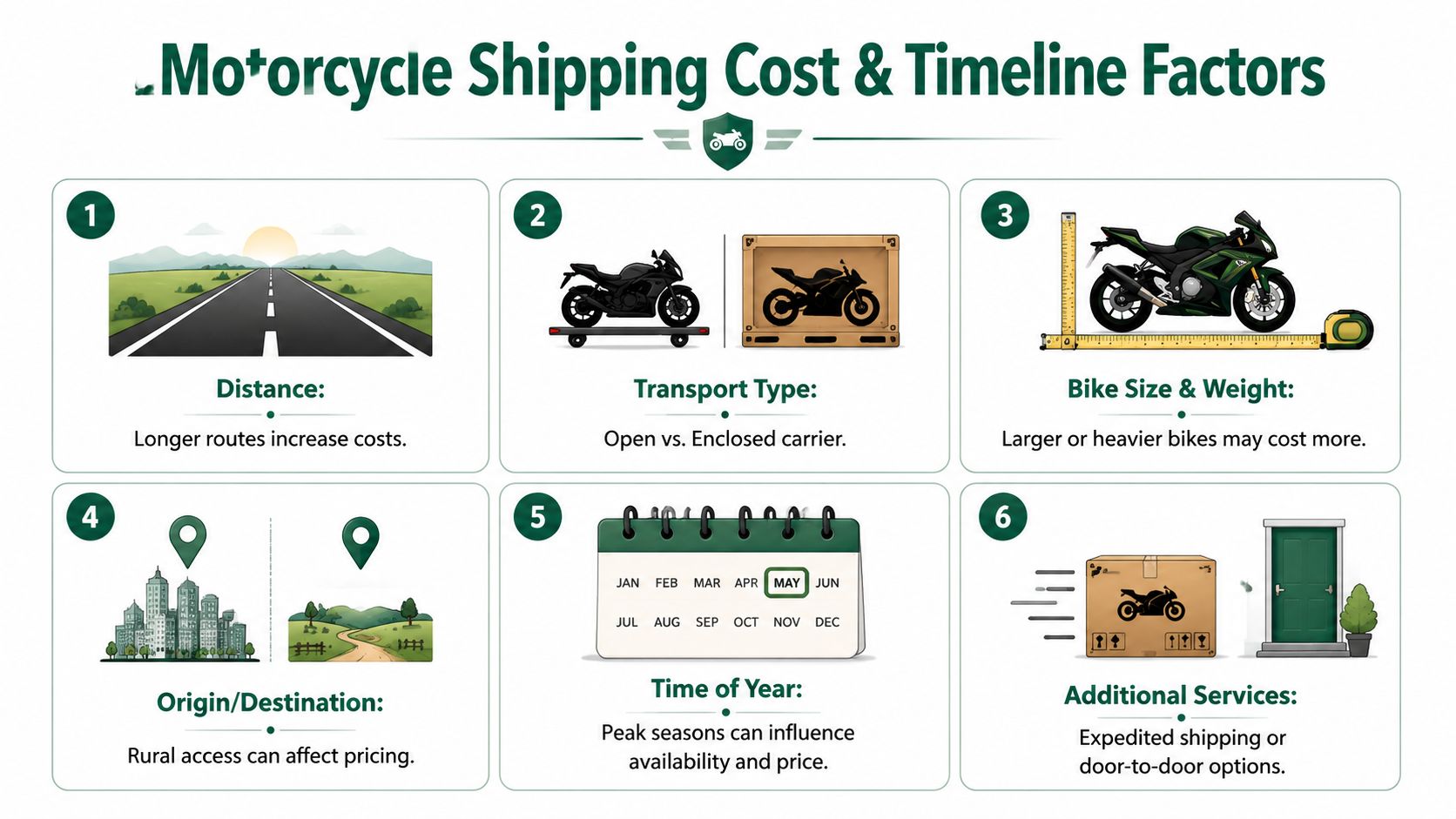
What changes the quote
Distance is obvious, but it isn't the only pricing driver. Motorcycle shipping quotes usually move up or down based on a mix of operational details.
- Route type: A direct lane between major metro areas is easier to service than a rural pickup with limited truck access.
- Service level: Open service costs less than enclosed. Expedited service usually costs more than flexible scheduling.
- Bike profile: Heavy touring motorcycles, oversized handlebars, custom fairings, and low-ground-clearance builds can require more careful loading.
- Pickup model: Residential, terminal, business, dealership, and port access all affect how a carrier plans the job.
- Protection level: Valuation coverage included in a quote isn't always the same thing as broader insurance expectations.
For readers comparing transport categories across industries, this heavy equipment shipping cost guide is useful because it shows the same core pricing principle. Specialized handling changes the quote because the equipment and risk profile change.
Here's a simple way to think about motorcycle pricing:
| Cost factor | Usually lowers cost | Usually raises cost |
|---|---|---|
| Route | Common metro-to-metro lane | Remote or hard-access locations |
| Carrier type | Open trailer | Enclosed equipment |
| Scheduling | Flexible pickup window | Rush or priority timing |
| Motorcycle setup | Standard dimensions | Oversized or low-clearance setup |
| Handoff style | Business or terminal access | Complex residential or port coordination |
A video can help if you want a general visual overview of vehicle shipping workflow before booking.
What realistic timing looks like
Timing causes more confusion than price because customers often mix transit time with total logistics time. Verified U.S. industry estimates published in A-1 Auto Transport's 2026 motorcycle shipping statistics put domestic delivery windows at 5 to 10 business days in typical cases, with 1 to 3 days for shorter regional moves and 7 to 14 days for cross-country shipments.
Puerto Rico doesn't fit neatly into those mainland-only windows. A Puerto Rico move can include mainland dispatch, port intake timing, ocean scheduling, arrival processing, and release coordination. That's why experienced coordinators don't promise island timing the same way they quote a direct domestic route.
Ask for the timeline in stages. Pickup window, inland transit, port handoff, ocean leg, arrival release, and final delivery if applicable.
If you want the smoothest experience, focus less on the lowest raw quote and more on whether the provider can explain what is included, what is excluded, and how the route will move.
How to Prepare Your Motorcycle for Pickup
A well-prepared motorcycle is easier to inspect, safer to secure, and less likely to trigger disputes later. Good prep protects you just as much as it protects the bike. Most avoidable problems show up before the trailer leaves, not halfway through the trip.
Start with condition records
Wash the motorcycle first. Dirt hides scratches, small chips, and rub marks that matter during inspection. Once it's clean, take timestamped photos from all angles and capture close shots of any existing cosmetic issues.
The verified handling data for this article is very clear on one point. Carriers need timestamped photos and a signed Bill of Lading, and without that record, insurance claims for new scratches or dents face a 90% denial rate.
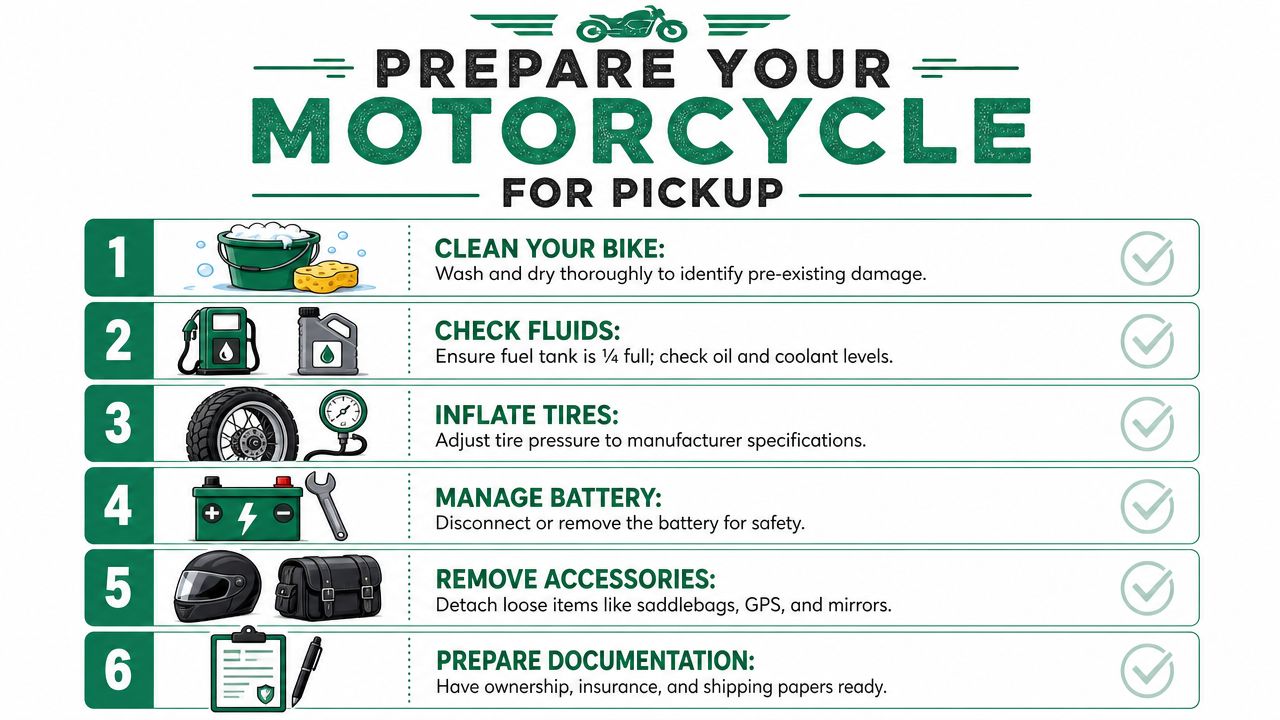
Use this pickup checklist before the driver arrives:
- Clean the bike completely: A clean surface makes inspection accurate.
- Photograph everything: Include both sides, front, rear, controls, tank, fairings, wheels, and existing marks.
- Record mileage: Note the odometer in your photo set.
- Remove loose accessories: Saddlebags, phone mounts, GPS units, and anything detachable should come off unless the carrier approves them.
- Disarm alarms: An armed bike creates avoidable loading delays.
- Have your documents ready: ID, registration or title copy if needed, and booking details should be easy to access.
A rushed inspection is where disagreements begin. Slow the handoff down enough to document the bike properly.
Prep that protects the bike in transit
Mechanical prep matters too, even if the motorcycle isn't being ridden. The most useful rule is to make the bike stable, dry, and easy to secure.
The same verified data highlights several technical handling standards:
- Soft-loop straps and a wheel chock: This setup reduces suspension compression damage by 40% compared with standard tie-downs attached directly to handlebars.
- Correct strap angle: Straps should be applied at a 45-degree angle to the frame to spread tension evenly.
- Brake setup before loading: Failure to apply the brake lever and engage the parking brake contributes to 25% of reported damage claims because the bike can shift laterally under sudden deceleration.
- Tire pressure adjustment: Lowering tire pressure by 10% to 15% before transport can help dampen high-frequency vibration from rough roads.
That doesn't mean you need to do the driver's job. It means you should know what proper loading looks like so you can spot shortcuts.
A few practical prep points also help:
- Check for leaks: Active leaks can delay pickup because carriers don't want fluids spreading on the trailer.
- Keep fuel limited: Follow the carrier's instructions and avoid a full tank.
- Charge or maintain the battery if the bike needs to roll and steer cleanly: Especially important for bikes with electronic locks or accessories.
- Tell the dispatcher if the bike has quirks: Very low clearance, wide bars, a custom front fairing, or a non-running condition should be disclosed early.
The best pickups feel routine. That usually means the owner prepared well and the carrier arrived ready for the specific motorcycle in front of them.
Choosing the Right Carrier and Understanding Your Paperwork
A motorcycle shipment usually goes off course long before delivery. It happens when the booking sounds simple, but no one can explain who is handling the bike, what equipment they use, or what paperwork controls the release once the shipment reaches Puerto Rico.
Carrier selection matters even more on Puerto Rico moves because you are not booking one isolated trip. You are setting up a chain of custody that often includes mainland pickup, port intake, ocean freight, arrival processing, and final release. If any handoff is vague, delays and confusion tend to show up later.
What separates a specialist from a generic hauler
A motorcycle specialist should be able to describe the job in practical terms. According to Meridian Worldwide Transportation's motorcycle shipping overview, specialist carriers use equipment such as air-ride trucks and extra-large lift gates, which can reduce loading risk for heavy touring models and low-clearance bikes. That is the level of detail you want during booking.
Ask questions that force clear answers:
- What equipment will be used to load the bike? Lift gate, ramp type, wheel chock, and tie-down setup should all be clear.
- Where will the bike be secured? The answer should reference solid structural points, not trim pieces, cables, or lines.
- Who is responsible at each stage of a Puerto Rico move? You should know who handles the mainland leg, the port handoff, the ocean segment, and the release contact.
- What credentials can the carrier provide? Licensed and bonded should not be treated as a vague reassurance.
- How are updates communicated? One informed contact is better than being passed between dispatch, port staff, and ocean representatives.
Puerto Rico shipping exposes weak coordination fast. A carrier can be perfectly capable on a domestic mainland route and still struggle once port procedures, release authorization, and Spanish-language documentation enter the process. Experienced bilingual support helps because paperwork questions often need to be resolved quickly and clearly, especially when an owner, family member, or dealer is receiving the bike on the island.
The paperwork that matters most
The Bill of Lading, or BOL, is the document customers should understand before pickup day. It records the motorcycle's visible condition, identifies the shipment, and serves as the reference document at delivery. If a problem is visible when the bike arrives, it needs to be written on the BOL before the delivery is signed off.
Coverage terms also deserve a close read. Customers often hear "insured" and assume every type of damage or delay is covered the same way. That is not how transport claims work. Ask what is included, what exclusions apply, what evidence is required, and how a claim must be submitted.
Review these items before the bike moves:
| Document or item | Why it matters |
|---|---|
| Bill of Lading | Records condition at pickup and delivery |
| Booking confirmation | Confirms route, service type, and responsible parties |
| ID | Verifies the shipper or authorized receiver |
| Title or registration copy | Supports ownership verification |
| Coverage terms | Explains what protection is included and how claims are handled |
Puerto Rico documents and handoffs
Puerto Rico shipments usually require more coordination than a mainland booking because the paperwork follows the bike through multiple checkpoints. Proof of ownership, government-issued identification, and release information are common requirements. Depending on the route and receiving arrangement, an authorized representative may also need to be listed in advance.
The strongest files are the boring ones. Matching names, readable ID, clean ownership documents, accurate booking details, and a complete BOL prevent a lot of avoidable delays.
Customers often focus on the truck pickup and assume the hard part is over once the bike reaches the port. In practice, the harder questions tend to come later. Who can collect the motorcycle on arrival? Are taxes, fees, or local processing steps already understood? Is the person receiving the bike prepared to present the same name and documentation shown in the booking file?
That is why experienced Puerto Rico coordination matters. The shipment needs to work as one connected process from mainland dispatch to island release, not as separate bookings stitched together after the fact.
Navigating Pickup Delivery and Special Scenarios
Pickup day should feel structured. The driver arrives, confirms the unit, inspects the motorcycle with you, notes visible condition on the Bill of Lading, and loads the bike using the agreed equipment. If the bike has a custom fairing, low pipes, ape hangers, or limited steering lock, speak up before loading starts, not after the straps are on.
What happens on pickup day
A good handoff is collaborative. You and the driver should both look at the motorcycle closely. Any existing scratches, chipped paint, bent levers, or cosmetic wear should be listed before the truck departs.
If the route includes Puerto Rico, your pickup may only be the first leg. That means you should confirm the next handoff point, whether the bike is going to a port facility, and who will contact you when the ocean segment is scheduled or completed.
Delivery day and exception handling
Delivery is where customers sometimes rush, especially if they've waited a while for the bike to arrive. Don't sign final acceptance before inspecting it. Check the same areas documented at pickup, compare them to your photos, and review the BOL before closing out the delivery.
If something looks off, note it immediately on the paperwork and keep your photo record organized. Delayed complaints are harder to resolve than issues identified during the delivery inspection.
Special moves that need extra coordination
Some shipments need more planning than a standard residential move.
- Dealership purchases: The carrier may need a release contact, buyer confirmation, and coordination with receiving hours.
- Non-running project bikes: Carriers need advance notice because loading equipment and labor may differ.
- Military relocations: PCS timelines often involve tight windows, shifting orders, and handoffs between family schedules and transport schedules.
- Puerto Rico port pickup: Owners should expect identity verification, release procedures, and possible scheduling around port operations rather than a simple curbside handoff.
The common thread is simple. The more unusual the bike or route, the more valuable clear communication becomes.
If you need a motorcycle move that may involve mainland pickup, enclosed handling, or Puerto Rico coordination, National Car Transport can help you map the route, review the required documents, and explain the handoff process before you book. Their U.S.-based bilingual agents work in English and Spanish, which is especially useful when a shipment involves both mainland scheduling and Puerto Rico release steps.