

For a CONUS-to-CONUS PCS, the government generally doesn't pay to ship a service member's vehicle. The member usually drives and uses MALT reimbursement or privately arranges transport, with exceptions confirmed through the local transportation office.
You've got PCS orders, a reporting date, a household to coordinate, and a vehicle sitting in the driveway. The difficult part often isn't finding a carrier. It's determining whether shipping is your responsibility, whether driving makes more financial sense, and how to protect yourself if the vehicle arrives before you do.
That's the central issue in military car shipping CONUS. Domestic PCS vehicle transport follows different funding rules from many overseas relocations, so choosing a carrier before confirming your entitlement can create an avoidable bill. The right sequence is funding first, transportation method second, paperwork third, and delivery controls last.
Table of Contents
- Why CONUS Military Car Shipping Is Different
- Eligibility and the Money Question for CONUS POV Shipping
- Self-Drive, Commercial Shipping, or Government POV
- Documents and Timing for a CONUS Vehicle Move
- Booking, Pickup, and Delivery Workflow
- Peak-Season Risk and How to Beat It
- Putting It All Together Before You Call
Why CONUS Military Car Shipping Is Different
A permanent change of station inside the continental United States can look similar to an overseas move from the family's perspective. You still have orders, household goods, school or work arrangements, housing deadlines, and a duty-station reporting date. Vehicle funding, however, can work very differently.
The Department of Defense is the largest customer in the U.S. personal-property moving and storage industry, representing approximately 15% of domestic and international moves. Through the Defense Personal Property Program, it coordinates roughly 400,000 personal-property shipments each year, including household goods, storage, and privately owned vehicle services. About 40% of those shipments occur during the peak period from mid-May through late August, according to the Government Accountability Office overview of the Defense Personal Property Program.
That scale explains why military relocation logistics can become congested, but it doesn't answer the first question for a CONUS vehicle: who pays?
Start with entitlement, not a quote
Before requesting open or enclosed transport, ask your transportation or personnel office to confirm the vehicle benefit attached to your specific orders. A CONUS-to-CONUS move generally means you'll either:
- Drive the vehicle yourself and use any authorized travel reimbursement.
- Arrange and pay for commercial shipping.
- Qualify for an exception that changes the normal funding result.
The answer can depend on medical limitations, vehicle condition, concurrent travel, deployment timing, household circumstances, and the exact language in your orders. Generic military shipping articles can't replace written confirmation from the office handling your PCS.
Once the funding question is settled, the rest becomes manageable. You can compare self-driving with commercial transport, gather registration and insurance documents, establish a pickup window, prepare a condition report, and plan for delivery access. Reverse that order and you may book a shipment that your orders never authorized or miss a deadline while waiting for an answer.
Advisor's rule: Treat the vehicle handoff as a controlled custody event, not a casual driveway appointment.
This guide focuses on the practical decisions that affect families, students, snowbirds, dealerships, and businesses moving vehicles across the 48 states, between mainland cities, or from the mainland to San Juan, Puerto Rico. The same planning discipline applies whether you're relocating a daily driver from Atlanta to San Diego, sending a second family vehicle from New York to Florida, or coordinating a commercial shipment to Puerto Rico.
Eligibility and the Money Question for CONUS POV Shipping
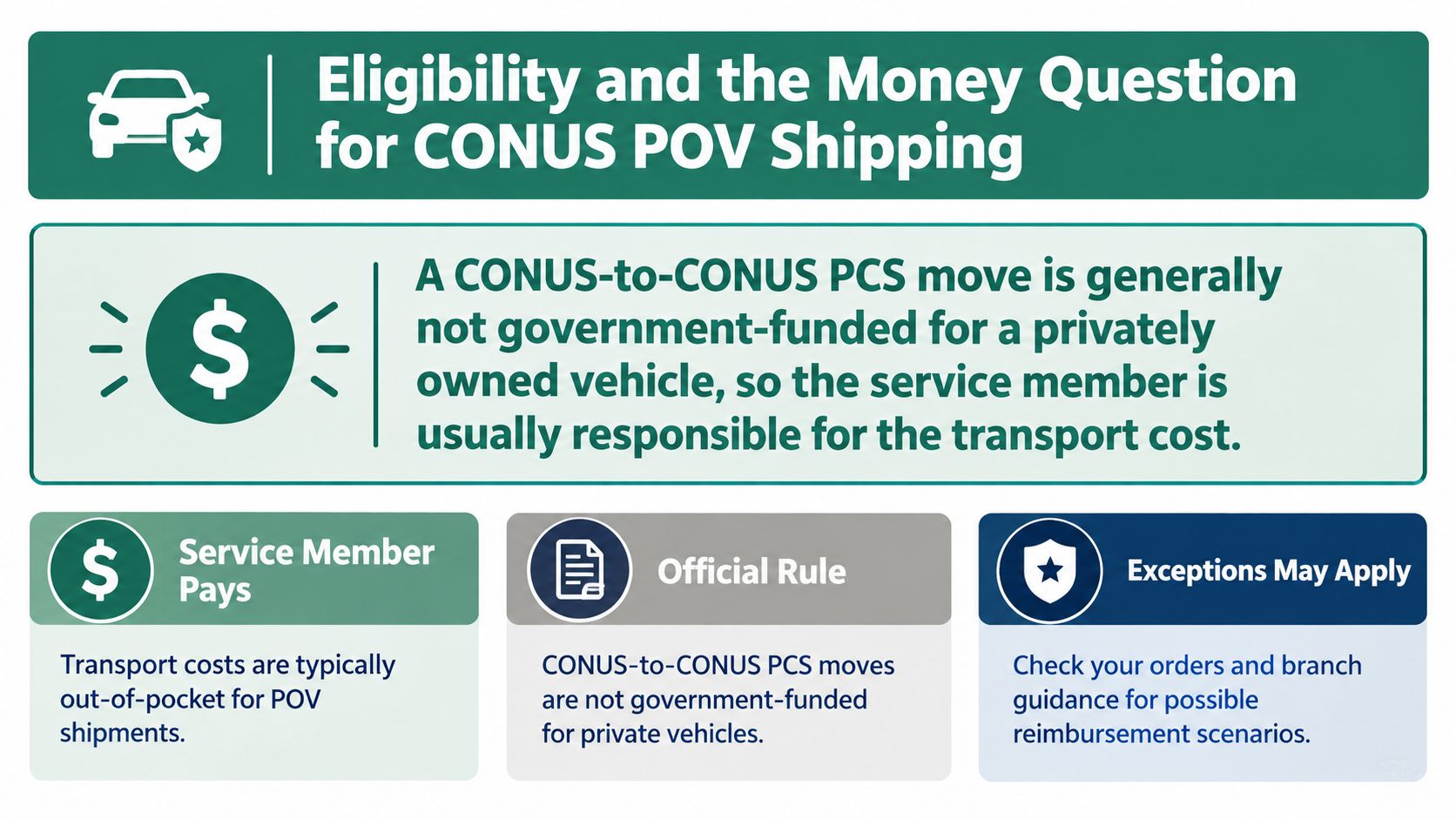
For a CONUS-to-CONUS PCS, a privately owned vehicle is generally not fully government-funded. Military OneSource explains that a service member may have an entitlement to ship or store one qualifying POV at government expense under applicable PCS circumstances, but transporting that vehicle between two CONUS duty stations is largely the member's responsibility, subject to exceptions. Confirm the result with your local transportation office before signing a commercial booking or assuming reimbursement applies. The governing guidance is summarized in the Military OneSource PCS moving FAQs.
A qualifying POV is generally self-propelled, licensed for public highways, and designed to carry passengers or household goods. The standard entitlement is limited to one personally used vehicle owned or leased by the member. Motorcycles and dirt bikes may be treated differently during a CONUS move, with their weight counted against the authorized household-goods allowance rather than handled like a standard car shipment.
The exceptions deserve a written answer
The normal rule isn't the entire story. A medical limitation may make a long drive unreasonable. A non-drivable vehicle may require a transport solution. A second vehicle, childcare responsibility, deployment schedule, or overlapping reporting requirements may make self-driving impractical. Those facts don't automatically create an entitlement, but they're exactly the circumstances your transportation or personnel office should evaluate.
Consider a family receiving orders from Fort Liberty to Joint Base Lewis-McChord. One spouse drives the family's SUV while the service member flies ahead to report. That family may choose private shipping for the SUV, but it shouldn't assume the commercial charge is reimbursable because the move is military-related. The family needs a written determination before booking.
For a practical comparison of related relocation benefits, readers may also want to compare pet relocation reimbursement caps when calculating the full cost of a PCS. Vehicle and pet benefits follow different rules, so keep those budgets separate.
Commercial pricing also needs its own evaluation. Review route, vehicle type, carrier type, service level, and timing through a car shipping cost guide, but don't treat a market quote as proof that the military will reimburse it.
The contrarian answer: “PCS” doesn't automatically mean free CONUS vehicle shipping. On a domestic move, the default financial model is often self-drive reimbursement or privately paid transport.
Self-Drive, Commercial Shipping, or Government POV
Once the transportation office gives you an answer, compare the actual alternatives. The cheapest quote isn't necessarily the cheapest move, and driving isn't free just because no carrier invoice arrives.
MALT reimbursement is based on the official distance used for the travel authorization, not the odometer reading. Your comparison should include fuel, lodging, meals, tolls, vehicle wear, missed work, childcare, and the possibility that the car won't be available when you report. A service member who drives alone may spend less than a commercial shipment, but that calculation changes when dependents fly, two vehicles need to move, or the reporting schedule is compressed.
| Option | Who Typically Pays | Typical Timeline | Best Fit |
|---|---|---|---|
| Self-drive with MALT | The member incurs travel costs and may receive authorized mileage reimbursement | Built around the driver's travel schedule | One operable vehicle, one available driver, and a manageable route |
| Private commercial shipping | Usually the member, unless an exception or separate authorization applies | Pickup and delivery depend on route, carrier availability, and service level | Families flying, members with limited driving capacity, second vehicles, or narrow reporting windows |
| Government-arranged POV shipment | Government funding may apply only when orders and circumstances authorize it | Controlled by the applicable military process and destination requirements | Authorized exceptions, qualifying overseas arrangements, or specific official guidance |
When driving wins
Driving can make sense when one person can safely operate one vehicle, the official distance is manageable, and the family already plans to travel by road. It also gives you direct control over departure and arrival. That control disappears if weather, fatigue, mechanical trouble, or a hard reporting deadline enters the picture.
MALT reimbursement doesn't erase every travel cost. It also doesn't reimburse the lost time or wear on the vehicle in the same way a commercial shipment avoids them. Build a simple worksheet with the reimbursable travel allowance on one side and the full road-trip cost on the other.
When private shipping earns its place
Commercial transport becomes more compelling when dependents fly, the member must report before the vehicle can arrive, a second vehicle is involved, or a medical limitation makes a long drive unsafe. In the 48 states, door-to-door service is often the simplest arrangement, provided the pickup and delivery locations are accessible to the carrier.
Open transport usually offers broader availability, while enclosed service makes more sense for high-value, classic, luxury, or particularly vulnerable vehicles. You'll find the main trade-offs explained in this guide to open car transport.
Government-arranged POV shipping is not the default domestic option. Treat it as an exception path that requires confirmation from your orders and transportation office, not as a standard booking category offered by a private dispatcher.
Documents and Timing for a CONUS Vehicle Move
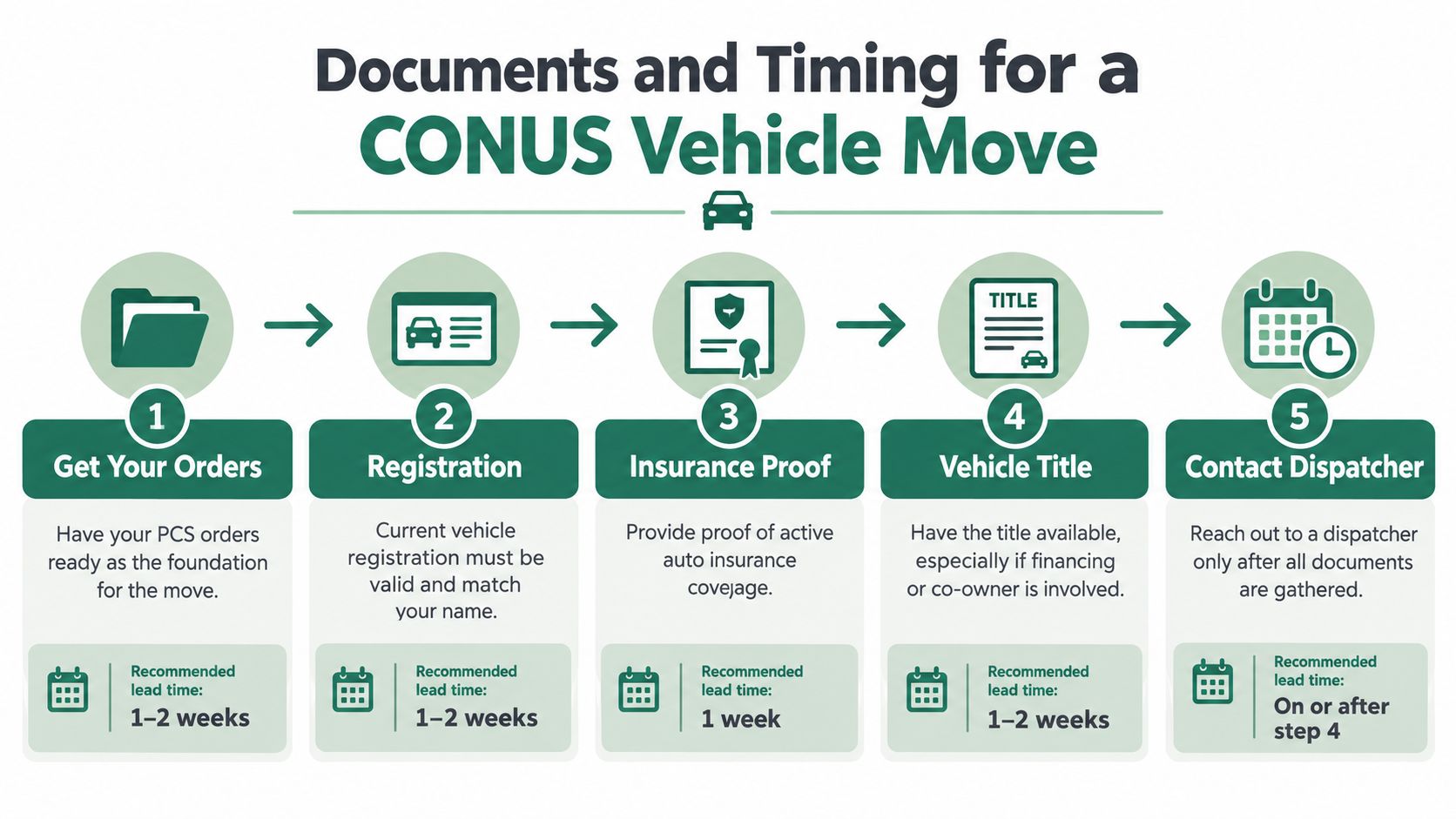
Paperwork should be ready before you ask a dispatcher to locate capacity. At minimum, assemble your PCS orders and amendments, current registration, proof of insurance, title or lease documents, photo identification, and any lienholder or leasing-company authorization that applies. If a spouse or designated representative may release or receive the vehicle, prepare the appropriate power of attorney in advance.
The vehicle also needs operational instructions. Write down key details, alarm procedures, toll-tag handling, special starting instructions, and destination contact information. A carrier can't follow instructions it never receives.
Use the report date as your anchor
One installation recommends beginning POV shipment planning 90 days before departure, giving military families a useful planning benchmark even when the exact carrier timeline differs. Organize the countdown this way:
- At 90 days: Confirm the orders, report date, origin, destination, vehicle operability, and likely access restrictions.
- At 60 days: Get a firm answer on whether any government entitlement or exception applies. Keep the answer in writing.
- At 30 days: Choose self-drive or private commercial transport, then request service based on a realistic pickup window.
- At 7 days: Reconfirm access, keys, alarm instructions, contact names, vehicle availability, and the loading appointment.
The night before pickup, wash the vehicle well enough to expose existing damage. Remove personal property, photograph every exterior side, the interior, glass, wheels, and accessible lower areas, and save the images with the date. Document fuel level, mileage, warning lights, and accessories.
A clean condition report protects you far more effectively than a vague promise about careful handling. If the vehicle has scratches, dents, cracked glass, wheel damage, or mechanical issues, make sure the carrier records them before loading.
Booking, Pickup, and Delivery Workflow
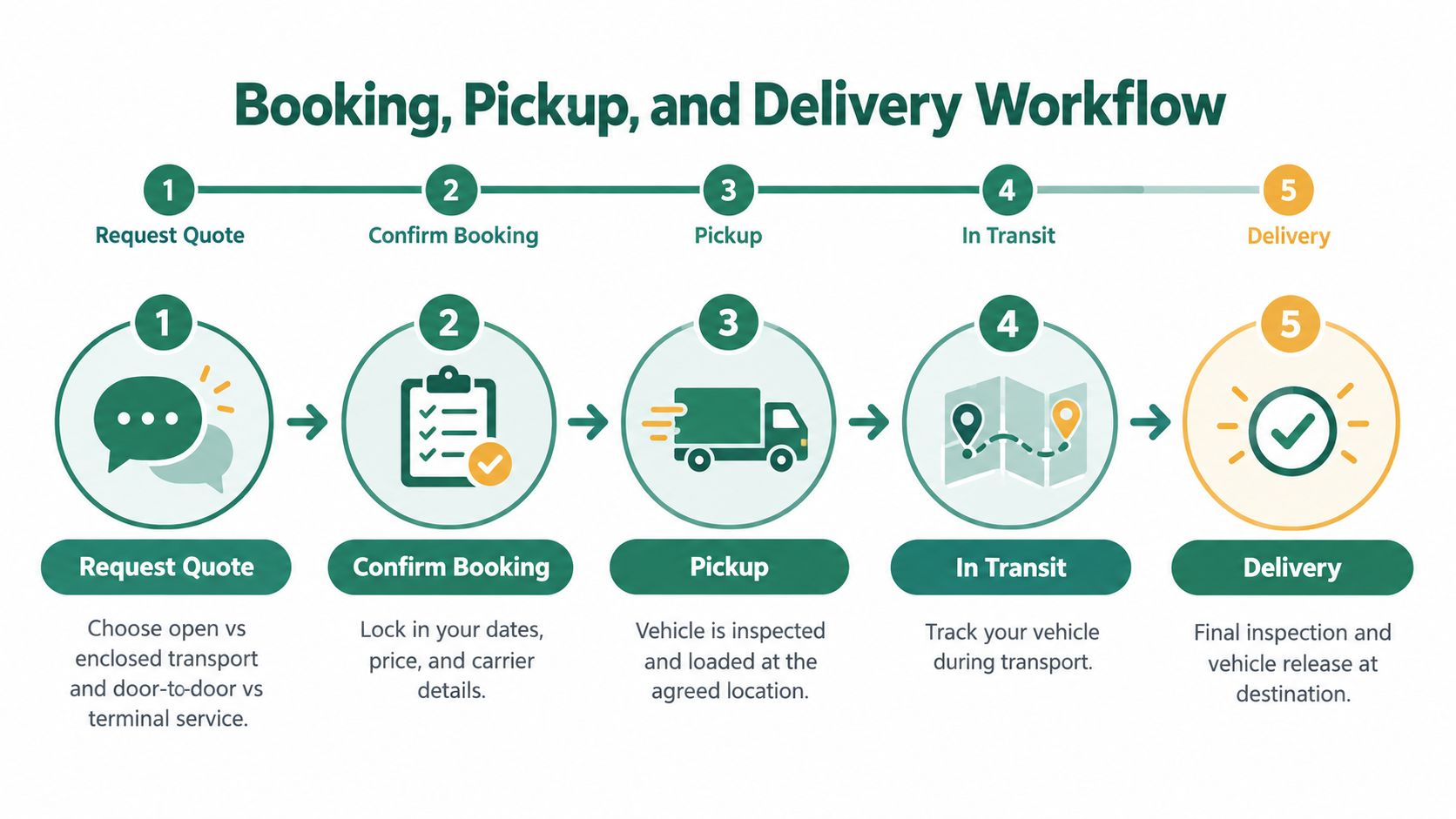
A good shipment follows a chain. The quote establishes the service, the booking identifies the carrier, the pickup creates the baseline condition record, transit updates establish custody milestones, and delivery closes the record.
Start by specifying the vehicle, origin, destination, operability, preferred dates, and service type. Decide whether you need open or enclosed transport and whether door-to-door or terminal service is realistic. A flat-rate quote should clearly state what it covers, including carrier compensation, applicable insurance, fuel assumptions, and possible access or location restrictions. Don't accept “guaranteed” language unless the actual service commitment appears in writing.
Pickup creates the evidence
Confirm the loading appointment in writing. Verify the driver's name, carrier information, expected arrival window, pickup address, and destination contact. Restricted installations may require pre-clearance, an alternate meeting point, or a transportation-office instruction.
Before signing the bill of lading or condition report, inspect the vehicle with the driver. Compare the written record with your dated photographs. Point out every existing defect, even one that seems minor. Remove loose belongings, leave only the fuel level required by the carrier, provide the keys, and disable or explain alarms.
Keep these four milestones separately:
- Booking accepted, with the service and carrier details confirmed.
- Pickup completed, with the signed origin condition report.
- Arrival in the destination region, with a current carrier update.
- Final delivery, with the destination inspection completed.
For military families, door-to-door auto transport can reduce handoffs, but “door-to-door” still depends on safe truck access, local restrictions, and installation rules.
Here's a practical visual explanation of the process:
Delivery is not complete until you inspect
Compare the car against the original condition report before accepting possession. Inspect the exterior, interior, glass, wheels, accessible underbody areas, and accessories. Record every discrepancy on the delivery document before the driver leaves, then photograph the damage.
Military guidance warns customers to list damage on DD Form 788 or its commercial equivalent before leaving the Vehicle Processing Center. Damage discovered after 48 hours is substantially harder to attribute to the carrier, as discussed in the GAO review of military household-goods shipment management.
Retain the signed origin and destination reports, photographs, booking confirmation, dispatch records, and time-stamped messages in one folder. If concealed damage appears later, notify the responsible transportation provider immediately and preserve the evidence.
Peak-Season Risk and How to Beat It
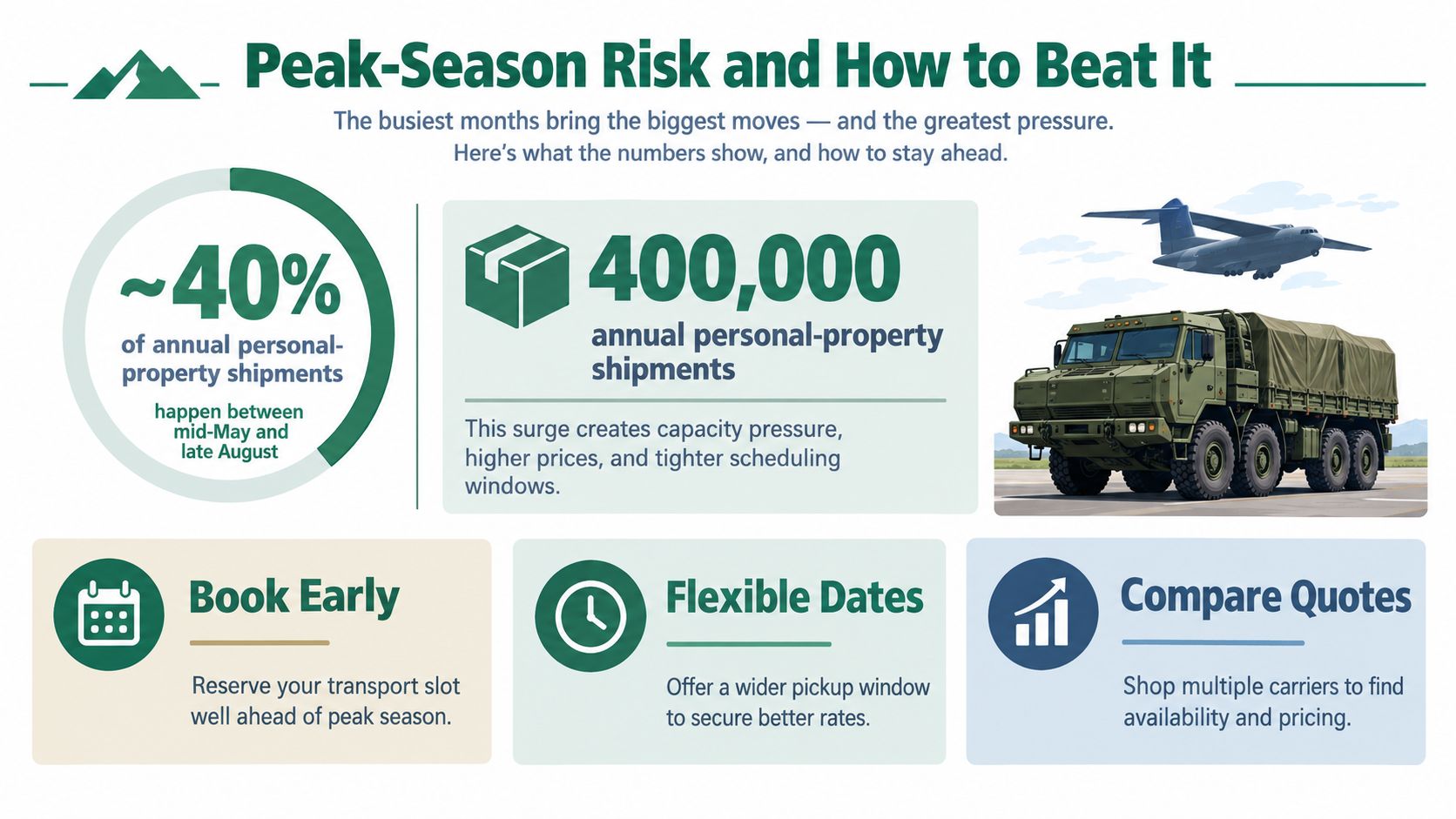
The summer PCS surge changes the booking problem. GAO reports that approximately 40% of roughly 400,000 annual personal-property shipments occur during the 14-week peak season from May 15 through August 31. That figure covers the broader Defense Personal Property Program, not only privately owned vehicles, but it's a useful indicator of pressure on carrier availability, appointments, and scheduling.
The lowest quote can become the most expensive choice if the carrier can't reach a restricted installation, arrives during a narrow no-access window, or delivers before the family has a legal and practical way to accept the vehicle. A cheap booking that fails to align with housing, leave, school travel, or reporting dates creates costs that don't appear on the original quote.
Track milestones instead of one delivery promise
Use a simple scorecard:
- Booking accepted: The provider confirms the service, dates, route, and carrier details.
- Pickup completed: The vehicle is loaded and the origin condition report is signed.
- Destination region reached: The vehicle is approaching the final area.
- Final delivery completed: The recipient inspects and signs the destination report.
Book as soon as orders and reporting dates are known. Offer a flexible pickup window rather than insisting on one narrow date. Confirm installation access, vehicle operability, keys, alarm instructions, and the destination contact. Obtain written appointment confirmation, then re-confirm 48 to 72 hours before pickup.
Do not treat a requested pickup date as a guaranteed delivery date unless the transportation provider defines that service level contractually. A commercial provider's advertised fleet-wide “success rate” also doesn't answer the damage question when no validated CONUS POV damage-rate denominator exists. The stronger quality controls are complete origin and destination reports, full photo coverage of pre-existing defects, and written notification of every discrepancy.
Putting It All Together Before You Call
Before contacting a dispatcher this week, take three actions. First, confirm your CONUS POV entitlement with the transportation office. Second, compare self-drive with MALT against private shipping using your household's real travel, work, medical, and reporting constraints. Third, start from the report date and protect the 90-day planning window.
Photograph the vehicle the night before pickup, and name a delivery agent with appropriate power of attorney if you may not be present. Reject any quote demanding full payment upfront, any provider without verifiable MC operating authority, any “guaranteed” pickup date that isn't written into the order, and any carrier that won't provide written condition reports at both ends.
National Car Transport handles door-to-door vehicle transport across the mainland, Puerto Rico, and other U.S. routes, with open and enclosed options, transparent flat-rate pricing, and a network of 25,000+ vetted carriers backed by 25+ years of experience and an A+ BBB rating. Its U.S.-based bilingual English and Spanish agents have more than 20 years of auto transport logistics experience, so National Car Transport can help you compare the funding decision, pickup window, access requirements, and delivery plan before you book.