
The most popular advice about military auto transport reviews is to compare star ratings and pick a highly rated company. That's a weak way to choose. A review can praise a smooth domestic pickup yet tell you nothing about overseas paperwork, a Vehicle Processing Center handoff, or what happens when delivery damage turns into a claim.
Start by identifying which process applies to your move. A government-authorized shipment and a self-funded commercial shipment aren't interchangeable, and a mainland route to San Juan adds ocean-export documentation that an over-the-road move doesn't involve. The comparison below gives you a better starting point than the headline rating.
| Situation | What the review should help you judge | What to verify before booking |
|---|---|---|
| Government-authorized overseas POV shipment | Inspection records, paperwork accuracy, handoffs, and claims follow-through | Entitlement, orders, required documents, and Vehicle Processing Center instructions |
| Self-funded CONUS move | Pickup coordination, condition documentation, communication, and claim support | Written scope, assigned-carrier details, and total out-of-pocket cost |
| Mainland to or from Puerto Rico | Export paperwork, VIN accuracy, port coordination, and delivery arrangements | Who files EEI, who books the sailing, and whether the move is a relocation or an import |
Table of Contents
- Why Star Ratings Mislead Military Shippers
- How to Read Reviews Like an Investigator
- Government POV Shipping Versus Commercial Auto Transport
- What Strong Reviews Actually Reveal About Claims Handling
- When the Destination Is Puerto Rico
- Real Scenarios That Change What You Should Look For
- Questions to Ask Before You Book
- Putting the Scorecard to Work in 24 Hours
Why Star Ratings Mislead Military Shippers
A five-star average can't tell you whether a company handled a PCS move well. Military vehicle shipping may involve a transportation office, a Vehicle Processing Center, a port, and one or more contractors. A reviewer who had an easy pickup may never have faced the paperwork or custody handoffs that matter most to a service member.
Reviews also represent only the customers who chose to post them. BrightLocal's 2025 Local Consumer Review Survey analyzed responses from 1,026 U.S. adults and found that 74% check at least two review platforms before choosing a local business. The same survey reported that 96% were open to writing a review, but only 29% had done so in the preceding year. That gap means posted feedback can be useful without representing every customer's experience. BrightLocal's 2025 survey also found that 89% would use a business that responds to all reviews, compared with 44% for one that responds to none.
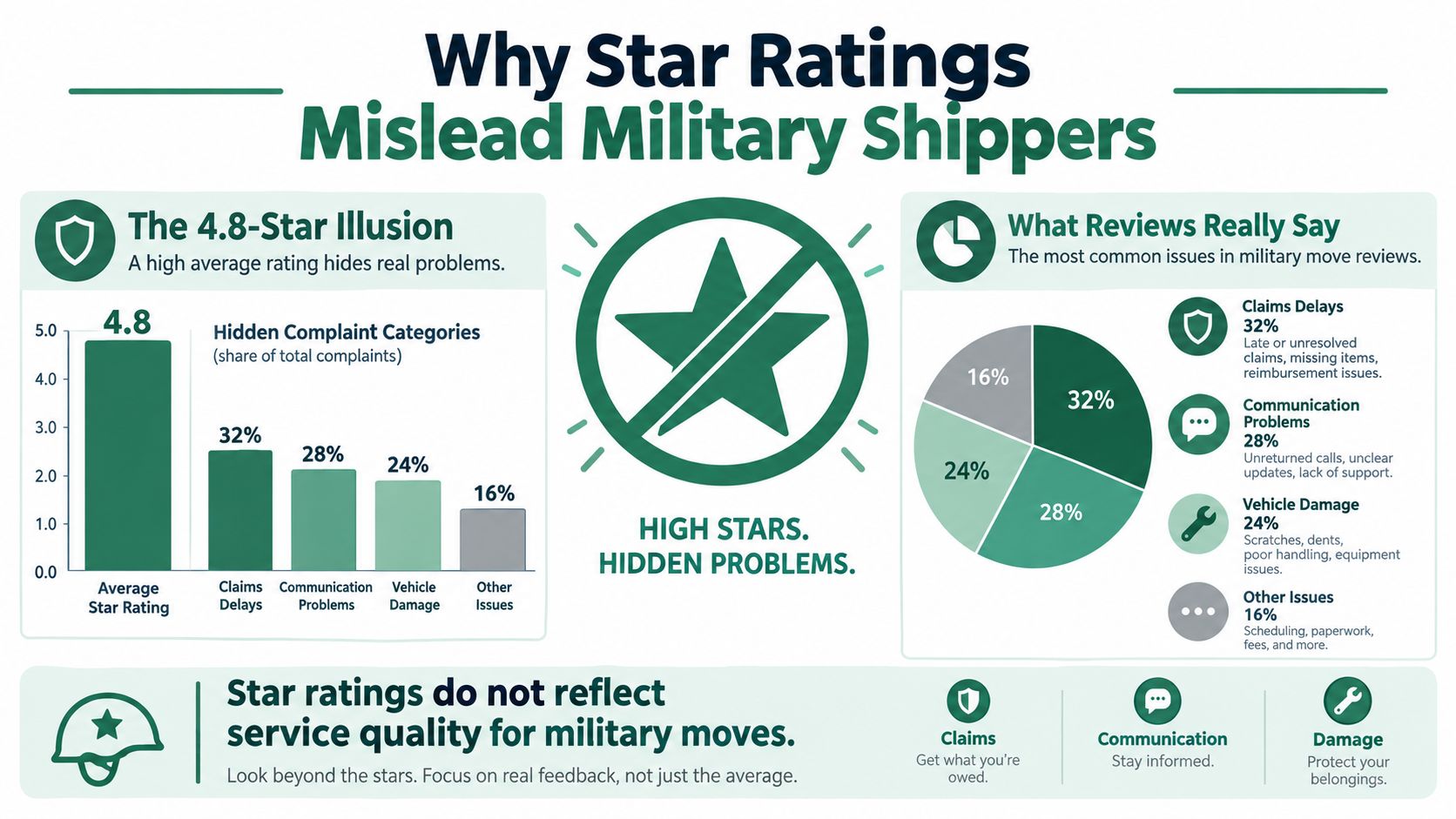
For a military move, look past the score to the details: Did the provider explain the required documents before pickup? Was the vehicle's condition recorded? Did the reviewer describe a claim process and how the company communicated when something went wrong? A headline rating won't answer those questions.
My rule: A detailed account of a well-documented problem is more useful than vague praise that says only “great service.”
The reviews worth your time describe the route, the handoff, the inspection evidence, and how the provider handled exceptions. Use star ratings as a filter, not a verdict. Then check multiple independent platforms and notice whether the company responds professionally to criticism as well as praise.
How to Read Reviews Like an Investigator
Read each review for evidence, not enthusiasm. “Driver was friendly” may be true, but it doesn't tell you whether anyone verified the vehicle's condition or explained what to do if damage appeared. Specific dates, inspection records, a clear claim channel, and a documented resolution give you something you can evaluate.
For military POV claims discovered after pickup, Military OneSource says the claim must be submitted within 10 business days. It says the contractor is expected to review, process, and settle the claim within 40 days. Military OneSource's moving-claims guidance gives you a practical reference point when a reviewer describes a damage dispute.
| Criterion | What to Look For | Red Flag |
|---|---|---|
| Inspection completeness | A condition report signed at pickup and delivery, with specific marks noted | No inspection record or unclear vehicle condition |
| Damage documentation | Photos and a description tied to the handoff | “It arrived damaged” without saying when or how it was recorded |
| Claim submission ease | A named claims channel and clear filing instructions | Reviewer couldn't find out whom to contact |
| Settlement speed | A claim date and a resolution date you can compare with the published timeline | No outcome described, or repeated delays without explanation |
| Communication | Updates during pickup, transit, delivery, and escalation | Unanswered messages or shifting explanations |
A five-star review can still score poorly on these criteria if it gives no evidence. A lower rating may be more useful if the customer carefully describes the inspection, claim process, and resolution.
Pay attention to handoffs. If the reviewer can't identify who picked up the vehicle or where its condition was recorded, the account leaves a major gap. Vague pickup windows and no mention of an inspection record deserve follow-up questions before you book.
Government POV Shipping Versus Commercial Auto Transport
First establish whether you're arranging an official shipment or hiring a commercial provider yourself. Under Military OneSource guidance, eligible service members may generally ship or store one qualifying privately owned vehicle at government expense after PCS orders. A qualifying vehicle must be self-propelled, highway-licensed, and designed to carry passengers or household goods. Military OneSource's PCS moving FAQs explain the eligibility and documentation context.
| Decision point | Government-authorized POV shipment | Commercial, self-funded transport |
|---|---|---|
| Who arranges the move | Official process tied to orders and entitlement | Customer books a commercial provider |
| Where the vehicle goes | May pass through a designated Vehicle Processing Center or port | Pickup and delivery depend on the booked service and route |
| What drives the cost | Entitlement and orders determine what the government covers | Customer pays under the agreed commercial terms |
| What to compare in reviews | Document checks, inspection records, handoffs, and claims | Price clarity, scheduling, communication, and claim support |
| What to confirm | Eligibility, paperwork, and processing-center instructions | Scope, pickup plan, carrier assignment, and charges |
For an overseas pickup, expect to confirm PCS orders, identification, and title, registration, or lienholder authorization. Missing paperwork can prevent acceptance at a port or processing center. That's why reviews praising a commercial carrier's price or speed may be irrelevant if your vehicle must move through an official channel.
CONUS-to-CONUS transport is generally the service member's responsibility, though the local transportation office determines exceptions. Driving can also make financial sense: MALT and per-diem rules may affect the comparison, while shipping can avoid mileage, vehicle wear, and disruption to family plans. Don't compare a quote with a reimbursement figure until you've considered the broader trip costs, including fuel, lodging, tolls, time away from work, rental-car needs, and possible excess-size charges. Military OneSource's PCS entitlements guidance is the place to check the rules that apply to your orders.
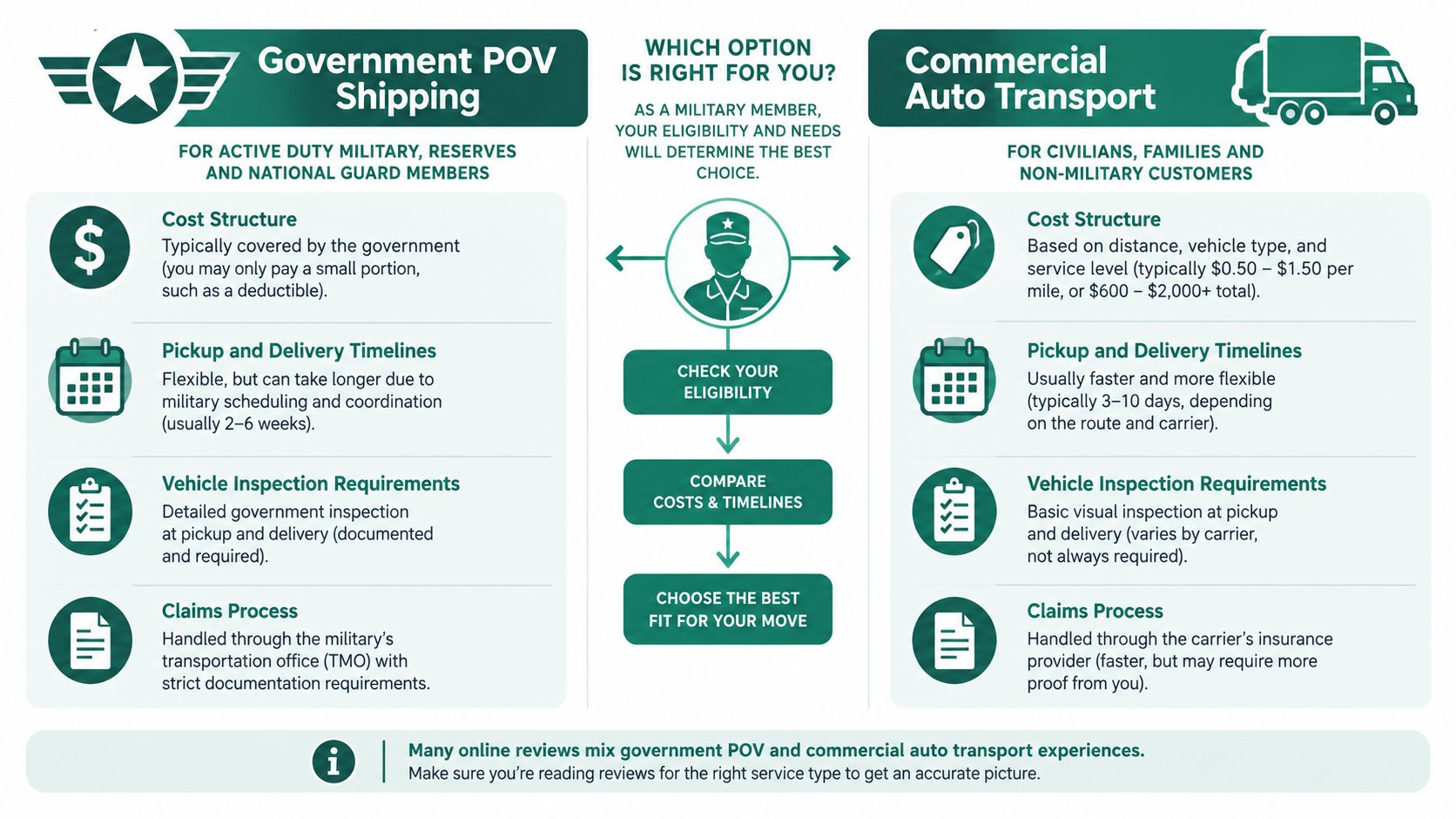
Before reading reviews, decide which column describes your move. If you're unsure whether a commercial carrier is needed or eligible for reimbursement, ask your local transportation office before treating a provider review as relevant.
What Strong Reviews Actually Reveal About Claims Handling
A review that says “the car arrived safely” is reassuring, but it doesn't test a provider's claims process. The more telling account explains how the company recorded the vehicle's condition, what happened when damage was found, and whether the customer could get a clear answer from the contractor.
At delivery, inspect the vehicle before leaving the Vehicle Processing Center. Record any new damage on DD Form 788 or its commercial equivalent. The best reviews identify the handoff point, describe the inspection evidence, and say when the claim was filed and resolved. They also separate new transport damage from defects that were already present.
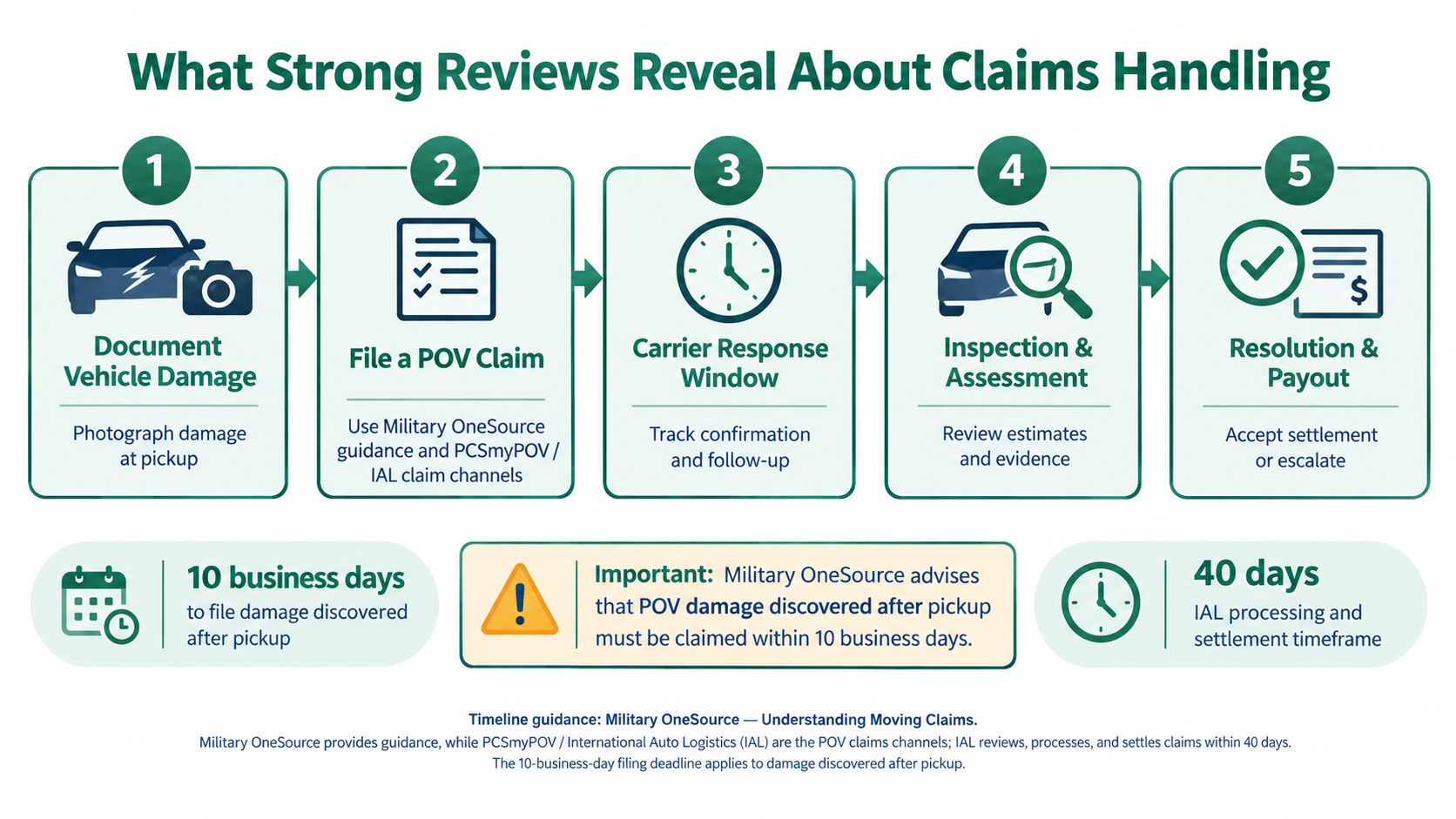
What to look for in a useful claim account
- Condition before shipment: The reviewer says whether the provider documented existing damage and supplied a signed inspection record.
- A usable claims route: The customer can identify whom they contacted and how they submitted the claim.
- A traceable timeline: The account gives the filing and resolution dates, making it possible to judge whether the provider met its stated process.
- Communication during escalation: The reviewer describes whether the company kept them informed, not just whether it eventually settled.
Overseas moves make custody records more important because the vehicle may pass among ports, processing centers, storage locations, and transport contractors. A routine domestic review may never test those handoffs. For broader cargo-claim context, My Safety Manager's Carmack Amendment cargo claim guide can help readers understand the subject, but follow the specific process that applies to your military shipment.
If a review mentions damage but not an inspection record, treat it as an incomplete account, not proof that a provider is either reliable or unreliable. Ask the company how it records vehicle condition, where claims go, and how it tracks a case through resolution.
When the Destination Is Puerto Rico
A move to or from San Juan isn't just a longer version of a mainland route. Mainland auto transport usually centers on road pickup and delivery. Puerto Rico shipping involves an ocean-export process, so a strong review should discuss document handling and port coordination as well as vehicle condition.
For used, self-propelled vehicles, U.S. Customs and Border Protection requires Electronic Export Information to be filed through the Automated Export System, with the vehicle's VIN or PIN included. CBP's Puerto Rico ruling resource makes VIN accuracy a practical checkpoint: compare it against the title and bill of lading, and ask who is responsible for filing the EEI. Missing or incorrect export information can delay vessel loading or customs release.

Relocation or import
Don't assume that every vehicle moving between the mainland and Puerto Rico is handled as a simple domestic relocation. If the vehicle is treated as an import, CBP says importers generally need proof of ownership, such as an original title or certified copy, and may need DOT Form HS-7 and EPA Form 3520-1. As a general rule, vehicles less than 25 years old must meet applicable Federal Motor Vehicle Safety Standards. Vehicles that don't meet U.S. emissions requirements may be refused, required to achieve compliance, or exported. CBP's vehicle-import guidance explains why customers should clarify the vehicle's status before arranging ocean transport.
When reading reviews for a mainland-to-Puerto Rico move, look for answers to practical questions: Did the provider identify who files EEI? Did staff check the VIN against the paperwork? Did the customer know who handled the sailing and port handoffs? A review that says only “delivery was on time” skips the parts most likely to distinguish an island shipment from an ordinary road move.
If your route involves San Juan, ask the provider to explain the ocean leg and the documents it needs before you schedule pickup. National Car Transport's Puerto Rico car-shipping service describes an option for customers arranging island-route transport; compare its stated process with the documentation your shipment requires.
Real Scenarios That Change What You Should Look For
The right review depends on the move. A provider may handle a straightforward domestic pickup competently yet be the wrong fit for a government-coordinated overseas shipment. Judge the service against your route, paperwork, and handoffs.
Overseas PCS from a CONUS base
A useful review describes whether the customer received document instructions before the appointment, whether the vehicle was accepted at the processing center, and how its condition was recorded. Ask whether the provider understands which parts of the move are government-directed and which, if any, need commercial arrangements. Reviews that mention only a carrier's arrival time don't answer those questions.
- Look for: Clear preparation instructions, inspection evidence, and a named handoff point.
- Ask: Who confirms that your paperwork is complete before the vehicle reaches the port or processing center?
CONUS-to-CONUS move with a young family
Here, the main choice may be commercial shipping versus driving. A family may value reduced mileage and fewer travel logistics, while a service member needs to confirm whether the shipment is personally funded or covered under an applicable exception. Look for reviews that describe pickup coordination, communication, and whether the customer understood the service and charges.
- Look for: A defined pickup plan and clear updates if timing changes.
- Ask: Does the proposed arrangement match your orders and the advice from your transportation office?
CONUS-to-Puerto Rico relocation
A retiring service member moving a vehicle to Puerto Rico needs more than a good road carrier review. Read for export-document responsibility, VIN accuracy, port coordination, and a clear explanation of what happens after the vehicle reaches the ocean terminal. Ask whether your situation is a relocation or an import, since the paperwork can differ.
- Look for: A review that names the ocean and port handoffs, not just pickup and final delivery.
- Ask: Who files EEI, who books the sailing, and who updates you if a document needs correction?
For mainland routes that need a defined pickup and delivery arrangement, compare the promised service details with door-to-door auto transport. The label matters less than knowing exactly where the vehicle changes hands and who is accountable at each stage.
Questions to Ask Before You Book
Ask the same direct questions of every provider. A capable company should answer clearly and explain what it needs from you before pickup. If the answer is vague, get it in writing before you make a decision.
Documentation
- What documents do you need from me? A sound answer names the paperwork for your route and asks about orders or lienholder authorization when relevant.
- How do you check the VIN against my title and transport documents? The answer should describe an actual verification step.
- What condition report will I receive? Expect a signed inspection record, with a clear way to note existing and new damage.
- What must I remove or prepare before handoff? The provider should give instructions early enough to act on them.
Claims
- Who receives a damage claim? The company should identify the channel and explain its role in helping you submit it.
- What evidence should I keep? Look for guidance on inspection records, photos, and delivery paperwork.
- How will you communicate during a dispute? A competent response explains who follows up and how you'll get status updates.
- What resolution timeline do you publish? Ask for the timeline in writing and compare it with the relevant military claims process.
Logistics
- Who is physically transporting my vehicle? The provider should tell you when the carrier is assigned and who handles dispatch.
- What pickup and delivery arrangements are included? Get the locations, timing expectations, and any limits explained.
- For Puerto Rico, who files EEI and books the sailing? Don't accept an answer that leaves responsibility unclear.
- What does the quoted price include? Ask what could change the final amount and what is excluded.
Always ask: “Who owns the next step if the vehicle can't be accepted, a document is wrong, or a sailing changes?”
For example, National Car Transport describes its service as offering 25+ years of experience, an A+ BBB rating, transparent flat-rate pricing, and a network of 25,000+ vetted carriers. It also offers bilingual, U.S.-based agents with over 20 years of auto transport logistics experience. Treat those details as starting points for the same questions you should ask any provider, not a substitute for confirming the process that applies to your shipment. For route-specific pricing factors, review its car-shipping cost information.
Putting the Scorecard to Work in 24 Hours
Today, confirm whether your move qualifies for a government POV shipment or needs a commercial booking. Then shortlist providers using the review scorecard, ask the questions above, and get documentation and claims responsibilities in writing. Compare price only after you know what the service includes and whether your shipment may be reimbursed. For service members who need bilingual, U.S.-based guidance on domestic routes or Puerto Rico shipping, National Car Transport is one provider to evaluate alongside your other options.
National Car Transport offers vehicle shipping across the United States and Puerto Rico, with bilingual, U.S.-based agents who can help clarify scheduling, documentation, and handoffs. If you're comparing options for a PCS or island move, contact National Car Transport to discuss your route and request a clear quote.