

You have a second vehicle to move, a rented tow dolly in the driveway, and a route that looks manageable on the map. The equipment seems simple, but a car dolly changes braking, turning, visibility, weight distribution, and legal responsibilities. A careless loading decision can damage the vehicle, loosen a strap, or create a dangerous roadside problem long before you reach your destination.
Learning how to use a car dolly starts with deciding whether a dolly is appropriate at all. The right setup can work well for a prepared driver on a suitable route. For long-distance moves, valuable vehicles, and shipments to or from Puerto Rico, professional auto transport often removes risks that a dolly cannot solve.
Table of Contents
- Understanding Car Dolly Basics and When to Use One
- Pre-Trip Vehicle and Equipment Inspections
- Loading and Securing the Vehicle on the Dolly
- Legal Requirements and Safety Rules Across Jurisdictions
- Driving Techniques and On-Road Best Practices
- When Professional Auto Transport Makes More Sense
- Making the Right Choice for Your Vehicle Move
Understanding Car Dolly Basics and When to Use One
A car dolly is a distinct towing device that lifts the front wheels of a vehicle while its rear wheels roll on the road. The tow vehicle pulls the dolly through a hitch connection, while the dolly supports the front end of the towed vehicle. The National Highway Traffic Safety Administration classifies a tow dolly as a motor vehicle designed to tow another vehicle, rather than carry persons or property itself. NHTSA's tow-dolly classification reflects the fact that this is specialized towing equipment, not a small trailer.
That design makes a dolly different from both a flatbed trailer and a tow bar. A flatbed carries all four wheels off the road, which generally provides more control over drivetrain compatibility but requires a larger tow vehicle and more loading space. A tow bar connects the vehicles directly and leaves all four wheels of the towed vehicle on the pavement. A dolly sits between those options, offering a smaller footprint while still lifting the driven end of many vehicles.
Match the drivetrain before you hitch
Front-wheel-drive cars are usually the most straightforward candidates because the powered front wheels rest on the dolly. Rear-wheel-drive and all-wheel-drive vehicles require closer review. The rear wheels may turn the drivetrain while rolling, and the manufacturer may require a driveshaft disconnect, a specific transmission position, or another approved procedure. Never assume that putting the transmission in neutral makes every vehicle safe to tow.
You also need to compare:
- Vehicle weight and width: The dolly must support the vehicle's front axle load and accommodate the tires within its wheel trays.
- Tow vehicle capacity: The tow vehicle's rated towing capacity must cover the dolly and loaded vehicle, while its hitch, cooling system, and brakes must also be suitable.
- Vehicle condition: A car with a locked wheel, damaged steering, low ground clearance, or transmission trouble may not load safely under its own power.
- Route and distance: A short, controlled move is a different assignment from a cross-country trip with mountain grades, heavy traffic, and changing laws.
For enclosed protection during a domestic move, review enclosed auto transport options. A dolly can be practical when the vehicle, equipment, driver, and route all match. It isn't the right answer for every car, and island shipping requires an entirely different logistics chain.
Pre-Trip Vehicle and Equipment Inspections
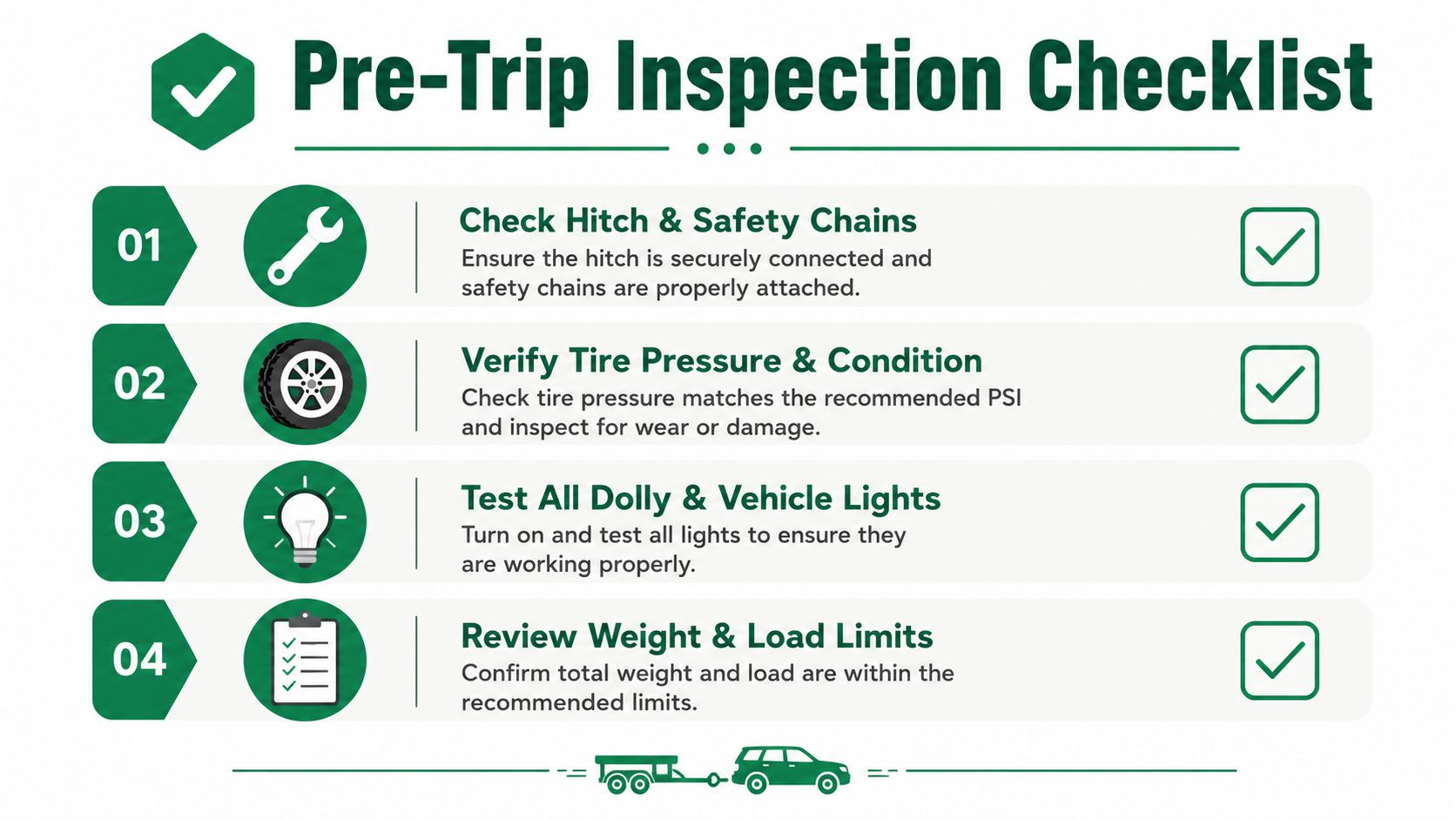
Most dolly problems begin before the vehicle reaches the ramp. Start with the tow vehicle's owner's manual and the dolly manufacturer's plate or manual. Confirm the rated towing capacity, hitch rating, tongue-weight guidance, and electrical connector type. The combined operating weight must remain within the limits of the tow vehicle, hitch, dolly, tires, axles, and coupler, not merely within one advertised capacity.
Write down the tow vehicle's curb weight, the towed vehicle's actual weight, and the dolly's listed weight. Add cargo, passengers, fuel, and equipment. If the manufacturer gives separate gross vehicle weight rating, gross combined weight rating, axle limits, or tongue-weight limits, treat the lowest applicable limit as controlling. A scale ticket is more reliable than guessing, especially with SUVs, electric vehicles, modified cars, and loaded interiors.
Inspect the dolly as a transport machine
Walk around the dolly in the same order every time. Check tire pressure against the dolly manufacturer's specification, examine tread and sidewalls, and look for uneven wear. Inspect wheel bearings, hubs, lug nuts, welds, ramps, wheel trays, tire stops, coupler, and ratchet assemblies. A cracked frame weld, bent tray, frayed strap, or ratchet that won't hold is a stop-work defect.
Check the hitch ball size, coupler lock, safety chains, breakaway equipment where fitted, and the full lighting harness. Test brake, turn, tail, and marker lights on the tow vehicle and dolly. Make sure the towed vehicle's steering is disengaged where required, the transmission and transfer case are in the manufacturer-approved mode, and the parking brake is released only when you're ready to load.
Use a written checklist rather than relying on memory. If the vehicle is front-wheel drive but has a damaged tire, seized brake, or steering fault, loading it normally may create a recovery job instead of a transport job.
Loading and Securing the Vehicle on the Dolly
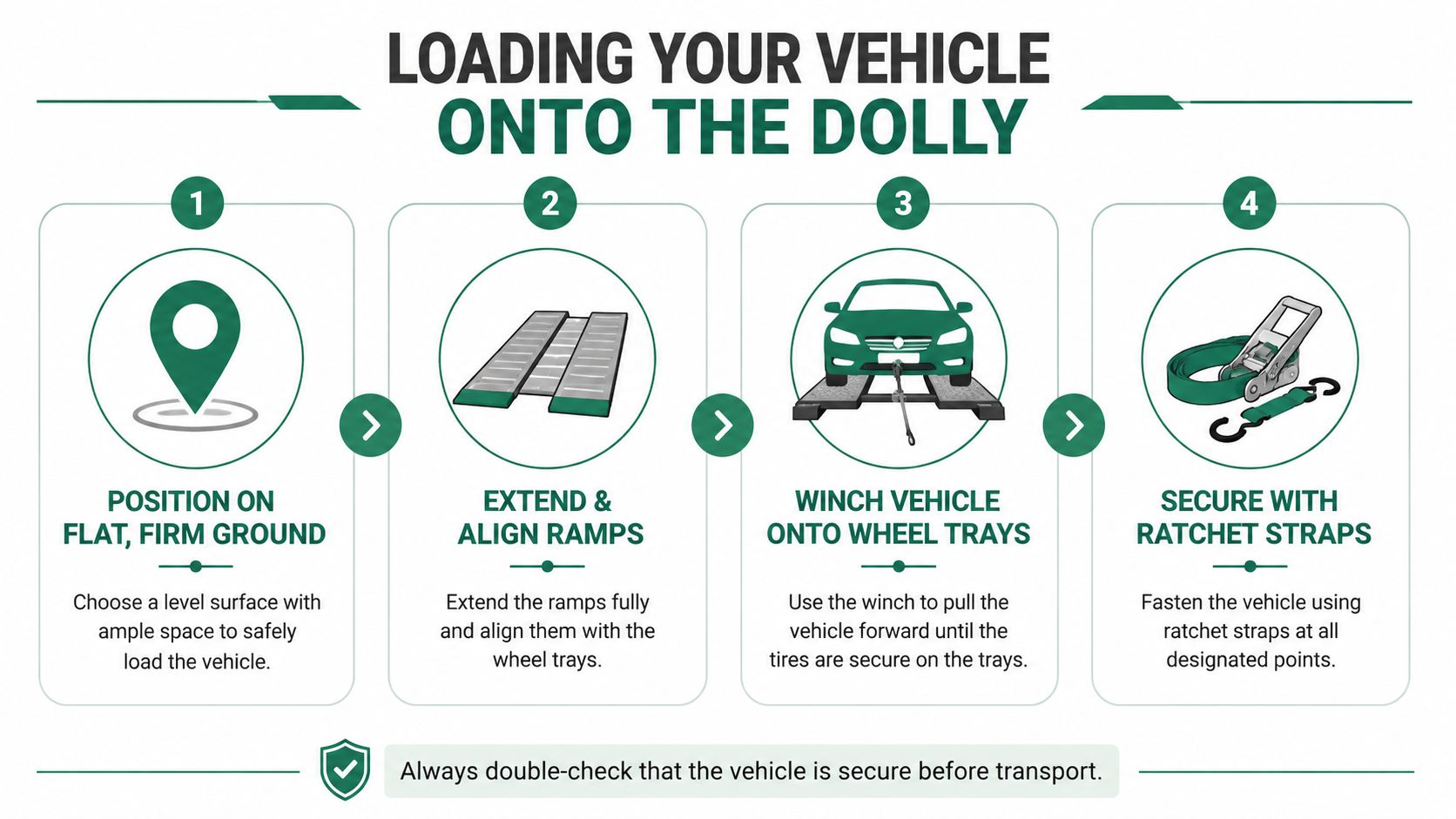
Loading should happen on flat, firm ground, with enough room to keep the tow vehicle, dolly, and car straight. Set the tow vehicle in park, apply its parking brake, and chock the dolly or follow the manufacturer's coupling procedure before extending the ramps. Align the wheel trays with the towed vehicle's front tires. A crooked approach can force a tire against the tray edge, bend equipment, or place the vehicle off-center.
Follow a controlled loading sequence
- Position both vehicles: Keep the dolly straight behind the tow vehicle. Remove people and loose objects from the loading path.
- Extend and align the ramps: Confirm that each ramp is fully seated and that the trays line up with the tires.
- Drive slowly onto the trays: Use the lowest practical speed and make small steering corrections. A spotter should guide you when the driver can't see both trays and stops.
- Seat the tires against the stops: Stop when the tires rest firmly against the prescribed tire stops. Don't use momentum to climb the ramps.
- Apply the tire straps: Center each strap over the tire tread, feed it through the ratchet, and hand-tighten until secure. Straps should restrain the tires, not press aggressively against body panels or suspension components.
- Attach safety chains and connect lights: Use the designated attachment points. Keep chains clear of the ground, tires, steering, and moving parts. Connect and test the lighting harness before departure.
The practical sequence is also reflected in this car-dolly loading procedure, which emphasizes straight alignment, centered trays, slow loading, and a spotter when visibility is limited. For broader restraint principles, securing heavy equipment before dispatch offers useful context, although your dolly's own manual remains the controlling document.
Practical rule: Tight straps are secure straps. Overtightened straps can damage tires, wheels, or suspension parts, while loose straps allow the vehicle to move inside the trays.
Watch the loading demonstration below, then repeat the checks yourself rather than treating the video as a substitute for the dolly manual.
After driving a short distance, stop in a safe location and inspect strap tension, chain position, tire seating, and connector security. Repeat the inspection at fuel stops and rest breaks. If a strap has relaxed, a tire has moved from its stop, or the dolly tracks differently, pull over and correct the cause before continuing.
Legal Requirements and Safety Rules Across Jurisdictions
“Check local laws” is incomplete advice. A compliant setup depends on the route, dolly brakes, combined mass, lighting visibility, chain arrangement, and the rules of every jurisdiction you enter. Requirements can change across state lines, so equipment accepted at home may still draw attention elsewhere.
South Australia shows how specific these rules can be. Its transport guidance requires tow dollies to have brakes. When the combined mass exceeds 2,000 kg, those brakes must be independently controlled and include a breakaway system. Towing speed is limited to 80 km/h, and the towed vehicle's lights must remain visible from multiple angles. The South Australia tow-dolly guidance demonstrates why route planning must rely on the actual local requirements, not general towing habits.
Virginia takes a different approach. Its law requires safety chains, or chains strong enough to restrain both the dolly and the towed vehicle if the connection fails. It also addresses rear marker lights or reflectors when the dolly is towed without a load. The practical lesson is to verify each jurisdiction's wording instead of assuming one state's setup applies everywhere.
Build a route-specific compliance file
Before departure, identify the authority responsible for motor vehicle or trailer rules in every state on your route. Confirm the following:
- Brake requirements: Determine whether the dolly needs service brakes based on its design, load, or combined weight.
- Breakaway equipment: Check whether an independent breakaway system is required, then verify its battery and activation mechanism.
- Chain requirements: Use the manufacturer's designated points and confirm the chains can restrain the complete combination.
- Lighting rules: Make sure required lamps and reflectors remain visible and unobstructed.
- Speed limits: Follow the lowest applicable towing limit, even when the general highway limit is higher.
- Width, registration, and equipment rules: Check whether the dolly needs separate registration or additional markings.
Keep the dolly manual, rental agreement, vehicle documents, and route notes in the tow vehicle. For a long-distance move, especially one involving different jurisdictions, unresolved compliance questions are a real liability. If you cannot verify the setup before departure, professional auto transport is safer than discovering the rule during an inspection. DIY towing can work for a short, well-understood route, but the legal and equipment gaps become harder to manage as distance and jurisdictional changes increase.
Driving Techniques and On-Road Best Practices
A loaded dolly changes how the combination accelerates, stops, turns, and occupies a lane. The towed vehicle tracks inside the tow vehicle through corners, while uneven loading or loose restraints can start sway. Treat every control input as a chance to keep the combination stable.
Drive below the posted limit when conditions, visibility, traffic, or the dolly require it. Accelerate gradually, leave extra following distance, and brake early with smooth, progressive pressure. Sudden braking can transfer force through the hitch and make the towed vehicle push forward, especially downhill or on wet pavement.
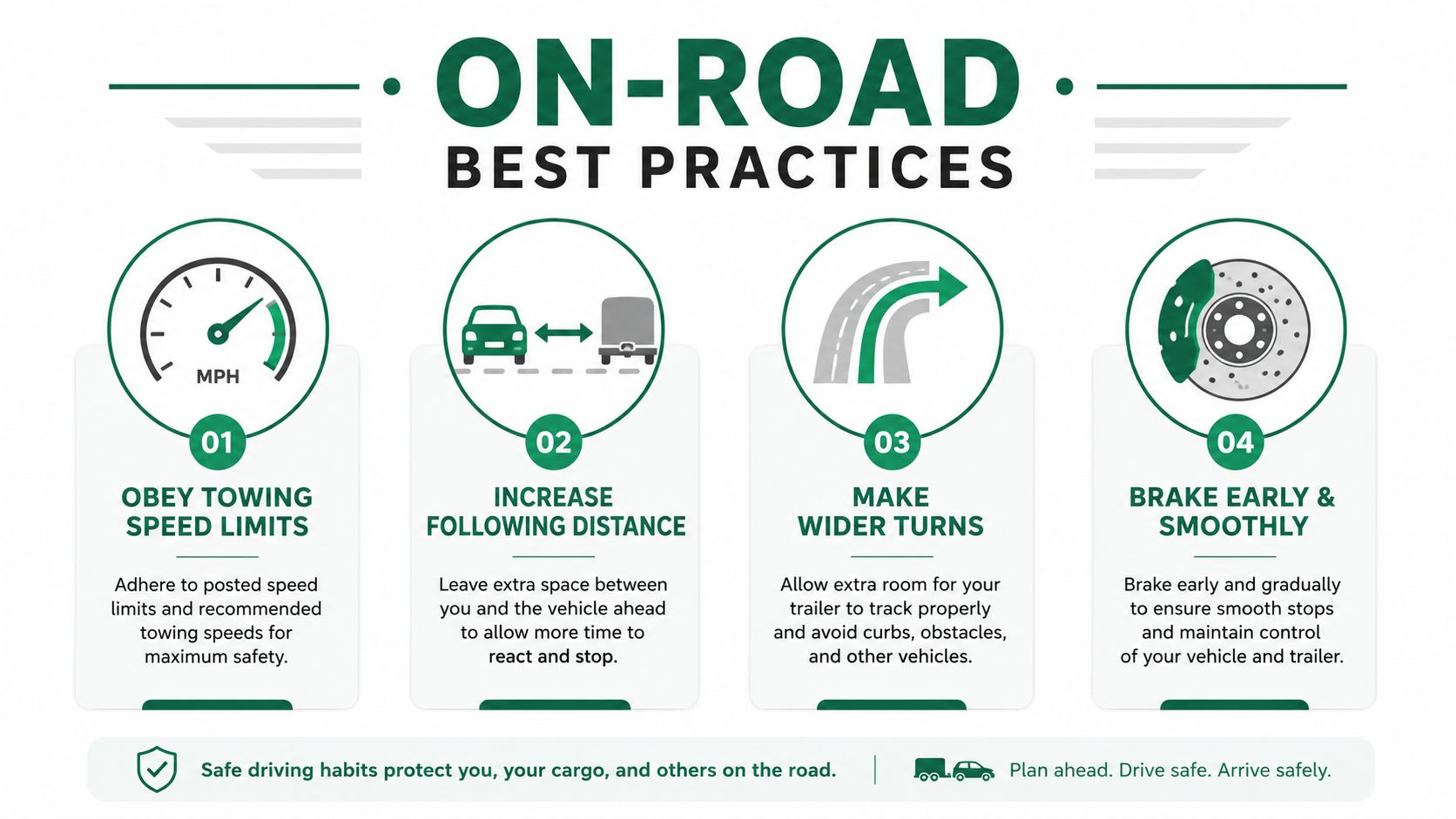
Take corners wider and watch the inside rear tires so they do not clip a curb. Merge only with a clear gap, signal before changing lanes, and use the mirrors continuously. The dolly and loaded vehicle occupy more road length than the tow vehicle's normal sight picture suggests, so check the full combination before moving across traffic.
If sway begins, keep the steering direction steady, ease off the throttle, and apply the tow vehicle's brakes smoothly if needed. Do not jerk the wheel, press hard on the accelerator, or make an abrupt lane change while the combination is unsettled. Persistent sway means stopping to inspect tire pressure, load centering, strap tension, hitch connection, and possible mechanical faults.
Sway is a warning, not a challenge to drive through. Reduce the cause before you resume speed.
Long downhill grades require planning. Use engine braking where appropriate, select a suitable lower gear, and avoid riding the brake pedal. Choose a safe stopping area rather than waiting for a tire, strap, or brake problem to force the decision.
At every stop, check the tires for heat or damage, confirm the straps remain centered, inspect the chains and lights, and verify that the vehicle still rests against its stops. If anything has shifted, correct it before continuing. A short inspection costs less time than handling a damaged vehicle or an unstable dolly at roadside.
When Professional Auto Transport Makes More Sense
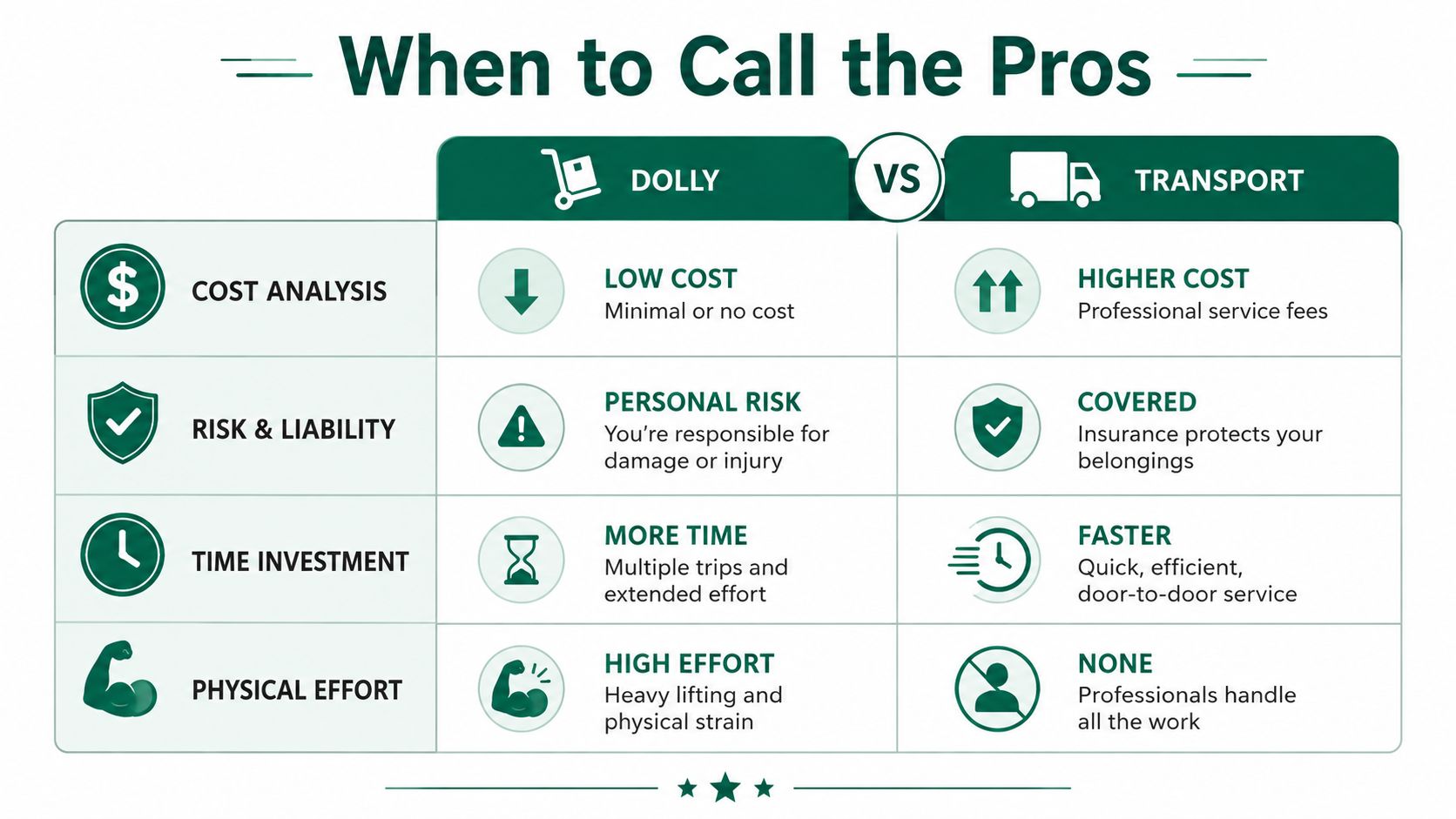
A dolly may reduce equipment cost on a short move, but the apparent savings exclude fuel, rental charges, tolls, lodging, lost work time, tow-vehicle wear, and the consequences of a loading error. You also carry responsibility for route compliance, roadside exposure, vehicle damage, and every inspection. A modest towing plan can become expensive once those obligations are included.
Professional auto transport changes the assignment from towing a vehicle yourself to coordinating a shipment with door-to-door auto transport. Open transport generally suits ordinary cars, while enclosed transport is better for high-value, classic, luxury, or unusually vulnerable vehicles. A professional carrier supplies the appropriate truck, loading equipment, insurance, and operating experience. You still document the vehicle's condition at pickup and delivery, but a passenger vehicle is no longer managing the full combination.
Puerto Rico requires a shipping plan, not a dolly
A car dolly cannot move a vehicle across the water to San Juan. Puerto Rico shipments commonly use door-to-port service, in which the vehicle is collected from a mainland address and taken to a departure port, or port-to-port service, in which the customer delivers it to a port such as Jacksonville, Florida, or Pennsauken, New Jersey. Published examples describe New Jersey to San Juan ocean transit as about 10 to 14 days, with 3 to 7 additional days when mainland door pickup is included. Puerto Rico transport and tax guidance explains these service structures.
Puerto Rico export procedures require more than a vehicle and hitch. Sea-transport enterprises must notify police of vehicle export requests and provide vehicle and owner information. A police certification showing no export restriction is required before transport can proceed, as outlined in Puerto Rico vehicle shipping documentation guidance.
Documentation differs by direction. For westbound moves to Puerto Rico, a shipping guide identifies the title, registration, and photo ID as typical requirements. Eastbound moves from Puerto Rico may require a title copy, current registration, and a notarized lien release letter for financed vehicles, with both owners' consent when the title is jointly owned. Review Crowley's Puerto Rico vehicle shipping requirements before scheduling.
Bills of lading and shipping papers provide the transport record. FMCSA inspection materials list bills of lading among documents used to verify vehicle movement, while FMCSA training material states that a bill of lading must be signed and dated at origin and destination. Puerto Rico shipping instructions and transport paperwork adds useful context for this chain of custody.
For moves over 500 miles, island routes, high-value vehicles, or trips without a properly rated tow vehicle, professional transport usually makes more practical sense. The decision concerns more than price. It determines who will manage the equipment, paperwork, liability, and route from pickup through delivery.
Making the Right Choice for Your Vehicle Move
Choose a dolly when the vehicle is compatible, the tow vehicle is properly rated, the equipment is in excellent condition, the route rules are verified, and you're comfortable handling a loaded combination. It can work well for a short or medium domestic move when you have time to inspect, load, drive, and recheck the setup.
Choose professional transport when the route is long, the vehicle is valuable, the tow vehicle is unsuitable, or the destination involves Puerto Rico, Alaska, or Hawaii. For a clearer budget comparison, review car shipping cost factors, then compare that figure with fuel, lodging, equipment, time, and personal risk.
Not one vehicle transport is alike. Bilingual English and Spanish agents based in the United States, with more than 20 years of auto transport logistics experience, can guide individuals, snowbirds, military families, students, dealerships, and businesses through the right arrangement. If you're prepared, equipped, and informed, a dolly can work. There's no shame in calling professionals who handle these moves every day.
National Car Transport provides domestic vehicle shipping across the United States and routes to and from Puerto Rico, with open, enclosed, container, ocean, door-to-port, and port-to-port options. Request a free quote through National Car Transport and speak with a bilingual U.S.-based agent who can make your move simple, quick, and properly coordinated.