

You may be relocating for work, sending a student to college, reporting to a new military assignment, or buying a vehicle online that's sitting several states away. Snowbirds face the same problem in reverse, while mainland owners shipping a vehicle to Puerto Rico must coordinate a port and ocean leg in addition to the vehicle's inland movement. In each case, the question is the same: how to ship a car to another state without paying for protection you don't need or accepting risk you could have avoided.
Interstate auto transport is a logistics service, not a casual local delivery. The right choice depends on the vehicle, route, timing, condition, and how much control you need over pickup and delivery. This guide covers the process across the 48 contiguous states, major cities such as New York, Los Angeles, Chicago, Houston, Phoenix, Miami, Atlanta, Denver, Seattle, Boston, and San Antonio, plus routes to and from San Juan, Puerto Rico.
Table of Contents
- What Interstate Car Shipping Actually Involves
- Choosing the Right Service Type for Your Vehicle
- Preparing the Car and Booking Your Shipment
- Pickup Day, Transit, and Delivery Inspection
- What Really Drives Cost, Timing, and Risk
- Tailored Tips for Different Customer Types
- Consumer Protection and Your Pre-Shipment Checklist
What Interstate Car Shipping Actually Involves
The search usually starts with a deadline. Your employer has transferred you from Atlanta to Dallas, your student needs a car at a university in Boston, or you've bought an SUV online in Los Angeles and need it delivered to Chicago. A military family may have orders to Fort Liberty, while a snowbird is planning a seasonal move from New York to Arizona. The process is similar in each case, but the best service depends on the lane and the vehicle.
When a car crosses state lines in the United States, the shipment is treated as interstate commerce. Carriers operating across state lines are subject to the Federal Motor Carrier Safety Regulations under 49 CFR, and the Federal Motor Carrier Safety Administration publishes its regulations through the Federal Register and 49 CFR Parts 300 to 399. That federal framework establishes the national compliance baseline for legitimate cross-state transport. You can review the regulator's interstate transportation regulations before booking.
A licensed motor carrier typically loads your vehicle onto a multi-car hauler and transports it between states. Your price covers the carrier's dispatch, the driver's fuel and time, transport insurance, equipment, and coordination by a broker when a broker is involved. Door-to-door service means pickup and delivery as close as safely possible to the requested addresses, although large haulers may need nearby streets because of clearance or access restrictions. National Car Transport's door-to-door auto transport service follows that practical model.
The mainland route is different from an island move
Overland trucking covers routes between states such as Florida and New York, Texas and California, or Illinois and Colorado. Puerto Rico, Hawaii, and international destinations require ocean transport, port handling, and additional paperwork. For Puerto Rico, a common routing description has vehicles dropped at the Port of San Juan, shipped to Jacksonville, and then delivered to the final mainland address or routed onward through the domestic network. Review the Puerto Rico vehicle shipping process before assuming a mainland quote applies.
Transit normally takes roughly 1.5 to 10 days, depending on the route and season. A carrier can provide an estimated window, but a single guaranteed calendar date is uncommon because drivers coordinate several vehicles, traffic, weather, and loading locations.
If you're traveling with a pet during a relocation, handle the animal's arrangements separately from the vehicle and use this guide to plan furry family travel. Your main decisions are straightforward: choose open or enclosed equipment, decide whether door-to-door convenience matters, verify the broker and carrier, and document the vehicle before handing over the keys.
Choosing the Right Service Type for Your Vehicle
Most customers don't need the most expensive option. They need the service that matches the car's value, condition, route, and tolerance for exposure. A daily-driver sedan going from Chicago to Florida has different requirements from a restored Corvette moving from Los Angeles to New York.
| Service Type | Best For | Avg. Cost vs. Open | Transit Impact | Key Trade-Off |
|---|---|---|---|---|
| Open transport | Standard sedans, SUVs, online purchases, relocations | Baseline | Broad availability and efficient routing | Exposure to weather and road debris |
| Enclosed transport | Classics, exotics, luxury vehicles, custom paint | Higher than open | Fewer available spaces can affect scheduling | Better protection at a higher price |
| Door-to-door | Families, professionals, students, businesses | Usually higher than terminal service | Convenient pickup and delivery coordination | Large trucks may require nearby safe streets |
| Terminal-to-terminal | Flexible customers near storage yards | Slightly lower than door-to-door | Requires drop-off and pickup at designated facilities | Less convenience and possible storage coordination |
| Container or roll-on/roll-off ocean shipping | Puerto Rico, Hawaii, and overseas routes | Separate ocean and port pricing | Adds an ocean and port logistics phase | More paperwork, handling, and coordination |
Open transport is the sensible default
Open carriers are the industry standard for ordinary vehicles. A standard sedan or SUV usually belongs on an open, door-to-door shipment because the price and availability make sense for a vehicle already built for daily road use. This is the choice I recommend for most relocations, dealership transfers, military moves, and online vehicle purchases.
Choose enclosed transport when cosmetic protection matters more than the lowest quote. A restored Mustang, classic Corvette, exotic, luxury model, low-clearance build, or vehicle with custom paint deserves a covered trailer and careful loading. National Car Transport describes its enclosed auto transport as a separate service for customers who need that added protection.
Door-to-door service saves you a trip to a terminal and reduces handoffs. Terminal-to-terminal can work if you're flexible, live near both facilities, and can manage the vehicle at each end. It isn't automatically safer, and the lower price may not justify the inconvenience for a family working around a move-in date.
Non-running and oversized vehicles need a different quote
An inoperable car needs a winch-equipped carrier, and the transporter must know that before dispatch. Oversized vehicles, vehicles with very low clearance, and certain exotic cars may require a flatbed or specialized trailer. Never describe a non-running vehicle as operational just to obtain a lower quote. That creates a loading problem at pickup and can trigger a revised price or failed collection.
Puerto Rico moves are a separate category. Container or roll-on/roll-off ocean shipping adds port coordination and customs paperwork, so don't compare an island shipment directly with a standard interstate trucking quote.
Preparing the Car and Booking Your Shipment
Preparation should happen in a fixed order. Start with the vehicle, then gather documents, then vet the companies, and only afterward commit to dates and payment terms.
Prepare the vehicle at home
Wash the exterior so existing scratches, dents, and glass chips are visible. Photograph all four corners, each side, the roof, wheels, windshield, interior, and odometer. Remove personal items, toll transponders, removable accessories, and anything that can shift inside the cabin. Fold in the mirrors, disable the alarm, and leave approximately a quarter tank of fuel so the driver can load and unload the car without carrying unnecessary weight.
Check tire pressure, battery health, fluid leaks, and whether the car starts, rolls, brakes, and steers. If any of those functions fail, tell the provider before the quote becomes a dispatch. A carrier may need a winch or other loading equipment.
Assemble the paperwork
Your registration should be current for the destination state, and the title should be in your name or accompanied by authorization from the lien holder. Keep a valid photo ID that matches the shipping order. The carrier may refuse release to someone who isn't listed as the authorized recipient.
For Puerto Rico shipments, prepare the notarized title, export power of attorney, and coordination details for a licensed customs broker at the arrival port. Don't wait until the vehicle reaches San Juan to discover that a document is missing.
Vet the shipment before paying
Get comparable quotes from at least three providers, but compare the same service type, vehicle condition, route, and pickup flexibility. Verify the actual broker and the carrier assigned to the shipment through the FMCSA carrier search and MC docket information. The federal consumer advisory says both brokers and carriers must be registered for interstate operations, and it specifically recommends checking the assigned carrier rather than relying only on the broker's promise. You can review the FMCSA automobile transporter consumer advisory.
Ask for the cancellation and deposit policy in writing. Confirm the pickup window, delivery contact, insurance certificate, and whether a broker or carrier will dispatch the load. Flexible dates usually help, and avoiding the first and last three days of each month can reduce scheduling pressure. Don't authorize pickup until the commercial terms and inspection expectations are clear.
Pickup Day, Transit, and Delivery Inspection
Pickup day is where a smooth booking becomes a defensible shipment record. The driver arrives, checks access, and walks around the vehicle with you before loading. You should have your photos ready, but the driver's inspection on the Bill of Lading, or BOL, is the official condition record.
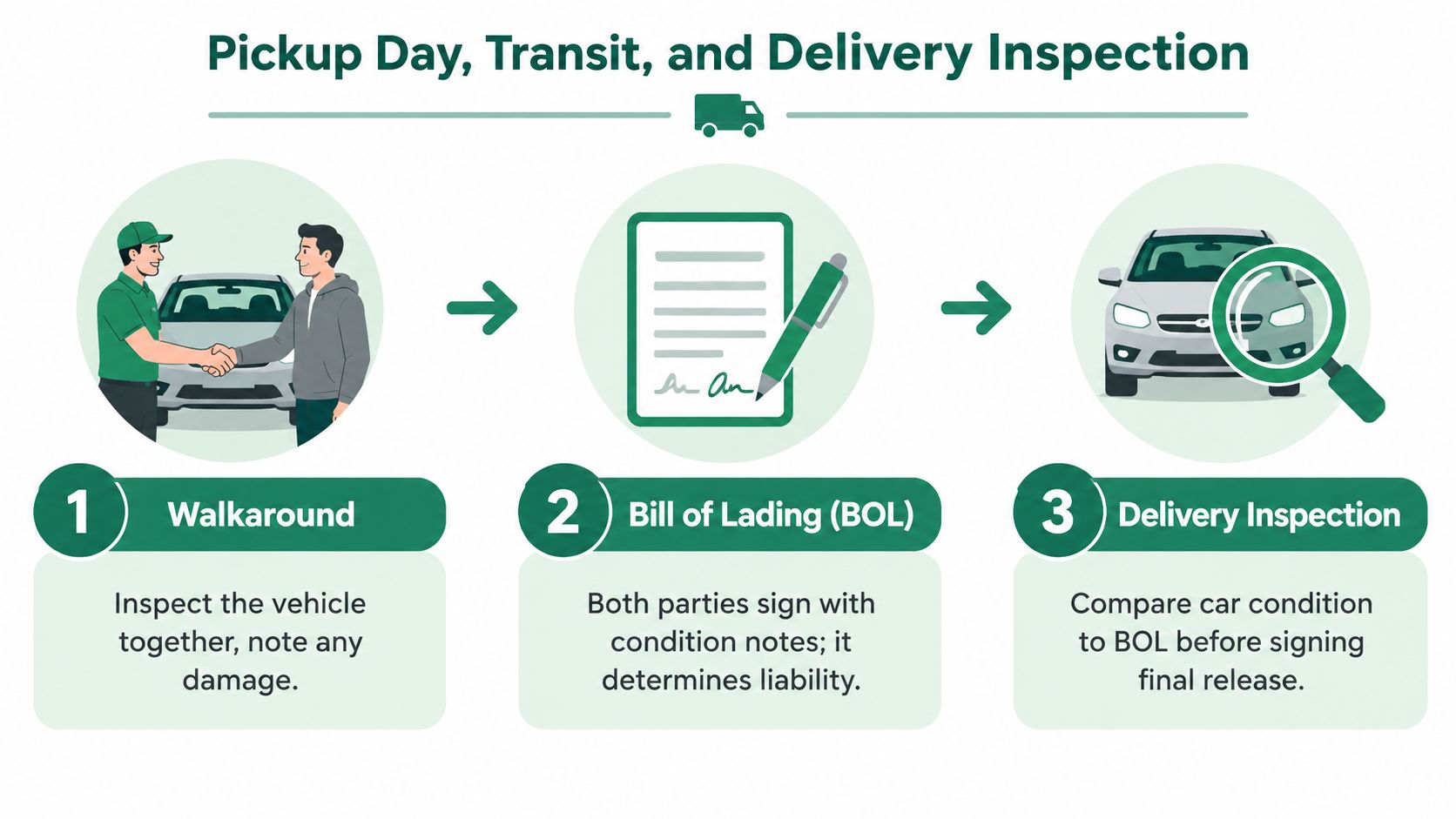
Treat the BOL as the evidence file
A driver who writes “minor scratches” has created an ambiguous record. Ask for specific locations, such as a scratch on the left rear door, a chip at the lower passenger-side windshield, or a dent above the rear wheel. Mark every existing defect in the appropriate diagram or notes, then compare the written entries with your photographs.
FMCSA guidance says an interstate bill of lading must contain 17 items, including the mover's legal or trade name, physical address, and signatures at origin and destination. It also must be signed and dated by both parties. That makes the BOL more than a receipt. It connects the vehicle, the parties, the route, and the condition record in one document. Keep a copy before the driver leaves.
Practical rule: If a condition isn't written on the BOL, treat it as though it wasn't documented.
During transit, the hauler may move through several cities and coordinate multiple vehicles. Pickup and delivery estimates can shift because the driver is managing the entire load, not only your car. Tracking updates are useful, but the delivery window remains an estimate unless your written agreement provides something different.
At delivery, inspect the vehicle in good light before signing the final release. Compare the four corners, roof, wheels, glass, and interior with the pickup record. If you find new damage, write it on the BOL, take clear photographs, and notify the carrier using the claim procedure and deadline in your contract.
The industry guidance on carrier vetting emphasizes systematic inspection because transport damage estimates vary by source and market. The consistent advice is simple: document existing damage before pickup, compare at delivery, and record discrepancies immediately to preserve your claim rights. For a visual walkthrough of the handoff, watch this vehicle shipping inspection video before your driver arrives.
What Really Drives Cost, Timing, and Risk
The quote isn't determined by mileage alone. Distance, lane density, vehicle size, operability, service type, season, and scheduling flexibility all affect the carrier's decision to accept a load.
The U.S. market handles approximately 35 to 40 million vehicle shipments annually, with more than 30,000 carriers actively registered with FMCSA, according to an industry summary. That source also places the annual market above $12 billion and gives a broad consumer shipping range of approximately $800 to $1,500 per shipment. See the auto transport industry report for that benchmark. These figures explain why major corridors are more predictable than remote lanes, not why every individual quote will match an average.
| Variable | Effect on Price | Effect on Transit Time | Effect on Risk |
|---|---|---|---|
| Distance and route | Longer moves cost more overall, while dense major lanes can price more efficiently | High-demand corridors generally offer more dispatch options | Rural endpoints can create extra handoffs or access issues |
| Vehicle size and condition | Larger or inoperable vehicles require more space or equipment | Special loading can add coordination time | Poorly disclosed condition creates loading and claim problems |
| Open versus enclosed | Enclosed costs more because it provides added protection and specialized capacity | Availability can be narrower | Enclosed reduces exposure to weather and road debris |
| Scheduling flexibility | Flexible pickup dates give dispatchers more options | A fixed date can limit available carriers | Rushed matching can increase selection pressure |
| Season and demand | Busy relocation and seasonal lanes can raise quotes | Capacity becomes tighter | Last-minute booking leaves less room for vetting |
Pay for the lever that matters
For a daily driver, open transport is usually the rational economy choice. For an expensive classic, paying for enclosed protection addresses a real risk rather than adding a luxury feature. For an inoperable vehicle, accurate disclosure matters more than bargaining because the carrier must bring the right equipment.
A broad industry estimate places the market's average consumer shipment cost around $800 to $1,500, but that range isn't a promise for your route. A separate industry report describes year-over-year delivery growth of 27% in the Northeast and 19% in the West, which illustrates how demand can concentrate in particular regions. Those figures are market context, not a quote calculator.
For a route-specific estimate, use a provider's car shipping cost information, then ask what assumptions produced the number. The cheapest offer is often the one with the weakest carrier match, the vaguest pickup commitment, or the greatest chance of a price revision. Save money through flexibility, not by skipping authority checks or insurance confirmation.
Tailored Tips for Different Customer Types
The right shipment changes with the customer's deadline and the vehicle's role. A family moving for work needs reliability at the destination, while a dealership needs repeatable documentation and predictable dispatch.
Individuals relocating for work
Book early enough to leave room for carrier matching, especially if your move has a firm lease or employment date. Ask your employer whether relocation benefits cover vehicle transportation, and request the policy requirements before accepting a quote. A sedan between major cities generally fits open, door-to-door service. If the destination is a rural address, identify a safe nearby meeting point in advance.
Snowbirds and seasonal residents
Snowbirds should plan both the southbound and return legs before departure. Demand tightens on popular seasonal corridors, so flexibility is more useful than insisting on a precise delivery day. If you're shipping between places such as New York and Phoenix, or Florida and Chicago, coordinate the vehicle's arrival with your housing access and avoid booking after travel arrangements are already fixed.
Military families
Give the provider your orders, pickup authority, delivery contact, and installation access details. Ask whether the quote reflects military or PCS eligibility, and keep the chain of authorization clear if another family member handles the handoff. Military routes may involve restricted access, so a safe public pickup location can be more practical than the gate at Fort Liberty or another installation.
Students and dealerships
Students can ask classmates heading to the same campus whether a coordinated pickup is practical. Consolidating communication doesn't mean placing several unrelated vehicles under one informal agreement. Each vehicle still needs its own condition record and authorized recipient.
Dealerships and auction buyers need repeatable processes. Standardize VIN information, operability status, auction release contacts, title handling, and delivery photos. Open transport is usually appropriate for ordinary inventory, while a broker with auction experience can reduce missed release windows and incomplete paperwork.
Classic, luxury, and Puerto Rico customers
Classic and luxury owners should choose enclosed service, soft-tie loading, and a controlled pickup window. Tell the provider about low clearance, custom wheels, alarms, or mechanical quirks before dispatch.
Puerto Rico moves require ocean container shipping or roll-on/roll-off coordination, customs paperwork, and a separate port timeline. For mainland-to-San Juan shipments, identify who handles the port appointment, customs broker, inland delivery, and final recipient. National Car Transport has 25+ years of experience, an A+ BBB rating, transparent flat-rate pricing, a network of 25,000+ vetted carriers, and bilingual English and Spanish agents based in the United States with more than 20 years of auto transport logistics experience. Those details may matter to customers who want one advisor to coordinate a complex move, but you should still compare the written scope of service.
No vehicle transport is alike. Having an agent who guides the shipment, explains the trade-offs, and keeps the process simple and quick is valuable, particularly when a move includes a port, dealership, military installation, or non-running vehicle.
Consumer Protection and Your Pre-Shipment Checklist
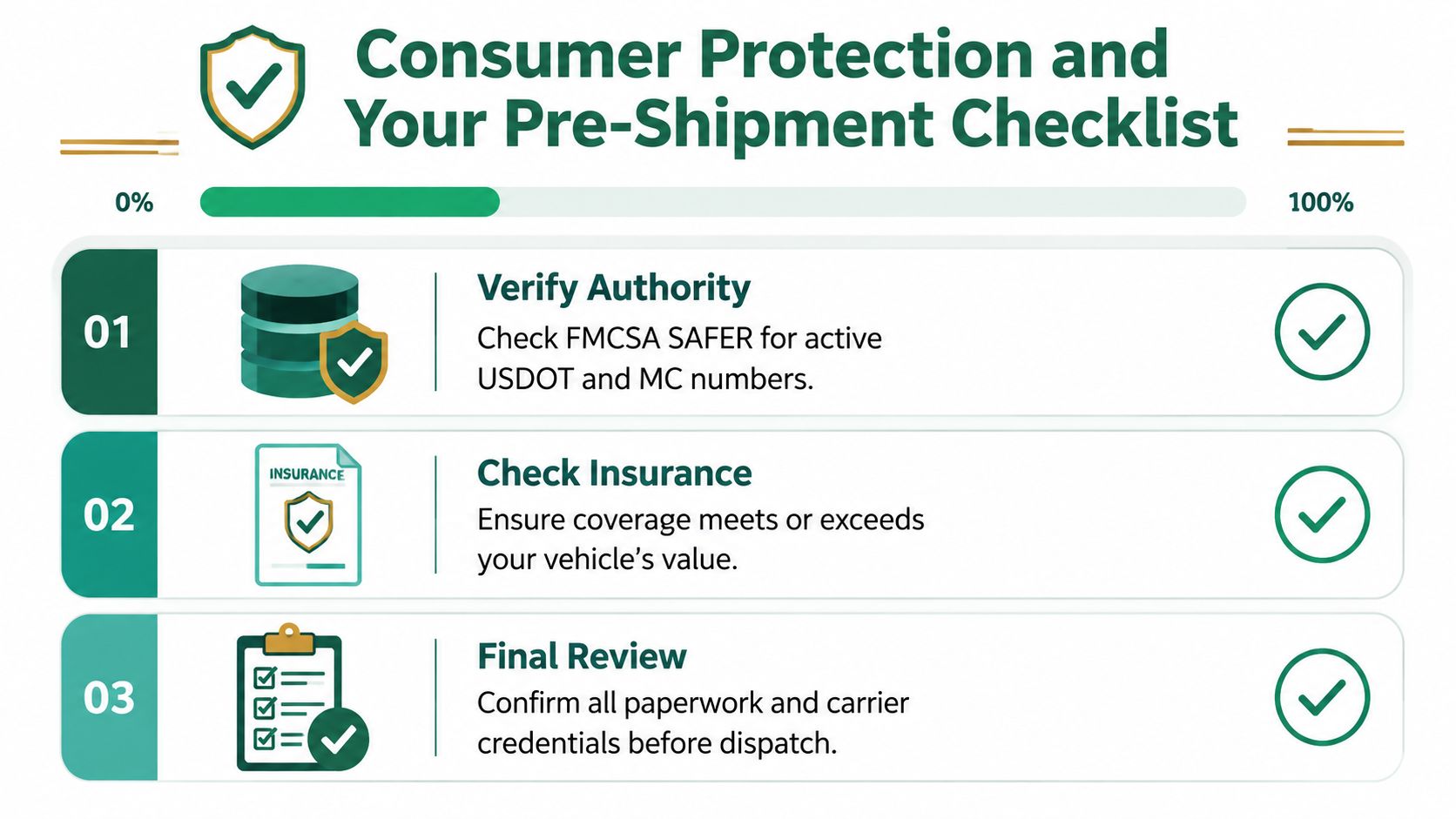
The lowest quote isn't automatically a bargain. Before booking, verify the broker and the actual carrier through the FMCSA search, confirm active USDOT and MC authority, and request insurance information that is appropriate for the vehicle's value. FMCSA's complaint system accepts complaints involving brokers, auto transporters, moving companies, and other regulated businesses. Its complaint process asks for identifiers such as USDOT or MC numbers, estimates, bills of lading, and inventory pages, so preserve every document.
Red flags worth taking seriously
- Large unexplained deposits: Ask what the payment covers and when it becomes refundable.
- No written agreement: You should receive clear service terms, pickup information, and a BOL process.
- Vague pickup windows: A provider should explain the estimated window and what can change it.
- Pressure to wire funds: Don't send money before reviewing the company, carrier, and cancellation terms.
- Broker-only reassurance: Verify the carrier assigned at dispatch, not just the company that gave you the quote.
At delivery, document any discrepancy on the BOL before signing the release. Notify the carrier and its insurer according to the contract's stated process. If the dispute stalls, use the FMCSA National Consumer Complaint Database and submit the shipment records requested by the agency.
Your final pre-shipment checklist is short:
- Confirm documents: Registration, title or lien authorization, and valid identification.
- Prepare the car: Remove personal items and toll transponders, wash the vehicle, and leave roughly a quarter tank of fuel.
- Record condition: Photograph all angles, the odometer, glass, wheels, roof, and existing damage.
- Review the paperwork: Save the signed BOL and confirm the delivery contact's phone number.
- Verify the route: Ensure the origin and destination appear consistently across the shipment documents.
A cheap quote can reduce the price, but it can't replace active authority, adequate insurance, accurate condition notes, and a carrier that understands your vehicle and route.
National Car Transport offers open and enclosed door-to-door transport across the United States, along with container and ocean coordination for Puerto Rico routes, transparent flat-rate pricing, and bilingual English and Spanish agents based in the USA. Visit National Car Transport to request a route-specific quote and speak with an experienced advisor about the vehicle, timing, pickup access, and protection level that fit your move.