
You're staring at a vehicle shipping quote that feels far too high. Maybe you're moving an SUV from Phoenix to Miami, sending a car to a child at school, relocating after military orders, or arranging a Puerto Rico shipment from the mainland. The number on the screen may look simple, but it reflects several moving parts, and some of them are negotiable.
A dispatcher doesn't lower the price by chasing the cheapest truck blindly. The work is matching your vehicle to the right equipment, giving the carrier a workable pickup window, choosing a practical route, and separating necessary charges from avoidable ones. That's how to save on shipping costs without creating a damage problem, a missed delivery, or a last-minute rate increase.
Table of Contents
- When the Quote Feels Too High
- What Actually Drives Vehicle Shipping Prices
- Timing and Flexibility Tactics That Cut Costs
- Open, Enclosed, and Container Options Compared
- Shipping to and from Puerto Rico on a Budget
- Real Scenarios and How Customers Saved
- Your Vehicle Shipping Savings Checklist
When the Quote Feels Too High
A homeowner in Phoenix receives an $1,800 quote to move an SUV to Miami. The reaction is immediate: that's outrageous. Then the homeowner adds up fuel, two hotel nights, meals, mileage, wear and tear, and time away from work. Driving roughly 2,400 miles can easily exceed $2,400 in total personal cost, especially when the vehicle arrives tired and the owner loses several workdays.
The quote still deserves scrutiny. A dispatcher should take it apart instead of asking the customer to accept it on faith.
First, confirm the vehicle details. A standard sedan belongs on an open carrier unless the owner has a strong reason to choose enclosed transport. Next, review the route. Phoenix to Miami is a common domestic lane, and carriers may have opportunities to load another vehicle on the return trip. Finally, check the pickup window. A customer who can move pickup by several days gives the dispatcher more carrier options than someone demanding one exact morning.
Dispatcher's rule: A high quote usually needs diagnosis before it needs negotiation.
The order of operations matters
Experienced dispatchers generally work through the booking in this sequence:
- Verify the vehicle: Confirm whether it runs, rolls, steers, and fits standard carrier equipment.
- Choose the equipment: Use open transport for an ordinary daily driver, and reserve enclosed service for vehicles that need extra protection.
- Open the calendar: Flexible pickup dates help the dispatcher match an existing route instead of forcing a carrier to detour.
- Review the route: A nearby metro or terminal may provide better carrier access than a difficult residential street.
- Separate service levels: Door-to-door convenience, terminal service, and port delivery carry different logistics requirements.
The goal isn't to promise an artificial discount. It's to remove the conditions that make a carrier price risk into the quote. A flexible customer with an operable vehicle on a practical route is easier to match, and that usually creates a better rate.
National Car Transport describes transparent flat-rate pricing, with no upfront charge until a mainland vehicle is assigned to a carrier, and coordinates open, enclosed, container, and ocean transport through its carrier network. That model can be useful when you want one advisor to explain which variables are affecting your number.
What Actually Drives Vehicle Shipping Prices
Vehicle transport pricing follows a pattern. Distance matters, but it isn't the only factor, and it often isn't the factor a customer can change. The biggest savings usually come from controlling the details that affect carrier capacity, handling time, and route efficiency.
A carrier may earn well moving a loaded truck from New York to Florida, then face a weak return route from Florida to New York. That imbalance influences pricing by direction and season. Vehicle size matters too. A compact car uses less trailer space than a Suburban, Tahoe, lifted pickup, or other oversized vehicle. An inoperable car requires loading equipment and additional handling, while a running vehicle can usually be driven onto the trailer.
| Factor | Typical impact |
|---|---|
| Distance and route | Longer lanes generally cost more, while busy, balanced lanes can be easier to price |
| Lane direction | Strong outbound demand or a weak return route can raise the quote |
| Vehicle size | Larger vehicles consume more trailer space and may create an oversize charge |
| Operability | Inoperable vehicles require special loading and unloading equipment |
| Equipment type | Open transport costs less than enclosed transport, while container service adds ocean freight and port handling |
| Pickup and delivery access | Difficult streets, remote areas, and detours increase carrier time |
| Timing | Seasonal demand and tight pickup windows can reduce available capacity |
| Puerto Rico logistics | Port handling, ocean freight, sailing schedules, and island delivery create separate cost layers |
The carrier sees your car as space
Parcel shippers also deal with volume-based pricing. Major carriers may calculate dimensional weight with a divisor of 139 for domestic shipments and 166 for international shipments, charging based on package volume when that calculated weight exceeds the actual weight, as explained in this ecommerce shipping overview. A vehicle works differently, but the operating principle is familiar: space, handling, and route efficiency affect the price as much as weight.
For broader context on transporting oversized goods, the guide to shipping bulky items safely in the UK is a useful comparison. In auto transport, the equivalent question is whether your vehicle requires more deck space, special loading, or a route deviation.
Before accepting a quote, use the National Car Transport car shipping cost guide to understand how distance, vehicle type, transport method, timing, and service location interact. Don't focus only on the headline number. Ask which inputs created it and which inputs you can change.
Timing and Flexibility Tactics That Cut Costs
Timing is the discount lever customers overlook most often. A carrier can work with a flexible pickup window, but an exact date may force the dispatcher to reject otherwise suitable trucks or pay for a driver to reposition.
Start by shifting pickup by three to seven days when your schedule allows. Midweek pickup and a date away from the end of the month can give the dispatcher more room to find a carrier already traveling your route. A narrow appointment window doesn't make the shipment impossible, but it can make the quote less forgiving.
Four practical scheduling moves
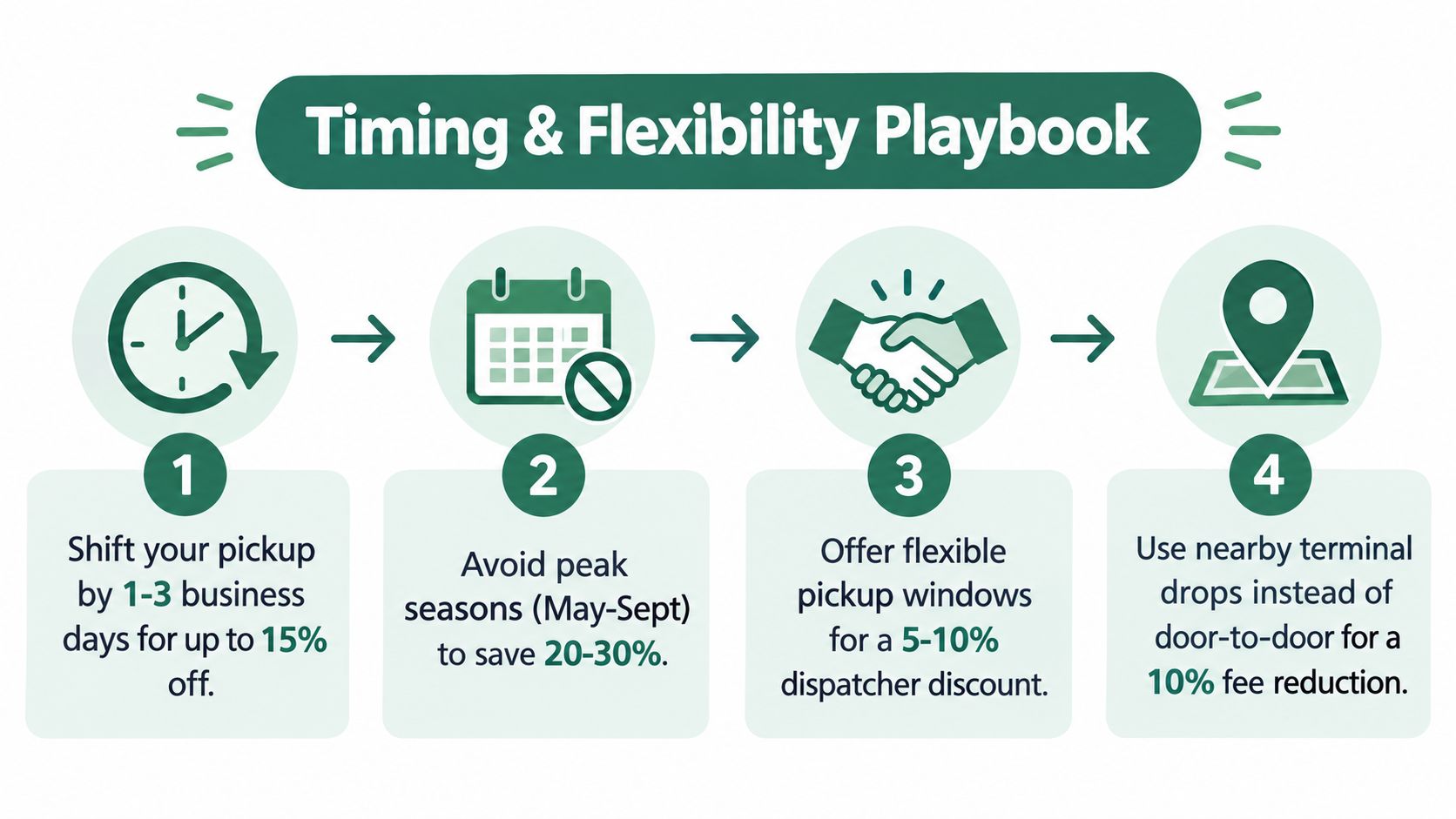
- Move the date: Offer a pickup range instead of one fixed day. The dispatcher can then match the vehicle to a truck with an existing route.
- Use a practical meeting point: If a residential street is difficult for a large carrier, meet at a safe commercial location or terminal. Removing a detour can lower the carrier's time and fuel exposure.
- Avoid heavy demand: Snowbird traffic affects popular Florida routes, and the Jacksonville to San Juan lane can become especially competitive during seasonal moves.
- Book before the truck is full: Early planning gives the broker time to compare available carriers instead of searching under pressure after capacity tightens.
The provided timing graphic uses different planning assumptions, including pickup shifts of one to three business days, off-season planning, flexible windows, and terminal drops. Treat those as planning prompts rather than guaranteed discounts. No dispatcher can promise a fixed percentage without checking the exact lane, vehicle, dates, and equipment.
Practical booking advice: Give the dispatcher the widest honest window you can. False flexibility creates a failed pickup, which costs more than a straightforward quote.
The same principle applies to Puerto Rico. A flexible sailing window may provide more options than a fixed departure demand, particularly when the vehicle must move through Jacksonville. Confirm the port cutoff, paperwork, and delivery plan before changing dates.
Here's a visual explanation of the process:
Open, Enclosed, and Container Options Compared
The cheapest equipment isn't automatically the right equipment. It's the equipment that protects the vehicle appropriately without making you pay for safeguards you don't need.
Open transport is the default for most sedans, crossovers, family SUVs, and daily drivers. The carrier loads multiple vehicles on an exposed, two-level trailer, which spreads operating costs across several customers. Your vehicle may encounter normal road dust and weather, but open transport remains the practical choice for ordinary vehicles moving through the 48 contiguous states.
Enclosed transport adds protection from weather and road debris. Independent auto transport guides commonly place enclosed shipping at 40% to 60% more per mile than open transport, depending on the route and vehicle, as described in this car shipping calculator guide. That premium makes sense for classics, exotics, restored paint, and vehicles whose owners value controlled handling over the lowest possible rate.
Container shipping is a different service. It's used heavily for Puerto Rico and other ocean routes, where the vehicle moves as ocean freight rather than on an overland trailer. It can suit an inoperable car or an owner who wants physical separation from other cargo, but port handling and sailing schedules become part of the plan.
| Feature | Open transport | Enclosed transport | Container shipping |
|---|---|---|---|
| Cost position | Usually the lowest | Higher because of added protection and limited equipment | Depends on ocean freight, port, handling, and route |
| Best fit | Daily drivers, sedans, SUVs, ordinary moves | Classics, luxury cars, exotics, restored vehicles | Puerto Rico routes, inoperable vehicles, maximum isolation |
| Exposure | Open to ordinary road and weather conditions | Shielded from most road debris and weather | Enclosed inside an ocean container |
| Scheduling | Broad domestic carrier availability | Fewer suitable carriers | Tied to port schedules and sailing availability |
| Main trade-off | Less environmental protection | Higher price | More logistics and port coordination |
For Puerto Rico, customers often compare container service with RORO, or roll-on/roll-off shipping. The explanation of shipping vehicles with RORO can help clarify why ocean transport options differ in loading method, handling, and cargo protection.
National Car Transport's enclosed auto transport service is one option for owners who decide the vehicle's condition or value justifies the premium. Ask every provider about cargo insurance, inspection procedures, exclusions, and the exact equipment assigned. A lower rate is worthless if the coverage doesn't match the vehicle.
Shipping to and from Puerto Rico on a Budget
Puerto Rico is not just a longer car shipment. It's a port-and-ocean move with mainland pickup, terminal handling, sailing coordination, and island delivery. The Port of San Juan is the common origin or destination point, while Jacksonville, Florida, and Eddystone, Pennsylvania are identified as primary mainland ports for vehicles and cargo moving between Puerto Rico and the mainland, according to this Puerto Rico vehicle shipping overview.
For many shipments, Jacksonville is the practical lane to understand first. A mainland carrier brings the vehicle to the port, ocean freight moves it to San Juan, and a local provider handles delivery on the island. Each leg has its own scheduling and handling requirements, so a quote that looks like a normal door-to-door domestic rate is incomplete.
Choose the service level deliberately
Door-to-port means the vehicle is collected from your mainland address and delivered to the departure port. You avoid arranging the long drive to Jacksonville, but you pay for that local pickup leg.
Port-to-door begins with you dropping the vehicle at the mainland port or arranging delivery there, then continues to your address in Puerto Rico. This can be useful when you're near Jacksonville or can arrange a reliable drop-off.
Door-to-door combines both local legs. It's convenient, but it also exposes the shipment to more handling, scheduling dependencies, and location-based charges.
To reduce the bill, ask whether you can drop the vehicle at the Jacksonville terminal yourself. Give the shipping coordinator a flexible sailing window, and ask whether a return-trip carrier has capacity for your direction. On the island side, meeting the driver at or near the port may save more than negotiating a small mainland discount, especially when your address requires a long or difficult delivery route.
Use National Car Transport's Puerto Rico car shipping information to compare the service choices before you request a final quote. Have the vehicle's year, make, model, operability, pickup location, delivery location, and preferred port ready. Also ask which port fees, ocean charges, insurance terms, and final-mile services are included.
Real Scenarios and How Customers Saved
The savings tactics above work differently depending on the shipment. A snowbird, a military family, and a classic-car owner shouldn't receive the same advice because they face different constraints.
A snowbird moving from Chicago to Phoenix in January had an $1,100 open-transport quote. The customer shifted pickup by nine days and accepted the first suitable carrier slot, reducing the booking by roughly $180. The saving came from flexibility, not from choosing an unsafe carrier or stripping away necessary service.
A military family moving an SUV from Norfolk to Jacksonville needed a Puerto Rico connection. They used terminal drop-off and kept the sailing window flexible, bringing the Puerto Rico leg to about $250 below the door-to-door estimate. The family accepted more responsibility on the mainland in exchange for removing a local pickup leg and giving the dispatcher room to schedule the port move.
A classic-car owner moving a restored Mustang from Dallas to Seattle chose enclosed transport. That was the right equipment for the vehicle, so downgrading to open service would have undermined the purpose of the shipment. Instead, the owner booked six weeks ahead and met the carrier at a regional hub, offsetting part of the enclosed premium through timing and route efficiency.
The cheapest booking is not always the lowest quote. It's the quote that solves the customer's actual problem without paying for avoidable logistics.
These examples also show why no two vehicle transports are alike. A student with a compact car may prioritize price and a flexible date. A dealership may prioritize repeatable scheduling and inspection records. A military family may need dependable coordination around orders, while a Puerto Rico dealership may need port knowledge and island-side delivery planning.
Your Vehicle Shipping Savings Checklist
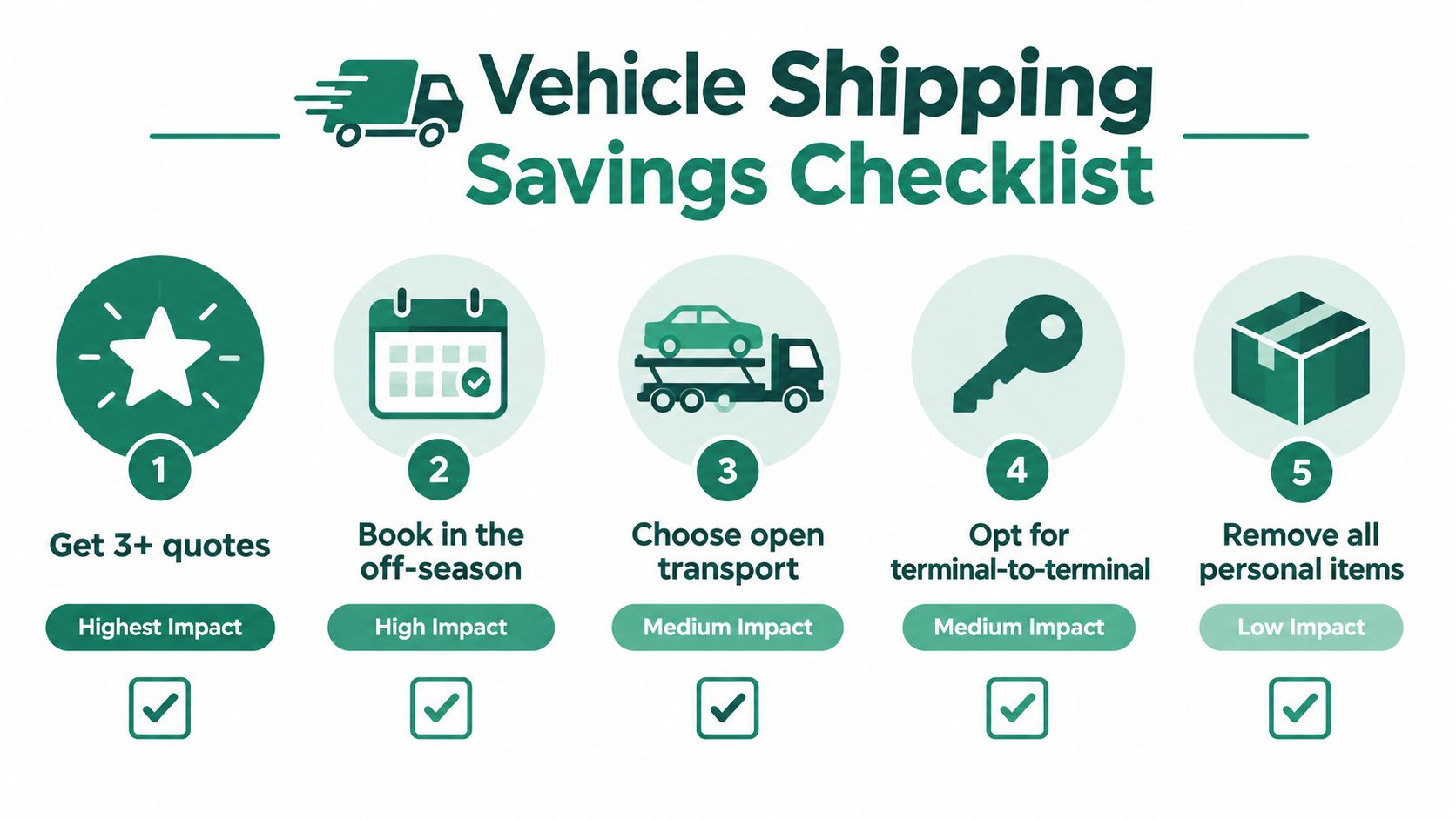
Start with the moves that affect carrier availability, then review convenience upgrades and protection choices. Don't waste time negotiating a few dollars while leaving the pickup date, equipment type, or delivery location unnecessarily restrictive.
- Get at least three quotes: Compare the effective service, equipment, pickup window, port, and included charges. A cheap headline quote may exclude important handling or delivery work.
- Book two to four weeks ahead: Early planning gives the dispatcher time to locate a suitable carrier and avoid a last-minute capacity problem. The exact result depends on the route and season.
- Keep pickup flexible: Offer a multi-day window whenever possible. This is often more useful than demanding a particular discount.
- Choose open transport when appropriate: For a normal, operable daily driver, open service usually costs less than enclosed transport. Don't pay for premium protection your vehicle doesn't need.
- Use terminal service selectively: Dropping off or collecting the vehicle at a terminal can remove local mileage and detours. Confirm the terminal's hours, inspection process, and release requirements first.
- Adjust the route: A nearby commercial meeting point may be easier for a carrier than a narrow residential street. Never choose an unsafe meeting location just to lower the rate.
- Review Puerto Rico service legs: Ask whether the quote covers mainland pickup, port delivery, ocean freight, San Juan handling, and island-side delivery. Remove a leg only if you can handle it reliably.
- Check insurance and registration: Verify the broker or carrier's FMCSA registration, read recent dispatch reviews, and confirm cargo insurance limits before signing a dispatch sheet.
- Remove personal items: Clear the cabin and trunk, document existing damage, and photograph the vehicle at pickup. Personal property can create coverage and handling complications.
The right provider matters as much as the tactic. National Car Transport coordinates domestic transport across the 48 contiguous states, Puerto Rico, Alaska, and Hawaii, with open, enclosed, container, and ocean options. It also offers bilingual English and Spanish agents based in the United States, with more than 20 years of auto transport logistics experience, while the company reports 25+ years in business, an A+ BBB rating, transparent flat-rate pricing, and a network of 25,000+ vetted carriers.
One experienced agent can make the difference between a confusing quote and a workable plan. Not one vehicle transport is alike, and having an advisor guide the timing, equipment, route, port, and delivery details is what makes the process simple and quick at a sensible value.
National Car Transport can compare open, enclosed, container, and Puerto Rico shipping options around your vehicle's real requirements, not a generic rate card. Request a clear quote through National Car Transport, then speak with a bilingual U.S.-based agent about your dates, locations, vehicle condition, and the most practical way to lower the total cost.