
Supplemental vehicle-shipping insurance typically costs roughly $200–$500 per shipment, or about $0.50–$1.00 per mile, layered over whatever the carrier's built-in liability covers. That price is only a starting point, because the actual question is whether the policy can cover the gap between what the carrier owes and what your vehicle is worth.
You may be arranging an SUV from Atlanta to San Juan, sending a commuter car from Chicago to Dallas, or moving several dealership vehicles from California to Texas. The quote may show “insurance included,” but that phrase doesn't tell you the coverage limit, deductible, exclusions, or whether protection applies during an ocean crossing. Those details decide whether a damaged vehicle becomes a manageable claim or an expensive dispute.
I've priced enough auto transport to know that customers often focus on the premium first. That's backwards. Start with the vehicle's documented value, compare it with the carrier's cargo limit, and then identify which risks remain uninsured. Shipping insurance is a coverage-gap problem before it's a price-tag problem.
Table of Contents
- What a Real Shipping Insurance Quote Looks Like
- The Three Kinds of Coverage Hiding Behind One Word
- Six Factors That Actually Move the Price
- Domestic Routes vs Mainland to Puerto Rico
- Four Documents to Demand Before Dispatch
- Why Documentation Beats a Higher Policy Limit
- Smart Coverage Choices for Common Shipping Situations
What a Real Shipping Insurance Quote Looks Like
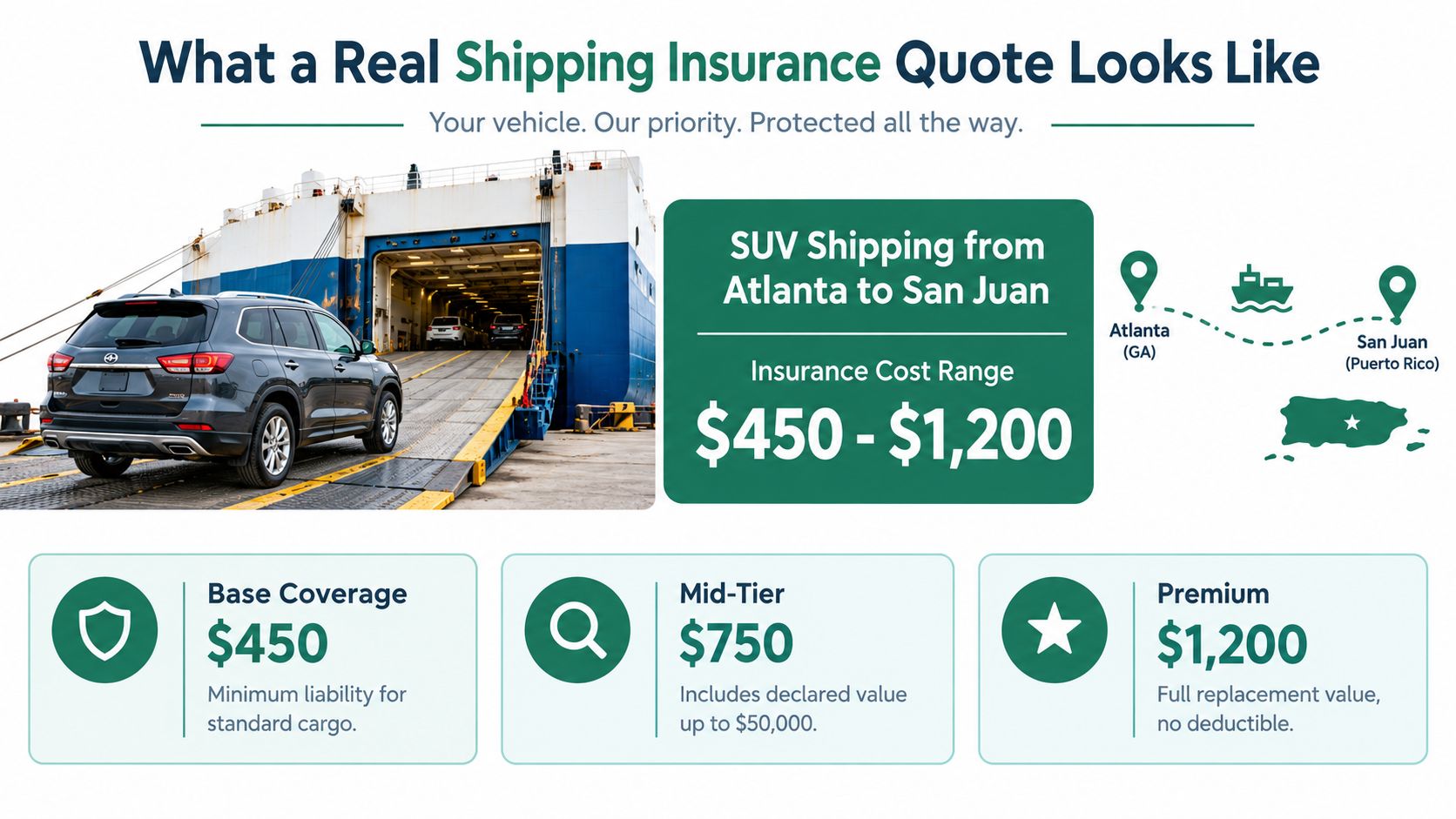
A family shipping an SUV from Atlanta to San Juan may receive a transport quote that includes the carrier's standard liability, followed by an optional charge for additional protection. A dealer moving vehicles from California to Texas may see a similar structure, although the declared value, route, transport method, and number of vehicles can change the underwriting.
For a typical U.S. vehicle shipment, optional supplemental coverage may cost roughly $200–$500 per shipment, or about $0.50–$1.00 per mile, depending on the vehicle value, route, deductible, exclusions, and whether the protection is primary or excess. Those figures come from vehicle-shipping insurance guidance, and they should be treated as a starting range, not a guaranteed menu price.
Why mileage gives the wrong impression
Mileage affects exposure, but it doesn't determine the premium by itself. A $0.60-per-mile charge on a short enclosed move can cost less in total than a $0.30-per-mile charge on a much longer open-carrier shipment. The vehicle's value and the risks covered usually matter more than the mileage line alone.
Ask the quoting company to show you four separate details:
- Insured value: Is the policy based on market value, replacement value, or a declared amount?
- Carrier responsibility: Does the carrier pay only when it is legally responsible for covered damage?
- Deductible: What amount comes out of your claim before payment?
- Coverage period: Does protection run from pickup through final delivery, including storage or a vessel leg?
A useful pricing comparison is the gap between your car's documented value and the carrier's applicable limit. A vehicle worth more than the carrier's per-vehicle limit may need supplemental protection even when the transport quote says insurance is included.
Before approving a quote, compare the coverage terms with the car shipping cost information, then ask for the carrier's certificate of insurance. If you're also shipping loose parts or accessories, proper preparation matters. Resources that help you find packaging solutions can reduce handling damage for items traveling separately from the vehicle.
The first quote should tell you what the shipment costs. The follow-up questions tell you what that price protects.
The Three Kinds of Coverage Hiding Behind One Word
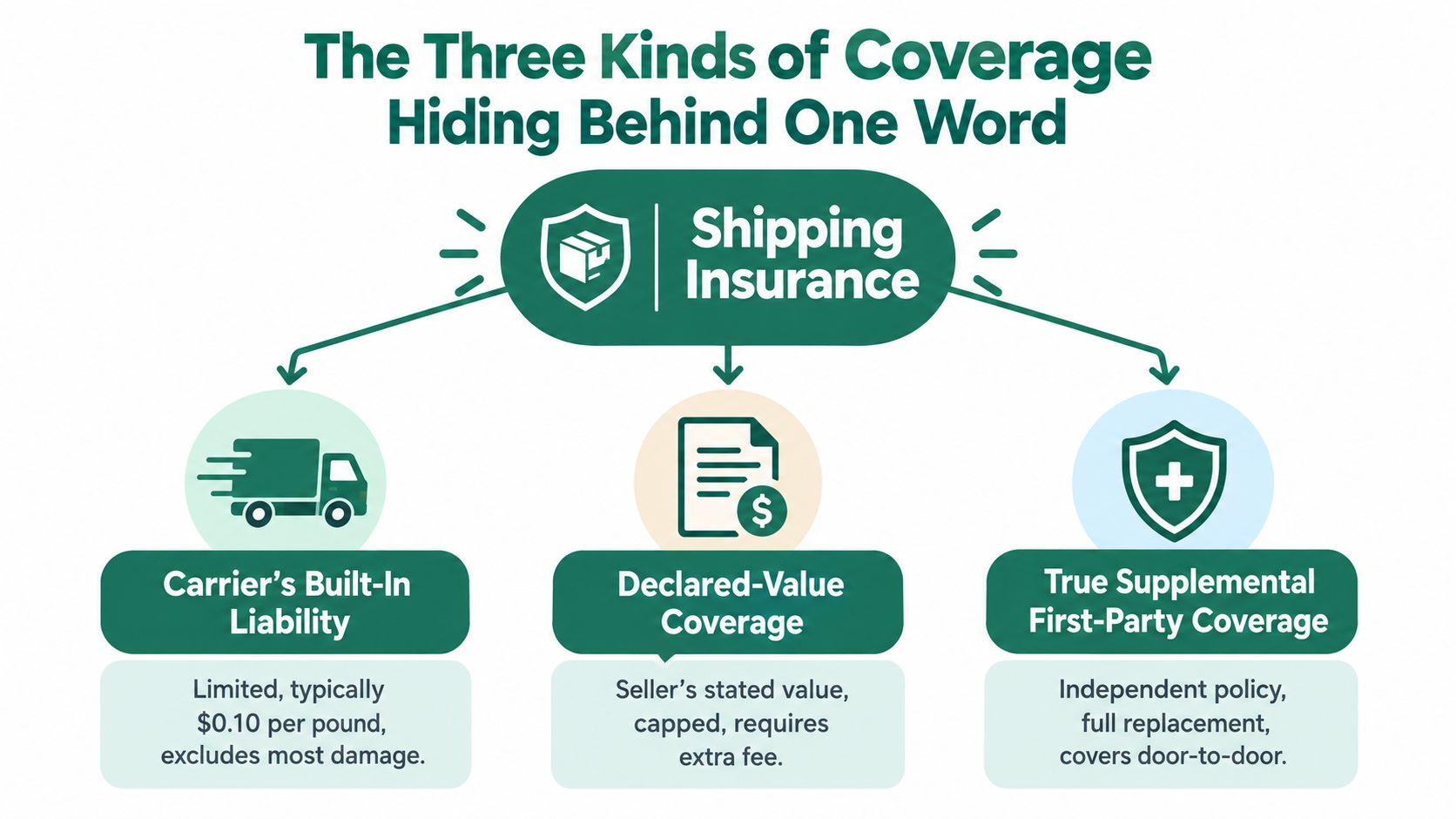
“Shipping insurance” is an umbrella phrase. In auto transport, it can describe three very different arrangements, and confusing them is how owners discover a coverage gap after delivery.
Think of a rental truck. The basic contract may cover the operator's legal responsibility. An upgraded damage waiver may address more damage to the vehicle. A separate insurance rider can provide broader protection under its own terms. Car shipping works similarly.
Carrier liability
Carrier liability responds to covered loss or damage for which the carrier is responsible. It isn't automatically the same as full replacement-value insurance. A carrier's financial responsibility also addresses operational risks such as bodily injury and property damage arising from the carrier's business.
Federal requirements vary by carrier type, vehicle characteristics, cargo, and operating authority. The Federal Motor Carrier Safety Administration insurance requirements generally show a $300,000 public-liability minimum for certain for-hire property carriers using vehicles under 10,001 pounds GVWR, and generally $750,000 for covered carriers using vehicles at or above that threshold. Some listed categories also involve a $5,000 cargo-insurance requirement, while the required financial assurance can rise to $5 million depending on the operation.
Those are coverage limits, not premiums paid by a customer.
Declared-value coverage
Declared-value coverage sets the value used to measure the carrier's responsibility. It may carry a separate fee, a cap, or specific conditions. Declaring a vehicle's value doesn't automatically add every peril a first-party policy would cover.
Federal rules can create an especially misleading floor for auto transport. Published guidance describes cargo-insurance requirements as low as $5,000 per vehicle and $10,000 per occurrence in some carrier arrangements, which may be inadequate for a modern, luxury, financed, or classic vehicle. Shipping insurance cost analysis explains why a declared amount and true insurance protection shouldn't be treated as interchangeable.
Supplemental first-party coverage
A supplemental first-party policy is designed to protect the vehicle owner under its own terms, subject to limits, exclusions, and deductibles. It may fill a gap when carrier liability doesn't reach the vehicle's documented value, but you must confirm whether it is primary or excess.
The distinction matters. Liability coverage generally requires a covered event connected to the carrier's responsibility. First-party protection may respond under broader terms, but “broader” doesn't mean unlimited. Weather, pre-existing damage, personal belongings, mechanical failure, theft, and acts of nature may be excluded.
Before signing, name the product you're buying. “Insurance included” isn't enough.
Six Factors That Actually Move the Price
Underwriters don't price a car shipment from distance alone. They look at the vehicle, the movement, and the policy wording together. These six inputs usually explain why two cars on similar routes receive different coverage quotes.
Declared vehicle value
A higher declared value usually raises the premium because the insurer faces a larger potential loss. A $40,000 enclosed SUV presents a different exposure from a $12,000 commuter sedan, even if both travel a similar route.
The declared figure should be supportable through purchase records, valuation documents, photographs, or comparable listings. A high number can increase the price without expanding the covered perils, so confirm what the policy pays for.
Transport mode
Open transport is usually the practical choice for ordinary vehicles. Enclosed transport adds protection from road debris and exposure, and it often suits luxury, collectible, restored, or unusually valuable vehicles.
The insurance question is separate from the equipment question. Enclosed service doesn't automatically turn a liability policy into full first-party coverage.
Route and remoteness
A major city-to-major-city route may have more carrier availability than a remote pickup or delivery. Island routes add handling stages and may involve a marine-cargo arrangement. Rural access, port transfers, storage, and limited sailing schedules can all change the exposure.
Deductible
A higher deductible can reduce the premium, but it also increases your out-of-pocket share of a covered claim. Choose a deductible you could pay without delaying repairs or creating a dispute over a relatively small loss.
Exclusions and acts of nature
Ask specifically about hail, storms, flooding, theft, loose parts, personal items, mechanical failure, pre-existing damage, and acts of God. A policy with a generous limit can still provide little value if the event falls under an exclusion.
Primary or excess status
Primary coverage responds first under its terms. Excess coverage generally responds after another applicable policy or carrier liability has been considered. If the quote doesn't identify this clearly, ask the agent to state the order of payment in writing.
| Factor | Raises Premium | Lowers Premium |
|---|---|---|
| Declared value | Higher vehicle value or replacement-value wording | Lower, well-documented value |
| Transport mode | Enclosed, specialized, or multimodal handling | Standard open transport |
| Route | Remote pickup, port transfer, or island movement | Direct, established domestic route |
| Deductible | Lower deductible | Higher deductible you can afford |
| Exclusions | Broader peril wording and fewer exclusions | Narrower coverage with more exclusions |
| Policy position | Primary protection | Excess protection layered over valid carrier coverage |
A quote should make these levers visible. If it gives you one unexplained number, you don't yet have enough information to compare providers.
Domestic Routes vs Mainland to Puerto Rico
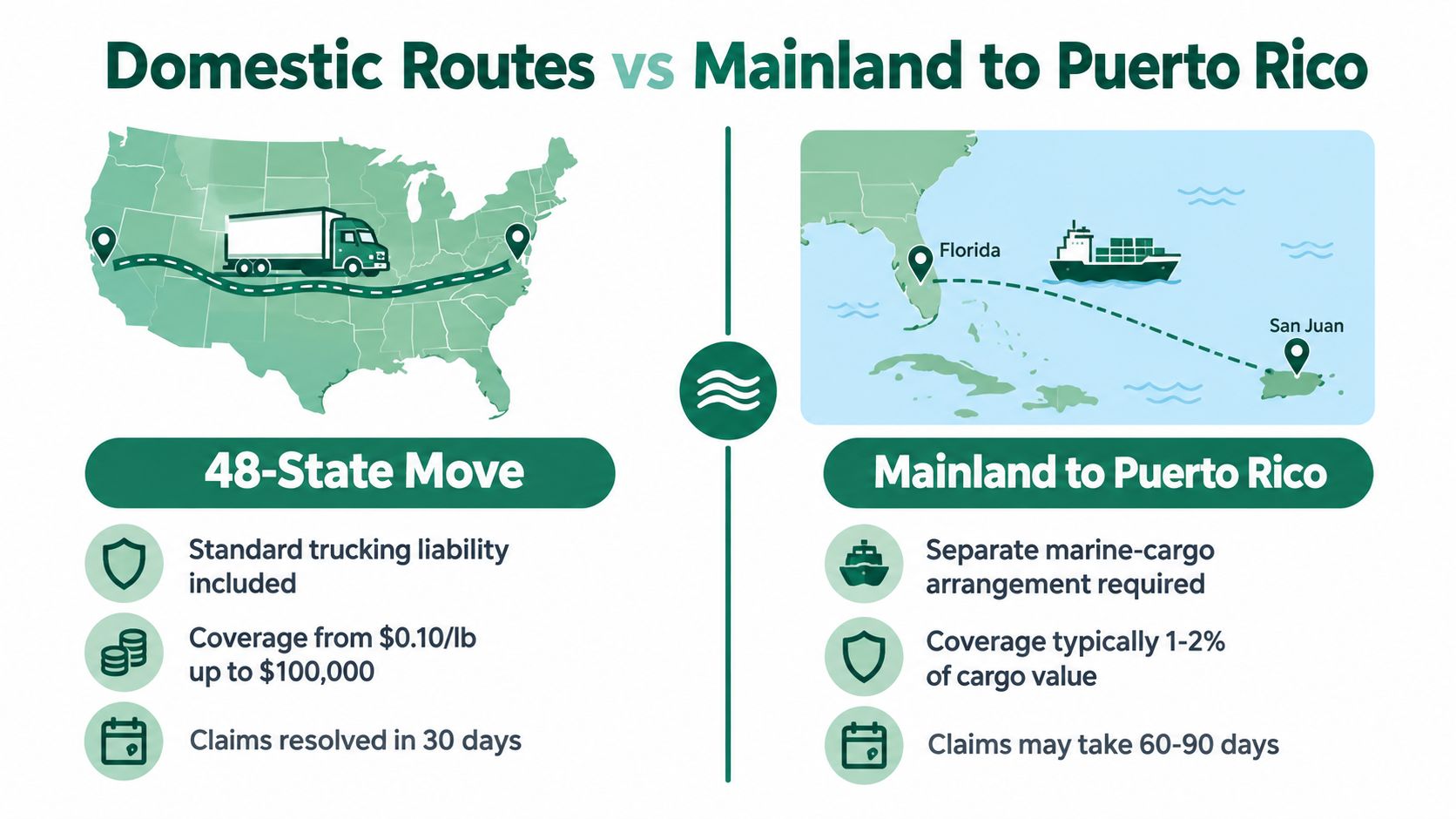
A vehicle moving between the 48 states usually stays within a trucking network. The carrier loads the car, transports it over the road, and completes delivery under the carrier's applicable terms. The coverage conversation centers on cargo liability, inspection records, declared value, and the policy's exclusions.
A mainland-to-Puerto Rico shipment is different. The vehicle typically crosses an ocean segment, which can introduce a separate marine or ocean-cargo arrangement. The important question isn't just whether the truck is insured before the port. It's whether the vehicle remains protected while it is transferred, loaded, carried, discharged, and delivered in San Juan.
What changes on the Puerto Rico route
A published Crowley Puerto Rico vehicle-shipping policy states that cargo insurance isn't required by law, while optional coverage may be purchased with $25,000 or $50,000 limits and a zero deductible. The same policy states that customers declining optional coverage must sign a cargo-insurance opt-out form, and that carrier liability may be limited to $500 per vehicle under its terms.
That $500 figure is why customers shouldn't assume the transport price itself provides full-value protection. A vehicle worth substantially more than the stated liability cap requires a direct conversation about supplemental cargo coverage.
Ask these questions before dispatch:
- Coverage stage: Does protection run door to door, or only while the vehicle is on the vessel?
- Ocean terms: Is marine cargo insurance included in the quoted price?
- Limit: Does the available limit match the vehicle's documented value?
- Deductible: Is the deductible zero, or does another policy apply?
- Claims process: Which party receives the notice, and what deadline applies?
A provider can coordinate trucking, port handling, and sailing paperwork, but coordination doesn't replace reading the policy. National Car Transport offers information about Puerto Rico car shipping services, while the customer should still request the actual insurance terms before authorizing the move.
For snowbirds, military families, students, dealerships, auction buyers, and businesses, the practical difference is simple. A domestic move is mainly a trucking-liability question. Puerto Rico is a multimodal coverage question, and the ocean leg must be addressed in writing.
Four Documents to Demand Before Dispatch
A phone promise isn't a claims file. Before the driver arrives, keep four documents together in one email folder or printed packet.
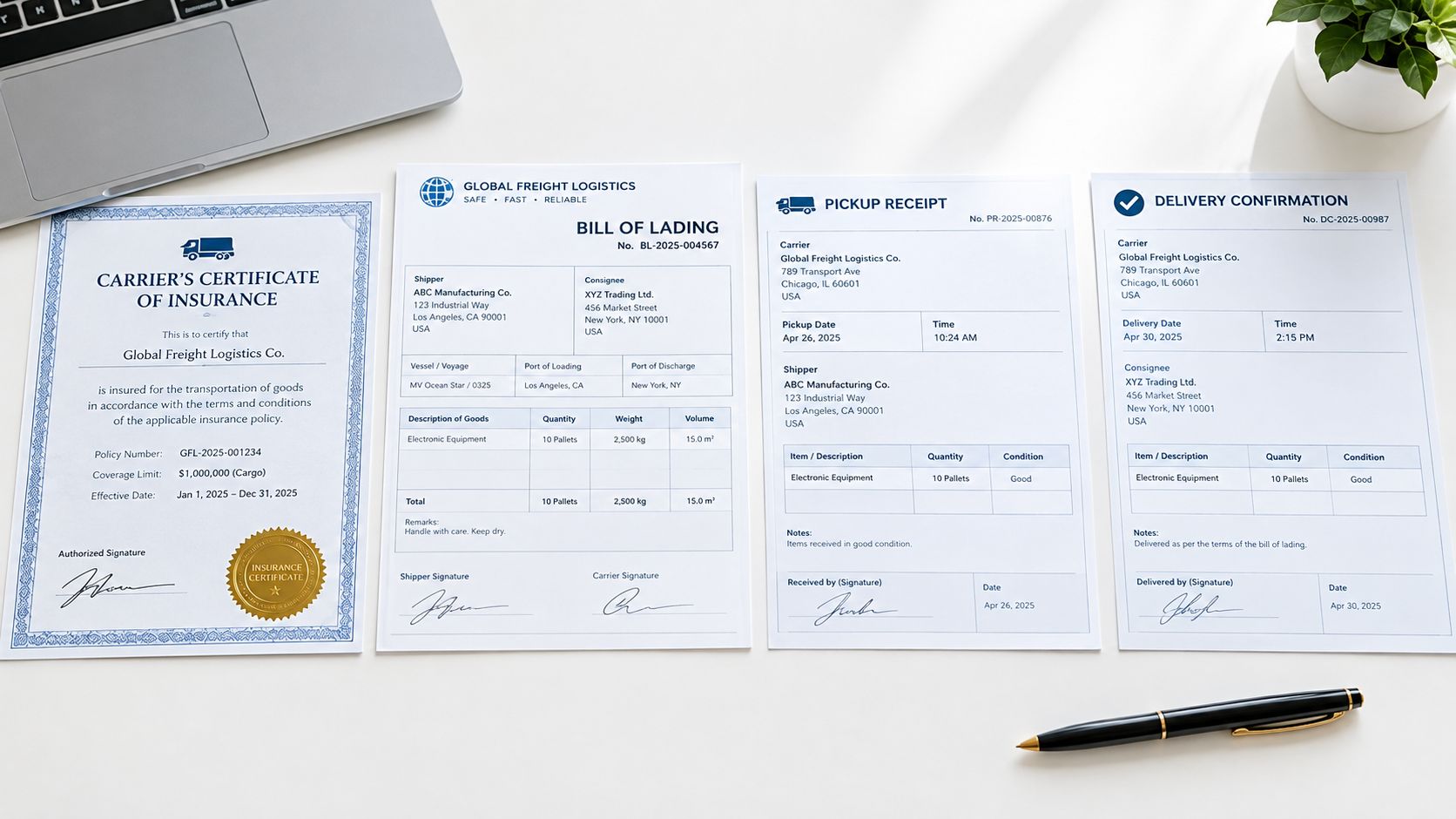
The certificate of insurance
Request the carrier's current certificate of insurance, not just a statement that coverage exists. Check:
- Named insured: The legal name should match the carrier handling the vehicle.
- Cargo limit: Confirm the applicable per-vehicle and per-occurrence limits.
- Policy dates: Make sure the policy is active during pickup and delivery.
- Coverage type: Ask whether the certificate reflects cargo liability, physical damage, or another form of protection.
A certificate summarizes coverage. It doesn't replace the policy wording, so ask about exclusions and deductibles when the limit looks lower than the vehicle value.
The bill of lading
The bill of lading records the transport agreement and vehicle condition at key points. Verify the VIN, mileage, fuel level, accessories, pickup location, delivery location, and visible damage.
Don't accept a vague entry such as “scratches noted” when the vehicle has several panels with different marks. Specific descriptions give the carrier and insurer something concrete to compare at delivery.
The pickup inspection report
Walk around the vehicle with the driver in good light. Photograph every panel, wheel, windshield, mirror, roof, bumper, and interior surface. Record mileage and photograph the dashboard if the vehicle has warning lights or unusual readings.
Upload the images immediately and keep the original files. A dated, complete set is far more useful than a handful of photographs taken only after delivery.
The declared-value form
The declared-value form should show the exact amount used for coverage and identify exclusions, deductibles, and valuation rules. Confirm whether the figure represents market value, replacement value, or a carrier-set maximum.
Skipping this form can leave you with a payout capped below the vehicle's value. It can also create an argument over whether the verbal quote or the signed document controls.
Your dispatch-day routine should be consistent in every U.S. state and on every Puerto Rico sailing: review the certificate, complete the bill of lading, finish the inspection, sign the declared-value form, and store copies before the vehicle leaves.
Why Documentation Beats a Higher Policy Limit
A high policy limit doesn't rescue a claim that fails on proof. A $300,000 policy limit could still pay nothing for a delivery scratch if the pickup inspection failed to record the vehicle's condition and the carrier disputes when the damage occurred.
That isn't because the limit is small. It's because the claim must connect the loss to a covered event during the carrier's responsibility. The pickup report, dated photographs, mileage, bill of lading, and delivery notation establish that timeline.
Practical rule: Photograph first, sign second, and report damage before accepting final delivery.
Use the same routine at both ends:
- Photograph every panel, wheel, glass surface, and visible accessory at pickup.
- Record the mileage and any existing marks on the inspection report.
- Repeat the walk-around at delivery in daylight where possible.
- Write every discrepancy on the bill of lading before signing.
- Retain the inspection report, photographs, quote, policy terms, and correspondence.
A higher limit can matter when the carrier's available protection is below the vehicle's value. But better documentation often has more practical value than paying for extra protection you can't successfully prove.
The cheapest protection on the curb is your phone camera. Use it before the truck leaves, not after the driver has gone.
Smart Coverage Choices for Common Shipping Situations
A snowbird moving a standard commuter car between a mainland home and a seasonal residence may need the carrier's documented liability if the vehicle's value fits comfortably within the applicable limit. A military family should request the same paperwork, then pay close attention to tight pickup windows, storage, and delivery condition.
A dealership, auction buyer, or business moving several vehicles should compare each vehicle's declared value with the per-vehicle and per-occurrence limits. Fleet shipments also deserve a written explanation of whether one incident can consume a shared occurrence limit.
Classic-car owners and luxury-vehicle owners should usually consider enclosed transport and supplemental protection when the carrier's liability doesn't match the vehicle's documented value. A separate resource on transport insurance via ABS Insurance Brokers can help explain broader insurance concepts, but the transport policy still controls the shipment itself.
Use this checklist:
- Compare documented vehicle value with the carrier's applicable limits.
- Request the certificate of insurance before dispatch.
- Confirm whether coverage is primary or excess.
- Ask whether Puerto Rico coverage includes the ocean leg and final delivery.
- Photograph the vehicle at pickup and delivery.
- Keep the bill of lading with the inspection report.
- Read exclusions for weather, theft, personal items, mechanical failure, and pre-existing damage.
- Choose enclosed auto transport when the vehicle's condition or value justifies the added protection.
National Car Transport can arrange open, enclosed, and island-route vehicle transport through a nationwide network of 25,000+ vetted carriers, with 25+ years of experience and an A+ BBB rating. Its agents can explain the quote, coordinate documents, and provide bilingual English/Spanish support from the United States. Not one vehicle transport is alike, and a knowledgeable agent can make the process simpler without asking you to accept unclear policy language.
National Car Transport provides door-to-door vehicle transport across the United States and Puerto Rico, with transparent flat-rate pricing and insurance details included in the transport quote. Visit National Car Transport to request a shipment review, compare coverage with your vehicle's value, and speak with an experienced English/Spanish agent before the vehicle is loaded.