

You're relocating from Atlanta to San Juan, sending a car ahead of a military transfer, or moving a second vehicle from Chicago to Florida for the winter. The question sounds simple, but how does car shipping work in practice involves much more than handing over keys. A dispatcher must match the vehicle to an available carrier, the driver must inspect and secure it, and the shipment may involve highways, terminals, ports, customs paperwork, and changing delivery conditions.
The process is manageable when you know where responsibility sits. You'll choose a transport method, confirm the quote, prepare the vehicle, review the condition report, follow communication updates, and inspect the car again before signing for delivery. The details differ for a sedan moving between the 48 contiguous states and a vehicle traveling by ocean to or from Puerto Rico, but the operating logic remains the same: plan the route, document the handoff, and verify every party handling the vehicle.
Table of Contents
- The Car Shipping Journey From Quote to Delivery
- Choosing the Right Transport Method for Your Vehicle
- Understanding Car Shipping Pricing and Flat Rates
- Booking Pickup and Tracking Your Vehicle in Transit
- Preparing Your Vehicle and Handling Puerto Rico Documentation
- Avoiding Fraud and Verifying Your Auto Transport Carrier
- Key Takeaways and Choosing a Reliable Shipping Partner
The Car Shipping Journey From Quote to Delivery
A family moving from Atlanta to San Juan may begin with a basic quote request, but the shipment quickly becomes a coordinated logistics project. The shipper provides the vehicle identification details, condition, pickup address, destination, and preferred dates. The transport company then determines whether the car will travel by open carrier to a mainland port, continue by ocean service, and arrive through San Juan, or use another available routing option.
A snowbird moving a vehicle from Chicago to Florida usually has a simpler road-based shipment. A military family changing duty stations may need the carrier to coordinate around housing access, reporting dates, and a pickup location that cannot accommodate a large hauler. In each case, the quote is only the starting point. The actual shipment begins when a carrier is assigned and the pickup plan is confirmed.
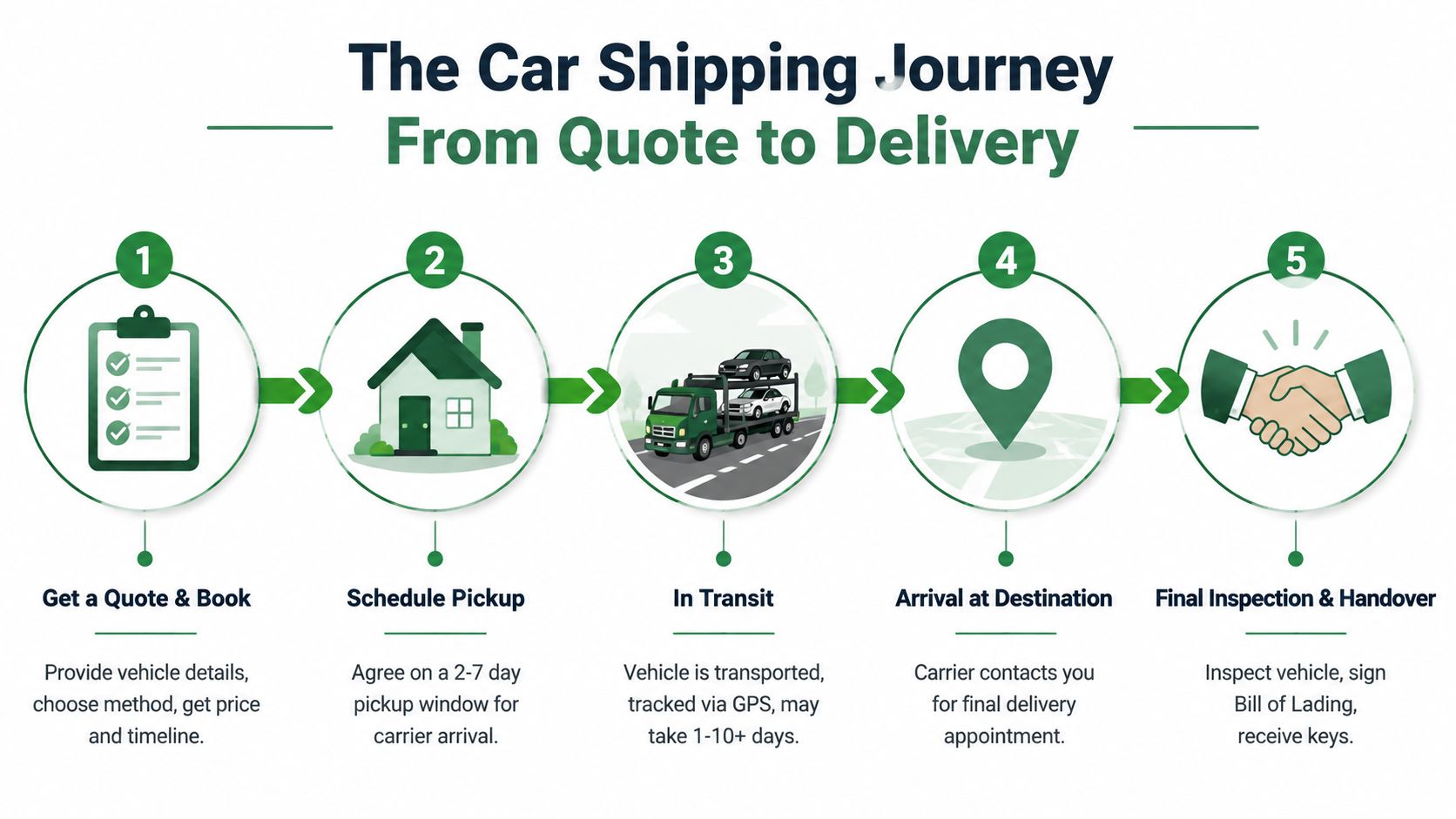
What happens after booking
The carrier typically arrives within a pickup window rather than at an exact guaranteed minute. Industry information indicates that pickup usually takes 2 to 7 days, while long-distance domestic transit is often estimated at about one day per 500 miles according to industry shipping data. Traffic, weather, route density, carrier availability, and seasonal demand can change those expectations.
At pickup, the driver and shipper inspect the vehicle together. Existing dents, scratches, chips, and other visible conditions are recorded on the Bill of Lading, which functions as the shipment receipt and condition report. The driver loads the car onto a multi-car hauler or enclosed trailer, depending on the selected service and the vehicle's protection requirements.
Practical rule: Treat the pickup inspection and the delivery inspection as one continuous record. Photograph the same areas before loading and after unloading.
During transit, the carrier follows the planned route and provides status information through the transport company or its tracking process. Near delivery, the driver contacts the recipient to arrange a practical meeting point. Door-to-door service means the company aims to bring the vehicle as close as safely and legally possible to the requested addresses, but narrow streets, low branches, restricted neighborhoods, and terminal rules can require a nearby handoff.
At delivery, inspect the exterior and interior before signing the final paperwork. Compare the vehicle with the pickup condition report, note any new visible issue on the Bill of Lading, and collect the keys only after the handoff details are clear. For Puerto Rico shipments, the final stage also depends on port release procedures and the selected door-to-port or port-to-door arrangement.
Choosing the Right Transport Method for Your Vehicle
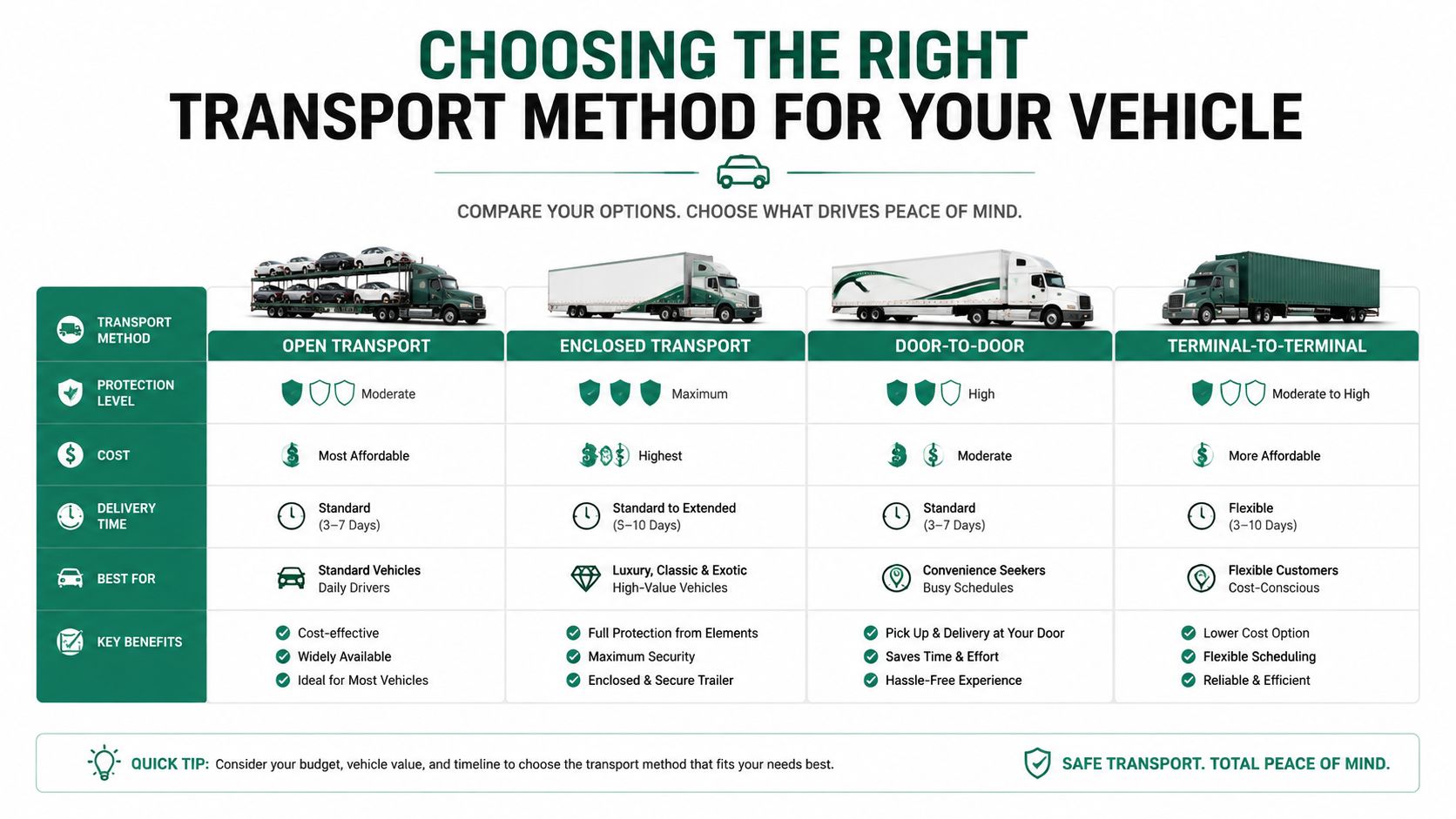
The right service depends on the vehicle, route, value, and tolerance for exposure or extra handling. A standard sedan moving between major cities such as Phoenix and Denver usually has different needs from a restored classic traveling from New York to San Juan. The four main options are open transport, enclosed transport, container shipping, and roll-on/roll-off ocean transport.
Open carriers for everyday vehicles
Open transport remains the dominant U.S. method, accounting for roughly 80% of shipped vehicles because one hauler can move multiple cars efficiently across long distances industry data explains the capacity advantage. It's usually the practical choice for daily drivers, family SUVs, dealership inventory, online purchases, and vehicles moving between cities such as Los Angeles, Dallas, Atlanta, Miami, Chicago, Seattle, or Boston.
The vehicle travels on an exposed multi-car trailer. That means it can encounter ordinary road dust, rain, and outdoor conditions, but the method is widely used because consolidation keeps the per-vehicle cost lower. Review the open car transport service details before deciding whether the standard option fits your vehicle.
Enclosed transport for higher-value cars
An enclosed trailer provides greater protection from weather, road debris, and public exposure. Owners commonly choose it for classic, exotic, luxury, restored, or particularly valuable vehicles. Enclosed loading may also accommodate equipment suited to low-clearance cars, but availability can be narrower and the premium is harder to justify for an ordinary commuter vehicle.
Containers for additional protection
Container shipping places a vehicle inside a steel ocean container and can suit non-operable cars, high-protection shipments, or vehicles traveling with stricter handling preferences. It can also be useful when the shipper wants the car isolated from open-deck exposure. Space, loading requirements, port availability, and the vehicle's dimensions all affect whether a container is appropriate.
RoRo for Puerto Rico and other ocean routes
Roll-on/roll-off, or RoRo, is the core ocean method for operable vehicles. The car is driven onto a specialized vessel through a stern, bow, or side ramp, secured on a vehicle deck with lashings and supports, and driven off at the destination this overview of RoRo vehicle movement explains why it requires fewer crane-handling steps than lift-based methods. Container service is generally better suited to non-operable or higher-protection shipments.
If you're inspecting a carrier's loading equipment or learning how straps function, this practical guide on how to tie a webbing strap offers useful background. A video can also help first-time shippers visualize the loading process:
Understanding Car Shipping Pricing and Flat Rates
Car shipping has no single national tariff. A 100-mile move may cost about $300, while a cross-country shipment can reach $1,000 or more, depending on the vehicle and route, as a shipping guide gives these route examples. Market coverage places prices across a broad $0.53 to $2.30 per mile range and reports that single-vehicle shipping prices rose 10% year over year in the second half of 2025 market commentary outlines the volatility.
Distance sets the starting point, not the final rate. A major-city lane may have more available carriers than a rural pickup. Vehicle dimensions consume different trailer space, enclosed service adds protection, and seasonal demand changes which loads carriers will accept. Puerto Rico moves also include mainland trucking to the departure port, ocean transport, terminal handling, and port paperwork.
What changes the quote
| Factor | Impact on Price | Example |
|---|---|---|
| Route distance | Longer routes generally require more fuel, driving time, and coordination | A short regional move versus a cross-country shipment |
| Vehicle size | Larger vehicles use more trailer or container capacity | A pickup truck may price differently from a compact sedan |
| Transport method | Enclosed and container service provide added protection and handling | A classic car may justify enclosed transport |
| Route density | Busy corridors can offer more carrier options | Major-city routes may be easier to match than rural lanes |
| Season and timing | Demand and available capacity affect the assigned rate | A flexible pickup date can help when capacity changes |
| Island routing | Port and ocean steps add operational requirements | Mainland trucking plus sailing to San Juan |
An instant quote reflects available capacity when you request it, not a locked-in rate. The estimate can change after the carrier reviews the exact route, vehicle details, pickup access, and schedule. A low figure may secure a booking, then rise if no carrier will accept the load at that amount.
A transparent flat-rate model should identify what the price includes, which conditions permit a change, and whether payment is due before a carrier is matched. National Car Transport explains its car shipping cost process through a flat-rate approach with no upfront charge until a carrier is matched.
Read the quote as an operating plan, not just a number. Ask who assigns the carrier, what happens if that carrier cancels, and which port, terminal, access, or service fees are excluded.
Insurance also needs a direct answer before pickup. Review Professional Insurance Advisors, LLC for transport as an industry resource, then ask the shipping company to identify the transporting carrier's coverage and explain how claims are handled. A cheaper quote can cost more after damage or delay if responsibility, communication, or coverage was never clear.
Booking Pickup and Tracking Your Vehicle in Transit
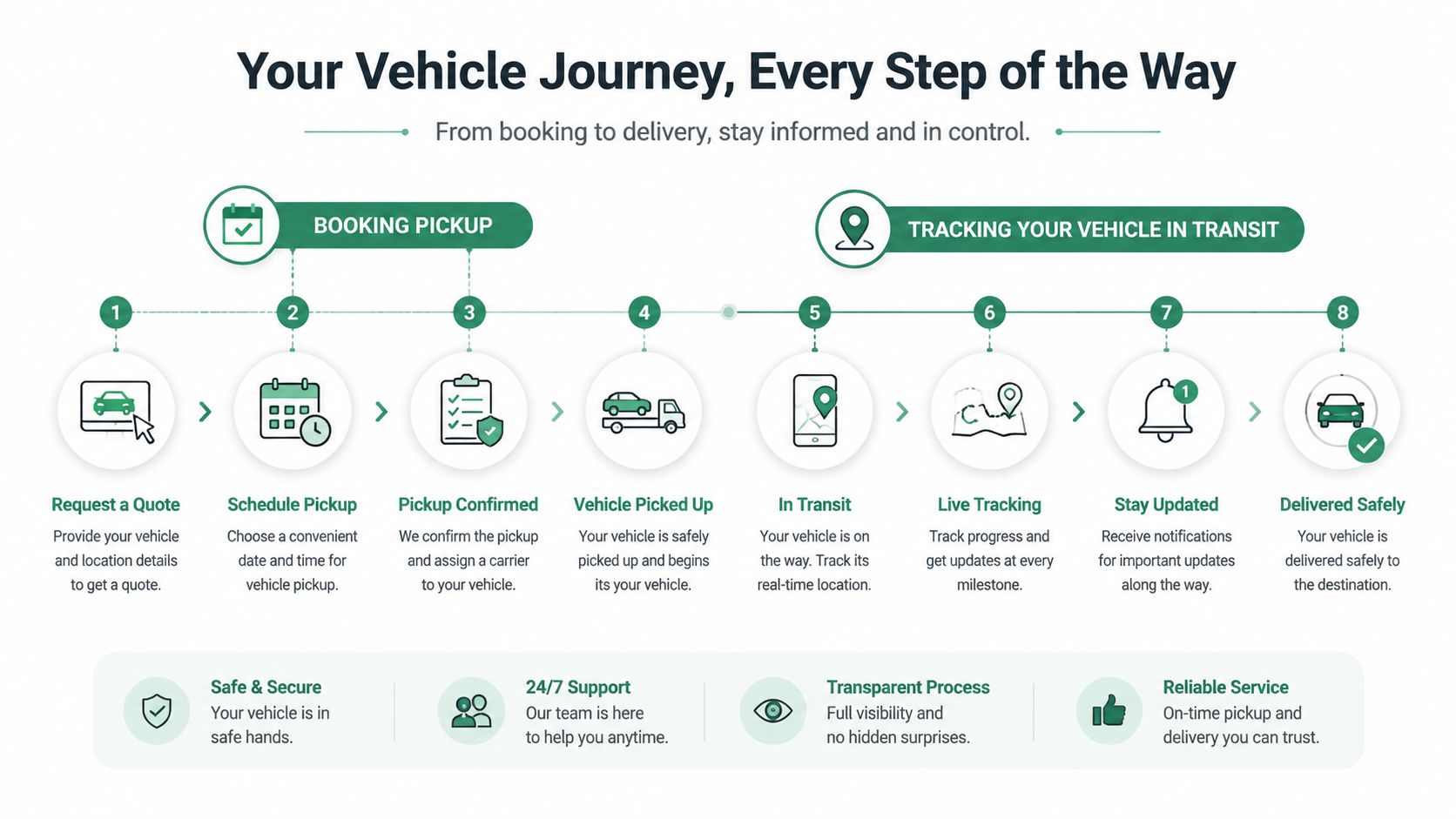
Once you approve the shipment, the transport company starts carrier matching. A broker may assign the move to a licensed carrier rather than operating its own truck. That arrangement is common, but confirm who your service contact is, which company performs the inspection, and who sends updates if the driver is delayed. Carrier availability can change after booking, so a low initial offer may require adjustment if no qualified driver accepts the load.
The pickup window generally spans 2 to 7 days, based on industry shipping information the operational estimate is documented here. Exact arrival times are difficult to promise. The truck may be finishing another delivery, encountering traffic, or waiting for a vehicle at an earlier stop.
Pickup day checkpoints
Before loading, complete the inspection with the driver:
- Walk around the vehicle together. Check the exterior, windows, wheels, lights, and visible trim.
- Record existing damage. Confirm that scratches, dents, chips, and other conditions appear accurately on the Bill of Lading.
- Photograph the vehicle. Take clear, well-lit images of every side, including the odometer.
- Confirm the loading plan. Ask where the vehicle will sit and how the driver will secure it.
- Keep your paperwork. Retain the inspection record and the driver's contact information.
FMCSA rules in 49 CFR Parts 300–399 govern interstate auto shipping. Cargo securement requirements cover automobiles, light trucks, and vans weighing 4,536 kilograms, or 10,000 pounds, or less the FMCSA regulations are available here. The carrier must use compliant tie-down and inspection procedures before traveling on public roads.
Transit updates and Puerto Rico port handling
For domestic routes, long-distance transit is often estimated at about one day per 500 miles. Treat that figure as a planning benchmark, not a delivery appointment. Ask whether updates arrive by phone, email, text, or portal, and establish who contacts you when the route changes.
Puerto Rico shipments add a port handoff. The vehicle may travel by truck to a mainland departure port, commonly Jacksonville, Florida, or Pennsauken, New Jersey, before ocean transport to San Juan. Crowley describes vehicle service to Puerto Rico as taking about two to two-and-a-half days, while other ocean services can take up to seven days Crowley explains its vehicle shipping service. Terminal cut-off times affect the sailing plan, so a late truck arrival can create a longer wait even when the ocean leg itself is on schedule.
A personal tracking device can provide another location signal, but confirm that the carrier permits it and that it is powered appropriately. Guidance on how to find your car locator explains the role of a separate vehicle locator. Use it alongside, not instead of, updates from the transport company.
Preparing Your Vehicle and Handling Puerto Rico Documentation
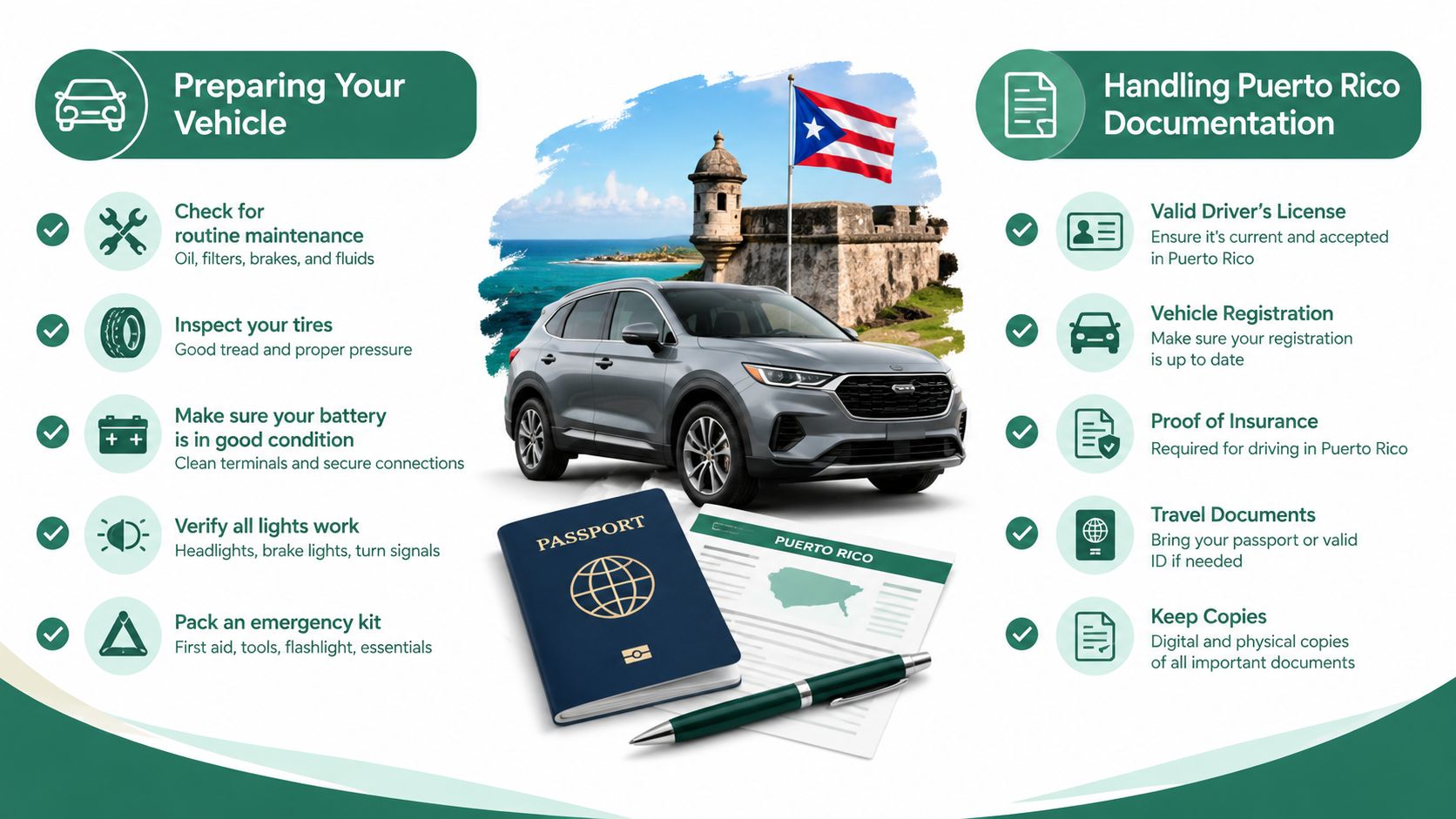
Preparation prevents avoidable delays and makes the condition report easier to verify. Wash the exterior so existing damage is visible, remove personal belongings, secure or remove loose accessories, and photograph the vehicle from multiple angles. Leave the driver with access to the keys, but keep personal documents, valuables, and unnecessary items out of the car.
A practical mainland preparation checklist includes:
- Clean the vehicle: Dirt can hide scratches and dents during the inspection.
- Remove belongings: Personal items can shift, disappear, or violate carrier rules.
- Check operating condition: Tell the carrier if the car doesn't start, roll, steer, or brake normally.
- Disable alarms: A triggered alarm can interrupt loading and transit.
- Document the condition: Keep dated photographs that match the Bill of Lading.
- Confirm access: Make sure the pickup location can safely accommodate the truck.
Puerto Rico shipments require stricter acceptance controls. Carrier instructions commonly require the car to be clean, empty of personal items, and at or below a quarter tank of fuel. The VIN must be legible on the vehicle body panels, and the booking must be completed before the vehicle is delivered to the terminal the Puerto Rico shipping instructions describe these requirements.
Time the certificates instead of collecting them too early
Outbound shipments from Puerto Rico require coordination with ACAA, CESCO, and the Puerto Rico police stolen-vehicle branch. The required certificates have short validity periods: the No Fines certificate lasts three days, the police pre-inspection certificate lasts five days, and the ACAA no-debt certificate lasts thirty days the U.S. Coast Guard checklist identifies the agencies and validity windows.
Schedule the inspection and port drop-off around those windows, not weeks in advance. A certificate that expires before terminal acceptance can force rescheduling, additional coordination, or a missed sailing. For route-specific guidance, review Puerto Rico car shipping options and confirm current carrier requirements before arranging the inspection.
Avoiding Fraud and Verifying Your Auto Transport Carrier
A low quote doesn't prove that a shipment is fraudulent, but an unusually low quote can signal that the person offering it hasn't secured realistic carrier capacity. The accountability gap matters because 29% of shippers experienced transportation fraud during the past three years, while 46% ranked finding dependable carriers as their top challenge the vehicle-logistics study reports these findings.
Start with identity and compliance. Ask for the carrier's USDOT number, determine whether the company is acting as a broker or carrier, and verify the operating information through FMCSA resources. Interstate carriers must meet FMCSA compliance requirements, including a USDOT number and at least $750,000 in public liability insurance the auto transport industry report summarizes these requirements.
A verification checklist that works
- Confirm the legal business identity: The quote, contract, payment instructions, and company contact details should align.
- Check the USDOT information: Don't rely on a number copied into an email without verifying the associated company.
- Ask who owns the truck: A broker may arrange the shipment, while a separate carrier performs pickup and delivery.
- Request written coverage details: Clarify what the carrier's insurance covers and how damage claims are documented.
- Demand a clear payment schedule: Understand deposits, balances, cancellation terms, and any conditions that could change the price.
- Require communication ownership: Know who contacts you if the driver is delayed, reassigned, or unable to reach the address.
Communication is part of risk control, not merely customer service. The same study found that 91% of shippers considered real-time updates important or very important, and 69% wanted more insight into expected arrival times the study identifies this visibility gap. A reputable provider should be able to explain how it monitors the shipment and how you'll receive status changes.
National Car Transport is one example of a provider that describes dedicated advisors, around-the-clock monitoring, bilingual English and Spanish agents based in the United States, and a network of 25,000+ vetted carriers. Compare those service details against any other company's written proposal rather than accepting a badge, rating, or low price without verification.
Key Takeaways and Choosing a Reliable Shipping Partner
The answer to how does car shipping work is a chain of accountable handoffs. You select open, enclosed, container, or RoRo service; the company matches the shipment to available capacity; the driver inspects and secures the vehicle; the route proceeds through trucking and, when required, port or ocean operations; and you complete a documented inspection at delivery.
Use this decision filter before booking:
- Transport fit: Choose open service for ordinary mainland vehicles, enclosed protection for higher-value cars, and RoRo or container handling for Puerto Rico and other ocean routes.
- Price clarity: Ask whether the quote is flat, what can change it, and whether carrier matching has been completed.
- Preparation: Clean the vehicle, remove belongings, photograph its condition, and follow fuel and VIN rules.
- Carrier verification: Confirm the USDOT information, insurance, operating role, and written payment terms.
- Visibility: Choose a provider that explains who sends updates and how delays are escalated.
- Human guidance: Look for a dedicated advisor who understands personal moves, snowbirds, military families, students, dealerships, and business fleets.
National Car Transport operates across all 50 states, Puerto Rico, Alaska, and Hawaii, with 25+ years of experience, an A+ BBB rating, transparent flat-rate pricing, and a network of 25,000+ vetted, licensed, and bonded drivers. Every shipment is different, so bilingual English and Spanish agents based in the USA, each with more than 20 years of auto transport logistics experience, can help coordinate the details instead of forcing you to interpret port rules, carrier availability, and inspection paperwork alone.
Get a free quote and speak with an experienced advisor who can explain your route, transport method, preparation requirements, and delivery plan. Visit National Car Transport to arrange nationwide or Puerto Rico vehicle shipping with clear guidance from booking through final handoff.