

About 60,000 people are injured every year in U.S. parking lot accidents, and more than 500 people die in these non-traffic crashes, primarily from backing incidents, according to the National Safety Council data summarized by Parking Network. That changes how you should think about something as ordinary as parking.
For drivers arranging vehicle shipping, parking isn't a minor detail. It's part of the handoff. The way a car is positioned at pickup or delivery can affect safety, loading time, property access, and the chance of a smooth, damage-free move. That matters whether you're shipping across the lower 48 states, moving between major cities, relocating to San Juan, Puerto Rico, or coordinating transport for a dealership, student, military move, or seasonal residence.
Table of Contents
- What Is Head On Parking and Why It Matters for Safety
- Head On vs Back In Parking A Clear Comparison
- How Parking Choices Affect Auto Transport Logistics
- Shipping a Car to Puerto Rico Port and Parking Logistics
- Expert Tips for Safe and Efficient Vehicle Handoffs
- Your Parking and Car Shipping Questions Answered
- Is head on parking illegal in some areas?
- What if my apartment complex only allows head-in parking?
- Does parking orientation matter for enclosed transport?
- I'm shipping from the mainland to San Juan. Should I meet the driver somewhere other than home?
- Do snowbirds, students, and military families need different pickup planning?
- What if I already parked head-in and can't change it?
What Is Head On Parking and Why It Matters for Safety
Head on parking usually means pulling nose-first into a space. In parking operations, that is more accurately called head-in parking. The maneuver feels simple because the vehicle enters going forward, but the risk shifts to departure. The driver must back into an active lane with limited sightlines, and that is where low-speed collisions, close calls, and property damage often happen.
For a private driver, that may mean a scraped bumper or a near miss with a pedestrian. For auto transport, the potential for issues is considerably greater. Pickup and delivery locations are temporary work zones, and a poor parking position can slow loading, tighten turning space, increase exposure to damage claims, and force the carrier to relocate the handoff before the inspection even begins.
Why the exit creates more risk
A head-in space trades easy entry for a harder exit. By the time the vehicle starts backing out, visibility is usually blocked by SUVs, vans, trucks, walls, or landscaping. Mirrors and backup cameras help, but they do not remove cross-traffic, foot traffic, or the narrow reaction window that comes with reversing into a shared lane.
That trade-off matters in real operations. Carriers need room to approach, inspect, and load without guessing what is coming around the next parked vehicle. A customer vehicle sitting nose-in at a crowded apartment lot or hotel loop often takes longer to access safely than one positioned for a clean forward departure.
Practical rule: If the vehicle has to back into uncertain traffic to leave the handoff point, the setup is already working against a safe shipment.
Why this matters in auto transport
Parking choice affects more than convenience. It affects timing, safety, and liability. If a carrier has to maneuver around a tightly packed head-in vehicle, every extra correction adds exposure to curbs, poles, overhangs, parked cars, and delivery traffic. That is one reason experienced dispatchers and drivers care about site layout before they care about speed.
Good parking setup supports a smooth inspection and handoff. Bad parking setup creates avoidable friction. Customers often focus on the truck route, but the last 100 feet at pickup or delivery can determine whether the job stays on schedule.
Site design also plays a role. A tight lot with narrow aisles, short stall depth, or poor turning radii can make even a routine pickup harder to handle. This guide to parking lot design gives useful context for why some properties work well for vehicle handoffs and others do not.
In practice, I have seen the same pattern in city condos, suburban complexes, hotels, campuses, and port staging areas. A vehicle parked head-in with little clearance around it can turn a routine transfer into a higher-risk maneuver. Position the car so the carrier can inspect it clearly and move it out with control, and the shipment usually starts cleaner and ends with fewer problems.
Head On vs Back In Parking A Clear Comparison
A lot of drivers choose head on parking because it feels faster. In a low-pressure moment, that's understandable. But speed on entry isn't the same as control on exit, and exit control is what usually matters most.
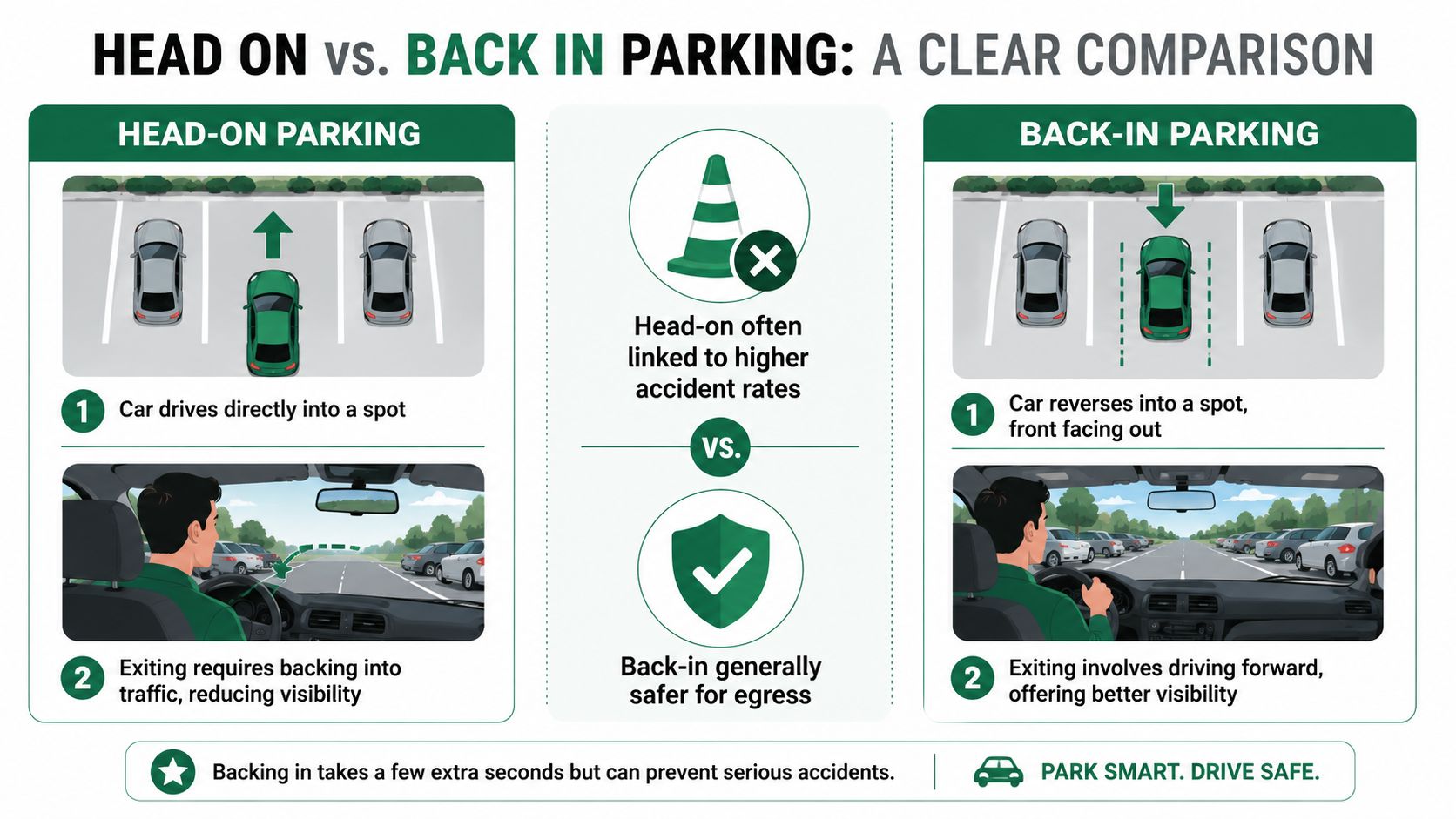
Where each method helps and hurts
Head on parking gives the driver a straightforward forward movement into the space. In a wide, quiet lot, that can feel convenient. The trade-off is poor visibility when leaving, especially if larger vehicles sit on both sides.
Back-in parking asks the driver to do the more demanding maneuver on arrival, when the lane behind the vehicle is still visible and the driver can choose the timing. Once parked, the car exits forward with a cleaner view.
Here's the comparison that matters most in practice:
| Factor | Head On Parking (Nose-In) | Back In Parking (Reverse-In) |
|---|---|---|
| Entry into the space | Usually feels easier for many drivers | Takes more setup and steering precision |
| Visibility when leaving | Limited because the car must back into traffic | Better because the car drives forward out |
| Pedestrian awareness | Harder to detect movement from both sides while reversing | Easier to scan while pulling forward |
| Speed of departure | Often slower because the driver hesitates and corrects | Usually cleaner and more direct |
| Suitability for transport pickup | Often poor in tight lots or narrow aisles | Better for inspection and staging |
Why space planning matters too
Parking design affects how forgiving either method is. If you want a useful visual reference for layout basics, aisle function, and space planning, this guide to parking lot design gives helpful context.
Backing into a space puts the difficult move at the beginning, when visibility is better. Pulling in head-first postpones that difficulty until the moment visibility is worse.
The practical verdict
For safety, back-in parking is the better choice in most lots where it's allowed. For transport logistics, it's also the cleaner setup because the vehicle starts the handoff facing out. That doesn't mean head on parking is always wrong. It means it becomes a weaker choice when traffic is active, visibility is blocked, or the pickup location is tight.
How Parking Choices Affect Auto Transport Logistics
A transport driver doesn't look at a parking spot the way a daily commuter does. The question isn't just, "Can the car get out?" Instead, the question is, "Can the car be inspected, accessed, aligned, and loaded without creating unnecessary risk?"
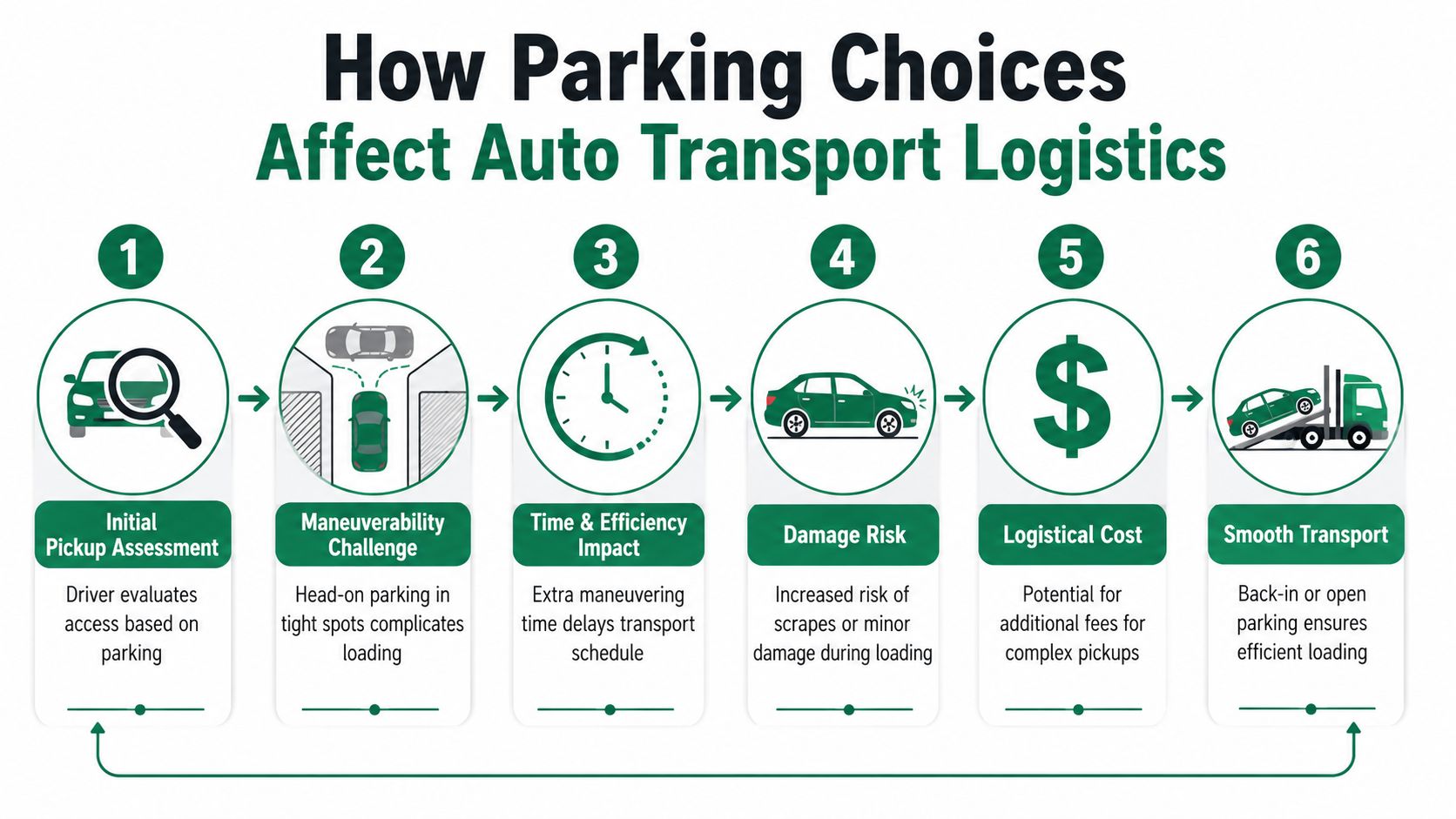
Why tight head-in layouts slow a pickup
A standard 90-degree head-in parking layout requires a minimum aisle width of 60 feet for two rows to allow vehicles to back out safely, according to the Fort Worth code reference cited here. That's an important dimension for auto transport because carriers need room to line up and work without using the street improperly or forcing risky maneuvers.
If your car is parked nose-in in a narrow apartment lot, gated condo court, office garage approach, or retail center with limited turning room, the driver may ask you to relocate the vehicle to a wider meeting point. That's not inconvenience for its own sake. It's risk control.
What works better at pickup
The best handoff locations usually share a few traits:
- Facing-out vehicle position: A car that's already pointed toward the exit is easier to inspect and move.
- Open approach lane: The driver can enter and leave without sharp corrections.
- Minimal side pressure: Fewer walls, curbs, posts, and adjacent parked cars reduce scrape risk.
- Clear property rules: Some locations don't allow commercial truck maneuvering in the way customers expect.
For customers using door-to-door auto transport, this is why a coordinator may suggest a nearby grocery lot, wide side street where legal, dealership overflow area, or another open commercial space rather than an interior apartment parking court.
A simple way to prepare
If head on parking is unavoidable where you live, do this before pickup:
- Walk the route yourself: Look for low branches, narrow turns, security gates, and places where a larger truck can't safely pause.
- Move the car early if needed: A nearby open lot can save time and reduce pressure on pickup day.
- Tell the coordinator what's tight: Photos and direct notes help more than vague reassurance.
- Leave room for inspection: The driver needs access around the vehicle, not just the driver's door.
The smoothest transport jobs usually start before the truck arrives. Good staging removes most of the avoidable friction.
Shipping a Car to Puerto Rico Port and Parking Logistics
Puerto Rico moves add another layer. The first leg still begins on the mainland, and that means the parking situation at your home, campus, office, or storage location matters before the car ever reaches the port.
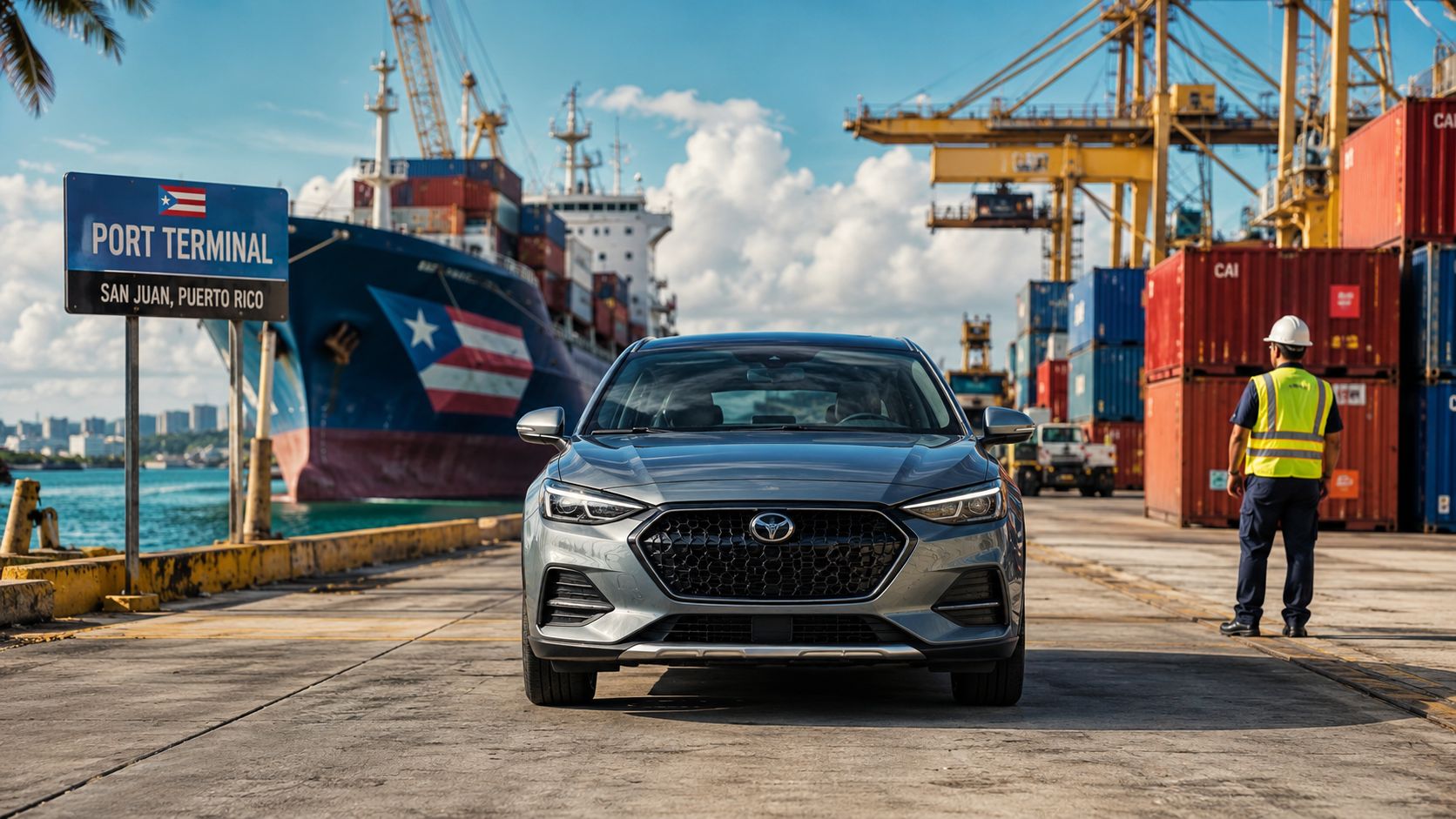
A typical shipment might start in Orlando, Tampa, Jacksonville, Miami, Atlanta, Charlotte, Houston, Dallas, Nashville, Philadelphia, Newark, New York, Chicago, or another mainland city, then move toward the port for ocean service to San Juan. If the vehicle starts in a cramped head-in apartment lot or downtown garage entrance, that first handoff can become the hardest part of the move.
Mainland pickup affects the whole chain
For Puerto Rico shipping, the cleanest jobs usually begin with a flexible meetup point on the mainland. A wide-access location helps the driver complete the inspection, load efficiently, and keep the schedule intact for the port leg. That matters for individuals, students, military families, dealerships, and snowbirds alike.
For customers pricing the ocean segment, Roll-On/Roll-Off service between Jacksonville, Florida, and Puerto Rico typically costs $1,200 to $1,500, with standard vehicle rates around $1,210, based on the TOTE Maritime Puerto Rico personal vehicle pricing page. Ocean pricing may be predictable, but the ground handoff still depends on practical details like where the car is parked and how accessible it is.
For route details, paperwork guidance, and island-specific planning, a dedicated car shipping to Puerto Rico service page is worth reviewing before you book.
Why experienced coordination matters on island moves
Puerto Rico shipments rarely fit a one-size-fits-all script. Some customers need home pickup from a suburban driveway. Others need an off-site handoff because their building doesn't allow truck access. Some are sending a student car, some are moving household vehicles after PCS orders, and some are coordinating dealership inventory.
A strong logistics team helps by asking the right questions early. Is the car stored nose-in behind other vehicles? Does the condo require a narrow ramp approach? Is the pickup point legal for truck staging? Is the delivery side in San Juan best handled at the port or through a local continuation plan?
Here's a useful walk-through for the Puerto Rico vehicle process:
When agents are bilingual in English and Spanish and based in the USA, communication tends to get easier at exactly the moments customers need it most. That matters because no two vehicle shipments are alike, and the best support usually comes from people who've spent years handling auto transport logistics rather than reading from a generic script.
Expert Tips for Safe and Efficient Vehicle Handoffs
The handoff is where planning becomes visible. Customers often assume the carrier will solve everything on arrival. Good drivers solve a lot, but the easiest pickups happen when the vehicle is staged well beforehand.
A better handoff starts with location choice
If your current spot forces a blind reverse, move the vehicle before the pickup window. A wide retail overflow lot, a legal open curb lane with enough approach room, or a spacious office lot often works better than the place where the car usually sits overnight.
For enclosed transport, staging matters even more because the loading process is more controlled and the equipment approach can be less forgiving. If you're moving a collector vehicle, muscle car, antique, exotic, or other specialty vehicle, it's smart to review what's involved in classic car shipping before pickup day.
The handoff checklist that actually helps
- Choose room over convenience: The closest spot isn't always the best spot. A larger, calmer pickup point is usually safer.
- Leave the car accessible: If the vehicle is boxed in by family cars, landscaping blocks, or apartment posts, loading gets harder fast.
- Share the awkward details: Tight turns, HOA rules, gate codes, school traffic, or downtown loading restrictions should be disclosed early.
- Keep the keys and paperwork ready: Delays often come from simple handoff friction, not the transport itself.
- Walk the car with the driver: Inspection goes faster when both sides can move around the vehicle without parked-car interference.
A clean handoff is less about luck and more about setup. Good access gives the driver better options.
What doesn't work well
Some pickup environments repeatedly cause trouble:
- Underground or low-clearance garages: Transport trucks often can't enter.
- Narrow cul-de-sacs with nose-in guest parking: Cars may be easy to park there, but not easy to load from there.
- Busy student housing lots: Traffic, double-parking, and limited staging space can compress the timeline.
- Dense urban curb zones: Legal stopping space can disappear before the truck arrives.
If any of those describe your situation, the fix is usually simple. Pick a safer nearby meeting point and confirm it in advance. That small adjustment can make the process feel simple and quick, which is exactly what experienced transport agents try to create for customers every day.
Your Parking and Car Shipping Questions Answered
Specific parking problems come up all the time in shipping. Most aren't deal-breakers. They just need a practical solution.
Is head on parking illegal in some areas?
Sometimes, yes. Rules vary by property and municipality. In transport, the bigger issue is usually whether maneuvering in or out would force the carrier or customer to use the street in a way local rules or site rules don't allow. If a pickup point creates that kind of conflict, use an alternate meeting location.
What if my apartment complex only allows head-in parking?
That's common. If the lot is tight, don't wait until the truck is outside your building to figure it out. Ask your coordinator whether a nearby legal lot, wider entrance area, or commercial space would work better for the handoff.
Does parking orientation matter for enclosed transport?
Yes. Enclosed shipping protects the vehicle in transit, but loading still depends on access and alignment. A car that's already facing out in an open, level area is easier to inspect and stage than one trapped nose-first between concrete columns or parked SUVs.
I'm shipping from the mainland to San Juan. Should I meet the driver somewhere other than home?
Sometimes that's the best move. Home pickup sounds ideal, but many houses, apartment communities, and campus properties don't provide enough room for a commercial carrier to work comfortably. A nearby open lot may be safer and faster.
Do snowbirds, students, and military families need different pickup planning?
They often do. Snowbirds may use long-term storage lots. Students may be in crowded campus housing. Military families may face base access rules or short timelines. The parking issue isn't the same in each case, so the handoff plan shouldn't be either.
The right pickup point is the one that reduces risk, not the one that sounds nicest in theory.
What if I already parked head-in and can't change it?
Tell your transport contact before pickup day. That's usually enough to build a better plan. The solution might be moving the car earlier, changing the meetup point, or adjusting the truck approach so the driver isn't forced into a risky maneuver.
If you're shipping a vehicle across the U.S., to San Juan, Puerto Rico, or anywhere in between, National Car Transport is a reliable option to consider. The company has 25+ years of experience, an A+ BBB rating, transparent flat-rate pricing, and a network of 25,000+ vetted carriers. Their bilingual English and Spanish agents are based in the USA, and many have over 20 years of experience in auto transport logistics. That's useful because no vehicle transport is exactly alike. Having an experienced advisor who can guide pickup access, parking logistics, timing, and route planning can make the process simpler, quicker, and a better value for individuals, snowbirds, military families, students, dealerships, and businesses.