

31 million collector vehicles is the conservative Hagerty estimate, and another Hagerty publication puts the U.S. total closer to 43 million cars, or about 16% of the nation's 275 million registered vehicles. For a classic car, Hagerty's transport guidance points to an enclosed carrier, verified cargo insurance, and a transport method that matches the car's value and condition.
You're probably staring at a car that matters too much to trust to the cheapest quote. Maybe it's a restored muscle car in a garage, a snowbird move to Florida, a military transfer, or a Puerto Rico shipment that has to leave the mainland without drama. That's the right moment to pay attention to Hagerty, because Hagerty isn't just a name in insurance, it's a serious market reference for collector-car owners who want the car protected the right way.
Table of Contents
- Why Hagerty Comes Up First When Shipping a Classic Car
- What Hagerty's Classic Car Transport Guidance Actually Covers
- Enclosed vs Open Transport for a Collector Car
- How Pricing Really Works for Hagerty-Style Classic Car Shipping
- Preparing a Classic Car for Transport Without Stress
- Common Pitfalls When Shipping a Classic Car
- When a Specialist Like National Car Transport Makes More Sense
- Choosing the Right Path for Your Classic Car
Why Hagerty Comes Up First When Shipping a Classic Car
The first reason Hagerty shows up in every serious classic-car shipping search is simple, it sits in the middle of the collector-car conversation. Hagerty's own market data infrastructure covers 40,000 vehicles, and in the second quarter of 2025, three-fifths of those vehicles didn't change value at all, which tells you this is a deep, relatively stable asset class, not a toy market that turns over overnight. Hagerty's collector base is also large enough to matter in the world, with research estimating about 31 million collector vehicles in the U.S. and another Hagerty publication placing the count at around 43 million, roughly 16% of the country's registered vehicles. Those numbers explain why owners assume Hagerty must be involved in transport itself, even when the company is really acting as the educator and benchmark. Mitchell-Joseph Insurance Agency classic car coverage is another reminder that serious collector protection starts with valuation, not just movement.
Why owners trust the Hagerty name
Hagerty has spent years building valuation tools, market guides, and insurance products around collector vehicles. That makes its transport guidance feel authoritative, because the company understands that a classic isn't a commodity sedan. It's a managed asset with condition, provenance, and originality concerns.
Practical rule: if the car's value would make you nervous in an ordinary open carrier, Hagerty belongs in the conversation whether you insure through it or not.
The other reason Hagerty keeps coming up is its audience. Hagerty says there are 18 million enthusiast vehicle owners, about 8% of Americans with a driver's license, which is a massive pool of people who care about how a vehicle is handled in transit. That scale matters for transport providers because it proves classic-car shipping isn't a niche side job, it's part of a broad ownership ecosystem with real demand across the U.S.
What Hagerty usually gives you is direction, not a moving truck. That distinction matters. The safe approach is to use Hagerty as the standard, then choose a carrier that executes the shipment with the right equipment and coverage.
What Hagerty's Classic Car Transport Guidance Actually Covers
Hagerty's domestic shipping guidance is direct, and it's the right way to think about a collector car. Use an enclosed carrier for a classic or specialty vehicle, confirm the carrier carries cargo insurance, and match the transport method to the car's value and condition. That's not marketing language, it's risk management.
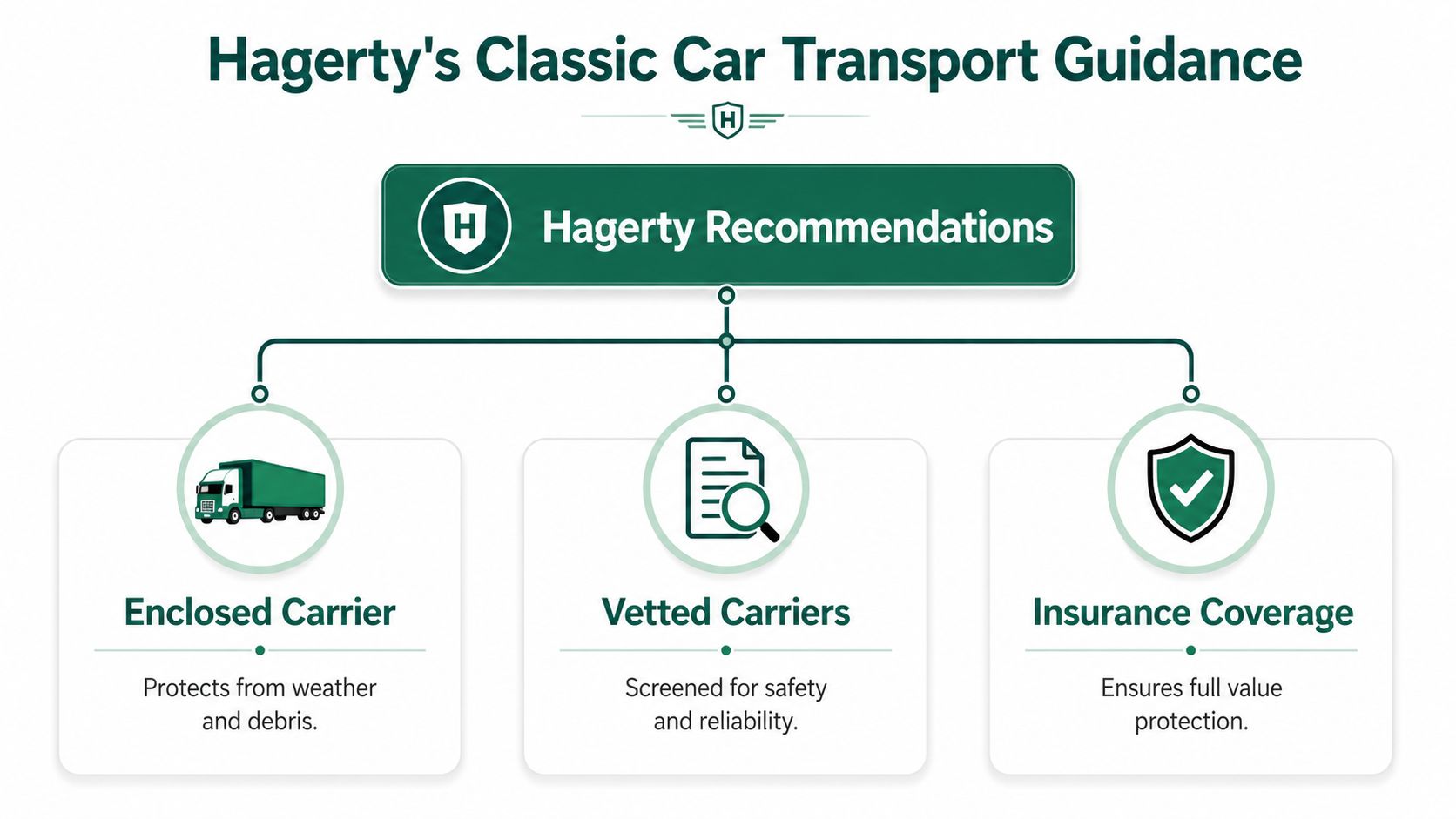
The three parts that matter
The first part is the trailer itself. Enclosed transport protects the car from weather, road grime, and debris that can mark paint, trim, chrome, and glass. That matters more on a restored car than on a daily driver, because collector paint and detailing usually have less tolerance for contamination.
The second part is insurance. Hagerty's advice to verify cargo insurance is essential. A carrier saying “we're insured” is not enough; you want to know the shipment is protected under a policy that specifically applies to the vehicle in transit.
The third part is fit. A car's transport method should reflect its condition and value, not the shipper's convenience. A $90,000 restored muscle car belongs in enclosed transport. A $25,000 driver-quality classic might still deserve enclosed service if it's low-clearance, freshly painted, or hard to source parts for.
A smart prep checklist starts with this rule, if the car would make you angry to see dirty, scratched, or exposed, don't put it on an open trailer. Hagerty's own PDF guidance is the clean reference point for that judgment. Use the company's domestic shipping advice as the baseline, then get specific about how your carrier will protect the car from pickup to delivery. Hagerty's domestic shipping guidance is the document to read if you want the standard in black and white.
Enclosed vs Open Transport for a Collector Car
Open transport is fine for ordinary vehicles. For a classic, it's a compromise, and sometimes a bad one. Open carriers can stack more vehicles and usually cost less, but they leave the car exposed to weather, road grime, and minor debris the entire trip. Enclosed transport keeps the car in a controlled, garage-like environment from pickup to delivery, which is the right call for anything rare, restored, low-clearance, or genuinely valuable.
Side-by-side comparison
| Factor | Open Carrier | Enclosed Carrier |
|---|---|---|
| Protection | Exposed to weather and road grime | Shields the car from weather and debris |
| Load capacity | Up to about 10 vehicles | About 6 vehicles |
| Loading style | Standard ramps | Hydraulic lift gates for low-clearance cars |
| Best fit | Late-model daily drivers | Classics, exotics, restored cars |
| Price | Lower | Typically 40% to 60% higher |
The extra cost is there for a reason. Enclosed trailers are built to protect, and they usually come with higher insurance limits. That's why I tell owners to stop thinking in terms of “shipping a car” and start thinking in terms of “moving an asset.”
My value-based recommendation
If the car is just a clean driver and you'd shrug off a little road film, open transport is acceptable. If the car has paint you care about, trim you can't easily replace, or a value that would hurt to absorb a claim on, choose enclosed without overthinking it.
For owners comparing carrier options, National Car Transport's enclosed auto transport is the kind of service lane to look at when the car needs full protection instead of basic movement. Hagerty's guidance points in the same direction, and I agree with it.
How Pricing Really Works for Hagerty-Style Classic Car Shipping
Classic-car shipping prices are driven by five things, not one. Distance, vehicle value, transport mode, seasonal demand, and route scarcity all push the quote up or down. If you understand those five levers, you can spot a real quote fast and ignore the junk.
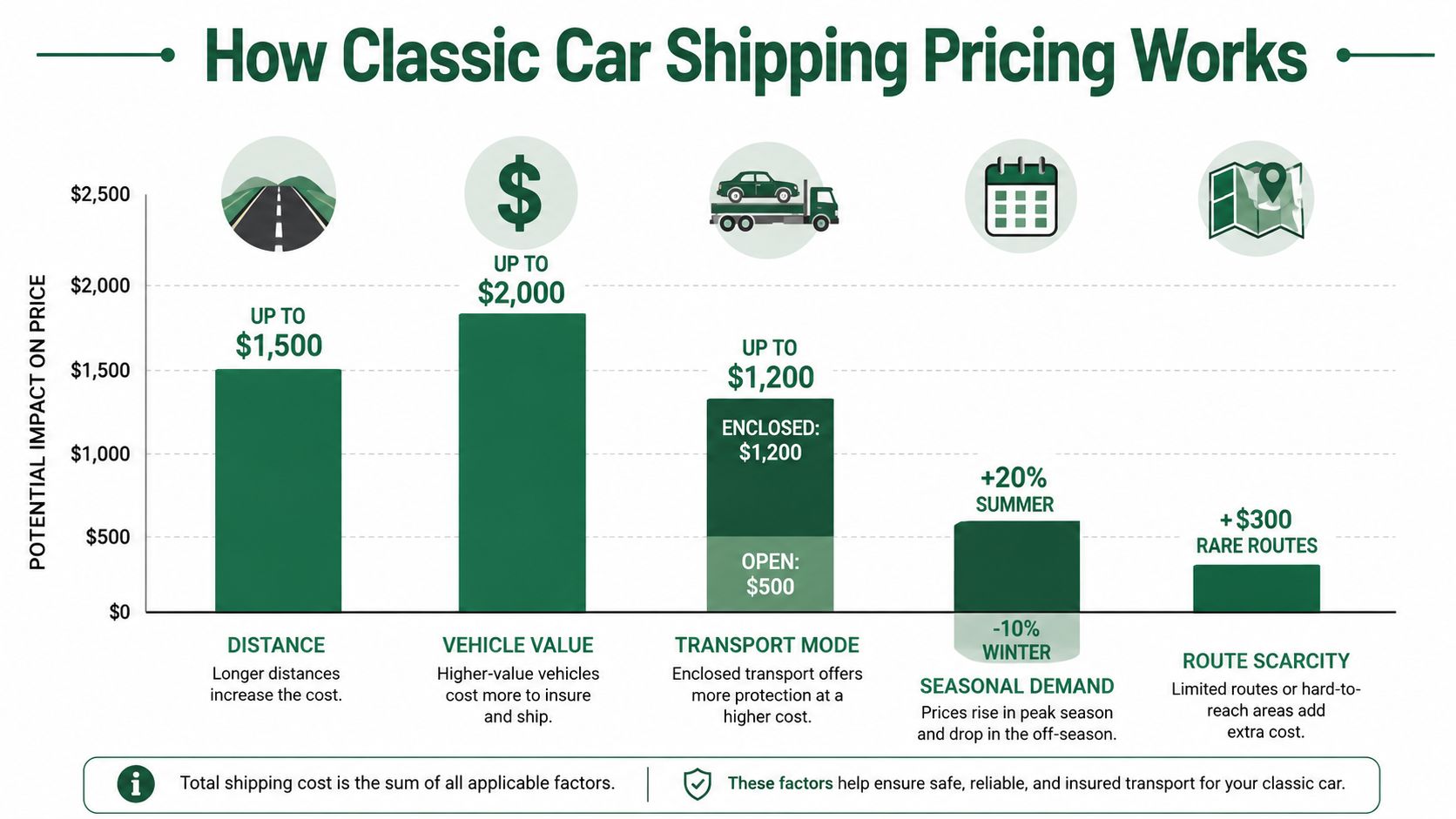
The simple math behind a quote
Start with the route. Longer moves cost more because the carrier burns more time, fuel, and scheduling capacity. Then add the car's value, because higher-value vehicles tend to require better equipment, tighter handling, and more insurance exposure.
Transport mode matters just as much. Open is the baseline, enclosed adds cost because the trailer, loading process, and protection standard are higher. Seasonal demand also moves the number, since carriers tighten up when more people are shipping at once.
Route scarcity is the sleeper factor. Rural pickup, island delivery, and less common lanes are harder to bundle, so the price climbs. For a classic heading to Puerto Rico, that scarcity matters because ocean or container coordination isn't the same as a simple mainland run.
Sanity check: if a quote looks unusually cheap, assume something is missing until the carrier proves otherwise.
Hagerty's market numbers show why this pricing reality exists. In 2025, collectible-vehicle sales through auctions and online channels surged 10% to about $4.8 billion, and online classic-car sales rose 12% to $2.5 billion. More high-value classics are moving, which keeps enclosed transport demand strong and keeps the good carriers busy. For a deeper look at how the money side works, National Car Transport's car shipping cost guide is useful because it forces the same pricing questions you should be asking any shipper.
Preparing a Classic Car for Transport Without Stress
The best transport day is boring. That starts with prep, not with the driver showing up. If the car is documented, cleaned, and ready to roll, the pickup goes faster and the damage conversation is easier if anything goes wrong.
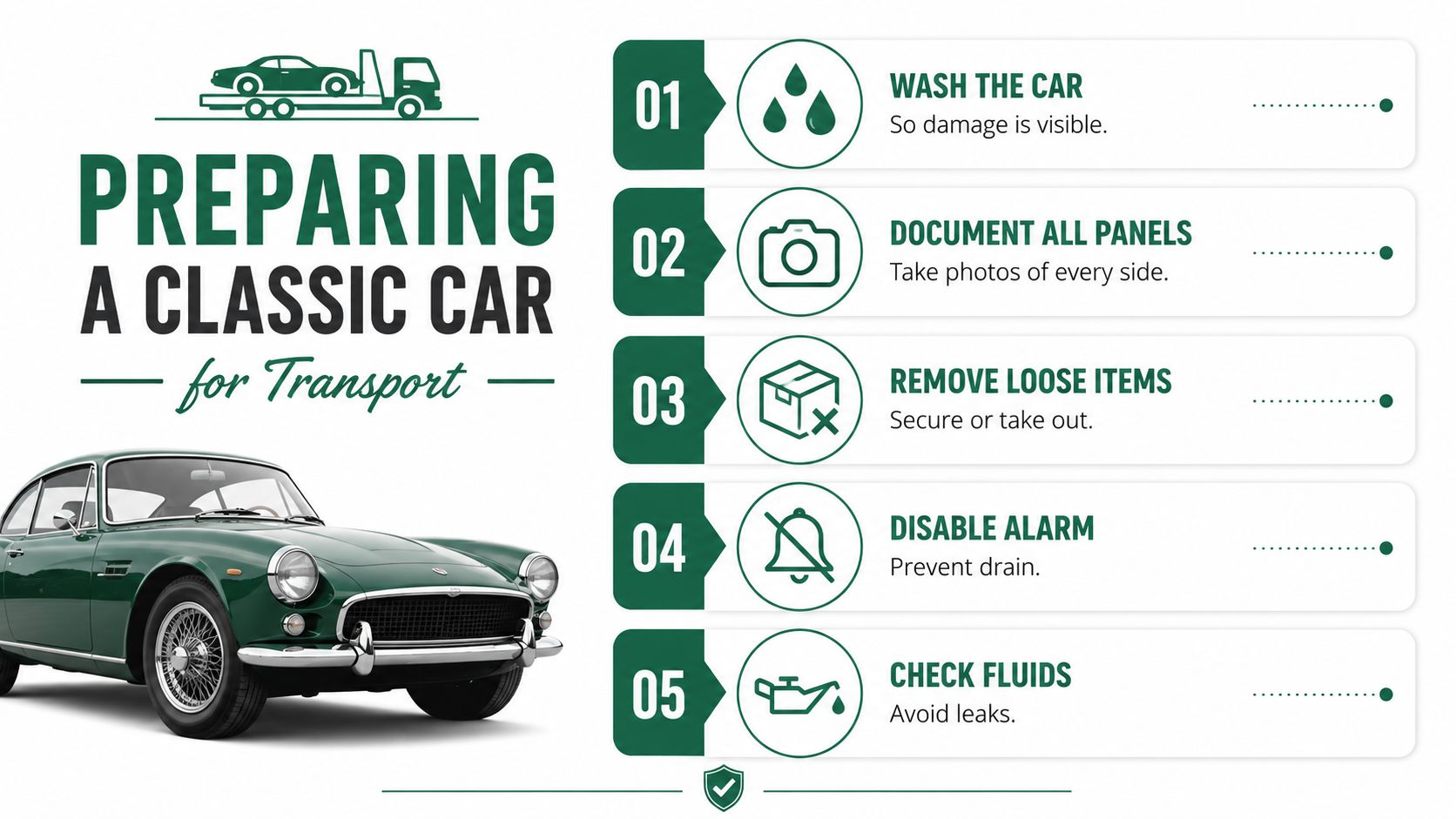
Your pickup checklist
- Wash the car. Dirt hides scratches, dents, and chips, so wash it before photos and pickup.
- Document every panel. Take timestamped photos of the front, rear, sides, roof, wheels, glass, trim, and interior.
- Remove loose items. Spare parts, loose tools, personal items, and anything that can shift should come out.
- Disable the alarm. A dead battery or a screaming alarm makes loading harder than it needs to be.
- Check fluids. You want the car ready for transit, not leaking on the trailer.
A clean car is easier to inspect, and that matters more than most owners realize. If you're prepping for a show-level detail, a practical guide like avoid extra detailing charges is worth reading before pickup because the same logic applies, remove the stuff that creates extra labor and confusion.
What to do at pickup and delivery
The Bill of Lading is the document that controls the shipment condition. Walk the car with the driver, mark existing damage, and don't rush the inspection. At delivery, do the same thing before you sign anything final.
If something looks off, note it immediately and start the claim process inside the carrier's required window. Waiting can weaken an owner's position. The best claims are the ones backed by clean photos, a clear Bill of Lading, and a calm handoff.
Common Pitfalls When Shipping a Classic Car
Most classic-car shipping problems are self-inflicted. Owners book too fast, trust vague promises, or skip the paperwork that protects them later. You don't need to be paranoid, you just need to be disciplined.
Five mistakes that cause real damage
- Booking on price alone. The symptom is a quote that looks fantastic. The cost is usually weak equipment, thin insurance, or a carrier that can't handle the car's value. The fix is to ask for cargo coverage details before you book.
- Skipping the Bill of Lading inspection. The symptom is “it was fine when it left.” The cost is a weak damage claim. The fix is to photograph the car and note every issue before the driver departs.
- Accepting vague door-to-door language. The symptom is a driver who can't reach your driveway, especially on island, rural, or restricted-access stops. The cost is delay and surprise fees. The fix is to confirm access details in advance.
- Ignoring seasonal congestion. The symptom is a rushed booking around high-demand auction periods. The cost is limited carrier availability and less flexibility. The fix is to schedule earlier than you think you need to.
- Assuming Hagerty is hauling the car. The symptom is confusion about who's responsible for the move. The cost is bad expectations. The fix is to treat Hagerty as the standard, then verify the carrier.
That last mistake trips up a lot of owners. Hagerty's transport guidance is valuable because it tells you what good looks like, but the car still has to be moved by a real carrier with real equipment and real coverage.
Don't let a familiar brand name replace basic vetting.
A good shipper will answer direct questions about carrier type, insurance, pickup access, and delivery timing without dodging. If the answers are fuzzy, the shipment will be fuzzy too.
When a Specialist Like National Car Transport Makes More Sense
Hagerty's guidance points owners toward enclosed, insured, vetted transport. The next question is who can execute that cleanly on a mainland lane, a Puerto Rico move, or a multi-state relocation without turning the job into a coordination mess.
Where a specialist earns its keep
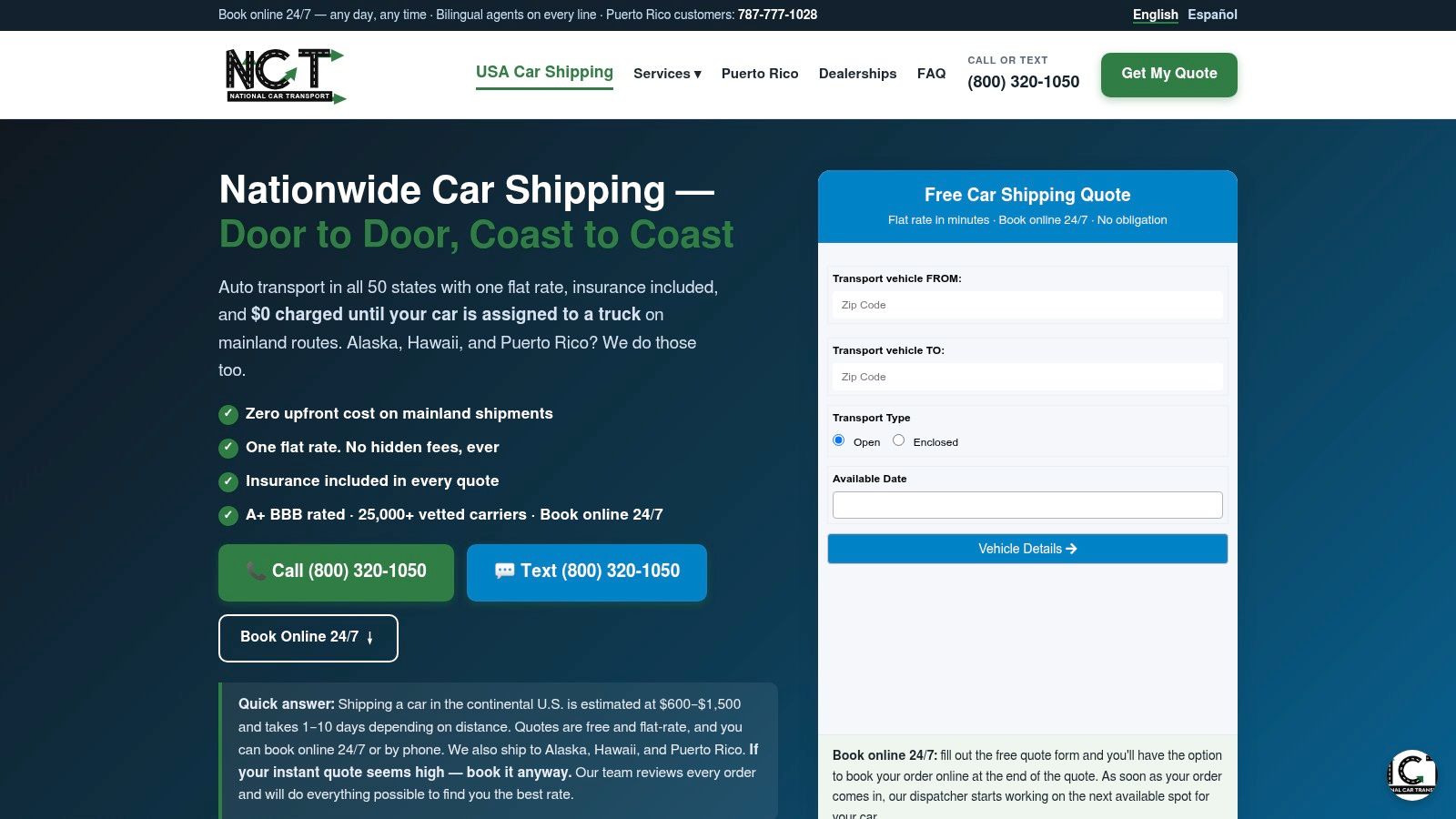
For cross-country moves, island routes, military relocations, snowbird shipping, dealership logistics, and online purchases from another state, a dedicated transport coordinator usually makes more sense than a generic broker. National Car Transport operates with 25+ years of experience, an A+ BBB rating, transparent flat-rate pricing, and a network of 25,000+ vetted carriers, which is the kind of scale that matters when the route gets complicated. It also staffs bilingual English and Spanish agents based in the U.S. with more than 20 years of auto transport logistics experience, which helps when the paperwork, timing, or pickup details need to be handled fast.
That matters for Puerto Rico especially. Mainland-to-island shipping isn't just another domestic lane, it requires mode coordination and tighter documentation discipline. If you're shipping a classic to San Juan, the carrier has to handle the route like a logistics problem, not a curbside favor.
The same logic applies to military families and students. If the move has a hard deadline, the wrong carrier or a sloppy handoff creates avoidable stress. A specialist is worth it when timing, coverage, and communication all have to work at once.
When a standard partner is enough
Short, straightforward domestic moves on well-traveled lanes can be handled by a capable Hagerty-aligned partner. If the car is going a familiar route and the pickup is easy, you don't need an overbuilt solution. You need a clean one.
The point is simple. Match the carrier to the job, not the brand to the car. If the shipment is more than a basic point A to point B run, a specialist like National Car Transport's classic car shipping service is the kind of option that fits the route, the vehicle, and the paperwork load.
Choosing the Right Path for Your Classic Car
Start with value. Under $25,000, a clean driver can sometimes move open, but I'd still lean enclosed if the paint or trim matters. Between $25,000 and $100,000, enclosed is the right default. Above $100,000, I wouldn't settle for anything less than premium enclosed handling and a carrier that can prove its insurance and process.
Then look at the route. A normal mainland lane is simple. A rural pickup adds friction. Puerto Rico changes the game, because island delivery requires a carrier that understands container or ocean coordination and the document side of the move.
Then choose the operator. Hagerty-aligned guidance is the right benchmark for the car's protection standard. A specialist like National Car Transport makes more sense when the move is cross-country, island-based, tied to military or snowbird timing, or wrapped around dealership or auction logistics.
The fast decision rule
- Low-value daily classic, easy lane: open may be acceptable.
- Clean driver-quality classic, moderate value: enclosed is the smarter call.
- Rare, restored, low-clearance, or six-figure car: enclosed only.
- Mainland to Puerto Rico or any complicated move: use a specialist that handles routing, insurance, and communication cleanly.
If you want the shortest possible answer, here it is. Use Hagerty as the standard, insist on enclosed transport when the car deserves it, and book a carrier that can handle the route without excuses. For a classic-car move that needs clear communication, flat-rate pricing, and mainland or island coordination, National Car Transport is a practical place to start.