

Flat rate car shipping prices typically range from roughly $500 for short open-transport lanes to $1,500 to $1,800 for mainland-to-Puerto Rico moves, with the rate intended to bundle pickup, transport, and delivery into one number. You're probably sitting at a kitchen table comparing quotes, wondering whether that number really covers the whole move or whether another charge will appear after you book.
That question matters whether you're sending a sedan from Atlanta to Dallas, moving an SUV from Chicago to Miami for the winter, transporting a vehicle to San Juan, or arranging a dealership transfer between major cities across the 48 contiguous states. A flat quote can make budgeting easier, but only if you understand what the dispatcher included, what the carrier expects, and which services remain outside the headline price.
For mainland routes, shipping usually combines local pickup, long-haul transport, and delivery. Puerto Rico adds a domestic truck leg, ocean freight, port handling, and island-side delivery. The United States Postal Service offers a useful analogy for the broader pricing concept. Its published flat-rate products use fixed prices regardless of weight within the service rules, and retail domestic products in 2026 included prices from $12.90 for a Flat Rate Envelope to $34.00 for a Large Flat Rate Box, with a 70-pound cap. Those published prices demonstrate how fixed shipping prices became a familiar benchmark, although vehicle transport has a much more complicated cost stack. USPS pricing information provides the clearest example of how the model works at a national scale.
Table of Contents
- What Flat Rate Shipping Prices Mean for Your Vehicle
- How Flat Rate Differs From Per-Mile and Other Pricing Models
- What Actually Goes Into a Flat Rate Auto Transport Quote
- Sample Flat Rate Shipping Prices by Route and Lane
- Who Flat Rate Pricing Works Best For
- What a Flat Rate Usually Covers and What It Does Not
- How to Evaluate Any Flat Rate Quote You Receive
- Locking In Your Flat Rate Without Surprises
What Flat Rate Shipping Prices Mean for Your Vehicle
A customer about to book a shipment usually wants one thing: a number that can be trusted. In auto transport, flat rate shipping prices generally mean one bundled figure for moving one operable vehicle between two specified ZIP codes. The quote should identify the pickup location, delivery location, vehicle type, transport method, and the services included.
The practical sequence is simple:
- You provide the vehicle and route. The dispatcher needs the year, make, model, condition, origin ZIP code, destination ZIP code, and preferred timing.
- The shipment gets priced as a complete move. The quote combines pickup, linehaul transport, and delivery rather than leaving you to calculate each leg.
- The rate is confirmed at booking. A properly written quote should explain whether the price is locked and identify any conditions that could change it.
That differs from a per-mile bid, where a customer may focus on the distance while overlooking route access, carrier availability, deadhead travel, fuel, or port requirements. A flat rate is designed to give you cost certainty. It can absorb fuel movement, driver routing decisions, and ordinary detours instead of sending you a revised invoice every time the truck's route changes.
Practical rule: A flat rate applies per vehicle, not per shipment. If two cars travel on the same truck, the dispatcher still prices each vehicle separately because each one occupies trailer space and carries its own loading, insurance, and delivery requirements.
A broker or dispatcher may arrange the carrier, but the number you receive should represent the all-in delivered price the carrier expects to receive, plus the administrative margin for arranging the move. That's why it's useful to compare quotes with a practical guide to interstate car moving costs, especially when you're comparing vehicle transport with driving the car yourself or hiring a moving service.
How Flat Rate Differs From Per-Mile and Other Pricing Models
Customers generally encounter three pricing structures. Each one fits a different kind of vehicle move, and choosing the wrong model can make a seemingly cheap quote expensive in practice.
| Pricing Model | How It Is Calculated | Typical Use Case | Risk To Customer |
|---|---|---|---|
| Flat Rate | One bundled price for the specified vehicle and route | Standard open transport on established domestic lanes | The quote may exclude storage, inoperable loading, or special access fees |
| Per-Mile | Distance multiplied by a quoted mileage rate, often with additional trip costs | Custom single-vehicle runs or enclosed transport | The final bill can rise when routing, deadhead miles, or fuel are handled separately |
| Per-Pound or Per-Cubic-Foot | Vehicle weight or occupied volume determines the charge | Container shipping, freight-style moves, or shared household-goods space | A vehicle's size and packing arrangement can produce a less predictable total |
Flat rate usually makes the most sense when a standard open carrier already runs the corridor. A dispatcher can place your car on a multi-vehicle hauler moving in the same direction, which spreads operating costs across several vehicles. That structure is common for established lanes connecting cities such as Los Angeles, Phoenix, Denver, Dallas, Atlanta, Chicago, New York, Miami, Seattle, and Las Vegas.
A per-mile model becomes more relevant when you need a custom trip. An exotic car requiring enclosed service, a vehicle outside a normal loading route, or a single-car hauler traveling specifically for your shipment may be priced against the actual run. Freight-style pricing appears when the vehicle moves inside a container or shares space with household goods.
Consider a 1,200-mile lane quoted at a $1,000 flat rate. That equals roughly $0.83 per mile, but the customer isn't necessarily paying only for the miles between the two ZIP codes. The flat number can also account for the truck's positioning, loading sequence, route planning, and ordinary operating costs. With a pure mileage quote, those items may appear separately or be calculated differently.
The right question isn't “Which formula is cheapest?” Ask instead, “Does this formula match my vehicle, route, and service requirements?”
What Actually Goes Into a Flat Rate Auto Transport Quote
A flat quote isn't a mystery number. It's a condensed cost stack. The carrier needs enough money to run the truck, the broker needs compensation for arranging the move, and the shipment needs appropriate protection and coordination.
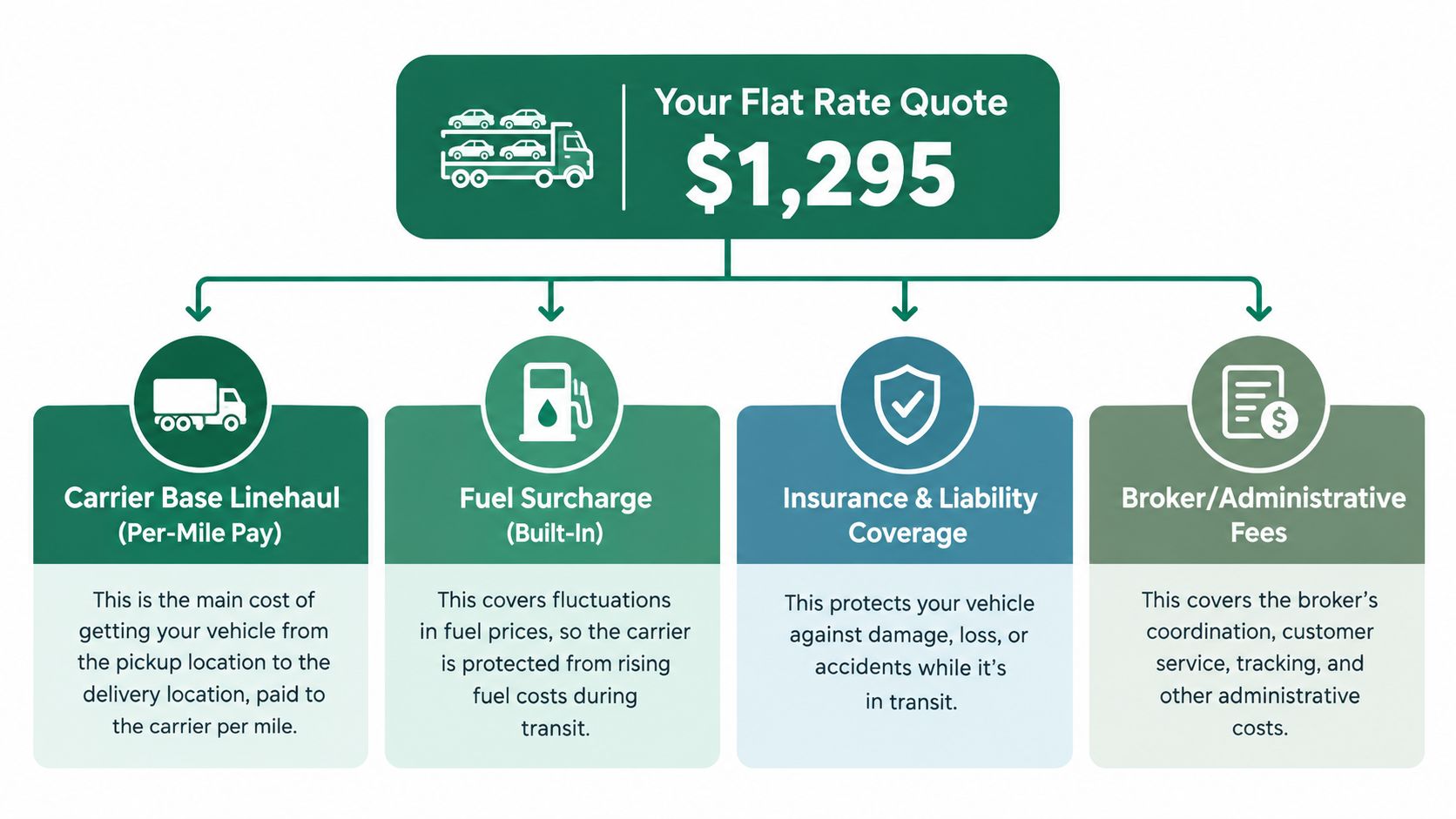
The mainland cost stack
Carrier base linehaul pay is the largest operational component. It represents what the driver accepts to move the vehicle along the route, including the loaded miles and the positioning required to reach pickup and delivery areas. The carrier doesn't price only the odometer distance between two addresses.
Fuel costs are commonly built into the quoted rate. A reputable dispatcher shouldn't promise a fixed number and then add an unexplained fuel bill after delivery. Fuel can still affect the original quote before a carrier is assigned, particularly on long routes or during periods of sharp market movement.
Insurance and liability coverage support the vehicle while it's in the carrier's possession. The customer should receive the carrier's insurance details and understand the limits, exclusions, and claims process before handing over the keys.
Dispatch and administrative work covers carrier sourcing, scheduling, route coordination, customer communication, and shipment monitoring. The broker margin pays for that work. It isn't the same as a hidden carrier surcharge, but it should be visible in the agreement or explained by the representative.
For a practical look at broader shipping coordination and logistics topics, the Arete Global blog offers additional industry context.
Why Puerto Rico costs more
Puerto Rico adds a separate transportation layer. A mainland vehicle may travel by truck to a consolidation port, move by ocean freight, clear the required terminal process, and then continue by truck from the San Juan area to the final island destination. Ocean booking and port handling therefore belong in the quote discussion, not in a vague “special destination” note.
Mainland-to-Puerto Rico vehicle shipping is a domestic-ocean move, not a foreign import or export. Vehicles traveling from Puerto Rico to the U.S. mainland don't require a U.S. Customs and Border Protection inspection, while shipments to foreign ports such as the U.S. Virgin Islands do require that inspection. Crowley's vehicle documentation guidance explains that distinction.
Tolls on heavily traveled corridors, including I-95, are normally absorbed into a properly prepared flat quote. Storage days, inoperable vehicle charges, and special loading surcharges commonly remain separate. Review the open car transport service details before assuming every vehicle condition qualifies for the standard price.
Sample Flat Rate Shipping Prices by Route and Lane
A route price is only useful when you connect it to the service type. Open transport, enclosed transport, vehicle condition, timing, pickup access, and island logistics all change the quote. The ranges below are practical planning bands, not promises for every vehicle or ZIP code.
| Route / Lane | Vehicle Type | Service | Flat Rate Range |
|---|---|---|---|
| Short domestic lane, roughly 500 to 800 miles | Standard sedan | Open transport | $500 to $750 |
| Cross-country mainland lane | Standard sedan or small SUV | Open transport | $1,000 to $1,400 |
| Cross-country mainland lane | Classic, luxury, or exotic vehicle | Enclosed transport | Typically 30% to 50% above open service |
| Mainland to San Juan, Puerto Rico | Standard sedan | Trucking and ocean transport | $1,500 to $1,800 |
| Mainland to San Juan, Puerto Rico | SUV or lifted truck | Trucking and ocean transport | $1,800 to $2,400 or more |
A short open-transport move might connect Charlotte to Atlanta, Dallas to Houston, or Los Angeles to Phoenix. Mid-range and cross-country lanes can connect New York to Los Angeles, Seattle to Miami, Chicago to San Francisco, or Denver to Boston. The vehicle still needs to be operable, accessible to the truck, and suitable for standard loading.
Puerto Rico requires a closer look
For a mainland-to-Puerto Rico shipment, the cost stack may include mainland pickup to a southern consolidation port, often Jacksonville or Houston, roll-on/roll-off ocean booking, terminal handling, and island delivery from San Juan. Puerto Rico vehicle shipments commonly use San Juan as the island port, and moves are often organized as door-to-port or port-to-port services, with mainland pickup available from locations across the United States. Puerto Rico car transport guidance describes that general routing structure.
The island destination also affects the final handoff. Confirm whether the quote ends at the San Juan port or includes delivery to the vehicle's final address. If the car is traveling from Puerto Rico to the mainland, confirm the mainland destination and whether the rate includes final delivery beyond the receiving port.
Seasonal demand matters most on snowbird corridors. Northeast-to-Florida shipping commonly tightens from October through April, while reverse movement usually softens during summer. Book around your actual move date, not the date you hope the market will be quiet.
Who Flat Rate Pricing Works Best For
Flat pricing helps customers who need a dependable transportation budget more than they need a perfectly itemized cost per mile. The advantage is strongest when the vehicle fits a normal open trailer, the route connects active markets, and the pickup and delivery locations are reasonably accessible.
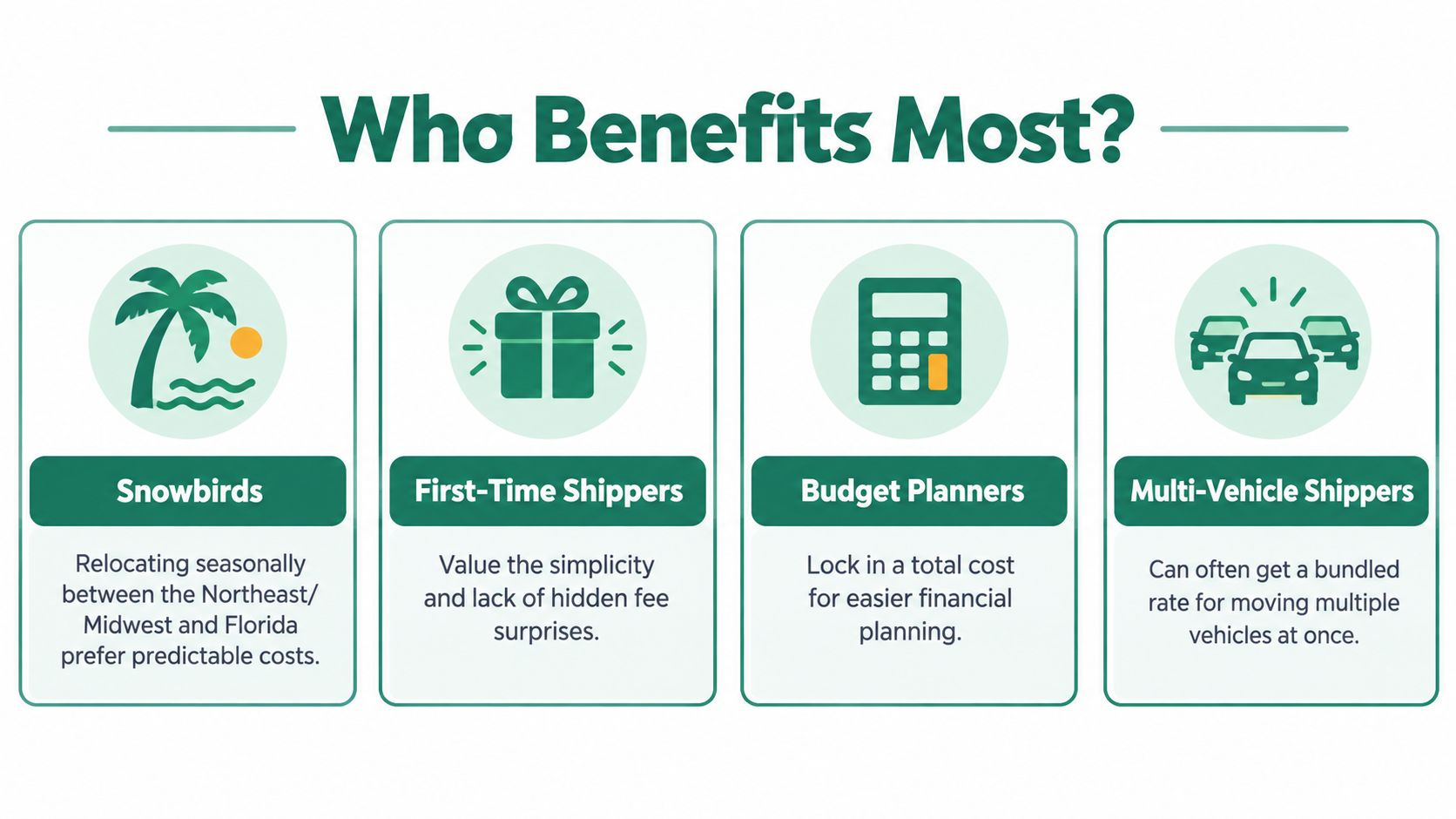
Customers who value predictability
Snowbirds moving between the Northeast or Midwest and Florida often plan around a fixed seasonal budget. A bundled number lets them compare vehicle transport with driving, airfare, fuel, lodging, and the wear associated with a long trip. Standard sedans and compact SUVs also tend to load efficiently on open carriers.
Military families need paperwork that matches relocation planning and reimbursement requirements. A single transportation figure is easier to review and file than a collection of changing mileage, fuel, and access charges. The customer should still confirm what the official move policy reimburses before booking.
Students often need a simple answer before leaving for college. A flat quote removes the need to calculate fuel, hotel nights, meals, and vehicle wear against the transportation price. It also lets a parent or student budget for the move without managing a self-drive trip.
Dealerships and auction buyers care about repeatability. A dealer moving vehicles between New York, Atlanta, Dallas, Chicago, Los Angeles, and other major markets can compare completed quotes across similar lanes and spot unusual changes. Online car buyers also benefit because shipping becomes part of the landed cost before they send money for a vehicle.
Businesses with multiple vehicles need a careful distinction. Two vehicles aren't automatically one flat-rate shipment, but a dispatcher may evaluate the cars together and coordinate a bundled movement when trailer space and routing allow it. Get that arrangement in writing so the combined price, loading order, and delivery plan are clear.
What a Flat Rate Usually Covers and What It Does Not
The phrase “flat rate” doesn't mean “every possible service included.” It means the listed transportation service has been priced as one package. Read the quote like a shipping contract, not like an advertisement.
Standard inclusions
A typical domestic quote may include:
- Door-to-door service: Pickup and delivery within areas the carrier can safely serve.
- Base freight: The carrier's charge for transporting the vehicle.
- Fuel: Ordinary fuel expense built into the agreed transportation amount.
- Cargo protection: The carrier's standard insurance, subject to the policy terms and limits.
- Scheduling coordination: Dispatch communication and basic shipment monitoring.
Door-to-door doesn't always mean the truck can stop directly in front of every address. Narrow streets, low branches, gated communities, steep roads, and local restrictions can require a nearby safe meeting point. Confirm that detail before you book door-to-door auto transport.
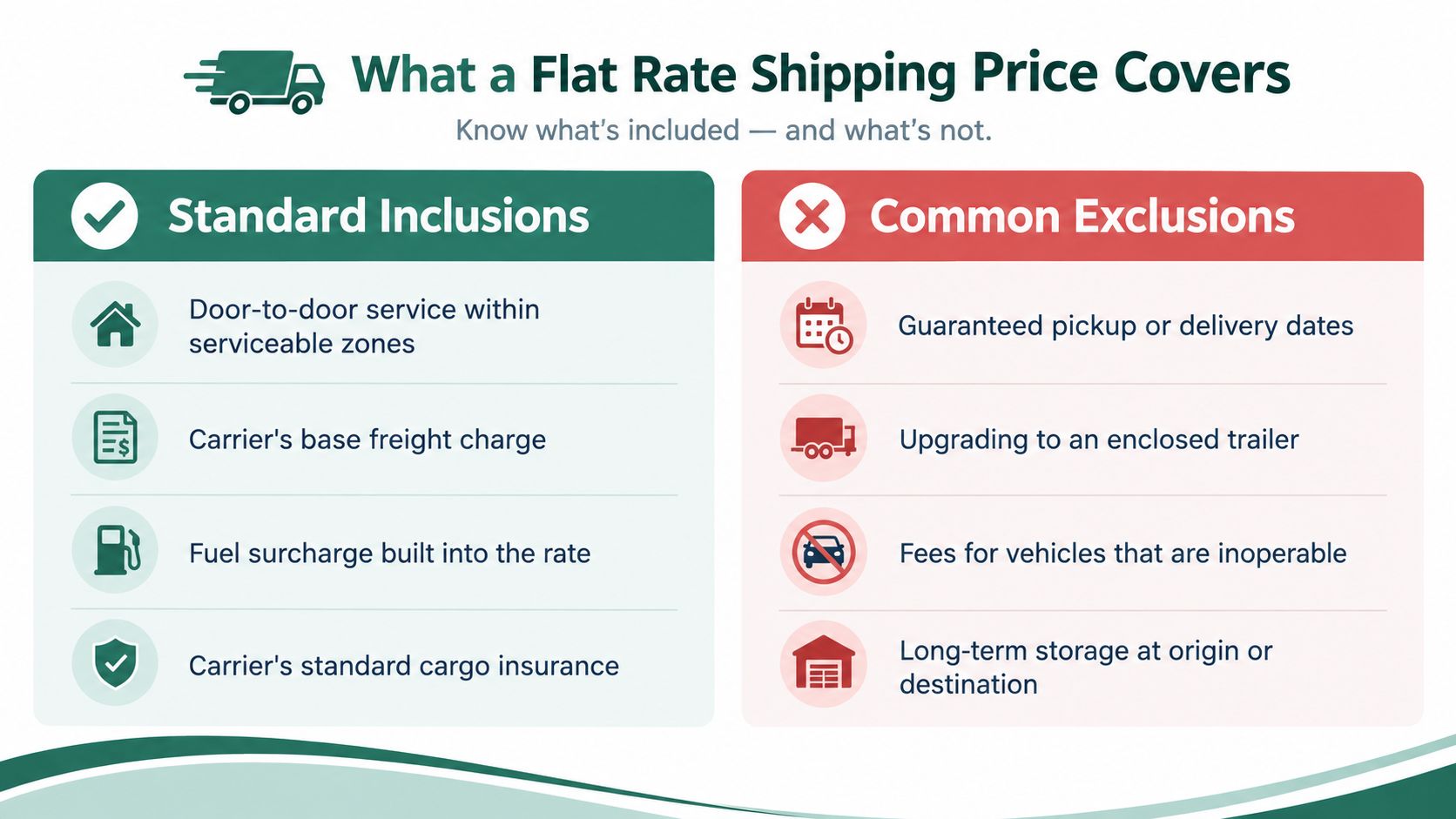
Common exclusions
Guaranteed pickup or delivery dates usually require a higher service level because the carrier must reserve capacity around a deadline. Expedited pickup windows, terminal storage, and long-term storage can also create separate charges. A vehicle that doesn't run may need winching or special equipment, which changes the loading work.
Remote ZIP codes can require rural access fees or a terminal-to-door handoff. Enclosed transport, top-load placement, and white-glove handling for an exotic or collector vehicle are separate service choices in most cases.
Puerto Rico quotes deserve an extra line-by-line review. Port gate fees, customs broker charges, and island-side delivery may be included, partially included, or excluded depending on the provider and route. Don't accept “Puerto Rico included” as enough detail. Ask whether the quoted destination is the San Juan terminal or the final address.
How to Evaluate Any Flat Rate Quote You Receive
The cheapest number isn't automatically a good quote. A lowball offer can leave the vehicle unassigned, add charges later, or create pressure when your pickup date arrives. Compare quotes only after you make the service terms equivalent.
Run this pressure test
- Verify identity. Check the carrier's USDOT and MC numbers through the Federal Motor Carrier Safety Administration. Confirm whether the company arranging the shipment is a broker, a carrier, or both.
- Define the dates. Ask for the dispatch date, the pickup window, and the delivery window. Dispatching a shipment doesn't always mean the driver collects the vehicle that day.
- Read the money terms. Confirm the deposit amount, final payment timing, cancellation terms, and rescheduling policy. Don't rely on a verbal promise.
- Check coverage. Ask for the carrier's insurance limits, what the policy covers, and how pre-existing damage gets recorded.
- Normalize the quote. Compare door-to-door with door-to-door, open with open, and guaranteed service with guaranteed service. A terminal quote shouldn't be compared directly with a residential delivery quote.
A credible flat rate has boundaries. The carrier should be able to tell you what happens if the car is inoperable, the address is inaccessible, the dates change, or the vehicle needs port handling.
Vague fuel language is a warning sign. So is a price that appears far below the other quotes for the same lane, vehicle, and timing. Pressure to wire money immediately should end the conversation until you verify the company, the contract, and the payment process.
National Car Transport presents quotes as a combined transportation figure that can include carrier pay, fuel, insurance, and Puerto Rico port fees when applicable. Its car shipping cost information can help you frame the questions, but you should still request the exact inclusions for your vehicle and route.
One verification point deserves special care. National Car Transport's business profile is listed by the Better Business Bureau as not BBB Accredited, while another industry profile describes it as BBB Accredited with an A+ rating. The direct BBB listing is the more appropriate source for checking accreditation status, so ask the company to reconcile any conflicting profile information before relying on that claim.
Locking In Your Flat Rate Without Surprises
Once the quote survives your review, prepare the shipment before paying a deposit. Gather the vehicle registration, any lienholder authorization required for a financed car, photographs of existing damage, and government identification that matches the registered owner. For Puerto Rico, ask whether additional terminal or shipping documents are required for the specific route.
Get these points in writing:
- Exact transportation amount: Confirm the full rate and every included fee.
- Service boundaries: Identify door-to-door, port-to-port, or terminal delivery.
- Timing: Record the pickup window and estimated delivery window.
- Insurance: Keep the carrier's coverage limits and claims instructions.
- Payment terms: Confirm the deposit, balance due date, accepted payment methods, and cancellation policy.
- Carrier details: Request the assigned carrier name, contact information, and regulatory identifiers when available.
A deposit can reserve dispatch work, but don't assume the remaining balance is due before delivery. Many arrangements collect the balance at delivery, and the written contract controls the actual schedule. Credit cards or verified escrow arrangements generally give customers more documentation and recourse than an unverified wire transfer.
What happens after booking
First, the dispatcher assigns or searches for a carrier that can serve the lane. The driver confirms the pickup plan, inspects the vehicle, and records existing damage on the condition report. The car then moves through the planned mainland route or, for Puerto Rico, through the port and ocean leg before island delivery.
At delivery, inspect the vehicle in daylight if possible and compare it with the pickup condition report. Record any discrepancy before signing the final delivery paperwork. A locked-in flat rate should tell you what transportation begins, what the carrier is responsible for, and which unusual services require approval before they add to the cost.
National Car Transport offers transparent flat-rate vehicle shipping across the United States and Puerto Rico, with open, enclosed, container, and ocean options coordinated by experienced logistics agents. Visit National Car Transport to request a route-specific quote, review what the rate includes, and speak with a bilingual English and Spanish agent based in the USA, with more than 20 years of auto transport logistics experience.