

You're comparing quotes late at night, a move date is already fixed, and every company looks reassuring. One page shows a clean five-star review and a low flat price. Another shows a complaint about a missed pickup and a higher final charge. Neither tells you whether the car moved across town on an open trailer or traveled from the mainland to San Juan by truck, port, and ocean carrier.
That's the problem with flat price auto transport reviews. A review is useful only if you can reconstruct what happened, what the price covered, and who handled each handoff. Read for evidence, not reassurance.
Table of Contents
- Why Flat Price Reviews Mislead on Complex Routes
- What Flat Price Auto Transport Really Includes
- How to Audit Online Auto Transport Reviews
- Compare Open Enclosed and Coordinated Service
- Assess Reliability Beyond the Star Rating
- Use This Checklist to Choose a Trustworthy Carrier
- Evaluate National Car Transport With Care
- Make the Final Decision Before Booking
Why Flat Price Reviews Mislead on Complex Routes
A sedan picked up in Houston and delivered to Dallas on an open carrier is a contained job. One truck, one driver, accessible streets, and a short window for something to go wrong. A glowing review from that move may be completely honest, and still tell you almost nothing about a shipment to Puerto Rico.
Now change the job. A family in Orlando ships an SUV to San Juan, Puerto Rico. The vehicle needs inland pickup, delivery to a port, ocean transport, port handling, possible inspection, and local delivery on the island. More parties touch the car, more documents matter, and a delay in one leg can shift every later date.
The comparison below shows why one review cannot cover both kinds of move.
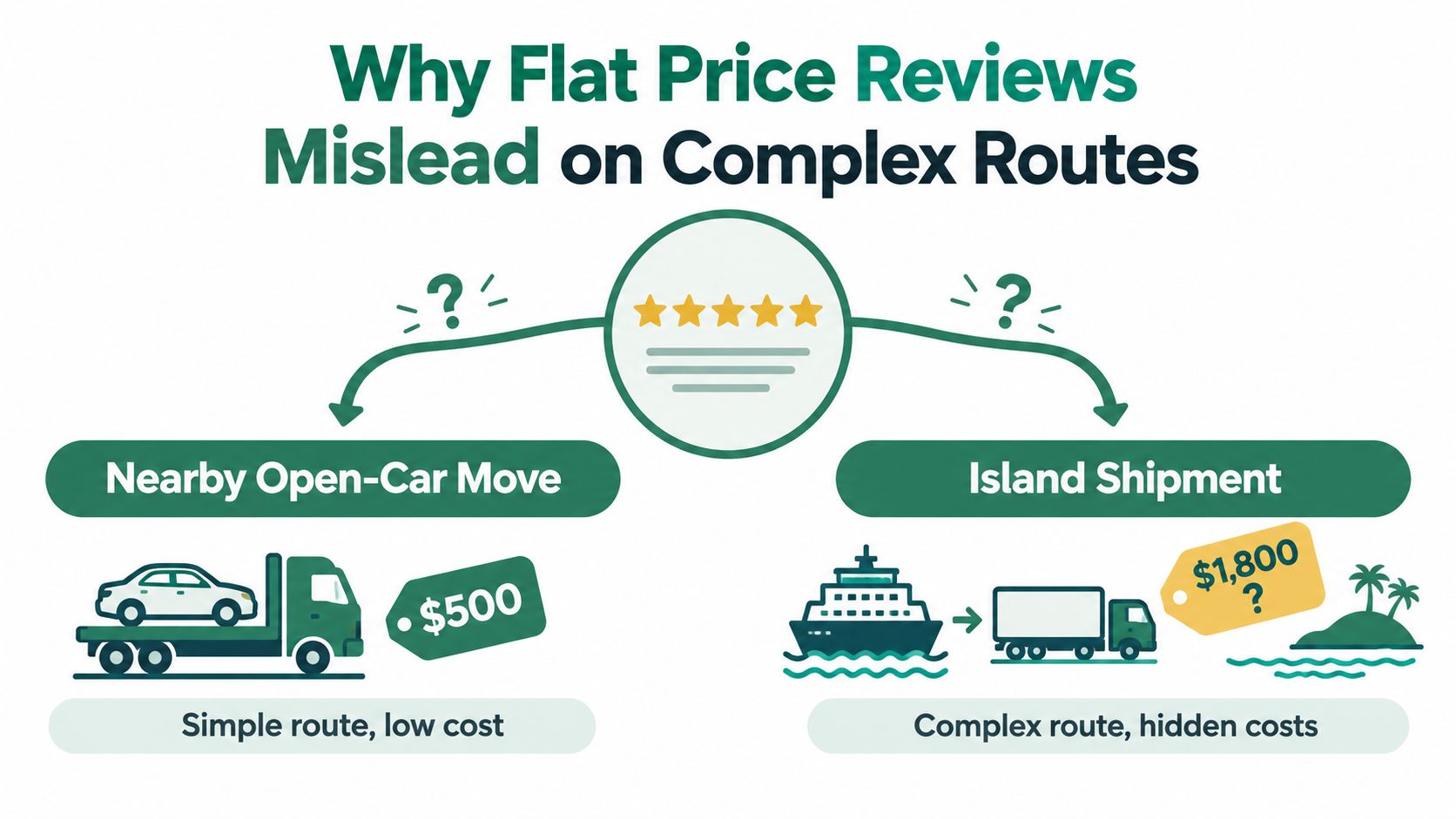
Route details change what a review proves
Route, season, vehicle size, operability, and pickup access all shape the outcome. A review from Phoenix in a quiet month doesn't predict carrier capacity for a snowbird move from Chicago to Tampa, or a military transfer that must line up with reporting dates. Service level matters too, since door service, terminal handling, and enclosed equipment create different risks.
Scale explains part of that variation. Federal Highway Administration data recorded approximately 3.247 trillion vehicle-miles traveled, 197,134,299 motor vehicles, and an average of 11,026 miles per vehicle in 2023, a reminder that vehicle movement operates in a large and variable logistics environment, as shown in the Federal Highway Administration travel data referenced in the BBB profile.
Treat every review as a case record for one route, one vehicle, and one set of terms, not as a verdict on every shipment.
When reviews omit the route, ask what you're missing before you trust the price. A useful starting point is to compare the shipment described against your own distance and access conditions using a car shipping cost breakdown by route and vehicle. If the review doesn't match your move on those basics, its stars carry little weight.
What Flat Price Auto Transport Really Includes
A flat price should mean a defined scope at a defined amount. It shouldn't mean every vehicle costs the same, and it shouldn't be confused with the lowest number on a quote page. The question that matters is whether the written quote is binding, and what event, if any, allows it to change.
The diagram below breaks a quote into the pieces you should be able to identify before booking.
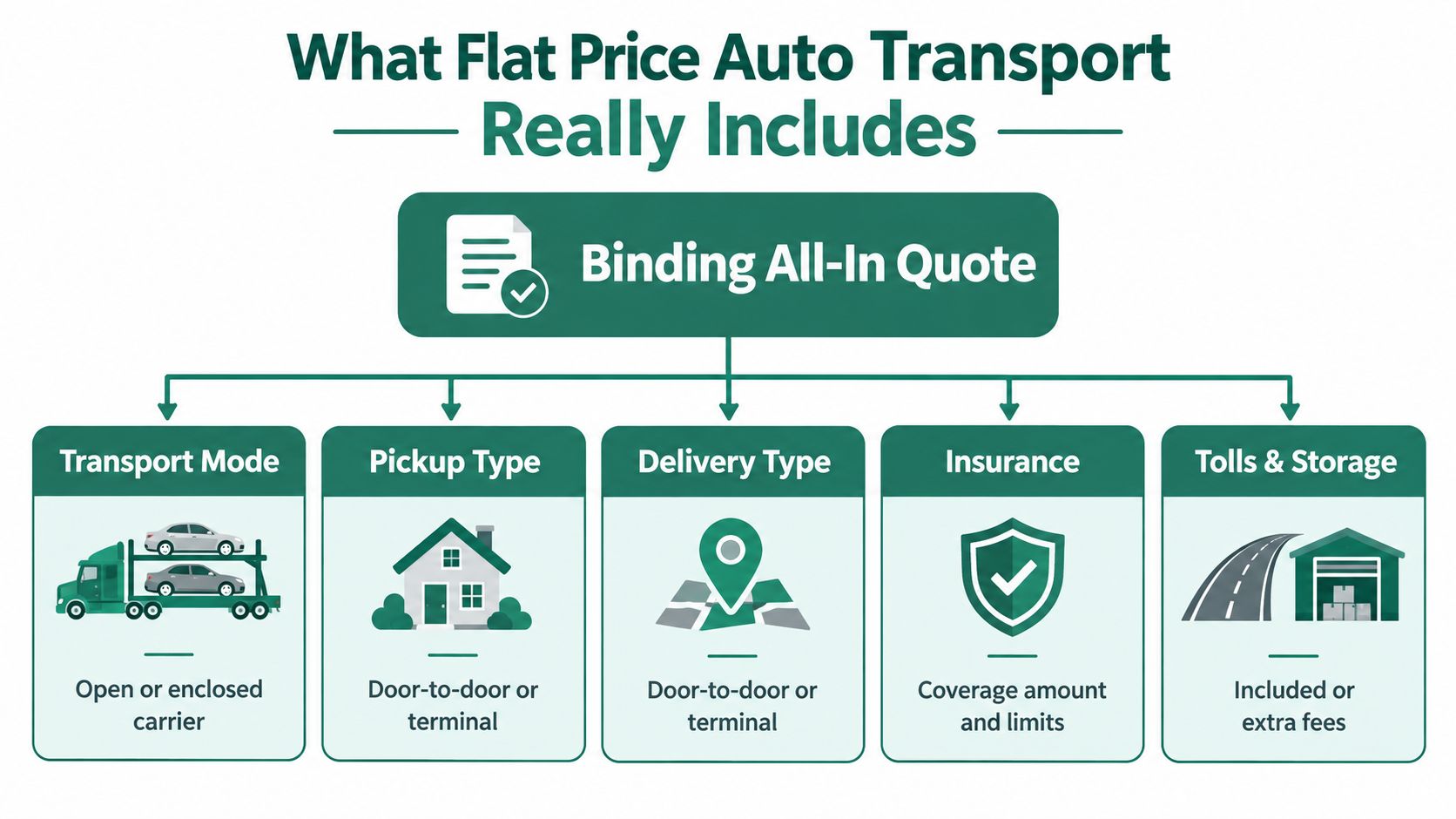
What a binding quote names explicitly
A quote worth trusting identifies the transport mode, open or enclosed, and whether pickup and delivery are door service or terminal based. It states how insurance applies, and whether tolls, storage, and re-delivery are included or billed separately. It also addresses oversized vehicles, inoperable vehicles that can't roll or steer, remote pickup locations, and expedited service.
- Broker and carrier amounts: Ask whether the total covers both the coordination fee and the carrier's payment, or only one part.
- Payment timing: Confirm what's due at booking, at dispatch, and at delivery, and get that schedule in writing.
- Change triggers: Ask which facts, if different at pickup, can revise the amount, such as a vehicle that doesn't run as described.
Why the underlying cost still moves
Auto transport is a variable-cost logistics service, even when your quote is fixed. Fuel, distance, vehicle dimensions, seasonal demand, and carrier type all affect what a carrier needs to accept the load. The Bureau of Transportation Statistics reported an average 2025 on-highway diesel price of $3.10 per gallon, illustrating how a basic operating input can influence transportation pricing even when you expect a fixed quote, according to the Bureau of Transportation Statistics transportation cost trends.
That creates a counterintuitive risk. A quote that's too low may not attract a carrier at all, so the car sits, then you're asked to approve an increase. A higher, clearly scoped quote can be more predictable than a bargain number with no carrier behind it.
The short video below walks through how a typical shipment is coordinated, which helps you see where quote inclusions apply.
Before you compare totals, confirm whether both quotes describe the same pickup method. Two prices aren't comparable if one assumes terminal drop-off and the other includes door-to-door auto transport pickup and delivery. Price transparency is a contract question first, and a shopping question second.
How to Audit Online Auto Transport Reviews
Star averages hide the details you need. A better method is to audit flat price auto transport reviews the way you'd audit an invoice, looking for documents, dates, and outcomes you can verify.
The five pieces of evidence to find
Start with reviews that name specifics. Vague praise tells you a customer was happy, but it doesn't tell you why, or whether your shipment resembles theirs.
- Original quote and final invoice: Look for both amounts, and for the stated reason if they differ.
- Payment timing: Note when money was collected, since early full payment changes your bargaining power if dispatch stalls.
- Carrier assignment status: Separate the company that coordinated the move from the carrier that hauled the car.
- Pickup and delivery windows: Check promised windows against actual dates, not just overall satisfaction.
- Condition records: Look for mention of the bill of lading, pickup inspection, photos, and how damage claims were resolved.
The checklist below turns those checks into a repeatable pass you can run on any review platform.
Patterns that lower confidence
Review authenticity is a quality-control issue, not a gut feeling. The Federal Trade Commission's Consumer Reviews and Testimonials Rule prohibits businesses from creating, buying, selling, or disseminating reviews that misrepresent a reviewer's experience, and it prohibits compensation conditioned on a specific positive or negative sentiment, as the Federal Trade Commission guidance on the Consumer Reviews and Testimonials Rule explains.
That rule gives you a practical filter. Treat identical wording across reviews, praise with no route or vehicle details, unusually concentrated five-star bursts, and sudden sentiment shifts as lower-confidence signals. Curated testimonials on a company site carry less weight than a balanced distribution on an independent platform where negative reviews remain visible.
Audit rule: A review that shows the quote, the final charge, and the reason for any difference is worth more than a dozen short endorsements.
Compare at least two independent platforms for the same company. Then sort what you find into categories, price variance, missed appointments, damage, communication, and resolution. You'll quickly see whether complaints describe one bad carrier, weak coordination, or a pattern in how quotes are written.
Compare Open Enclosed and Coordinated Service
Reviews often praise or blame a company without naming the service the customer bought. That's a problem, because open transport, enclosed transport, and the coordination layer behind them solve different problems.
| Option | Best suited for | What reviews should confirm |
|---|---|---|
| Open carrier | Daily drivers, standard relocations, dealer moves | Pickup timing, condition at delivery, total paid |
| Enclosed carrier | Classic, luxury, exotic, or low-clearance vehicles | Equipment type, loading method, insurance scope |
| Broker coordination | Routes needing carrier sourcing across a network | Assignment speed, update frequency, carrier identity |
| Hands-on coordination | Island, military, or multi-leg shipments | Handoff tracking, document help, escalation response |
Matching equipment to the vehicle
Open carriers are the common, lower-cost choice for ordinary cars, and capacity is usually easier to find. If you're weighing that route, review what's included in open car transport service and carrier handling before you assume every open quote is identical. Enclosed carriers protect the vehicle from weather and road exposure, which can justify the higher price for a restored classic in Denver or a luxury car leaving Miami.
Neither option is universally better. Paying for enclosed equipment on a short move for a commuter sedan may add cost without adding much protection you need. Choosing open transport for a high-value vehicle to save money can be the opposite mistake.
The coordination layer is a separate purchase
Coordination is where many reviews originate. A broker or advisor sources the carrier, sets expectations, and handles updates, while the carrier drives. When a review complains about silence, that's usually coordination. When it complains about loading damage, that's usually execution.
Ask whether your quote includes carrier sourcing, delivery handoff support, and insurance verification for the assigned carrier. Then look for reviews that credit or blame the right party. You'll make a cleaner decision, and you'll know who to call when something changes.
Assess Reliability Beyond the Star Rating
Reliability isn't one number. A one-day weather delay with proactive updates and a week of silence after a missed pickup can both end up as one-star reviews, yet they describe entirely different failures.
Separate the delay types
Break every complaint into its cause before you judge it.
- Pickup delay: The carrier wasn't assigned, arrived outside the window, or couldn't access the location.
- Transit delay: Weather, breakdowns, road closures, or routing changes slowed the truck after loading.
- Terminal or port delay: The vehicle waited at a facility, or an island shipment waited on a sailing schedule.
- Communication failure: The move may have been on track, but nobody told the customer, so trust collapsed anyway.
Reviews of auto transport can report missed pickup windows, vehicles held at facilities, unexpected equipment changes, and additional expenses such as rentals or rideshare costs, which is why route and cause analysis is more useful than a single sentiment label, as illustrated by customer reviews describing missed windows and added expenses.
What to measure instead of stars
Look for reviews that mention update frequency, how quickly someone responded when the customer escalated, and whether a remedy existed. Ask providers directly how they handle a missed window, whether storage is charged during a delay they caused, and how rental or re-delivery costs are treated. Written answers matter more than verbal reassurance.
Route context sets a fair standard. A shipment from Atlanta to Charlotte has dense carrier capacity and few handoffs. A shipment from Seattle to San Juan involves long inland hauling, port timing, and ocean scheduling, so the same delivery variance means something different. Season matters too, since capacity tightens when snowbirds, students, and military families all move at once.
Judge reliability by how a company behaves when the plan breaks, because that's the part of the service you can't do yourself.
Vehicle type also shapes expectations. An inoperable project car needs specific equipment, and an oversized truck reduces the pool of carriers who can take it. If a review doesn't disclose route, season, vehicle, and service level, don't treat its timing complaint, or its praise, as representative of your shipment.
Use This Checklist to Choose a Trustworthy Carrier
You don't need more opinions. You need a sequence you can repeat for every provider, whether you're a student shipping to Austin, a snowbird heading to Scottsdale, or a dealership moving inventory through San Juan.
The four-step flow below keeps the decision tied to documents rather than sales conversations.
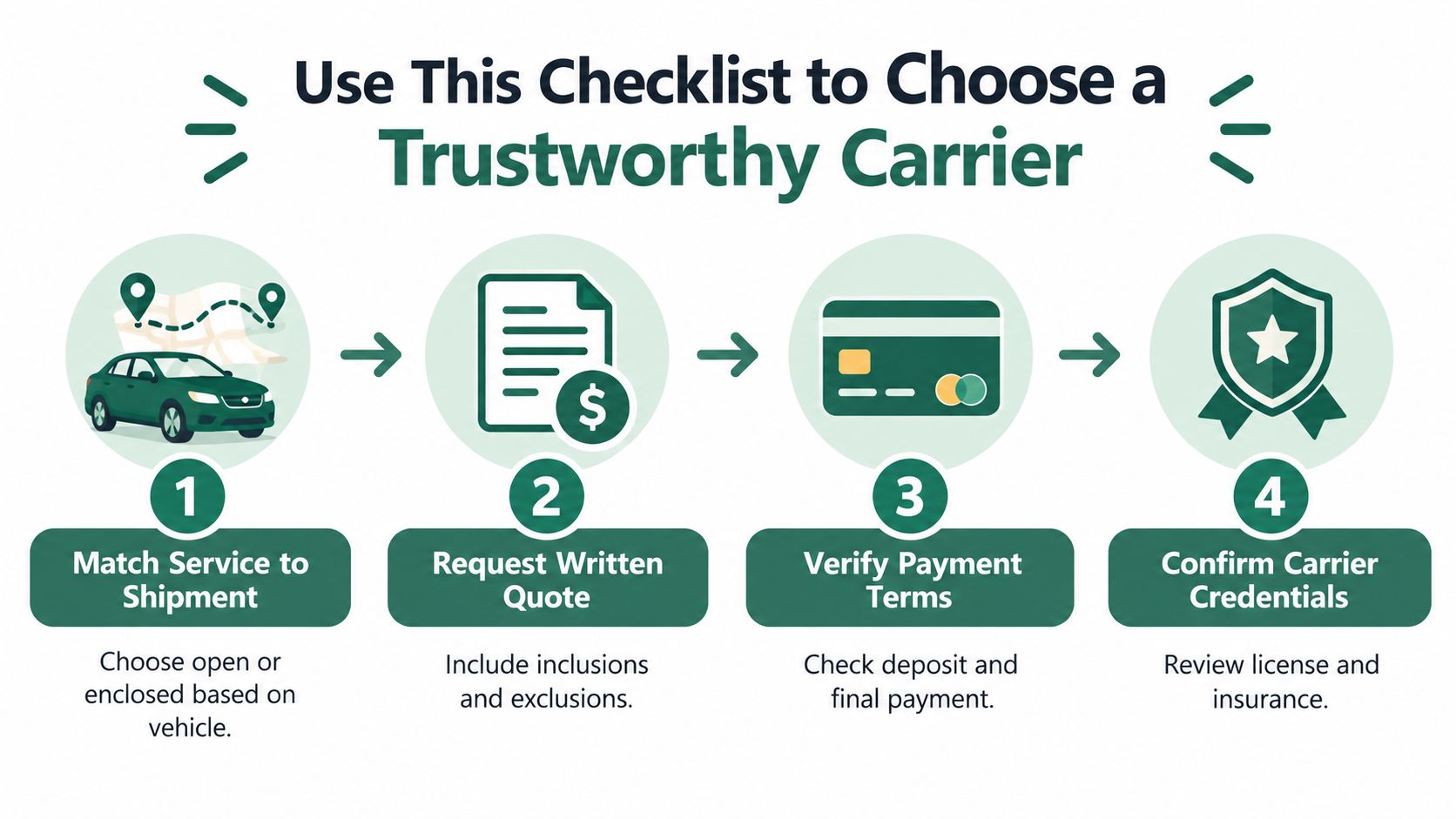
Run the decision in order
First, match the service to the shipment. Define the route across the 48 continental states or to Puerto Rico, the vehicle, operability, and your date flexibility. Major-city pickups in places like New York, Los Angeles, Chicago, Houston, and Miami usually offer more carrier options than remote addresses, and that affects both price and timing.
Second, request the quote in writing with inclusions, exclusions, cancellation terms, and the change-control policy. Third, verify payment timing and insurance, and ask how the assigned carrier's coverage is confirmed. Fourth, confirm how pickup, transit, and delivery updates will reach you, and who owns escalation.
For Puerto Rico, add documentation to that list. For mainland-to-Puerto Rico shipments, Electronic Export Information must still be filed through the Automated Export System with the vehicle identification number or product identification number, and the vehicle is not exempt from inspection, per the U.S. Customs and Border Protection Puerto Rico vehicle ruling. Ask who files it, and what you must supply.
If your move crosses the northern border instead, the guide for Canadian auto exporters from Sunmax Motors is a useful companion resource for comparing how export-focused transport requirements differ. Different border, same principle, documents decide whether the car moves.
Businesses and dealerships should add volume questions about multiple vehicles, title handling, and delivery sequencing. Military families should ask how pickup windows flex if orders change. One carrier won't fit every case, and that's fine. The checklist tells you where a provider fits yours.
Evaluate National Car Transport With Care
A company's credentials can help narrow a search, but they do not establish whether a quoted price covers a specific shipment. National Car Transport provides a useful example of how to check a provider's claims against the route and written terms.
What the company discloses
National Car Transport describes itself as a U.S.-based provider with 25+ years of experience, an A+ BBB rating, and flat-rate pricing. Its stated services include door-to-door vehicle transport across all 50 states, Puerto Rico, Alaska, and Hawaii, with open and enclosed carriers, container and ocean shipping for island routes, and a network of more than 25,000 vetted carriers. These are company disclosures, not a substitute for confirming which services apply to a particular quote.
The company also highlights bilingual English and Spanish agents based in the USA with over 20 years of experience in auto transport logistics. That may be useful when family members coordinate a Puerto Rico shipment from different locations. Advisor-guided handling is another stated feature, but the practical test is whether the advisor can explain the shipment's scope and handoffs clearly.
What you still verify yourself
Ask for a written quote tied to your vehicle and addresses. For a Puerto Rico shipment, check whether the quoted price includes port handling, ocean transport, inland delivery, and documentation. Ask when the carrier will be assigned, how insurance applies to that carrier, and what circumstances could change the final charge.
Reviews can help test those disclosures. Look for accounts involving a comparable route, such as mainland to San Juan, snowbird travel, or military moves. Check whether customers say the quoted flat rate held through delivery, and distinguish reports about advisor communication from reports about the hauling carrier's pickup, transit, and delivery.
Credentials tell you a company is worth investigating. Your written terms tell you whether it's right for this shipment.
Use stated experience, carrier-network claims, and bilingual support as questions to verify, not as proof of performance. The decision should rest on details you can confirm before payment, including who handles each stage and what the quoted price covers.
Make the Final Decision Before Booking
Compress everything into a short sequence and don't skip steps because a salesperson is friendly. Start with the route and vehicle, then compare like-for-like written quotes with the same pickup method, equipment, and inclusions. Audit reviews for transaction evidence, ask about exclusions and remedies, and confirm island requirements where they apply.
Consider how the same budget can buy different things. One quote for a move to Puerto Rico includes inland delivery, port handling, ocean transport, and documentation support. Another covers only part of that chain, so the cheaper headline number grows later. The totals looked comparable. The scopes weren't.
Preparation is part of that scope on island routes. The Federal Maritime Commission advises owners shipping overseas to prepare vehicles as maritime cargo, including addressing gasoline, hazardous or flammable materials, the battery, personal belongings, and title or registration documents, as set out in the Federal Maritime Commission guidance on shipping your vehicle overseas. Confirm fuel level, battery handling, loose items, keys, and inspection requirements with your carrier before pickup day.
A trustworthy flat price isn't the lowest number. It's a price supported by transparent scope, realistic scheduling, documented handoffs on the bill of lading, and accountable communication when conditions change. If a provider can show you all four in writing, you've found something reviews alone can't give you, a decision you can defend.
If you're shipping within the 48 states or between the mainland and Puerto Rico, National Car Transport offers flat-rate, door-to-door service with open and enclosed options, island shipping coordination, and bilingual U.S.-based agents who can walk through your quote scope, documents, and timing before you book. Bring your checklist from this guide, ask for the inclusions and exclusions in writing, and start your comparison at National Car Transport.