
Friday afternoon. Your new job starts Monday in another state, your SUV is still in the driveway, and the first standard quote you get says pickup and delivery will happen on the carrier's normal schedule. That's when people start searching for express auto shipping.
This isn't just a relocation problem. It hits when a dealership needs a unit moved before a customer backs out, when a lease return date won't move, when a student needs a car on campus after a last-minute housing change, or when a military family gets orders and the timeline gets tight fast. It also comes up with mainland to Puerto Rico moves, especially when ocean schedules, port handoff timing, and inland pickup all have to line up cleanly.
They assume “express” means a truck shows up the same day and the vehicle arrives on a guaranteed calendar date. That's not how this business works. In most cases, you're paying for dispatch priority, faster carrier outreach, tighter communication, and a better shot at catching the right truck at the right moment.
That can be worth every dollar. It can also be a waste of money if your route is sparse, your timing is flexible, or the carrier still has to wait on lane coverage.
The good news is that the market is big enough that expedited options matter. The U.S. vehicle shipping services industry was valued at $10.5 billion in 2026 and included 7,073 businesses, with the number of businesses growing at a 7.0% CAGR between 2020 and 2025 according to Business Research Insights on the auto transportation market. That scale is exactly why faster service exists as a real commercial option instead of a fringe add-on.
Table of Contents
- When Faster Shipping Suddenly Matters
- What Express Auto Shipping Actually Means
- What Drives Speed Behind the Scenes
- What Express Really Costs and When It Pays Off
- Real Shipper Scenarios and How Speed Plays Out
- How to Book Express Service the Right Way
- What Expedited Service Does Not Guarantee
- Choosing Standard or Express Without Regret
When Faster Shipping Suddenly Matters
A standard shipment works fine when you've got cushion. A snowbird planning a seasonal move months ahead usually doesn't need to pay extra. A family shipping a second vehicle with a flexible delivery week usually doesn't need to rush. If the vehicle can arrive a few days earlier or later without causing a problem, standard dispatch is usually the smarter buy.
The story changes when the date isn't negotiable.
Three deadlines that force the issue
These are the situations where express auto shipping earns its keep:
- A hard work start date: If you're moving from Dallas to Phoenix, Atlanta to Chicago, or Los Angeles to Denver and you need the car there for your first week, waiting in a standard dispatch queue can create a bigger problem than the shipping premium.
- A dealer or purchase window: If you bought a vehicle from Miami, Houston, Seattle, Boston, or San Diego and the release timing is tight, speed matters because storage rules, lot space, and seller availability don't wait.
- A lease or return deadline: If the car must be turned in by a fixed date, late pickup can trigger extra cost and hassle that wipes out any savings from going standard.
Practical rule: If missing the pickup window costs you more than the expedite fee, express is the right call.
Puerto Rico adds another layer. Mainland to San Juan moves, or San Juan back to cities like Jacksonville, Orlando, Philadelphia, or Newark, don't run on truck timing alone. They depend on getting the inland leg, port processing, and vessel schedule aligned. If one piece misses, the whole move slips.
Where pressure shows up first
In my view, the first question isn't “How fast can the truck drive?” It's “How fast can dispatch find the right truck for this lane?” A 2026 industry report found that 38.5% of shipments needed a truck within 2 days of booking, up from 34.9%, which points straight at the bottleneck: immediate capacity matching near the origin, not just line-haul driving speed, as reported in SGT Auto Transport's State of Auto Transport 2026 release.
That's the part most sales pages skip. The rest of the decision comes down to how express service is structured, what the premium buys, and when paying more changes the outcome versus just changing your place in line.
What Express Auto Shipping Actually Means
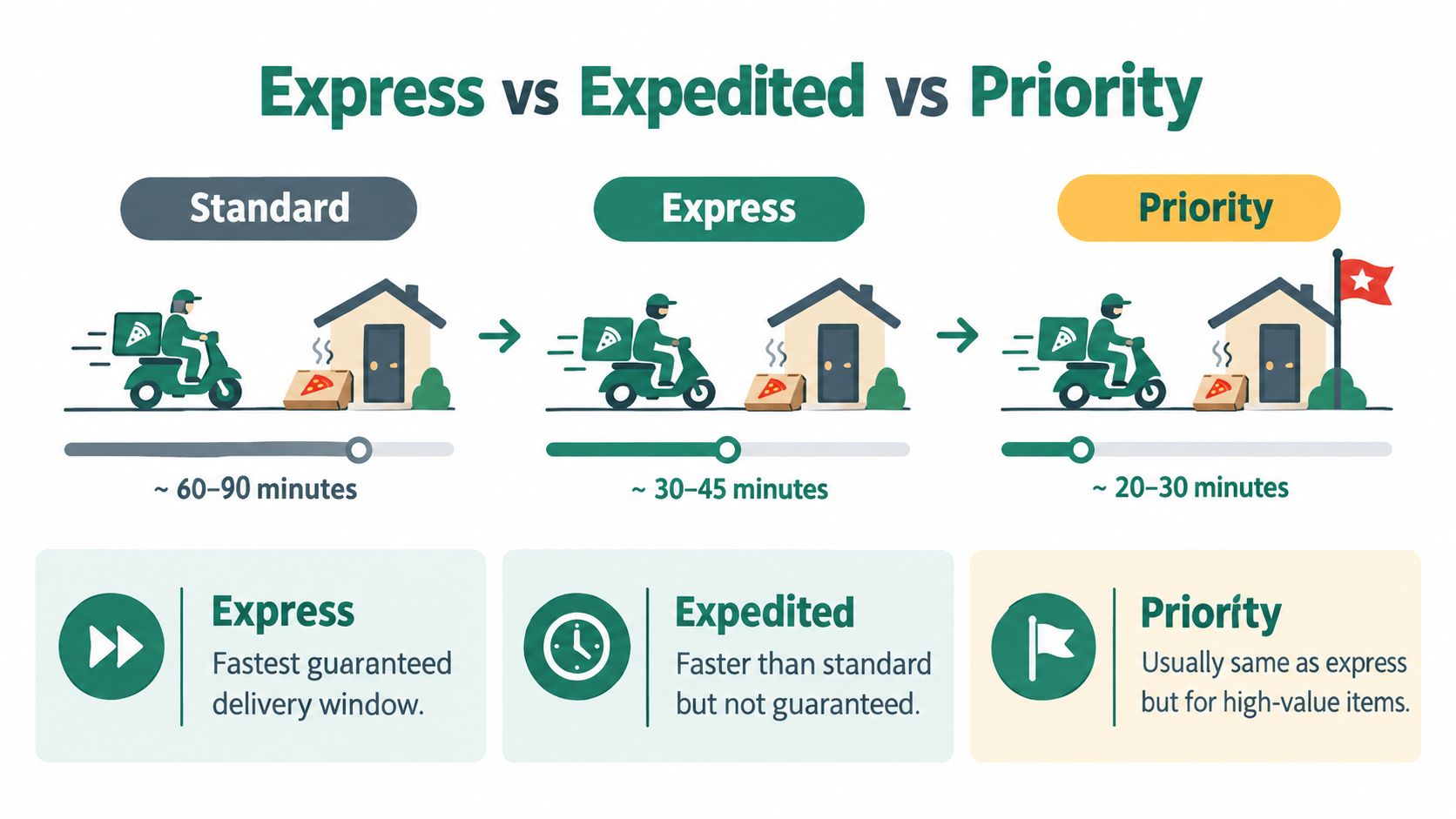
Most companies throw around express, expedited, and priority like they all mean the same thing. They don't. If you don't separate those terms before you book, you'll probably overpay for a promise that was never real.
Think about it like delivery tiers
You already accept this logic when you order food.
- Standard shipping is the regular order. Your vehicle gets listed and matched to the next suitable truck already building a route through your area.
- Express or expedited shipping usually means your order gets moved up in the dispatch queue. The broker or carrier starts calling sooner, pushes harder, and may increase the posted rate to attract a truck already moving near your origin.
- Priority or guaranteed-style service is a different animal. That's closer to a dedicated move, special handling, or a highly controlled schedule. It exists, but it costs more and isn't what most people are buying.
Most customers think they're paying for faster wheels. They're usually paying for faster attention.
What same-day language usually hides
A lot of ads imply same-day pickup is normal. It isn't. Same-day or next-day pickup is only feasible when a carrier is already close, has room, and likes your lane enough to reroute. Dense corridors give you a shot. Rural origins and awkward routes usually don't.
If you need that option, ask for the service in plain language and compare it against a provider that openly discusses same-day auto transport instead of hiding behind generic “priority” wording.
Later delivery can create another issue people miss. If your housing, condo rules, or driveway access don't line up, temporary parking may matter more than shaving a day off dispatch. In that situation, resources on secure car storage solutions can help bridge the gap without forcing a bad booking decision.
A short explainer is useful here because the terminology gets muddled fast:
The only definition that matters
Ask this instead of “Do you offer express?”
“Does this rate buy priority dispatch, a tighter pickup window, or an actual delivery commitment in writing?”
If they can't answer that cleanly, keep shopping. Good dispatchers know the difference, and honest ones will say it out loud.
What Drives Speed Behind the Scenes
The speed of a shipment is decided long before the truck gets on the highway. Dispatchers watch lane flow, truck position, timing, compliance, and whether the vehicle fits into a load that already makes sense. That's why one move from Orlando to Charlotte gets picked up quickly while another from rural Montana to southern Arizona sits.
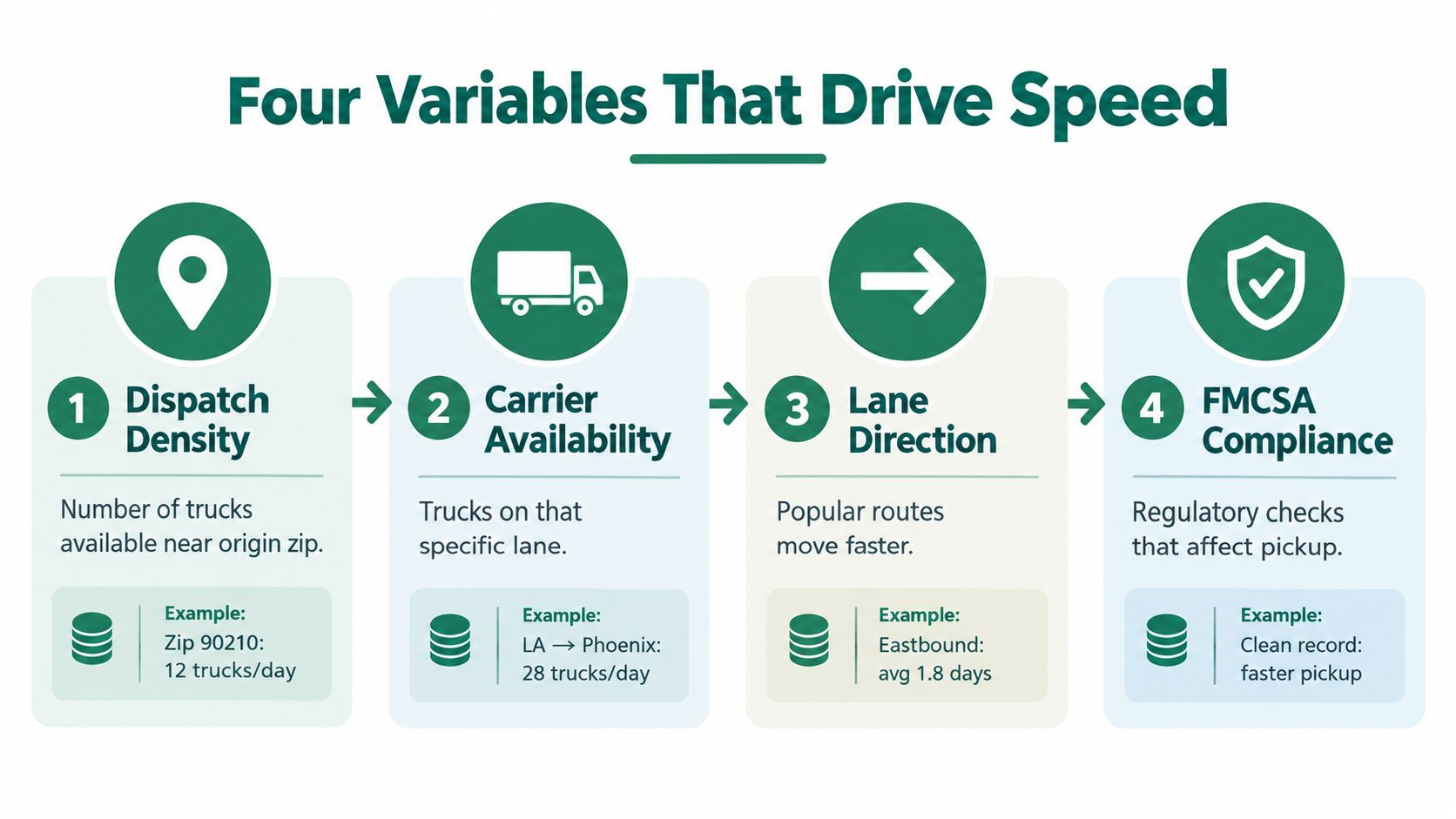
Four things that actually control speed
Origin density matters first. A car in Miami, Los Angeles, Chicago, Houston, Atlanta, Phoenix, or Newark is easier to assign quickly than a car outside a small town with limited truck traffic.
The lane has to be active. A carrier may have space, but not on your route. Availability isn't generic. It's lane-specific.
Direction matters as much as distance. Florida to New York during a migration wave can move differently than New York back to Florida when the flow changes. The route may be identical on a map and totally different in dispatch reality.
Compliance still comes before speed. Interstate carriers operate under FMCSA rules in 49 CFR Parts 300–399, and the agency states these regulations set the minimum standards for motor carriers and drivers, as summarized in this car shipping industry statistics and compliance overview. If operating authority, insurance on file, or safety requirements aren't in place, the shipment can stall before pickup is even attempted.
What a dispatcher actually does
When an express order lands, nobody presses a magic button.
A real dispatcher starts by checking which vetted carriers are already scheduled near the pickup area, who has an open slot on the right trailer type, and whether adding your vehicle breaks the economics of the existing load. Then they start calling, texting, repricing, and trying to insert your vehicle into a route with the least disruption.
That's why the second call often matters more than the first quote. The first quote is pricing theory. The second round is where someone has talked to trucks.
A fast booking doesn't move a car. A matched carrier does.
For businesses moving units regularly, route-readiness matters too. If you manage multiple vehicles, basics like visibility and road safety prep help avoid last-minute mechanical surprises. Fleet operators may also keep maintenance references handy, including a guide to selecting fleet wipers for weather-heavy lanes where vehicles sit outside during staging and transfer.
Puerto Rico changes the timing chain
Puerto Rico shipments add handoffs. Federal jurisdiction treats transportation between the United States and a U.S. territory or possession as interstate commerce for motor-carrier compliance purposes, which is why mainland to Puerto Rico moves work differently from a simple intrastate job, according to FMCSA passenger carrier guidance.
That means your speed depends on more than truck proximity. Inland pickup, port cutoffs, vessel timing, and release paperwork all have to line up. If you miss one handoff, priority on the truck side won't rescue the schedule.
What Express Really Costs and When It Pays Off
People get emotional and make bad decisions. They hear “urgent,” focus on the total quote, and never ask what they're buying per day saved. That's backwards.
The practical benchmark from current industry content is that express service can cost roughly 30–50% more than standard transport, with same-day pickup sometimes adding another 20–30% premium, according to Navi Auto Transport's express auto transport service overview. On less-trafficked routes, even express may still take 48–72 hours because the carrier has to be rerouted from existing loads. That's the nuance that matters.
Compare the premium to the time actually saved
If the route is short, dense, and active, paying extra can materially cut waiting. If the route is long, sparse, or awkward, the premium may mostly buy queue priority and better communication.
| Service Tier | Typical Premium Over Standard | Realistic Pickup Window | Best-Use Scenario |
|---|---|---|---|
| Standard | Base rate | Flexible, based on normal dispatch | Flexible household moves, planned snowbird transport, non-urgent dealer inventory |
| Express | Roughly 30 to 50 percent more | Faster priority dispatch if capacity is nearby | Job relocation, purchase release, lease return, student move with a firm date |
| Same-day or urgent rush | May add another 20 to 30 percent on top in some cases | Only realistic when a truck is already positioned correctly | Dense metro lanes, hard commercial deadlines, port cutoff situations |
For a closer look at how quotes are built, compare any rush quote against a provider that explains car shipping cost in plain terms rather than just dropping a premium on top of a base rate.
Where the premium pays
Express is usually worth it when:
- The route is under tighter timing pressure: You're trying to protect a start date, sale date, or release date that has real downstream cost.
- The lane is dense: Major city pairs such as Los Angeles to Phoenix, Miami to Atlanta, Dallas to Houston, or New York to Charlotte have a better chance of turning premium dollars into actual pickup speed.
- The delay cost is obvious: Hotel nights, rental car extension, missed delivery appointment, or a dealership issue can outweigh the transport markup fast.
Where it mostly burns money
Cross-country runs still depend on legal drive time, route sequencing, weather, and truck utilization. Paying more won't let the driver ignore operating rules or teleport across the country.
Bottom line: On many long-haul shipments, express changes when your car gets assigned. It doesn't change how highways work.
That's especially true if your origin is remote or your destination requires extra coordination, as happens with some mainland-to-port or port-to-door Puerto Rico jobs.
Real Shipper Scenarios and How Speed Plays Out
The easiest way to judge express auto shipping is to stop thinking in slogans and look at the move in front of you. Same service tier. Different geography. Totally different result.
Cross-country relocation
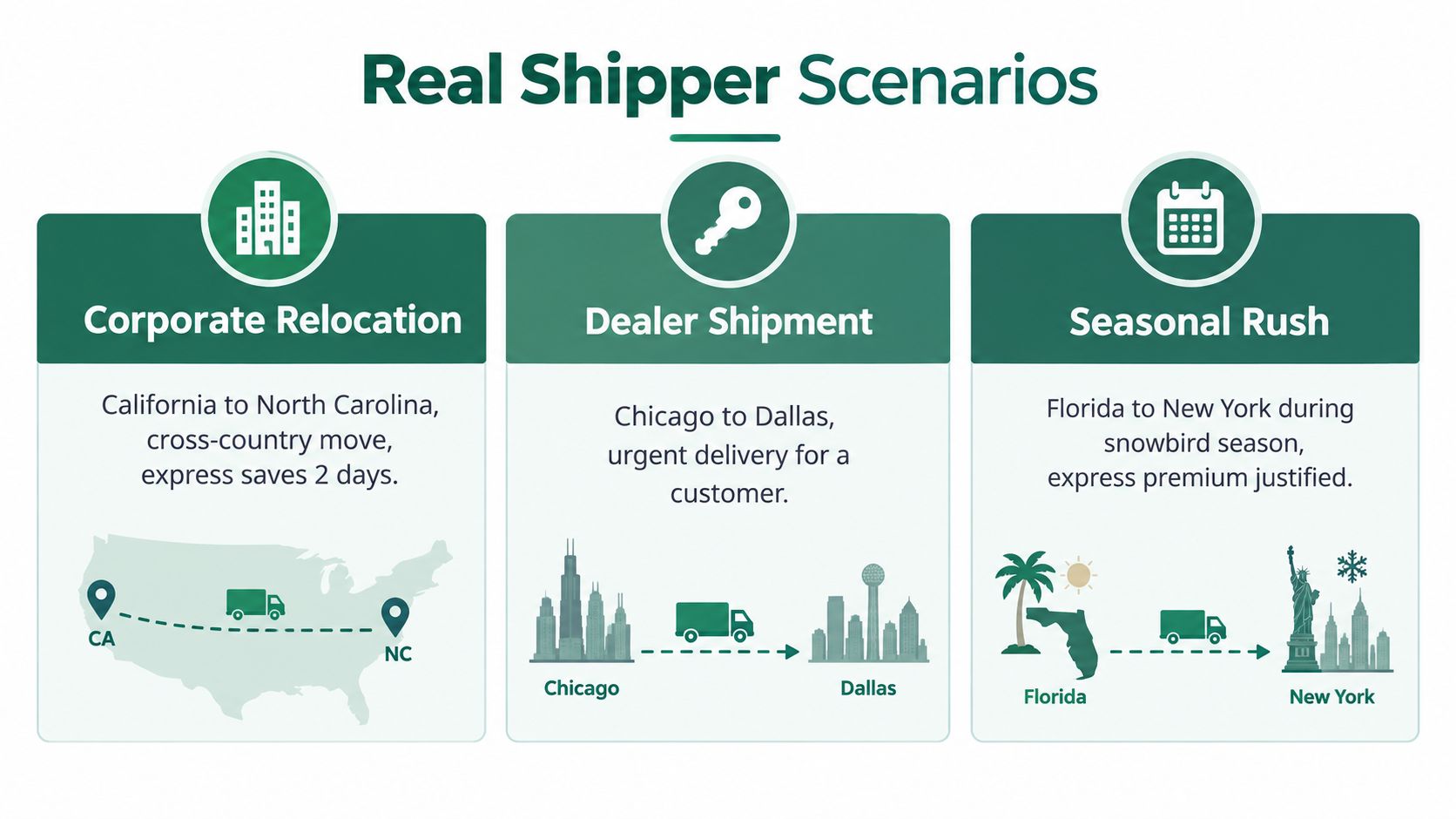
A project manager leaves San Jose for Raleigh with a hard move-out date and a fixed start week. On paper, express sounds like a way to make the whole shipment “fast.” In reality, the premium mainly buys aggressive dispatch, a stronger chance of quick pickup, and less idle time before the vehicle gets on a truck.
The driving portion still takes the time it takes. For a move like that, express often has value because pickup certainty matters more than pretending the trailer can beat physics.
Dealer and auction timing
Now switch to a dealership moving a sold vehicle from Chicago to Dallas before a customer delivery or auction date. Urgency has teeth. Missing pickup can mean lost gross, missed retail delivery, and a vehicle sitting in the wrong place at the wrong time.
For commercial moves, priority dispatch is often essential because the cost of delay is larger than the rush premium. Businesses usually understand that better than retail shippers do.
If the vehicle is tied to revenue, waiting for a standard opening is often the expensive choice.
Snowbird season and route crowding
A retiree ships from Michigan to Arizona in the fall, or from New Jersey to South Florida before peak migration. This is the classic case where standard service can look cheaper and perform worse because too many people are trying to move at once.
Express may not turn the trip into a race. What it often does is keep the order from sinking behind a long line of similar vehicles on the same seasonal lanes.
Puerto Rico scenario
A family in Orlando needs to ship a car to San Juan before a housing handoff, or a student in Puerto Rico needs a vehicle sent back to the mainland before a term change. Documentation and port timing matter as much as dispatch priority.
Published guidance for Puerto Rico shipments notes that door-to-port moves from other mainland locations can add 3–7 days, with port-to-port transit often quoted at 7–10 days from Florida and 10–14 days from New Jersey, according to Crowley's guidance on shipping a vehicle from Puerto Rico to the U.S.. So yes, paying for faster inland scheduling can help. But if you miss the vessel side of the chain, the savings disappear.
That's why smart shippers judge express by the whole route, not just the truck leg.
How to Book Express Service the Right Way
If you book in a rush, protect yourself in writing. The biggest failures in expedited shipping don't come from highways. They come from sloppy paperwork, weak vetting, vague contract language, and bad communication after the first carrier falls through.

Start with documents before you chase speed
For any domestic move, have your registration, photo record of the vehicle's condition, and insurance details ready before booking. For Puerto Rico, document rules are stricter and depend on ownership status.
Published guidance says vehicles shipped from Puerto Rico to the mainland typically need a title copy and current registration, while financed vehicles need a notarized lien-release letter valid for 30 days. Joint ownership can require both owners to be present or to provide notarized consent, according to Car Shipping Explained's Puerto Rico car shipping guide.
That paperwork isn't a side issue. It can decide whether your “express” order even moves.
Vet the company like the timeline depends on it
Because it does.
Use this checklist:
- Check active authority: FMCSA says interstate for-hire operators must have active operating authority before transporting property for hire in interstate commerce, as stated in FMCSA licensing and insurance requirements for for-hire motor carriers.
- Read delay complaints carefully: You're not looking for perfect reviews. You're looking for patterns around missed pickup expectations and vague dispatch promises.
- Verify who handles communication: One person should own the file. If every call goes to a different rep, your urgent shipment will drift.
For door delivery expectations, compare the process against a company that clearly explains door-to-door auto transport instead of assuming terminal-style handoffs.
Get three promises in writing
Don't just ask “How fast?”
Ask for these:
- The pickup window tied to the service tier you're paying for.
- The escalation contact if the first carrier cancels or misses.
- The cancellation terms if the promised dispatch effort doesn't happen.
This is also where one provider can stand out by process, not by hype. National Car Transport is one example of a U.S.-based option that offers flat-rate pricing, works with a network of 25,000+ vetted carriers, has 25+ years of experience, an A+ BBB rating, and bilingual U.S.-based agents in English and Spanish with deep auto transport logistics experience. That kind of advisor support matters because no two shipments are alike, especially when you're balancing speed, port timing, and delivery access.
What Expedited Service Does Not Guarantee
Paying more does not put your vehicle on a calendar with ink on it. That's the misconception that causes the most frustration.
What dispatchers can control
A broker or carrier can control:
- Queue position
- How fast the order is posted and repriced
- How aggressively they contact trucks
- How clearly they communicate delays or alternatives
That's real value. It just isn't the same as a guaranteed arrival date.
What they can't control
They can't control weather shutdowns, route disruptions, truck breakdowns, rural pickup reach, vessel timing, or legal operating limits. And they usually won't sign a contract promising a hard delivery day unless the move is structured very differently and priced accordingly.
BBB complaint records reflect this gap. Multiple brokers explicitly state that transit times are estimates only and that they do not guarantee pickup or delivery on specified dates, which is exactly the problem most “faster service” pages gloss over, as shown in BBB complaint records for V2 Logistics Corp.
“Priority handling” is not the same sentence as “guaranteed delivery.”
That distinction matters for every route, but especially for Puerto Rico, Alaska, Hawaii, and inland rural pickups where handoffs create more points of failure.
Promises worth verifying in writing
Before you hand over a deposit, verify these items in plain English:
- Named dispatch tier: Ask what “express” means inside their system.
- Pickup window language: Get the expected range in writing.
- Escalation path: Ask who calls you if the assigned carrier drops.
- Refund terms: Ask what happens if the expedited effort doesn't produce faster pickup.
What isn't enough? Marketing shorthand like “fast service,” “priority booking,” “guaranteed rates,” or “rush delivery available.” If it's not tied to a defined service obligation, it's just sales language.
Choosing Standard or Express Without Regret
Here's the decision rule I'd use if I were booking my own vehicle.
Choose express auto shipping when the route is active, the deadline is hard, and the cost of waiting is higher than the premium. That includes job starts, dealer deadlines, lease returns, student moves with fixed dates, and Puerto Rico shipments where inland timing has to hit a vessel window.
Choose standard when you've got a real buffer. If the car can move within a broader week, the route is long-haul, or the premium is buying stress relief more than measurable speed, save your money.
The question that cuts through the sales pitch
Ask this exact question:
If I book standard today versus express today, what is the realistic pickup window for each?
That question forces a real answer. It makes the dispatcher separate marketing language from actual lane conditions.
A simple screenshot test
Express usually makes sense when:
- You have a non-movable date
- Your route starts or ends in a major market
- Delay creates direct cost or operational trouble
Standard usually makes more sense when:
- You have schedule flexibility
- The route is long and transit time won't compress much
- The premium mainly changes your place in line, not your actual delivery outcome
The one phrase to get in writing before paying anything is this: “Priority dispatch with estimated pickup window of [X to Y].” If they won't write that clearly, keep your card in your wallet.
National Car Transport handles the kind of moves this article is about every day, including door-to-door shipping across the mainland and coordinated vehicle transport to and from Puerto Rico. If you want a real pickup discussion instead of vague speed promises, visit National Car Transport and talk with a U.S.-based bilingual advisor who can walk you through timing, route density, and whether express service will help your shipment.