

You've just bought a Porsche in Miami, and the delivery address is across the state, up north, or on the mainland before an ocean leg to Puerto Rico. The car has a low front splitter, expensive paint, and no tolerance for a rushed loading job. The quote looks simple until someone asks about trailer clearance, insurance, port handling, storm routing, and whether the truck configuration needs a Florida permit.
That's why exotic car transport in Florida requires more than choosing the lowest online price. The trailer, carrier, declared-value coverage, pickup timing, and final inspection all matter. This guide applies to private owners, snowbirds, military families, students, dealerships, collectors, and businesses shipping vehicles across the 48 contiguous states, Florida, or from the mainland to San Juan, Puerto Rico.
Table of Contents
- Why Florida Is Its Own Beast for Exotic Car Transport
- Choosing Between Enclosed, Open, and Container Transport
- Vetting Carriers, Brokers, and Quotes the Right Way
- What Really Drives Exotic Transport Pricing in Florida
- Florida Permits, Low Clearance, and Hurricane-Season Routing
- Pickup Day, Transit, and the Delivery Inspection
- Florida Exotic Transport Checklist and Final Recommendations
Why Florida Is Its Own Beast for Exotic Car Transport
Florida's vehicle market creates steady demand for specialized shipping. The state has about 19.52 million registered vehicles, and the average vehicle age is 11 years, compared with a national average of 12.2 years. Its ownership mix includes 35.30% cars, 39.70% utility vehicles, 17.10% pickups, and 5.10% vans and minivans, while its fleet also includes 330,854 electric vehicles and 69,898 plug-in hybrids. That broad mix supports everything from everyday relocation moves to enclosed transport for collector and exotic vehicles. Florida vehicle-market data
South Florida adds another layer. In Greater Miami, luxury vehicles represented 7% of new auto sales in March 2013, and 9,834 luxury cars and trucks sold during that year's first quarter. The region also sees about 30,000 luxury vehicles priced at $40,000 and up transact annually, according to South Florida market reporting. That concentration sends high-value cars between Miami, Fort Lauderdale, Palm Beach, Naples, Orlando, Tampa, and destinations nationwide. South Florida luxury-market context
Four decisions control the move
- Trailer type: An exotic usually belongs in an enclosed trailer, especially with custom paint, low clearance, or collector value.
- Carrier vetting: Confirm who will take possession of the car, who carries the insurance, and whether the assigned equipment fits the vehicle.
- Coverage: A standard policy may not match the car's agreed value. Ask about declared-value protection before dispatch.
- Timing: Florida's coastal geography, Keys access, port schedules, and storm activity can change the practical delivery plan.
Salt air matters around coastal properties, and route choices can become more complicated near the Keys or during tropical weather. If the car needs cosmetic work after arrival, owners may also find a specialist resource such as paint correction for exotic cars Columbus useful for understanding how delicate finishes should be handled.
Choosing Between Enclosed, Open, and Container Transport
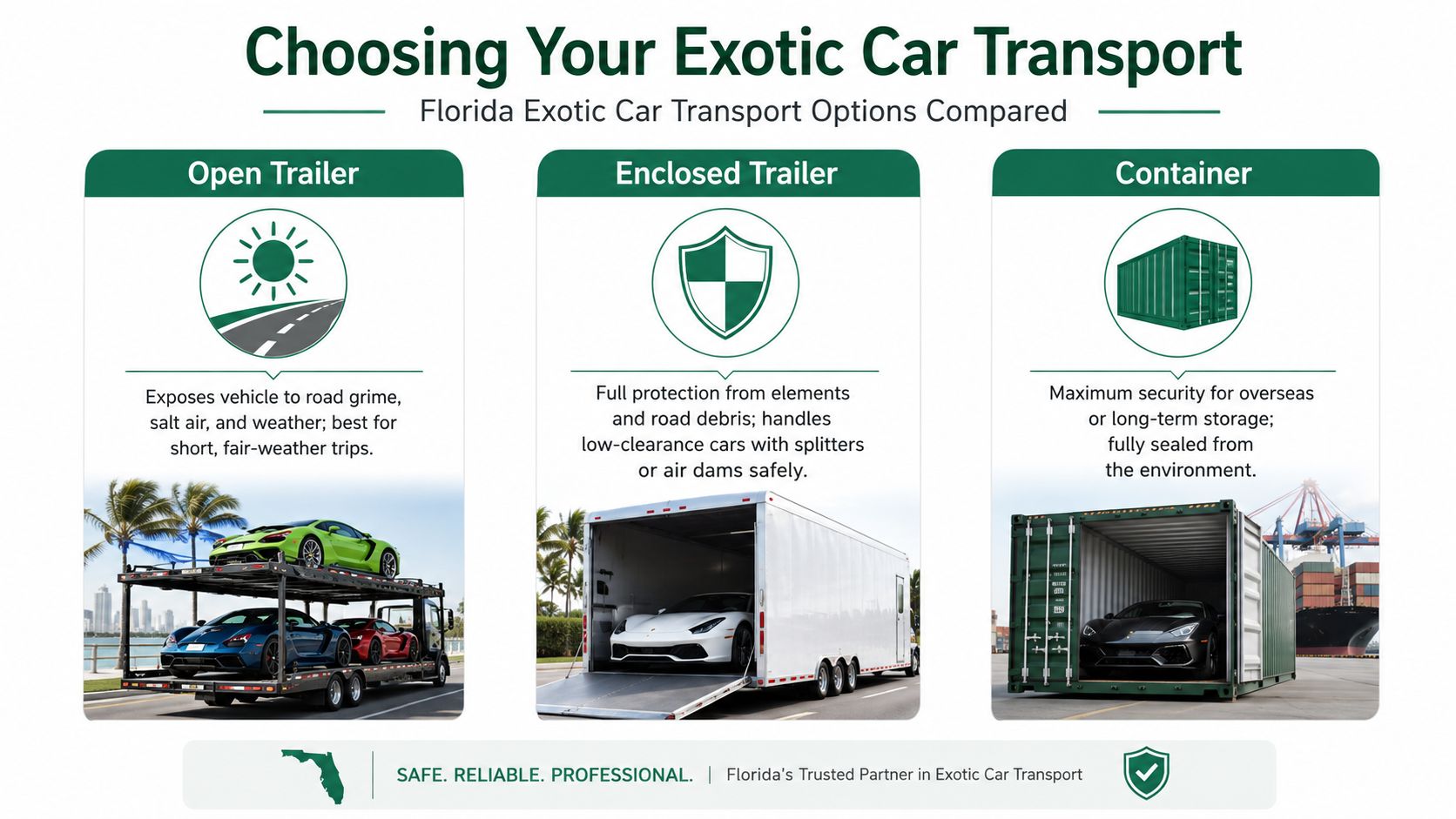
A Ferrari with a front splitter, low ride height, or fresh custom paint can become a loading problem before it becomes a trailer problem. Start with protection and loading geometry, then compare quotes. Enclosed transport keeps the car away from road debris, rain, and salt air, while hydraulic lifts and adjustable ramps can reduce the risk of scraping.
Open transport suits a short domestic move in stable weather when the owner accepts exposure. I would not make it the default for an exotic. Equipment varies by carrier, so confirm the ramp angle, deck height, tie-down method, and whether the driver has handled low-clearance cars.
A container serves a different operation. Use it for ocean movement, including a mainland shipment routed through Jacksonville toward San Juan. The vehicle travels in a sealed space and follows a port-based chain of custody rather than a standard domestic truck handoff. Puerto Rico shipping is not a routine international import, so ownership history and origin can affect the required paperwork. Puerto Rico shipping documentation guidance
| Factor | Enclosed | Open | Container/Ocean |
|---|---|---|---|
| Protection | Strong protection from weather, salt air, and road debris | Exposed to weather and road conditions | Sealed protection for ocean and long-term movement |
| Ground clearance | Best choice with hydraulic loading equipment and adjustable ramps | Equipment varies, so verify ramp angle before booking | Requires careful loading and securement inside the container |
| Price | Typically 30% to 60% above open transport on the same lane, according to industry guidance | Lower-cost domestic option | Separate ocean, port, documentation, and handling charges apply |
| Dispatch time | Often slower to arrange because equipment is less available | Usually easier to match | Depends on port schedule, documentation, and vessel availability |
For domestic Florida moves, choose enclosed service when the car has custom paint, low clearance, or meaningful collector value. Review equipment and service details in National Car Transport's enclosed auto transport information. For Jacksonville to San Juan, get the inland leg, port receiver, document requirements, and release process in writing.
A container is not a larger truck. The car must be positioned, secured, documented, and released through port procedures. Require a written handoff plan covering the pickup address, Jacksonville terminal, vessel movement, and San Juan delivery.
Vetting Carriers, Brokers, and Quotes the Right Way
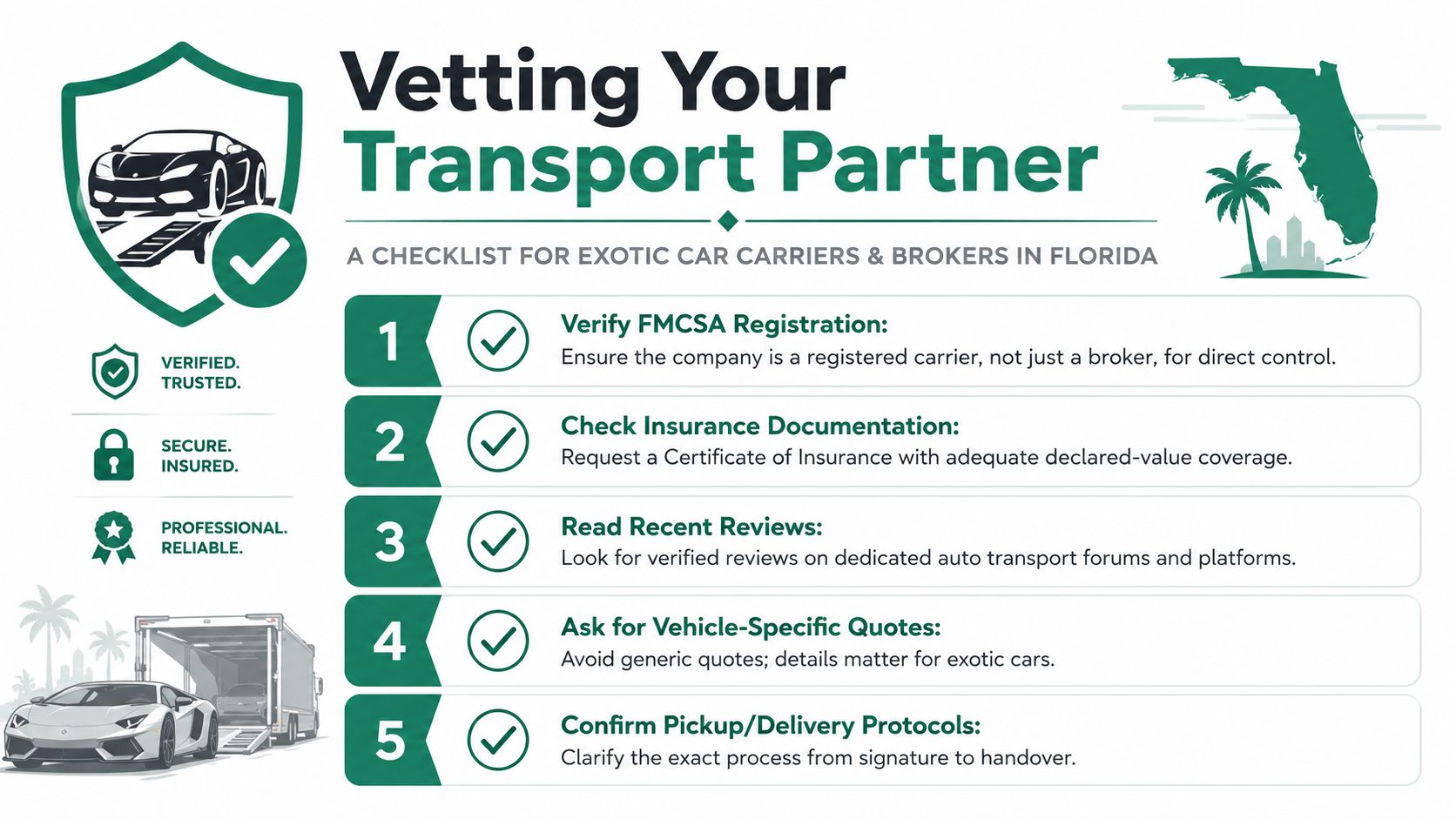
A quote isn't proof that the company can safely handle a Ferrari, Corvette, Lamborghini, Porsche, or another low-clearance vehicle. First identify the company's role. Under FMCSA rules, a motor carrier transports the vehicle and takes possession of it, while a broker arranges transportation without taking possession. Authorized for-hire carriers must file public-liability and cargo-insurance proof for interstate operating authority, while household-goods brokers must maintain a $75,000 surety bond or trust fund agreement. FMCSA operating-authority definitions
The five-minute verification routine
- Search the company: Use FMCSA's public licensing and insurance lookup to verify the business, authority status, and available filings.
- Identify the actual carrier: If a broker is arranging the move, request the assigned carrier's legal name and operating details before pickup.
- Request insurance documentation: Ask for a current certificate and confirm that cargo protection applies to your vehicle's declared value. FMCSA's insurance table includes a $750,000 minimum bodily-injury and property-damage benchmark for certain household-goods carriers, but that figure isn't automatically the correct cargo limit for an exotic. FMCSA licensing and insurance lookup guidance
- Check the BBB record: Review the company's rating, complaint history, and response pattern rather than relying only on testimonials.
- Read the quote line by line: The written price should identify trailer type, pickup and delivery terms, insurance assumptions, port services if applicable, and cancellation conditions.
National Car Transport is one option for owners who want a U.S.-based dispatcher, 25+ years of experience, an A+ BBB rating, transparent flat-rate pricing, and access to a network of 25,000+ vetted carriers. Those facts don't replace your own verification. Ask which company will physically load the car and insist on vehicle-specific answers about lift gates, ramp angles, tie-downs, and claims handling.
A broker can be useful for uncommon lanes, including a mainland move that connects to Jacksonville and San Juan. The mistake is assuming the broker's name on the quote is the same company that carries the vehicle. Get both names in writing.
What Really Drives Exotic Transport Pricing in Florida
A quote can look reasonable until the dispatcher learns the car has a front splitter, a tight coastal driveway, and a delivery deadline at Jacksonville's port. Exotic transport pricing comes from those operating details, not a universal rate card. The same Porsche may receive different quotes based on its pickup neighborhood, delivery access, dimensions, equipment availability, season, and whether the route ends at a port.
Trailer choice affects the baseline. Enclosed transport generally runs 30% to 60% above open transport on the same lane, according to enclosed transport pricing guidance. The premium covers added protection, specialized equipment, and a smaller pool of suitable carriers. Paying it makes sense for fragile paint, limited ground clearance, or a vehicle that should not share an open deck with road debris. It wastes money only when the car's condition, route, and exposure risk do not justify enclosed service.
Read the quote as a cost model
- Distance and lane demand: Longer routes require more fuel, driver time, and coordination. A Miami pickup headed to a major mainland city may price differently from a rural origin, a narrow coastal address, or a lane with limited carrier availability.
- Vehicle dimensions: Width, height, wheelbase, splitter clearance, air-ride settings, and door-opening needs determine whether the car fits standard enclosed equipment. Give the dispatcher exact measurements rather than relying on the model name.
- Declared-value coverage: A high-value vehicle may require a declared-value rider or written coverage adjustment. A carrier's general cargo policy may not match the car's actual value, so confirm the limit and claims process before booking.
- Fuel and operating charges: Quotes may include fuel adjustments, tolls, storage, lift-gate service, or special handling. Ask whether the price is flat and which specific events can change it.
- Seasonality: Snowbird traffic increases competition for Florida lanes. Hurricane season runs June through November and can affect coastal routing, pickup windows, and dispatch timing.
- Port involvement: A Jacksonville-to-San Juan move adds inland transport to the port, documentation, terminal handling, ocean movement, and delivery coordination in Puerto Rico. Treat the ocean leg as a separate operation, not a routine extension of domestic trucking.
Do not trust a precise universal price-per-mile promise when the seller has not asked about clearance, dimensions, vehicle value, route, trailer, and delivery conditions. A credible quote itemizes those inputs and identifies what is included. Use National Car Transport's car-shipping cost guide for a preliminary reference, then have an agent review the exact vehicle and addresses.
Prepare the car before the truck arrives
Damage prevention begins before loading. Photograph every panel, wheel, glass surface, and interior area in good light. Record existing marks on the bill of lading, disable alarms, remove loose accessories and toll transponders, and leave only the fuel amount permitted by the carrier. For a long move, ask how the battery should be secured and whether the alarm or air suspension needs a vehicle-specific procedure.
Low front splitters need direct planning. Tell the dispatcher the actual ride height, identify any lift system, and confirm that the assigned carrier has a hydraulic lift gate or another low-clearance loading method. A generic promise of “enclosed service” does not confirm that the ramp angle will work.
For a coastal pickup, rinse away salt residue before inspection. That gives the origin record a clean baseline and reduces arguments over whether surface contamination existed before transit. Keep the title and registration in a secure location where the driver or port agent can copy required information.
Confirm the pickup window against the forecast before dispatch. A low quote that omits insurance details, equipment requirements, or storm contingencies can create storage charges, missed appointments, or a disputed claim. Ask for those terms in writing before the carrier is assigned.
Florida Permits, Low Clearance, and Hurricane-Season Routing
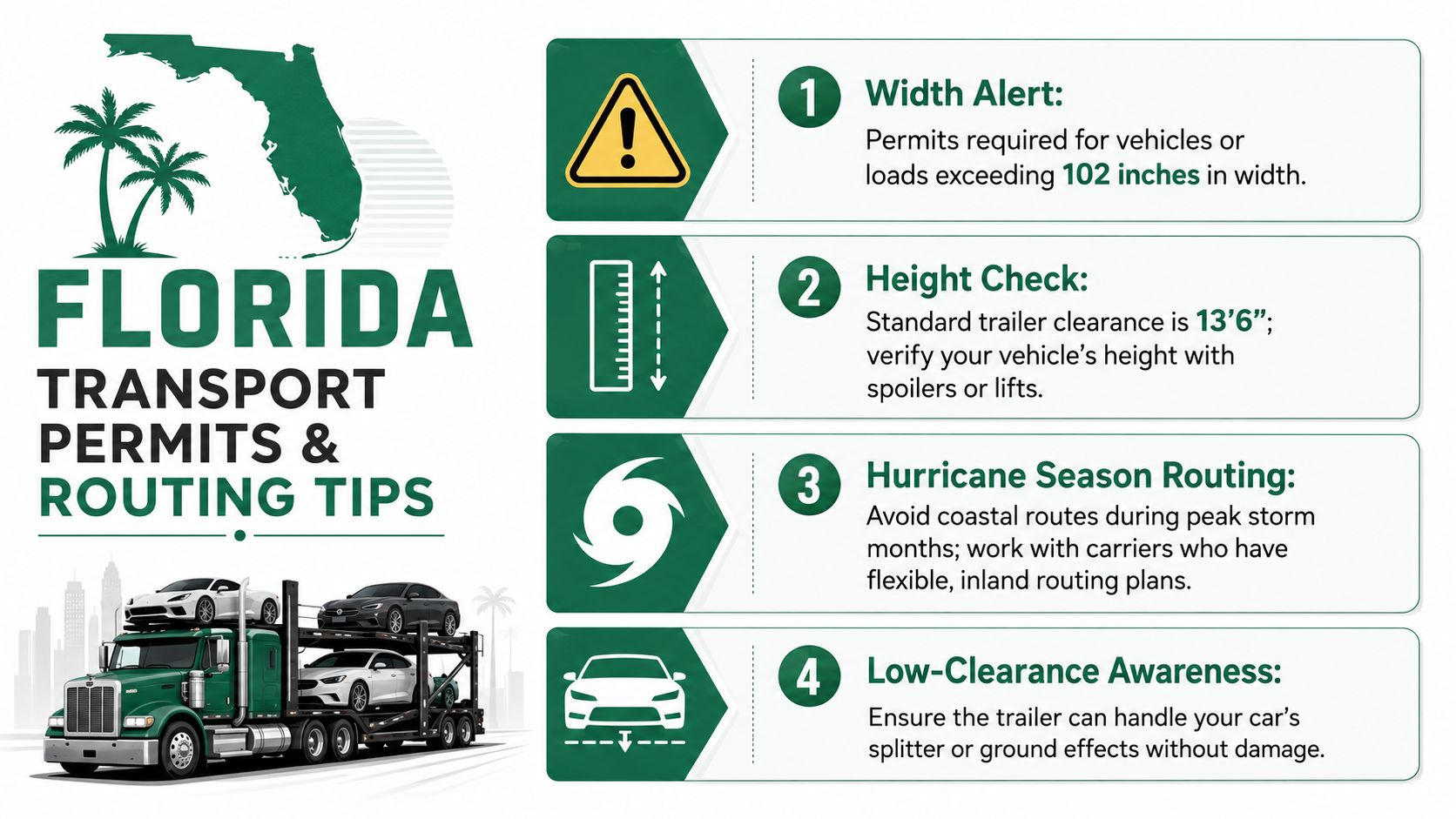
The permit question depends on the vehicle-and-trailer combination, not only on whether the car is exotic. Florida permit rules can apply when a vehicle or load exceeds statutory limits, including 102 inches in width, 13 feet 6 inches in height, and certain length thresholds. An oversized move without a valid permit can face penalties of up to $1,000 per violation. Florida size, load, and permit requirements
A low-slung car may fit by itself while the complete setup becomes permit-sensitive. Front-end overhang on a specialty trailer, an enclosed trailer's total height, or a transporter configuration can change the measurement. The load must also be secured so it doesn't shift, blow, or escape during transit.
Complete the week-before pickup check
- Measure the full setup: Give the dispatcher the car's height, width, length, splitter position, and any lift or suspension modifications.
- Confirm trailer fit: Ask whether the equipment uses a hydraulic lift gate, adjustable ramps, and soft securement appropriate for the car.
- Inspect coastal condition: Rinse salt residue from the exterior and photograph the finish before the driver arrives.
- Organize documents: Keep title, registration, authorization forms, and port paperwork accessible if the move continues to Puerto Rico.
- Set weather contingencies: Confirm whether the pickup window can move if a tropical weather advisory affects coastal roads or port operations.
Florida hurricane season runs June through November, and coastal routing can change quickly during that period. Book enclosed assignments early and get the storm plan in writing. A carrier that can't explain where it will hold, reroute, or reschedule the vehicle isn't ready for a Florida exotic move.
Pickup Day, Transit, and the Delivery Inspection
The most important document on pickup day is the bill of lading, not the text message confirming that the truck is nearby. Walk around the car with the driver, compare the condition to your photographs, and make sure every existing chip, scratch, wheel mark, and interior issue appears in the condition report. The driver should also record mileage and note whether the car has special operating instructions.
Don't rush the loading process. Watch the approach angle, confirm the lift system is positioned correctly, and tell the driver about the lowest point on the car. If the vehicle has an active hydraulic lift, air suspension, or unusual starting procedure, explain it before the driver moves the car.
During the move
A professional dispatcher should provide realistic updates rather than promise an exact arrival time that weather, construction, port queues, or delivery access can undermine. Ask how the driver will contact you, who handles schedule changes, and whether the delivery address has enough clearance for the truck and trailer.
Door-to-door service can simplify residential, dealership, military, and business relocations, but “door” means the safest legal access point. A narrow street, gated community, steep driveway, or low clearance may require a nearby meeting location. Review door-to-door auto transport service details before assuming a large carrier can reach the exact driveway.
At delivery, inspect the car before signing the final paperwork. Compare every panel and wheel with the origin report, check the underside of the splitter if it was accessible at pickup, and verify that accessories and documents are present.
Delivery rule: If you see new damage, write it on the bill of lading before signing. Take clear photographs, notify the dispatcher immediately, and request the claims instructions in writing.
If the vehicle arrives in the recorded condition, sign the delivery section and keep a copy. If there's a discrepancy, don't accept a blank or clean report. A claim becomes harder to establish when the delivery document doesn't record the visible issue.
Florida Exotic Transport Checklist and Final Recommendations
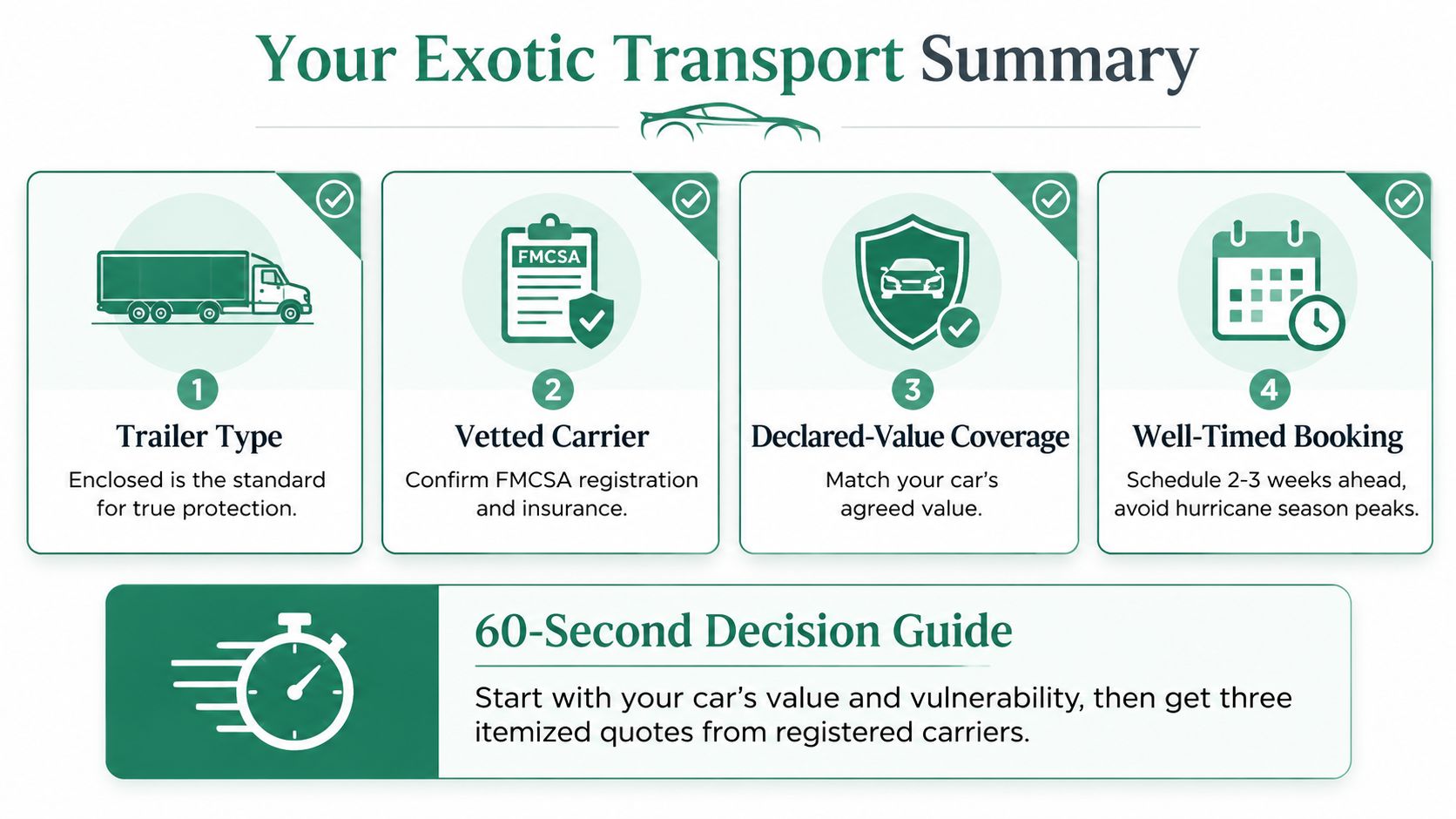
A smooth Florida move comes down to four decisions: the right trailer, a vetted carrier, coverage that matches the car's value, and timing that respects weather and equipment availability. Open transport can save money for ordinary vehicles, but an exotic with fragile paint, low clearance, or collector value deserves a serious enclosed-transport review. A mainland-to-Puerto Rico move requires a separate look at container handling, Jacksonville port coordination, and ownership documents.
Use this 60-second pre-ship checklist
- Confirm FMCSA registration: Verify the broker or carrier, then identify the company that will physically take possession of the vehicle.
- Confirm the equipment: Ask whether the enclosed trailer has a hydraulic lift gate and whether the ramp angle suits the splitter, air dam, and ride height.
- Confirm declared-value coverage: Match the written protection to the car's agreed value and request any rider before dispatch.
- Confirm the pickup window: Check the weather forecast, especially for coastal addresses and moves scheduled between June and November.
- Document the origin condition: Photograph every panel, wheel, glass surface, and interior detail, then review the bill of lading with the driver.
National Car Transport offers flat-rate quotes, English and Spanish-speaking agents based in the United States, and access to a network of 25,000+ vetted carriers. Its advisors can help coordinate domestic moves across the 48 states, Florida routes, dealership and auction shipments, snowbird relocations, military moves, and mainland-to-Puerto Rico transport.
One detail separates a careful shipment from a rushed one: the agent asks the right questions before a carrier is assigned. Tell the dispatcher the exact make, model, clearance, modifications, value, pickup conditions, delivery address, and whether the vehicle will continue through Jacksonville to San Juan. Not one vehicle transport is alike, and an experienced bilingual English and Spanish agent based in the USA, with over 20 years in auto transport logistics, can make the process simpler and faster while keeping the quote aligned with the actual move.
For exotic car transport in Florida, National Car Transport can arrange enclosed, open, or container and ocean options, with flat-rate pricing and bilingual U.S.-based advisors to coordinate the shipment. Visit National Car Transport with your vehicle details, addresses, clearance information, and preferred dates so an advisor can build a practical quote for the full route, including Puerto Rico connections when needed.