

You've found a classic car, luxury EV, or second vehicle and need it moved across the country. Two companies quote the same route, yet the prices are hundreds of dollars apart. One promises “full insurance,” another gives only a mileage-based number, and neither explains what happens if the car can't roll onto the trailer or if a Puerto Rico port adds a delay.
An enclosed transport quote should answer those questions before you sign. It should show how the carrier evaluated the vehicle, route, equipment, insurance, access, and possible extra charges. The lowest number matters less than knowing exactly what you're buying.
Table of Contents
- Why Enclosed Transport Quotes Vary So Much
- What Details to Provide When Requesting a Quote
- Options That Affect Your Enclosed Transport Price
- Reading the Insurance Terms in Your Quote
- Enclosed Quotes for Puerto Rico Routes
- How to Evaluate and Book with Confidence
Why Enclosed Transport Quotes Vary So Much
A classic car owner comparing two routes from Miami to Los Angeles may see one quote that assumes a running, standard-size vehicle and another that includes careful loading, enclosed equipment, and flexible delivery. Both companies may be acting in good faith. They are pricing different levels of risk and capacity.
A defensible quote isn't a single mileage calculation. It's a documented assessment of the origin and destination, truck access, vehicle condition, dimensions, ground clearance, modifications, declared value, equipment, route demand, tolls, fuel, repositioning mileage, and timing. The written offer should separate transportation from accessorial charges, insurance terms, and cancellation or delay conditions. FMCSA's insurance filing guidance also makes clear that insurance obligations vary by entity type, operating authority, cargo, and vehicle type.
The same route can require different equipment
A running sedan may fit a standard enclosed trailer. A lowered Corvette may need specialized loading. A non-running vehicle may require a winch, while an oversized or heavily modified vehicle can change the carrier's available capacity. Those details affect both the equipment and the carrier's ability to combine your shipment with other vehicles.
Your pickup address matters too. A large enclosed trailer may not safely reach a narrow residential street, gated community, steep driveway, or congested downtown location. A nearby commercial meeting point can prevent an accessorial charge and reduce loading risk.
Practical rule: A quote is trustworthy when another person can read it and understand why the price was chosen.
National Car Transport approaches quotes through dedicated advisors rather than leaving customers to decode a vague online estimate. The company has 25+ years of auto transport experience, an A+ BBB rating, transparent flat-rate pricing, and a network of 25,000+ vetted carriers. Its bilingual English and Spanish agents are based in the USA and have over 20 years of experience in auto transport logistics, helping customers explain vehicle details, compare options, and keep the process simple.
For broader background on importing and moving vehicles, transport auta z USA 2026 offers another useful resource. You can also review the practical factors behind an enclosed auto shipping cost before requesting a formal rate.
What Details to Provide When Requesting a Quote
Accurate information produces an accurate quote. If you omit a modification, give a vague address, or describe an inoperable car as running, the price can change when the carrier arrives.
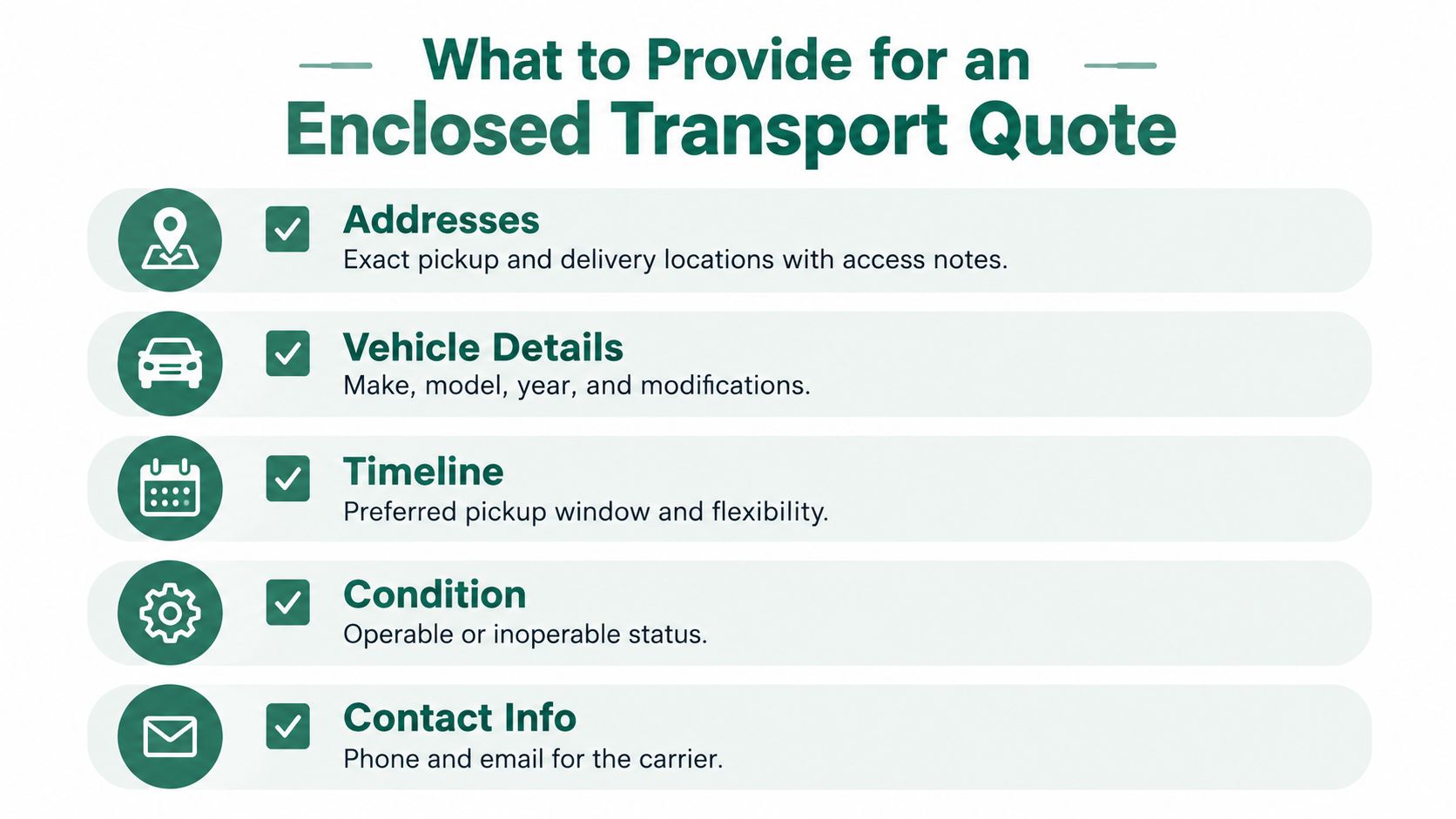
Start with the route
Provide the exact pickup and delivery addresses, not only the city and ZIP code. Explain whether each location is accessible to a large truck and enclosed trailer. Mention narrow roads, low bridges, gated properties, steep driveways, loading restrictions, or a preferred commercial alternative.
Then give the timing details. State your preferred pickup window and whether you can accept flexible pickup or delivery scheduling. A customer shipping a collector car to a concours event has different requirements from a snowbird moving a convertible between homes.
Describe the vehicle precisely
Include the year, make, model, running condition, dimensions, ground clearance, modifications, and declared value. A lowered sports car, wide-body build, vehicle with a roof rack, or car with nonstandard tires may need different clearance or loading equipment.
Condition must be specific. Say whether the vehicle starts, rolls, steers, brakes, and can be driven onto the trailer. If it can't, explain whether it needs a winch or specialized loading. Don't use “runs” as shorthand for “loads normally.” A car that starts but has seized brakes still creates a loading problem.
Declared value also deserves care. It helps frame the insurance discussion, but it doesn't automatically establish the amount a claims department will pay. Ask how the carrier handles valuation and what documentation it needs.
Treat the request like a comparison checklist
When comparing transport providers, use the same information for each quote. The car insurance quote comparison checklist from QuoteFii, LLC illustrates the value of comparing coverage details rather than looking only at the headline price.
- Addresses: Include access notes for both ends of the route.
- Vehicle details: List modifications, dimensions, clearance, and declared value.
- Timeline: State the preferred pickup window and flexibility.
- Condition: Identify whether the vehicle is fully operable, partially operable, or inoperable.
- Contact information: Provide a reliable phone number and email so scheduling changes don't get missed.
Give the same complete description to every provider. That's the simplest way to compare like with like and avoid a teaser quote that changes at pickup.
Options That Affect Your Enclosed Transport Price
The enclosed option itself is only one part of the price. A 2025 pricing analysis estimates enclosed transport at roughly 30–60% more than open transport and says specialty vehicles may add $500–$1,000. The same analysis warns that federal liability minimums may not cover a $120,000 EV or classic, while deductibles can reach $500–$1,000. Review the 2025 cross-country car shipping cost analysis for that pricing context.
Understand what you control
You can often control scheduling flexibility and delivery access. You can't change the vehicle's size, operability, or need for specialized loading. A snowbird moving a running convertible may need only a standard enclosed trailer and a flexible window. A dealership shipping a heavily modified inventory vehicle may need more detailed loading coordination.
| Option | What It Covers | Typical Price Impact |
|---|---|---|
| Standard enclosed trailer | Weather and road-debris protection for a normally loading vehicle | Enclosed service generally carries a premium over open transport |
| Lift-gate capability | Loading for low-clearance vehicles or vehicles that can't use a standard ramp | May add an accessorial charge |
| Specialized loading | Winching or other handling for non-running, oversized, or heavily modified vehicles | Specialty vehicles may add $500–$1,000, according to the cited 2025 analysis |
| Flexible scheduling | More pickup or delivery options for the carrier | May help avoid urgency-related pricing |
| Fixed timing | A narrow pickup window or expedited handling | Can raise the quote when capacity is limited |
| Port and route access | Repositioning, tolls, fuel, and difficult pickup locations | Varies with the route and access conditions |
Route distance is only the starting point. A carrier may need to travel beyond the main route to collect a vehicle, pay tolls, reposition equipment, or work around seasonal demand. A residential pickup outside a major shipping lane can cost more than a commercial location near a carrier's planned route.
The quote should state whether these elements are included. If it says “all-inclusive,” ask what that phrase covers, especially for lift-gate service, residential access, storage, and changes to the vehicle description.
For vehicles that need premium protection, review the enclosed auto transport service and request a written explanation of the equipment assigned to the shipment.
Reading the Insurance Terms in Your Quote
“Insured” doesn't mean “fully protected.” It tells you that some policy exists. It doesn't tell you whether the policy covers the vehicle's full value, aftermarket parts, personal belongings, pre-existing damage, mechanical failure, loading damage, or the specific loss you're worried about.
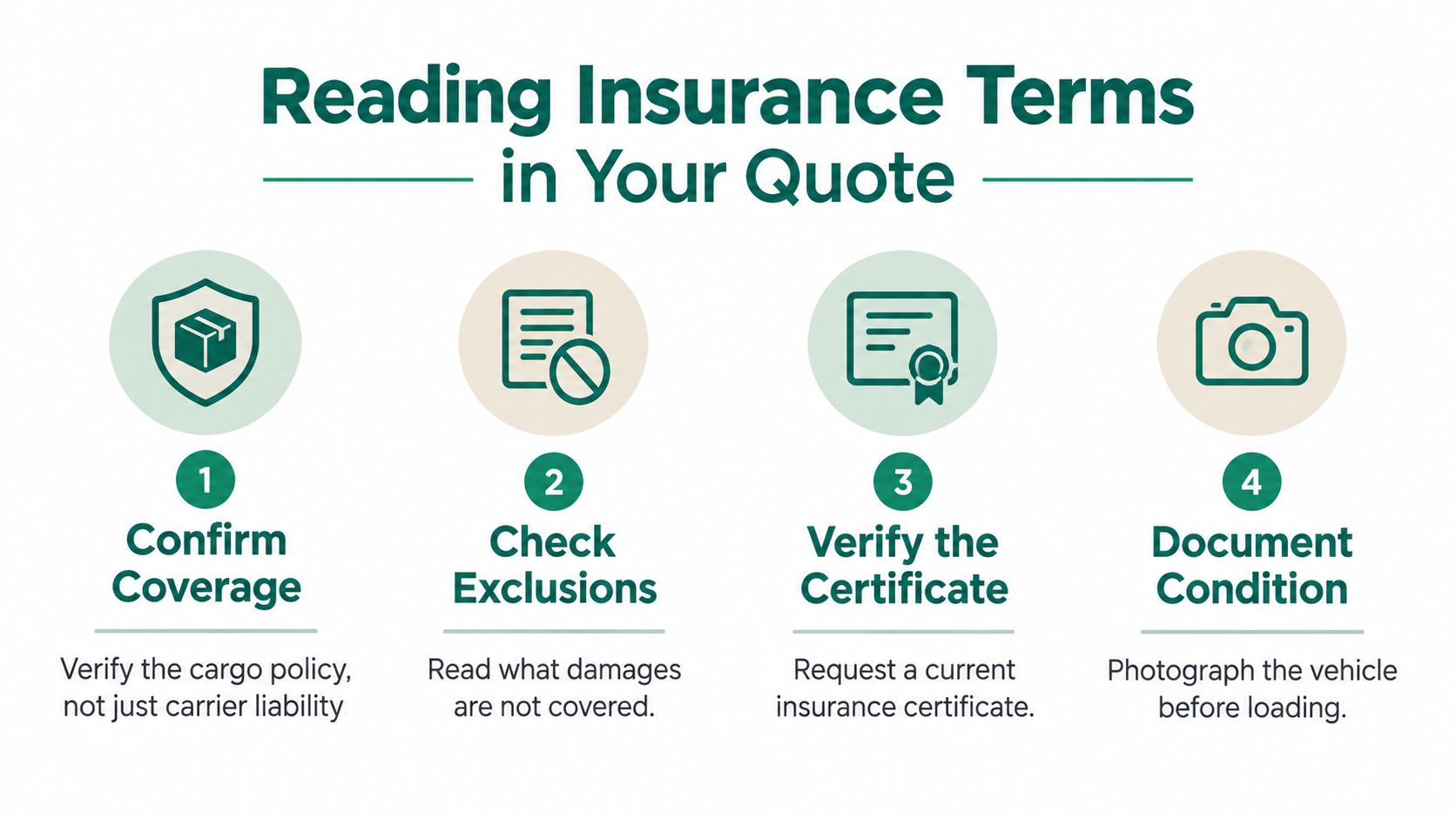
Ask for the terms behind the label
Request the carrier's current insurance certificate and check that it corresponds to the carrier handling your vehicle. FMCSA explains that insurance obligations vary according to the entity, operating authority, cargo, and vehicle type. Federal rules also eliminated prescribed cargo-insurance filing requirements for most non-household-goods for-hire carriers, so independent verification matters.
Read the policy or certificate information with these questions in front of you:
- What is covered: Confirm whether cargo coverage applies to your vehicle during loading, transport, unloading, and storage.
- What is excluded: Look for personal property, aftermarket parts, pre-existing damage, mechanical failure, flood damage, battery issues, and other exclusions.
- What is the deductible: Ask who pays it and whether it applies per incident or per vehicle.
- How value is calculated: Determine whether the carrier uses actual cash value, replacement value, declared value, agreed value, or another method.
- How claims work: Get the notification deadline, required photographs, inspection procedure, and documentation requirements in writing.
A high-value classic or EV deserves more scrutiny than a routine daily driver. If the vehicle's value exceeds the applicable cargo limit, the quote may need a separate protection discussion. Don't assume an enclosed trailer solves that gap.
Build the evidence before loading
The signed condition report should record existing scratches, dents, chips, wheel damage, and other visible conditions. Take timestamped photographs at pickup and delivery, including wide shots, close-ups, the odometer, and the vehicle identification information when practical.
A condition report is not routine paperwork. It is the link between the vehicle's documented condition and any later claim.
Have the driver and customer sign the report at both ends. Keep copies with the quote, insurance terms, photographs, and delivery paperwork. That record protects both parties and gives a claims reviewer something concrete to evaluate.
Enclosed Quotes for Puerto Rico Routes
A mainland shipment between Atlanta and Dallas is primarily a road-transport decision. A shipment between Chicago and San Juan combines mainland trucking, ocean transportation, port handling, inspection, and local release. The quote must show those stages separately.
Compare the line items, not just the total
Ask whether the quote separates mainland pickup, ocean or container service, port handling, inspection, storage, taxes, and government charges. A customer shipping one car to San Juan needs a different explanation from a dealership moving several vehicles or a military family transporting vehicles under official orders.
Fort Buchanan's Puerto Rico transportation guidance states that active-duty military personnel and civilian employees traveling under transportation orders may receive a tax exemption for one privately owned vehicle shipped to Puerto Rico. Additional vehicles can incur Puerto Rico government import taxes that must be paid before release. Confirm current requirements with the relevant transportation office or Puerto Rico authorities before booking.
The vehicle should also be clean of soil, plant material, and other potentially restricted matter. USDA APHIS guidance explains that vessels from Puerto Rico and the U.S. Virgin Islands must be boarded at the first port of arrival, illustrating why inspection procedures can affect ocean scheduling and release.
Port-route check: Ask who handles inspection preparation, storage, port charges, and any government fees before you accept the total.
A quote for Puerto Rico should identify the vehicle count, owner or employee status, destination arrangements, and responsibility for taxes or port charges. National Car Transport coordinates mainland pickup options with ocean or container routing, while bilingual English and Spanish agents can guide individuals, snowbirds, military households, dealerships, and businesses through the logistics.
This Puerto Rico car shipping service can help customers compare mainland transport with island-route options. Confirm the current rules before release, particularly when shipping multiple vehicles or a vehicle with unusual ownership or import circumstances.
The ocean leg deserves a separate conversation about documentation, timing, and condition controls. Watch the following overview for additional context before finalizing the route.
How to Evaluate and Book with Confidence
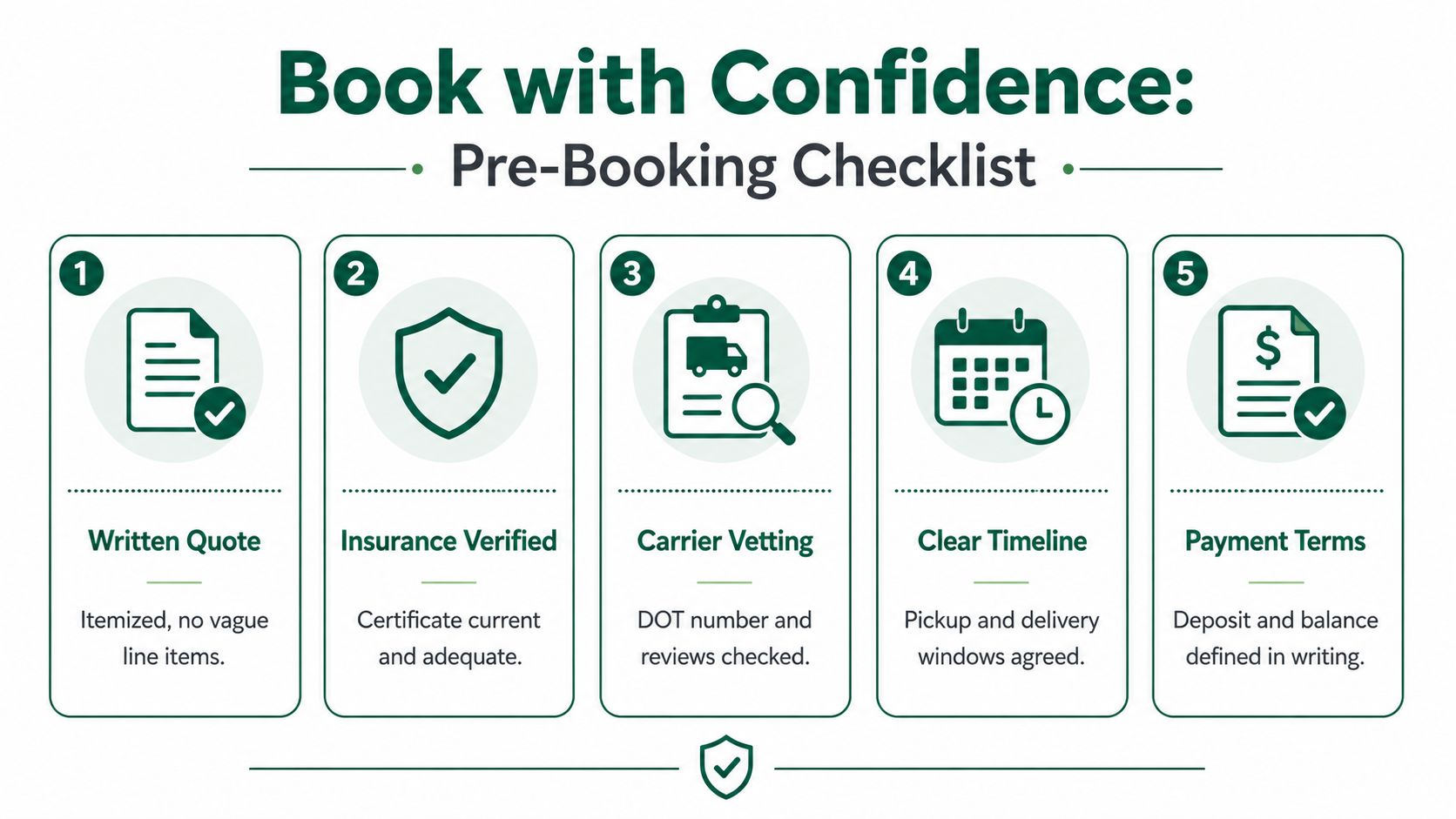
A reliable quote should survive close reading. It names the vehicle, route, equipment, price components, insurance terms, accessorial charges, timing assumptions, and cancellation conditions. If the provider can't explain a line item before booking, don't assume it will become clearer later.
Use a final decision screen
Look for these green flags:
- Written pricing: The base transportation charge and every known extra are separated.
- Current insurance evidence: The certificate is current and the coverage is appropriate for the vehicle.
- Carrier identification: The company explains which carrier will handle the shipment and how that carrier is vetted.
- Documented condition: Pickup and delivery inspections include signed reports and timestamped photographs.
- Clear communication: You have a named contact for schedule changes, questions, and claims.
Be cautious with a vague verbal quote, pressure to book immediately, unclear payment terms, or a large upfront payment before carrier matching. A low price that excludes the equipment your vehicle needs isn't a bargain. It's an incomplete quote.
National Car Transport uses dedicated advisors to coordinate scheduling, monitor shipments, and keep customers informed from pickup inspection through final delivery. Its U.S.-based bilingual agents simplify communication for English- and Spanish-speaking customers, and the service supports domestic routes across the 48 contiguous states, major cities throughout all states, and Puerto Rico, along with personal, military, dealership, fleet, and business shipments.
For a quote that accounts for vehicle condition, enclosed equipment, insurance terms, and Puerto Rico route requirements, contact National Car Transport with your exact pickup, delivery, vehicle, and timing details. Ask for an itemized rate and a clear explanation of coverage before booking, so your shipment starts with documented expectations rather than surprises.