
Enclosed car transport typically costs 30%–60% more than open shipping, with quotes commonly falling around $1.00–$2.50 per mile, depending on distance and the shipment details. The total can range from roughly $600–$1,200 for trips under 500 miles to $1,800–$3,500 or more for cross-country moves above 2,000 miles.
You may be comparing quotes from Miami to Scottsdale, moving a classic car to a second home, or arranging delivery for a dealership. The numbers can look inconsistent until you separate the actual pricing inputs. Enclosed car transport rates reflect trailer capacity, route demand, vehicle dimensions, protection requirements, and the overland or ocean logistics involved.
A low quote isn't automatically a bargain, and a high quote isn't automatically inflated. The reliable approach is to compare each bid against the same shipment profile, the same service level, and a defensible per-mile benchmark.
Table of Contents
- Why Two Enclosed Quotes Can Differ by Hundreds of Dollars
- The Core Pricing Factors Behind Enclosed Car Transport Rates
- How Distance Reshapes the Per-Mile Cost
- Enclosed Versus Open Transport and When the Premium Pays Off
- Comparing Quotes the Smart Way
- Puerto Rico Routes and How They Change the Math
- Putting It All Together Before You Book
Why Two Enclosed Quotes Can Differ by Hundreds of Dollars
A collector in Miami wants to move a 1969 Corvette to Scottsdale. Three brokers return quotes on the same day, and the numbers land far apart. One says $1,850, another says $2,100, and the third asks $2,400.
The first reaction is predictable. One quote must be wrong. In practice, the gap may come from different assumptions about pickup timing, trailer access, insurance, vehicle dimensions, carrier availability, or whether the price is truly door-to-door. A broker may also be quoting a shared enclosed trailer, while another is pricing a dedicated enclosed move.
The important point is that enclosed car transport rates aren't random. They're assembled from a small group of inputs that should appear in, or be explained alongside, the quote.
The same vehicle can produce different freight math
Distance creates the starting point, but it doesn't settle the final price. A wide Corvette with low clearance may need loading equipment that a standard coupe doesn't. A collector may also require soft straps, extra inspection, and a carrier whose insurance is appropriate for the vehicle's value.
Route balance matters too. A carrier already positioned for Arizona may price the move differently from one that must reposition equipment before pickup. Timing creates another difference. A flexible pickup window gives a broker more ways to match the vehicle with an available enclosed carrier.
Published industry pricing places enclosed service at a premium because enclosed trailers use specialized equipment and carry fewer vehicles. Typical rates are reported around $1.00–$2.50 per mile, while enclosed shipments commonly cost 30%–60% more than open transport on the same route, according to industry pricing guidance for enclosed auto transport.
Practical rule: Don't ask which quote is cheapest until you've confirmed that all three quotes describe the same service.
Your job isn't to find the lowest number in isolation. Your job is to identify the quote that clearly explains what you're buying, how the carrier will handle the vehicle, what insurance applies, and whether the total can change after booking.
The Core Pricing Factors Behind Enclosed Car Transport Rates
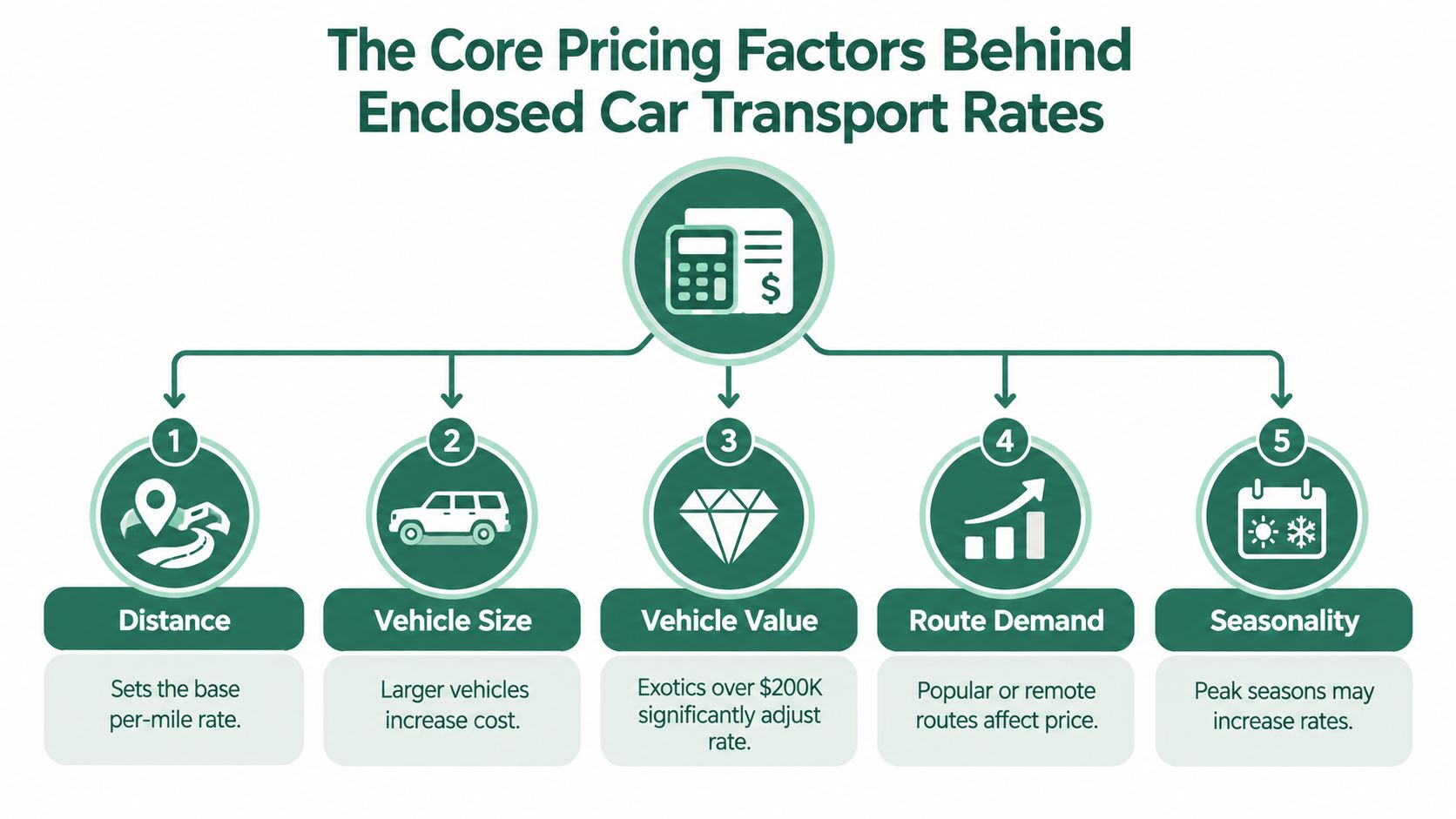
Every enclosed quote starts with the shipment profile. Give two brokers different details, and they may return two prices that look comparable but aren't.
Distance sets the baseline
Carriers spread dispatch, loading, positioning, and driving costs across the route. Short moves therefore carry a higher per-mile figure, while longer moves can achieve a lower per-mile rate even when the total invoice is larger. A quote should identify the pickup and delivery cities, not just the states.
Use the car shipping cost information from National Car Transport as a reference point for the questions your quote should answer, including route, service type, and vehicle details.
Size changes trailer utilization
A standard coupe takes less trailer space than a lifted truck, full-size SUV, or modified van. The quote should identify the exact year, make, model, and modifications. “SUV” isn't enough if the vehicle has oversized tires, a roof rack, altered suspension, or unusually low clearance.
Value affects handling and protection
Vehicle value doesn't add a generic surcharge. It can determine which carriers are appropriate, what cargo coverage is needed, and whether a single-car or specialized enclosed trailer makes sense. A rare restoration and a newer luxury sedan may occupy similar physical space but require different handling standards.
The plan notes sometimes used by shippers include exotics valued above $200,000 as a special pricing category. Treat that figure as a screening point, not an automatic universal surcharge. Ask the broker to explain the specific equipment and coverage adjustment.
Route demand changes the bid
A carrier serving a regular lane may offer a more competitive price than one making a special repositioning move. Major U.S. corridors, including routes connecting Miami, Atlanta, Dallas, Houston, Los Angeles, Phoenix, Chicago, New York, Boston, Denver, Seattle, and San Francisco, can price differently from remote pickups or deliveries.
Timing and carrier type complete the quote
Demand rises and falls with relocation schedules, snowbird traffic, collector events, and available equipment. The quote should show the earliest pickup date and the acceptable pickup window rather than hiding timing assumptions.
Carrier type matters just as much. A multi-car enclosed trailer usually shares costs across several vehicles. A dedicated single-car enclosed hauler costs more but may provide more controlled loading, padding, and liftgate capability. Confirm whether “enclosed” means a fully covered trailer, not an open carrier with a temporary tarp.
How Distance Reshapes the Per-Mile Cost
Distance changes enclosed pricing in two ways. It increases the total miles the carrier must cover, but it can reduce the cost assigned to each mile because fixed dispatch and loading costs are spread across a longer trip.
A 2025 enclosed transport benchmark places short routes of 1–500 miles at about $2.53 per mile, medium routes of 501–1,500 miles at about $1.25 per mile, and routes of 1,500 miles or more at about $0.84 per mile, as reported in Montway's enclosed auto transport rate benchmark.
| Distance Tier | Typical Per-Mile Rate | Example Lane | Sample Quote, Standard Coupe |
|---|---|---|---|
| Under 500 miles | About $1.75–$2.50 | Regional mainland route | About $600–$1,200 |
| 501–1,500 miles | About $1.10–$1.60 | Midwest to Southeast | About $1,200–$2,200 |
| Over 1,500 miles | About $0.90–$1.30 | Long-haul mainland route | Often $1,800–$3,500 or more |
The broader published rate bands show the same pattern. Enclosed shipments under 500 miles commonly run $600–$1,200, while trips of 1,000–1,500 miles often fall around $1,200–$2,200. Cross-country shipments above 2,000 miles frequently reach $1,800–$3,500 or more, depending on the vehicle and service level, according to enclosed auto transport rate examples.
A 2026 review found that the enclosed premium averaged 32.3% overall, but it varied from 21.3% on trips under 500 miles to 38.9% on shipments of 1,500–2,000 miles. The same review estimated one-mile costs declining from about $1.24 on short hauls to roughly $0.51 on 3,000–3,500-mile moves, a decrease of about 59% per mile, as explained in the 2026 auto transport pricing review.
Don't judge a long-distance quote by the total alone. Divide the freight portion by the route miles, then ask whether the equipment and service assumptions match.
Enclosed Versus Open Transport and When the Premium Pays Off
Open transport is the sensible choice for many operable daily drivers. Enclosed transport earns its premium when protection, loading control, privacy, or vehicle value matters more than the lowest available price.
A 2026 comparison places open transport around $1.00–$2.50 per mile and enclosed transport around $1.40–$3.75 per mile, with enclosed averaging about 32.3% higher overall, according to the 2026 enclosed-versus-open rate comparison.
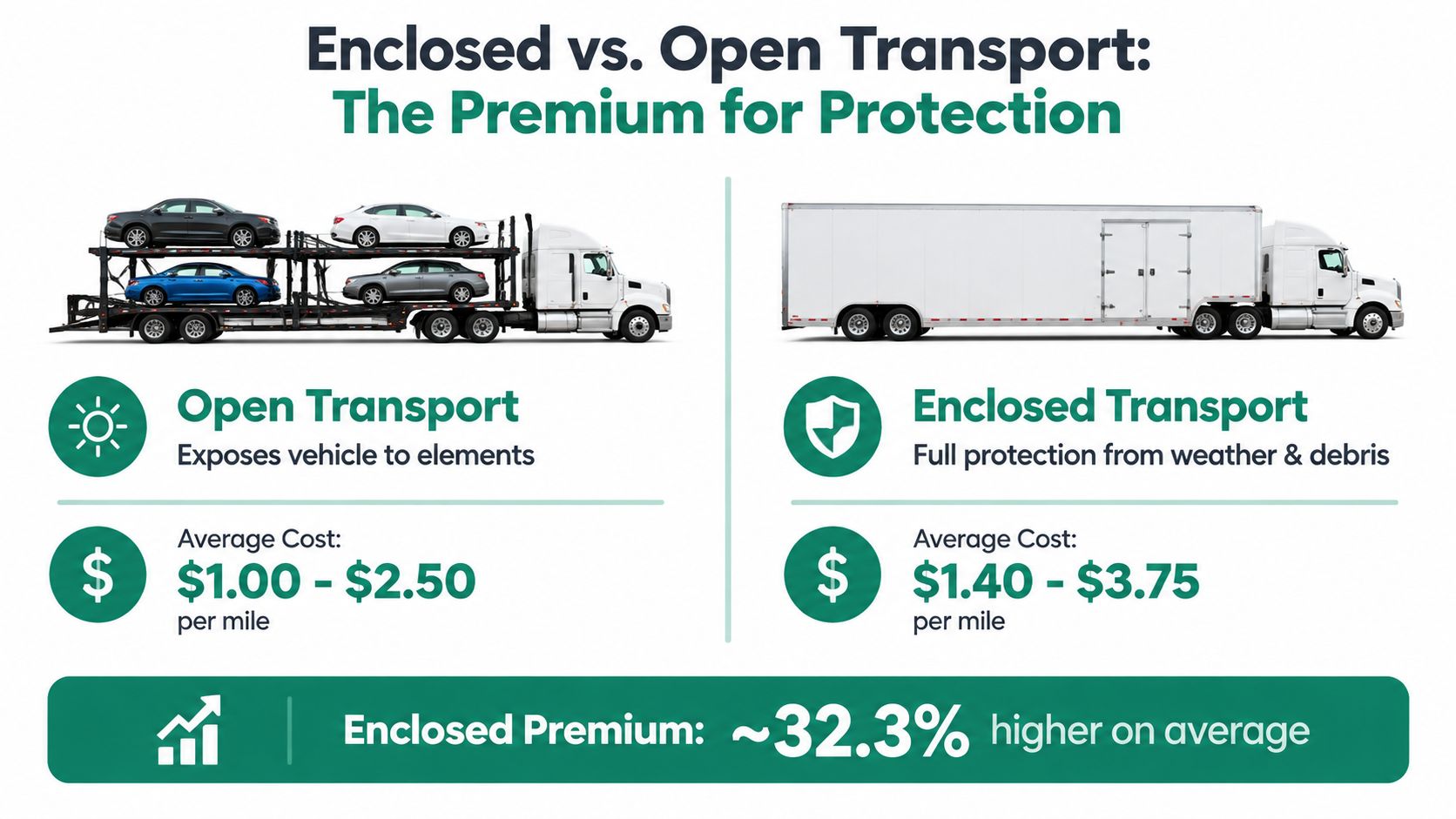
Enclosed trailers shield vehicles from weather and road debris. They can also support hydraulic or liftgate loading, which is valuable for low-clearance, inoperable, or heavily modified vehicles. The trailer design gives the carrier more control over tie-down points and reduces exposure during a long trip.
Where enclosed service makes sense
Choose enclosed transport for exotics, classics, one-off restorations, high-end EVs, and vehicles valued above $75,000 when exterior condition and replacement difficulty justify the added cost. An original paint finish, rare trim, or irreplaceable restoration work may be impossible to recreate after damage.
Open transport generally works for a stock-height sedan, ordinary SUV, or pickup that you drive regularly and can tolerate normal exposure. The lower price and broader carrier availability usually outweigh the protection benefit for that type of vehicle.
The decision should be financial, not emotional. If a stone-chip respray or paint correction would cost $1,500, and enclosed service costs $400 more, the premium is easy to defend. If the vehicle is a replaceable daily driver and the enclosed upgrade adds substantial cost without solving a real handling problem, open transport is the better buy.
Watch this overview before requesting quotes, then compare the service details rather than relying on the transport label alone.
For everyday vehicles, National Car Transport's open car transport information provides a useful comparison point when you're deciding whether full enclosure is necessary.
Comparing Quotes the Smart Way
Compare quotes only after you make the shipment details identical. A broker can't price the same job accurately if one request says “car from Florida to Arizona” and another identifies a non-running, lowered vehicle with a fixed pickup date.
Normalize the request first
Send every broker the same information:
- Vehicle profile: Provide the exact year, make, model, operability, dimensions, modifications, and declared value.
- Service level: State whether you need door-to-door delivery, terminal service, a shared enclosed trailer, or an exclusive single-car trailer.
- Timing: Give the earliest ship date and your acceptable pickup window.
- Locations: Use complete pickup and delivery addresses, especially when either address is outside a major metro area.
Then separate the payment structure. A quote with a deposit or broker fee can look lower than a quote showing the full freight amount. Subtract those charges before calculating the transportation rate, and ask whether the balance is due by a specific payment method at delivery.
Confirm that “enclosed” means enclosed
Ask for the carrier's equipment description. A fully covered trailer should protect the car from weather and road debris. A soft-sided enclosed trailer can be appropriate for many classics and luxury vehicles, while a hard-sided trailer may be preferable for especially sensitive or valuable cars. A tarp attached to an open trailer isn't an equivalent service.
Insurance deserves its own line. The plan notes for quote reviews use $250,000 in cargo coverage as an enclosed benchmark, but the right limit depends on your vehicle's value and the carrier's policy terms. Request the certificate, exclusions, deductible, and claims procedure in writing.
For business transactions, verify the broker and carrier before sending documents or money. These licensing and ownership verification tips can help you check whether the company you're dealing with has a legitimate operating identity.
Reject the quote that hides the risk
A bid priced more than 20% below the market median deserves an explanation, not an automatic booking. Other warning signs include cash-only demands, vague pickup windows longer than seven days, missing insurance details, an undefined cancellation policy, and a price that can change without a documented reason.
Rank each quote on a simple matrix:
| Check | Strong quote | Weak quote |
|---|---|---|
| Total price | Written and itemized | Verbal or incomplete |
| Equipment | Specific enclosed trailer type | “Covered” with no details |
| Insurance | Limits and exclusions supplied | Certificate unavailable |
| Timing | Clear pickup window | Open-ended schedule |
| Payment | Terms explained before booking | Cash pressure or surprise fees |
The winner is the quote that survives this inspection, not the one that flashes the smallest number.
Puerto Rico Routes and How They Change the Math
Puerto Rico shipping isn't a standard mainland mileage calculation. A vehicle moving between the mainland and San Juan may involve inland transport, ocean freight, port handling, customs processing, and delivery on the island. The quote needs to separate those components so you know what you're paying for.
Published regional examples place Florida to Puerto Rico around $845–$1,195, the Northeast around $1,095–$1,545, Texas and the Midwest around $1,195–$1,595, and the West Coast around $1,395–$1,795, according to Puerto Rico vehicle shipping rate examples. Those figures show why a customer in Miami shouldn't benchmark a Los Angeles or Chicago shipment against the Florida lane.
Read the quote as a logistics stack
Ask the provider to identify the mainland pickup charge, port or ocean segment, destination handling, customs-related requirements, and final delivery. Enclosed service may apply to the inland legs, while the overwater portion follows a separate shipping method and schedule.
Route examples also show distinct timing. Miami to Puerto Rico is published at about 9–11 days and $1,879–$2,179, New York to Puerto Rico at about 10–12 days and $2,309–$2,609, and Los Angeles to Puerto Rico at about 13–15 days and $2,609–$2,909, as shown in route-specific Puerto Rico shipping examples.
| Route | Vehicle | Enclosed Quote | Open Quote | Premium |
|---|---|---|---|---|
| Mainland regional origin to Puerto Rico | Varies | $845–$1,195 from Florida examples | Depends on service | Route-specific |
| Northeast origin to Puerto Rico | Varies | $1,095–$1,545 | Depends on service | Route-specific |
| Texas or Midwest origin to Puerto Rico | Varies | $1,195–$1,595 | Depends on service | Route-specific |
| West Coast origin to Puerto Rico | Varies | $1,395–$1,795 | Depends on service | Route-specific |
Paperwork can delay release if you overlook it. Puerto Rico shipments may require customs inspection, payment of duties and taxes before port release, the original title, registration, a driver's license copy, proof of a Puerto Rico address, and, in some cases, a notarized lien-holder letter, according to Puerto Rico customs and documentation guidance.
Customers shipping to or from San Juan, Ponce, or another Puerto Rico location should request a written breakdown before booking. The same applies to snowbirds, military families, students, dealerships, and businesses moving multiple vehicles. National Car Transport's Puerto Rico vehicle shipping service is one option to include when comparing ocean, container, and enclosed logistics.
Putting It All Together Before You Book
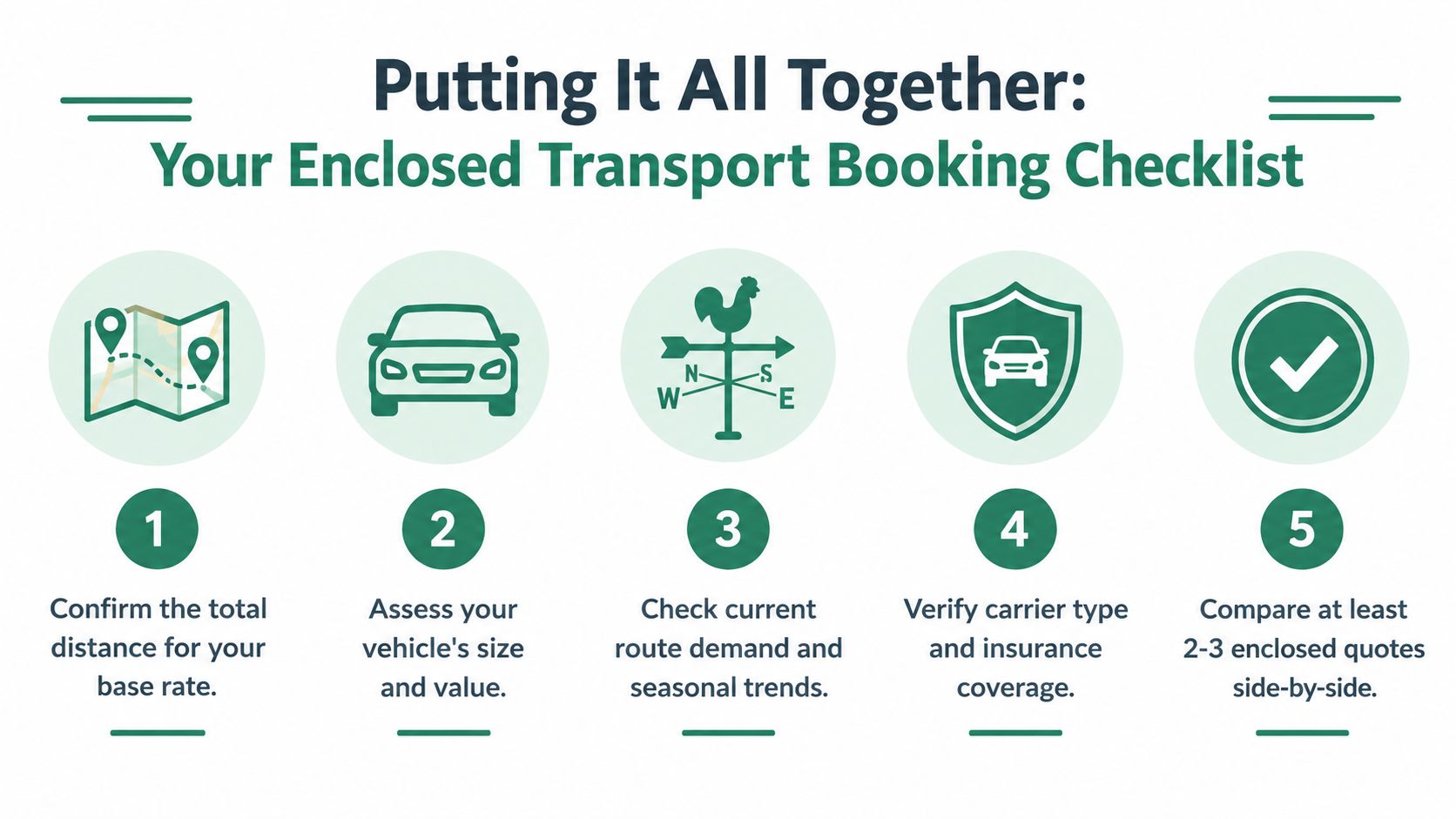
A defensible enclosed quote answers five questions. How far is the vehicle traveling? What space and handling does the vehicle require? How much route and seasonal demand affects the move? What trailer will carry it? Does the insurance match the vehicle's real value?
Use one final booking test
Before you authorize the shipment, check the following:
- Confirm total distance: Verify the actual pickup and delivery locations, then compare the freight portion with the appropriate distance band.
- Assess size and value: Make sure the quote reflects the exact vehicle, including lift, lowered suspension, oversized dimensions, or inoperable status.
- Check demand and timing: Ask whether the price reflects a fixed date, a flexible window, a seasonal lane, or a remote location.
- Verify equipment and insurance: Confirm the carrier's enclosed trailer type, loading method, cargo limit, exclusions, and claims process.
- Compare at least two or three bids: Give each provider the same details and rank the written offers side by side.
The usual recommendation is straightforward. Book enclosed service for a classic, exotic, rare restoration, low-clearance car, inoperable vehicle, or high-value model where weather, debris, loading, or replacement risk matters. Choose open transport for a standard operable daily driver when the protection premium doesn't solve a meaningful problem.
Push back when a quote doesn't identify the equipment, insurance, timing, or total charges. Use the published 30%–60% enclosed premium as a starting benchmark, but remember that Puerto Rico ocean logistics, vehicle size, route demand, and carrier availability can move the final number well outside a simple mainland comparison.
National Car Transport provides door-to-door open and enclosed vehicle shipping across the mainland United States and Puerto Rico, with transparent flat-rate pricing, 25+ years of experience, an A+ BBB rating, and a network of 25,000+ vetted carriers. Visit National Car Transport to request a route-specific quote, and speak with a U.S.-based bilingual English/Spanish agent with more than 20 years of auto transport logistics experience who can match the service to your vehicle and simplify the booking process.