

You're probably looking this up because the car in your driveway isn't just transportation. It might be a classic you finally bought, a luxury SUV you don't want sitting exposed on a cross-country trailer, or a family vehicle you need moved to a new duty station in Puerto Rico without adding miles, wear, and risk. That's exactly when people start searching for enclosed car transport near me.
The search makes sense. Enclosed shipping is the option people choose when the vehicle's condition matters as much as the delivery itself. It's common for collectors, snowbirds, military families, students heading to or from the mainland, dealerships moving premium inventory, and businesses handling specialized fleet moves. It also matters more on complicated routes, especially when you're shipping to or from San Juan, Puerto Rico, and need both land transport and port coordination handled correctly.
Table of Contents
- Protecting Your Investment During a Move
- What Is Enclosed Transport and When Is It Essential
- Enclosed vs Open Transport A Detailed Comparison
- How to Find Reliable Enclosed Transport Near You
- Understanding Costs and Scheduling Timelines
- Your Pre-Shipment Checklist for Enclosed Transport
- Why a Trusted Partner Matters for Complex Shipments
Protecting Your Investment During a Move
A customer buys a restored muscle car in Arizona and needs it delivered to New Jersey. Another is relocating from Orlando to San Juan and wants their luxury sedan protected through both inland transport and ocean shipping. A military family gets orders and needs one vehicle handled fast, but the collector car stays the priority. Different situations, same concern. They don't want the vehicle arriving with avoidable exposure, stress, or handling damage.
That's why enclosed transport exists. It's a premium service, but the premium usually makes sense when the vehicle is rare, expensive, sentimental, or difficult to repair correctly if something goes wrong. If repainting one panel would bother you for years, enclosed shipping belongs on your shortlist.
Demand for that protection isn't niche anymore. The global enclosed car transportation service market reached USD 724.2 million in 2023 and is projected to grow at a 7% CAGR from 2024 through 2032, driven by increasing luxury and classic car ownership, according to GM Insights on the enclosed car transportation service market.
People usually regret skipping enclosed transport only after they imagine their car spending days exposed to weather, debris, and heavy interstate traffic.
For customers moving high-value vehicles, I also tell them to think beyond the trailer itself. Coverage matters. If the vehicle is part of a business, dealership operation, or commercial fleet, this Miami business auto insurance guide helps clarify how commercial auto coverage and shipping risk fit together.
When the car is replaceable, open shipping is often fine. When it isn't, the conversation changes quickly.
What Is Enclosed Transport and When Is It Essential
Enclosed transport isn't just a truck with walls. Good enclosed service is built around how the vehicle is loaded, secured, and protected for the entire trip.
What enclosed transport actually includes
The feature that matters most for fragile or low-clearance vehicles is the loading system. The technical specification that defines enclosed transport's superior protection is the use of hydraulic lift gates and soft tie-down systems, which eliminate the risk of undercarriage scraping or body contact damage often associated with traditional methods, as described by Passport Transport's explanation of enclosed vs. open auto transport.
That matters in practical terms because many expensive vehicles don't load well on steep ramps. Front splitters scrape. Side skirts catch. Low exhaust components sit too close to the angle. A lift gate solves that problem in a way a standard loading approach often doesn't.
Soft tie-downs matter too. They secure the vehicle without the rough contact methods that can leave marks, strain components, or create body contact concerns. If you're shipping a collector car, this is one reason many owners specifically look for classic car shipping options instead of booking the first carrier with an available trailer.
When enclosed shipping stops being optional
Some vehicles can go either way. Others really shouldn't.
Use enclosed transport when you're shipping:
- Classic or antique vehicles that are hard to replace and often harder to repair correctly
- Luxury and exotic cars where cosmetic condition directly affects value
- Race cars with low ground clearance and specialized bodywork
- Cars with custom paint or wrap work that you don't want exposed for a long haul
- Modified vehicles with lowered suspensions, aero kits, or delicate trim
- High-end daily drivers being moved for corporate relocation or seasonal living
- Vehicles headed to or from Puerto Rico when added handling and route complexity make extra protection worthwhile
Practical rule: If you wouldn't park the vehicle outside during a week of bad weather and highway grime, don't ship it exposed on an open trailer unless you've consciously accepted that trade-off.
Snowbirds often use enclosed transport for premium sedans and SUVs when moving between northern states and Florida. Dealerships use it for inventory that needs to arrive presentation-ready. Families use it when one vehicle is ordinary and the second is the one they baby. That's where enclosed transport earns its keep.
Enclosed vs Open Transport A Detailed Comparison
Most customers don't need a sales pitch. They need a clean comparison and an honest answer about whether enclosed is worth paying for.
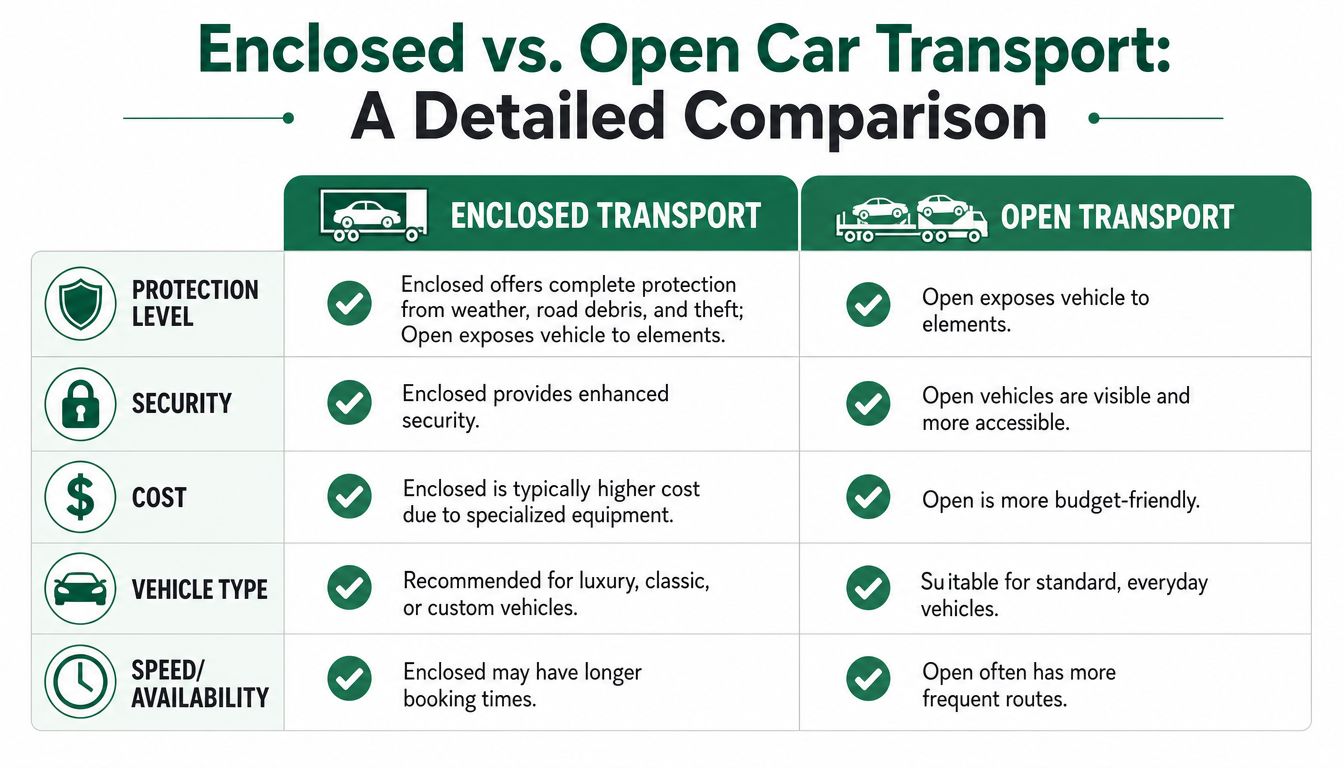
One useful benchmark comes from Sherpa's Mansfield route page: sources confirm enclosed transport costs 40 to 60 percent more than open, while open carriers handle about 90 percent of all shipments safely, and for cars under $50,000 the extra enclosed cost may be wasted money in some cases, as noted in Sherpa Auto Transport's discussion of open versus enclosed trade-offs.
That doesn't mean enclosed is overpriced. It means vehicle type should drive the decision.
Open vs. Enclosed Transport At a Glance
| Feature | Open Transport | Enclosed Transport |
|---|---|---|
| Protection | Exposed to weather, road grime, and normal highway debris | Shielded from outside exposure during transit |
| Security | Vehicle remains visible on trailer | Vehicle is concealed and less accessible |
| Typical use | Standard cars, trucks, SUVs, commuter vehicles | Classic, luxury, exotic, custom, and collector vehicles |
| Cost position | More budget-friendly | Higher cost because of specialized equipment and limited capacity |
| Availability | Easier to schedule on many domestic routes, including major cities | Fewer carriers, tighter scheduling, especially outside major hubs |
| Best fit | Everyday vehicles where value and condition tolerance are straightforward | High-value vehicles where condition protection is the priority |
For many customers, open transport is a sensible choice. If you're shipping a regular sedan from Dallas to Atlanta or a family SUV from Chicago to Phoenix, an open car transport option is usually the practical answer.
How to decide without overpaying
Ask yourself four direct questions.
First, would minor cosmetic exposure bother you? Not expected damage. Just the reality of road travel. Dust, grime, rain, and highway debris are part of open shipping.
Second, how hard is the vehicle to replace? A late-model commuter vehicle and a numbers-matching classic don't belong in the same risk discussion.
Third, what's the destination? A simple route between large mainland metros is one thing. A move involving port processing in Florida and delivery to San Juan is another.
Fourth, how do you value peace of mind? Some owners sleep fine knowing open shipping is standard and widely used. Others know they'll worry the entire time unless the vehicle is enclosed. Both reactions are reasonable.
Open shipping is the default because it works. Enclosed shipping is the upgrade because certain vehicles deserve a different standard.
The mistake isn't choosing open. The mistake is choosing open for a vehicle you already know you're overly protective of.
How to Find Reliable Enclosed Transport Near You
Those looking for enclosed car transport near me usually picture a local truck parked a few miles away, ready for pickup tomorrow. Sometimes that happens. Most of the time, it doesn't.
What near me really means in auto shipping
In this business, “near me” usually means a company can arrange pickup from your address, your dealership, your storage facility, your auction lot, or a nearby safe meeting point. It doesn't always mean the enclosed carrier is based in your town.
That distinction matters because enclosed availability is thinner than many local landing pages suggest. In one Ohio market, 55 enclosed shipments were recorded versus 845 open shipments, and 70 percent of enclosed requests faced waits of 7 to 14 days because of limited carrier supply, according to Sherpa Auto Transport's Centerville availability discussion.
So if you live near Los Angeles, Miami, Houston, Atlanta, New York, Chicago, Phoenix, Charlotte, Orlando, Seattle, Denver, Boston, San Diego, San Antonio, or San Juan, scheduling is usually more flexible. If you're in a smaller town, the carrier may still pick up close to home, but you should expect less immediate availability.
A good transport coordinator doesn't pretend enclosed capacity is endless. They explain the lane, the timing, and the actual pickup window.
How to vet a company before you book
Use a short screening process. It works.
- Verify authority: Ask for DOT and MC numbers and confirm the company operates legally.
- Check insurance: Don't stop at “yes, we're insured.” Ask what coverage applies while the vehicle is in transit.
- Read recent reviews: Look for comments about communication, pickup accuracy, and delivery handling, not just star counts.
- Ask how they source carriers: A national network can be an advantage if it's vetted carefully.
- Get the process in writing: Quote, cancellation terms, pickup expectations, and required documents should all be clear.
If you work in logistics or if you want a broader view of how transport networks are managed, this guide to UK transport management firms offers a useful operational perspective on routing, coordination, and carrier oversight. Different market, same lesson. Good transport management is mostly about disciplined execution.
A broker model can be very effective for enclosed shipping because it gives access to more route coverage than a single local fleet. What matters is whether the company vets carriers and communicates like a coordinator, not just a lead generator.
Understanding Costs and Scheduling Timelines
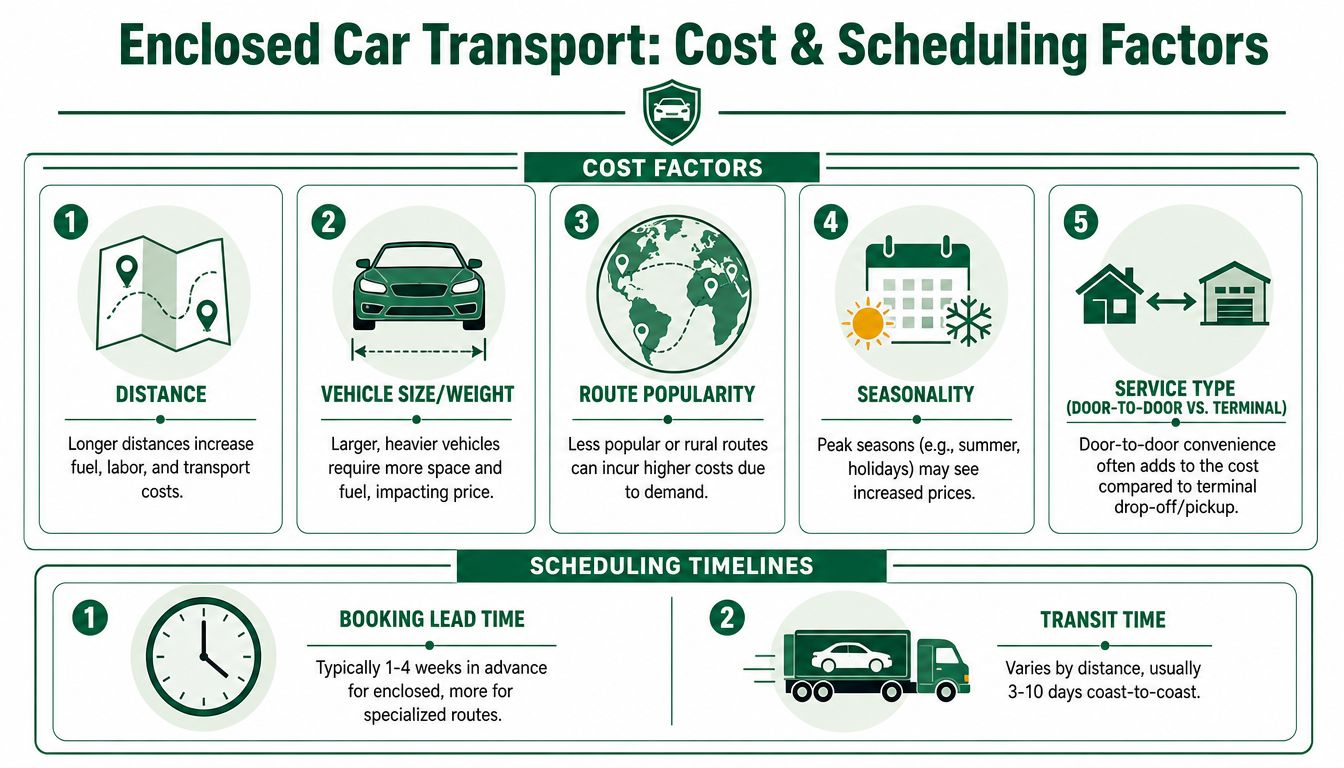
Price surprises usually happen when customers don't know what they're paying for. Enclosed shipping costs more for structural reasons, not because someone decided to label it “premium.”
Why enclosed pricing is higher
The economics are straightforward. Enclosed carriers typically transport only 1 to 6 vehicles per trailer, which raises the per-vehicle cost and produces average enclosed rates of $1.00 to $2.50 per mile, with short hauls under 500 miles often costing $600 to $1,200, according to A1 Auto Transport's enclosed auto transport statistics.
That smaller load count changes everything. Fuel, driver time, insurance, equipment cost, and route planning are spread across fewer vehicles.
The quote itself usually moves based on a handful of practical factors:
- Distance: Cross-country shipping costs more than a regional move.
- Vehicle size: Large SUVs and trucks take more room than compact cars.
- Route density: Major city lanes are easier than remote pickups.
- Seasonality: Some routes tighten up at certain times of year.
- Service format: Door-to-door convenience can affect the final number.
If you're comparing quotes, watch for whether the price is usable. A clear quote should explain what's included, what kind of trailer is expected, and whether the route involves any handoff or terminal step. Customers who want a pricing baseline can review a car shipping cost guide and then compare it to the details on their intended route.
What realistic scheduling looks like
Long-haul trucking doesn't work like package delivery. You usually won't get a precise appointment a week in advance and then watch the truck stop on your street at 2:17 p.m.
What you get is a pickup window and a delivery range shaped by route flow, traffic, weather, legal driving limits, and the order in which vehicles are loaded and unloaded. That's normal.
The most reliable customers are the ones who leave some room in their schedule and communicate early about hard deadlines, gated access, and port paperwork.
For Puerto Rico routes, scheduling gets another layer. A mainland pickup may be simple, but port cutoffs, vessel timing, paperwork, and destination release can all affect the handoff. The more valuable the vehicle, the more important it is to build extra breathing room into the timeline instead of chasing the cheapest fast quote.
Your Pre-Shipment Checklist for Enclosed Transport
Preparation makes pickup smoother and protects you if any condition question comes up later. A clean handoff saves time for everyone.
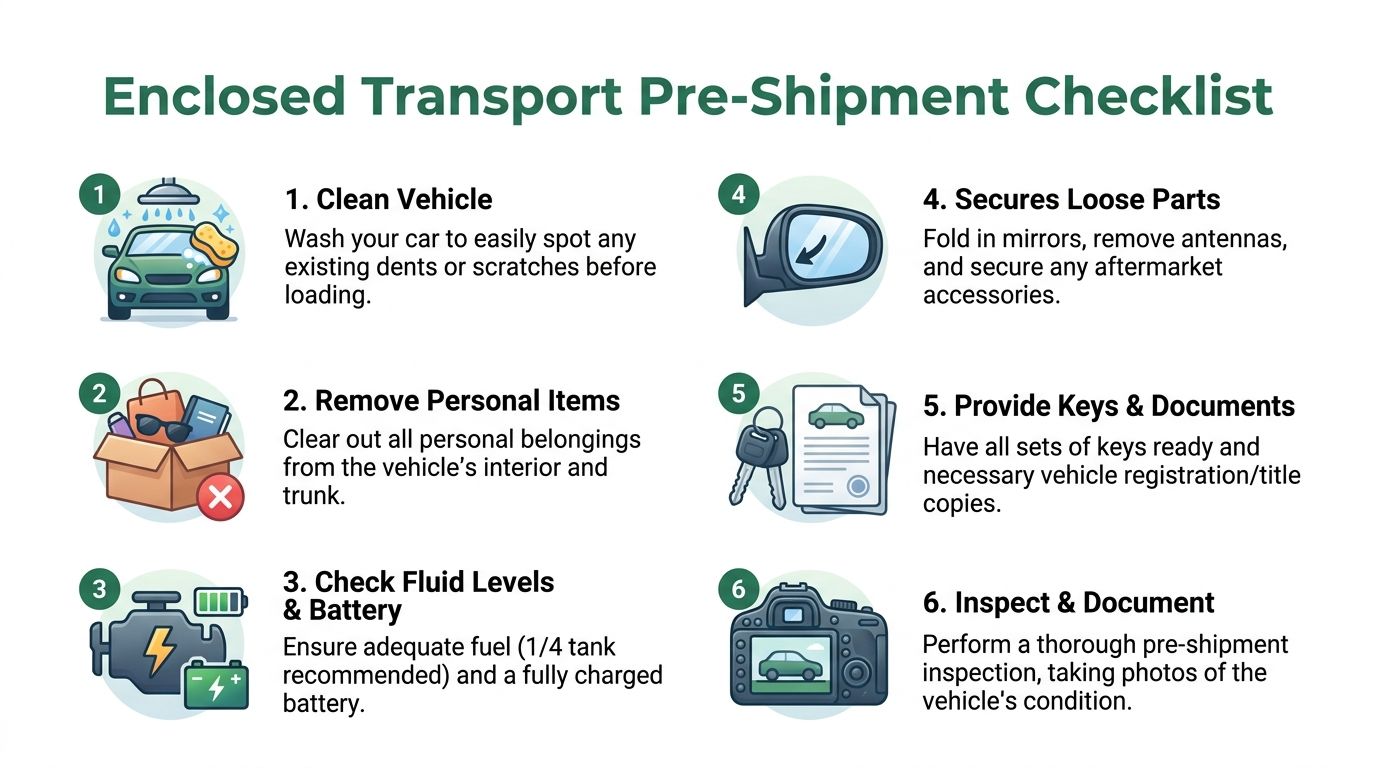
Start with this checklist.
What to do before pickup day
- Wash the vehicle: Dirt hides scratches, chips, and small dents. A clean exterior makes the inspection accurate.
- Remove personal items: Carriers generally don't insure your belongings inside the vehicle.
- Check battery and fluids: The car should be able to load and unload without drama.
- Leave about a quarter tank: Enough fuel for movement, not so much that you add unnecessary weight.
- Secure loose accessories: Fold mirrors if appropriate, remove toll tags if needed, and secure anything aftermarket that could shift.
After you've done that, document the condition yourself.
What to have ready when the driver arrives
Take fresh photos from multiple angles in good lighting. Include close-ups of any existing blemishes. Then review the inspection report carefully before signing.
Have these ready:
- Keys: At least one full working set
- Registration or ownership paperwork if needed: Especially useful on port or special-route moves
- Contact numbers: Yours and the receiver's
- Special instructions: Alarm, kill switch, battery disconnect, low-clearance notes, or non-operational details
Don't rush the bill of lading inspection. A careful five minutes at pickup can prevent a long argument at delivery.
For Puerto Rico moves, confirm document requirements early. Mainland carriers, port staff, and ocean transport operators all need the paperwork chain to line up cleanly.
Why a Trusted Partner Matters for Complex Shipments
A simple mainland move can be straightforward. A premium vehicle, a tight timeline, a rural pickup, or a Puerto Rico route changes the equation fast. That's where experience matters most.
Puerto Rico is the clearest example. The total cost to ship a car to Puerto Rico from the U.S. mainland typically ranges from $1,200 to $3,300 in 2026, depending on shipping method, distance from origin, and vehicle size, according to AmeriFreight's Puerto Rico car shipping guide. That range reflects real complexity. You may be dealing with mainland pickup in cities like Miami, Jacksonville, Orlando, Tampa, Atlanta, Charlotte, Dallas, Houston, Los Angeles, San Diego, Phoenix, Denver, Chicago, New York, Philadelphia, Boston, or Washington, then moving through port logistics before final delivery in San Juan.
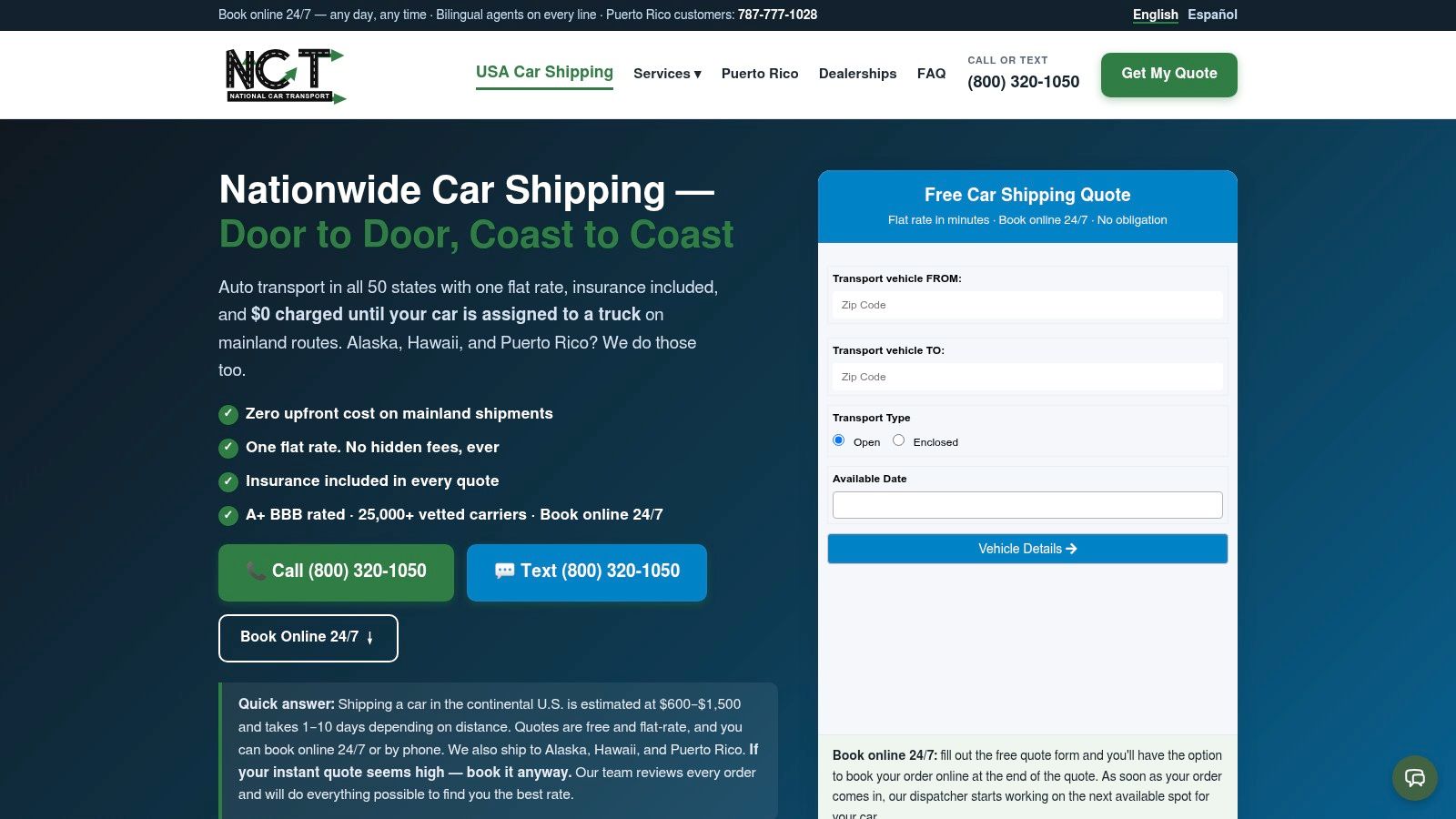
A capable coordinator keeps that chain from breaking. One example is National Car Transport, which operates across the United States, Puerto Rico, Alaska, and Hawaii with 25+ years of experience, an A+ BBB rating, transparent flat-rate pricing, and a network of 25,000+ vetted carriers. For customers who need help in English or Spanish, having U.S.-based bilingual agents with deep auto transport experience makes a real difference. Not one shipment is exactly alike, and the value is usually in having one person guide the process from quote to delivery instead of leaving you to connect the dots yourself.
That matters for individuals, snowbirds, military families, students, dealerships, and businesses alike. The truck is only part of the job. Coordination is the other half.
If you need enclosed shipping anywhere in the U.S. mainland or a vehicle moved to or from Puerto Rico, National Car Transport can help you review the route, explain the trade-offs, and match your shipment with the right carrier option. Their bilingual U.S.-based agents handle both standard domestic routes and more involved island moves, with practical guidance that keeps the process simple and clear.