
Enclosed car transport in California should start with verifying the carrier's permit and actual cargo policy, not choosing a trailer, and California's regulated vehicles must be inspected at least every 90 days. Pickup and delivery may require a wider commercial meeting point rather than your driveway, so get the access plan and complete price in writing before booking.
You've bought a restored car, accepted a relocation offer, or decided your exotic shouldn't make the interstate trip under its own power. Now you're comparing quotes that sound suspiciously similar: enclosed service, insured transport, convenient delivery. The differences that matter are less glamorous, loading clearance, policy exclusions, a documented handoff, and a driver who can safely reach the agreed location.
Buy a documented transport plan, not a reassuring sales pitch. That applies whether your car is crossing California, traveling across the mainland, or beginning a shipment to San Juan, Puerto Rico.
Table of Contents
- What Enclosed Car Transport in California Actually Involves
- Open vs Enclosed Transport in California
- Verifying a California Carrier Before You Book
- What Enclosed Shipping Costs in California
- Pickup and Delivery Logistics Across California
- Inspections, Paperwork, and Insurance at Handoff
- Scheduling Tips and a Pre-Booking Checklist
What Enclosed Car Transport in California Actually Involves
You have three decisions to make: trailer type, carrier legitimacy, and pickup location. Make them in this order: establish who can legally and safely haul your vehicle, confirm the equipment fits, then settle the handoff address. Starting with the cheapest enclosed quote gets that sequence backward.
Enclosed transport moves your vehicle inside a covered carrier rather than exposing it to ordinary road debris and weather. It's relevant for classic-car owners, exotic and luxury buyers, dealerships moving special inventory, online auction purchasers, and snowbirds relocating a prized vehicle. Individuals, students, military families, and businesses should choose it because their vehicle needs the protection, not because enclosed sounds automatically superior.
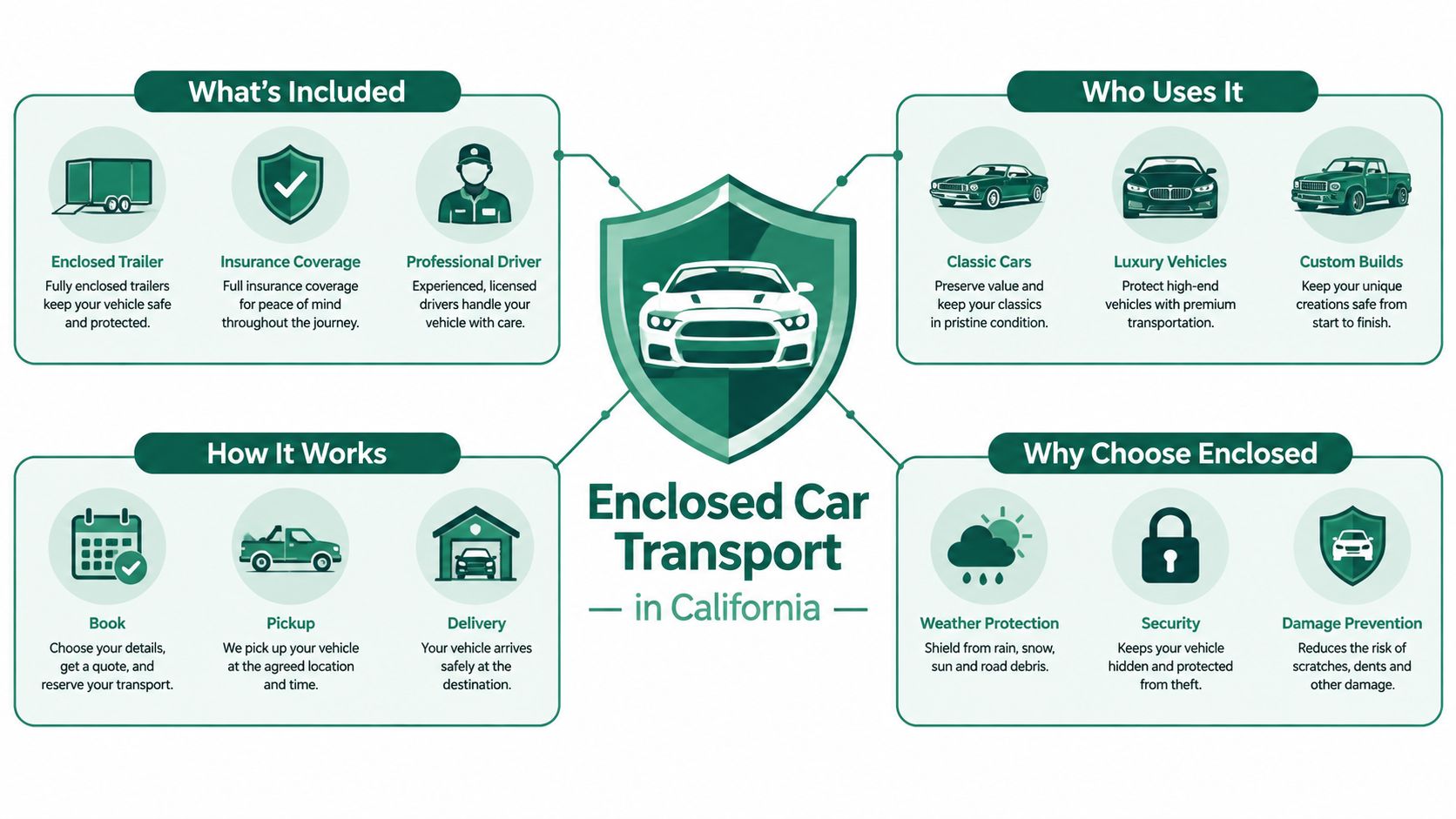
The service involves more than putting a car behind trailer walls.
Match the service to the vehicle
- Equipment fit: Supply the car's dimensions, weight, ground clearance, and modifications before dispatch. A lowered suspension or wide body changes the loading conversation.
- Handling requirements: Disclose whether the car starts, rolls, steers, and brakes. Specify winch needs and approved tie-down contact points.
- Shipment coordination: Establish a pickup window, authorized contacts, progress-update method, and delivery inspection arrangements.
- Financial protection: Treat insurance verification as a separate purchase decision. A covered trailer doesn't establish what a policy will pay.
This overview illustrates the service components and common customer needs.
California isn't a single shipping market
The California DMV's vehicle-registration report recorded 35,983,261 registered vehicles in 2024, including 25,782,147 automobiles and 6,461,647 trucks, with 7,776,731 vehicles in Los Angeles County alone. That scale makes California a substantial origin, destination, and internal market for vehicle movement.
Don't treat a Los Angeles pickup and a remote Northern California pickup as interchangeable. Ask the dispatcher to evaluate the actual address, not just the state or nearest recognizable city.
Same-day pickup may be available, but don't build a flight, closing appointment, or dealership release around it until a carrier is assigned and the window is confirmed. A quote isn't a dispatch commitment.
Open vs Enclosed Transport in California
For an ordinary daily-driver sedan, I'd start with open transport. For a restored muscle car, low-clearance exotic, custom build, or valuable auction purchase, I'd start with enclosed and verify the loading equipment before discussing extras.
The useful distinction is exposure versus handling, not cheap versus safe. Enclosed service reduces exposure to road debris and weather, but it doesn't eliminate clearance mistakes or poor securement. Open transport may be appropriate when the vehicle doesn't require that additional environmental protection.
Compare the trip your car will actually make
A coastal relocation raises different questions than a mountain-pass shipment or a classic-car show transfer. Ask how the carrier will address the route and vehicle together, rather than accepting a generic assurance that every enclosed trailer offers the same service.
Open vs Enclosed Transport in California
| Factor | Open Transport | Enclosed Transport |
|---|---|---|
| Road and weather exposure | Vehicle travels on an uncovered carrier | Covered carrier reduces ordinary debris and weather exposure |
| Coastal road-grime concerns | Exterior remains exposed during transport | Covered space provides an additional barrier |
| Mountain-route planning | Route and weather still require coordination | Route and weather still require coordination |
| Restored or custom finishes | Consider whether exposure is acceptable | Stronger choice when finish preservation matters |
| Low-clearance vehicles | Confirm suitable loading equipment | Confirm suitable loading equipment, don't assume it |
| Typical daily-driver decision | Sensible starting point | Choose when specific vehicle needs justify it |
| Insurance verification | Still necessary | Still necessary |
For a conventional vehicle, compare the available open car transport option before committing to enclosed service. Dont buy additional protection because youre nervous about shipping for the first time.
When I recommend paying for enclosed
Choose enclosed when replacement difficulty, modifications, paint condition, or emotional significance make additional protection worth the expense. A collector car with hard-to-replace trim deserves a different decision than a commuter you routinely park outdoors.
For a lowered exotic, insist on a loading plan that accounts for approach angles and ground clearance. For a restored vehicle, tell the carrier which contact points and surfaces must be avoided.
Practical rule: Pay for protection your car actually needs. Don't pay for a trailer label that leaves the loading method unspecified.
A show deadline can justify tighter scheduling, but it doesn't justify skipping verification. The right choice combines appropriate equipment with a carrier willing to document how the vehicle will be handled.
Verifying a California Carrier Before You Book
Ask for the actual hauling carrier's legal name, not just the company taking your reservation. If a broker arranges the shipment, establish who will operate the truck and which company's insurance applies.
California's Motor Carrier Permit program generally applies to compensated property transport, subject to exemptions. The DMV checks insurance and related compliance, while the California Highway Patrol oversees safety through terminal inspections and roadside enforcement; carriers generally obtain a California Carrier Identification Number from CHP before applying for the permit.
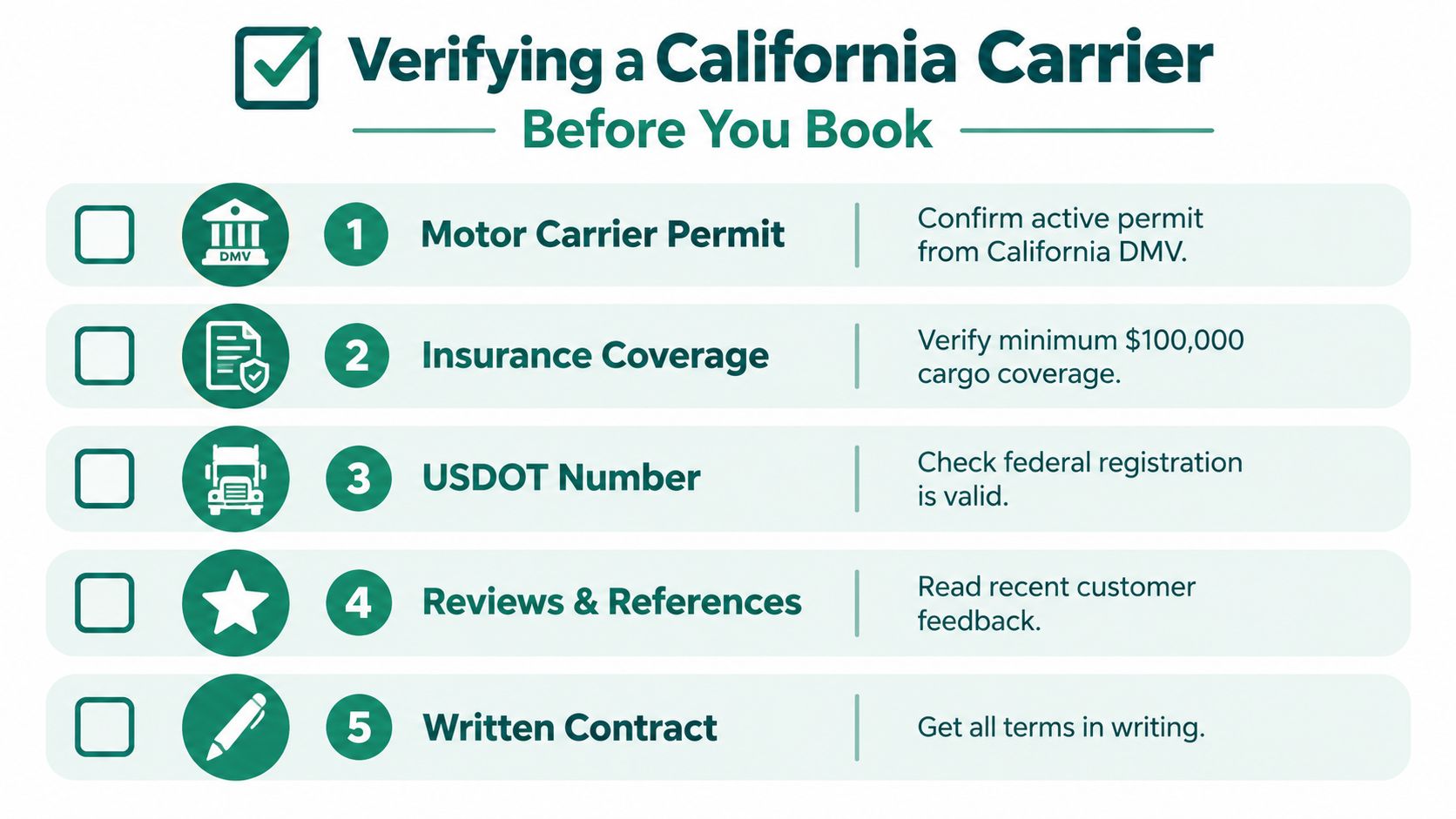
Use this visual as an organizational checklist, then verify the coverage details against the actual policy.
Verify authority before accepting insurance assurances
- Identify the operator: Obtain the legal name, USDOT number, California carrier number, and applicable permit information.
- Check the movement: Confirm active California operating authority where required, particularly for intrastate service. Ask which authorizations cover an interstate shipment.
- Check safety documentation: Request confirmation of applicable vehicle inspections and terminal inspection records.
- Match the paperwork: Make sure the operator named in the transport agreement matches the carrier and insurance documents.
California also defines a licensed vehicle transporter separately from ordinary towing. Its vehicle-transporter guidance requires a valid DMV license or temporary permit for businesses operating within that category. Ask which requirements apply to the company's actual operation.
Read cargo protection separately from public liability
California identifies $300,000 to $5 million in combined single-limit liability requirements, depending on classifications, and requires regulated vehicle inspections at least every 90 days, according to its Motor Carrier Permit handbook guidance. Those liability figures are not a promise of cargo reimbursement for your car.
Request current insurance evidence and the relevant cargo-policy terms: limits, deductible, exclusions, covered handling stages, and claims procedure. Ask specifically about modifications, accessories, personal belongings, and how the policy addresses your vehicle's value.
A generic coverage amount in a checklist isn't enough. The insurer's actual terms must fit the vehicle you're shipping.
Use the following video alongside your document review, not instead of it.
End the verification call with a concrete request: send the carrier identity, authority details, relevant insurance terms, and written shipment agreement. If the answer remains limited to public liability or vague assurances, don't tender a high-value vehicle.
What Enclosed Shipping Costs in California
There isn't a responsible universal price for enclosed car transport in California. A useful quote needs the actual route, vehicle specifications, operating condition, pickup access, and scheduling requirements.
Don't budget around an unsupported fixed percentage above open transport. Compare written open and enclosed quotes for the same vehicle, addresses, dates, and terms. Otherwise, you're comparing different services and calling the difference a trailer premium.
The contract should make the price structure visible before you authorize dispatch.
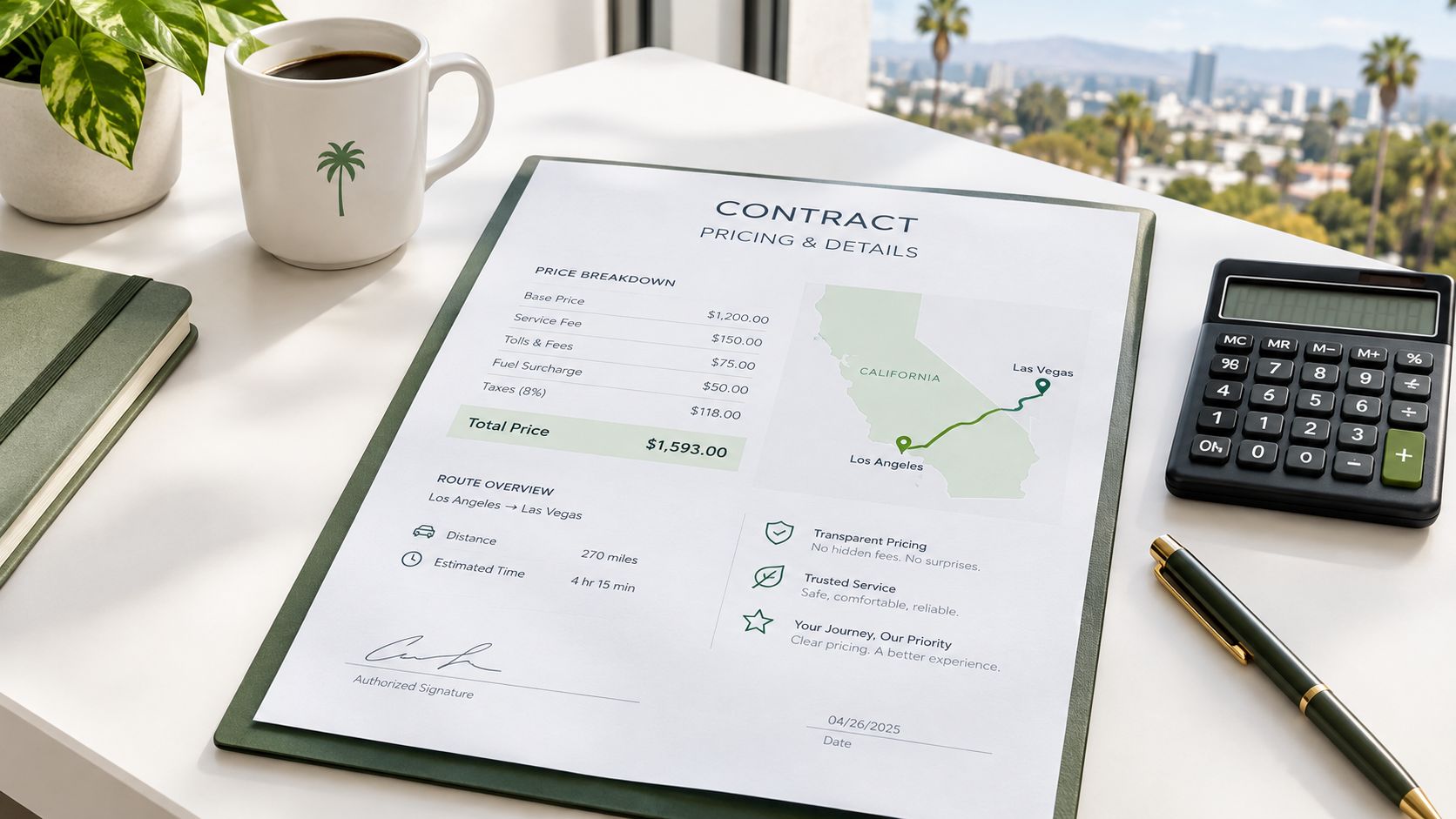
Separate route costs from optional services
Ask whether an accessible meeting point would change a rural Northern California quote. For Los Angeles to Las Vegas or Arizona, request pricing for your actual lane rather than assuming a recognizable route must be inexpensive. Carrier availability needs to be confirmed for your shipment.
Vehicle dimensions and loading requirements belong in the original quote. If you disclose a non-running condition or suspension modification only after assignment, you haven't given the dispatcher enough information to price the correct equipment.
| Quote item | What to ask before paying |
|---|---|
| Enclosed service | What equipment and loading method are included? |
| Expedited dispatch | Is this a dispatch effort or a committed pickup window? |
| Door-to-door surcharge | What happens if the address is inaccessible? |
| Requested trailer position | Is the position confirmed, and what benefit does it provide? |
| Non-running handling | Does the assigned carrier have the required equipment? |
| Storage or rerouting | Which events trigger charges, and who authorizes them? |
Buy commitments, not vague upgrades
A guaranteed pickup window can matter when a seller has a release deadline. An expedited label with no defined obligation is much less useful. Require the agreement to explain what happens if the promised service can't be delivered.
Don't assume a particular season will automatically produce a bargain. Ask for alternate-date quotes and let confirmed availability guide the decision.
Use a car-shipping cost breakdown to organize your comparison, then request a total that identifies exclusions and conditions. For Puerto Rico shipments, require separate clarity on mainland trucking, ocean or container service, destination handling, and any charges outside the transport contract.
A flat rate is useful only when you know what's included and which changes can reopen the price.
Pickup and Delivery Logistics Across California
The safest handoff address isn't always your home. In a narrow Los Angeles neighborhood, gated San Diego community, steep San Francisco street, or remote Sierra location, ask the driver to assess access before arrival.
Sacramento suburban addresses, Fresno pickup sites, and rural Mendocino properties also need an address-specific review. Supply gate instructions, parking restrictions, turning-space concerns, and any known limits on commercial vehicle access.
This process works best when scheduling and access are settled together.
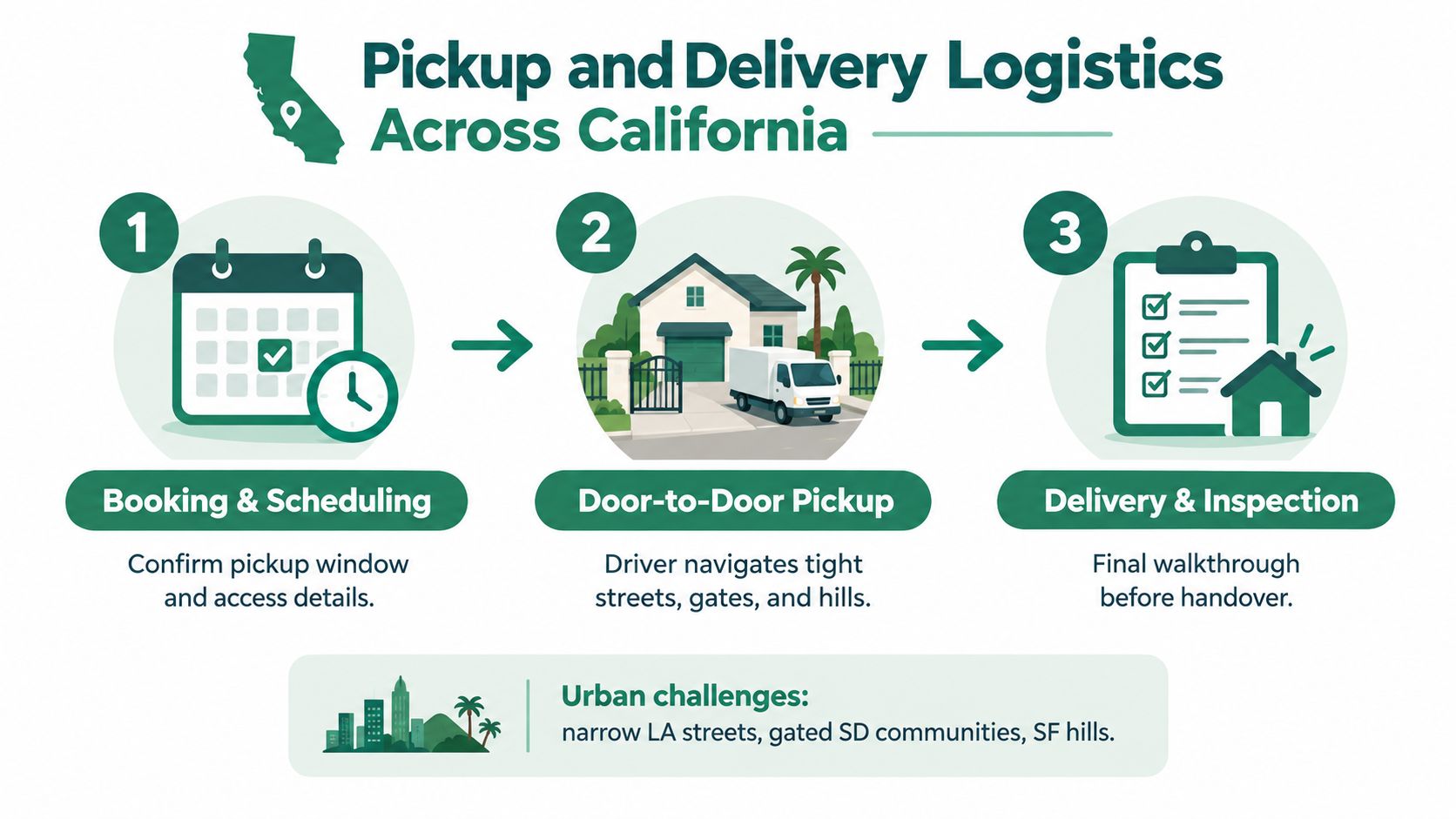
Agree on the primary and alternate location
Treat door-to-door auto transport as an access-dependent service, not a promise that a large carrier can reach every driveway.
- Primary address: Ask the carrier to confirm that the approach, stopping area, and loading space are suitable.
- Alternate meeting point: Choose a permitted commercial lot, industrial location, or wide street that the driver approves.
- Authorized recipient: Provide a secondary contact who can inspect the vehicle and sign the delivery documents.
- Written agreement: Record both locations and clarify whether a change affects charges or timing.
Don't select a shopping-center lot without checking permission. Convenient space isn't necessarily authorized space, and you don't want to relocate the handoff again while the truck waits.
Plan for disruptions without dramatizing the risk
California recorded 133,372 vehicle thefts in 2025, with estimated losses of $1.2 billion; only 55.2% of recovered vehicles were intact and drivable, according to the CHP vehicle-theft fact sheet. These figures don't measure professional transport safety, but they support choosing a monitored handoff location instead of leaving a valuable vehicle unattended.
For wildfire warnings, evacuations, road closures, or extreme heat, establish who contacts whom and who can approve a revised location. Never assume a driver can enter an active evacuation or fire-control zone.
Ask who pays if a disruption requires storage, rerouting, or another delivery attempt. For Puerto Rico-bound shipments, also ask how a delayed mainland pickup affects the confirmed port handoff.
The goal isn't to predict every emergency. It's to avoid making insurance, storage, and access decisions under pressure while your vehicle is already in transit.
Inspections, Paperwork, and Insurance at Handoff
Your handoff paperwork needs to describe the vehicle that entered the trailer. A rushed walkaround followed by a clean-looking signature leaves too much unresolved if you later discover damage.
California's safety framework requires inspection documentation to be retained for at least two years, while a complete customer condition record should cover the VIN, odometer, fuel level, exterior panels, roof, wheels, glass, interior, and visible underbody areas; use the CHP inspection framework alongside that customer checklist. Don't confuse regulated equipment-inspection records with your vehicle's pickup condition report.
Build a usable condition record
- Vehicle identity: Record the VIN, odometer, fuel level, warning lights, and operating condition.
- Photographic evidence: Take timestamped photographs of every panel, roof, wheels, glass, interior, and safely visible underbody areas.
- Existing damage: Identify scratches, chips, dents, wheel marks, and loose accessories precisely.
- Signed acknowledgment: Have the customer and driver sign the pickup condition report and retain a readable copy.
The bill of lading and accompanying records should identify the parties, vehicle, pickup and delivery details, condition exceptions, and signatures. For classic, luxury, exotic, and modified vehicles, keep the approved loading requirements and insurance declarations in the shipment file.
Handle stored vehicles and delivery exceptions correctly
California's REG 172 Vehicle Moving Permit authorizes certain qualifying movements for one day, is issued without a fee, must be obtained before movement, and requires the selected date to fall within 60 days of issuance, according to the DMV's moving-permit guidance. It isn't a universal shipping document or a substitute for ordinary registration.
Confirm whether it applies if a stored or planned-nonoperation vehicle must be operated to reach loading, repair, or inspection. Separately ask your insurer which coverage remains active during transport, especially for a newly purchased or unregistered car.
At delivery, compare condition before unloading where practical, then complete the final inspection safely. Document discrepancies before signing acceptance, retain photographs and paperwork, and follow the insurer's stated reporting procedure.
At delivery: Don't sign a report stating there's no damage if you haven't inspected the car or if it omits a discrepancy you've found.
Scheduling Tips and a Pre-Booking Checklist
Request scheduling early enough to resolve equipment and paperwork issues before your seller, flight, or move-out deadline. Give the dispatcher a workable window, but distinguish your preferred dates from a carrier-confirmed commitment.
For domestic service across the 48 contiguous states, discuss the actual city pair rather than a generic nationwide promise. Major markets to include in your route planning are:
- West: California, Los Angeles and San Diego; Arizona, Phoenix; Nevada, Las Vegas; Oregon, Portland; Washington, Seattle; Idaho, Boise; Utah, Salt Lake City; Montana, Billings; Wyoming, Cheyenne; Colorado, Denver; New Mexico, Albuquerque.
- Midwest and Plains: North Dakota, Fargo; South Dakota, Sioux Falls; Nebraska, Omaha; Kansas, Wichita; Oklahoma, Oklahoma City; Minnesota, Minneapolis; Iowa, Des Moines; Missouri, Kansas City; Wisconsin, Milwaukee; Illinois, Chicago; Indiana, Indianapolis; Michigan, Detroit; Ohio, Columbus.
- South: Texas, Houston; Arkansas, Little Rock; Louisiana, New Orleans; Mississippi, Jackson; Alabama, Birmingham; Tennessee, Nashville; Kentucky, Louisville; Georgia, Atlanta; Florida, Miami; South Carolina, Charleston; North Carolina, Charlotte; Virginia, Richmond; West Virginia, Charleston.
- Northeast: Maryland, Baltimore; Delaware, Wilmington; Pennsylvania, Philadelphia; New Jersey, Newark; New York, New York City; Connecticut, Hartford; Rhode Island, Providence; Massachusetts, Boston; Vermont, Burlington; New Hampshire, Manchester; Maine, Portland.
Treat San Juan as a coordinated island shipment
Shipping to or from San Juan, Puerto Rico, from anywhere on the mainland requires an agreed inland route and ocean handoff. Don't assume a California origin means the vehicle sails from California, or that enclosed trucking specifies how it travels at sea.
Military families should obtain Puerto Rico export instructions through their transportation office and processing appointments through the designated Vehicle Processing Center system. Fort Buchanan's vehicle guidance identifies mandatory ACAA injury-liability payment documentation before collection, qualifying military registration provisions, and civilian registration within the third month after port entry, along with applicable import-excise documentation.
Keep this checklist with your reservation
- Authority verified: Actual carrier identified and applicable permits checked.
- Policy reviewed: Cargo terms, exclusions, deductible, and reporting procedure understood.
- Access approved: Primary address and alternate meeting point recorded.
- Equipment confirmed: Dimensions, clearance, and operating condition disclosed.
- Handoff prepared: Photos, condition report, and authorized contacts arranged.
- Exceptions resolved: Moving permits, emergency charges, and island documentation addressed where applicable.
For California enclosed shipping and mainland-to-Puerto Rico coordination, National Car Transport offers 25+ years of experience, an A+ BBB rating, transparent flat-rate pricing, and a network of 25,000+ vetted carriers. Its U.S.-based bilingual English/Spanish agents have over 20 years of auto-transport logistics experience and can guide the equipment, paperwork, and handoff decisions that differ with every vehicle. Visit with your pickup and delivery ZIP codes, vehicle specifications, and preferred dates to request a clear shipping plan and quote.