
A lot of people land on this question at the same moment. They've bought a car online from another state, they're moving across the country, they're sending a motorcycle to a seasonal home, or they're trying to get a vehicle to San Juan without making an expensive mistake. The stress usually starts with one thought: what's the safest way to move something you care about when you won't be the one driving it?
That concern gets sharper when the vehicle isn't ordinary to you. It might be a restored Mustang, a low-slung Tesla, a custom bike, or a family vehicle headed to Puerto Rico for a military move, college term, or long-term relocation. Open transport works well for many standard shipments, but enclosed service exists for the situations where exposure, handling, and route conditions matter more than lowest price.
After coordinating auto transport for more than two decades, I can say the biggest mistakes usually happen before loading. People choose based only on vehicle value, not on the actual risk profile. They also assume motorcycles can be handled like compact cars, which is where avoidable damage starts. Before shipping, it also helps to review a car's paperwork and condition records. If you're buying remotely, understanding vehicle history reports can help you verify what you're about to ship before the carrier ever arrives.
For customers moving vehicles across the mainland, to Alaska or Hawaii, or to and from Puerto Rico, the right setup is less about jargon and more about protection, timing, and clean coordination. That's where experienced planning matters.
Table of Contents
- Introduction Protecting Your Investment on the Road
- What Is Enclosed Transport and Who Needs It
- The Critical Differences for Enclosed Motorcycle Shipping
- Cost Timing and Insurance Factors Explained
- Shipping to Puerto Rico Alaska and Hawaii
- How to Prepare Your Vehicle for Transport
- FAQs for Enclosed Auto and Motorcycle Shipping
- Can you ship an inoperable classic car
- What works for military PCS moves
- How far ahead should you book
- Can you ship a motorcycle with household goods
- Is enclosed shipping only for luxury vehicles
- What should you ask before booking a motorcycle shipment
- What makes agent support matter
- What kinds of customers use these services most often
- What's a practical option if you want one point of contact
Introduction Protecting Your Investment on the Road
A Phoenix customer called about a clean classic coupe headed to the East Coast. His first question was not transit time. He wanted to know what could happen to the paint, trim, and underbody after days on the highway behind other traffic. That is the right place to start.
Enclosed car transport and motorcycle shipping are protection decisions first. Cost still matters, but the calculation is exposure versus consequence. Road grit, weather, leaking fluids from vehicles ahead, and harsh loading angles do not affect every shipment the same way.
Vehicle value is only part of the decision. Geometry matters just as much. I have seen affordable low-clearance sedans, long-front sports cars, and modified vehicles require enclosed service because the bigger risk was undercarriage contact during loading, not theft or weather. A car does not need to be exotic to be vulnerable.
The same principle applies to motorcycles, but with a stricter standard. Bikes need a hard-sided enclosed carrier if the goal is to reduce movement-related damage during transit. Soft protection is not the same as rigid protection, especially for fairings, bars, mirrors, and painted surfaces that can suffer from sway or contact inside a trailer.
Practical rule: Choose enclosed service when repair cost, finish sensitivity, low ground clearance, or bike stability concerns would outweigh the price difference.
Island moves raise the stakes further. Puerto Rico shipments add port handling, ocean transit, release procedures, and local pickup or delivery. Good planning and accurate paperwork prevent more problems than rushed booking ever will. Customers also benefit from understanding vehicle history reports before shipment, especially when documenting condition for resale, insurance, or delivery inspection.
For shipments moving from major mainland markets to long-distance or port destinations, the core question stays the same. Are you buying the lowest transport rate, or are you reducing the specific risks your vehicle is most likely to face?
What Is Enclosed Transport and Who Needs It
Enclosed transport means your vehicle rides inside a covered trailer instead of on an open multi-car carrier. The main benefit is straightforward. It reduces exposure to weather and road debris, and enclosed carriers typically carry only 1 to 6 vehicles per trailer versus 7 to 10 for open carriers, which contributes to higher cost and more specialized handling, according to A1 Auto Transport's enclosed auto transport statistics.
That smaller load count matters in practice. Fewer vehicles usually means more deliberate loading, more room for securement, and better compatibility with tools like hydraulic lift gates and soft-strap tie-downs for low-clearance or delicate vehicles.
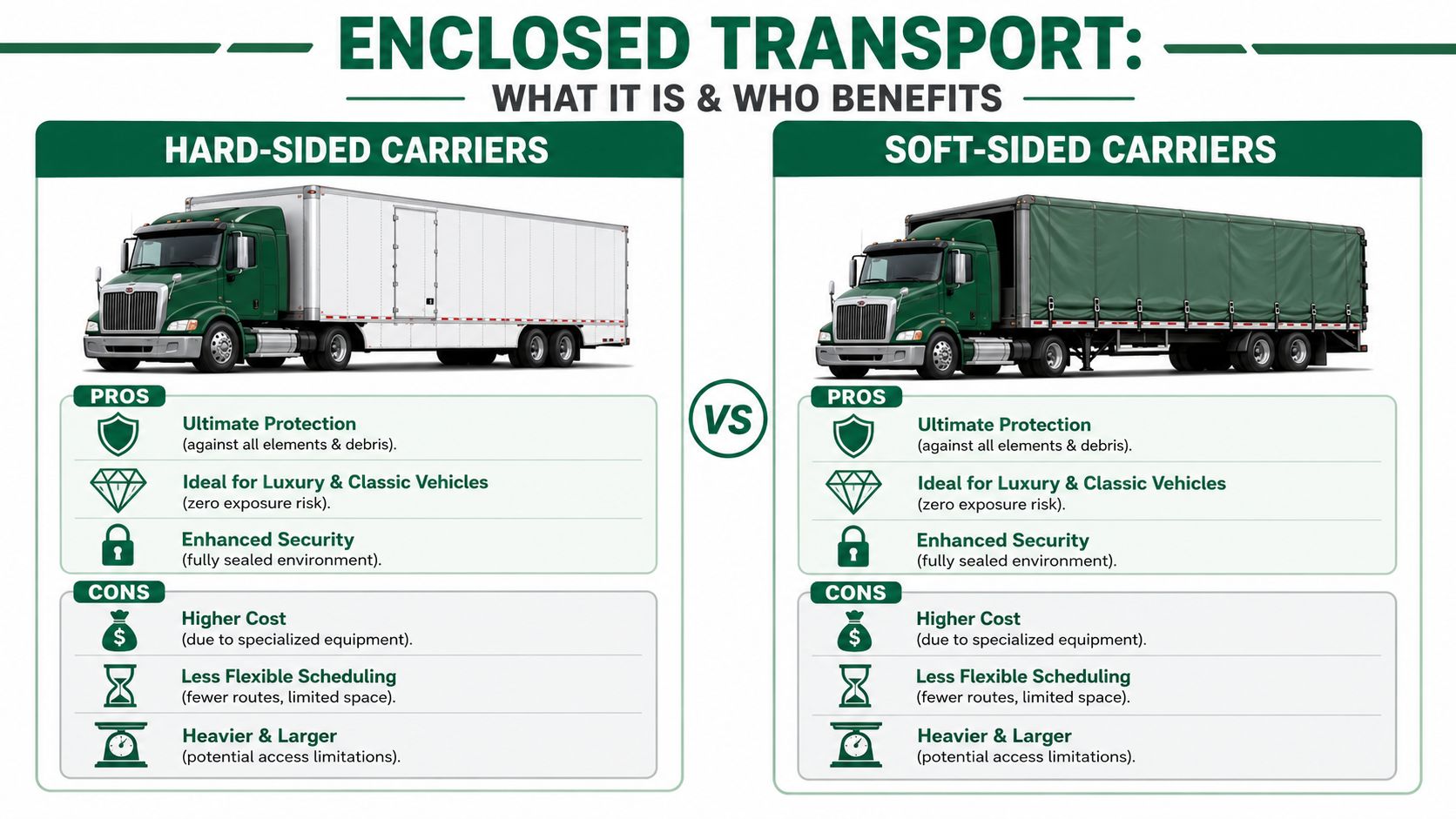
Hard sided and soft sided are not the same
Customers often hear “enclosed” and assume all enclosed trailers provide the same level of protection. They don't.
| Carrier type | What it does well | Where to be cautious |
|---|---|---|
| Hard-sided enclosed | Full physical barrier from debris and weather, stronger security, best for show cars and sensitive finishes | Usually costs more and can be harder to schedule |
| Soft-sided enclosed | Better protection than open transport, can suit some standard enclosed moves | Still not the same structural barrier as hard-sided equipment |
If I'm moving a high-end classic, an exotic, or a vehicle with fragile paint correction or detailing work, hard-sided equipment is the cleaner choice. For some customers, soft-sided enclosed can still be a reasonable middle ground. The key is not to treat those two options as interchangeable.
Who should seriously consider enclosed service
The obvious candidates are still valid:
- Classic and collector cars that need protection from dirt, moisture, and incidental debris
- Luxury and exotic vehicles where finish condition and loading angle matter
- Restored cars with fresh paint, trim, chrome, or parts that are difficult to replace
- High-value online purchases where the buyer wants the vehicle to arrive in the same condition shown in listing photos
But there's a less obvious group that gets overlooked. Low-clearance modern vehicles.
Many owners assume enclosed transport is only for luxury or classic cars, but vehicles with ground clearance under 4 inches face distinct risks on open carriers. Move.org's open vs enclosed car shipping analysis notes that enclosed transport costs about 40% more than open ($1,500 vs. $1,080), yet the bigger issue is often geometry, not prestige. A modern sedan or EV with a low front fascia and limited clearance can be just as vulnerable to underbody contact, road debris, and loading-angle issues as a collector car.
Vehicle value tells you what the car is worth. Ride height tells you how easily it can get damaged.
That's why I tell customers to stop asking only, “Is my car expensive enough for enclosed?” and start asking, “Is my car low, delicate, freshly finished, or difficult to replace parts for?” A low-slung Tesla, Audi, sports coupe, or modified sedan may not be rare, but it can still be a poor candidate for open transport.
The Critical Differences for Enclosed Motorcycle Shipping
Motorcycle shipping fails for a different reason than car shipping. With cars, the common risks are exposure, loading angle, and clearance. With motorcycles, the main risk is movement inside the trailer.
A bike has a narrow footprint and a high center of gravity. If the carrier uses the wrong rack, the wrong tie-down points, or a generic enclosed space without real side-to-side control, the motorcycle can shift under repeated road vibration. The damage is often subtle at first. Scuffed fairings, stressed fork seals, bar-end contact, strap rub, and pressure at frame points are the problems I watch for when I review a bike move.
That is why the right question is not whether the shipment is enclosed. The right question is what kind of enclosed equipment the carrier is using.
Why bikes need a different standard
Motorcycles do best in hard-sided enclosed trailers with bike-specific rack systems, wheel chocks, non-slip flooring, and soft-strap securement at proper anchor points. A soft-sided setup may block some weather, but it does less to limit lateral movement if securement is not dialed in. For motorcycles, structural containment matters as much as weather protection.
This distinction gets missed in broad vehicle shipping guides that treat bikes like small cars. They are not. A car can tolerate minor movement far better because it sits on four contact points with a wide track. A motorcycle depends on the carrier to create that stability artificially through equipment and technique.
Reddit's 2025 motorcycle transport guide points to a recurring problem in bike transport. Damage often traces back to poor strapping and equipment mismatch, not just road exposure. That matches what experienced coordinators see in real shipments. The enclosed trailer itself is only part of the answer.
What works and what does not
For long-distance motorcycle shipping, the better setups usually include:
- Hard-sided enclosed equipment with full interior containment
- Compartmentalized rack systems that keep each bike separated
- Soft-strap securement at proper motorcycle tie-down points
- Drivers who ship motorcycles regularly, not carriers improvising with mixed freight space
The setups that cause problems usually look like this:
- Generic enclosed trailers without bike-specific wheel chocks or rack systems
- Incorrect strap angles that put unnecessary load on bars, forks, or bodywork
- Partial enclosure that reduces weather exposure but does not control sway well
- Brokered moves without equipment verification, where the trailer type changes after booking
At National Car Transport, this is one of the clearest judgment calls we make for customers shipping vintage, custom, touring, and sport bikes. If the carrier cannot explain how the motorcycle is isolated from sway, secured at the correct points, and kept upright through the full route, the equipment is not right for that load.
If you are shipping a motorcycle any serious distance, ask what physically stops side-to-side movement inside the trailer. A clear answer usually means the carrier knows bikes. A vague answer usually means they do not.
Cost Timing and Insurance Factors Explained
Price matters, but the quote only makes sense once you know what is being protected and how the carrier plans to move it. In enclosed shipping, customers often focus on vehicle value first. In practice, geometry changes the decision just as often. A low-clearance sedan with a long front overhang may need the same loading protection as an exotic car, and a motorcycle needs enclosed equipment that controls movement inside the trailer, not just weather exposure.
In the U.S., enclosed car transport often falls in the $1,000 to $2,000 range and can run about 50% higher than open transport, according to Message Plane's auto transport industry statistics. That premium usually comes from lower trailer capacity, more specialized equipment, and higher cargo limits on the loads carriers choose to place inside enclosed units.
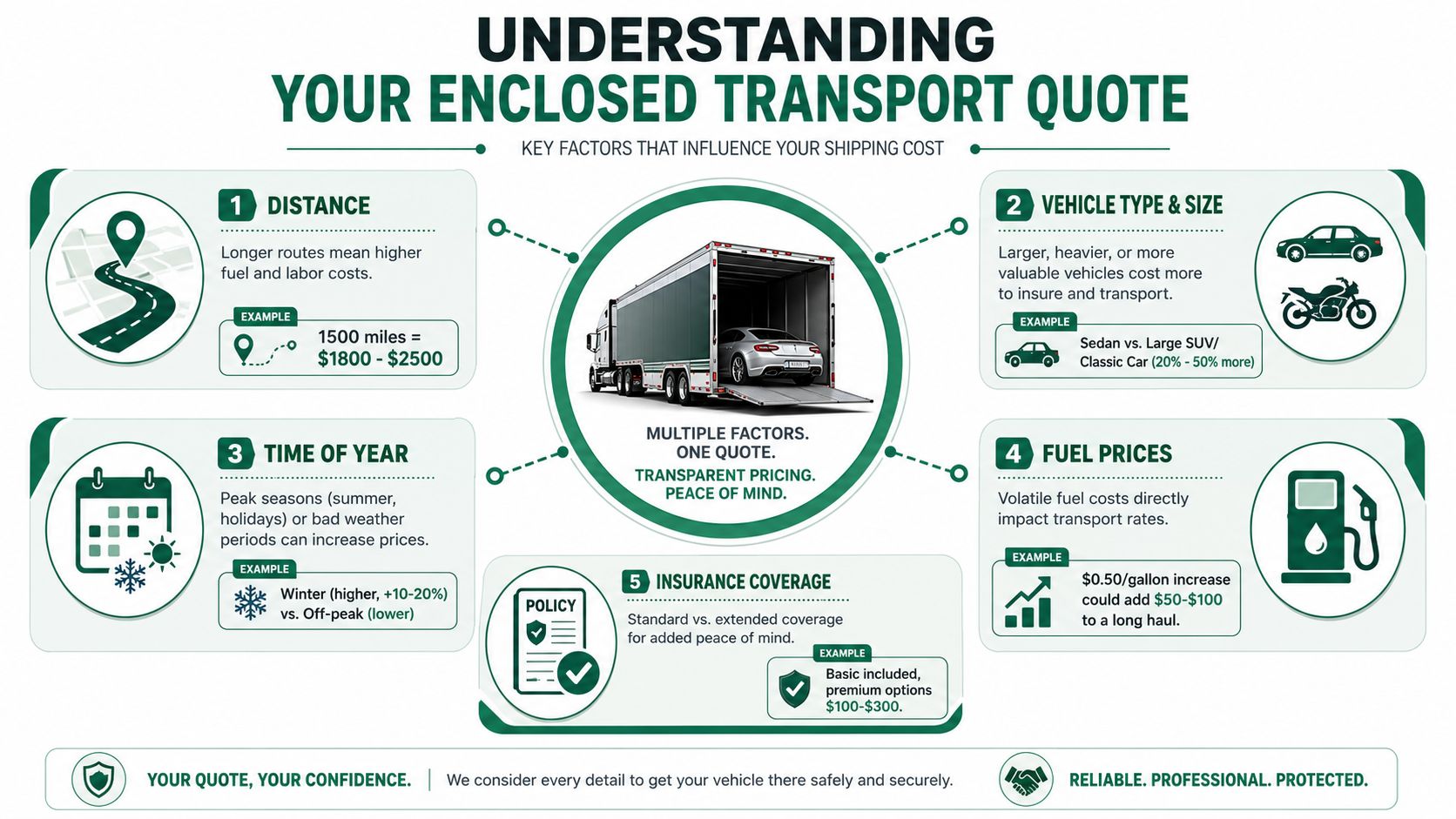
Why enclosed pricing is higher
Capacity is the first reason. An enclosed trailer usually carries fewer vehicles than an open carrier, so each position has to cover more of the trip cost.
Equipment is the second. Lift gates, soft-tie systems, interior wheel straps, and trailer configurations that work for low cars or properly secured motorcycles cost more to run and maintain. For motorcycles, hard-sided enclosed space is the right standard because sway prevention depends on the interior setup as much as the outer walls.
Quotes also move based on the details dispatchers check right away:
- Route and lane density. Major metro-to-metro lanes are usually easier to fill than rural pickups or deliveries.
- Vehicle shape and clearance. Low noses, splitters, long wheelbases, and lowered suspensions can limit which trailer can safely load the car.
- Bike handling requirements. Motorcycles need the right chocks, tie-down points, and spacing inside the trailer. A bike moved on general-purpose equipment may cost less on paper and create more risk in transit.
- Season and timing. Snowbird traffic, auction cycles, relocation peaks, and holiday weeks all affect availability.
- Running condition. Inoperable vehicles or bikes with loading issues usually require more time and equipment.
Short enclosed moves under 500 miles often land in the $600 to $1,200 range and may take 1 to 3 days, while cross-country enclosed shipments commonly run 7 to 14 days, based on the A1 Auto Transport figures cited earlier in the article.
Transit time and scheduling realities
Enclosed service is often more controlled, not faster.
Fewer enclosed carriers work each route, so pickup windows can be tighter and cross-country scheduling can take longer to line up than open transport. That matters most on less common lanes, during peak season, and on shipments with special loading requirements. A low-clearance car may need a trailer with the right ramp angle or lift gate. A motorcycle shipment may need a carrier that uses a bike-specific interior system instead of making room in a mixed-freight trailer.
I tell customers to budget for two separate clocks. One is time to get assigned to the right carrier. The other is the actual transit once the vehicle is loaded. The first clock is where enclosed shipping often stretches.
For buyers comparing mainland transport with port moves, Snappycrate on roll off shipping gives useful background on how vessel-based methods differ from standard over-the-road transport. That distinction matters later for Puerto Rico, Alaska, and Hawaii because the insurance and handling chain changes once ocean transport enters the job.
What to confirm about insurance
Insurance deserves a careful review before booking, especially for collector cars, modified vehicles, and motorcycles with custom parts. Higher carrier limits help, but the policy terms matter more than the headline number.
Ask these questions before you sign:
- What is the carrier's active cargo coverage limit? Ask for the actual amount and confirm it applies to your shipment.
- How is condition documented at pickup and delivery? Clear photos and a detailed inspection report make claim disputes easier to resolve.
- Are aftermarket parts, custom paint, accessories, or loose items excluded? Many policies limit or exclude them.
- Is the trailer appropriate for the vehicle's shape and loading risk? Insurance pays after a loss. It does not prevent a front valance from scraping on a bad loading angle or a motorcycle from being strained by poor securement.
- Who is the actual carrier? The broker's certificate is not the same as the motor carrier's cargo policy.
At National Car Transport, the jobs that go most smoothly are the ones where the quote spells out trailer type, route, timing expectations, and special handling before dispatch. That is especially true for low-clearance cars and motorcycles, where the wrong equipment choice creates damage that a simple price comparison will never show.
Shipping to Puerto Rico Alaska and Hawaii
Shipping a vehicle beyond the continental mainland is where process matters more than guesswork. Puerto Rico, Alaska, and Hawaii all involve different combinations of inland transport, terminal handling, ocean movement, release procedures, and local delivery. Puerto Rico usually generates the most questions because customers often assume it works like any domestic state-to-state shipment. It doesn't.
For Puerto Rico moves, I always tell customers to think of the shipment in stages. First comes inland pickup from the mainland. Then port delivery and processing. Then ocean transit to San Juan. Then release, tax handling, and final pickup or delivery.
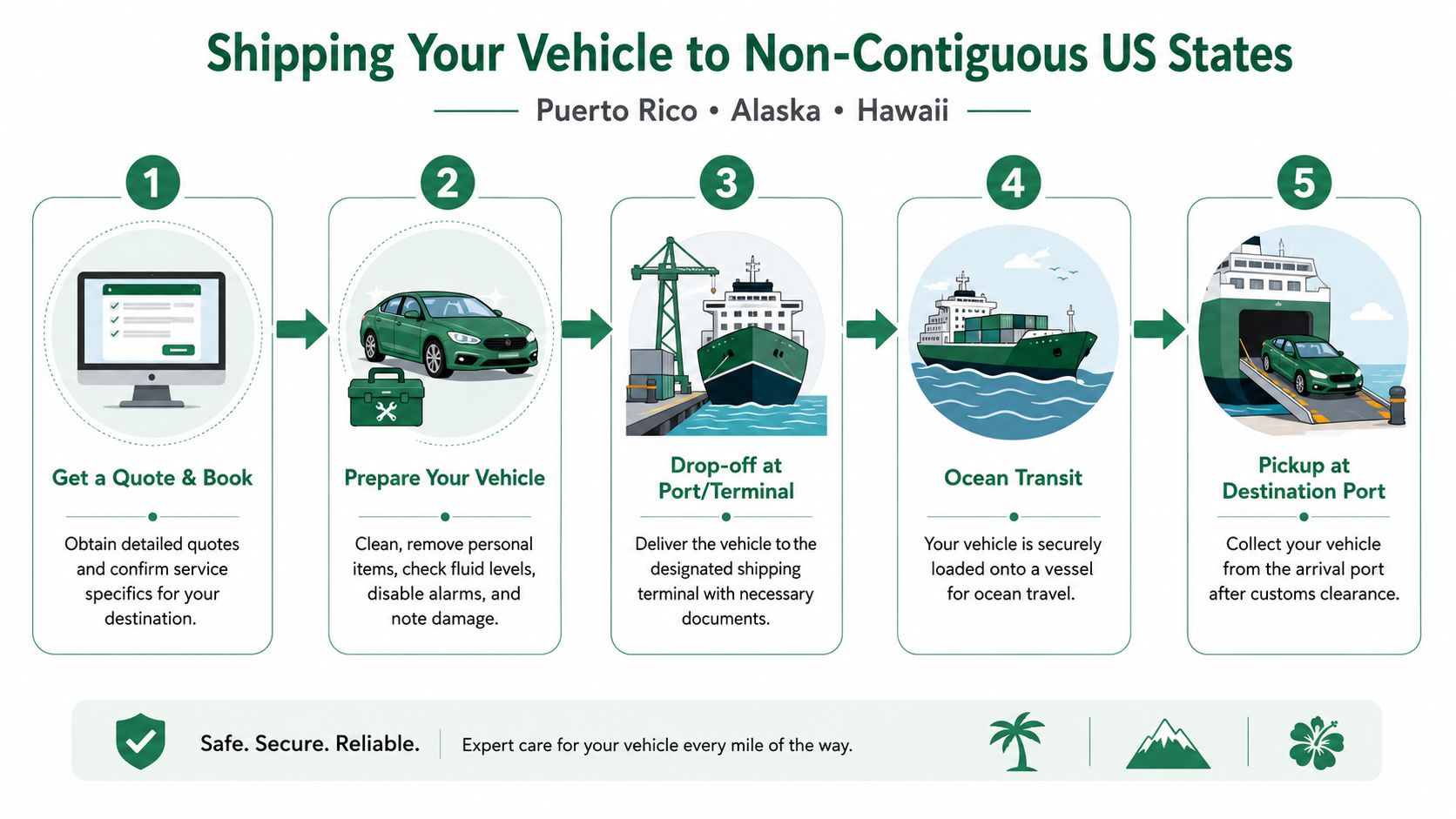
Puerto Rico from the mainland step by step
The route many customers use runs through Florida. One standard lane from Jacksonville to Puerto Rico takes 8 to 11 days total, including inland movement to Jacksonville, port processing, ocean transit, and unloading, according to Car Shipping Explained's Puerto Rico car shipping guide.
A broader timing range from mainland pickup through final delivery is 12 to 21 days, with time allocated across pickup, port processing, ocean movement to San Juan, clearance, and final delivery, according to Puerto Rico Car Transport's shipping timeline.
For customers who want a plain-language explanation of vessel loading methods, Snappycrate on roll off shipping is a useful primer. It helps people understand how port operations differ from regular over-the-road auto transport.
A typical Puerto Rico move involves these checkpoints:
- Mainland pickup or terminal drop-off in cities such as Miami, Orlando, Tampa, Jacksonville, Houston, Atlanta, Charlotte, Philadelphia, New York, Chicago, Dallas, Phoenix, Los Angeles, or elsewhere in the lower 48
- Delivery to the departure port, often in Florida depending on the lane
- Port processing and vessel loading
- Ocean transit to San Juan
- Release steps in Puerto Rico, including required documentation and tax handling
- Final pickup or local delivery
Later in the process, customers often want a visual overview of what happens at the island end.
Documents taxes and timing
Puerto Rico shipments do not involve customs duties in the same way international imports do, but they do involve an excise tax called Impuesto de Consumo, calculated based on the vehicle's value, make, model, and year, as explained by Montway's Puerto Rico shipping cost guide.
That tax surprises people because they hear “domestic U.S. territory” and assume there won't be any additional island-specific charges. This is one of the main reasons Puerto Rico shipments benefit from an experienced coordinator who can explain what applies before the car reaches the port.
Insurance can also work differently. For vehicles under 7 years old, insurance for Puerto Rico shipments costs $25 per $1,000 of declared value, and that insurance is available only for vehicles less than 7 years old, according to TOTE Maritime's personal vehicle information.
Puerto Rico shipping goes smoothly when the customer treats it like a logistics chain, not just a truck order.
Alaska and Hawaii planning notes
Alaska and Hawaii also require ocean planning, though the details differ by route and origin. The practical issues are similar. Port deadlines matter. Vehicle prep standards matter. Documentation matters. Delivery timing often depends on the handoff between inland carrier, terminal, and vessel schedule.
For customers relocating for work, military orders, school, or seasonal residence, the main advice is simple. Build extra time into your plan, verify terminal instructions early, and don't assume island shipping works like routine door-to-door domestic transport.
How to Prepare Your Vehicle for Transport
Preparation affects two things customers care about most. Condition at delivery and what happens if there is a dispute.
I tell customers to treat pickup day like a documented handoff, not a casual key exchange. That matters for any vehicle, but it matters even more with low-clearance cars, custom motorcycles, and Puerto Rico shipments where port staff may reject a unit that does not meet intake rules.
Before pickup or terminal drop off
Start with a clean vehicle. Dirt hides chips, scuffs, and paint flaws, which makes the inspection slower and less accurate.
Then work through this checklist:
- Wash the vehicle so existing scratches, chips, and cosmetic marks are easy to see.
- Remove personal items from the cabin, trunk, saddlebags, tank bags, and storage compartments.
- Take clear photos from multiple angles, including wheels, roofline, bumpers, rocker panels, fairings, and any prior damage.
- Check for leaks and mechanical issues. Carriers may refuse a vehicle with an active fluid leak, even on an enclosed trailer.
- Leave only a low fuel level if your carrier or port instructions call for it.
- Secure or remove loose accessories such as bike bags, detachable electronics, spoilers, toll tags, radar detectors, and custom trim pieces.
For low-clearance cars, add one more step. Tell the carrier about front splitters, side skirts, lowered suspension, or long overhangs before dispatch, not at pickup. Vehicle geometry changes loading strategy. I have seen ordinary sedans require the same ramp planning as an exotic because the approach angle was the primary risk.
Motorcycles need tighter prep than cars. Fold mirrors if possible, remove loosely mounted accessories, and point out any custom parts that sit proud of the bars or tail section. Hard-sided enclosed motorcycle shipping protects the bike in transit, but the handoff still depends on accurate notes about what can shift, snag, or crack during loading.
Inspection habits that save disputes later
Good enclosed carriers document condition at pickup and at delivery. Use that process carefully.
- Be present for the pickup inspection, or assign someone you trust.
- Read the Bill of Lading before signing.
- Confirm that every visible flaw is marked.
- Keep your own time-stamped photos until the shipment is complete.
- Inspect the vehicle at delivery before final sign-off.
Small details matter here. Photograph the wheels, lower bumper corners, chin spoiler, windshield, seat, tank, and fairings. Those are common dispute points because they are easy to miss in a quick walkaround and expensive to repair on specialty vehicles.
If you are dropping at a port, follow the terminal checklist exactly. Ports can reject a vehicle for missing paperwork, prohibited contents, alarm issues, excess fuel, or loose items that would never matter on a standard mainland pickup.
FAQs for Enclosed Auto and Motorcycle Shipping
Can you ship an inoperable classic car
Yes, but it changes the equipment requirement. The carrier needs to know the vehicle doesn't run, steer, or brake normally so the right loading method can be arranged. For a classic car, that often means extra care around ramp angle, winching, and tire condition. Don't hide inoperable status to get a lower quote. That's how pickups fail.
What works for military PCS moves
Military families usually need three things. Predictable scheduling, good communication, and flexibility if orders shift. For mainland routes, open transport is often the practical choice for daily-use vehicles. For specialty cars or motorcycles, enclosed service makes more sense when condition matters. Puerto Rico, Alaska, and Hawaii moves also require tighter timing because vessel schedules and terminal cutoffs don't wait for last-minute paperwork.
How far ahead should you book
Earlier is better, especially for enclosed transport and island lanes. Open carriers are more common, so there's usually more flexibility. Enclosed trailers operate with tighter capacity, and Puerto Rico shipments add port timing to the equation. If your dates matter, don't wait until the week of your move to start comparing options.
Can you ship a motorcycle with household goods
Usually, no. Auto and motorcycle carriers generally don't want loose personal goods packed with the vehicle because of liability, safety, and inspection issues. Island routes can be stricter still. Treat vehicle shipping and household moving as separate logistics unless a provider clearly tells you otherwise in writing.
Is enclosed shipping only for luxury vehicles
No. That's one of the biggest misconceptions in the industry. Classics, exotics, and collector vehicles are obvious enclosed candidates, but so are many low-clearance modern cars, custom builds, fresh restorations, and motorcycles that need protected securement. The deciding factor is often exposure and loading sensitivity, not price tag.
What should you ask before booking a motorcycle shipment
Ask what type of enclosure is being used, how the bike is immobilized, whether the trailer uses motorcycle-specific rack systems, and how inspections are documented. If the answers sound generic, keep looking. Bikes don't tolerate vague securement plans well.
What makes agent support matter
Because not one vehicle transport is alike. A student shipping a sedan from Boston to Miami, a snowbird moving from New York to Tampa, a dealership sending inventory from Dallas to San Juan, and a family relocating from California to Hawaii all need different timing, paperwork, and carrier matching. Good support means you're dealing with someone who spots those differences before they become delays.
What kinds of customers use these services most often
In practice, it's a wide mix. Individuals relocating for work. Snowbirds heading south for the season. military families moving between duty stations. Students going to or from campus. Dealerships managing inventory. Businesses moving fleet units. Online buyers who don't want to fly out and drive home.
What's a practical option if you want one point of contact
Some customers prefer working through a provider that coordinates the shipment from dispatch through delivery rather than trying to piece together multiple handoffs on their own. National Car Transport is one example. The company offers flat-rate pricing, bilingual U.S.-based agents, and access to a 25+ years operational background with an A+ BBB rating and a 25,000+ carrier network, which can be useful for mainland routes and more complex Puerto Rico, Alaska, and Hawaii shipments.
If you need a quote or want to talk through whether enclosed service makes sense for your car or motorcycle, National Car Transport is available to help you compare the trade-offs. Their U.S.-based bilingual agents work in English and Spanish, and they can walk you through mainland, Puerto Rico, Alaska, or Hawaii shipping without overcomplicating the process.