
You've found a vehicle you care about, or you're trying to move one without adding risk to an already stressful relocation. It might be a restored classic headed to a new garage, a family SUV going to a new duty station, a student's car crossing the mainland, or a snowbird vehicle moving between the U.S. mainland and San Juan. In each case, the key question isn't just how to move the car. It's how to protect it while it moves.
That's where enclosed car carrier rental enters the conversation. Some people mean a literal trailer they rent and tow themselves. Others are really looking for enclosed auto transport handled by a professional carrier. Those are very different choices, with different risks, costs, and planning requirements. One gives you equipment. The other gives you logistics, loading experience, carrier coordination, insurance handling, and route management.
That distinction matters more now because the broader trailer rental market is growing. The global moving trailer rental market is projected to grow from USD 5.17 billion in 2026 to USD 7.83 billion by 2035, with North America expected to hold 50 to 55 percent of market share, according to Business Research Insights on the moving trailer rental market. As more people compare DIY equipment rental with managed transport, understanding the trade-offs becomes more important, not less.
Table of Contents
- Your Guide to Enclosed Car Carrier Rental
- Understanding Enclosed Transport and Its Ideal User
- Enclosed vs Open Transport a Direct Comparison
- Key Factors That Determine Your Transport Cost
- The Booking Process From Quote to Delivery
- How to Prepare Your Vehicle for Transport
- Why Choose a Managed Service for Peace of Mind
Your Guide to Enclosed Car Carrier Rental
When customers ask about enclosed car carrier rental, they're usually trying to solve one of three problems. They need better protection than open transport provides. They don't want to put extra miles on a valuable vehicle. Or they're dealing with a route that adds complexity, such as a long interstate move, seasonal relocation, or shipping to or from Puerto Rico.
A true enclosed setup protects the vehicle from weather, road debris, and unwanted attention. That protection matters when paint condition, trim, low ground clearance, or overall value changes the risk calculation. For a commuter sedan, open transport is often a practical choice. For a collector car, specialty vehicle, or carefully maintained luxury model, the decision often leans the other way.
Equipment rental and managed shipping are not the same thing
A DIY rental gives you the trailer. From there, you handle tow vehicle compatibility, loading angle, tie-downs, route planning, fuel stops, parking, weather exposure while stopped, and delivery timing. If the trip includes mainland-to-island logistics, that complexity rises fast.
A managed enclosed shipment works differently. The carrier provides the trailer, driver, loading method, and transport plan. You're hiring expertise, not just equipment.
Practical rule: If the vehicle would be expensive, difficult, or emotionally painful to repair, don't make your first enclosed haul a learning experience.
When people usually start looking into it
These are the most common situations where enclosed service makes sense:
- Collector ownership: You bought a classic, restored, or show vehicle and want to keep it shielded from road grime and weather.
- Luxury relocation: You're moving a higher-end car between states and don't want added mileage or exposure.
- Military and student moves: You need reliable transport while managing a larger life change and don't want towing to become another job.
- Snowbird and Puerto Rico routes: You want the vehicle to arrive clean, secure, and professionally handled over a longer or more complex route.
The right choice comes down to risk tolerance. Some customers want the lowest upfront transportation cost. Others want the lowest chance of a preventable problem. Those aren't always the same thing.
Understanding Enclosed Transport and Its Ideal User
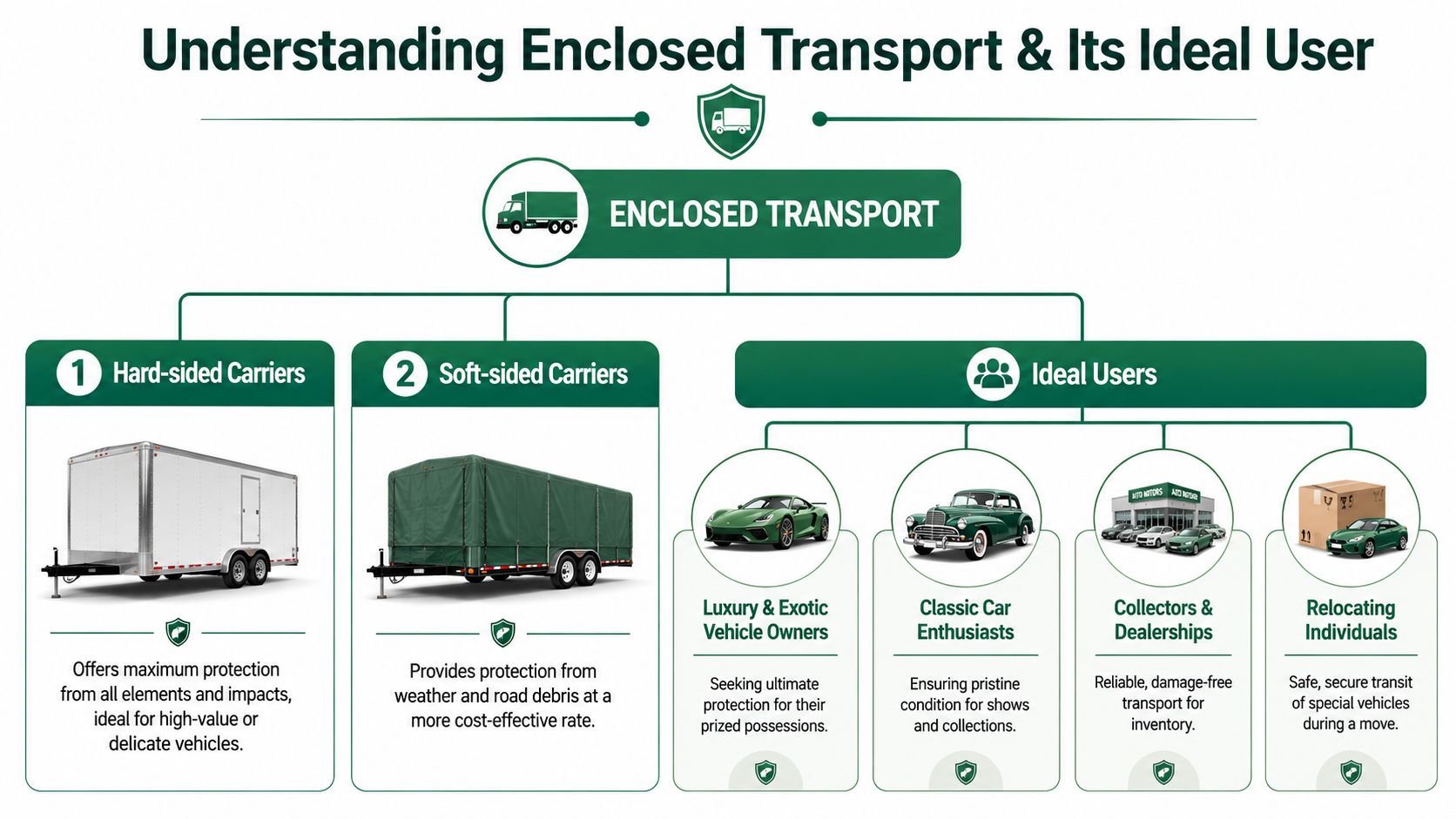
Enclosed transport means the vehicle rides inside a covered trailer instead of on an open rack. That sounds simple, but the practical benefit is specific. You're paying for containment, more controlled handling, and a lower level of outside exposure during transit.
Enclosed trailers are often listed in dimensions such as 8.5 x 20 feet or larger, and they're used because they provide a weatherproof and theft-resistant environment that reduces exposure to rain, wind, and road debris, as noted in rental guidance for enclosed car haulers.
What enclosed transport actually protects against
On a long route, a vehicle can encounter rain, construction dust, tire spray, insects, gravel kick-up, and constant road film. Open carriers handle these exposures every day, and for many vehicles that's acceptable. Enclosed transport is for customers who don't want to accept that exposure in the first place.
There are also two broad forms people discuss:
- Hard-sided enclosed carriers: These provide the strongest physical barrier and are often preferred for high-value or delicate vehicles.
- Soft-sided enclosed carriers: These still offer more shielding than open transport, especially against weather and debris, but they aren't the same as rigid-wall containment.
What matters most isn't the label. It's whether the carrier's equipment fits your vehicle's height, length, clearance, and loading needs.
Who usually benefits most
Not every car needs enclosed transport. The service is best matched to specific use cases.
- Classic car owners: Older vehicles often have delicate trim, older seals, specialty paint, or restoration work that owners want protected.
- Luxury and exotic owners: High-value vehicles justify a lower-risk transport method, especially over long distances.
- Dealerships and collectors: Inventory condition matters. A cleaner arrival and more controlled handling can be worth the premium.
- Military families, students, and snowbirds: The value here is less about prestige and more about reducing moving stress when the route is already complicated.
The right customer for enclosed transport isn't always the person with the most expensive car. It's often the person with the least room for something to go wrong.
For Puerto Rico routes, the ideal user profile expands further. Mainland pickup coordination, port handling, timing, and final delivery all add layers that make managed enclosed service much more attractive than trying to solve the move with a rented trailer and a lot of guesswork.
Enclosed vs Open Transport a Direct Comparison
Most customers don't need a lecture on transport theory. They need a straight comparison that helps them decide. Open transport is the standard option for everyday vehicles because it's widely available and efficient. Enclosed transport is the premium option when protection and controlled handling matter more than keeping the price as low as possible.
How the two methods differ in practice
Here's the simplest side-by-side view.
| Feature | Open Transport | Enclosed Transport |
|---|---|---|
| Protection | Vehicle is exposed to weather, dust, and road debris | Vehicle is shielded inside a covered trailer |
| Cost position | Usually the more budget-conscious choice | Usually the premium choice |
| Scheduling | Often easier to find on common routes | May require more planning on some routes |
| Best fit | Standard daily-driver vehicles | Luxury, classic, exotic, collector, or specialty vehicles |
| Visual privacy | Low | Higher |
| Handling expectations | Standard commercial handling | Often chosen when owners want more controlled handling |
The main mistake people make is assuming enclosed is automatically “better” for everyone. It isn't. If you're shipping a standard family vehicle between major mainland cities and your main goal is affordability, open transport often makes more sense. It's a normal, widely used service.
If you're moving a car with custom paint, sentimental value, collector status, or very low tolerance for cosmetic exposure, enclosed usually earns its keep.
Which choice makes sense for your situation
Use this decision filter instead of marketing language:
- Choose open transport if your vehicle is a normal daily driver, the route is straightforward, and your priority is practical cost.
- Choose enclosed transport if the vehicle's condition, value, rarity, or finish changes how much risk you're willing to accept.
- Choose managed enclosed service over DIY trailer rental if the route is long, unfamiliar, one-way, interstate, or includes Puerto Rico.
One more point matters. A rented enclosed trailer and a professional enclosed carrier are not equivalent alternatives. With a rental, you become the dispatcher, tow operator, spotter, and risk manager. With a managed shipment, those roles stay with professionals who do this every day.
That difference shows up in the details customers don't always think about at first:
- Loading geometry: Low-clearance cars need careful ramp approach and interior space management.
- Tow setup: Hitch class, brake controller compatibility, and towing stability matter before the wheels ever turn.
- En route security: Parking an enclosed trailer overnight is not the same as a commercial carrier managing the route.
For mainland U.S. moves between major cities, either service can work depending on the car. For moves involving San Juan or broader Puerto Rico logistics, the balance shifts hard toward managed service because the shipment involves more than just pulling a trailer from point A to point B.
Key Factors That Determine Your Transport Cost
Customers usually ask for a price first, but price only makes sense after the route and vehicle details are clear. Enclosed transport quotes move up or down based on how difficult the job is to execute well, not just how far the vehicle is traveling.
As a general benchmark for the DIY side of the equation, industry rental guides report enclosed cargo trailers typically rent for about $75 to $150 per day or $350 to $650 per week, as referenced in Budget Truck Rental's car carrier and related rental information. That's useful because it shows why a fully managed enclosed shipment costs more than equipment alone. The service includes the trailer, the driver, commercial coordination, route execution, and delivery handling.
What changes the quote
These are the variables that usually matter most:
- Distance and route shape: Major city to major city moves are usually simpler to coordinate than remote pickup or delivery locations.
- Vehicle size and profile: Large SUVs, trucks, low-clearance cars, and modified vehicles can affect equipment choice and loading method.
- Seasonality: Snowbird demand, holiday congestion, and weather patterns can tighten capacity on popular lanes.
- Pickup and delivery flexibility: Narrow windows are harder to schedule than broader ones.
- Transport type: Enclosed service costs more than open because the equipment and handling requirements are more specialized.
A good quote should also reflect whether the shipment is door-to-door as close as legally and safely possible, or whether access constraints require alternate meeting points.
Why Puerto Rico moves require more planning
Puerto Rico shipments are a category of their own. The mainland leg and the island leg have to line up with port timing, documentation, and final delivery coordination. Customers often underestimate how much communication is involved.
That's one reason flat-rate pricing and clear written terms matter so much. You want to know what is included, what documents are required, how the handoff works, and who will guide you if the schedule shifts.
If a quote looks simple but the route isn't, ask more questions. Complex moves fail in the details, not in the headline price.
Insurance review belongs here too. Customers should verify what the carrier covers, how condition is documented, and what procedures apply if there's a claim. For high-value vehicles, don't assume coverage language means what you think it means. Ask for plain-English explanations before you book.
The Booking Process From Quote to Delivery
A smooth enclosed shipment follows a predictable workflow. Problems usually show up when details are missing early, especially with one-way moves, unusual vehicle dimensions, or routes that require extra coordination. That's a known gap in DIY trailer content, which often leaves customers without clear answers on one-way trips, fitment questions, and towing requirements, as noted in Neighbor's Trailer guidance on trailer rental decision-making.
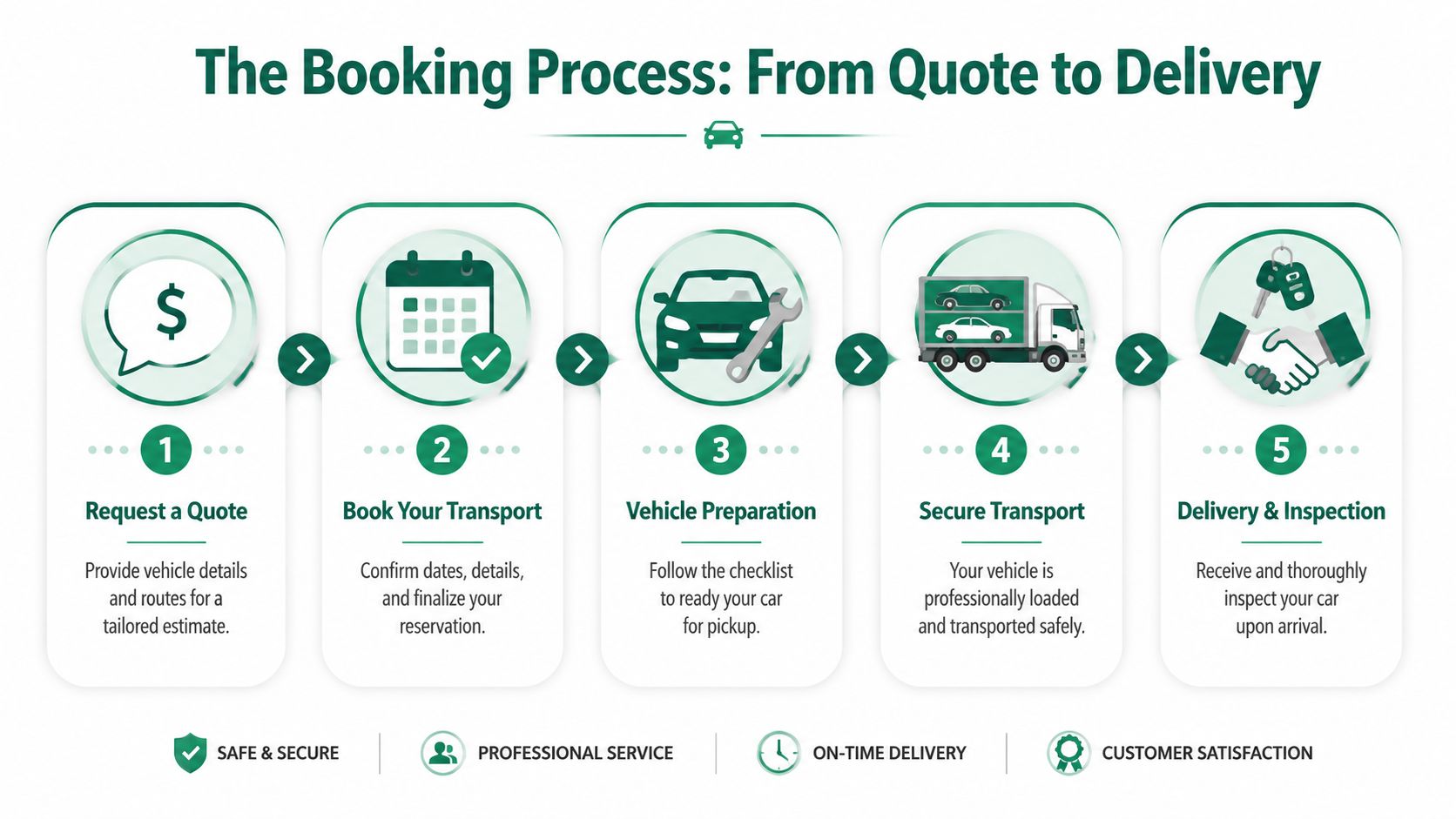
Start with the visual overview below.
What happens before pickup
First, you request a quote with accurate vehicle and route details. Don't guess on the vehicle type if it has modifications, oversized tires, lowered suspension, or inoperable status. Those details affect equipment choice.
Then the shipment is booked and assigned. At that point, timing, contact information, access constraints, and pickup instructions should be confirmed clearly. For Puerto Rico traffic, documentation and handoff instructions need extra attention because there are more moving parts than a standard mainland run.
Here's the process in plain terms:
- Quote request: Provide the year, make, model, route, and whether the car runs and steers.
- Scheduling: Confirm the pickup window and any location limitations such as narrow streets, gated access, or port timing.
- Carrier coordination: The transport team aligns equipment and route timing with your shipment needs.
- Pickup inspection: The vehicle condition is recorded before loading.
- Transit and delivery: The car is delivered, inspected again, and signed off if everything matches expectations.
A short video can also help customers understand what a professional shipping process looks like in practice.
What happens in transit and at delivery
Pickup day is where preparation meets paperwork. The driver or carrier representative inspects the vehicle and notes visible condition on the bill of lading. If you're handing the car off to someone else, make sure that person is authorized and has the right information.
During transit, communication matters. Customers don't need constant updates, but they do need reliable ones. That becomes especially important on longer routes and island shipments where timing can change due to traffic, weather, or terminal operations.
At delivery, inspect the vehicle before signing off. Don't rush this step.
- Check the exterior carefully: Look at the same panels reviewed at pickup.
- Review photos if needed: Your pre-shipment photos help resolve confusion quickly.
- Test basic functions: If practical, confirm the vehicle starts and moves as expected.
- Match paperwork to condition: The final inspection should line up with the original report.
The best shipping experiences feel organized, not dramatic. That usually comes from good planning long before the truck arrives.
How to Prepare Your Vehicle for Transport
Preparation is where customers can make the shipment easier, safer, and cleaner from the start. A vehicle that's ready for pickup reduces delays, avoids inspection disputes, and helps the carrier load and deliver it properly.
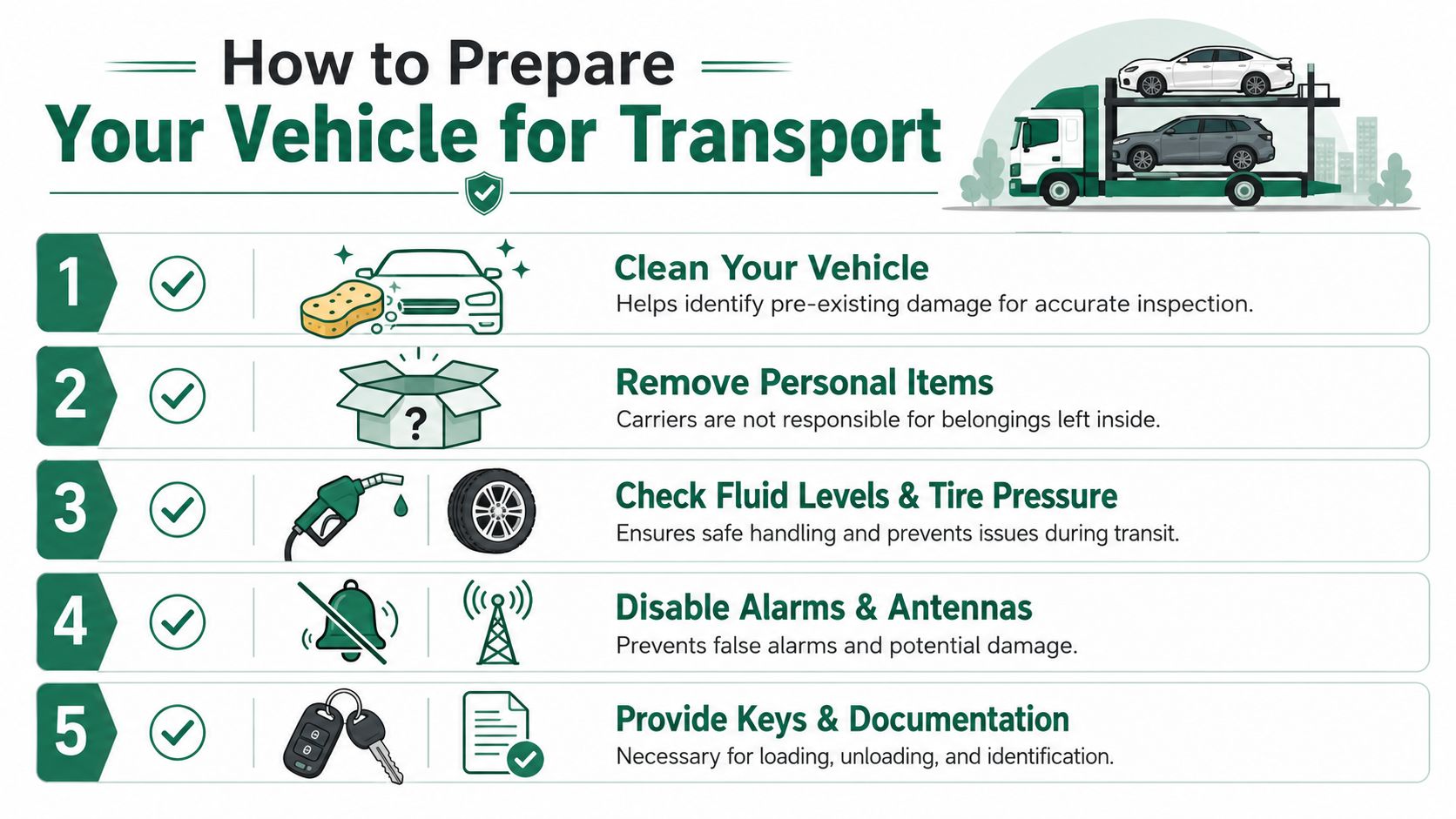
Your pre-shipping checklist
Use this checklist before pickup:
- Wash the vehicle: Dirt hides scratches, chips, and trim issues that should be documented during inspection.
- Remove personal items: Carriers generally don't want loose belongings inside the vehicle because they can shift, create claims issues, or violate policy.
- Check for leaks: Active leaks can create safety and loading problems.
- Make sure the battery is charged: A car that won't start when it should can complicate pickup and delivery.
- Fold in or secure loose parts: Antennas, accessories, and detachable exterior pieces should be protected.
- Provide one working key: The driver needs to load, reposition, and unload the vehicle safely.
- Document condition with photos: Take clear photos from multiple angles before the carrier arrives.
Clean cars don't just look better at pickup. They create a more accurate inspection record.
Common preparation mistakes
Customers often assume enclosed transport means they can skip the basics. That's backwards. Higher-protection shipping works best when the car is prepared well.
The most common mistakes are simple:
- Leaving household items in the car
- Forgetting to disable alarms
- Not mentioning mechanical issues
- Handing off the car without taking photos
- Assuming a modified vehicle will load like a stock vehicle
If the vehicle is inoperable, say so upfront. If it sits very low, say that too. Accurate information at booking prevents surprises on pickup day, and surprises are what disrupt otherwise smooth shipments.
Why Choose a Managed Service for Peace of Mind
DIY enclosed trailer rental can work in a narrow set of situations. Short distance. The right tow vehicle. Good towing experience. A straightforward route. A vehicle that fits the trailer correctly and loads without drama. Once any part of that changes, the risk rises quickly.
A core technical issue is weight matching. One rental example specifies a 7,000 lb GVWR with a 5,100 lb payload capacity, and another enclosed car-hauler example shows a 6,500 lb capacity configuration with dual 5,200 lb axles and electric brakes, according to DS Trailer Rentals equipment listings. That's the kind of detail professionals use to determine whether a specific vehicle can be moved safely. Payload, axle setup, and braking capacity matter more than a trailer merely “looking big enough.”
Where DIY rental works and where it breaks down
DIY usually breaks down when the move includes any of the following:
- A high-value vehicle: The margin for loading error is small.
- A long one-way route: Fatigue, parking, fuel planning, and weather all become more serious.
- Urban pickup or delivery constraints: Tight access is harder with a trailer than often anticipated.
- Puerto Rico shipping: This isn't a normal tow job. It's a multi-step logistics move.
- Limited towing experience: Confidence doesn't replace training or repetition.
Managed service removes those burdens. The shipper coordinates the route, assigns suitable equipment, handles dispatch communication, and manages the inspection chain from pickup to delivery.
Why experienced coordination matters
The core value isn't just that someone else drives the truck. It's that someone else handles the judgment calls before they become your problem.
That includes:
- Matching equipment to the vehicle
- Planning around access restrictions
- Coordinating specialized routes
- Keeping documentation organized
- Responding when schedules shift
For customers moving cars between mainland cities, that support saves time and stress. For customers shipping to or from San Juan and the rest of Puerto Rico, it can be the difference between a controlled process and a frustrating one.
A managed provider also gives you a human point of contact. That matters. Vehicle shipping rarely follows the same script twice, and bilingual support can make a real difference for families, students, military households, dealerships, and Puerto Rico customers managing details across English and Spanish.
If you want enclosed transport handled by an experienced team, National Car Transport is a reliable option to consider. With 25+ years of experience, an A+ BBB rating, transparent flat-rate pricing, and a network of 25,000+ vetted carriers, they coordinate domestic U.S. shipping and Puerto Rico moves with dedicated bilingual agents based in the USA. If your goal is security, clarity, and less stress, a managed enclosed shipment is often the smarter choice.