
You're moving across the country, sending a car to a college student, transferring a vehicle for military orders, or arranging a shipment between the mainland and Puerto Rico. The vehicle is ready, but the logistics are less clear. Do you need to drive it to a terminal? Will the carrier reach your exact address? What happens when an apartment entrance, gated community, narrow street, or port schedule changes the handoff?
Door to door transport sounds simple because the name suggests a vehicle travels from one front door to another. In practice, it's a coordinated transportation service built around accessible pickup and delivery locations. Once you understand that distinction, the quote, timing, documents, and delivery appointment become much easier to manage.
This guide explains how door-to-door auto transport works across the continental United States, including major cities such as New York City, Los Angeles, Chicago, Houston, Phoenix, Philadelphia, San Antonio, San Diego, Dallas, San Jose, Jacksonville, Austin, Columbus, Indianapolis, Charlotte, Seattle, Denver, Washington, Nashville, Oklahoma City, Las Vegas, Louisville, Baltimore, Milwaukee, Albuquerque, Tucson, Fresno, Sacramento, Atlanta, Kansas City, Miami, Raleigh, Omaha, Minneapolis, Cleveland, Tampa, New Orleans, and Honolulu for applicable island logistics, as well as San Juan, Puerto Rico. It also addresses the details many basic guides skip, especially last-mile access, port-pair realities, inspection records, and the responsibilities that remain with the customer.
Table of Contents
- Introduction to Door to Door Transport for Everyday Drivers
- What Door to Door Transport Really Means
- How Door to Door Auto Transport Works From Pickup to Delivery
- Door to Door vs Terminal to Terminal Which Option Fits You
- Pricing Timelines and Puerto Rico Routes You Should Know
- Safety Compliance and What Makes a Carrier Trustworthy
- Booking With Confidence and Getting Ready for Delivery
Introduction to Door to Door Transport for Everyday Drivers
A family leaving New Jersey for Texas may have movers handling the furniture, children preparing for a new school, and a second vehicle that still needs to reach the destination. Driving both cars adds another long-distance obligation. Leaving one at a terminal creates a separate trip at each end. Door-to-door service appears attractive because the carrier coordinates pickup near the origin and delivery near the destination while the customer focuses on the move.
The same logic helps a parent sending a car to a student in Boston, a snowbird moving a vehicle between Florida and a northern home, or a military family changing duty stations. Dealerships and businesses also use coordinated vehicle transport for inventory, auction purchases, fleet movement, and online vehicle sales. The service can reduce the number of handoffs a customer has to arrange, but it doesn't remove every responsibility.
Puerto Rico shipments add another layer. A vehicle moving between San Juan and a mainland city such as Jacksonville, Miami, Atlanta, Orlando, New York, Philadelphia, Chicago, Dallas, or Los Angeles combines inland trucking with port and ocean coordination. The residential addresses matter for the mainland pickup and final delivery, but the ocean portion follows a port-based process rather than a literal residential-to-residential sailing.
Why the phrase can cause confusion
The most useful way to understand door to door transport is to treat it like a planned relay. One party prepares the vehicle, the carrier accepts it at an accessible location, transportation providers move it through the route, and another driver or terminal completes the final handoff. Each stage has its own access, scheduling, and documentation requirements.
National Car Transport works with customers across the United States and Puerto Rico, including individuals, snowbirds, military families, students, dealerships, and businesses. Its U.S.-based bilingual English and Spanish agents have more than 20 years of auto transport logistics experience, which matters because no two vehicle shipments are alike. The value of a knowledgeable advisor isn't just obtaining a quote. It's having someone identify route constraints, explain the handoff, and make the process simple and quick at a practical value.
What Door to Door Transport Really Means
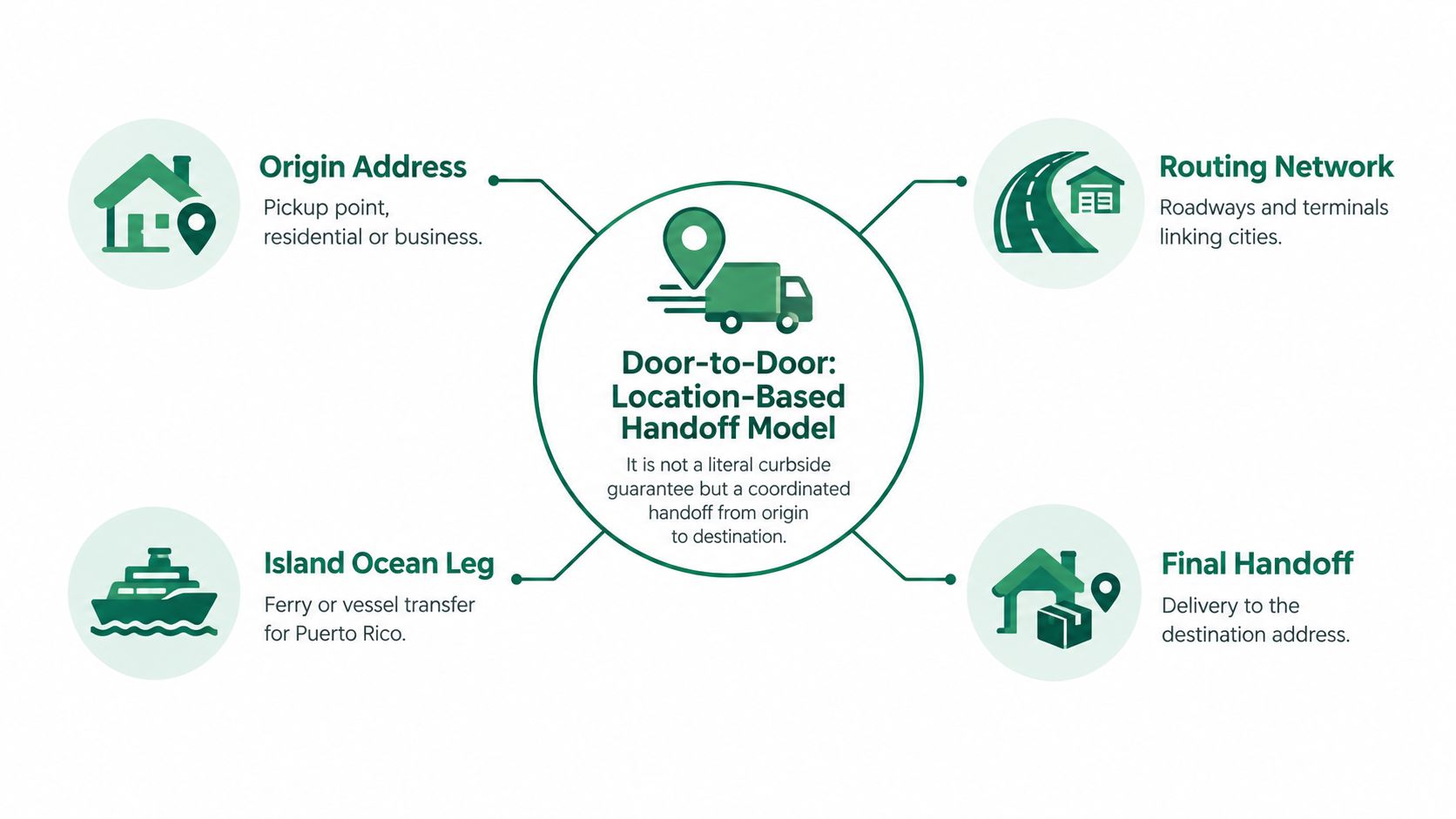
Door-to-door vehicle transport is best understood as a location-based handoff model, not a promise that a large carrier will park directly at every front door. The carrier coordinates pickup and delivery as close as possible to the requested origin and destination, subject to roadway access, vehicle size, and local safety rules. When a residential street is restricted, the driver may use a nearby safe and legal meeting point, as explained in this door-to-door auto transport guidance.
Think of the carrier as a moving warehouse that must use public roads. A tractor-trailer may be able to reach a commercial lot but not a low-clearance garage, narrow residential lane, gated complex, or crowded downtown block. The driver can't safely block traffic or risk striking an overhang to satisfy a literal address.
The access check comes before the appointment
Before booking, provide the full origin and destination details, including apartment or community restrictions. Tell the advisor whether the street has tight turns, low wires, weight limits, construction, steep grades, or limited space for loading. A carrier can then evaluate whether the address is usable or whether a nearby public road, shopping center, office lot, or other lawful location would be safer.
The vehicle itself also affects planning. Year, make, model, operating condition, dimensions, and whether it rolls, steers, and brakes help the carrier match equipment to the load. A non-running vehicle may require different loading arrangements, while an oversized vehicle can create route and equipment limitations.
Practical rule: Treat your address as the requested service area, then confirm the actual meeting point before dispatch.
This distinction matters most in dense cities, gated communities, and apartment complexes. A customer may still receive convenient pickup and delivery without receiving literal curbside service. The goal is a controlled handoff that protects the vehicle, driver, property, and surrounding traffic.
How Door to Door Auto Transport Works From Pickup to Delivery
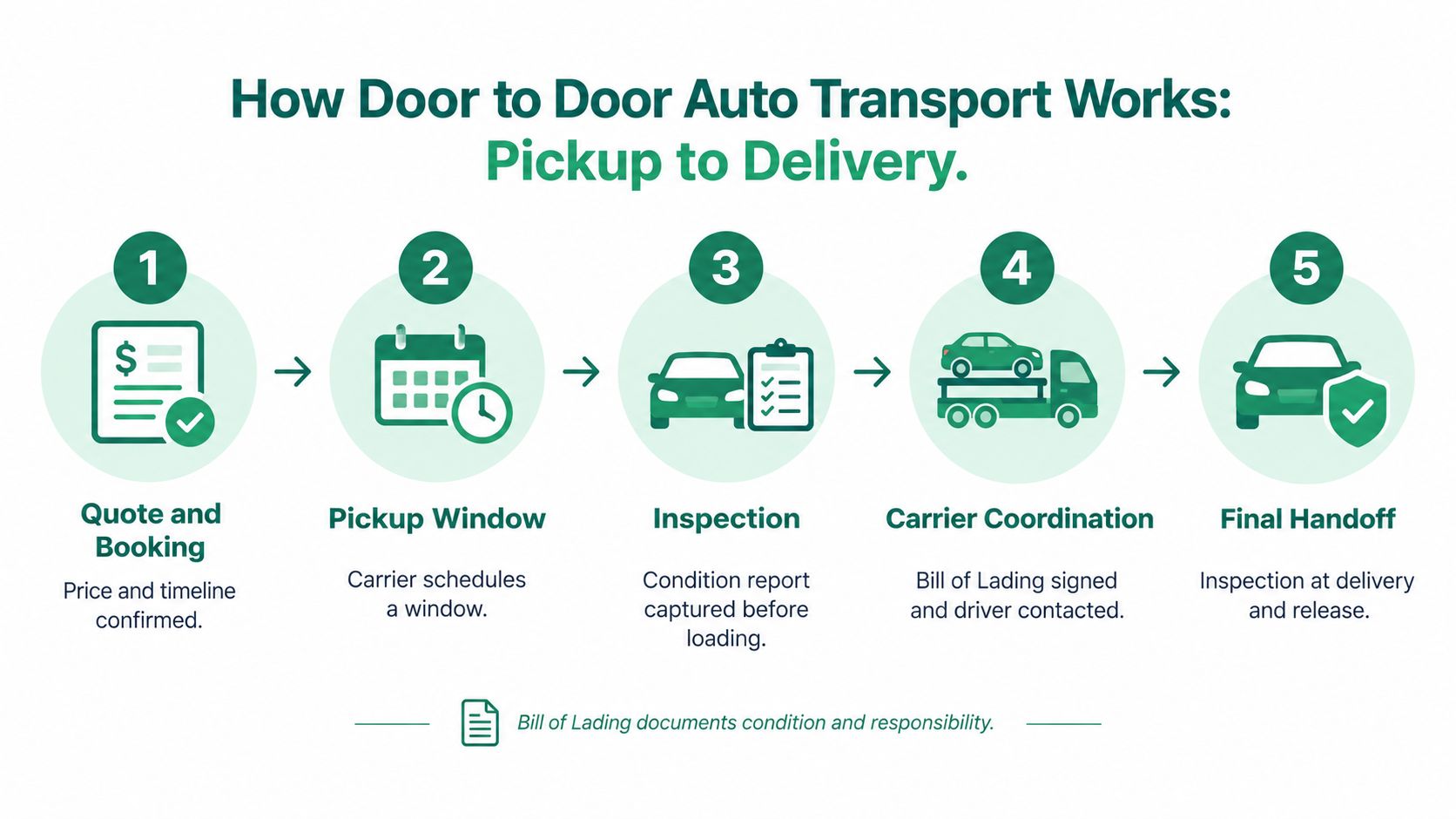
A successful shipment follows a sequence. The customer supplies accurate information, the advisor matches the shipment to an available carrier, and the driver documents the vehicle at each handoff. Clear communication prevents small uncertainties from becoming missed appointments.
The booking and pickup stage
Start with the origin, destination, vehicle details, desired dates, transport type, and address-access information. Ask whether the quote is flat-rate, what services are included, and when payment is due. National Car Transport describes transparent flat-rate pricing with no upfront charge until the vehicle is matched with a carrier, but customers should still review the quote terms before authorizing service.
The carrier then provides a pickup window rather than treating the appointment like a guaranteed local delivery slot. An adult representative should be present, or the customer should arrange an authorized person who can release the vehicle and sign the paperwork. If the address isn't serviceable, the advisor or driver should confirm a nearby safe location before pickup day.
Inspection and loading
Before loading, the driver and customer inspect the vehicle together. They record existing condition on the Bill of Lading, including visible exterior marks, mileage when applicable, keys, accessories, and special notes. Photos support the written record and create a practical reference for the delivery inspection.
Remove personal belongings unless the carrier has specifically approved an arrangement. Secure loose parts, disable alarms when possible, and provide operating instructions for modified or non-running vehicles. Keep the fuel level low enough to meet the carrier and port requirements, while ensuring the driver can move the vehicle safely.
Transit and final delivery
After loading, the driver carries the shipping papers and communicates progress through the assigned contact. Routes can change because of weather, traffic, equipment, access, or port schedules. A delivery appointment is normally coordinated near the destination, and the customer should be available with the keys or authorized representative ready.
At delivery, inspect the vehicle before signing the final release. Compare its condition with the pickup record and photograph any apparent new issue. The Bill of Lading documents the vehicle's condition and responsibility at both ends, so don't treat the signature as a formality.
Puerto Rico shipments add port handoffs to this sequence. Crowley identifies Jacksonville, Florida, and Eddystone, Pennsylvania, as the two main U.S. ports used for vehicles shipped from Puerto Rico, while San Juan is the island's primary vehicle port, as outlined in its Puerto Rico vehicle shipping route explanation. Residential pickup and delivery may be included in the inland portions, but the vessel leg remains port-based.
Door to Door vs Terminal to Terminal Which Option Fits You
The choice isn't between expensive and inexpensive service. It's a decision about who handles the first and last local connection. Door-to-door transport asks the carrier to solve more of the route. Terminal-to-terminal shipping asks the customer to deliver and collect the vehicle at designated facilities.
| Feature | Door to Door | Terminal to Terminal |
|---|---|---|
| Customer convenience | Pickup and delivery are coordinated near the requested addresses | Customer arranges transportation to and from terminals |
| Address flexibility | Requires access screening and may use a nearby safe meeting point | Uses established terminal locations |
| Last-mile coordination | Carrier manages more local routing | Customer manages the local connection |
| Pricing | Typically carries a 15% to 25% premium over terminal-to-terminal service because of last-mile access complexity, according to industry pricing research | Often costs less when terminal access is convenient |
| Best fit | Relocations, students, snowbirds, military moves, dealerships, and customers who value reduced driving | Customers near terminals who can manage drop-off and collection |
| Vehicle handling | Fewer customer-arranged ground transfers | Customer may need to drive the vehicle to and from facilities |
Door-to-door is usually the practical choice when the customer is already managing a move, lacks a second driver, or needs the vehicle collected from a home or business. It can also simplify dealership and auction logistics by reducing the need to coordinate separate local transport.
Terminal service may make sense for someone who lives near a facility, has flexible transportation, and wants to prioritize a lower service cost. It can also be useful when an address has difficult access, although the customer must still confirm terminal rules, storage conditions, appointment procedures, and release requirements.
For everyday cars, open car transport is often the standard equipment choice. Luxury, classic, collectible, or highly customized vehicles may justify enclosed transport, but the correct option depends on the vehicle's condition, value, route, and the customer's tolerance for exposure.
The contrarian point is important: door-to-door doesn't always mean completely hands-off. You may still need to provide access instructions, meet the driver at a safe location, arrange an adult representative, and keep some flexibility around the pickup window. Premium service pays for greater coordination, not immunity from physical road limitations.
Pricing Timelines and Puerto Rico Routes You Should Know
A transport quote reflects more than mileage. Route demand, season, vehicle size, operating condition, equipment, access at both ends, and whether the shipment includes an ocean leg can all affect the final price. A flat-rate quote can make budgeting easier, but only when the shipment details are accurate.
Mainland moves within the 48 states generally involve direct or connected highway routing. A vehicle traveling between Los Angeles and Dallas has a different access profile from one moving between Manhattan and Miami. A sedan collected from a commercial lot may be easier to place than a large SUV on a narrow residential street, even when the route distance is similar.
The supplied route infographic lists the following planning windows:
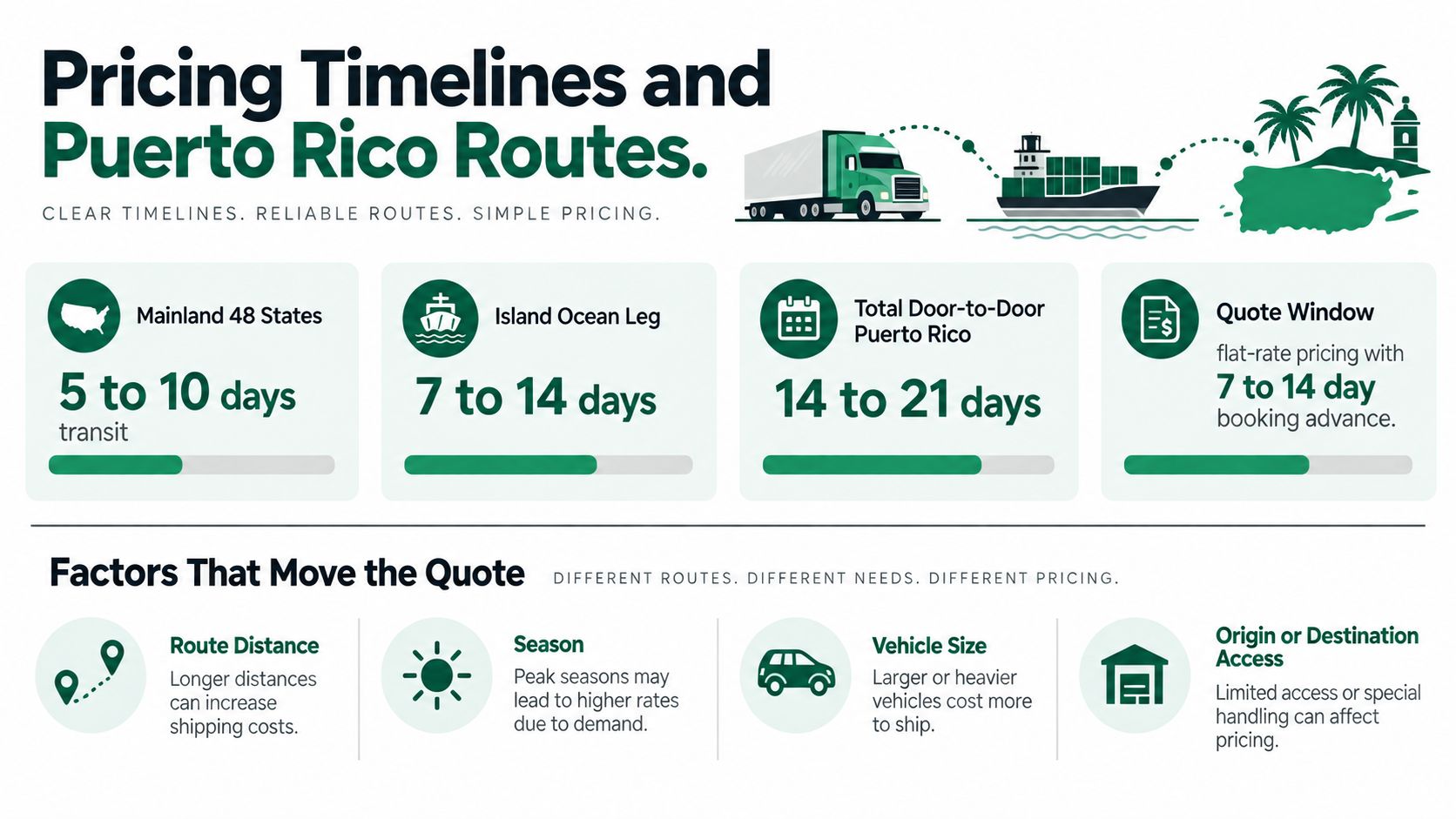
Those figures should be treated as planning guidance rather than a promise for every shipment. Port availability, sailing schedules, documentation, weather, inland access, and the specific carrier assignment can change the calendar. For Puerto Rico, the ocean portion is the key difference from ordinary mainland service, and Jacksonville to San Juan is a central route consideration for many mainland moves.
Puerto Rico preparation is document-driven
Crowley's published vehicle shipping requirements call for several preparation items:
- Ownership paperwork: Provide the title, or lienholder authorization when the vehicle is financed.
- Identity documents: Have a government photo ID available.
- Registration: Keep current registration ready for the shipment process.
- Personal items: Remove belongings from the vehicle, leaving only a spare tire and jack where permitted.
- Fuel level: Crowley says the vehicle should contain 1/4 tank of gas or less and arrive at the port 24 hours before sailing.
Port rules can differ from ordinary residential pickup expectations. Confirm who handles the inland move to the port, where the vehicle must be delivered, and how the final mainland or Puerto Rico delivery will be scheduled.
For route-specific planning, review Puerto Rico car shipping options and provide the complete vehicle and address details before accepting a quote. Accurate information helps the advisor match equipment and identify whether the vehicle needs a terminal, port, or nearby rendezvous point.
Safety Compliance and What Makes a Carrier Trustworthy
A reliable auto transport company should be able to explain how it protects the vehicle before, during, and after loading. Safety isn't limited to careful driving. It includes inspection discipline, required documents, insurance verification, equipment suitability, and a clear chain of custody.
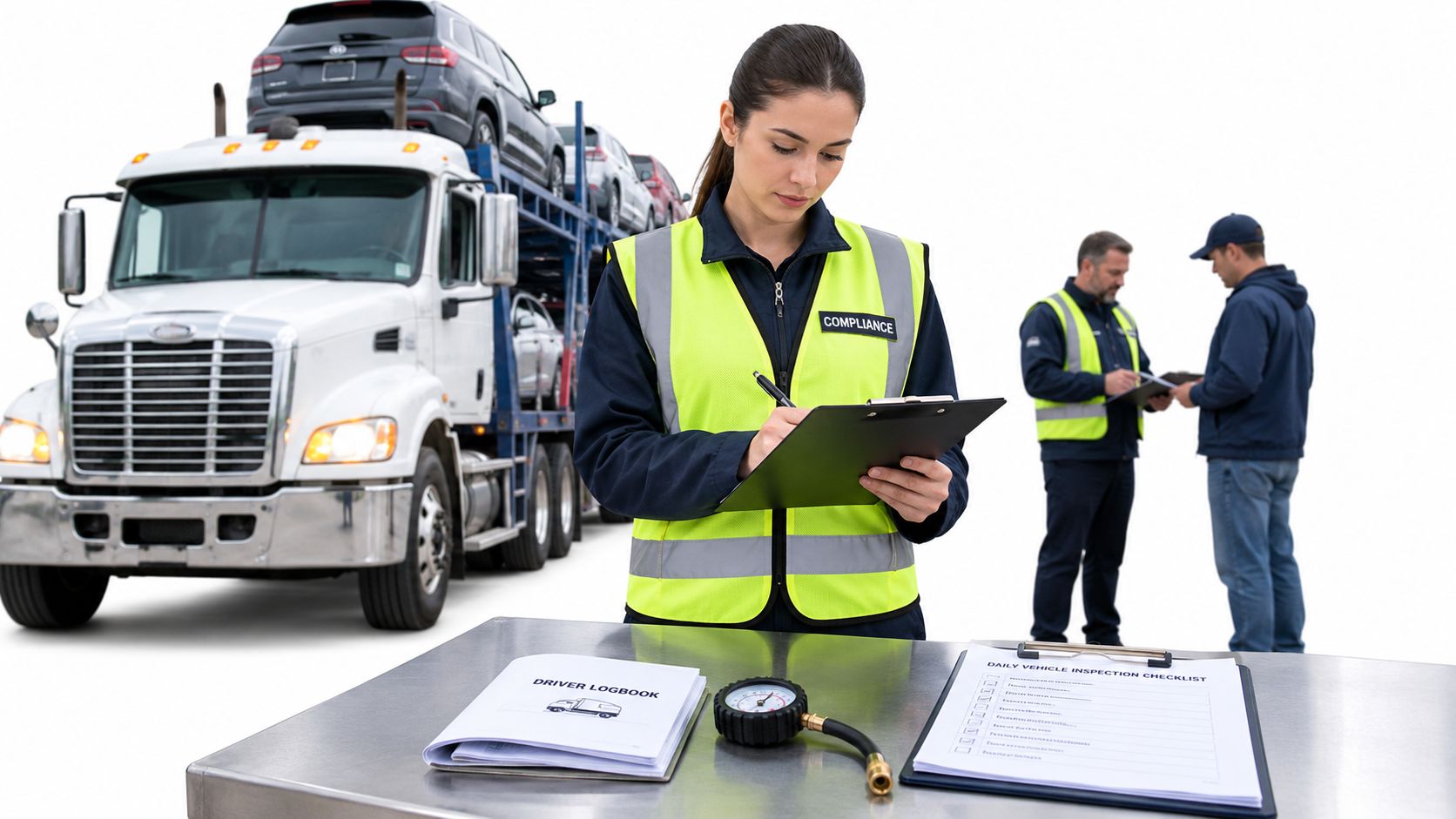
FMCSA rules require drivers to complete daily vehicle inspections, while carriers must maintain periodic inspections at least once every 12 months and retain inspection reports for 14 months, according to the FMCSA safety requirements. Drivers must also carry shipping papers or bills of lading, proof of insurance, and current inspection documentation before dispatch.
Paperwork connects safety to delivery
A vehicle can be physically accessible and still experience a delay if the paperwork is incomplete. The Bill of Lading identifies the shipment and records condition. Inspection records demonstrate equipment readiness. Proof of insurance gives the customer a basis for understanding responsibility if a covered issue occurs.
Customers who want broader compliance context can review the resources from My Safety Manager before speaking with a transporter. Ask practical questions rather than relying only on marketing language:
- Carrier assignment: Who will transport the vehicle?
- Inspection readiness: Can the carrier confirm current inspection documentation?
- Insurance: What coverage applies, and what exclusions should the customer understand?
- Condition records: Will both parties review and sign the Bill of Lading at pickup and delivery?
- Equipment fit: Is open or enclosed equipment appropriate for the vehicle?
National Car Transport describes a nationwide network of 25,000+ vetted carriers, an A+ BBB rating, and U.S.-based bilingual agents who support English and Spanish customers. Its enclosed auto transport option is relevant when a customer wants additional protection for a high-value, classic, luxury, or specially finished vehicle.
Booking With Confidence and Getting Ready for Delivery
The best booking decision begins with a complete shipment description, not a vague request for the cheapest price. Share the exact origin and destination, vehicle year, make, model, condition, preferred dates, access restrictions, and whether an adult representative will be available. If the vehicle is going to or from Puerto Rico, identify the mainland city, port expectations, ownership documents, and desired final delivery location.
Use this preparation checklist:
- Confirm the meeting point: Ask whether the carrier can reach the address or needs a nearby safe and legal location.
- Prepare the vehicle: Remove personal items, document existing condition, and leave the keys and operating instructions as agreed.
- Review the paperwork: Read the quote, Bill of Lading, insurance information, and delivery instructions.
- Plan availability: Keep an adult present for pickup and delivery, with enough flexibility for the agreed window.
- Inspect before release: Compare the vehicle with the pickup condition report and record any concern before signing.
Door-to-door transport remains a location-based handoff, so the smoothest shipments are the ones that address access before dispatch. An experienced advisor can also explain the difference between open, enclosed, terminal, port, and inland service without forcing every vehicle into the same process.
National Car Transport supports personal and commercial shipments across the 50 states and Puerto Rico, with transparent flat-rate quotes and no upfront charge until a carrier is matched. Its bilingual English and Spanish agents are based in the United States and have more than 20 years of auto transport logistics experience, helping customers coordinate the shipment from pickup inspection through final delivery.
For a shipment that needs careful access planning, mainland routing, or Puerto Rico port coordination, visit National Car Transport to request a quote. Share your vehicle, locations, timing, and access details, and a U.S.-based bilingual advisor can help match the service to your actual logistics instead of treating your move like every other vehicle transport.