

You've got a move scheduled, a vehicle sitting in your driveway, and no practical way to put miles on it yourself. Maybe you're leaving Phoenix for the winter, reporting to Camp Pendleton while your car travels separately, or relocating your family from Texas to San Juan. A door to door shipping service can handle that move, but the phrase doesn't mean a tractor-trailer can always reach the exact driveway.
For auto transport, door to door means coordinated pickup at the origin and delivery as close as safely and legally possible to the destination. The important details are the access plan, inspection record, carrier authority, and handoff procedure. Get those right, and the process becomes predictable instead of stressful.
Table of Contents
- What Door to Door Shipping Service Really Means for Your Car
- How the Pickup, Transport, and Delivery Process Works
- Door to Door Shipping Compared With Terminal to Terminal
- Pricing Factors That Move Your Quote Up or Down
- Choosing Between Open, Enclosed, and Container Transport
- Insurance Coverage and How to Vet a Carrier
- Shipping a Car to or From Puerto Rico End to End
- Smart Next Steps When You Are Ready to Book
What Door to Door Shipping Service Really Means for Your Car
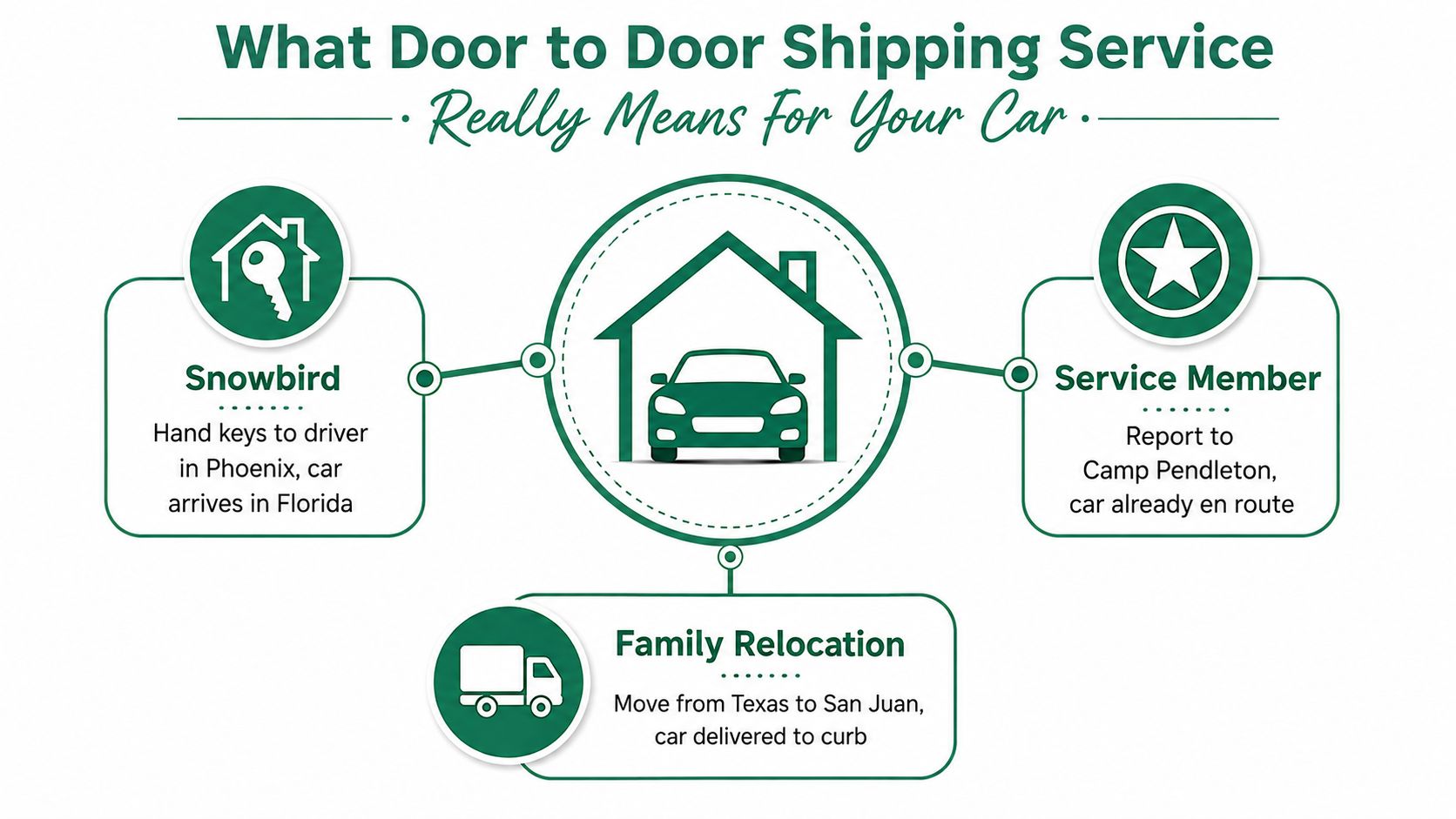
A snowbird in Phoenix hands the keys to a driver before flying to Florida. A service member reports to Camp Pendleton while the family vehicle is already moving west. A family leaving Texas for San Juan wants the SUV collected at home, transferred through the mainland shipping network, and delivered near the final residence.
In each situation, door to door auto transport means one coordinated shipment from the origin address to the destination address. A carrier or broker arranges the pickup truck, route, ocean or terminal transfer when necessary, and final delivery. The service reduces the need for the customer to drive to a freight yard, organize separate providers, or track several unrelated handoffs. FreightCenter's explanation of door-to-door shipping describes the model as pickup at the origin and delivery directly to the final destination.
The doorstep has a practical limit
Large auto haulers need room to turn, stop, load, and leave without damaging property or violating local restrictions. Low-hanging trees, narrow alleys, weight-limited bridges, steep streets, construction, or HOA rules can prevent the truck from reaching the exact address.
When that happens, the driver meets you at the nearest safe and legal location, often a broad residential street, shopping center, or nearby landmark. You'll drive the vehicle the last short distance to that meeting point, and the driver will complete the inspection and loading there. The same rule applies at delivery. A dispatcher should explain this before booking, not after the truck arrives.
Practical rule: Door to door means address-to-address coordination, not a promise that a full-size carrier can enter every driveway.
This model works well for individuals moving between major cities, seasonal residents, military families, students, online car buyers, dealerships, and businesses transferring inventory. It also fits mainland-to-Puerto Rico moves, where the service remains end to end even though the vehicle must pass through a port and travel by ocean.
The scale of this model explains why it's treated as core logistics rather than a luxury add-on. One industry report estimates that more than 161 billion parcels moved globally in 2024, with door-to-door delivery representing approximately 78% of parcel movements. The StartUs Insights last-mile delivery report also describes the global door-to-door delivery services market as projected to grow from USD 605.68 million in 2026 to USD 1,486.77 million by 2035, with a projected 10.49% CAGR.
How the Pickup, Transport, and Delivery Process Works
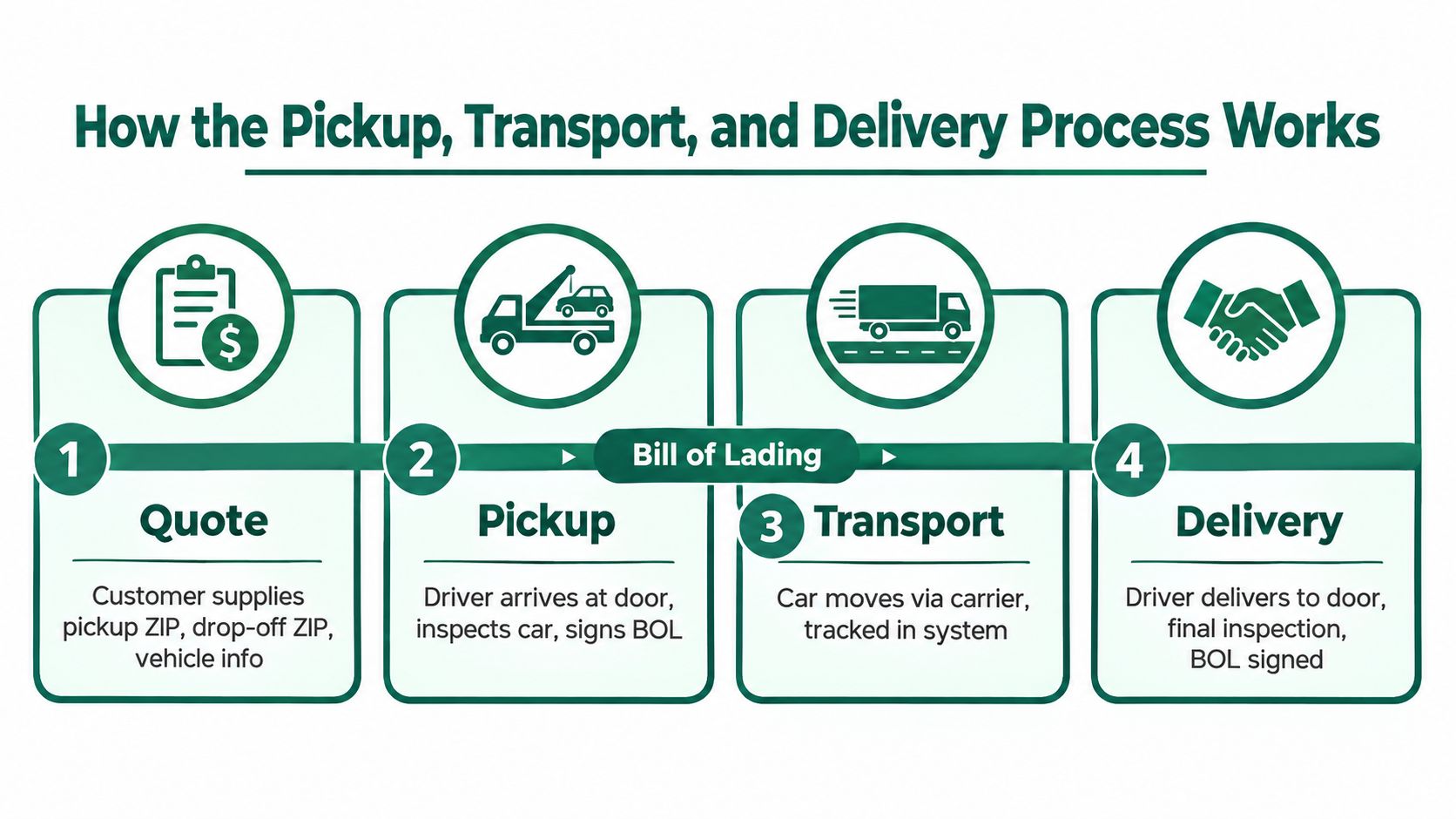
A reliable shipment has four checkpoints. The Bill of Lading, often called the BOL, connects them by recording the vehicle's condition, custody, and delivery confirmation.
Quote and scheduling
You provide the pickup ZIP code, delivery ZIP code, vehicle year, make, model, operable status, and preferred pickup window. The dispatcher uses those details to match the shipment with an appropriate carrier and explain whether the quote is binding or subject to market conditions.
Don't describe the move only as “Dallas to Boston.” Give the actual address, whether the street can accommodate a large truck, and whether someone will be available. For Puerto Rico, identify the mainland location and the intended island destination early, because port routing and documentation affect the plan.
Pickup inspection
At pickup, the driver walks around the vehicle with you. The driver records existing scratches, dents, chips, cracked glass, and other visible conditions on the BOL. Take your own dated photographs in good light, then compare them with the driver's report before signing.
The BOL is not casual paperwork. Interstate motor carriers must issue one under FMCSA rules, and vehicle condition is documented at pickup and delivery. Viceroy Auto Transport's Bill of Lading guidance explains why this record supports claims, chain of custody, and verification of the shipment terms.
Transit and delivery
Your car travels on an open carrier, enclosed trailer, container, or vessel-based service, depending on the route and vehicle. Transit timing varies with distance, weather, traffic, carrier routing, port schedules, and access conditions. A dispatcher should provide a delivery window, not pretend that a long-distance shipment can be guaranteed to an exact minute.
The driver calls ahead before delivery. You inspect the vehicle against the pickup BOL, note any new condition issue before signing, and retain your copy. If a concern exists, document it on the delivery paperwork immediately.
For customers coordinating storage around a move, Endless Storage modern solutions offers useful background on planning pickup, delivery access, and site readiness.
Door to Door Shipping Compared With Terminal to Terminal
The choice comes down to who handles the last mile. With door to door, the provider coordinates pickup and delivery at addresses or nearby safe meeting points. With terminal to terminal, you take the vehicle to a designated yard and retrieve it from another yard, usually coordinating your own transportation around those locations.
| Factor | Door to Door | Terminal to Terminal |
|---|---|---|
| Convenience | Pickup and delivery happen near the addresses that matter to you. | You arrange drop-off and collection at freight yards. |
| Customer time | Less driving and fewer scheduling tasks. | More personal coordination, including travel to terminals. |
| Access | The driver may use a nearby curbside meeting point if the address is restricted. | The vehicle goes to a facility designed for carrier access. |
| Best fit | Military families, snowbirds, relocations, dealerships, and Puerto Rico moves. | Flexible customers, students, budget-focused shippers, and project cars. |
| Main tradeoff | You pay for more coordinated residential service. | You may save money but assume more of the logistics work. |
Terminal service can make sense if your car is already going to a repair shop, dealership, or storage yard and you're comfortable handling the handoffs. It's less attractive when you're traveling with children, catching a flight, reporting for duty, or shipping between the mainland and Puerto Rico.
Door to door also adds residential driving, which can involve tight turns and slow maneuvering. Terminal operations involve facility handling and yard transfers. Neither option removes the need for a careful inspection and signed BOL.
My rule is simple: choose door to door when time, convenience, and centralized coordination matter more than the lowest possible quote. Choose terminal service only when the terminal locations work for your schedule and budget.
Pricing Factors That Move Your Quote Up or Down
A legitimate quote needs more than two city names. Dispatchers evaluate the lane, vehicle, timing, equipment, and access conditions before assigning a rate. You can review the general factors behind a quote through National Car Transport's car shipping cost guide.
The specific dollar figures sometimes published in generic pricing examples aren't universal, and they shouldn't be treated as guaranteed rates. Your quote depends on the actual lane and the available carrier.
| Pricing Factor | Typical Impact on Quote | Example |
|---|---|---|
| Route distance | Longer routes add transportation cost, while dense lanes may have more carrier availability. | A major-city route may be easier to cover than a remote rural pickup. |
| Vehicle size | Larger, taller, or heavier vehicles consume more trailer space. | A lifted dually generally needs different planning than a compact sedan. |
| Operability | A running vehicle loads normally. A non-running vehicle may require winch equipment and extra labor. | Tell the dispatcher if the car won't start, roll, steer, or brake. |
| Season | Demand changes during seasonal relocation periods and popular snowbird corridors. | Winter and spring planning can affect carrier availability on busy routes. |
| Equipment | Open transport is usually the practical choice for ordinary daily drivers. Enclosed service costs more because it provides additional protection and specialized handling. | A classic, exotic, or freshly restored vehicle may justify enclosed transport. |
| Island routing | Puerto Rico shipments include mainland transport, port handling, ocean movement, and island delivery coordination. | A quote should explain port-related charges rather than hiding them inside vague fees. |
Your 2019 SUV moving from Dallas to Boston in February needs a quote based on its exact ZIP codes, operability, size, and pickup flexibility. Ask whether the amount is all-inclusive, whether a deposit is required, and what could change the price.
A transparent dispatcher won't quote an unrealistically low number to secure your booking. The right comparison is not the cheapest headline price. It's the total cost, service scope, access plan, insurance arrangement, and delivery window.
Choosing Between Open, Enclosed, and Container Transport
These options aren't interchangeable upgrades. They solve different problems.
Open transport is the standard choice for daily drivers, leased vehicles, family SUVs, online purchases, and dealership transfers. The vehicle rides on a multi-car hauler exposed to normal road conditions. That exposure is acceptable for most cars, and open equipment is generally easier to source on common U.S. lanes.
Enclosed transport places the car inside a hard-sided or soft-sided trailer, depending on the equipment. It's appropriate for classics, exotics, luxury vehicles, collector cars, and freshly restored builds where additional protection matters. National Car Transport's enclosed auto transport information explains why owners choose enclosed handling for higher-value vehicles.
Container shipping puts the vehicle inside a steel shipping container for an ocean or island route. It can suit owners who want the car protected inside the container during the maritime portion, especially for Puerto Rico, Hawaii, or certain international movements. Container planning may also require attention to loading space and port procedures.
Roll-on/Roll-off, or RoRo, uses a vessel designed for vehicles that are driven onto and secured inside the ship. It's a practical island option when the vehicle meets the operating and documentation requirements. The mainland carrier typically delivers the vehicle to the port rather than driving onto the vessel.
| Service Tier | Protection Level | Best For | Relative Cost |
|---|---|---|---|
| Open | Standard road exposure | Daily drivers, SUVs, dealerships, relocations | Usually the most economical |
| Enclosed | Added trailer protection | Classics, exotics, restored and luxury vehicles | Higher than open |
| Container | Enclosed steel-box maritime transport | Island routes and owners seeking container protection | Route-dependent |
| RoRo | Vessel-based vehicle transport | Operable vehicles moving through island ports | Often a practical island option |
Don't pay for enclosed transport just because it sounds premium. Choose it when the vehicle's condition, value, or restoration work makes additional protection worth the added cost. For an ordinary commuter car, open transport is usually the sensible decision.
Insurance Coverage and How to Vet a Carrier
Start with authority, not advertising. FMCSA explains that brokers arrange transportation through authorized motor carriers and don't take possession of the property. That distinction matters because the broker may coordinate the shipment while the carrier owns the truck and performs the physical move.
Verify the operating party
Use the official FMCSA licensing and insurance lookup to check the carrier, broker, or freight forwarder before booking. Confirm that the operating authority is active and that the company identity matches the paperwork you receive.
Ask for the carrier's USDOT and MC information, then verify that the details correspond to the business handling your shipment. A broker should identify the assigned carrier once one is booked, not leave you guessing who will arrive.
Read the insurance arrangement
Request a current Certificate of Insurance. Confirm that the carrier's cargo coverage applies to your vehicle and ask what exclusions or deductibles affect a claim. Broker contingent coverage, where offered, shouldn't replace the carrier's primary policy.
At pickup and delivery, the BOL condition report carries significant weight. Photograph the car, review every notation, and record any new issue before accepting delivery. A claim becomes harder when damage isn't documented promptly.
Be cautious with a provider that demands a large unexplained deposit, refuses to provide a physical business identity, avoids authority questions, or gives an unclear pickup plan. A low quote isn't useful if the provider can't explain who carries the vehicle, how the inspection works, or what happens when the truck can't reach the address.
Shipping a Car to or From Puerto Rico End to End
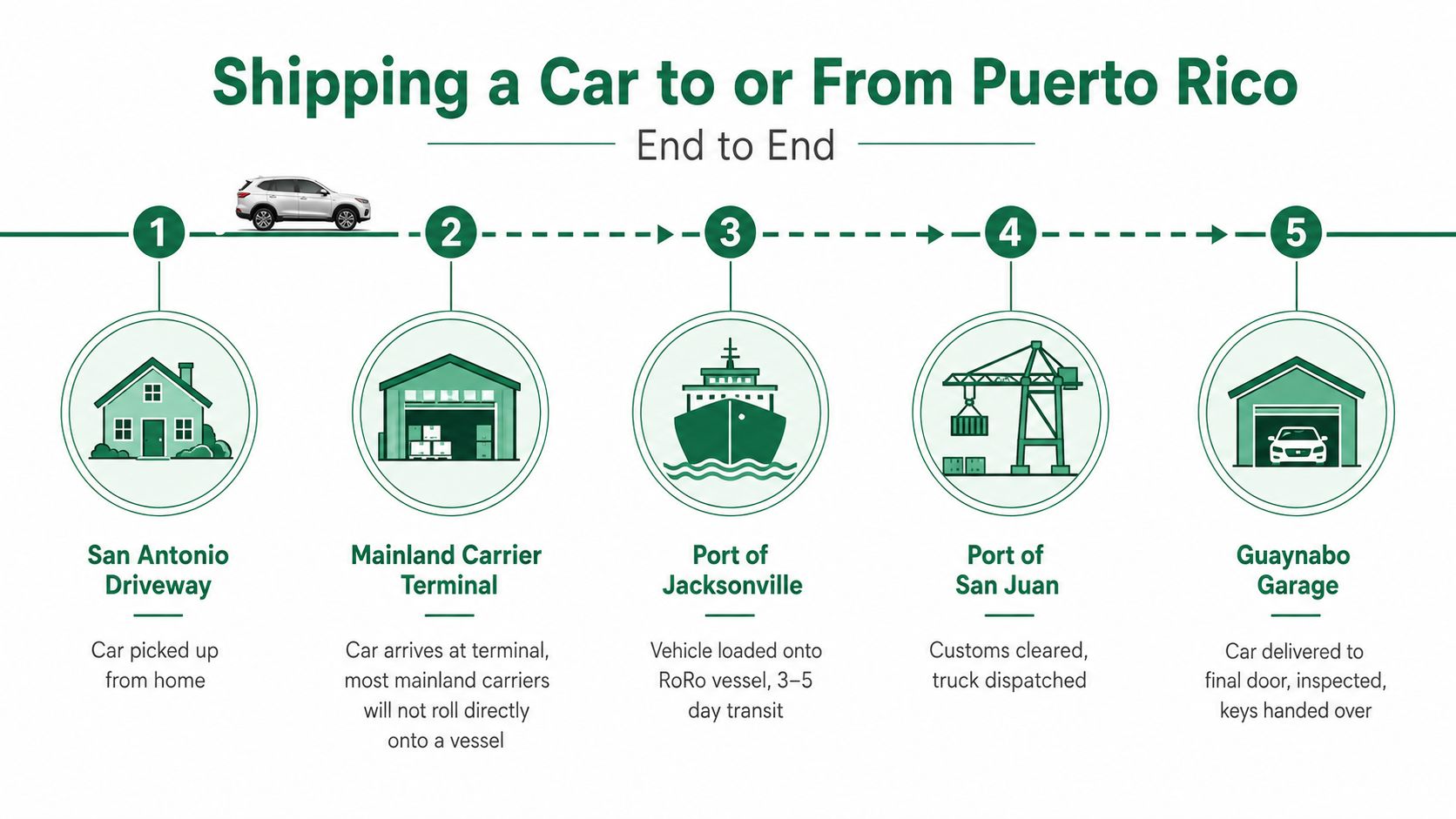
Take an SUV leaving a home in San Antonio for a garage in Guaynabo. The first leg looks like ordinary domestic auto transport. A carrier collects the SUV at the mainland address, completes the inspection, and moves it toward the port selected for the Puerto Rico route.
The mainland handoff
Most mainland auto carriers don't roll directly onto the vessel. They deliver the vehicle to a port terminal, where it's processed for vessel loading. San Juan is the primary Puerto Rico port referenced in common shipping guidance, while mainland routing depends on the carrier and sailing plan.
For a westbound shipment, prepare the vehicle's title or title copy, current registration, and valid photo identification. Financed vehicles may require additional lender documentation, including a notarized lien release in some situations. Puerto Rico car shipping documentation guidance outlines these requirements and explains that return shipments can involve title or title copy, current registration, and lender paperwork.
The ocean and island legs
At the port, the vehicle may move through RoRo service or a container. RoRo is designed for vehicles driven onto the vessel. Container service places the vehicle inside a container and may suit owners seeking enclosed maritime handling or a specific port arrangement.
After arrival in San Juan, customs and local release procedures must be completed before an island carrier collects the vehicle. Puerto Rico registration can involve local tax and documentation requirements, so the person receiving the car should confirm current procedures with the relevant authorities before shipment.
Door to door still applies at both ends. The mainland provider coordinates the San Antonio pickup, port transfer, maritime booking, San Juan release, and final delivery toward Guaynabo. The port is an internal transfer point in the route, not a reason for the customer to manage every separate leg.
For a detailed service overview and documentation discussion, review National Car Transport's Puerto Rico car shipping service.
Japan shows how mature door-to-door networks can become. In fiscal year 2023, Japanese door-to-door delivery services handled a record 5.01 billion packages, and three providers accounted for about 95% of traffic, according to the market information summarized by Market Reports World. Auto transport to Puerto Rico has different infrastructure, but the lesson is relevant: the quality of the service depends on coordinated collection, transfer, routing, and final delivery.
Smart Next Steps When You Are Ready to Book
Treat the booking as a conversation with a dispatcher, not just a form submission. Your vehicle, street, schedule, and destination may create conditions that another shipment doesn't have. A knowledgeable agent can identify those differences before they become a missed pickup or surprise meeting point.
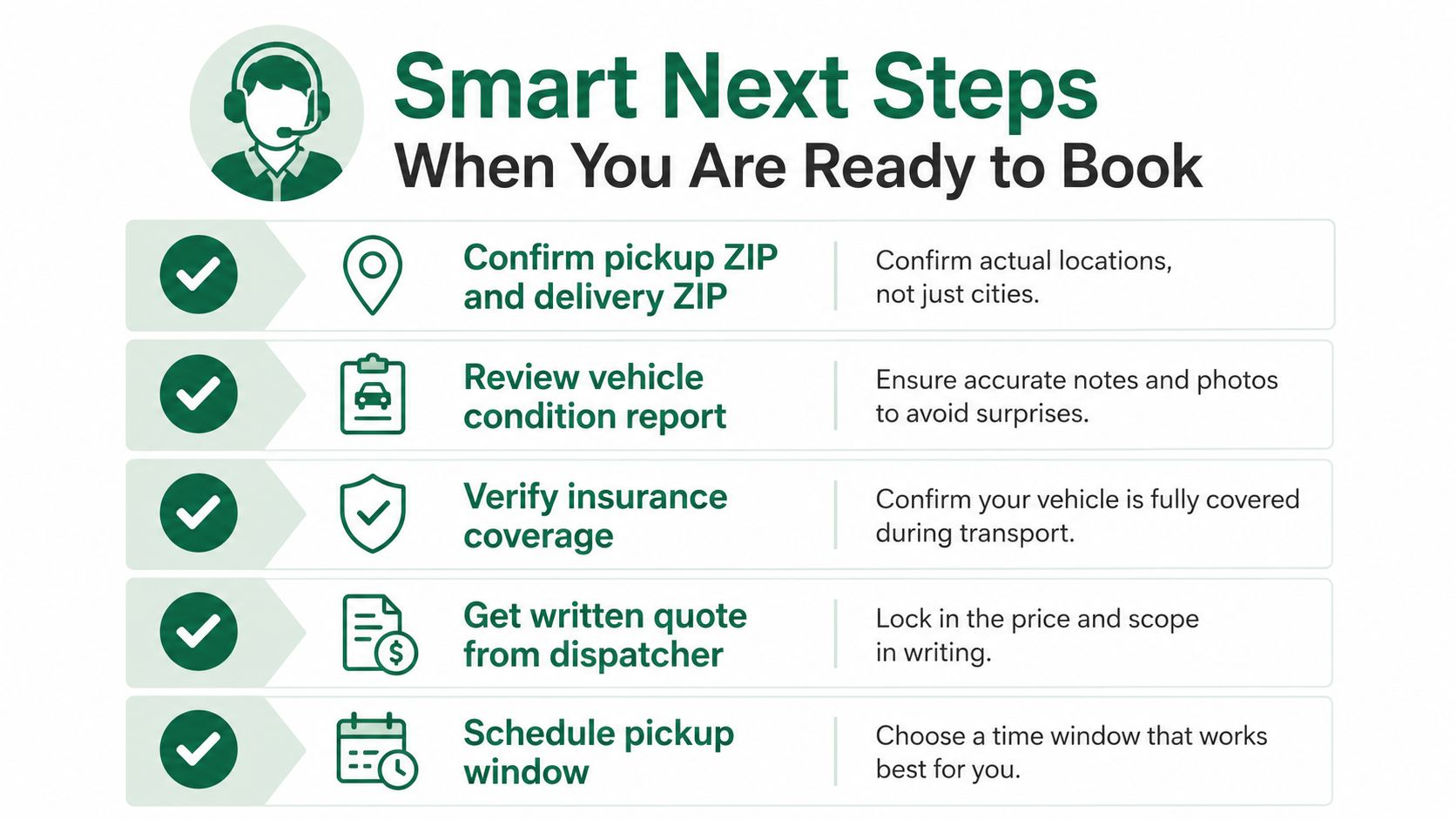
Use this shortlist before you authorize the move:
- Confirm both ZIP codes: Provide the exact mainland pickup location and Puerto Rico destination, including the correct postal information.
- Describe the vehicle accurately: State whether it runs, rolls, steers, and brakes. Mention modifications, oversized dimensions, personal mobility equipment, or alarm systems.
- Select equipment deliberately: Use open transport for most standard vehicles, enclosed for cars needing extra protection, and ask whether container or RoRo service fits an island route.
- Request the carrier details: Ask for the assigned carrier's FMCSA information and current insurance certificate.
- Review the inspection process: Confirm that the driver will complete and sign the BOL at pickup and delivery.
- Clarify curbside access: Ask where the handoff will occur if the truck can't enter your street, driveway, community, or destination property.
- Prepare the vehicle: Remove personal items, photograph existing damage, leave only the fuel needed for normal handling, and secure loose parts or accessories.
- Confirm a delivery window: Traffic, weather, carrier routing, port schedules, and access restrictions can affect timing. A window is more honest than an exact promise.
National Car Transport coordinates door-to-door moves through dedicated advisors, open and enclosed carriers, island shipping options, transparent flat-rate pricing, and a nationwide network of vetted carriers. Its U.S.-based bilingual English/Spanish agents have more than 20 years of auto transport logistics experience, while the company has more than 25 years in the industry and an A+ BBB rating. Not one vehicle transport is alike, so having a real agent guide the access plan, paperwork, inspection, and timing is often what makes the process simple and quick at a fair value.
If you're moving a vehicle within the 48 states or between the mainland and San Juan, visit National Car Transport to request a clear quote and speak with a bilingual U.S.-based advisor. Ask about the carrier, inspection record, curbside plan, and delivery window before you book, so your door-to-door shipment is coordinated from the first address to the final handoff.